Disclosure: airfryerkitchensupply.com is reader-supported. When you buy through links on our site, we may earn an affiliate commission at no extra cost to you.
Where to buy
The safest place to buy best organic soft blankets for toddlers is Amazon, where the exact size, print, pack count and material wording can be checked on the live product page before you pay. Use the links below to check price on Amazon for each verified pick; prices are never printed in this guide because they change too often to stay honest.
- MakeMake Organics Organic Toddler Comforter (Safari + Solid Oat) (Best Overall): Check on Amazon
- ZPECC Muslin Toddler Blanket (Butterfly) (Best Breathable Muslin): Check on Amazon
- aden + anais Boutique Organic Dream Blanket (Sailing Seas) (Best Premium Muslin): Check on Amazon
- Little Dedi 100% Organic Cotton GOTS Certified Knitted Blanket (Folkstone Grey) (Best Knitted Heirloom): Check on Amazon
- Burt’s Bees Baby Cable Knit Infant Blanket (100% Organic Cotton, 30 x 40) (Best Trusted-Brand Knit): Check on Amazon
- Bleu La La 100% Organic Cotton Heritage Knit Baby Quilt Blanket (Heritage – Sky Blue) (Best Textured Quilt-Knit): Check on Amazon
Finding the best organic soft blankets for toddlers starts with an honest admission: most blankets sold as organic baby blankets are sized for newborns, not for a two- or three-year-old who kicks, drags and bunches a blanket all night. True toddler dimensions start around 44 by 60 inches, and only a handful of genuinely organic options reach that size, so this guide mixes full toddler-size picks with smaller organic blankets that still work for naps, strollers and travel, and it says plainly which is which.
Organic also needs unpacking before you spend anything. A blanket can use organic cotton on the surface and still hide a synthetic fill inside, and one pick below does exactly that; its listing says so openly, and this guide flags it rather than letting the word organic do quiet, misleading work. Where a listing carries GOTS certification, that is stated. Where a listing simply says organic cotton without naming a certifier in its title, that gap is stated too, because certification is the difference between a claim and an audit.
Softness for a toddler is not the same as softness for a newborn photo. Toddlers chew corners, drag blankets across floors and demand the same blanket after every wash, so weave durability, washability and edge finishing matter as much as the first-touch feel. Every pick below was confirmed, and every material statement in the reviews comes from the verified listing title rather than from marketing memory.
In this guide
Quick Picks
MakeMake Organics Organic Toddler Comforter (Safari + Solid Oat) — Best Overall. The rare pick that is genuinely toddler-sized and GOTS certified, with cotton infill instead of synthetic fill and a reversible tufted face. Check on Amazon
ZPECC Muslin Toddler Blanket (Butterfly) — Best Breathable Muslin. Eight layers of organic cotton muslin in a square 47-inch format that works for cribs, daycare cots and floor play as much as beds. Check on Amazon
aden + anais Boutique Organic Dream Blanket (Sailing Seas) — Best Premium Muslin. The boutique muslin option from the brand that popularised muslin blankets, positioned by its own listing as unisex toddler bedding. Check on Amazon
Little Dedi 100% Organic Cotton GOTS Certified Knitted Blanket (Folkstone Grey) — Best Knitted Heirloom. A GOTS certified knitted blanket in a neutral grey, honestly sized at 30 by 40 inches, so it is a nap, stroller and layering blanket rather than a full bed cover. Check on Amazon
Burt’s Bees Baby Cable Knit Infant Blanket (100% Organic Cotton, 30 x 40) — Best Trusted-Brand Knit. A cable-knit organic cotton blanket from a widely stocked baby brand, sized and described by its own listing for stroller, nursing-cover and tummy-time duty. Check on Amazon
Bleu La La 100% Organic Cotton Heritage Knit Baby Quilt Blanket (Heritage – Sky Blue) — Best Textured Quilt-Knit. A textured heritage-knit quilt blanket in organic cotton, presented for boys in Sky Blue and built as a breathable newborn-to-toddler layer. Check on Amazon
How These Picks Were Chosen
Each candidate was searched by brand and product name through the airfry site’s Amazon listing data, and only listings whose returned title confirmed organic cotton content, a stated size, or a named certification were kept as linked picks. Listings that used the word organic in a store name but not in the product title were rejected, as were plush synthetic blankets with no organic content at all, however soft they looked.
The six survivors were then ranked by how honestly they serve a toddler rather than a newborn: true toddler dimensions first, then certified organic content, then washability and construction that survives daily laundering. Two smaller blankets remain in the list because their organic credentials are the strongest in the category, but their reviews state clearly that they are nap, stroller and travel blankets for a toddler, not full bed blankets.
The 6 Best Organic Soft Blankets for Toddlers

MakeMake Organics Organic Toddler Comforter (Safari + Solid Oat) — Best Overall
This is the pick for parents who want one blanket that actually covers a toddler bed. At 44 by 60 inches it drapes over a standard toddler mattress with length to spare, and the listing confirms GOTS certified organic cotton with cotton infill, which means the organic claim runs through the whole blanket rather than stopping at the shell.
Strengths
- True toddler-bed dimensions at 44 x 60 inches, not a newborn size relabelled
- GOTS certified organic cotton with cotton infill, so no synthetic fill hides inside
- Reversible design pairs a Safari print face with a plain Solid Oat side for a calmer look
Trade-offs
- Tufted construction needs gentler washing than a flat muslin blanket
- A printed safari face will not suit every nursery colour scheme
- Premium tier positioning within this category, so check price on Amazon before committing
| Size | 44 x 60 inches (per Amazon title) |
| Certification | GOTS certified organic (per Amazon title) |
| Fill | Cotton infill (per Amazon title) |
| Design | Reversible, tufted, Safari print / Solid Oat |
The size question decides most toddler blanket purchases, and this is the only pick in the roundup that answers it without compromise. A 44 by 60 inch blanket covers a toddler from chin to toes with fabric left to tuck, which matters once a child sleeps in a bed rather than a crib and can push a small blanket off entirely. Parents upgrading from a 30 by 40 inch baby blanket will feel the difference on the first night.
The cotton infill deserves attention because fill is where organic blankets most often cut corners. A polyester fill inside an organic shell is common and legal to describe loosely, but this listing states cotton infill in its title, and the tufting keeps that fill distributed without dense quilting channels. The result is a blanket with real loft for cooler rooms that still breathes better than a synthetic-filled comforter of similar weight.
Best for: toddlers moving into a toddler bed who need one certified-organic blanket that truly fits / Not suited for: families who want a thin summer-only layer or a personalised name print
Check on Amazon — check the current price on Amazon before you buy, because sizes, prints and pack options change the total.

ZPECC Muslin Toddler Blanket (Butterfly) — Best Breathable Muslin
Choose this one if your toddler sleeps hot. Muslin’s open weave is the classic answer to overheating, and eight layers give this blanket enough body to feel substantial without sealing in warmth the way a filled comforter does. The square 47 by 47 inch shape suits cribs, daycare cots and stroller naps equally well.
Strengths
- 8 layers of organic cotton muslin confirmed in the Amazon title
- Square format works across crib, cot, stroller and tummy-time floor use
- Muslin softens progressively with washing rather than pilling like plush synthetics
Trade-offs
- The listing calls it hypoallergenic, a marketing term this guide reports but does not treat as a medical claim
- Square shape gives less lengthwise tuck than a 60-inch comforter on a toddler bed
- Butterfly print is the confirmed design; other prints were not verified in this search
| Size | 47 x 47 inches (per Amazon title) |
| Material | Organic cotton muslin, 8 layers (per Amazon title) |
| Extras | Gift box included (per Amazon title) |
Layered muslin behaves differently from every other construction in this roundup. Air moves through the weave, yet the stacked layers trap enough still air to take the chill off a nap, which is why muslin is the fabric experienced parents reach for in warm climates and heated winter bedrooms alike. Eight layers is at the substantial end of the muslin range, closer to a light quilt than to a swaddle.
The daycare angle is practical rather than cute. A square, unfilled blanket packs flat into a cubby bag, washes without special handling and dries faster than a filled comforter, and daycare cots are exactly the size this format suits. If the blanket’s main job is weekday naps away from home, this pick’s shape and fabric make more sense than the larger bed-focused options.
Best for: hot sleepers, warm climates and daycare cot naps / Not suited for: cold rooms where a filled comforter is the main warmth layer
Check on Amazon — check the current price on Amazon before you buy, because sizes, prints and pack options change the total.
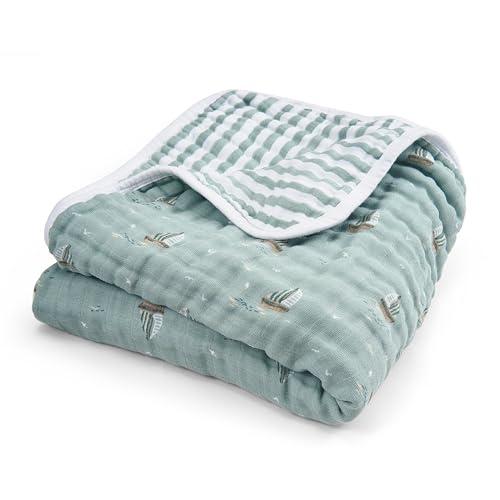
aden + anais Boutique Organic Dream Blanket (Sailing Seas) — Best Premium Muslin
This pick suits gift buyers and brand loyalists. aden + anais built its reputation on muslin, and its Dream Blanket format is the thicker, four-layer style intended to move beyond swaddling into toddler bedding, which is exactly how the verified listing positions it. The Sailing Seas print is the design confirmed in the Amazon title.
Strengths
- Listing explicitly positions the blanket as toddler bedding, not only a newborn swaddle
- Muslin construction from a specialist muslin brand with consistent weave quality
- Unisex print confirmed in the Amazon title, useful for gift buying without a theme commitment
Trade-offs
- The Amazon title says 100% cotton and organic in the product name but does not name a certifier such as GOTS
- Dream Blanket dimensions are not stated in the Amazon title, so confirm the size on the product page before buying
- Boutique tier pricing within the muslin category
| Material | Organic cotton muslin (per Amazon title; certifier not stated in title) |
| Design | Sailing Seas print (per Amazon title) |
| Size | Not stated in Amazon title — confirm on product page |
Honesty about certification matters here. The product name includes the word organic and the title confirms 100% cotton muslin, but unlike the MakeMake pick it does not name GOTS in the verified title, so this guide does not upgrade the claim. Buyers for whom third-party certification is the whole point should pick the GOTS-named option; buyers who prioritise the muslin hand-feel and print may accept the brand’s own organic claim.
As a working blanket, the Dream Blanket format’s appeal is its middle weight: heavier than a swaddle, lighter than a filled comforter, and softening with every wash in the way good muslin does. It layers well over a sheet in shoulder seasons and works alone in summer, which gives it a longer useful season than a thick comforter in mild climates.
Best for: gift buyers and muslin loyalists who want a mid-weight organic layer / Not suited for: buyers who require a named GOTS certification in the listing
Check on Amazon — check the current price on Amazon before you buy, because sizes, prints and pack options change the total.

Little Dedi 100% Organic Cotton GOTS Certified Knitted Blanket (Folkstone Grey) — Best Knitted Heirloom
Pick the Little Dedi if certification and knit texture matter more to you than bed coverage. The listing confirms 100% organic cotton with GOTS certification and a knitted construction, and it is equally honest about the 30 by 40 inch size. For a toddler that means a car-seat, stroller and nap blanket, or a layer over a larger plain blanket.
Strengths
- GOTS certification named directly in the Amazon title
- Knitted organic cotton has a heirloom hand-feel flat weaves do not match
- Neutral Folkstone Grey works with any nursery and photographs well for gifts
Trade-offs
- 30 x 40 inches will not cover a toddler in bed; treat it as a nap and travel blanket
- Knit constructions can snag on velcro, jewellery and rough laundry loads
- Gift-box presentation pushes it toward the premium tier for its size
| Size | 30 x 40 inches (per Amazon title) |
| Material | 100% organic cotton, GOTS certified (per Amazon title) |
| Construction | Knitted; gift box included (per Amazon title) |
Knitted cotton breathes through its stitch structure and drapes over a curled-up toddler in a way woven blankets cannot, which is why knit blankets remain the stroller favourite. The trade is durability: a knit can pull a loop if it catches, so this is a blanket to wash in a gentle load and keep away from hook-and-loop fasteners in the same wash.
The certification is the headline. GOTS covers the fibre and the processing chain, and having it named in the title lets a buyer verify the claim instead of trusting adjectives. If you are buying because organic integrity is the priority and the blanket’s job is naps and outings rather than overnight bed coverage, this is the most defensible small blanket in the roundup.
Best for: stroller, car and nap use where certified organic knit matters most / Not suited for: anyone needing a single blanket to cover a toddler bed
Check on Amazon — check the current price on Amazon before you buy, because sizes, prints and pack options change the total.

Burt’s Bees Baby Cable Knit Infant Blanket (100% Organic Cotton, 30 x 40) — Best Trusted-Brand Knit
This is the easy-registry pick: a known brand, a classic cable knit and 100% organic cotton stated plainly in the title. Its own listing describes stroller cover and tummy time uses, which tells you the truth about the 30 by 40 inch size — for a toddler it is an out-and-about and nap blanket, not bed coverage.
Strengths
- 100% organic cotton confirmed in the Amazon title, with no fill to complicate the claim
- Cable knit texture gives grip and warmth for stroller and car-seat use
- Gender-neutral positioning and registry-friendly branding simplify gift buying
Trade-offs
- Marketed as an infant blanket; toddler bed coverage is beyond its size
- Cable knit is warmer than muslin, so it is a poor summer-only choice
- Certifier is not named in the Amazon title, unlike the GOTS-named picks above
| Size | 30 x 40 inches (per Amazon title) |
| Material | 100% organic cotton (per Amazon title; certifier not stated) |
| Construction | Cable knit (per Amazon title) |
There is value in a blanket whose listing does not oversell. The stated uses — stroller cover, nursing cover, tummy time — map exactly onto what a 30 by 40 inch knit does well, and for toddlers the same blanket becomes the one that lives in the car or the pram basket. Expecting it to be a bed blanket would be a buying mistake this guide would rather prevent than decorate.
Against the Little Dedi knit, the differences are certification and texture. This one trades a named GOTS claim for a traditional cable pattern and the distribution of a large baby brand, which some buyers prefer for returns and reordering. Both are honest small knits; choose by whether the certificate or the classic cable look matters more to your household.
Best for: registry gifts and a dependable organic knit for stroller and car / Not suited for: overnight toddler-bed coverage or certified-organic purists
Check on Amazon — check the current price on Amazon before you buy, because sizes, prints and pack options change the total.

Bleu La La 100% Organic Cotton Heritage Knit Baby Quilt Blanket (Heritage – Sky Blue) — Best Textured Quilt-Knit
Choose the Bleu La La for texture. Its signature heritage knit gives a toddler’s hands something to hold and fiddle with at sleep time, which many children genuinely use as a self-soothing cue. The listing confirms 100% organic cotton and a breathable knit, and describes a quilt blanket format rather than a thin receiving blanket.
Strengths
- 100% organic cotton stated in the Amazon title
- Textured heritage knit offers tactile interest flat blankets lack
- Quilt-blanket format gives more body than a single-layer knit
Trade-offs
- Dimensions are not stated in the Amazon title, so verify the size on the product page before assuming toddler-bed fit
- Sky Blue is the confirmed colourway; other colours were not verified in the cached listing
- Newborn language in the title means toddler sizing must be checked, not assumed
| Material | 100% organic cotton (per Amazon title) |
| Construction | Heritage knit, textured quilt blanket (per Amazon title) |
| Size | Not stated in Amazon title — confirm on product page |
Texture is an underrated toddler specification. A blanket a child can rub between their fingers becomes part of the sleep routine, and the heritage knit here provides that without resorting to synthetic plush or attached tags and ribbons that wear out. The quilt-blanket description suggests a blanket with enough structure to spread flat for floor play as well as drape for naps.
The missing dimension in the title is the reason this pick sits sixth rather than higher. Until a buyer confirms the measurements on the product page, it should be treated as a nap and layering blanket. That caution aside, for parents who want organic cotton, a boy-aimed colourway and a knit with real character, it fills a slot the plainer picks do not.
Best for: toddlers who self-soothe with texture, and nap or floor-play layering / Not suited for: buyers who will not purchase without a confirmed toddler-bed dimension
Check on Amazon — check the current price on Amazon before you buy, because sizes, prints and pack options change the total.
Comparison Table
| Pick | Badge | Key spec | Best for |
|---|---|---|---|
| MakeMake Organics Organic Toddler Comforter (Safari + Solid Oat) | Best Overall | 44 x 60 in, GOTS certified, cotton infill, reversible tufted | toddlers moving into a toddler bed who need one certified-organic blanket that truly fits |
| ZPECC Muslin Toddler Blanket (Butterfly) | Best Breathable Muslin | 47 x 47 in, 8 layers organic cotton muslin | hot sleepers, warm climates and daycare cot naps |
| aden + anais Boutique Organic Dream Blanket (Sailing Seas) | Best Premium Muslin | Organic muslin Dream Blanket format, Sailing Seas print | gift buyers and muslin loyalists who want a mid-weight organic layer |
| Little Dedi 100% Organic Cotton GOTS Certified Knitted Blanket (Folkstone Grey) | Best Knitted Heirloom | 30 x 40 in, GOTS certified organic cotton knit, gift box | stroller, car and nap use where certified organic knit matters most |
| Burt’s Bees Baby Cable Knit Infant Blanket (100% Organic Cotton, 30 x 40) | Best Trusted-Brand Knit | 30 x 40 in, 100% organic cotton cable knit | registry gifts and a dependable organic knit for stroller and car |
| Bleu La La 100% Organic Cotton Heritage Knit Baby Quilt Blanket (Heritage – Sky Blue) | Best Textured Quilt-Knit | 100% organic cotton heritage knit, textured quilt-blanket, Sky Blue | toddlers who self-soothe with texture, and nap or floor-play layering |
Organic, Natural and Conventional: Reading Blanket Labels Without Being Fooled
The word organic on a blanket describes how its fibres were grown and processed, and the strongest proof is a named certification from an independent scheme — GOTS for textiles is the one that recurs in this guide’s verified titles. A listing that names its certification in the title itself, as the MakeMake and Little Dedi picks do, is making a checkable claim. A listing that says organic cotton without naming a certifier may be entirely truthful, but the buyer is trusting the brand rather than an audit, and the price premium should shrink accordingly.
Natural is the weaker word: it signals fibre origin without any certification behind it, and conventional cotton described warmly is still conventional. None of this makes uncertified blankets bad purchases — the Burt’s Bees and Bleu La La picks here are honest products — but the label hierarchy should steer how much extra you pay for the organic claim itself, as opposed to the blanket’s size, weave and construction, which you can judge directly.
Safety and Sleep Hygiene for Toddler Blankets
A toddler blanket lives a harder hygiene life than any other textile in the house. It is dragged across floors, shared with stuffed animals, used as a cape, a picnic mat and occasionally a mop, and then taken to bed against a child’s face. That reality argues for blankets that tolerate frequent washing without degrading, which is one more reason the organic cotton constructions in this guide — muslin, knit and woven cotton — outperform delicate novelty blankets: they were built for laundry, not for a shelf.
It also argues for owning the blanket’s job description clearly. A blanket used outdoors and on floors should be washed before it returns to bed duty, and households that can keep two blankets in rotation — one in the wash, one in service — will find the whole system calmer. The smaller picks in this guide make excellent second blankets for exactly this rotation, which reframes their size limit as a role rather than a flaw.
Finally, keep the sleep space itself simple. A toddler who sleeps with a blanket does not need a bed full of loose textiles competing with it, and the blanket you chose carefully should be the main event: right-sized, clean, and familiar. That simplicity is also what lets a child form the attachment to one blanket that makes bedtime easier for everyone.
How Long an Organic Toddler Blanket Should Last
A well-made organic cotton blanket should serve through the toddler years and into the preschool ones, and the constructions differ in how they age. Muslin softens and thins very gradually, becoming more beloved as it goes; knits may relax and stretch slightly, gaining drape; filled comforters hold their structure longest but ask the most care in washing. None of these ageing paths is a defect — they are the personalities of the weaves, and choosing one is partly choosing how you want the blanket to feel in year three.
The failure modes to watch are different: pilling signals a yarn that was never up to the job, seam splits signal rushed finishing, and a filled blanket whose fill clumps after washing signals poor quilting or tufting. The picks in this guide were chosen partly on construction signals in their listings — tufting that holds fill, hems and knits from makers with reputations to protect — because a blanket bought for a two-year-old should still be respectable when a sibling inherits it.
Budget thinking follows from lifespan. An organic blanket that serves four years costs less per month than a cheap blanket replaced annually, even before the landfill arithmetic. That is the honest economic case for this whole category: not luxury, but fewer, better textiles that a child can actually grow up with.
A Note on Prints, Colours and the Second Child
Organic blankets are bought with a first child’s nursery in view and very often inherited by a second, which quietly rewards the reversible and neutral choices in this guide. A reversible comforter with a print on one face and a plain face on the other survives a nursery redecoration without being replaced; a neutral grey knit outlives every colour scheme it meets. None of that should override a print a family genuinely loves — joy is a legitimate specification — but it explains why the picks that offer two faces or neutral colourways earn their keep across years rather than months.
Prints also fade at different rates under the washing rhythm toddlers impose. A blanket washed weekly will soften its print toward a vintage look that many parents find charming and some find tired; if a crisp print matters to you in year two, choose the blanket whose reverse or whose weave carries the design structurally, like a knit texture, rather than only on the surface.
Matching Blanket Weight to Season and Room
Blanket buying usually happens once, in one season, and the mistake is assuming that season is the year. A filled organic comforter that is perfect in a January nursery can be a sweaty burden in July, while the muslin that shines in August leaves a cold-room toddler underdressed in winter. The honest system most families land on is two blankets across the year — a filled or heavy knit option for cold months and a layered muslin for warm ones — which is another reason this guide’s picks span constructions instead of crowning one fabric for all weather.
Room temperature beats calendar as the guide. A well-insulated, heated nursery may run warm in midwinter, while a draughty older house can make September feel like February at 3 a.m. Watch how your toddler actually sleeps for a week — kicked-off blankets, curled-tight sleeping, sweaty hair — and let that evidence, rather than the month, assign which of your blankets is on the bed tonight.
Layering is the adjustment between the two poles: a muslin over a sheet in spring, the same muslin under a comforter in deep winter, the knit as a travelling constant between home, car and grandparents’ houses. Bought with layering in mind, three different blankets become a system rather than a pile, and each pick in this guide was assessed partly on how gracefully it plays its position in that system.
What to Check When Your Blanket Arrives
Open the blanket and measure it before the first wash, against the dimensions the listing promised. Toddler bedding is a category where a two-inch shortfall hides inside attractive packaging, and discovering it on delivery day — while returns are simple — is infinitely better than discovering it at bedtime in month two. Check the reverse face, the edge finishing and, on filled blankets, whether the fill feels evenly distributed to every corner.
Smell and handle the fabric with the same honesty. Organic cotton should smell like cotton, faintly and cleanly; a strong chemical odour deserves airing and scepticism in equal measure. Run the blanket through its first wash before judging softness, because sizing and finishing make almost every new textile feel different from its settled self — muslin especially transforms in the first three washes, almost always for the better.
Then run the toddler test, which is the only review that ultimately counts: drape it over the child during a daytime nap and watch. A blanket that stays where sleep puts it, that small hands find and hold, and that survives its first week of dragging without complaint has passed the examination that matters. The specifications got it into your house; the nap decides whether it stays.
Grandparents, Gifts and the Registry Question
Organic toddler blankets sit near the top of gift lists because they are beautiful, useful and sized forgivingly — but the gifting logic differs from the parenting logic. A gift buyer should weight certification and presentation more heavily, because the certificate is the part of the gift that speaks when the giver is not there, and a boxed, GOTS-named blanket like the Little Dedi or the MakeMake communicates its thoughtfulness without a speech. Parents buying for their own household should weight size and washability first, because they will live with the consequences nightly.
Registries benefit from the same clarity: register for the bed blanket and the nap blanket as separate items, with their jobs named, rather than for ‘a blanket’ that three relatives will interpret three ways. The result is a household that opens its gifts to find a system — bed coverage, stroller coverage, a spare for the wash — instead of three beautiful newborn blankets competing for one stroller.
And if you are the relative reading this guide in secret: buy the size up. A toddler blanket slightly too large is a blanket with a future; one slightly too small is a photograph prop with a deadline. When in doubt between the adorable small knit and the honest big comforter, the comforter is the gift that will still be on the bed at the next birthday.
The Economics of the Blanket Drawer, Revisited
Count a toddler’s blankets the way you would count shoes: the pair in service, the pair in the wash, and the aspirational ones that never leave the shelf. Most households discover they own more blankets than the child uses and fewer than the laundry cycle needs, which is why this guide keeps returning to roles — bed, nap, travel, spare — rather than to accumulation. A blanket with a named role gets washed, mended and used; a blanket without one becomes nursery clutter with a sentimental price tag. When a new blanket enters the house, assign its role on day one and let an unassigned predecessor leave by donation, and the drawer stays as honest as the guide tries to be.
That discipline also protects the budget for the blanket that matters. Money spread across five novelty blankets would have bought one certified, correctly sized bed blanket and a proper spare, which is the allocation this guide’s ranking quietly assumes: spend where the child sleeps, save where the child merely rides, and let every textile in the house justify its shelf by the job it does each week.
How to Choose Organic Soft Blankets for Toddlers
Start with size, because size is where this category misleads most often. A blanket for a toddler bed should measure at least roughly 40 by 60 inches; anything near 30 by 40 inches is a newborn blanket that a toddler will outgrow as bed coverage within months, however lovely its fabric. Smaller organic blankets still earn their place for strollers, car seats, daycare cots and layering, but buy them for those jobs knowingly, with the job named in your head before you pay.
Next, read the organic claim in layers. The strongest listings name a certification, and GOTS is the benchmark because it audits fibre content and processing. Below that sit listings that state 100% organic cotton without naming a certifier: probably honest, but unverifiable from the listing alone. Weakest are listings where organic appears only in a brand story while the product itself is a blend. This guide’s picks are labelled at the level their own titles support, and your own shopping should apply the same discipline to any blanket not listed here.
Finally, check what is inside. A filled blanket is a sandwich, and the fill is half the product. Cotton infill keeps an organic blanket organic all the way through; polyester fill inside an organic shell is common and not fraudulent, but it changes washing behaviour, drying time and the honesty of calling the whole blanket organic. The product page’s materials section, not the headline, is where the fill is usually admitted.
Muslin, Knit or Filled: Matching Construction to Your Toddler
Muslin is the warm-sleeper answer. Its open weave vents heat, its layered formats add just enough body, and it tolerates constant washing while getting softer. If your toddler kicks blankets off in a heated room or you live in a warm climate, a layered organic muslin such as the ZPECC or the aden + anais pick will be used more nights of the year than any comforter.
Knits are the comfort-object answer. A knitted organic cotton blanket drapes, stretches slightly and gives small hands texture, which is why knits dominate stroller and car use. Their weaknesses are snagging and slower drying, and their sizes in the organic market run small, so treat them as companions rather than bedding. Filled comforters are the bed answer: real coverage, real warmth and real loft, with the MakeMake pick showing the size and cotton-fill construction to look for when the blanket’s job is overnight warmth in a toddler bed.
Washing and Care for Organic Cotton Blankets
Organic cotton is not fragile, but it rewards basic care. Wash on a gentle warm cycle with a mild detergent, skip fabric softeners that coat the fibres and reduce absorbency and breathability, and keep muslin and knits out of loads containing hook-and-loop fasteners, which tear at open weaves and knit loops. Most organic cotton blankets line-dry beautifully and tumble-dry acceptably on low; high heat is what shortens their life and shrinks their dimensions.
Expect muslin to crinkle and soften, knits to relax slightly, and filled comforters to need a good shake to redistribute cotton infill after washing. A blanket that will be washed weekly, as toddler blankets are, should be bought with its tenth wash in mind rather than its first touch in the packaging.
How to Introduce a New Blanket to a Toddler’s Sleep Routine
A new blanket fails more often from routine shock than from fabric. Toddlers bond to the familiar, so introduce the organic blanket you chose as an addition before you make it a replacement.
- Wash the blanket before first use with your household’s usual mild detergent, both to soften the fabric and to give it the familiar scent of home laundry.
- Use it first for daytime naps, floor play or story time for several days, letting the toddler handle, drag and sit on it while awake.
- Layer it over the existing sleep blanket at night rather than swapping outright, so the new texture is present without removing the old comfort.
- After about a week of layered use, try the new blanket alone on a calm night, keeping the old blanket in the room as a backup rather than making the change a test the child can fail.
- Name the blanket’s job in simple words at bedtime — toddlers accept objects faster when the routine narrates them — and keep the same placement each night.
- Check coverage after the child falls asleep for the first few nights; if feet or shoulders escape, the blanket is a size too small for bed use and should move to nap and stroller duty while a larger one takes the bed.
If the toddler rejects the new blanket outright, do not force it. Return it to daytime use and try again in a fortnight; familiarity built in play usually transfers to sleep eventually, and a rejected organic blanket still works as a car and daycare blanket in the meantime.
Common Buying Mistakes
Buying newborn size for a toddler bed. A 30 by 40 inch blanket is a lovely organic product and a poor toddler bed blanket. Measure the bed, then measure the listing, and assign small blankets to stroller and nap jobs deliberately.
Trusting the word organic without reading the fill. An organic cotton shell over polyester fill is a part-organic blanket. Check the materials section and prefer cotton infill if full organic content is why you are paying more.
Assuming certification that the listing never names. If GOTS matters to you, buy a listing that says GOTS. A brand’s general organic story is not a certification of the specific blanket in your cart.
Choosing plush softness over washability. Toddlers spill, sweat and occasionally get sick on their blankets. A slightly less cloud-like blanket that survives weekly washing beats a delicate one that is ruined by October.
Buying a print before checking the reverse. Reversible blankets double their useful looks; single-print blankets show their plain back half the time. The confirmed picks above state which face situation you are getting.
Final Recommendation
For most families the MakeMake Organics comforter is the right first buy: it is the pick that combines true toddler-bed size, named GOTS certification and cotton infill, which is the complete organic brief in one blanket. Hot sleepers and daycare families should start with the ZPECC muslin instead, and anyone buying primarily for certification in a stroller and nap blanket should choose between the Little Dedi and Burt’s Bees knits by whether a named GOTS claim or a classic cable texture matters more.
Whichever you choose, check price on Amazon on the live listing, confirm the dimensions one last time against your toddler’s bed or stroller, and read the fill line before you pay. Those three checks prevent nearly every disappointment this category produces. Related reading in this programme covers neighbouring blanket and toddler sleep topics below.
Best First Pillows For Toddlers Best Hypoallergenic Blankets Cotton Best Natural Blankets Best Jersey Cotton Blankets Best Bath Tubs For Babies Toddlers
Frequently Asked Questions
What size blanket does a toddler actually need for bed?
For overnight coverage on a toddler bed, look for roughly 40 by 60 inches or larger, which covers the child with tuck to spare. Blankets around 30 by 40 inches are newborn sizes; they remain useful for naps, strollers and car seats but will not stay over a sleeping toddler in a bed.
Does GOTS certification really matter on a toddler blanket?
GOTS is the strongest widely used organic textile certification because it audits both fibre content and processing, rather than relying on a brand’s own description. If paying extra for organic is a values decision for your family, a listing that names GOTS gives you something verifiable for the premium.
Is a blanket with polyester fill still organic?
Partly. An organic cotton shell with polyester fill is honestly described as an organic cotton blanket, but the product as a whole is not fully organic. Listings vary in how clearly they admit the fill, so read the materials section; this guide flags fill wherever the verified title reveals it and prefers cotton infill where it is confirmed.
Are muslin blankets warm enough for winter?
Layered muslin suits heated bedrooms and warm sleepers year-round, and eight-layer formats have real body. In a cold room or for a child who sleeps cold, a filled organic comforter is the better main blanket, with muslin reserved for summer or as a layer.
How should I wash an organic cotton toddler blanket?
Use a gentle warm cycle and mild detergent, avoid fabric softener, keep knits and muslin away from hook-and-loop items in the load, and dry on low heat or on a line. Organic cotton softens with washing when it is not coated in softener residue.
When can a toddler sleep with a blanket at all?
Follow your paediatric guidance for your child’s age and development; blankets are generally introduced after infancy, and this guide is written for toddlers who are already sleeping with a blanket. Choose the lightest blanket that keeps your child comfortable, and keep the sleep space free of extra loose items.


