Disclosure: airfryerkitchensupply.com is reader-supported. When you buy through links on our site, we may earn an affiliate commission at no extra cost to you.
Where to buy
Foam pillows are sold by size, profile height, and pack count, and the same model often appears in standard, queen, and king listings. Use the links below to land on the exact model reviewed, then confirm the size and height option on the product page before ordering — with neck support, the height option is the decision, not an accessory. A note on sizes and two-packs: several of these models are sold singly and in pairs at separate listings, and queen and king versions of the same pillow differ by more than width — the loft can feel different once your head’s weight spreads over a larger surface. Buy the size that matches your bed and your case inventory, and if you are testing a shape for the first time, buy one pillow, learn from it, and let the second purchase be the informed one.
- Coop Home Goods Cool+ Adjustable Pillow (Best Overall) — check price on Amazon
- Osteo Cervical Pillow (Best Sculpted Contour) — check price on Amazon
- Ultra Pain Relief Cooling Cervical Pillow (Best Adjustable Contour) — check price on Amazon
- Bedsure Cervical Neck Pillow (Best for Side and Back Sleepers) — check price on Amazon
- Tempur-Pedic TEMPUR-Ergo Neck Pillow (Best Premium Solid Foam) — check price on Amazon
- EPABO Contour Memory Foam Pillow (Best Value Contour) — check price on Amazon
The best foam pillows for neck support all try to solve the same geometry problem: your head needs to rest lower than your shoulders expect, while the curve of your neck needs filling so your spine stays in a straight, relaxed line. Foam is the material that holds that shape all night, which is why this category is dominated by two families — solid molded contour pillows with a sculpted neck roll, and adjustable shredded-foam pillows you can thin or thicken until the height is right.
An honest caution before the picks: a pillow is a comfort product, not a medical device. The listings below use the language of neck support and ergonomic contouring, and the right pillow can absolutely make sleep more comfortable — but no pillow in this guide is presented as a treatment for any condition, and persistent pain belongs in a conversation with a clinician, not a shopping cart.
We verified six foam pillows against the API, spanning adjustable shredded foam, hollow-center cervical designs, dual-height contours, and a classic solid TEMPUR neck pillow, so that back sleepers, side sleepers, and stomach sleepers each have a defensible option. The buying guide after the reviews explains how to match pillow height — loft — to your body and sleep position, which matters more than any brand name.
Expect this guide to ask something of you that most pillow roundups do not: a measurement. Neck support is geometry before it is shopping, and the two minutes spent measuring the gap between your head and your mattress will do more for your sleep than any brand comparison. The picks below are organized so that once you know your number, the right choice is nearly automatic — adjustable if your number is uncertain, sculpted if it is known, firm if softness has failed you before.
In this guide
Quick Picks
The short version: one adjustable all-rounder, three sculpted cervical contours at different shapes, one premium solid-foam classic, and one straightforward contour for value shoppers.
- Coop Home Goods Cool+ Adjustable Pillow — Best Overall: A plus-shaped adjustable shredded memory foam pillow with cooling gel, sized queen, that back, stomach, and side sleepers can all tune to their neck. Check on Amazon
- Osteo Cervical Pillow — Best Sculpted Contour: A hollow-center memory foam cervical pillow with a cooling case and adjustable height, designed to cradle the head while the neck roll does the supporting. Check on Amazon
- Ultra Pain Relief Cooling Cervical Pillow — Best Adjustable Contour: An adjustable ergonomic contour memory foam pillow with a cooling focus — a sculpted shape you can still fine-tune. Check on Amazon
- Bedsure Cervical Neck Pillow — Best for Side and Back Sleepers: A memory foam contour pillow shaped to cradle the head and support the neck, pitched at side and back sleepers by a mainstream bedding brand. Check on Amazon
- Tempur-Pedic TEMPUR-Ergo Neck Pillow — Best Premium Solid Foam: The original solid TEMPUR material neck pillow in a medium profile — firm, dense, and shaped for back and side sleeping. Check on Amazon
- EPABO Contour Memory Foam Pillow — Best Value Contour: A long-running ergonomic contour memory foam pillow for side, back, and stomach sleepers at the accessible end of the category. Check on Amazon
How These Picks Were Chosen
Every pillow here is foam — memory foam in solid or shredded form — because foam is what holds a neck-supporting shape through the night; latex, down, and fiberfill pillows were left to their own guides. Each pick was verified, matching the product name to the listed title before a link was allowed, and claims in this article stay inside what those titles confirm: materials, adjustability, cooling features, and certifications the listing itself names.
We then balanced the list across sleep positions and adjustment styles. Some sleepers know their loft and want a fixed sculpted shape; others need to experiment, and for them an adjustable fill is worth more than any contour. Cooling covers and gel infusions appear where listings confirm them, because foam sleeps warmer than fiberfill and honesty about that trade-off belongs in a guide like this. Nothing here carries a star rating or a review count, because those numbers change constantly and help nobody choose a height.
One more filter shaped this list: honesty of description. Pillow listings are a swamp of therapeutic promises, and we favored products whose titles describe construction — materials, adjustability, certifications, shapes — over products that mostly promise outcomes. Where a brand name itself references pain relief, we treat that as branding, not evidence, and the reviews below discuss these pillows strictly as sleep-comfort equipment. That discipline is why a modest, clearly described pillow like the Bedsure made this list while louder products did not.
Finally, a note on what we did not do: we did not rank these pillows by review volume or by the enthusiasm of their marketing, and we did not let any pillow buy its badge with a feature its listing does not confirm. In a category where the same foam appears under a dozen names, the discipline of matching every claim to a verified listing is most of the value a guide can add — the rest is the measurement advice, which costs nothing and decides everything.
The 6 The 6 Best Foam Pillows for Neck Support, Reviewed

Coop Home Goods Cool+ Adjustable Pillow — Best Overall
The Cool+ is the pick for anyone who does not yet know their ideal loft, because you change the loft yourself: the fill is cross-cut memory foam blended with cooling gel, and you add or remove it until your neck sits level. The plus-shaped cut gives side sleepers a shoulder-friendly profile while staying usable for back and stomach sleeping, and the listing confirms CertiPUR-US and GREENGUARD Gold certifications for the foam. For a category where the wrong fixed height is the main failure mode, adjustability is the safest engineering.
Strengths
- Adjustable fill lets you dial loft instead of guessing it
- Cooling gel blend and a plus shape aimed at all three sleep positions
- Foam carries CertiPUR-US and GREENGUARD Gold certifications per the listing
Trade-offs
- Shredded foam feels less sculpted than a molded cervical contour
- Tuning takes a few nights of adding and removing fill
- Queen size only in this listing — check the page for other sizes
| Detail | What the listing confirms |
|---|---|
| Fill | Adjustable cross-cut memory foam with cooling gel |
| Shape | Plus shaped, queen size |
| Positions | Back, stomach, or side sleeping |
| Certifications | CertiPUR-US / GREENGUARD Gold (per listing) |
Adjustable pillows ask a little work up front and repay it for years, because your ideal loft changes with your mattress, your weight, and your habits. The Cool+ also sidesteps the classic memory foam complaint — heat — with its gel blend and a shape that exposes more surface area than a solid slab. If you share a bed with someone of a different build, buy two and tune them differently; that is a feature no fixed contour can match.
Practical notes: tune the Cool+ over several nights, removing fill in small handfuls and keeping the removed fill in its bag — your preference may drift back as seasons and mattresses change. The plus shape’s cut-outs also make it the friendliest pick here for sleepers who hug a pillow or tuck a hand under it. Couples should know that two sleepers rarely land on the same fill level; the adjustability quietly solves the matched-set problem that fixed pillows cannot.
Best for: Sleepers unsure of their loft, combination sleepers, and couples with different builds / Not suited for: Anyone who wants a firm, sculpted neck roll that never changes shape
Osteo Cervical Pillow — Best Sculpted Contour
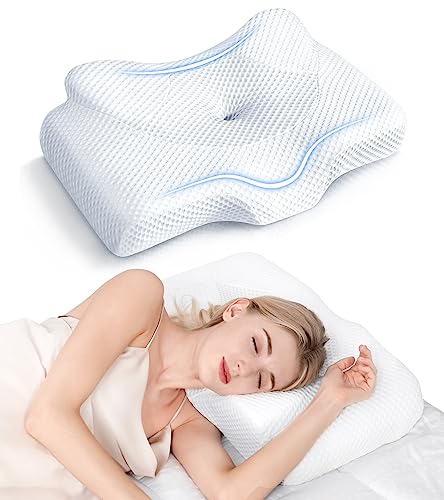
The Osteo takes the opposite approach from shredded fill: a molded memory foam core with a hollow center that cradles the back of the head, surrounded by a raised contour that supports the neck curve. The listing describes the foam as odorless — a small mercy, since new memory foam often is not — and the case as cooling, and the design is adjustable, so the height can be modified rather than accepted. It is aimed squarely at back sleepers, with side-sleeping edges built into the contour.
Strengths
- Hollow center cradles the head while the contour supports the neck
- Adjustable design softens the fixed-height gamble
- Cooling case and odorless foam address the two classic foam complaints
Trade-offs
- The sculpted shape feels strange for the first few nights
- Primarily a back-sleeper design; committed side sleepers may want higher edges
- Molded foam cannot be reshaped as freely as shredded fill
| Detail | What the listing confirms |
|---|---|
| Core | Molded memory foam, hollow design |
| Case | Cooling case (per listing) |
| Adjustability | Adjustable orthopedic bed pillow design |
| Foam note | Described as odorless in the listing |
The hollow-center idea is borrowed from clinical cervical pillows: by letting the head settle into a shallow bowl, the pillow keeps the neck roll in contact with the neck instead of pushing the head forward. Whether it suits you depends on your head shape and how still you sleep. Restless sleepers sometimes drift off the contour; still back sleepers tend to love it. Give any sculpted pillow a full week before judging it — your neck needs time to stop expecting the old shape.
The Osteo’s hollow center rewards sleepers who stay centered; if you use a CPAP mask or sleep with an arm overhead, test how the contour interacts with your actual position during the trial nights rather than an idealized one. Its cooling case is removable for washing on most such designs — confirm on the product page — and the foam itself should be aired, never washed. Back sleepers with a smaller frame often find the hollow design’s gentle containment more comfortable than a tall roll pressing upward.
Best for: Back sleepers who want a defined cradle and neck roll in one molded piece / Not suited for: Restless sleepers who roam the whole pillow by morning
Ultra Pain Relief Cooling Cervical Pillow — Best Adjustable Contour
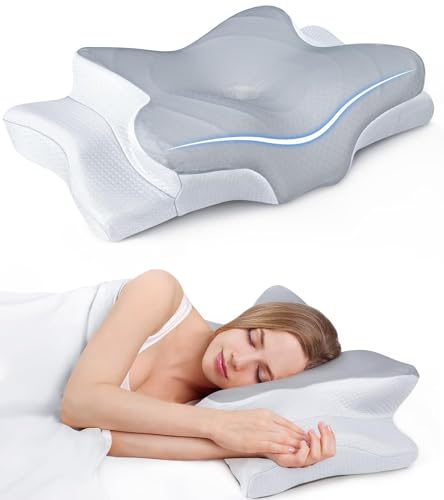
This pillow tries to give you both families at once: an ergonomic contour molded into memory foam, with adjustability so the height is not a take-it-or-leave-it proposition. The listing emphasizes cooling and an odorless foam, and the contour is shaped for neck support in the classic cervical style — a roll under the neck, a dip for the head. For shoppers torn between the Coop’s loose fill and a fixed sculpture like the Osteo, this is the middle path.
Strengths
- Contour shape with adjustability, rather than one or the other
- Cooling emphasis for warm sleepers
- Odorless memory foam per the listing
Trade-offs
- Brand is less established than the Coop or Tempur-Pedic names here
- Adjustment range is narrower than a fully shredded-fill pillow
- Contour-first design suits back and side sleeping better than stomach sleeping
| Detail | What the listing confirms |
|---|---|
| Core | Ergonomic contour memory foam |
| Adjustability | Adjustable cervical design |
| Cooling | Cooling pillow design (per listing) |
| Foam note | Described as odorless in the listing |
Treat this as the experimenter’s contour pillow. Start at its fullest height for a few nights, then reduce in small steps; most people overshoot downward on night one because a new contour feels tall before the foam warms and settles. The cooling build is a genuine plus in this category, since a sculpted pillow wraps more of your head than a flat one and can feel warm by 3 a.m. if the cover does not breathe.
Because this contour adjusts, keep notes during the first week: which height you tried, how the morning felt. Pillow tuning fails when it is done by vibes across forgotten nights. The cooling build also makes this the contour we would choose for warm bedrooms and summer use, where the Osteo’s case and this model’s cooling emphasis compete directly. Side sleepers should pay attention to the shoulder-side edge height — that edge, not the center dip, decides side-sleeping comfort.
Best for: Back and side sleepers who want a contour they can fine-tune / Not suited for: Stomach sleepers, who need a much thinner pillow than any contour offers

Bedsure Cervical Neck Pillow — Best for Side and Back Sleepers
Bedsure’s entry is the straightforward one: a memory foam contour whose listing says it gently cradles the head and provides orthopedic contour support for side and back sleepers. No shredded fill, no hollow center — just the classic butterfly-style cervical shape from a brand most bedding shoppers already know. If the experimental designs in this guide feel like over-engineering, this is the conventional choice, and conventional is a perfectly good answer for a pillow.
Strengths
- Classic contour shape from a familiar bedding brand
- Listing explicitly targets side and back sleepers
- Simple, no-fuss design with nothing to adjust or assemble
Trade-offs
- Fixed shape — if the height misses, the pillow misses
- Listing confirms fewer extras than the premium picks
- Pure contour shape will not suit stomach sleepers
| Detail | What the listing confirms |
|---|---|
| Core | Memory foam |
| Shape | Orthopedic contour, cradles the head |
| Positions | Side and back sleepers (per listing) |
| Brand | Bedsure |
There is a real virtue in a pillow that asks nothing of you. The Bedsure works or it does not, and you will know within a week. Its contour is the middle-of-the-road height most average-build back sleepers need, and the side edges give side sleepers a place to land when they roll. Pair it with the loft-measuring steps in the how-to section below; if your measured gap matches a standard contour, this is the low-drama way to fill it.
The Bedsure’s simplicity extends to care: a removable cover on most Bedsure pillow designs, straightforward sizing, and a shape that fits standard pillowcases when you want a familiar feel over the contour. It is also the easiest pick here to buy for a guest room, where a middle-of-the-road contour suits the widest range of visitors. If your measured gap is close to standard and your taste runs to known brands with no experiments attached, this is the calm choice.
Best for: Average-build back and side sleepers who want a simple, known-brand contour / Not suited for: Anyone between standard heights, who should choose an adjustable model

Tempur-Pedic TEMPUR-Ergo Neck Pillow — Best Premium Solid Foam
Tempur-Pedic’s Ergo Neck Pillow is the elder statesman of this category: a solid piece of TEMPUR material molded into a neck pillow, offered in profile heights, with the medium profile in this listing. Solid TEMPUR foam feels different from every shredded or conventional memory foam here — denser, slower to respond, and firmer once it warms to you. That firmness is the point for sleepers who find ordinary memory foam mushy: the neck roll holds its line all night without bottoming out.
Strengths
- Solid TEMPUR material holds its contour without compressing flat
- Profile sizing lets you match height to your build
- The most established name in therapeutic-style neck pillows
Trade-offs
- Premium-priced within this category
- Firm feel divides sleepers — some find it unyielding
- Fixed height in the chosen profile; no adjustment after purchase
| Detail | What the listing confirms |
|---|---|
| Material | TEMPUR solid foam |
| Profile | Medium profile (this listing) |
| Color | White |
| Brand | Tempur-Pedic |
Buy the Ergo if you have tried softer foam pillows and felt your head sink through them by morning. The medium profile suits average frames; broader shoulders usually mean the large profile, and the brand’s own sizing guidance on the product page is worth the two minutes it takes. Solid foam also sleeps warmer than shredded fill, so hot sleepers should weigh the Coop Cool+ or a cooling contour first. Nothing else here feels like it — which is either the recommendation or the warning, depending on your taste in firmness.
Solid TEMPUR foam has one more trait worth knowing: it is temperature-sensitive, feeling firmer in a cold room and softer as it warms to your body through the night. That behavior is normal and, for many owners, beloved — the pillow meets you halfway. It also means first impressions in a cold bedroom mislead; judge the Ergo after it has warmed up, around the twenty-minute mark, not at lights-out. Keep it out of prolonged direct sunlight and never fold it for storage.
Best for: Sleepers who want maximum firmness and a contour that never flattens / Not suited for: Hot sleepers and anyone who prefers a soft, squeezable pillow
EPABO Contour Memory Foam Pillow — Best Value Contour
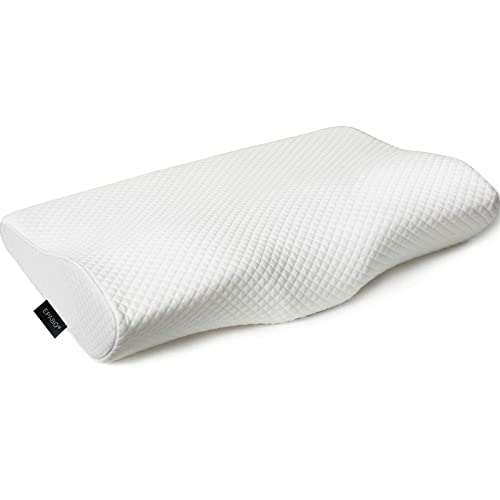
The EPABO contour is one of the originals of the Amazon cervical-pillow era: an ergonomic memory foam shape with a neck roll and a head dip, marketed for side sleepers, back sleepers, and stomach sleepers alike. It is the accessible way to test whether a contour suits you before spending premium money, and its shape is the reference design most other contours in this guide are variations on. The listing title is cut short in the listing response, so beyond the confirmed contour design we describe it conservatively.
Strengths
- Classic ergonomic contour at an accessible tier
- One shape aimed at all three sleep positions
- A low-risk way to test contour sleeping before upgrading
Trade-offs
- Fewer confirmed extras — no cooling or certification claims in the listing we verified
- Fixed height, like all molded budget contours
- Foam feel is conventional memory foam, softer than solid TEMPUR
| Detail | What the listing confirms |
|---|---|
| Core | Memory foam |
| Shape | Ergonomic cervical contour |
| Positions | Side, back, and stomach sleepers (per listing) |
| Brand | EPABO |
There is no shame in starting here. Contour pillows are a genuine change in how your head rests, and some sleepers discover in a week that they simply prefer a flat pillow — better learned at this tier than at the premium one. If the shape works, you can upgrade later with your height preference already known. If it does not, the experiment cost little. That honest role — the category’s trial pillow — is why the EPABO earns the sixth slot.
The EPABO also serves as a useful reference purchase inside a household: buy one, and every family member can test contour sleeping on it before committing to their own premium version. Its conventional memory foam feel is the category’s baseline — if you find it too soft, your upgrade path is the Tempur; too firm, the adjustable Coop. Few products at this tier teach you as much about your own preferences per dollar spent.
Best for: First-time contour buyers who want to test the shape affordably / Not suited for: Shoppers who want certified foams or cooling features confirmed in the listing
Comparison Table
Adjustment style is the column that predicts satisfaction. Fixed contours reward sleepers who know their height; adjustable fills forgive those who do not. The column to study is adjustment style, because it predicts your first month. Fixed contours ask for a correct guess and reward it with consistency; adjustable fills ask for a week of evenings and reward it with precision. Firmness runs on a separate axis entirely — the Tempur is the firmest object in the table at any height, and the shredded Coop can be made softer than any molded rival. Choose your row on both axes, not one.
| Pick | Badge | Key spec | Best for |
|---|---|---|---|
| Coop Home Goods Cool+ Adjustable Pillow | Best Overall | Adjustable shredded memory foam with cooling gel | Sleepers unsure of their loft, combination sleepers, and couples with different builds |
| Osteo Cervical Pillow | Best Sculpted Contour | Hollow-center molded memory foam with cooling case | Back sleepers who want a defined cradle and neck roll in one molded piece |
| Ultra Pain Relief Cooling Cervical Pillow | Best Adjustable Contour | Adjustable ergonomic contour memory foam, cooling design | Back and side sleepers who want a contour they can fine-tune |
| Bedsure Cervical Neck Pillow | Best for Side and Back Sleepers | Classic memory foam contour for side and back sleeping | Average-build back and side sleepers who want a simple, known-brand contour |
| Tempur-Pedic TEMPUR-Ergo Neck Pillow | Best Premium Solid Foam | Solid TEMPUR foam, medium profile neck pillow | Sleepers who want maximum firmness and a contour that never flattens |
| EPABO Contour Memory Foam Pillow | Best Value Contour | Classic ergonomic contour memory foam | First-time contour buyers who want to test the shape affordably |
How to Choose a Foam Pillow for Neck Support: Loft Comes First
Loft — the pillow’s height under your head — is the whole game. On your back, the right loft fills the curve behind your neck while letting your head rest only slightly above the mattress line; too high pushes your chin toward your chest, too low lets your head fall back and leaves the neck curve empty. On your side, the right loft is taller: it must span the distance from the mattress to your head across your shoulder, keeping your spine straight rather than tilting.
Measure before you buy. Lie on your side on your own mattress, have someone note the gap between your head and the mattress, or fold towels to the height that keeps your nose in line with your sternum and measure the stack. Then match that number to a contour’s height or an adjustable pillow’s range. Shoulder width, mattress firmness, and how much you sink into the bed all move the target, which is why adjustable pillows exist and why fixed contours publish profiles.
Solid Contour vs. Shredded Adjustable Foam
A solid molded contour gives you the same sculpted support every night and never needs fluffing; its weakness is that the shape is a bet placed at purchase. Shredded adjustable foam gives up the sculpture in exchange for control — you set the height, change it as your mattress or body changes, and can even shape a loose neck roll by pushing fill where you want it. Neither is better in the abstract; they suit different levels of certainty.
Feel differs too. Solid foam, especially TEMPUR material, is dense and slow, holding you in a cradle. Shredded foam is springier and more pillow-like, closer to what most people grew up with. If you move between positions all night, shredded fill usually forgives more; if you sleep like a statue on your back, a contour’s precision is wasted on no one — it is made for you.
Sleeping Position Changes the Right Answer
Back sleepers need the least height and benefit most from a neck roll with a head dip — the cervical contours in this guide are built for them. Side sleepers need the most height and a firm enough edge that the pillow does not collapse under the head’s full weight; look for contours whose side wings are as tall as your measured gap. Stomach sleepers need the opposite of a contour: the thinnest, softest surface possible, because any height twists the neck — among these picks, only a heavily thinned adjustable pillow honestly serves them.
Combination sleepers should weight their dominant position and choose forgiveness for the rest: an adjustable fill or a medium contour. And remember that a pillow interacts with your mattress — a soft mattress that lets your shoulders sink effectively lowers the loft you need, while a firm mattress raises it. Change one and you may need to revisit the other.
Pillowcases, Covers, and the Feel of the Surface
A neck pillow’s cover is not packaging; it is half the sleep surface. Cooling cases, like those on the Osteo and the Ultra contour, use smooth, cool-touch fabrics that reduce the warm-up period memory foam is known for. A standard cotton pillowcase over any of these pillows adds insulation and can bunch over a contour’s curves — if you use one, choose a case that fits the pillow’s actual dimensions so the shape underneath stays the shape you bought.
Wash covers on the maker’s schedule and air the foam cores in indirect light when you change bedding. Foam should never be machine washed or soaked; spot-clean only. And if anyone in the house has dust sensitivities, a zippered encasement under the pillowcase keeps the foam cleaner for longer — a small purchase that extends the pillow’s best years.
When to Replace a Foam Pillow — and What to Do With the Old One
Foam pillows announce their retirement in three ways: the loft no longer returns after you lift your head, the contour’s high points feel permanently compressed, or you start folding the pillow to get support — the universal sign. Adjustable pillows postpone the verdict because fill can be redistributed or refreshed, but the foam itself still ages; shredded fill that has gone lumpy rather than springy is done.
Retired pillows have honorable second lives: a knee pillow between the legs for side sleepers, a lumbar cushion in a reading chair, a travel pillow for the car, or padding for a pet bed. What they should not become is the guest pillow — guests deserve the same geometry you demand for yourself. When a pillow is truly finished, check whether your area accepts foam in textile recycling before it goes to landfill.
Foam Density and Firmness: The Spec Nobody Prints
Two pillows can both say ‘memory foam’ and feel like different materials, because density — how much foam is packed into the volume — drives firmness, durability, and price, and it is the spec listings print least. Higher-density foam feels slower and more supportive and keeps its shape for years; lower-density foam feels plush immediately and tires sooner. The picks here span that spectrum deliberately, from the Coop’s tunable shredded fill to the Tempur’s dense solid core.
Use the spectrum as a diagnostic. If every pillow you have owned felt fine for a month and then went flat, you have been buying low-density foam and your answer lives at the dense end. If firm pillows feel like sleeping on a book, your answer is shredded or conventional foam, tuned or chosen soft. Firmness preference is not a character trait to overcome; it is data about your body, and the right pillow is the one that agrees with it.
How to Set Up and Adjust a Foam Neck Pillow
Whether your pillow is adjustable or molded, the first week decides whether it works. Use this routine instead of judging it after one night.
Step 1: Measure your gap first
Before the pillow comes out of its packaging, measure the distance your head needs: lie in your main sleep position and stack folded towels until your spine feels straight and your chin is level. Note the height in inches — that number is your target loft and your reference for every adjustment below.
Step 2: Let the foam wake up
Unpack the pillow and give it several hours in a ventilated room. Compressed foam needs time to expand fully, and new foam often carries a factory smell that fades with airing. Judging height or firmness in the first hour misleads you about both.
Step 3: Set the starting height
For adjustable pillows, start slightly fuller than your measured target — fill settles and compresses in the first nights. For a molded contour, place the taller neck roll under your neck if you sleep on your side, the lower roll if you sleep on your back, if your model offers two heights.
Step 4: Sleep on it for three nights before changing anything
Your neck has habits built around your old pillow, and the first night on a new shape often feels wrong for that reason alone. Give it three nights. Note each morning whether any discomfort is fading (adaptation) or growing (a genuine mismatch).
Step 5: Adjust in small steps
Change one variable at a time: remove or add a small handful of fill, or rotate a dual-height contour. Small steps let you find the height where your head feels level and your shoulders stay relaxed, instead of oscillating between too tall and too flat.
Step 6: Maintain the shape
Fluff shredded pillows briefly each morning to redistribute fill. Keep molded contours out of the washing machine — wash the removable cover instead, per the care label — and keep foam away from prolonged direct heat, which degrades it.
Step 7: Re-check the fit after a mattress change
Any time the bed changes — new mattress, new topper, even a rotated mattress settling differently — repeat the three-night test before blaming the pillow. A small fill adjustment or a switch to the contour’s other height usually restores the geometry. Pillows and mattresses are one system wearing two price tags.
Step 8: Photograph your sleep posture
It sounds odd and works immediately: have a partner photograph you from the side, lying on the new pillow in your real sleep position, or prop a phone and use a timer. Seeing your head’s angle — chin level, spine straight, shoulder relaxed — tells you more than any amount of lying there wondering. Adjust once, photograph again, and stop when the line looks boring.
If, after a week of honest adjustment, a pillow still fights you, believe it: shape preference is real, and the right move is a different style, not more patience. One last calibration: your pillow height interacts with how you use your arms. Side sleepers who tuck a hand under the pillow are adding height they forget to count; back sleepers who fold an arm under the pillow change the angle entirely. When you photograph your posture, photograph the real one — arms where they actually sleep — and tune to that sleeper, not the tidy mannequin version.
Common Buying Mistakes
Buying height by habit
Most people replace a pillow with one that looks like the old one, even when the old one was the problem. Measure your gap and buy the number, not the silhouette. This single step prevents more bad pillow purchases than any brand research.
Judging a contour pillow on night one
A sculpted pillow changes your head position, and your neck notices. One night tells you almost nothing; a week of gradual adaptation tells you nearly everything. Returning a contour after a single sleep is the category’s most common own goal.
Expecting a pillow to treat pain
A well-chosen pillow supports comfortable sleep posture. It does not diagnose or treat neck conditions, and marketing language about pain relief should be read as comfort language. If pain persists, worsens, or involves numbness or weakness, the next step is a medical professional, not a firmer pillow.
Ignoring the mattress half of the equation
Pillow loft works relative to how far your body sinks into your bed. A new, firmer mattress can make a perfect pillow suddenly too tall. When you change mattresses, re-measure before blaming or replacing the pillow.
Washing the foam itself
Memory foam and water are enemies: a soaked foam core takes days to dry and can break down. Wash covers, spot-clean foam, and air everything thoroughly. Check the care label on your specific model rather than assuming.
Stacking two pillows to fix a height problem
Two soft pillows make an unstable, angled surface that bends the neck worse than either alone. If you need more height, buy it in one structured pillow or add fill to an adjustable one. Stacking is the most common home remedy in this category and the least effective.
Judging by the squeeze test
Squeezing a pillow in your hand measures hand comfort, not neck support — your head weighs far more than your grip and rests for hours, not seconds. Dense pillows that feel unyielding to a squeeze often feel perfect at 2 a.m. Judge pillows lying down, over nights, or not at all.
Final Recommendation
Start with the Coop Home Goods Cool+ if you do not know your loft — adjustability turns the riskiest part of this purchase into a few evenings of tuning, and the cooling gel blend answers foam’s warmth problem. If you already know you love a sculpted shape, the Osteo’s hollow-center contour is the most considered design here, the Ultra Pain Relief Cooling contour adds adjustability to the same idea, and the Bedsure is the simple, known-brand version. Firmness purists should go straight to the Tempur-Pedic Ergo, and anyone testing contour sleeping for the first time can do it affordably with the EPABO.
If you are buying for two sleepers, resist the matched-pair instinct unless both sleepers share a position and a build. Two different pillows that each fit their sleeper will outperform a handsome matching set that fits one of you. The bed does not care about symmetry; necks do not either.
Whichever you choose, measure first and judge after a week. Round out the sleep setup with our related guides: Best Gel Sleeping Pillows and Best Foam Rubber Pillows, then check price on Amazon for the size and profile you measured for.
Coop Home Goods Cool+ Adjustable Pillow Osteo Cervical Pillow Ultra Pain Relief Cooling Cervical Pillow
Best Gel Sleeping Pillows Best Foam Rubber Pillows Best Extra Firm Extra Thick Gusset King Pillows Best First Pillows For Toddlers Best Eco Friendly Hypoallergenic Pillows
Related guides
Frequently Asked Questions
What loft is best for neck support?
It depends on position and build. Back sleepers usually need a low-to-medium loft that fills the neck curve without pushing the chin down; side sleepers need a taller, firmer loft that spans the shoulder gap. Measure the gap in your sleep position and match the pillow’s height or adjustment range to that number.
Are contour pillows better than regular foam pillows?
They are better at one job: holding a specific head-and-neck position all night, which back sleepers especially appreciate. They are worse for restless sleepers and stomach sleepers. Adjustable shredded foam is the more forgiving all-round shape; contours are the more precise tool.
Do foam pillows sleep hot?
Foam insulates more than fiberfill, so plain memory foam can feel warm. Gel-infused fill, shredded construction, and cooling covers — all present in picks above — reduce the effect noticeably. If you sleep very hot, prioritize those features over maximum firmness.
How long does a memory foam pillow last?
Quality foam holds its support for a few years of nightly use before it softens or takes a permanent set. Adjustable pillows last longer in practice because you can refresh the loft by redistributing or topping up fill. Replace any pillow that no longer returns to shape or leaves your head unsupported.
Can a pillow fix neck pain?
A pillow can support a comfortable sleeping posture, and the wrong pillow can certainly make mornings worse. But pillows are comfort products, not medical treatments. Persistent or severe neck pain, or pain with numbness, tingling, or weakness, should be evaluated by a clinician rather than shopped away.
Which foam pillow suits stomach sleepers?
The thinnest option you can find — among these picks, an adjustable shredded pillow with much of its fill removed. Tall contours and firm neck rolls force a stomach sleeper’s neck into rotation and extension, the opposite of supported. Many stomach sleepers do best with a very low pillow or none under the head at all.

