Disclosure: airfryerkitchensupply.com is reader-supported. When you buy through links on our site, we may earn an affiliate commission at no extra cost to you.
Where to buy
Every model below was checked against Amazon listing for this site before it earned a link, and the shortlist for the best air purifiers for parrots follows one rule above all others: mechanical filtration first, and no ozone-generating technology anywhere near a bird. Parrots have highly efficient, sensitive respiratory systems, so the features that get marketed hardest for ordinary allergy rooms — ionizers, plasma generators and UV add-ons — are exactly the features a bird room does not need. The six units here clean with filters you can see, count and replace.
- Levoit Core 300-P Air Purifier — Check the current price on Amazon
- BLUEAIR Blue 211i Max Air Purifier — Check the current price on Amazon
- COWAY Mighty AP-1512HH Air Purifier — Check the current price on Amazon
- Austin Air HealthMate Plus Air Purifier — Check the current price on Amazon
- Rabbit Air MinusA2 SPA-780A Air Purifier — Check the current price on Amazon
- Medify MA-40 Air Purifier — Check the current price on Amazon
Introduction: Best Air Purifiers for Parrots, Honestly
Parrots are wonderful, dusty companions. Cockatiels, African greys and cockatoos produce fine powder down that drifts onto every surface, and even the smaller species add feather dander, seed hull dust and dried droppings dust to the air of the room they live in. An air purifier genuinely helps — it will not replace cage cleaning, misting or ventilation, but a good HEPA unit running steadily near the cage cuts the floating dust load noticeably, which is better for the bird, better for your lungs, and better for the furniture.
The catch is that parrot-safe purification is a narrower brief than general air cleaning. Birds are far more sensitive to airborne irritants than people are, and ozone is at the top of the avoid list: any purifier that generates ozone as a cleaning method, including many ionizing designs, is a poor roommate for a parrot. The honest approach is boring on purpose — a sealed or well-built mechanical filter, a real HEPA stage for the fine dander, activated carbon for everyday odors, a washable pre-filter that catches the big feather dust before it loads the expensive filter, and controls simple enough that you will actually leave the machine running all day.
Every pick below was verified, and the listing titles are quoted in the spec boxes so you can see exactly what was confirmed. Where a popular feature could not be confirmed from the listing — an ionizer on/off switch, for example — this guide says so rather than guessing, and the buying-guide sections explain how to check the manual before any purifier shares air with your bird. Coverage figures quoted are the manufacturers’ own room-size claims from those listings, stated as claims, not as test results.
In this guide
Quick Picks
Six mechanical-filtration purifiers at six different scales, from a single cage-side room to a whole open-plan aviary space. Start with the Levoit if you want the default answer, and read the trade-offs before you buy anything with a plasma or ion feature.
- Levoit Core 300-P Air Purifier — Best Overall: The default cage-room answer: a compact HEPA tower with a sleep mode, sized by its listing for rooms up to 1,073 square feet, that simply filters air without exotic add-ons. — check price on Amazon
- BLUEAIR Blue 211i Max Air Purifier — Best for Large Rooms: The big-space option, rated by its listing up to 3,235 square feet, with HEPASilent filtration, auto mode and a washable pre-filter that suits heavy feather dust. — check price on Amazon
- COWAY Mighty AP-1512HH Air Purifier — Best with Air Quality Monitor: A long-running favorite with a HEPA filter, a real-time air quality monitor, auto and eco modes, and a listing coverage claim up to 1,748 square feet. — check price on Amazon
- Austin Air HealthMate Plus Air Purifier — Best for Odor and Long Filter Life: A heavyweight steel unit with four-stage filtration, activated carbon and zeolite, coverage claimed up to 1,500 square feet, and a filter the listing rates for five years. — check price on Amazon
- Rabbit Air MinusA2 SPA-780A Air Purifier — Best Wall-Mountable and Quiet: An ultra-quiet, wall-mountable HEPA purifier that gets the machine up off the floor and away from curious beaks, with an odor-remover configuration in this listing. — check price on Amazon
- Medify MA-40 Air Purifier — Best Value for Big Coverage: A HEPA tower claiming 1,793 square feet of hourly coverage, aimed at smoke, odors, pollen and pets, at the accessible end of this roundup’s tiers. — check price on Amazon
How These Picks Were Chosen
The selection started with a hard filter of its own: no ozone purifiers, no essential-oil diffusing features, and no model whose cleaning method depends on generating ions as its primary trick. From there, each candidate had to be confirmed — the exact listing title had to match the product named here — and it had to offer a genuine HEPA stage, because powder down and dander are fine particles that cheap mesh filters barely touch. A washable or vacuumable pre-filter scored heavily, since feather dust will choke a HEPA filter months early if it reaches it unfiltered.
Room coverage was judged as a claim to sanity-check, not a promise: manufacturers rate coverage under laboratory conditions, and a cage room with a bird actively producing dust needs headroom, so each pick notes the space it suits honestly. Noise mattered too, because a purifier a parrot finds startling, or an owner finds annoying, gets switched off — and an off purifier cleans nothing. Finally, running cost was weighed qualitatively: filter life and filter availability decide what a purifier really costs over five years, and the picks favor mainstream models whose replacement filters are easy to find.
The 6 Best Air Purifiers for Parrots Reviewed

Levoit Core 300-P Air Purifier — Best Overall
This is the purifier to buy if your parrot lives in a bedroom, office or apartment living room and you want one machine that handles the daily dust without drama. The listing positions it squarely at pet households — pet hair, allergens, dust, smoke and pet odor are its stated targets — and powder down behaves like the fine end of that same dust spectrum. Its compact footprint tucks beside a cage stand without dominating the room, and the sleep mode keeps it running overnight, which is when a full day of accumulated dander is still floating. It suits one cage or a small group in a single room; a whole wall of breeding cages will outgrow it, and the larger rooms below exist for exactly that case.
Strengths
- HEPA filtration aimed at exactly the fine dust, pollen and pet dander a parrot room produces
- Sleep mode supports the quiet, always-on running a bird room actually needs
- Compact tower format fits beside a cage without rearranging the room
Trade-offs
- Single-room scale — open-plan spaces need the bigger units below
- The 3-in-1 filter is a consumable you will replace on schedule, an ongoing cost
- No washable separate pre-filter stage is named in the listing title
| Detail (from the verified listing title) | What it says |
|---|---|
| Listing coverage claim | Up to 1,073 ft² |
| Filtration | 3-in-1 filter with HEPA, sleep mode |
| Stated targets | Pet hair, allergens, dust, smoke, pet odor |
| Verification mark in title | AHAM VERIFIDE |
What makes the Core 300-P the overall pick is the absence of complications. There is no plasma feature to research, no scent cartridge, no app ecosystem you must join — it draws room air through a combined filter and returns it cleaner, which is the entire job description in a bird room. Run it on a medium setting near, but not blowing directly at, the cage: a gentle room-wide circulation pattern lifts dust from the cage area and traps it, while a direct draft on a parrot is stressful and can chill the bird. Expect the pre-filter layer of the combined cartridge to show grey dust quickly in a cockatiel or grey household; vacuuming the intake side during your weekly cage clean stretches the main filter’s useful life. If your bird startles at new sounds, introduce it on the lowest speed for two days before stepping up — most parrots habituate to a steady fan hum far faster than to intermittent noises.
Best for: Most parrot homes with one cage in a bedroom or living room / Not suited for: Large aviaries or open-plan rooms needing whole-space coverage
Check on Amazon — check the current price on Amazon before you decide, because sizes, colors and configurations change.

BLUEAIR Blue 211i Max Air Purifier — Best for Large Rooms
Choose the Blue 211i Max when the parrots live in a large living room, a converted sunroom or an open-plan space where a compact tower would be running at full blast forever just to keep up. Its listing claims coverage up to 3,235 square feet and pairs HEPASilent filtration with a washable pre-filter — that pre-filter is a genuinely bird-relevant feature, because powder down is bulky, and being able to rinse the coarse stage instead of buying it keeps the main filter working on the fine fraction it is actually for. Auto mode and WiFi controls suit owners who want the machine to react to dust events — a cage-cleaning session, a molting cockatoo’s afternoon shake — without manual fiddling.
Strengths
- Largest coverage claim in this roundup, for open-plan bird rooms
- Washable pre-filter handles bulky feather dust before the main filter
- Auto mode reacts to dust spikes from cage cleaning and molts
Trade-offs
- A physically larger, premium-tier machine — overkill for one small cage room
- HEPASilent is a proprietary approach; replacement filters are brand-specific
- WiFi features are convenience, not cleaning power — do not pay for them alone
| Detail (from the verified listing title) | What it says |
|---|---|
| Listing coverage claim | Up to 3,235 ft² |
| Filtration | HEPASilent with washable pre-filter |
| Noise figure in title | Quiet 23dB (lowest settings) |
| Controls | WiFi, auto mode |
Blueair’s HEPASilent approach combines mechanical filtration with an electrostatic assist inside the filter chamber, which is a different thing from a room ionizer that releases ions into your living space — but because parrots are the most cautious case in home air care, the honest advice is to read the model’s current manual section on emissions before purchase and keep the unit across the room from the cage rather than beside it. In return you get the strongest dust-handling package here: the washable pre-filter will visibly collect the white powder that greys and cockatoos shed, and rinsing it monthly is the cheapest filter-life extension in this guide. For a multi-cage room this is the pick that stops the ‘purifier always on turbo’ problem, because a big machine on a low, quiet setting moves more air gently than a small machine screaming at maximum.
Best for: Large or open-plan rooms with several cages or heavy powder-down species / Not suited for: Small bedrooms, or owners who want zero proprietary filter systems
Check on Amazon — check the current price on Amazon before you decide, because sizes, colors and configurations change.

COWAY Mighty AP-1512HH Air Purifier — Best with Air Quality Monitor
The Coway Mighty suits the owner who wants feedback: its air quality monitor shows you what cage cleaning, a window opening or a molting week actually does to the room, and the auto mode turns that information into fan speed without you thinking about it. The listing claims coverage up to 1,748 square feet, which comfortably handles a main living space with a cage or two, and the filter indicator removes the guesswork from replacement timing — useful in bird homes, where filters load faster than the packaging assumes. It is a mid-size tower that fits most rooms without the footprint of the big Blueair.
Strengths
- Air quality monitor makes invisible dander load visible and actionable
- Auto and eco modes balance cleaning against noise and running cost
- Filter indicator suits bird homes where filters load faster than standard schedules
Trade-offs
- The listing title does not confirm every feature detail — check the manual for any ion-related settings before use near birds
- Mid-size coverage sits between the compact and large-room picks
- Replacement filters are model-specific Coway parts
| Detail (from the verified listing title) | What it says |
|---|---|
| Listing coverage claim | Up to 1,748 ft² |
| Filtration | HEPA filter for smoke, allergies, pet dander, odor |
| Modes | Air quality monitor, auto and eco mode, timer |
| Warranty stated in title | 3yr warranty |
The monitor is the reason to buy this one, and it changes how you run a bird room. Within a week you learn your room’s patterns: dust spikes when you change cage papers, drifts down overnight, jumps again when the bird has a bathing splash and shake. Running auto mode through those cycles cleans hardest exactly when the dust is airborne, which is when filtration works — a purifier cannot catch dust that has already settled, it can only stop it settling. One caution handled honestly: Coway has sold versions of this platform with additional air-treatment features, and the listing title verified here does not describe them. Before the first run, read the manual for your exact unit, and if any ion-generating mode exists and can be switched off, leave it off permanently in the bird room; if it cannot, choose a different pick from this list.
Best for: Owners who want visible air-quality feedback and automatic response / Not suited for: Anyone unwilling to check the manual for optional air-treatment modes
Check on Amazon — check the current price on Amazon before you decide, because sizes, colors and configurations change.

Austin Air HealthMate Plus Air Purifier — Best for Odor and Long Filter Life
Pick the HealthMate Plus when odor and chemical load are the real problem — a bird room that also hosts cleaning products nearby, a home near traffic, or an owner sensitive to smells — and when you would rather buy one serious filter every few years than cartridges every few months. The listing describes four-stage filtration built around activated carbon and zeolite, a combination aimed at gases and odors as much as particles, and claims a five-year filter life, which transforms the running-cost math despite the premium tier of the machine itself. It is a substantial, heavy box that stays where you put it, best in a dedicated bird room rather than a space you rearrange often.
Strengths
- Activated carbon and zeolite stage targets odors and gases, not just dust
- Five-year filter life claim means minimal consumable churn
- Covers a full bird room at up to 1,500 square feet per the listing
Trade-offs
- Premium tier and heavy — a place-it-once appliance, not a portable
- The single big filter is a significant purchase when it finally needs replacing
- Particle-focused buyers may not need its gas-filtration emphasis
| Detail (from the verified listing title) | What it says |
|---|---|
| Filtration | 4-stage, activated carbon and zeolite |
| Listing coverage claim | Up to 1,500 sq ft |
| Filter life stated in title | 5 year filter life |
| Model | HealthMate Plus B450, white |
Austin Air’s design is the oldest-school approach here: a very large bed of granular carbon and zeolite wrapped around a HEPA stage, in a steel case, with a simple speed dial. For parrot homes the appeal is twofold. First, the carbon bed genuinely addresses the background smells of a lived-in bird room — seed, wood toys, cage papers — rather than masking them, and masking scents are themselves something to keep away from birds. Second, the long filter life removes the most common purifier failure mode, which is not breakdown but neglect: a filter nobody replaced. Be honest about placement, because this unit’s weight makes ‘move it to whichever room’ unrealistic; measure its corner, confirm the outlet reach, and let it live there. On its middle speed it becomes part of the room’s background, quietly processing the full volume many times a day.
Best for: Dedicated bird rooms where odor control and low maintenance matter most / Not suited for: Renters or anyone who needs to move the purifier between rooms
Check on Amazon — check the current price on Amazon before you decide, because sizes, colors and configurations change.
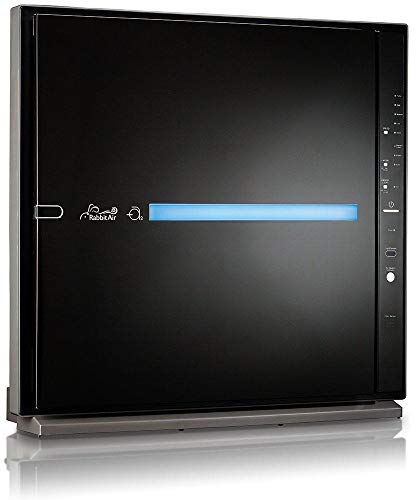
Rabbit Air MinusA2 SPA-780A Air Purifier — Best Wall-Mountable and Quiet
The MinusA2 answers a problem the other picks ignore: floor space and beaks. A purifier sitting on the floor beside a cage is a perch, a chewing target and a thing a large parrot can investigate with destructive curiosity. This unit wall-mounts, lifting it out of beak range and freeing the floor entirely, and its listing leads with ultra-quiet operation, which matters for light-sleeping birds and for owners whose cage shares a bedroom. This configuration is the odor-remover variant in black. It suits a single room and owners who value calm, unobtrusive design over raw coverage numbers.
Strengths
- Wall-mountable — safely out of reach of climbing, chewing parrots
- Ultra-quiet positioning suits bedroom cages and noise-sensitive birds
- Slim profile disappears into a room instead of dominating it
Trade-offs
- Premium tier for its coverage class
- Wall mounting needs a suitable wall and a little DIY confidence
- Filter system is model-specific with several variants — order replacements carefully
| Detail (from the verified listing title) | What it says |
|---|---|
| Format | Wall mountable, ultra quiet |
| Filtration | HEPA air purifier, odor remover configuration |
| Color in listing | Black |
| Model | MinusA2 SPA-780A |
Think of the MinusA2 as the furniture-grade option. Mounted at height, it draws air across the upper part of the room where warm, dust-laden air naturally circulates, and it never becomes a chew toy, a perch or a spill target during cage cleaning — three fates that befall floor units in real bird homes. The quiet operation is more than a luxury: parrots rest in the day as well as at night, and a purifier that drones will be switched off by owners and resented by birds. Its running costs sit at the premium end, and the filter set for this platform comes in several targeted variants, so keep the exact configuration name from your box when reordering. For a design-conscious single-room setup, though, nothing else in this roundup disappears into the room as completely while still doing proper HEPA work.
Best for: Single rooms where floor space, quiet and beak-proof placement matter / Not suited for: Budget-first buyers or very large multi-cage spaces
Check on Amazon — check the current price on Amazon before you decide, because sizes, colors and configurations change.

Medify MA-40 Air Purifier — Best Value for Big Coverage
The MA-40 is for the owner who needs real coverage in a main living area but is working to a sensible budget — a family room with a large cage, or a rescue-and-foster household where birds rotate through one big space. The listing claims 1,793 square feet of coverage in an hour and describes removal down to 0.3 microns, which is the particle size band that matters for fine dander. It is a straightforward tower without the design premium of the wall-mounted pick or the carbon bed of the Austin, and that plainness is its value proposition: money spent on filtration area rather than furniture looks.
Strengths
- Large coverage claim at an accessible tier
- HEPA filtration described to 0.3 microns — the fine dander band
- Simple tower format, easy to place and operate
Trade-offs
- Fewer refinements — no air quality display is named in the listing title
- Value towers tend to be louder at top speed; plan to run it mid-range
- Replacement filter cost should be checked before purchase, as with any value model
| Detail (from the verified listing title) | What it says |
|---|---|
| Listing coverage claim | 1,793 ft² coverage in 1hr |
| Filtration | HEPA filter, removal to 0.3 microns |
| Stated targets | Smoke, wildfires, odors, pollen, pets |
| Format | Tower, white, 1-pack |
Value purifiers earn their keep in bird homes because the alternative for many households is no purifier at all, and a mid-priced HEPA tower running daily beats a premium machine that stayed in the cart. The MA-40’s claimed coverage gives it headroom in a family room, and headroom is what lets you run a purifier at a civilized volume: oversize the machine, run it in the middle of its range, and you get both clean air and a room people and birds can live in. Keep expectations calibrated — at this tier the fit and finish of the filter housing matters, so when yours arrives, check the filter seats snugly with no obvious gaps, because unfiltered air sneaking past a filter is the silent failure of budget air cleaning. Paired with a weekly vacuum of its intake grille during cage cleaning, it will hold its performance well between filter changes.
Best for: Large living areas and multi-bird foster homes on a budget / Not suited for: Owners who want displays, app data or furniture-grade design
Check on Amazon — check the current price on Amazon before you decide, because sizes, colors and configurations change.
Comparison Table
| Pick | Badge | Key detail | Best for |
|---|---|---|---|
| Levoit Core 300-P Air Purifier | Best Overall | Up to 1,073 ft² | Most parrot homes with one cage in a bedroom or living room |
| BLUEAIR Blue 211i Max Air Purifier | Best for Large Rooms | Up to 3,235 ft² | Large or open-plan rooms with several cages or heavy powder-down species |
| COWAY Mighty AP-1512HH Air Purifier | Best with Air Quality Monitor | Up to 1,748 ft² | Owners who want visible air-quality feedback and automatic response |
| Austin Air HealthMate Plus Air Purifier | Best for Odor and Long Filter Life | 4-stage, activated carbon and zeolite | Dedicated bird rooms where odor control and low maintenance matter most |
| Rabbit Air MinusA2 SPA-780A Air Purifier | Best Wall-Mountable and Quiet | Wall mountable, ultra quiet | Single rooms where floor space, quiet and beak-proof placement matter |
| Medify MA-40 Air Purifier | Best Value for Big Coverage | 1,793 ft² coverage in 1hr | Large living areas and multi-bird foster homes on a budget |
What Makes a Purifier Safe Around Parrots?
Bird respiratory systems move air through the lungs and air sacs with an efficiency that extracts far more from every breath than ours does — which is wonderful for flight and terrible when the air carries irritants. That single fact drives every rule in this guide. Ozone is the headline hazard: it is a reactive gas that damages delicate airways, and any device that produces it deliberately, however effective it may be against odors, does not belong in a bird room. The same caution applies to ionizing features whose emissions are not clearly documented for the exact model you are buying.
Mechanical filtration — a fan moving air through physical filter media — has no such question mark, which is why every pick here is a filter box at heart. Scent is the second trap: fragrance sponges, essential oil pads and scented ‘refresh’ features add volatile compounds to the air on purpose, and a parrot room should have none of them. The third rule is placement: close enough to the cage to intercept dust, never blowing a direct draft onto the bird, and physically out of beak reach where a climbing species can get to cords and intakes.
- No ozone-generating cleaning modes in the bird room, ever
- No fragrance cartridges, oil pads or scented filter features
- Mechanical HEPA plus carbon is the whole formula — nothing exotic required
- Position for room circulation, not a direct draft on the cage
- When a feature is not documented for your exact model, treat it as absent and verify in the manual
Sizing a Purifier for a Cage Room
Manufacturer coverage claims assume the purifier exchanges the room’s air at a certain rate under test conditions; a room with an active dust source — a molting cockatiel is essentially a small, cheerful dust factory — needs more exchanges, not fewer. The practical rule is to buy for at least double your room’s actual area on the listing claim, which lets the machine run at a middle speed instead of its loudest. A 200-square-foot bird bedroom is therefore well served by a unit claiming 1,000-plus square feet, which describes most of this roundup.
Ceiling height and layout bend the math further. Vaulted ceilings add volume the claim did not count, and a cage tucked into an alcove sits in a dead-air pocket that any purifier will struggle to reach — in that case, placement near the alcove opening matters more than another hundred square feet of claimed coverage. Multi-cage rooms should simply step up a class: the large-room picks exist because six cages produce a dust load no compact tower was designed for, and running two smaller units at opposite ends of a big room is also a legitimate, often quieter, strategy.
Filters, Running Costs and the Five-Year View
The purchase price of a purifier is the down payment; the filters are the mortgage. In a bird home, pre-filters earn their keep first: every gram of feather dust you vacuum or rinse off a pre-filter is a gram that never reaches the HEPA stage, and HEPA life is where the money is. This is why the washable pre-filter on the Blueair pick and the long-life filter on the Austin pick matter more than their headline numbers, and why the honest total-cost comparison between a cheap tower and a premium one often narrows dramatically by year three.
Build the habit that makes any of these machines work: vacuum the intake and pre-filter during the weekly cage clean, glance at the filter indicator monthly, and replace the main filter when the indicator or a visible grey loading says so — not when a calendar app guesses. Keep one spare filter in the house if your bird is a powder-down species, because a filter that clogs during a heavy molt leaves you choosing between a screaming top-speed fan and dusty air while a replacement ships.
What a Purifier Cannot Do for Your Bird
Honesty matters here, because a purifier is sometimes bought as a substitute for husbandry, and it is not one. It cannot clean a cage, remove dried droppings, fix a seed-moth infestation in an open bag, or compensate for a room that is never ventilated. Dust that has settled on shelves is out of circulation until something disturbs it, which is why damp dusting — a barely wet cloth that traps powder instead of launching it — partners with filtration rather than competing with it.
It also cannot make unsafe air safe at the source. Non-stick cookware fumes, aerosol sprays, scented candles and strong cleaning chemicals are bird hazards that no filter purchase licenses you to ignore; the purifier’s job is the ordinary, constant dust of healthy bird keeping. Bought for that job, sized generously, filtered mechanically and run all the time, it is one of the best quality-of-life purchases a parrot home can make — for the bird first, and for everyone who shares the room second.
Matching the Purifier to Your Species of Parrot
Not all parrots dust alike, and the difference should drive your purchase more than room size alone. The powder-down specialists — cockatiels, cockatoos and African greys — coat a room in fine white powder that loads pre-filters quickly and rewards the picks with washable or easily vacuumed first stages, plus owners who keep a spare filter in the house. For these birds, treat every coverage claim in this guide as a minimum rather than a target, and expect filter intervals to run shorter than the manufacturer’s household average, because your household is not average; it is a small, joyful dust works with feathers.
Feather-dander species — macaws, conures, amazons, budgies and most others — produce a lighter, flakier load that any pick here handles comfortably at face value, which frees the choice to be about room size, noise and budget instead. Very small birds add one more consideration: a purifier’s intake is a grille with suction behind it, and while no healthy adult bird is at risk from a normal home purifier across the room, free-flying small birds should never be able to land on or cling to an intake — placement and the wall-mounted option in this roundup solve that as a side benefit. Match the machine to the bird first and the room second, and the pairing will feel obvious in hindsight.
The First Month With a Purifier: What to Expect
Week one is evidence-gathering. The pre-filter will show you a grey-white film that is equal parts satisfying and horrifying — that is dust that used to be your shelves’ problem — and the room’s flat surfaces should begin holding their dust longer between cleanings. If neither happens, the diagnosis is almost never the machine: it is placement in a dead corner, a speed too low for the room’s volume, or a door habit that keeps the cage room open to the whole house’s air. Adjust one variable at a time, like the bird keeper you are, and give each change three days.
By week four, the subtler benefits report themselves: the morning cage-clean takes less time because less dust settled overnight, the bird’s own sneezing at dust events — normal in small amounts during a molt — happens against a cleaner baseline, and your own sinuses file their opinion. This is also when to set the standing orders that make the system permanent: the filter indicator check on the first of the month, the pre-filter vacuum welded to the weekly cage clean, and the spare filter ordered before the current one is spent rather than after. Purifiers reward households that turn them into infrastructure, and a parrot home, with its decades-long companions, is exactly the household that benefits most from infrastructure thinking.
One Sentence to Remember
If everything else in this guide fades, keep this: buy mechanical filtration, oversize it for the room, place it near the cage without drafting the bird, clean the pre-filter with the cage, and let it run — that routine, faithfully kept, is the whole secret of cleaner air for a parrot.
How to Set Up a Purifier in a Parrot Room
Setup takes twenty minutes and mostly consists of decisions, not tools. Work through the steps in order and your purifier will spend its life intercepting dust instead of decorating a corner.
- Unpack and remove every plastic wrap from the filters themselves — purifiers ship with filters bagged inside the housing, and running one with the bag on is the most common first-week mistake in air care
- Place the unit on the same side of the room as the cage, a few feet away, intake facing the room — near enough to catch cage dust, never aimed so its outlet blows directly across the perch area
- For wall-mountable models, fix the unit high and confirm cords are routed where no climbing bird can reach them
- Run the purifier on its highest speed for the first hour with the bird out of the room if the bird is new to machine noise, then step down to a medium continuous setting
- Start a simple rhythm: vacuum the pre-filter at every weekly cage clean, and note the filter indicator’s state on the first of each month
- Mist or bathe your bird as usual — a purifier complements normal bathing, which itself keeps powder down under control at the source
After the first week, judge the setup by evidence: dust film on the shelf nearest the cage should form more slowly, and the pre-filter should show you a visible record of what it caught. If dust still settles as fast as before, the fix is almost always placement or a higher continuous speed — not a second machine bought in frustration.
Common Buying Mistakes
- Buying an ionizer or ozone model because the marketing sounded advanced — in a bird room, simple mechanical filtration is the advanced choice
- Sizing exactly to the room’s square footage, leaving the machine screaming on turbo to keep up with an active dust source
- Placing the purifier across the room from the cage, where it polishes already-clean air while cage dust settles locally
- Letting the pre-filter clog — a choked intake silently turns any purifier into furniture
- Running the purifier only when the room looks dusty; filtration works on airborne particles, so it must run while dust is airborne, which is always
- Assuming a purifier licenses scented products, aerosols or neglected cage cleaning — it does none of those things
The thread connecting these mistakes is treating the purifier as an event rather than a background utility. The owners who get the most from these machines buy plainly, oversize slightly, place deliberately, and then let the machine disappear into the room’s routine.
Final Recommendation
For most parrot homes, the Levoit Core 300-P is the buy: honest HEPA filtration, a sleep mode that keeps it running all night, and a footprint that fits beside a cage in a real room. If your birds live large — several cages, an open-plan space, a powder-down species in full molt — the BLUEAIR Blue 211i Max brings the coverage and the washable pre-filter that heavy dust demands, while the Austin Air HealthMate Plus is the long-haul answer when odor and filter life dominate your thinking.
The Coway Mighty earns its place for owners who want to see their air quality and let the machine respond on its own, the Rabbit Air MinusA2 solves the floor-space and beak problem by going up on the wall, and the Medify MA-40 proves that a sensible budget still buys real coverage. Whichever you choose, choose mechanical filtration, run it constantly, and keep the pre-filter clean — that routine, not any single feature, is what cleaner air for your parrot actually looks like. Related reading in this program: and.
Levoit Core 300-P Air Purifier · BLUEAIR Blue 211i Max Air Purifier · COWAY Mighty AP-1512HH Air Purifier
Best Air Purifiers Without Ionizer Best Air Purifiers For Pet Dander Best Air Purifiers For Dust Best Air Purifiers For Asthma
Frequently Asked Questions
Are ionizers and ozone purifiers really unsafe for parrots?
They are a risk a bird room does not need to take. Parrots extract far more from each breath than mammals do, and ozone is a reactive airway irritant; ionizing designs can also produce ozone as a by-product. Mechanical HEPA filtration cleans the same dust with no emissions question, so there is no practical reason to accept the risk.
Will an air purifier remove parrot dander and powder down?
Yes, that is precisely the particle load a HEPA filter is built for. Powder down and dander are fine airborne particles; a purifier running continuously near the cage traps a large share before it settles. It reduces dust noticeably, though it does not eliminate cage cleaning, bathing or damp dusting.
Where should I place the purifier relative to the cage?
On the same side of the room, a few feet from the cage, with its intake facing the room and its outlet not blowing directly across the perch. You want room air circulating gently past the cage and through the filter — interception without a draft on the bird.
How often will I replace filters in a bird home?
Faster than the box suggests if you keep a powder-down species. Vacuum or rinse the pre-filter weekly with the cage clean, watch the filter indicator monthly, and expect the main HEPA filter’s life to shorten in proportion to your bird’s dust output. Keeping a spare on hand avoids gaps during a heavy molt.
Can I run a purifier in the room while my parrot sleeps?
Yes — steady, quiet background noise is generally well tolerated, and the sleep or low modes on these picks exist for exactly that. Introduce a new machine at low speed for a couple of days so the bird habituates, and avoid models or settings that cycle noisily on and off through the night.
Is a purifier enough to protect my bird from household fumes?
No. A purifier manages ordinary dust; it is not protection against acute hazards like overheated non-stick cookware fumes, aerosol sprays or scented candles. Those must be kept away from birds at the source, filter or no filter.

