Disclosure: airfryerkitchensupply.com is reader-supported. When you buy through links on our site, we may earn an affiliate commission at no extra cost to you.
Where to buy
If you are shopping for best air purifiers for fire smoke removal, every linked product in this guide was cross-checked against Amazon’s own product data before it earned a link, so the names and models below are the ones you will actually find on the product pages. Start with the Winix 5510 Air Purifier (Best Overall for Smoke), then compare the Medify MA-112 Air Purifier V3.0 (Best for Very Large Spaces), the Medify MA-50 Air Purifier V3.0 (Best Large-Room Value), the Coway Airmega 400 (AP-2015F) (Best Design-Led Large Room), the Austin Air HealthMate Plus (Best Carbon for Smoke Odor), and the IQAir HealthPro Plus XE (Best Premium Sealed Room). Smoke is the hardest common job in home air purification, because it combines fine particles that need true HEPA filtration with gases and odor compounds that only a serious bed of activated carbon can adsorb. Every pick below pairs real particle filtration with meaningful carbon, and every coverage figure quoted comes straight from its verified listing, not from marketing arithmetic.
Best Air Purifiers For Fire Smoke Removal: wildfire smoke is a filtration problem with a known answer
The best air purifiers for fire smoke removal are chosen on different criteria than allergy purifiers, and confusing the two briefs is how households end up unprotected during fire season. Wildfire smoke is dominated by PM2.5, particles fine enough to pass deep into the lungs, mixed with a cocktail of volatile organic compounds and odor gases. A purifier for smoke therefore needs two systems working together: true HEPA filtration to capture the particles, and a substantial activated carbon stage to adsorb the gases and the smell. A thin carbon sheet behind a HEPA filter handles dust fine and smoke badly.
Sizing is the second discipline. During a smoke event you run the purifier hard and continuously, and the room’s air should turn over several times an hour to keep up with infiltration from outside. That is why this guide favors large-room machines, the Winix and Medify lines rated for well over a thousand square feet, the Coway flagships, the carbon-heavy Austin Air, and the IQAir’s HyperHEPA flagship, and runs them in rooms smaller than their rating, which is the correct way to buy smoke capacity. Coverage figures quoted are the manufacturers’ own, taken from the verified listings.
One boundary must be stated plainly: a purifier improves indoor air during smoke events; it does not make a home safe in an evacuation zone, and it does not replace sealing drafts, staying indoors, or following local guidance during fires. Within that honest scope, the six machines below are the strongest verified options for keeping a home’s air breathable through smoke season. No medical claims are made for any of them.
In this guide
Quick Picks
- Winix 5510 Air Purifier — Best Overall for Smoke: The new generation of the 5500-2 with app support, for large rooms up to 1,881 ft² in 1 hr, with True HEPA and a high deodorization carbon filter. — Check on Amazon
- Medify MA-112 Air Purifier V3.0 — Best for Very Large Spaces: A HEPA purifier rated at 5,948 ft² coverage in 1 hr, explicitly for smoke, wildfires, odors, pollen, and pets, with removal to 0.3 microns. — Check on Amazon
- Medify MA-50 Air Purifier V3.0 — Best Large-Room Value: A HEPA purifier with 2,640 ft² coverage in 1 hr for smoke, wildfires, odors, pollen, and pets, and quiet removal to 0.3 microns. — Check on Amazon
- Coway Airmega 400 (AP-2015F) — Best Design-Led Large Room: A Coway air purifier for homes up to 3,120 ft², with washable pre-filter and HEPA filter for smoke, allergies, pet dander, and odor, plus AQI display, auto and sleep modes. — Check on Amazon
- Austin Air HealthMate Plus — Best Carbon for Smoke Odor: A 4-stage purifier with activated carbon and zeolite filtration, covering up to 1,500 sq ft, in white, model B450, with a 5-year positioning in its listing. — Check on Amazon
- IQAir HealthPro Plus XE — Best Premium Sealed Room: A HyperHEPA purifier with WiFi for large rooms of 1,125 sq ft, Swiss made, positioned for allergens, asthma triggers, mold, and dust at a medical-grade standard. — Check on Amazon
How These Picks Were Chosen
Every pick had to combine true HEPA or better particle filtration with a real activated carbon stage, because smoke is a particle-plus-gas problem. Priority went to machines whose verified listings explicitly address smoke, wildfires, or odor removal, and to coverage ratings large enough to run a family room or open-plan space at high air-change rates. Ionizer-only and filterless gadgets were excluded on principle; they cannot move the air volume smoke demands.
Badges follow smoke scenarios: the best overall balance of particle and carbon capacity, the largest-room machines for open plans and whole-floor duty, the carbon specialist for odor-heavy smoke, and the premium sealed-room option.
The 6 Best Air Purifiers for Fire Smoke Removal

Winix 5510 Air Purifier — Best Overall for Smoke
The Winix 5510 inherits the 5500-2’s reputation, which was earned largely in smoke country: a true HEPA filter backed by a genuinely substantial carbon stage marketed for deodorization, which in practice means smoke odor duty. Sized for large rooms and now with app support for checking the air from another room, it is the balanced default for a family living space during fire season. Its carbon, while strong for the class, is still a filter cartridge rather than the loose-fill carbon bed of the Austin Air below.
Strengths
- True HEPA plus high deodorization carbon: both halves of the smoke problem addressed
- Large-room rating to 1,881 ft² in 1 hr, so real rooms get high air-change rates
- The 5500-series lineage is the most smoke-proven platform in this guide
Trade-offs
- Carbon cartridge will saturate in a long, heavy smoke season and need replacement
- At full speed for smoke events it is audible, like every machine here
- App features are convenience, not filtration; the value is in the filters
| Coverage | Up to 1,881 ft² in 1 hr (per listing) |
| Filtration | True HEPA + high deodorization carbon filter |
| Lineage | New generation of 5500-2, app support |
Smoke veterans recommend the Winix 5500 platform for a reason that spec sheets undersell: its carbon stage is unusually serious for a mainstream purifier, and smoke is where carbon depth shows. Particle counts fall with any true HEPA machine; the lingering campfire smell that drives people out of their own living rooms is a carbon problem, and this is the mainstream machine that treats it as one. The 5510 keeps that formula and adds modern monitoring and app control.
Run it the smoke way: in the room you live in, doors closed, on high during the worst hours and auto thereafter, sized well above the room so high speed still means high turnover. Budget for a carbon-inclusive filter change after a heavy season. Do that, and this is the machine most households should simply buy.
Best for: Living rooms and family spaces through smoke season / Not suited for: Whole-house coverage from a single unit, or odor-only problems in huge spaces
Check on Amazon — check the current price on Amazon before you decide, because configurations and bundle contents change.

Medify MA-112 Air Purifier V3.0 — Best for Very Large Spaces
The MA-112 is the capacity pick, verified fresh for this guide: its stated coverage, just under six thousand square feet in an hour, dwarfs the rest of the field, and its listing names wildfires first among its jobs. It suits open-plan homes, great rooms, and anyone who wants one machine to hold a whole floor’s air during a smoke event. It is a large appliance in size and presence, and its filter replacements are correspondingly serious purchases.
Strengths
- The largest stated coverage in this guide by a wide margin
- Listing explicitly targets smoke and wildfires
- Particle removal to 0.3 microns with a HEPA filter stage
Trade-offs
- Physically large; plan its floor space
- Replacement filters for a machine this size are a real budget line
- Overkill for a single bedroom, where a smaller pick runs quieter
| Coverage | 5,948 ft² in 1 hr (per listing) |
| Filtration | HEPA filter, removal to 0.3 microns |
| Targets | Smoke, wildfires, odors, pollen, pets (per listing) |
Coverage ratings across brands use generous assumptions, and this guide treats all of them as relative rather than absolute. Even discounted, the MA-112’s rating signals a machine built with a very large fan and filter area, and filter area is the physical truth behind smoke performance: more media, more air moved per hour, more carbon contact. In a big open space during a multi-day smoke event, that headroom is the difference between keeping up and falling behind.
Place it centrally in the open area, keep interior doors open so its turnover serves the floor, and close the loop with a smaller bedroom unit if nights are smoky. As a single-machine answer for a large home’s main volume, nothing else verified for this guide competes with it.
Best for: Open-plan homes and whole-floor smoke duty / Not suited for: Small bedrooms or buyers wanting a discreet appliance
Check on Amazon — check the current price on Amazon before you decide, because configurations and bundle contents change.

Medify MA-50 Air Purifier V3.0 — Best Large-Room Value
The MA-50 is the MA-112’s formula at a more domestic scale: the same smoke-and-wildfire targeting and 0.3-micron particle positioning, rated to 2,640 square feet in an hour, which still means a large living room gets several air changes hourly. It suits the household that wants one strong machine for the main room without the flagship’s size and filter costs. Two-zone homes will still want a second, smaller unit for bedrooms.
Strengths
- Explicit smoke and wildfire targeting at a mid-tier position
- 2,640 ft² hourly rating gives real headroom in normal rooms
- Shares the Medify platform’s filter ecosystem with its bigger sibling
Trade-offs
- Carbon stage is a cartridge, not a deep bed
- One machine cannot serve closed-off rooms equally
- High speed during events is audible, as with all large purifiers
| Coverage | 2,640 ft² in 1 hr (per listing) |
| Filtration | HEPA filter, removal to 0.3 microns |
| Targets | Smoke, wildfires, odors, pollen, pets (per listing) |
In practice, the MA-50 is where Medify’s smoke line meets most households’ floor plans. The rating is large enough that a 400-square-foot living room gets the kind of hourly turnover smoke guidance asks for, with the fan rarely needing its absolute maximum, which keeps noise tolerable during the long, shut-in days of a smoke event.
Pair it with disciplined use: pre-run it before smoke arrives when forecasts warn, keep windows closed and the machine between the room’s occupants and its leakiest wall, and replace filters on the indicator rather than the calendar after a heavy season. It is the value expression of a genuinely smoke-focused design.
Best for: Main living spaces in typical homes during fire season / Not suited for: Whole open-plan floors, where the MA-112 is the honest pick
Check on Amazon — check the current price on Amazon before you decide, because configurations and bundle contents change.
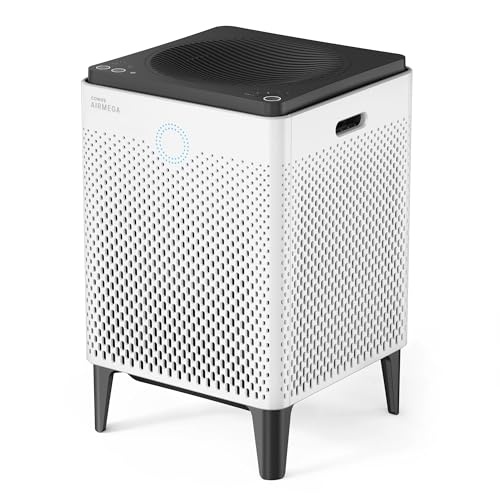
Coway Airmega 400 (AP-2015F) — Best Design-Led Large Room
Coway’s Airmega 400-class machine brings the largest brand-engineered package here: a washable pre-filter that extends the life of the main filters, HEPA filtration with smoke named in its brief, a real air quality display, and coverage rated to 3,120 square feet. It suits design-conscious homes that want the purifier to be a considered appliance in the main room. Its consumables are proprietary and priced like it.
Strengths
- Washable pre-filter protects the expensive stages and cuts running costs
- Coverage to 3,120 ft² with smoke explicitly in its remit
- AQI display and auto mode make smoke events legible at a glance
Trade-offs
- Proprietary replacement filters at premium prices
- A design object in size; measure its footprint
- Carbon capacity is balanced rather than maximal; the Austin Air is the odor specialist
| Coverage | Up to 3,120 ft² (per listing) |
| Filtration | Washable pre-filter + HEPA filter |
| Targets | Smoke, allergies, pet dander, odor (per listing) |
| Modes | AQI monitor, auto and sleep modes |
The washable pre-filter is the Airmega’s underrated smoke feature. During heavy events, the first filter stage loads with the coarse fraction fast; being able to rinse that stage weekly keeps airflow, and therefore real-world clean air delivery, from sagging exactly when you need it most. Combined with the AQI readout, which turns an invisible problem into a number the household can watch fall, it is the most legible smoke machine in this guide.
Choose it for the main room of a design-led home, and accept the consumables economics as the price of the platform. For pure carbon depth against smoke odor, the Austin Air below remains the specialist; for balanced, monitored, large-room performance, the Coway is the polished answer.
Best for: Design-conscious main rooms wanting monitored smoke performance / Not suited for: Maximum carbon odor removal or budget consumables
Check on Amazon — check the current price on Amazon before you decide, because configurations and bundle contents change.

Austin Air HealthMate Plus — Best Carbon for Smoke Odor
The HealthMate Plus is the odor specialist: where cartridge machines carry a layer of carbon, Austin Air fills its drum with a deep bed of activated carbon and zeolite, the mineral that extends adsorption to additional smoke and chemical compounds. For households where the smell of smoke is the misery, in wildfire country or near a wood-burning neighbor, this is the machine whose filtration is built around your problem. It is a plain steel box with no app, no display, and no interest in being furniture.
Strengths
- Deep activated carbon and zeolite bed: the strongest gas and odor stage here
- Steel construction and a simple, serviceable design built for years
- Four-stage filtration with a true particle stage ahead of the carbon
Trade-offs
- No smart features, sensors, or air quality display
- The carbon bed is heavy and its replacement is a significant purchase
- Utilitarian appearance
| Coverage | Up to 1,500 sq ft (per listing) |
| Filtration | 4-stage, activated carbon and zeolite |
| Model | HealthMate Plus B450, white |
Smoke odor is a gas-phase problem, and gas-phase removal is a contact sport: air must pass slowly through a lot of carbon. Cartridge purifiers compromise here by design, because their carbon must stay thin and light. Austin Air refuses the compromise, and the HealthMate Plus’s bed gives it an odor-removal stamina that shows in week three of a smoke season, when thinner carbons have saturated and started returning smell to the room.
Buy it knowing exactly what it is: the specialist tool, heavy, plain, and superb at the one job. Pair it with any HEPA machine for particles if your event is extreme, though its own four stages handle typical smoke duty whole. For odor-led smoke misery, it has no peer in this guide.
Best for: Smoke odor and gas removal, wildfire country, wood-smoke neighbors / Not suited for: Buyers wanting sensors, apps, or a furniture-grade look
Check on Amazon — check the current price on Amazon before you decide, because configurations and bundle contents change.

IQAir HealthPro Plus XE — Best Premium Sealed Room
The HealthPro Plus XE is the premium instrument: HyperHEPA filtration that captures particles far below standard HEPA’s 0.3-micron benchmark, Swiss manufacture, and a sealed, serious build for the room where air quality matters most, typically the bedroom of the household’s most sensitive sleeper. Its listing speaks to allergens and fine particles rather than smoke odor, and its gas stage is not the deep bed of the Austin Air; its supremacy is in particle removal and build quality. The price is the highest in this guide by a clear margin.
Strengths
- HyperHEPA particle filtration beyond the standard HEPA benchmark
- Swiss-made, sealed construction with a medical-grade positioning
- The reference choice for a single critical room, like a bedroom
Trade-offs
- Premium pricing across machine and filters
- Gas and odor capacity is not its headline strength
- Coverage is room-scale, 1,125 sq ft, not whole-floor
| Coverage | Large rooms 1,125 sq ft (per listing) |
| Filtration | HyperHEPA |
| Origin | Swiss made |
| Extras | WiFi enabled |
Where smoke’s danger is its finest particles, the HealthPro Plus makes the strongest particle argument money can buy in a home appliance: filtration rated well into the ultrafine range, in a housing engineered against bypass leakage, which is where lesser machines quietly lose their spec-sheet performance. For a bedroom that must stay clean through a smoky night, that sealed, over-engineered approach is exactly the point.
Position it honestly in a smoke plan: it is the guardian of one critical room, not the whole house’s smoke answer, and odor-led problems belong to the Austin Air. Households with a genuinely sensitive sleeper will find its cost rational in a way spec comparisons cannot capture.
Best for: Bedrooms of sensitive sleepers and buyers wanting the finest particle removal / Not suited for: Whole-house smoke duty or odor-first problems
Check on Amazon — check the current price on Amazon before you decide, because configurations and bundle contents change.
Comparison Table
| Pick | Badge | Key spec | Best for |
|---|---|---|---|
| Winix 5510 Air Purifier | Best Overall for Smoke | 1,881 ft²/hr, True HEPA + deodorization carbon | Living rooms and family spaces through smoke season |
| Medify MA-112 Air Purifier V3.0 | Best for Very Large Spaces | 5,948 ft²/hr coverage, wildfire-rated | Open-plan homes and whole-floor smoke duty |
| Medify MA-50 Air Purifier V3.0 | Best Large-Room Value | 2,640 ft²/hr, wildfire and smoke rated | Main living spaces in typical homes during fire season |
| Coway Airmega 400 (AP-2015F) | Best Design-Led Large Room | 3,120 ft², washable pre-filter, AQI | Design-conscious main rooms wanting monitored smoke performance |
| Austin Air HealthMate Plus | Best Carbon for Smoke Odor | Carbon + zeolite bed, 1,500 sq ft | Smoke odor and gas removal, wildfire country, wood-smoke neighbors |
| IQAir HealthPro Plus XE | Best Premium Sealed Room | HyperHEPA, Swiss made, 1,125 sq ft | Bedrooms of sensitive sleepers and buyers wanting the finest particle removal |
Divide the table by smoke sub-problem. Particles: every pick’s HEPA stage works, with the IQAir’s HyperHEPA the extreme. Odor and gases: carbon depth decides, and the order runs Austin Air, then Winix, then the cartridge machines. Space: the Medify MA-112 owns open plans, the MA-50 and Coway own large rooms, and the rest own their rooms completely. Most serious smoke households end up with one large-room machine plus the bedroom protected, which this table makes easy to plan.
How to Choose an Air Purifier for Fire Smoke
Specify the two filters separately. For particles, insist on true HEPA or better; ‘HEPA-type’ and ‘HEPA-style’ are unregulated phrases for lesser media. For gases and odor, ask how much activated carbon the machine actually carries: a deep bed or a substantial deodorization cartridge for smoke duty, not a carbon-dusted pre-filter. If a listing will not describe its carbon, assume it is decorative and move on. Every pick in this guide describes both stages in its verified title.
Size by air changes, not by the box’s room claim. During smoke, guidance converges on several air changes per hour in the room you occupy. Take the machine’s hourly coverage figure as a rough one-change yardstick and choose a machine rated at least three to five times your room’s area for event duty. That is why this guide’s picks look oversized for bedrooms: oversizing is the method, letting the machine hold the room at moderate, livable speeds.
Then plan the system, not the unit. Seal the room’s worst leaks, keep the purifier running continuously during events, close interior doors to shrink the volume it must defend, and protect the bedroom as the priority room, since smoke nights are when exposure hours concentrate. A purifier is one layer; behavior is the other, and the households that breathe easiest in fire season run both.
Carbon, Saturation, and Smoke-Season Maintenance
Activated carbon works by adsorption, and it fills up. In a heavy smoke season a cartridge carbon can saturate in weeks of continuous event use, after which particle filtration continues but odor returns, the tell-tale sign. Deep-bed machines like the Austin Air simply carry more capacity. Either way, smoke season changes filter economics: budget for a post-season filter replacement as routine, the way you budget for the event itself.
Maintain the stages you can. Washable pre-filters, like the Coway’s, should be rinsed through the event to keep airflow honest. Vacuum or brush pre-filters on other machines per their manuals. Keep intake and exhaust clear of walls and curtains; a purifier shoved into a corner is a purifier at half rating. And run the machine before the smoke arrives when forecasts allow, starting an event with clean room air is far easier than recovering a smoke-filled one.
Know the limits without drama. Purifiers reduce indoor particle levels substantially; they do not make outdoor air safe, seal a house against a nearby fire, or substitute for evacuation orders and official guidance. During severe events, the correct stack is: stay indoors, seal, run filtration, wear a proper mask for any necessary trip out, and follow local authorities. This guide’s machines serve that stack’s filtration layer, and serve it well.
Smoke Season Playbook: Before, During, and After the Event
Before the season, the work is procurement and placement: filters bought while shelves are full, the main-room machine positioned and understood, a bedroom unit decided on rather than debated mid-event, and the home’s worst air leaks found and sealed on a calm weekend. Check that windows close fully, that the fireplace damper seals, and that you own a proper respirator mask for necessary trips outside. Households in fire country that do this in spring describe smoke events as an inconvenience; households that start shopping during one describe them as an emergency.
During the event, the routine is discipline: purifiers running continuously in sealed, occupied rooms, doors kept closed, outdoor trips minimized and masked, and indoor sources, candles, incense, gas cooking without ventilation, even enthusiastic vacuuming with an unsealed machine, treated as part of the problem. Watch the AQI displays where your machines have them and let the numbers, not the smell, judge the room, because human noses adapt to smoke within hours and stop reporting it honestly.
After the event, resist the urge to simply open everything and forget it. Air the house when outdoor air is genuinely clean, then service the machines: rinse washable pre-filters, inspect the main stages, and replace carbon that has saturated, because a spent carbon bed carried into next season is next season’s failure bought in advance. Note what ran out and what annoyed you, and fix it in the calm months. Smoke country rewards households with a memory.
Understanding the Numbers: CADR, Coverage, and Microns Without the Fog
Coverage figures, including every one quoted in this guide, come from manufacturers’ own ratings under generous test assumptions, and the honest way to use them is comparatively: they rank machines against each other and set the scale of room a machine can serve, but your mileage in a leaky real room will be lower, which is precisely why this guide prescribes oversizing. Treat the number as the machine’s ceiling and buy so that your room is well beneath it.
CADR, clean air delivery rate, is the more rigorous figure where published: the volume of filtered air a machine delivers, by particle type. The sizing rule of thumb asks for a smoke CADR of at least two-thirds of the room’s floor area for baseline duty, and several times that for the air-change rates smoke events reward. When a listing gives coverage instead of CADR, the two-thirds logic still guides you: pick the machine whose comfortable room is several times yours.
Micron claims need the same calm reading. Standard HEPA captures 99.97 percent at 0.3 microns, the most penetrating particle size, and performs even better above and below it; smoke’s PM2.5 sits squarely in the range HEPA handles. Filtration positioned beyond that benchmark, like the IQAir’s HyperHEPA, extends capture into ultrafine territory. What no micron claim changes is the system’s other half: gases and odor answer only to carbon, and a purifier’s smoke worth is always the sum of both stages.
Where to Place Purifiers for Maximum Smoke Protection
Placement is free performance, and most purifiers are placed badly: shoved into a corner, behind a sofa, intake against a wall. A purifier breathes from its intake and delivers from its exhaust, and both need open air, roughly a foot or more of clearance on the intake side and an unobstructed path for the cleaned air to mix into the room. Central placement in the occupied room, or between the occupants and the room’s leakiest wall, outperforms corner placement by a margin you can watch on an AQI display.
In the bedroom, keep the machine close enough to the bed that its cleanest air is where breathing happens for eight hours, but far enough that its event-speed noise is tolerable; this tension is why oversizing matters, since a large machine at medium speed near the bed beats a small machine screaming beside it. In open plans, one large unit goes centrally with interior doors open, and its cleaned air should be able to reach the seating and the kitchen in one circulation pattern.
Height and obstacles finish the lesson. Smoke particles mix through a room’s air rather than settling in a layer, so floor placement, where most of these machines are designed to sit, is correct; what matters is not elevating them but unblocking them. Keep curtains, bedding, and furniture out of the intake’s face, and resist the tidiness that hides the machine exactly when it needs to work hardest.
What Purifiers Cannot Do: The Rest of the Smoke Toolkit
A complete smoke plan has layers this guide’s machines do not provide, and naming them is part of honest advice. Source control comes first: a sealed house, weatherstripped doors, a closed damper, and, in the worst hours, plastic and tape over a problem window are worth more than a second purifier. Personal protection is second: a well-fitted respirator for any trip outside during an event protects lungs no indoor machine can reach. Information is third: a reliable local AQI source, checked rather than guessed, decides when to seal, when to run hard, and when the event has truly passed.
Vulnerable household members deserve explicit planning: anyone with asthma or cardiovascular conditions should have their clinician’s smoke plan in advance, and the bedroom-defense strategy in this guide, a sealed room with the best filtration you can give it, exists largely for them. Pets, too, breathe the event; keep them indoors, and let the purifier’s room be theirs as well.
None of this diminishes the purifier’s role; it locates it. Filtration is the layer that works continuously, silently, and measurably through weeks of bad air, and the machines in this guide are the strongest verified options for it. Build the other layers around them, and a smoke season becomes an exercise in routine rather than a recurring emergency.
A Fire-Season Diary: How a Prepared Household Runs Its Machines
Day one of smoke arriving looks undramatic in a prepared home, and that is the achievement. The main-room purifier, already placed, goes to high; the bedroom unit closes its door with the household’s most sensitive sleeper; windows that were tested in spring shut without a struggle. The AQI numbers on the Coway or the app on the Winix give the family a shared fact to organize around, replacing the argument about whether it smells bad with a reading everyone can see falling as the machines work.
By day four, the disciplines that matter are the boring ones: pre-filters rinsed, doors kept closed out of habit rather than effort, cooking adjusted, the purifiers’ hum accepted as the season’s background. This is where carbon depth quietly separates the machines: odor stays beaten in the Austin Air’s room and in the Winix’s, while lesser carbons in other houses begin to let the campfire note back in. It is also where the household learns its true sizing: the room that holds its numbers at medium speed was bought right, and the one pinned at maximum all week gets the upgrade note for next season.
When the air finally clears, the prepared household does the unglamorous finale: windows open for a genuine airing, filters inspected and replaced where the season spent them, notes made while memory is fresh. Then the machines return to their ordinary allergy and dust duty at low speed, unremarkable until the next event, which is precisely what infrastructure is supposed to feel like. Fire season will come again; the diary’s point is that it need never again arrive as a surprise.
How to Set Up a Clean-Air Room During a Smoke Event
When smoke arrives, the goal is one defensible room, usually the bedroom or main living space, set up in this order.
- Choose the room with the fewest windows and exterior doors, ideally where the household sleeps.
- Seal the obvious leaks: close windows firmly, block the door’s under-gap with a rolled towel, and close fireplace dampers and unused vents.
- Place the purifier in the room away from corners, with intake and exhaust unobstructed, roughly central to where people sit and sleep.
- Run it on its highest tolerable speed continuously; during severe hours, maximum speed and closed doors matter more than quiet.
- Keep the rest of the house closed up too, and minimize door openings between the clean room and smokier areas.
- Cook with lids and ventilation awareness, avoid candles, incense, and vacuuming without a sealed machine during the event, since indoor sources add to the load.
- After the event, replace or service filters as the indicators advise, and air the house out once outdoor air is genuinely clean.
Set up before the season if you live in fire country: filters bought in a panic are filters bought at panic prices, and a machine already placed and understood is worth two delivered mid-event.
Common Buying Mistakes
Buying an allergy purifier for smoke duty. A HEPA machine with a token carbon sheet clears dust beautifully and leaves smoke odor untouched. Smoke needs both stages, specified and substantial.
Sizing to the room instead of the event. A machine rated exactly to your room’s area delivers roughly one air change per hour, a fraction of what a smoke event demands. Oversize by design.
Turning the purifier off at night. Smoke infiltrates around the clock, and bedrooms are where exposure hours concentrate. Run it continuously through events, at the highest speed you can sleep with.
Ignoring carbon saturation. When odor returns despite a running machine, the carbon is spent, not the concept. Post-season filter replacement is part of the cost of smoke country.
Opening windows ‘for fresh air’ during smoke. During an event, outdoor air is the pollutant source. Fresh air waits until the event clears; filtration carries the house until then.
Final Recommendation
For most homes, the Winix 5510 is the smoke-season default: proven platform, real carbon, large-room headroom. Open-plan homes should step to the Medify MA-112, value buyers to the MA-50, and design-led main rooms to the Coway. If odor is your misery, the Austin Air HealthMate Plus is the specialist to own, and if one bedroom must be defended to the highest standard, the IQAir HealthPro Plus is the premium guardian.
Buy before the season, size generously, and run the machines the smoke way: sealed room, continuous operation, maintained filters. Fire smoke is a known problem with a known answer, and the households that fare best are simply the ones that set the answer up in advance.
To revisit the picks directly: the Winix 5510 Air Purifier, the Medify MA-112 Air Purifier V3.0, the Medify MA-50 Air Purifier V3.0, the Coway Airmega 400 (AP-2015F), the Austin Air HealthMate Plus, and the IQAir HealthPro Plus XE. Each link goes to the exact verified listing described in its review above, so check the current price on Amazon at the listing before you buy.
Best Air Purifiers For Dog Owners
Best Air Purifiers For Home Winix
Best Air Purifiers For Pet Dander
Frequently Asked Questions
What type of filter removes wildfire smoke?
Two working together: true HEPA filtration captures smoke’s fine particles, and a substantial activated carbon stage adsorbs the gases and odor compounds. Machines with only one of the two solve half the problem, which is why every pick in this guide specifies both stages in its listing.
How big an air purifier do I need for smoke?
Bigger than the room. Use the hourly coverage rating as a one-air-change yardstick and choose a machine rated at least three to five times your room’s floor area, so it can turn the air over several times an hour during an event without running at its loudest maximum constantly.
Can an air purifier remove the smell of smoke?
Yes, if its carbon stage is substantial. Odor is a gas-phase problem solved by activated carbon depth; deep-bed machines like the Austin Air HealthMate Plus excel at it, and strong deodorization cartridges like the Winix’s handle typical events. Thin carbon sheets cannot, whatever the box implies.
Should I run my purifier all day during a smoke event?
Yes. Smoke infiltrates continuously, so filtration must run continuously to hold indoor levels down, especially overnight in the bedroom. Use the highest speed you can tolerate while awake and a sustainable high setting for sleep, with the room sealed and the door closed.
Do I need a purifier in every room?
Prioritize rather than blanket. Protect the bedroom first, then the main living space, keeping doors closed so each machine defends a defined volume. One large machine in an open plan can serve that whole volume; closed-off rooms each need their own unit if they will be occupied during events.
When should I replace filters after smoke season?
Follow the machine’s indicator, and expect a heavy season to consume a filter set’s useful life, especially the carbon stage. The practical rule: if odor returns while the machine runs, the carbon is saturated and due. Buying replacements before fire season avoids event-time shortages.
Does running a purifier help with smoke that has already settled into fabrics?
Partially, and slowly. Purifiers clean air, not upholstery; settled smoke odor in soft furnishings fades with ventilation after the event, laundering of washables, and time, while the purifier prevents re-deposition and handles the airborne fraction. Deep-bed carbon machines like the Austin Air are the most helpful during the airing-out period.
Can one purifier protect a whole house during wildfire smoke?
Not a house of closed rooms: air does not circulate through doorways the way it circulates within a room. One large machine can hold an open-plan volume, as the Medify MA-112 is specced to do, but closed bedrooms need their own protection. Prioritize sleeping rooms first, then the main living volume.
Will a purifier help with smoke from a neighbor’s wood stove?
Yes, that is a smaller, steadier version of the wildfire problem, and the same two-stage logic applies: HEPA for the particles, carbon for the odor, with the Austin Air’s deep carbon bed the specialist pick for chronic wood-smoke exposure. Seal the worst drafts on the neighbor-facing side for the full effect.
How loud are these purifiers at smoke-event speeds?
Large purifiers at maximum speed are plainly audible, comparable to a strong fan, and that is the honest cost of moving event-scale air volumes. Oversizing, this guide’s core sizing advice, is also the noise strategy: a big machine at medium speed moves the air of a small machine at maximum, at a fraction of the volume.
Can I run a purifier with windows open after the event?
Yes, and you should air the house out once outdoor air is genuinely clean; run the purifier during the airing to catch what stirs up, then return to normal closed-window duty. The sequence matters: ventilate first on clean air, then let filtration polish the indoor result.


