Disclosure: airfryerkitchensupply.com is reader-supported. When you buy through links on our site, we may earn an affiliate commission at no extra cost to you.
Where to buy
The fastest way to buy any pick in this guide to the best performing lightweight vacuums is Amazon, where each listing shows the current configuration, size and colour options before you order. Use the links below to check price on Amazon for the verified picks — we do not print static prices here because they change too often to stay honest. Every vacuum below was verified in Amazon listing data cache, and only listing-confirmed models carry a buying link.
- Shark Pet Cordless Stick Vacuum IX141 — check price on Amazon
- Levoit Cordless Vacuum Cleaner, Anti-Tangle — check price on Amazon
- Tineco A20 Cordless Stick Vacuum — check price on Amazon
- Eureka PowerSpeed Lightweight Upright NEU280 — check price on Amazon
- Bissell Featherweight Stick Vacuum 2033M — check price on Amazon
- Eureka Blaze Stick Vacuum, 3-in-1 — check price on Amazon
Lightweight vacuums have a reputation problem: too many of them are light because they left the motor, the brush roll and the dust capacity at home. The best performing lightweight vacuums refuse that trade — they keep real suction and proper floor cleaning, and shed weight through design instead of through absence. This guide ranks six verified models that make the honest version of the bargain, from cordless sticks that clean a whole floor to a featherweight stick that costs less than a family takeaway and still shows up for daily crumbs.
Performing is the operative word, and it means specific things: suction that survives a full dust cup rather than fading after five minutes, a brush or floor head that agitates carpet rather than skating over it, and filtration that does not return the fine dust to the room. Weight matters only after those boxes are ticked — a featherlight vacuum that needs four passes is heavier work than a slightly heavier one that needs one.
All six picks were verified cache. Runtime, capacity and design claims are stated only where the Amazon titles give them, and each review says plainly where a model’s lightness comes from and what, if anything, it cost.
A quick word on who should read this guide narrowly and who should read it widely. If you live in a small flat with hard floors, your answer is in the last two picks and you can be done in five minutes — the flagship sticks would be money spent on capacity you will never use. If you clean a family house, read the other way: the featherweights are your second vacuum, not your first, and the honest contest is between the cordless trio and the corded upright. Everyone in between — stairs, pets, a mix of floors — is who the middle of this guide was written for, and your deciding factors are probably the brush roll and the stairs, in that order.
In this guide
Quick Picks
The Shark IX141 and Levoit cordless sticks lead on all-round performance; the Tineco A20 adds capacity; the Eureka PowerSpeed is the corded lightweight upright; and the two featherweight sticks own the budget end honestly.
- Best Overall — Shark Pet Cordless Stick Vacuum IX141: 40 minutes of runtime, an XL cup and a handheld mode — the complete cordless package. Check on Amazon
- Best for Pet Hair — Levoit Cordless Vacuum Cleaner, Anti-Tangle: the longest runtime here, with an anti-tangle head aimed at pet households. Check on Amazon
- Best Capacity — Tineco A20 Cordless Stick Vacuum: a 1-litre bin, three power modes and a wall dock — built for multi-level homes. Check on Amazon
- Best Corded Lightweight — Eureka PowerSpeed Lightweight Upright NEU280: corded, so the runtime is forever — a full upright in a senior-friendly weight class. Check on Amazon
- Best Budget — Bissell Featherweight Stick Vacuum 2033M: the featherweight original — a stick, a handheld and an electric broom in one cheap machine. Check on Amazon
- Best for Small Homes — Eureka Blaze Stick Vacuum, 3-in-1: a 3-in-1 featherweight stick aimed at dorms and small homes, with corded consistency. Check on Amazon
How These Picks Were Chosen
Every model had to be confirmed in Amazon listing data cache as a complete vacuum — motors and batteries from the same caches were excluded — with an Amazon title supporting its lightweight positioning. From there we ranked on performance per kilogram: suction design, floor-head effectiveness across hard floors and carpet, dust capacity, and runtime where the title states it.
We deliberately mixed architectures, because ‘lightweight’ means different things in different homes: cordless sticks for stairs and quick circuits, a corded upright for unlimited runtime in a larger house, and ultra-light corded sticks for flats and dorms. Each review states its model’s architecture and its honest cost — runtime limits, cup size, or cord management — rather than letting one format’s strengths hide another’s.
Pet performance was weighted where titles support it: several picks here name pet hair explicitly, and pet hair is the real-world load that exposes weak suction and tangling brush rolls faster than any laboratory test.
The 6 Best Performing Lightweight Vacuums

Shark Pet Cordless Stick Vacuum IX141 — Best Overall
The IX141 is what a performing lightweight looks like when nothing important is missing. The Amazon title confirms a 40-minute runtime, an XL dust cup — the detail that separates whole-home cordless vacuums from top-up toys — LED headlights, and a removable handheld for stairs and upholstery. For most homes, this is the one-vacuum answer.
Strengths
- 40-minute runtime and XL cup confirmed in the Amazon title
- Converts to a handheld for stairs, cars and furniture
- LED headlights expose dust on hard floors you would otherwise miss
Trade-offs
- Cordless runtime is finite — very large homes may need a mid-clean charge
- Stick format means bending for edges a canister would reach
- Battery will age over years of use, like all cordless tools
Key spec: Cordless stick; 40-min runtime; XL dust cup; LED headlights; removable handheld (per Amazon title)
Two features here do more real work than any suction claim. The XL dust cup means the vacuum performs on minute thirty the way it did on minute one, because suction fade in small-cup sticks is mostly a full-cup problem. And the headlights sound like a gimmick until the first pass along a skirting board, when the raking light reveals a line of dust and hair that the room lighting hid completely — you clean what you can see. The handheld conversion completes the picture: the same machine that does the floors does the stairs, the sofa and the car, which is why a good cordless stick retires two or three lesser appliances. This is the benchmark the rest of the guide is measured against.
The IX141 becomes household infrastructure within a month: floors on the schedule, stairs without ceremony, the car interior demoted from a project to a pause. Its headlights create a small behavioural change owners laugh about — you start vacuuming the skirting line properly because you can finally see it. Keep the cup emptied at its line and the performance that impressed you in week one is the performance you get in year fifty-two; let it ride full and you will meet the suction fade every small-cup owner complains about, wearing an XL badge.
Best for: most homes wanting one cordless vacuum that genuinely replaces a plug-in / Not suited for: very large houses needing unlimited continuous runtime
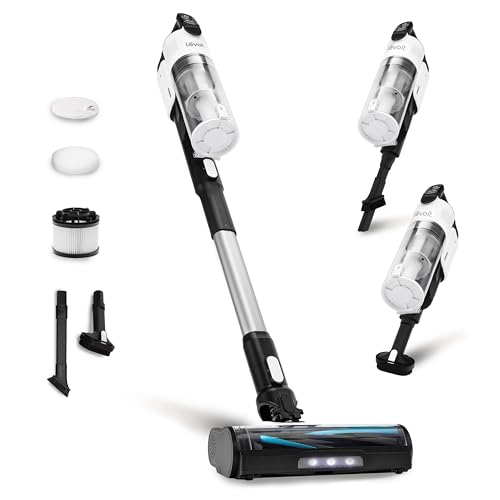
Levoit Cordless Vacuum Cleaner, Anti-Tangle — Best for Pet Hair
Pet hair defeats lightweight vacuums in a specific way: it wraps the brush roll until the roll stops brushing. This Levoit’s Amazon title leads with the countermeasure — an anti-tangle design for pet hair — and backs it with the longest runtime in this guide, up to 50 minutes, across carpets and hard floors. If a dog or cat runs your household, start here.
Strengths
- Anti-tangle pet-hair design confirmed in the Amazon title
- Up to 50 minutes runtime — the longest in this guide
- Rated by its title for both carpets and hard floors
Trade-offs
- Anti-tangle reduces wrapping; it does not abolish brush maintenance
- Maximum runtime figures assume the gentlest speed, as with all cordless models
- Pet homes will fill any cup fast — empty it every clean
Key spec: Cordless; up to 50 minutes runtime; anti-tangle design for pet hair (per Amazon title)
That runtime honesty deserves expanding, because it applies to every cordless pick: the headline figure is achieved on the lowest setting, and max-suction modes cut it sharply. The right way to read 50 minutes is as a generous budget for normal cleaning, with power mode reserved for the rug that needs it — and a generous budget is exactly what a pet household needs, because pet cleaning is a whole-home circuit, not a single spill. The anti-tangle design addresses the other pet tax, the Sunday ritual of cutting hair off a brush roll with scissors. It will still need checking; it will need it far less often. For homes where hair is the dominant floor covering, those two features together are the performance that matters.
Pet ownership with the Levoit settles into a rhythm the dog causes and the vacuum absorbs: quick circuits after muddy entrances, a weekly proper clean, and a brush roll that needs scissors rarely enough to feel like a holiday. The long runtime changes planning — there is no triage about which rooms get done, because the charge simply covers the house. Empty the cup more often than feels necessary; pet hair compresses deceptively, and the machine’s suction is only ever as good as the space left in front of it.
Best for: pet households and anyone tired of de-hairing brush rolls / Not suited for: homes needing a corded machine for endless deep cleans

Tineco A20 Cordless Stick Vacuum — Best Capacity
The A20’s Amazon title tells a considered story: a 1L larger dustbin — capacity stated outright — three modes for multi-level messes, an ergonomic dual-handle design and a wall-mount dock. This is the cordless for a house with stairs, levels and a family generating mess at altitude: capacity to finish, modes to match the mess, and a dock so it is always charged and never in a cupboard under the coats.
Strengths
- 1L dustbin capacity confirmed in the Amazon title
- Three modes let you trade runtime for power deliberately
- Wall-mount dock keeps it charged, visible and grabbable
Trade-offs
- Wall dock needs a suitable spot near a socket
- Three modes mean one more decision per clean
- Stick vacuums still ask more of your arm than a canister on stairs
Key spec: Cordless stick; 1L dustbin; 3 modes; wall-mount dock; LED headlight (per Amazon title)
Capacity is the quiet performance spec. Every time a small cup fills, suction fades and the clean becomes a walk to the bin; a 1L bin stretches that interval across a whole floor of a normal house. The three modes formalise what good cleaners do instinctively — eco for hard floors and daily dust, a middle gear for mixed rooms, max for the entrance rug full of grit — and the dual-handle design acknowledges the unglamorous truth that stick vacuums are carried as much as pushed, especially between levels. The dock completes the system: a vacuum that lives charged on a wall gets used for the two-minute messes, and two-minute messes handled daily are what keep a home feeling clean between deep cleans.
The A20’s dock quietly reorganises a home: the vacuum has an address, everyone knows it, and it returns there charged like a well-kept tool. Families find the modes become a shared language — eco for the morning crumb run, max for the entrance rug — and the 1L bin stretches the interval between bin walks across a whole floor’s clean. Its ownership homework is the dock’s placement: near a socket, on the cleaning route, not in a garage exile where a great vacuum goes to be forgotten.
Best for: multi-level family homes and anyone who hates emptying mid-clean / Not suited for: minimalists wanting the simplest possible one-button stick

Eureka PowerSpeed Lightweight Upright NEU280 — Best Corded Lightweight
Not every lightweight buyer wants a battery. The PowerSpeed NEU280’s Amazon title confirms a lightweight upright with an upgraded cyclone system, carpet and hard floor cleaning, pet hair capability and a washable filter — and a cord, which means full power for as long as the house takes. Its title even calls out senior-friendly handling, which is who lightweight uprights quietly serve best.
Strengths
- Unlimited corded runtime at full power
- Washable filter confirmed in the Amazon title — lower running costs
- Full upright format with a proper floor head for carpet
Trade-offs
- A cord to manage, unplug and re-plug between rooms
- Upright format is less nimble on stairs than a stick
- Storage needs an upright’s worth of cupboard
Key spec: Corded upright; lightweight; cyclone system; washable filter (per Amazon title)
There is a stubborn logic to the corded lightweight upright: batteries are heavy, expensive and mortal, and a cord weighs nothing and never fades. For a larger single-level home, or a household that deep-cleans in long sessions, this format simply out-works cordless — full suction in minute ninety, no dock, no charge anxiety. The washable filter is the running-cost story: instead of a calendar of replacement filters, a rinse and dry keeps the cyclone system breathing, and cyclonic separation is precisely what keeps suction steady as the cup fills with pet hair and grit. The lightweight build matters most at the end of the clean, carrying it back to the cupboard. If your home has the sockets and the storage, this is the performance-per-pound champion nobody brags about.
The PowerSpeed’s ownership pleasure is reliability theatre: plug in, clean everything, finish when you are finished. No dock discipline, no battery arithmetic, no mid-clean negotiations — a virtue that grows on households burned by cordless compromises. The washable filter becomes a small monthly ritual with the bins, and the machine’s weight tells its senior-friendly story at the cupboard door, not on the stairs. Keep a spare belt-era mindset: check the brush and underside seasonally, and this upright will outlast several battery generations.
Best for: larger homes, long cleaning sessions and buyers avoiding batteries / Not suited for: flats where a grab-and-go stick suits the rhythm better

Bissell Featherweight Stick Vacuum 2033M — Best Budget
The Featherweight line defined this category, and the 2033M’s Amazon title confirms the formula: a lightweight bagless stick that works as an electric broom for quick floors and converts for hand use, with a crevice tool in the box. It is not a deep-clean machine and does not claim to be; it is the vacuum that lives within reach and gets used ten times a week.
Strengths
- Genuinely featherweight — anyone can carry and use it
- Three roles in one: stick, handheld and electric broom
- Crevice tool included per Amazon title
Trade-offs
- Light-duty suction — not a weekly deep-clean replacement
- Small cup needs frequent emptying
- Corded, with a modest cord for larger rooms
Key spec: Corded stick; bagless; converts to handheld/electric broom; crevice tool included (per Amazon title)
Judge this machine by its actual job and it is superb. Crumbs under a highchair, litter by the door, the hallway that always looks dusty — these are thirty-second tasks that a big vacuum makes into five-minute productions, so they do not get done. A featherweight stick leaning by the kitchen does them in the moment, and a home cleaned in moments stays cleaner than a home cleaned in weekly campaigns. The honest limits are capacity and depth: it will not restore a neglected carpet, and its cup fills fast in a shedding season. Bought as the household’s second vacuum — or the only vacuum in a small hard-floored flat — it earns its place every single day, which is more than most appliances can say.
The Featherweight’s life is measured in snatched moments: the thirty seconds after breakfast, the litter scatter, the pre-guest hallway. Owners keep it where the mess is, not where vacuums are supposed to live, and that placement is its whole genius. It will not thank you for weekly whole-house duty — the cup fills, the arms ache, the deep dirt stays — but as the household’s first responder it has no rival here, and its price means a second one, upstairs, is a rational purchase rather than an indulgence.
Best for: flats, dorms, kitchens and as a second quick-clean vacuum / Not suited for: anyone expecting it to deep-clean a carpeted house alone

Eureka Blaze Stick Vacuum, 3-in-1 — Best for Small Homes
The Blaze’s Amazon title is admirably direct about its brief: a 3-in-1 small vacuum for the home and dorm, featherweight, corded. Like the Bissell it converts between stick and hand roles, but the corded design means its suction never depends on a battery’s mood or age — a real consideration for a student or first-flat buyer who needs one cheap machine to simply work for years.
Strengths
- 3-in-1 versatility confirmed in the Amazon title
- Corded power — no battery fade, ever
- Featherweight build suits small-space living
Trade-offs
- Small-home brief means small capacity
- Cord management in exchange for that consistency
- Not a whole-house deep-clean machine
Key spec: Corded stick; 3-in-1 design; featherweight class (per Amazon title)
The Blaze and the Featherweight are cousins, and the choice between them is taste and detail: handle feel, cup design, the exact conversion mechanism. What they share is the correct philosophy for small homes — in a dorm room or studio flat, storage is the scarcest resource, and a vacuum that leans in a corner, converts to a handheld for the desk and the car, and asks nothing but a socket is worth more than a powerful machine that lives in a box. The cord, often counted a flaw, is this buyer’s friend: no charger to lose in a house move, no battery to replace in year three, full power in a bedsit with one socket and a extension of patience. Small home, small vacuum, no drama.
The Blaze suits owners who value the absence of systems: no dock, no battery health, no app — a cord, a socket, a clean floor. In a dorm or studio it becomes as unremarkable and essential as the kettle, and its 3-in-1 conversions handle the desk, the floor and the car without a second appliance existing. Its limits arrive exactly where its title said they would — capacity and whole-house ambition — and owners who bought it for the brief it declared are, reliably, the satisfied ones.
Best for: dorms, studios and first flats / Not suited for: families needing capacity and cordless freedom
Comparison Table
| Pick | Badge | Key spec | Best for |
|---|---|---|---|
| Shark Pet Cordless Stick Vacuum IX141 | Best Overall | Cordless stick; 40-min runtime; XL dust cup; LED headlights; removable handheld (per Amazon title) | most homes wanting one cordless vacuum that genuinely replaces a plug-in |
| Levoit Cordless Vacuum Cleaner, Anti-Tangle | Best for Pet Hair | Cordless; up to 50 minutes runtime; anti-tangle design for pet hair (per Amazon title) | pet households and anyone tired of de-hairing brush rolls |
| Tineco A20 Cordless Stick Vacuum | Best Capacity | Cordless stick; 1L dustbin; 3 modes; wall-mount dock; LED headlight (per Amazon title) | multi-level family homes and anyone who hates emptying mid-clean |
| Eureka PowerSpeed Lightweight Upright NEU280 | Best Corded Lightweight | Corded upright; lightweight; cyclone system; washable filter (per Amazon title) | larger homes, long cleaning sessions and buyers avoiding batteries |
| Bissell Featherweight Stick Vacuum 2033M | Best Budget | Corded stick; bagless; converts to handheld/electric broom; crevice tool included (per Amazon title) | flats, dorms, kitchens and as a second quick-clean vacuum |
| Eureka Blaze Stick Vacuum, 3-in-1 | Best for Small Homes | Corded stick; 3-in-1 design; featherweight class (per Amazon title) | dorms, studios and first flats |
How to Choose a Performing Lightweight Vacuum
Define performance before weight. For your home that means: suction that holds as the cup fills, a floor head that agitates your actual flooring, and enough capacity — cup size or runtime — to finish your actual clean. The picks here publish those numbers in their titles: 40 and 50 minute runtimes, a 1L bin, an XL cup. A vacuum that states its working numbers is already ahead of one that only states its lightness.
Choose the architecture for your life. Cordless sticks rule stairs, quick circuits and homes without convenient sockets; expect finite runtime and battery ageing. Corded lightweight uprights give unlimited full-power cleaning for larger homes at the price of cord management. Featherweight corded sticks are the small-home and second-vacuum champions. Most dissatisfaction in this category is an architecture mismatch, not a bad machine.
Then be honest about pets and people. Pet hair demands anti-tangle design and capacity, as the Levoit pick recognises; older or smaller cleaners need the senior-friendly handling the Eureka upright’s title names. The best vacuum is the one its owner can and will use weekly — performance unused is not performance.
Suction, Brush Rolls and Filtration: The Performance Trio
Suction figures in this category are marketed in incompatible units, so judge by system behaviour instead: cyclonic separation that keeps suction steady as debris accumulates, a cup big enough that it is not always full, and a floor head sealed well enough to use the suction at the floor rather than leaking it at the edges. The reviews above flag exactly those properties where the titles support them.
The brush roll decides carpet performance — it is what lifts embedded grit and hair that suction alone leaves behind — and filtration decides what happens to the finest dust. Washable filters, like the Eureka upright’s, cut running costs; sealed systems keep what was captured. For dust-sensitive households, filtration deserves the same attention as suction, and a vacuum that exhausts fine dust back into the room is working against the air purifier in the corner.
Runtime and Weight: Reading the Numbers Honestly
Cordless runtime headlines are measured on the gentlest setting. Read 40 or 50 minutes as a generous whole-home budget at normal speeds, with max mode as a short-burst tool for rugs and doorways — and size your purchase so your normal clean fits comfortably inside the normal-speed figure, not the headline.
Weight, similarly, is a whole-clean figure: a stick vacuum’s weight is carried in one hand and arm for the entire job, while an upright’s weight is mostly borne by the floor. That is why a slightly heavier upright can feel easier over a long clean than a lighter stick, and why the featherweight sticks shine in short, frequent bursts. Match the format to the length of your typical clean, not to the number on the box.
Hard Floors vs Carpet: Why the Same Vacuum Scores Differently
Lightweight vacuums are usually demonstrated on hard floors, where almost anything with suction looks heroic — crumbs and grit offer no resistance. Carpet is the examination: fibres hold grit at their base, and only agitation from a brush roll, sealed against the pile so suction works at depth, brings it out. That is why this guide keeps asking what the floor head does, not just what the motor claims, and why the upright and the better sticks, with their full floor heads, out-clean the featherweights on carpet while losing to them on speed around a kitchen.
Hard floors have their own trap for the unwary: a powerful head on the wrong setting can scatter debris ahead of it or scratch delicate finishes with trapped grit in its wheels and brush. The better machines manage this with modes and head design — the Tineco’s three modes exist precisely to move between floor types deliberately rather than hopefully. Match the machine to your dominant floor, not your most photogenic one: the floor you clean weekly decides your satisfaction, and the guest-room carpet you clean monthly should not be allowed to choose your vacuum.
Mixed homes — most homes — should weight the transition. How the machine behaves crossing from tile to rug, whether it climbs the rug’s edge or pushes it, whether the mode change is a button or a head swap: these thirty-second frictions, repeated weekly, are what owners actually remember. The cordless sticks here handle transitions as a way of life; the upright treats them as an event. Choose according to how many thresholds your clean crosses.
Stairs, Storage and the Ergonomics Nobody Reviews
Stairs are where lightweight stops being a specification and becomes a safety matter. A vacuum you carry one-handed while the other hand holds the rail is a different product from one you haul, and the convertible sticks — Shark and Levoit in handheld mode, the featherweights in hand mode — exist because their designers understood the staircase use case. If your home has stairs and your current vacuum lives at the bottom of them un-carried, that fact alone should drive your shortlist.
Storage is the second invisible. A docked cordless on a wall, like the Tineco system, occupies no cupboard and is always ready; a stick in a cupboard occupies the cupboard’s best space; an upright needs its own territory outright. In small homes the storage answer often is the purchase answer, and there is no shame in it — a vacuum that does not fit your home will not clean it either. Measure the cupboard before you fall for the runtime figures.
Finally, hands and backs. A stick vacuum’s weight hangs from one wrist for the whole clean; an upright’s weight rolls. For long cleans, arthritis, or any grip limitation, the Eureka upright’s senior-friendly positioning in its own title is a genuine design stance, not a demographic insult. The best-performing vacuum is the one your body lets you use properly, at full attention, for the whole house — anything else performs on paper only.
Keeping Performance: The Maintenance Calendar
Lightweight machines are less forgiving of neglect than heavy ones, because their margins are thinner: a half-blocked filter that a big canister powers through will visibly strangle a stick. The calendar that prevents it is short. Empty the cup at its line, every time. Wash or tap the filter monthly — fully dry before refitting, because a damp filter is a blockage with good intentions. Check the brush roll weekly in pet homes, monthly in others, and clear the wand and head throat whenever suction drops before blaming the battery.
Batteries have their own etiquette. Cordless models live happiest docked and charged rather than deep-cycled to exhaustion, and a battery that is always run to flat on max mode will age faster than its owner’s patience. Use max as a tool, not a default, and the runtime you bought in year one is recognisably the runtime you still have in year three. When a battery does eventually fade, judge the machine by whether a replacement exists and what it costs — that answer, checked before purchase, separates tools from disposables.
Keep the receipts of your routine literally if you can: a note inside the cupboard door with filter dates turns maintenance from a memory test into a glance. The households whose lightweight vacuums still perform in year four are not lucky; they are the ones with the note on the door.
Accessories and Attachments: The Half of the Vacuum in the Box
Every pick in this guide arrives with more than a floor head, and the attachments gathering dust in cupboards across the country represent the most wasted performance in home cleaning. The crevice tool is the serious one: skirting boards, the gap beside the oven, the car seat rails and the sofa’s crumb strata all live in crevices, and a weekly pass with the tool fitted changes how clean a room feels more than a third pass over the open floor. The Shark and Tineco handheld conversions exist to make that tool usable everywhere, not just within cord’s reach of a socket.
Upholstery and stair tools deserve the same rehabilitation. Sofas and mattresses shed and collect in equal measure, and a lightweight vacuum in hand mode with the right head is the only appliance most homes own that addresses either. Stairs, covered in the ergonomics section, are an attachment problem before they are a weight problem: the right small head on a light machine cleans a staircase in minutes that a full-size vacuum turns into a quarterly event.
The discipline is storage, again: attachments live with the machine — on its dock, in its cupboard spot, in a bag hung on the same hook — or they effectively do not exist. Audit your own box when your vacuum arrives, learn each piece’s name and job in the first week, and the machine you bought will quietly be twice the machine your neighbour owns, identical model, attachments still in their plastic.
How to Get Full Performance from a Lightweight Vacuum
Lightweight machines reward good habits disproportionately — these routines keep suction, runtime and brushes at their best.
- Empty the cup before it looks full. Suction fades as the cup fills; emptying at the max line — or sooner — is free performance.
- Clean or wash filters on schedule. Rinse washable filters fully dry before refitting; tap-clean others outdoors. A choked filter strangles any motor.
- Check the brush roll weekly in pet homes. Anti-tangle designs reduce wrapping, not to zero — a quick check keeps the roll brushing instead of spinning hair.
- Use modes deliberately. Eco for hard floors, standard for mixed rooms, max only for rugs and grit — that is how the stated runtime becomes your runtime.
- Charge and store cordless models on their dock. A docked vacuum is a charged vacuum, and a charged vacuum gets used for small messes immediately.
- Slow down on carpet. The brush needs dwell time to agitate; a slower pass cleans deeper than two fast ones, especially with lighter machines.
- Work edges with the crevice tool. Skirting boards hold a disproportionate share of dust — the included crevice tool exists for exactly that line.
If performance drops, audit in order: cup, filter, brush roll, blockages in the wand. Nine times out of ten the fix is in that list and costs nothing.
Adopt the two-speed household rhythm that lightweight machines make possible, because it changes the house more than any single deep clean. The first speed is the daily circuit: ninety seconds with the stick or featherweight wherever life just happened — the hallway, the kitchen’s crumb zone, the rug by the door. The second speed is the weekly proper clean, slower, with attachments, edges done and furniture moved. Lightweight vacuums collapse when owners ask them to do only the second rhythm at full-house scale, and they triumph when the first rhythm keeps the second one’s workload small. Time yourself honestly for a week: most households discover their daily circuits total under ten minutes and their weekly clean halves within a month. The machine did not change. The system did — and the system, as every section of this guide has argued, is where performance actually lives.
Common Buying Mistakes
Buying the lightest instead of the best-performing
A vacuum that needs four passes doubles your work. Judge suction behaviour, capacity and floor head first; weight second.
Believing headline runtime
Max-mode minutes are a fraction of the headline. Size the machine so your normal clean fits its normal-speed runtime.
Letting the cup and filter choke the machine
Most ‘weak vacuum’ complaints are maintenance, not machinery. Empty early, clean filters, check the roll.
Using a featherweight as a deep cleaner
The Bissell and Blaze are quick-clean champions with honest limits. Pair them with periodic deep cleaning rather than expecting them to do everything.
Ignoring the stairs test
Stairs expose format choices brutally. If your home has them, a convertible cordless or a featherweight you can carry one-handed is not a luxury — it is the whole decision.
Final Recommendation
For most homes, the Shark IX141 is the performing lightweight to buy: real runtime, an XL cup, headlights that show you the dirt and a handheld mode for everything above floor level. Pet households should take the Levoit for its anti-tangle design and longer runtime, and multi-level family homes the Tineco A20 for its 1L bin and dock. If batteries are the objection, the Eureka PowerSpeed upright delivers full power indefinitely in a friendly weight class.
The Bissell Featherweight and Eureka Blaze close the guide as the honest budget end: not deep cleaners, but the machines most likely to be used daily in small homes — and daily use is its own kind of performance. Choose by your floors, your stairs and your square footage, then keep the cup empty and the filter clean, and any of these six will earn its keep.
- Shark Pet Cordless Stick Vacuum IX141 — check price on Amazon
- Levoit Cordless Vacuum Cleaner, Anti-Tangle — check price on Amazon
- Tineco A20 Cordless Stick Vacuum — check price on Amazon
- Eureka PowerSpeed Lightweight Upright NEU280 — check price on Amazon
- Bissell Featherweight Stick Vacuum 2033M — check price on Amazon
- Eureka Blaze Stick Vacuum, 3-in-1 — check price on Amazon
Best Extra Firm Extra Thick Gusset King Pillows Best 2 Person Portable Hot Tubs Best Hide Rugs Cheetah Best House Summer Slippers For Women Best Initial Bath Towels Best Air Purifiers For Dust
Related guides
Frequently Asked Questions
Can a lightweight vacuum really replace a full-size one?
The best cordless sticks here — with 40 to 50 minute runtimes and XL or 1L cups — genuinely can for most homes. Very large homes, deep-pile carpets or long weekly cleans may still suit a corded upright like the Eureka PowerSpeed, which is lightweight in its own class and never runs flat.
Why does my lightweight vacuum lose suction?
Almost always the cup or the filter. Suction fades as the dust cup fills and as filters clog; empty the cup at its line, clean or wash filters on schedule, and check the brush roll for wrapping before blaming the motor.
Is cordless or corded better for a lightweight vacuum?
Cordless wins on convenience, stairs and quick cleans, with finite runtime and a battery that ages. Corded wins on unlimited full-power runtime and longevity, with a cord to manage. The guide includes both because the right answer is your home’s layout, not a universal rule.
What makes a vacuum good for pet hair at lightweight sizes?
An anti-tangle brush design, enough suction to lift hair from carpet, and capacity — pet homes fill cups fast. The Levoit pick leads its title with anti-tangle pet design and the longest runtime here for exactly those reasons.
Are featherweight stick vacuums worth it?
As quick-clean machines, absolutely: the Bissell Featherweight and Eureka Blaze handle the daily crumbs and dust that make a home feel dirty, in seconds. They are not deep-clean replacements for a carpeted house, and this guide does not pretend otherwise.
How long should a cordless vacuum’s battery last per clean?
Read headline runtimes as best-case figures on low settings. A 40 to 50 minute rating comfortably covers a normal clean of an average home at working speeds, with max mode used in bursts. If your home is large, prioritise the longest runtime or choose corded.
How do I vacuum stairs with a lightweight vacuum?
Use the handheld conversion — every stick here offers one — working from the top down, one hand on the rail, the machine in the other. Featherweight models shine here precisely because they are one-hand light. Never stretch a cord or a body across a staircase to save a trip; move the machine, then move yourself.
Do lightweight vacuums work on thick or high-pile carpet?
They work, with effort and honesty: deep pile resists any light machine’s brush and seals poorly under a light head. Households with extensive thick carpet should weight the full upright pick or the strongest sticks, slow their passes, and accept that a periodic deep clean with a heavier machine may remain part of the system.


