Disclosure: airfryerkitchensupply.com is reader-supported. When you buy through links on our site, we may earn an affiliate commission at no extra cost to you.
Where to buy
The fastest way to buy any pick in this guide to the best air purifiers for dust is Amazon, where each listing shows the current configuration, size and colour options before you order. Use the links below to check price on Amazon for the verified picks — we do not print static prices here because they change too often to stay honest. Every purifier below was verified in Amazon listing data cache, and only listing-confirmed models carry a buying link.
- WINIX 5510 Air Purifier — check price on Amazon
- Levoit Core 600S-P Smart Air Purifier — check price on Amazon
- BLUEAIR Blue 311i Max Air Purifier — check price on Amazon
- COWAY Airmega Air Purifier, Up to 1,748 ft² — check price on Amazon
- LEVOIT Vital 200S-P Smart Air Purifier — check price on Amazon
- BLUEAIR Blue Pure 511i Max Air Purifier — check price on Amazon
Dust is the most honest test of an air purifier, because you can see the result: on the shelf that stays clean longer, in the shaft of sunlight with fewer motes drifting through it, on the pre-filter that comes out grey. The best air purifiers for dust are the ones built around that visible job — strong airflow through a genuine HEPA-grade filter, a pre-filter that catches the coarse load before it clogs the expensive media, and a room rating that matches the space you actually put it in. This guide ranks six verified models on exactly those terms.
A necessary piece of plain speaking: no purifier eliminates dusting. Dust is generated constantly by skin, fabric, pets and outdoor air, and much of it settles before any machine can catch it. What a good purifier does is cut the airborne fraction dramatically, so surfaces stay cleaner noticeably longer and the air itself carries far less of what makes people sneeze. Anyone promising a dust-free home is selling; this guide is measuring.
All six models were verified cache, from large-room flagships to a compact bedroom unit. Coverage figures, noise figures and certifications are stated only where the Amazon titles give them — and for dust, the AHAM VERIFIDE mark and True HEPA claims in several titles are the credentials that matter.
Before the reviews, a calibration for expectations, because dust is where purifier marketing and physics argue loudest. A purifier’s job is the air, and the air is only where dust spends part of its life — the rest is spent on surfaces, in carpets and inside bedding, waiting to be disturbed. The realistic promise of the machines below is a home where dust accumulates on surfaces markedly more slowly, where the air after vacuuming clears in minutes instead of hours, and where the pre-filter gives you grey, tangible proof every month that the system is working. Judged on that promise, a good dust purifier is one of the most satisfying appliances in the house. Judged on the promise of never dusting again, everything disappoints — including, eventually, the truth.
In this guide
Quick Picks
The WINIX 5510 leads for large rooms, the Levoit Core 600S-P for smart large-room coverage, the Blueair 311i Max for quiet power, and the 511i Max for bedrooms. The Coway and Vital 200S-P round out two different kinds of value.
- Best Overall — WINIX 5510 Air Purifier: the successor to a beloved dust classic, with True HEPA and a big-room rating. Check on Amazon
- Best Smart Large-Room — Levoit Core 600S-P Smart Air Purifier: the biggest coverage claim here, with AHAM verification and full smart control. Check on Amazon
- Best Quiet Performer — BLUEAIR Blue 311i Max Air Purifier: quiet, verified and dust-named in its own title — with a washable pre-filter. Check on Amazon
- Best for Monitoring — COWAY Airmega Air Purifier, Up to 1,748 ft²: a long-running favourite with a real air quality monitor and a filter indicator. Check on Amazon
- Best Mid-Size Value — LEVOIT Vital 200S-P Smart Air Purifier: AHAM-verified mid-size value with a monitor and a bedroom-friendly noise figure. Check on Amazon
- Best for Bedrooms — BLUEAIR Blue Pure 511i Max Air Purifier: a bedroom specialist — 19dB night mode, washable pre-filter, dust named in the title. Check on Amazon
How These Picks Were Chosen
Verification came from Amazon listing data cache: every model below appears there with an Amazon title confirming it is a true air purifier with HEPA filtration. Replacement filters and accessories that surfaced in the same caches were excluded — a filter is not a purifier, however well it ranks in search.
For dust specifically, we weighted three things. First, filtration architecture: a washable or cleanable pre-filter in front of the HEPA media is what keeps a dust purifier performing in month six, because household dust is bulky and clogs fine filters fast. Second, honest room sizing from the listing titles — a purifier’s coverage claim assumes air changes per hour, and undersizing is the commonest reason buyers conclude purifiers do not work. Third, the noise figures in the titles, because a dust purifier only works when it is running, and it only runs if the household can stand listening to it.
Certification language was treated carefully. AHAM VERIFIDE appears in several Amazon titles and is quoted as such; HEPASilent is Blueair’s own filtration technology name and is described as the manufacturer’s system, not relabelled as something else.
The 6 Best Air Purifiers for Dust

WINIX 5510 Air Purifier — Best Overall
The WINIX 5510 inherits the mantle of the 5500-2, a model dust sufferers recommended to each other for years, and its Amazon title confirms the formula: True HEPA filtration, a substantial carbon filter, auto mode and a large-room rating of up to 1,881 square feet in one hour. If one purifier has to carry a main living space, this is the default recommendation.
Strengths
- True HEPA stated plainly in the Amazon title
- Large-room coverage up to 1,881 ft² per Amazon title
- Auto mode lets it respond to dust events on its own
Trade-offs
- Large-room power is wasted in a small bedroom
- Carbon filter is a consumable to budget for
- App support is a convenience, not a filtration feature
Key spec: Large room up to 1,881 ft² in 1 hr; True HEPA; carbon filter; app support (per Amazon title)
Dust control is an airflow game played over hours, and the 5510 is built for it: enough capacity to cycle a big room’s air repeatedly, which is what actually lowers the dust load rather than merely filtering the corner near the machine. Auto mode matters more than buyers expect — cooking, vacuuming and a dog shaking itself all spike airborne particles, and a purifier that senses and responds catches those events while a purifier on a fixed low speed waves at them. The carbon stage, aimed at odours, is a bonus in a dust guide rather than the point, but in real homes dust and cooking smells share the same air. Place it with clearance around its intakes, keep the pre-filter clean, and this is the machine most households should buy first.
The 5510’s ownership rhythm is quarterly rather than weekly: a pre-filter check with the seasons, an app glance when the house has had a dusty event, and long stretches where it simply holds the living room’s air at a standard you stop noticing — until you visit a house without one. Its size asks for a permanent spot, so choose it once, with clearance, and let it become furniture. Households upgrading from its famous predecessor will find the transition painless and the improvements exactly where the old model’s owners asked for them.
Best for: main living spaces and open-plan rooms with a visible dust problem / Not suited for: small bedrooms, where its capacity and footprint are overkill

Levoit Core 600S-P Smart Air Purifier — Best Smart Large-Room
The Core 600S-P is Levoit’s large-room flagship and its Amazon title carries the strongest paperwork in this guide: coverage up to 2,933 square feet and the AHAM VERIFIDE mark, alongside app and Alexa control and an HEPA sleep mode. Choose it for big, open spaces where one machine must do the work of two — and where a verified rating matters more than a headline number.
Strengths
- AHAM VERIFIDE stated in the Amazon title
- Largest coverage figure in this guide: 2,933 ft²
- Smart control makes schedules and speed changes effortless
Trade-offs
- A flagship-size machine needs a proper home, not a corner squeeze
- Smart features are useless if your household never opens the app
- Filter replacements for large units are a real running cost
Key spec: Large room up to 2,933 ft²; HEPA; AHAM VERIFIDE; app and voice control (per Amazon title)
AHAM verification deserves a sentence of respect in a category full of self-declared numbers: it means the model’s clean-air delivery has been through an independent programme rather than only the manufacturer’s own lab. For dust, where performance claims decide purchases, that independence is worth weighting — and this guide does. The smart layer is the second genuine advantage: dust control rewards consistency, and a purifier on a schedule, responding to app control from the sofa, runs more hours than one that must be walked over to and argued with. Sleep mode keeps it running overnight at low noise, which is when bedroom-adjacent living spaces benefit most. In a large home, this is the set-and-forget option.
A flagship smart purifier changes household behaviour in a specific way: because it can be scheduled, boosted from the sofa and checked from a phone, it gets run properly by people who would never nurse a manual appliance. The Core 600S-P’s ownership discipline is filter budgeting — its large filters are a real annual line item — and in exchange it asks nothing else. In a big open-plan home it becomes infrastructure, noticed only in the dust that is not on the shelves.
Best for: large open-plan homes that will use scheduling and app control / Not suited for: buyers who want a simple dial and no app in their life

BLUEAIR Blue 311i Max Air Purifier — Best Quiet Performer
Read this Amazon title closely, because it is a dust buyer’s checklist: coverage up to 2,107 square feet, a stated quiet figure of 23dB, AHAM Verified status, a pre-filter in the design, and dust named explicitly among its targets. Blueair’s HEPASilent system — the manufacturer’s own filtration technology — is built around moving a lot of air without a lot of noise, which is precisely the trade dust control needs.
Strengths
- Dust named in the Amazon title, with AHAM Verified status
- 23dB quiet figure stated in the title — genuinely low
- Pre-filter catches the coarse dust load before the main filter
Trade-offs
- HEPASilent is a proprietary system — filters come from Blueair
- Scandinavian minimal styling will not suit every room
- WiFi and app features assume a connected household
Key spec: Up to 2,107 ft²; HEPASilent filtration; 23dB quiet figure; AHAM Verified; washable pre-filter (per Amazon title)
The pre-filter point cannot be overstated for dust. Household dust is mostly fibres and skin flakes — bulky material that blinds a fine filter’s surface if it reaches it. A design that intercepts that load at a washable pre-filter keeps the main filtration performing at its rated level for far longer, and turns maintenance into a rinse rather than a purchase. Add the low stated noise figure and you have the purifier most likely to still be running, on a useful speed, in a real living room in six months’ time. That, more than any peak specification, is what reduces dust. The 311i Max is the connoisseur’s pick in this guide: not the biggest, not the smartest, but the most thoughtfully matched to the actual job.
The 311i Max is the purifier for people who maintain things: rinse the pre-filter monthly and it rewards you with undiminished performance and a visible grey trophy of captured dust. Its quietness rewires expectations — guests ask whether it is on, which is the highest compliment a fan-driven appliance can earn. Keep its filters genuine and its position clear of curtains, and it will hold a large room’s air with a discretion that louder machines never achieve.
Best for: noise-sensitive households and anyone who will maintain a pre-filter / Not suited for: buyers who want the absolute largest coverage in one unit

COWAY Airmega Air Purifier, Up to 1,748 ft² — Best for Monitoring
The Coway Airmega in this listing — the long-serving 1,748 square foot model — earns its place on feedback. Its Amazon title confirms an air quality monitor, auto and eco modes and a filter indicator: the trio that tells you what the air is doing, responds without you, and warns you before performance quietly falls off a cliff. For dust, that feedback loop is the difference between a purifier and a placebo with a fan.
Strengths
- Air quality monitor shows the machine responding to dust events
- Filter indicator prevents the silent clogged-filter failure
- Auto and eco modes balance performance and running cost
Trade-offs
- An established design — fewer smart frills than newer rivals
- Coverage suits medium-large rooms, not the biggest open plans
- HEPA and carbon consumables remain an ongoing cost
Key spec: Up to 1,748 ft²; HEPA filter; air quality monitor; auto and eco modes; filter indicator (per Amazon title)
There is a particular failure mode in dust control: the purifier that runs for a year on a saturated filter, moving air and achieving little, while its owner concludes purifiers do not work. The filter indicator is the direct answer to that failure, and it is surprising how many prettier machines omit it. The air quality monitor earns its place differently — watching the reading spike when you shake out a rug and settle as the machine works is the most persuasive demonstration a sceptical household member will ever get, and it teaches you where your dust actually comes from. This is the thinking household’s purifier: not the newest, but instrumented like it means it.
Owning the Coway is an education in your own home: the air quality monitor teaches you which activities fill your air — the rug shake, the dog’s entrance, the frying pan — and the household unconsciously adapts, vacuuming with windows managed and doors considered. The filter indicator removes the one anxiety such machines create, replacing guesswork with a signal. It is the purifier most likely to convert a sceptical partner, because it shows its working.
Best for: households who want visible feedback and maintenance warnings / Not suited for: shoppers chasing the newest smart features

LEVOIT Vital 200S-P Smart Air Purifier — Best Mid-Size Value
The Vital 200S-P occupies the sensible middle: coverage up to 1,875 square feet per its Amazon title, AHAM VERIFIDE status, an air quality monitor, and a stated 27dB figure that its title aims at quiet bedrooms. It does most of what the flagship Core 600S-P does, for rooms that do not need the flagship’s scale.
Strengths
- AHAM VERIFIDE and an air quality monitor at a mid-size tier
- 27dB stated figure suits bedrooms and nurseries
- Smart features without flagship bulk
Trade-offs
- Mid-size coverage will under-serve very large open plans
- One more app in the house, if you use the smart layer
- Like all here, filters are a continuing expense
Key spec: Up to 1,875 ft²; AHAM VERIFIDE; air quality monitor; 27dB bedroom figure (per Amazon title)
Most homes do not have a 2,900 square foot problem; they have a living room and a main bedroom where dust visibly settles and someone wakes up congested. The Vital 200S-P is sized and priced for that reality, and its verified status means the sensible choice does not require a leap of faith. The air quality monitor, shared with the Coway, turns dust from an abstraction into a number you can watch fall after vacuuming — and behaviour follows feedback: households with monitors run their purifiers more, on the right speeds, and replace filters on time. If the Core 600S-P is the whole-house answer, this is the two-important-rooms answer, and for many buyers it is the smarter spend.
The Vital 200S-P settles into a home the way a good kettle does: used constantly, thought about rarely. Its monitor gives just enough feedback to keep the household honest, its size fits the rooms most people actually purify, and its verified rating means the trust is placed in evidence rather than hope. Apartment owners particularly will find it correctly scaled — one machine, two important rooms across the day, moved in a minute when the priority changes.
Best for: apartments and houses purifying one or two key rooms / Not suited for: very large open-plan spaces needing maximum coverage
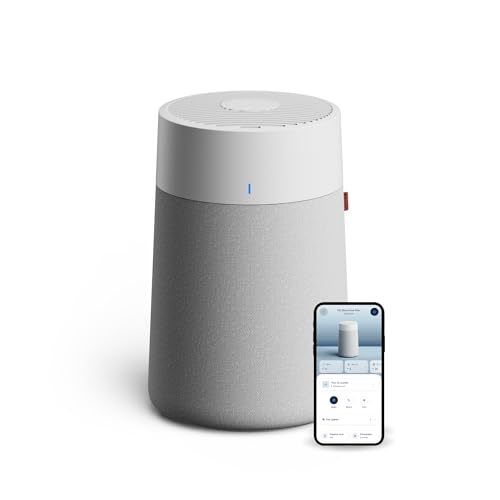
BLUEAIR Blue Pure 511i Max Air Purifier — Best for Bedrooms
Bedrooms are where dust matters most and where purifiers go to be switched off for noise. The 511i Max attacks both facts: its Amazon title names dust among its targets, confirms a washable pre-filter, and states a 19dB night mode — a figure low enough to disappear under normal room sound. Sized for bedrooms up to 1,138 square feet, it is the specialist pick for the room you spend a third of your life in.
Strengths
- 19dB night mode stated in the Amazon title — the quietest here
- Washable pre-filter suits dusty bedroom textiles
- Compact bedroom sizing with auto mode
Trade-offs
- Bedroom scale only — not a whole-home solution
- Proprietary Blueair filtration consumables
- Small machines need their pre-filter cleaned often in dusty rooms
Key spec: Bedroom up to 1,138 ft²; HEPASilent; 19dB night mode; washable pre-filter (per Amazon title)
Consider what a bedroom generates: bedding fibres, clothing lint, skin, and the dust mite habitat that lives in all of it, stirred up every time the bed is made. A bedroom purifier fights a local, constant source, which is why the washable pre-filter matters even more here than in a living room — it will load visibly, and rinsing it is free. The night mode is the other half of the design’s intelligence: purification you sleep through beats purification you switch off, every night of the year. Put it where air can circulate, run it through the evening bed-making hour on auto, and let the night mode carry the shift while you sleep. For allergy-conscious households, this little machine is frequently the highest-impact purchase in the whole guide.
A bedroom purifier’s ownership is judged at 3 a.m., and the 511i Max passes: the night mode is genuinely inaudible in a normal bedroom, so the machine runs all night, every night, which is when its work compounds. Its pre-filter will show you, month by month, exactly what bedding and clothing shed into your sleeping air — a sight that converts casual owners into diligent ones. Keep a spare evening a month for its rinse-and-dry, and it will guard the room you breathe in longest.
Best for: bedrooms, nurseries and light sleepers / Not suited for: anyone wanting one machine for an entire open-plan home
Comparison Table
| Pick | Badge | Key spec | Best for |
|---|---|---|---|
| WINIX 5510 Air Purifier | Best Overall | Large room up to 1,881 ft² in 1 hr; True HEPA; carbon filter; app support (per Amazon title) | main living spaces and open-plan rooms with a visible dust problem |
| Levoit Core 600S-P Smart Air Purifier | Best Smart Large-Room | Large room up to 2,933 ft²; HEPA; AHAM VERIFIDE; app and voice control (per Amazon title) | large open-plan homes that will use scheduling and app control |
| BLUEAIR Blue 311i Max Air Purifier | Best Quiet Performer | Up to 2,107 ft²; HEPASilent filtration; 23dB quiet figure; AHAM Verified; washable pre-filter (per Amazon title) | noise-sensitive households and anyone who will maintain a pre-filter |
| COWAY Airmega Air Purifier, Up to 1,748 ft² | Best for Monitoring | Up to 1,748 ft²; HEPA filter; air quality monitor; auto and eco modes; filter indicator (per Amazon title) | households who want visible feedback and maintenance warnings |
| LEVOIT Vital 200S-P Smart Air Purifier | Best Mid-Size Value | Up to 1,875 ft²; AHAM VERIFIDE; air quality monitor; 27dB bedroom figure (per Amazon title) | apartments and houses purifying one or two key rooms |
| BLUEAIR Blue Pure 511i Max Air Purifier | Best for Bedrooms | Bedroom up to 1,138 ft²; HEPASilent; 19dB night mode; washable pre-filter (per Amazon title) | bedrooms, nurseries and light sleepers |
How to Choose an Air Purifier for Dust
Size the machine to the room, using the coverage figures in the listing titles as your map — and understand what they mean. A rating like ‘up to 1,881 ft² in 1 hr’ describes the room size in which the purifier can cycle the air at a useful rate; put a small machine in a big room and it will clean its own corner beautifully while the rest of the room stays dusty. When your room sits between sizes, buy the larger machine and run it slower and quieter.
Insist on the filtration stack, in order: a pre-filter for the coarse load, true HEPA-grade media for the fine fraction, and carbon only as an odour bonus. For dust, the pre-filter’s existence — ideally washable, as on both Blueair picks — is the strongest predictor of long-term performance, because dust is bulky and fine filters clog from the surface inward.
Then check the two honesty features: an air quality monitor, which proves the machine is responding, and a filter indicator, which tells you when it has stopped performing. The Coway and Vital 200S-P carry both ideas between them, and they are worth more than any smart frill.
Dust, Allergens and What a Purifier Can and Cannot Do
A purifier treats airborne particles: the dust that has not settled yet, pollen tracked in from outside, pet dander floating after a shake. It does nothing for dust already in a carpet or mattress until activity launches it into the air — which is why purifiers partner with vacuuming and damp dusting rather than replacing them. Run the purifier during and after cleaning, when the airborne load peaks, and the combination outperforms either alone.
Keep the health framing honest, as this guide does: cleaner air is more comfortable air, and reducing airborne dust and dander is a reasonable comfort goal for any household. A purifier is not a medical device, and anyone managing a diagnosed condition should follow their clinician’s advice on top of — not instead of — sensible air cleaning.
Placement and Running Habits That Decide Everything
Purifiers clean the air that reaches them. Give the machine clearance on all sides — not shoved behind a sofa or into a corner — and place it in the room where the dust problem or the sleeping actually happens. Closed doors define its world: a purifier in the hall does almost nothing for a bedroom with the door shut.
Run it more than feels necessary. Dust is generated around the clock, and the households that see results run their machines on auto continuously, letting sensors handle events, rather than switching on for an hour after noticing a sunbeam full of motes. Continuous auto running on a modern machine is a modest energy cost — and it is the entire difference between owning a purifier and using one.
CADR and Air Changes: The Numbers Behind the Coverage Claims
Coverage figures like the ones in these titles are built from CADR — clean air delivery rate — translated into a room size at a target number of air changes per hour. The translation is where honesty lives: the same machine can be honestly rated for a large room at two air changes an hour or a much smaller one at five. For dust and allergen duty, more changes are better, which is why this guide repeatedly advises sizing up — a machine running at half speed in a room it could service twice over is quieter, longer-lived and more effective than a small machine screaming at its limit.
AHAM’s programme exists to police exactly this arithmetic, which is why the VERIFIDE mark on the Levoit picks matters and why this guide quotes coverage as the titles state it rather than inflating it. When a listing gives no verified figure, treat the number as the manufacturer’s optimism and size up again. Dust control is a game of margins, and every margin you buy at purchase is performance you do not have to coax out of the machine later.
Placement interacts with the maths more than buyers expect. A purifier’s rated circulation assumes it can actually move the room’s air; wedged behind a sofa, it recirculates its own cleaned bubble while the room’s far half stays dusty. The rated room is the room the machine can reach — give it the clearance its design asks for and the numbers on the box become the numbers in your air.
The Dust Sources You Control — and the Ones You Do Not
Half of household dust is imported: outdoor particles on shoes and clothes, pollen in season, the fine grit that enters every time a door opens. Entry discipline — a mat that gets shaken, shoes that stay at the door — reduces the purifier’s load before it starts, and no machine in this guide will ever be as cheap as a doormat. The other half is manufactured indoors: skin, fabric fibres from bedding and clothing, pet dander and hair, and the breakdown of soft furnishings themselves. That half cannot be excluded, only managed, and it is why bedrooms, with their acres of textiles, generate dust out of all proportion to their size.
Renovation and season change deserve special mention, because they produce the dust events owners remember. Building work overwhelms any domestic purifier’s filter budget — protect the machine, run it after the dust settles, and expect a filter change. Spring and autumn bring pollen and heating-system dust respectively; the purifier on auto mode handles both without being told, which is the strongest practical argument for leaving it running year-round rather than treating it as a seasonal appliance.
None of this diminishes the machine’s role; it defines it. Source control lowers the incoming load, cleaning removes the settled fraction, and the purifier owns everything in between — the airborne hours when dust is travelling from where it was made to where it will land. Own that middle well, as the better picks here do, and the whole system’s results multiply.
Filter Economics: The Cost Nobody Puts on the Box
A purifier’s purchase price is the down payment; its filters are the mortgage. Before buying, price the replacement HEPA and carbon filters for your finalist models and multiply by the replacement rhythm your dust load implies — in a pet household or a dusty postcode, that rhythm is faster than the box’s gentle estimate. The washable pre-filters on both Blueair picks in this guide are an economic feature as much as a performance one: every month of main-filter life they protect is money that stays in your pocket.
Beware the false economy of third-party filters of unknown provenance. A HEPA filter is a precision component; an ill-fitting or under-specified substitute can leak unfiltered air around its edges while displaying the right label, silently converting your purifier into a fan with a hobby. Genuine filters, bought on schedule, are the running cost of the results this guide describes — budget for them as part of the purchase, not as a surprise.
The good news is that dust itself keeps the accounts honest. Your pre-filter shows you the load monthly, your indicator tells you when the main filter’s work is done, and a household that follows those two signals spends exactly what its air requires — no more, and, crucially, no less.
Bedrooms, Living Rooms and the Two-Machine Question
Sooner or later every dust-conscious household faces the arithmetic of doors. One excellent purifier cleans one closed room excellently; a house is several closed rooms taking turns being occupied. The honest options are a large machine for the main living space plus a bedroom specialist — the pattern this guide’s picks naturally form, with the WINIX or Levoit flagship downstairs and the Blue Pure 511i Max on night duty — or one mid-size machine, like the Vital 200S-P, moved between the room you live in and the room you sleep in. Both work. What does not work is one machine expected to be everywhere, resented for being nowhere.
If budget forces a sequence, buy for the bedroom first. You spend a third of your life there, breathing its air at closest range, in the room with the highest textile dust generation in the house. A bedroom machine’s results are felt within the week, and that early proof is what funds the second machine for the living room without an argument. Households that start with the living room often stall there, because the benefit, while real, is less personal than waking up clearer.
Whichever sequence you choose, keep the machines’ roles fixed once set. A purifier’s effectiveness is partly its permanence — the room’s air reaches an equilibrium under its care, the pre-filter rhythm settles, the household stops thinking about it. Appliances that migrate weekly never quite arrive anywhere, and dust, which never migrates at all, wins by default.
How to Set Up and Maintain a Dust Air Purifier
Ten minutes of setup and a small monthly routine keep a dust purifier performing at its rated level instead of quietly fading.
- Unpack the filters. Most purifiers ship with filters sealed in plastic inside the machine — open it, remove every bag, and refit the filters before first use. Running a sealed filter is the classic first-week disappointment.
- Position with clearance. Place the unit on a hard floor or stable surface with space around its intakes and outlet, in the room that matters most.
- Run high, then auto. Start on a high speed for the first hours to pull the room’s load down, then settle into auto mode for continuous duty.
- Clean the pre-filter monthly. Vacuum or rinse the pre-filter (where washable) on a calendar rhythm — in dusty homes this single habit preserves most of the performance.
- Respect the filter indicator. When the machine or its schedule says the main filter is done, replace it; a saturated HEPA filter is a fan ornament.
- Vacuum the room with the purifier running. Cleaning launches dust into the air — exactly when you want maximum filtration working.
- Wipe the sensor lens if fitted. Air quality sensors drift when their lenses dust over; a dry cotton swab, as the manual directs, keeps readings honest.
If dust visibly persists, audit before blaming the machine: undersized room, clogged pre-filter, sealed filter plastic never removed, and a purifier running two hours a day account for nearly every disappointment in this category.
After setup, run one honest experiment before settling into routine: the tissue test is theatre, so instead use time. Note the day you start the machine, then dust a shelf thoroughly and date a small card placed beside it. Check the card weekly. In a correctly sized, continuously run setup, the visible accumulation that used to take days will stretch noticeably — and you will have your own household’s number, not a brochure’s, for what your purifier does. If the card shows no change after a fortnight, do not blame the concept: audit the machine’s placement, its pre-filter, its unremoved shipping plastic and its hours of operation, in that order, because the experiment has just told you something is wrong and the fault is almost always findable. This is the difference between owning an appliance and operating a system — and dust, uniquely among household problems, lets you measure the difference on a card.
Common Buying Mistakes
Undersizing the purifier
A bedroom unit in a vast open-plan room cleans its corner and nothing else. Match the title’s coverage figure to your room, and size up when in doubt.
Ignoring the pre-filter
Dust clogs from the outside in. A neglected pre-filter strangles airflow and makes an excellent machine perform like a cheap one.
Running it only when dust is visible
By the time a sunbeam shows the motes, the load has been airborne for hours. Continuous auto running is the habit that works.
Leaving the shipping plastic on the filter
It happens constantly and silently. If a new purifier seems to do nothing, open it and check before concluding anything.
Expecting it to replace cleaning
Purifiers catch what floats; vacuuming and damp dusting remove what settles. The combination is the system — either half alone disappoints.
Final Recommendation
Most households should start with the WINIX 5510: True HEPA, a serious large-room rating and an auto mode that handles dust events without supervision. Big open-plan homes that value verified numbers and smart scheduling should step up to the Levoit Core 600S-P, while noise-sensitive buyers will be happiest with the Blueair 311i Max and its washable pre-filter. The Coway suits anyone who wants a monitor and a filter indicator keeping them honest.
For the common two-room reality, the Vital 200S-P is the value answer, and bedrooms deserve their own specialist in the Blue Pure 511i Max — the quietest machine here, built for the room where dust matters most. Whichever you buy: unbag the filter, clean the pre-filter, run it on auto, and let it work.
- WINIX 5510 Air Purifier — check price on Amazon
- Levoit Core 600S-P Smart Air Purifier — check price on Amazon
- BLUEAIR Blue 311i Max Air Purifier — check price on Amazon
- COWAY Airmega Air Purifier, Up to 1,748 ft² — check price on Amazon
- LEVOIT Vital 200S-P Smart Air Purifier — check price on Amazon
- BLUEAIR Blue Pure 511i Max Air Purifier — check price on Amazon
Best Extra Firm Extra Thick Gusset King Pillows Best 2 Person Portable Hot Tubs Best Hide Rugs Cheetah Best House Summer Slippers For Women Best Initial Bath Towels Best Jersey Cotton Blankets
Frequently Asked Questions
Do air purifiers really help with dust?
Yes, with honest limits. A correctly sized purifier with HEPA filtration substantially reduces airborne dust, so surfaces stay cleaner longer and the air carries far fewer particles. It cannot stop dust settling or remove dust already in carpets — vacuuming and damp dusting remain necessary partners.
What size purifier does my room need?
Match the room to the coverage figures in the listings: the picks here range from the bedroom-scale 511i Max at up to 1,138 ft² to the Core 600S-P at up to 2,933 ft². If your room is near a machine’s limit, choose the larger model and run it on a lower, quieter speed.
How often do filters need replacing?
Pre-filters should be vacuumed or rinsed monthly in dusty homes — that habit protects everything downstream. Main HEPA filters are replaced on the manufacturer’s schedule or when the filter indicator says so; a saturated filter quietly stops performing long before it stops spinning.
Should I run a purifier all the time?
For dust, yes — on auto mode. Dust is generated continuously, and auto mode lets the machine idle quietly and respond to events like vacuuming or cooking. Intermittent use is the commonest reason owners conclude purifiers do not work.
What is AHAM VERIFIDE and why does it matter?
It is an independent verification programme for room air cleaners, and several picks here carry it in their Amazon titles. In a category full of self-declared coverage numbers, an independently verified rating is the closest thing to a guarantee a buyer gets.
Where should I place a dust purifier?
In the room where dust bothers you or where you sleep, on a stable surface with clearance around its intakes — not behind furniture or in a corner. A purifier cleans the air in its own room; a closed door is the boundary of its world.
Will a purifier help with dust mites?
Purifiers capture airborne particles, including mite debris that becomes airborne when bedding is disturbed — one reason bedroom models like the 511i Max exist. They do not treat the mites living in a mattress itself; hot washing of bedding and mattress encasements handle that side, and the combination is the standard comfort approach.
How close to the wall can a purifier sit?
Follow your model’s manual, but the principle is universal: intakes and outlets need clear air. A hand’s breadth is a minimum, more is better, and never drape curtains or laundry over a running machine — starved airflow is the silent killer of rated performance.
