Disclosure: airfryerkitchensupply.com is reader-supported. When you buy through links on our site, we may earn an affiliate commission at no extra cost to you.
Where to buy
Comparing the best air purifiers for 980 square feet? Every purifier below was confirmed against Amazon’s own catalog data before it earned a link, so the model names and coverage figures in this guide match live listings. Buy from Amazon or an authorized dealer so the filter warranty and return window stay intact, and check the current price on Amazon at checkout — purifier pricing moves with filter bundles and seasonal promotions, so we do not print static prices here.
- WINIX 5510 Air Purifier — Check on Amazon
- COWAY Mighty AP-1512HH Air Purifier — Check on Amazon
- IQAir HealthPro Plus XE Air Purifier — Check on Amazon
- LEVOIT Core 400S-P Smart Air Purifier — Check on Amazon
- Honeywell AllergenPlus HPA304 Air Purifier — Check on Amazon
- BLUEAIR Blue Pure 511i Max Air Purifier — Check on Amazon
Finding the best air purifiers for 980 square feet starts with a piece of arithmetic most product pages hope you skip. A room of 980 square feet with standard eight-foot ceilings holds about 7,840 cubic feet of air. To change that air twice an hour — the minimum most allergy guidance treats as meaningful — a purifier needs a clean air delivery rate of roughly 650 cubic feet per minute on the speed you can actually live with. The headline coverage numbers brands print, including several on this page, usually describe one air change per hour, sometimes on the highest and loudest setting. That does not make those machines bad; it means a purifier advertised for 1,700 square feet is, in honest terms, a solid 980-square-foot machine at a useful speed, and a purifier advertised for exactly 980 square feet will usually fall short in a real open-plan space.
That is the lens this guide uses. Every pick below carries a manufacturer coverage claim comfortably above 980 square feet, true HEPA or equivalent high-grade filtration confirmed in the listing data, and a filter ecosystem you can actually buy replacements for. We favored machines with automatic particle sensing, because a 980-square-foot open plan — a combined living, dining and kitchen space, a loft, a finished basement — produces uneven pollution: cooking plumes at one end, dust at the other. We also weighed filter replacement cost and interval honestly, since at this room size the filter, not the machine, is the long-term expense. Two honest warnings up front: no portable purifier fixes a ventilation problem, and no HEPA machine removes carbon monoxide or radon. Within those limits, the six machines below are the strongest verified options for a space this size.
In this guide
Quick Picks
- WINIX 5510 Air Purifier (Best Overall) — True HEPA plus a high-deodorization carbon filter and app support, with coverage headroom far beyond 980 square feet. — Check on Amazon
- COWAY Mighty AP-1512HH Air Purifier (Best Proven Design) — A decade-proven compact tower rated to 1,748 square feet, with a four-stage filter and a three-year warranty. — Check on Amazon
- IQAir HealthPro Plus XE Air Purifier (Best Premium Filtration) — Swiss-made HyperHEPA filtration on wheels, rated for large rooms of 1,125 square feet, built like medical equipment. — Check on Amazon
- LEVOIT Core 400S-P Smart Air Purifier (Best Smart Features) — AHAM VERIFIDE smart purifier rated to 1,718 square feet, with auto mode, air-quality display and voice-friendly controls. — Check on Amazon
- Honeywell AllergenPlus HPA304 Air Purifier (Best Value Coverage) — The largest coverage claim on the list at 2,250 square feet, from a mainstream brand with filters in every big-box store. — Check on Amazon
- BLUEAIR Blue Pure 511i Max Air Purifier (Best Quiet Design) — HEPASilent filtration rated to 1,138 square feet with a 19 dB night mode and a washable fabric pre-filter in colors. — Check on Amazon
How These Picks Were Chosen
We chose these picks in four passes. First, coverage: each machine’s confirmed listing claims single-pass coverage well beyond 980 square feet, giving headroom for real-world air-change rates. Second, filtration grade: true HEPA or a documented equivalent, plus activated carbon weight that matters for cooking and household odors — thin carbon sheets were marked down. Third, livability at working speed: sleep modes, night modes and auto modes that let the machine run continuously without dominating the room. Fourth, ownership: replacement filter availability, filter-life indicators, warranty length and whether the brand publishes CADR-style data at all. Machines that failed the coverage math, relied on ionizers as their main mechanism, or had orphaned filter supplies were cut, however popular they are.
The 6 Best Air Purifiers for 980 Square Feet

WINIX 5510 Air Purifier — Best Overall
The WINIX 5510 is the current generation of the long-running 5500-series formula: a serious carbon bed behind a true HEPA filter, sized for large rooms and confirmed in the listing for spaces up to 1,881 square feet in one hour. For a 980-square-foot open plan, that headroom is exactly what you want — it lets the machine do useful work on a medium speed instead of living on turbo.
Strengths
- True HEPA filtration paired with a genuinely substantial deodorization carbon filter, not a token carbon sheet
- Auto mode with air-quality sensing, so it ramps up for cooking plumes and settles down afterward
- App support on this generation makes scheduling and filter checks painless in a big open space
Trade-offs
- The carbon-heavy filter set is a recurring cost you should budget for from day one
- Tall tower footprint needs a permanent floor spot with clearance on all sides
- At full turbo it is audible across a large room — plan on medium for evenings
Key specs: Coverage claim up to 1,881 sq ft in 1 hr (Amazon listing); true HEPA; high-deodorization carbon filter; auto mode; app support.
What separates the 5510 from most large-room rivals is odor handling. A 980-square-foot space usually includes a kitchen, and fine particles are only half the problem — last night’s frying, cleaning sprays and pet smells linger in open plans because there is so much shared air. The deep carbon stage in this machine is built for exactly that load, and owners of the earlier generation consistently treated it as the class benchmark for odor work. Particle capture is handled by the true HEPA stage, and the auto sensor closes the loop: you are not guessing which speed the room needs.
Plan on the combined filter pack as an annual-ish expense depending on cooking load, and vacuum the pre-filter monthly so the expensive stages last. Place it on the kitchen side of the open plan if odors are your main complaint, or centrally if dust and pollen matter more. Register the warranty and keep the first filter receipt; with machines at this level, support is straightforward when paperwork is in order.
Best for: open-plan homes where cooking odor matters as much as dust / Not suited for: buyers who want the smallest possible footprint or the cheapest filters
Check on Amazon — check the current price on Amazon before you buy, because bundle and filter options change.

COWAY Mighty AP-1512HH Air Purifier — Best Proven Design
The Coway Mighty has been the default recommendation in this category for years, and the confirmed listing shows why it still earns a place: coverage to 1,748 square feet, a four-stage system with true HEPA, an air-quality monitor, auto and eco modes, and a three-year warranty that most rivals do not match.
Strengths
- Long production run means filters are everywhere and the design’s quirks are well documented
- Eco mode drops to near-silent standby when the air reads clean, saving filter life and power
- Three-year warranty is unusually strong for the class
Trade-offs
- No app control — everything is on the unit’s own panel
- The design looks dated next to newer smart purifiers
- Replacement filter packs are mid-priced rather than cheap
Key specs: Coverage claim up to 1,748 sq ft (Amazon listing); HEPA stage; air quality monitor; auto and eco modes; timer; filter indicator; 3-year warranty.
For 980 square feet, the Mighty sits in the sweet spot: its claimed coverage gives roughly the headroom the air-change math demands, while its footprint stays closer to a bedroom machine than a piece of furniture. The pollution sensor is genuinely useful in an open plan — it catches the spike when something hits a hot pan two rooms away and spins up before the smell settles into soft furnishings. Eco mode then does the unglamorous work of making continuous running affordable, which is the single biggest determinant of whether a purifier actually improves a home’s air.
The combined filter pack is the main consumable; the indicator tracks it, but dusty homes and homes with shedding pets should expect the shorter end of any interval. Wash or vacuum the pre-filter regularly — on this model it meaningfully extends HEPA life. Because the design has been sold for years, third-party filters exist; genuine ones fit and seal better, and the seal is what keeps unfiltered air from bypassing the HEPA stage.
Best for: buyers who value a proven, warranty-backed machine over smart features / Not suited for: buyers who want app control and the newest industrial design
Check on Amazon — check the current price on Amazon before you buy, because bundle and filter options change.

IQAir HealthPro Plus XE Air Purifier — Best Premium Filtration
The IQAir HealthPro Plus XE is the heavy artillery of this list: a Swiss-made, wheeled unit with HyperHEPA filtration that captures particles well below standard HEPA size, confirmed in the listing for large rooms of 1,125 square feet. Its coverage claim is the most conservative here — which, given the sizing math in our introduction, makes it one of the most honest.
Strengths
- HyperHEPA stage captures ultrafine particles that standard HEPA stages partially pass
- Granular gas-phase media handles chemicals and odors at a level sheet-carbon machines cannot
- Wheeled, serviceable, built-to-last construction with individual filter stages you replace separately
Trade-offs
- Premium-tier machine and premium-tier filter costs — this is a long-term investment
- Large and heavy; it reads as equipment, not décor
- Its 1,125 sq ft claim leaves less paper headroom, so placement and door discipline matter
Key specs: Coverage claim 1,125 sq ft (Amazon listing); HyperHEPA; 3-stage filtration; WiFi on XE generation; wheeled housing.
Choose the IQAir when the pollutant is the point: wildfire smoke drifting into a large living space, a home workshop sharing air with the house, a household member whose clinician has told them to take airborne particles seriously — in comfort terms, this is the machine people buy after lesser purifiers disappoint. The staged design means you replace the pre-filter, gas cartridge and HyperHEPA element on their own schedules instead of discarding a combined pack, which suits owners who maintain equipment properly. In a 980-square-foot space it should sit centrally, because its honest rating assumes it is actually conditioning the whole volume.
Budget honestly: the filter stages cost real money, though each lasts far longer than typical combined packs. Keep the wheels unlocked path clear, log filter changes in the app or a calendar, and run it continuously at a moderate speed rather than in bursts — staged media works best with steady airflow. This is the one pick where reading the manual fully pays for itself.
Best for: smoke-prone regions and buyers who want the strongest filtration available in a portable / Not suited for: budget buyers or anyone who needs a purifier that disappears visually
Check on Amazon — check the current price on Amazon before you buy, because bundle and filter options change.

LEVOIT Core 400S-P Smart Air Purifier — Best Smart Features
The Levoit Core 400S-P brings the strongest smart package in this group: an listing-confirmed coverage claim of 1,718 square feet, AHAM VERIFIDE status, an onboard air-quality monitor, auto mode and a quiet HEPA sleep mode. For a 980-square-foot space in a connected home, it is the easiest machine to live with day to day.
Strengths
- AHAM VERIFIDE listing means the room-size claims passed an independent program’s checks
- Auto mode plus a real particle display makes the invisible visible — and keeps speeds honest
- Sleep mode keeps it bedroom-quiet if the 980 feet include a sleeping area
Trade-offs
- The 3-in-1 filter design favors convenience over deep carbon odor capacity
- Smart features depend on the app ecosystem staying supported
- Cylindrical footprint needs floor clearance for its intake pattern
Key specs: Coverage claim up to 1,718 sq ft (Amazon listing); AHAM VERIFIDE; 3-in-1 HEPA filter; auto mode; air quality monitor; sleep mode; child lock.
Levoit’s advantage is behavioral: purifiers only work when they run, and this is the machine households actually leave running. The display tells you when the air dips — after vacuuming, when the dog comes in wet, when pollen counts spike — and auto mode answers without anyone touching a button. In a 980-square-foot open plan that responsiveness matters more than a few points of laboratory CADR. Filtration is a sealed 3-in-1 cylinder: pre-filter, HEPA and carbon in one swap, which keeps maintenance to a single annual-style task most owners will genuinely do.
Use genuine replacement cylinders; the seal geometry is part of the performance, and ill-fitting copies leak. Keep the sensor lens clean per the manual, because a dust-blinded sensor makes auto mode lazy. If the space includes a nursery corner, the child lock and sleep mode combination is the most parent-friendly setup on this list.
Best for: connected homes that want set-and-forget air care with visible feedback / Not suited for: heavy cooking-odor households that need a deep carbon bed
Check on Amazon — check the current price on Amazon before you buy, because bundle and filter options change.

Honeywell AllergenPlus HPA304 Air Purifier — Best Value Coverage
The Honeywell HPA304 takes the opposite approach to the IQAir: maximum claimed coverage — 2,250 square feet in the Amazon listing — at a mainstream tier, with HEPA filtration aimed at allergens, dust, pollen, smoke and pet dander. In a 980-square-foot room, that paper headroom translates into useful mid-speed performance.
Strengths
- Biggest coverage claim here, so it reaches useful air changes without living on its loudest setting
- Honeywell filters and pre-filters are stocked almost everywhere, including same-day retail
- Simple controls anyone in the household will actually use
Trade-offs
- Carbon pre-filter is a light odor solution — this is a particle machine first
- No smart features, no app, basic indicator feedback
- Larger tower presence in the room than the compact Coway
Key specs: Coverage claim 2,250 sq ft (Amazon listing); HEPA; allergen-focused; quiet operation modes.
There is a practical argument for the Honeywell in big spaces: when a purifier’s top claim is more than double your room, its middle speeds — the ones you can hold a conversation over — still move serious air. For a 980-square-foot great room that hosts gatherings, movie nights and a dog, that matters more than laboratory bragging rights. The replaceable carbon pre-filter wraps the HEPA drum and takes the first hit of dust and hair, and because it is cheap and everywhere, owners actually replace it on schedule, which keeps the main filter honest.
Treat the pre-filter as a consumable on a calendar, not a suggestion — in pet homes it loads fast. The HEPA drum itself is the longer-interval expense. Place the unit where its intake is not smothered by curtains or furniture; towers this size lose real performance when boxed into a corner. If you run it in a basement great room, check the space for damp: purifiers clean air, they do not dry it.
Best for: large great rooms and pet households that want simple, available-everywhere ownership / Not suited for: buyers who want app data or serious gas and odor filtration
Check on Amazon — check the current price on Amazon before you buy, because bundle and filter options change.
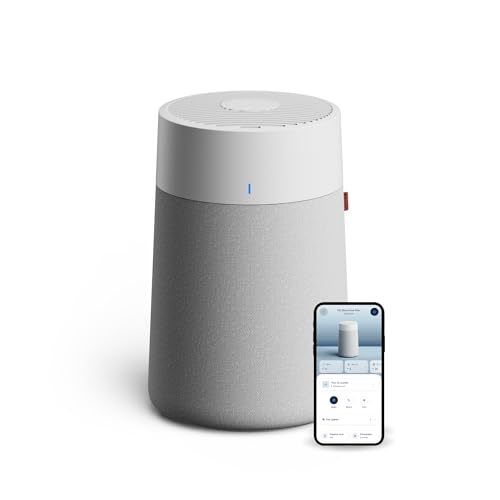
BLUEAIR Blue Pure 511i Max Air Purifier — Best Quiet Design
The Blue Pure 511i Max is the design-led pick: HEPASilent filtration confirmed for rooms up to 1,138 square feet, a night mode the listing puts at 19 dB, auto mode, WiFi app control and a 360-degree intake wrapped in a washable fabric pre-filter. Its coverage claim is modest — for 980 square feet, read the analysis before choosing it.
Strengths
- Exceptionally quiet night mode makes it the easiest pick for combined living and sleeping spaces
- Fabric pre-filter is washable and decorative — the machine looks like furniture, not equipment
- 360-degree intake gives flexible placement against a wall or between seating
Trade-offs
- 1,138 sq ft claim is the tightest fit here — best when the 980 feet are one well-sealed space
- HEPASilent blends filtration with electrostatic assistance, which purists debate
- Replacement main filters are brand-specific and mid-priced
Key specs: Coverage claim up to 1,138 sq ft (Amazon listing); HEPASilent; 19 dB night mode; auto mode; WiFi app; 360° intake.
Honesty first: on paper this is the closest call in the guide. A claim of 1,138 square feet against a 980-square-foot room leaves little margin for the two-air-changes rule, so this pick suits a single, well-defined 980-square-foot space — a studio loft, a primary suite with sitting area — better than a chopped-up floor plan. What it returns for that compromise is livability: at night-mode quietness it can run beside a bed indefinitely, and continuous running at a gentle speed cleans more real air over a week than a louder machine that gets switched off. The fabric pre-filter also catches the coarse dust load that chokes finer filters in open-plan homes.
Wash the fabric pre-filter on schedule — it is the machine’s first line of defense and its looks depend on it. Keep the app updated and use auto mode as the default so the unit spends its headroom when the room needs it. If your 980 feet are really two connected rooms, consider this as the bedroom-zone machine paired with a second unit rather than the whole answer.
Best for: studio lofts and suite-style spaces where quiet and looks decide whether it runs / Not suited for: fragmented floor plans that need maximum raw headroom from one machine
Check on Amazon — check the current price on Amazon before you buy, because bundle and filter options change.
Comparison Table
| Pick | Badge | Key spec | Best for |
|---|---|---|---|
| WINIX 5510 Air Purifier | Best Overall | Up to 1,881 sq ft/hr claim; true HEPA + heavy carbon | open-plan homes where cooking odor matters as much as dust |
| COWAY Mighty AP-1512HH Air Purifier | Best Proven Design | Up to 1,748 sq ft claim; 4-stage; 3-yr warranty | buyers who value a proven, warranty-backed machine over smart features |
| IQAir HealthPro Plus XE Air Purifier | Best Premium Filtration | 1,125 sq ft claim; HyperHEPA; granular gas media | smoke-prone regions and buyers who want the strongest filtration available in a portable |
| LEVOIT Core 400S-P Smart Air Purifier | Best Smart Features | Up to 1,718 sq ft claim; AHAM VERIFIDE; smart auto | connected homes that want set-and-forget air care with visible feedback |
| Honeywell AllergenPlus HPA304 Air Purifier | Best Value Coverage | 2,250 sq ft claim; HEPA; widely stocked filters | large great rooms and pet households that want simple, available-everywhere ownership |
| BLUEAIR Blue Pure 511i Max Air Purifier | Best Quiet Design | Up to 1,138 sq ft claim; 19 dB night mode | studio lofts and suite-style spaces where quiet and looks decide whether it runs |
How to Choose an Air Purifier for 980 Square Feet
Do the air-change math yourself. Multiply your room’s length by its width for square footage, then by ceiling height for volume. A purifier’s CADR in cubic feet per minute, multiplied by 60 and divided by room volume, gives air changes per hour. For 980 square feet with eight-foot ceilings, you want a CADR near 650 for two changes an hour, and near 325 even for one honest change at a livable speed. Brand coverage claims usually assume one change per hour or fewer — so shop for claims roughly double your room, or accept slower cleaning.
Match the filter to your pollutant. Dust, pollen and dander are particle problems: any true HEPA stage handles them. Cooking smells, smoke and household chemicals are gas problems: they need activated carbon by weight, not a carbon-dusted sheet. Wildfire regions and homes near busy roads should weight carbon and sealing heavily. If allergies drive the purchase, look for AHAM VERIFIDE models or published CADR figures you can check against the math above.
Plan the running cost before the purchase. At this room size, filters are the real budget. Check the replacement pack price, its realistic interval in a home like yours, and whether third-party or retail availability exists. A cheaper machine with expensive annual filters often costs more over five years than the premium pick.
- Measure the actual space, including ceiling height — vaulted ceilings add volume fast.
- Choose auto mode with a particle sensor if the space mixes cooking, living and sleeping.
- Confirm replacement filters are in production and stocked before buying any model.
- Budget floor space with clearance — intakes smothered by furniture lose performance.
What Size Air Purifier Do You Really Need for a Large Open Plan?
Open plans complicate sizing because the air does not respect the number on the listing. A 980-square-foot great room with an open stairwell is really conditioning the stairwell too; a basement room with a closed door is not. As a working rule: if your 980 feet are one sealed volume, one strong machine from this list, placed centrally, will do the job. If the space leaks into hallways and upper floors, either step up to the highest-coverage pick or run two mid-size machines at opposite ends — two units at gentle speeds are quieter than one unit straining, and they cover dead zones a single intake never reaches.
Placement multiplies or wastes capacity. Keep the machine away from corners, give the intake a clear radius, and put it on the pollutant side of the room: near the kitchen for cooking households, near the entry for pollen tracked in on shoes, near the litter or dog zone for pet homes. Run it continuously. Air cleaning is a rate, not an event — a purifier that runs all day at medium outperforms a stronger one used for an hour after dinner.
HEPA, Carbon and Everything Else: Filtration Explained
True HEPA is a defined standard: 99.97 percent capture at 0.3 microns, the hardest particle size. ‘HEPA-type’ and ‘HEPA-style’ are marketing terms with no standard behind them — every pick in this guide uses true HEPA or a documented equivalent such as IQAir’s HyperHEPA. Activated carbon adsorbs gases and odors; capacity scales with the weight of carbon, which is why the WINIX’s deep bed outperforms thin carbon sheets on cooking smells. Pre-filters are the unsung economics of the category: they catch hair and lint so the expensive stages survive to their rated life. Washable fabric pre-filters, like the Blueair’s, cut consumable costs; replaceable carbon pre-filters, like the Honeywell’s, trade money for convenience.
Be skeptical of add-ons. Ionizers can generate ozone and are not a substitute for filtration. UV lamps inside consumer purifiers rarely expose air long enough to matter. Photocatalytic and ‘plasma’ claims vary wildly. The boring stack — pre-filter, HEPA, serious carbon — remains what independent testing rewards, and it is what this guide selected for.
Air Purifiers and Allergies, Smoke and Pets: Setting Realistic Expectations
A purifier is a rate machine: it removes a fraction of the particles in the air each pass, forever competing with the new particles your home generates. That framing explains both its power and its limits. For pollen and dust, the competition is winnable — outdoor pollen enters in pulses, indoor dust settles, and a correctly sized machine steadily wins, which is why allergy households notice the difference in days: less morning congestion, less dust film on surfaces, easier breathing in the room where the machine runs. For pet dander the same logic holds, with the caveat that the animal is a continuous source; the purifier keeps the background level down rather than erasing it, and grooming and vacuuming remain part of the system.
Smoke is the hardest test. Wildfire smoke arrives as an overwhelming, days-long particle flood at exactly the sizes HEPA exists to catch — a sealed, high-CADR machine genuinely transforms indoor air during smoke events, provided windows stay closed and the machine runs high. Cigarette smoke adds gases that only carbon addresses, and even the best carbon bed saturates; a smoking household should treat carbon filters as a consumable on a short clock. Cooking is the friendliest load: a sharp spike, then recovery, which is precisely what auto-sensing machines like the WINIX and Levoit in this guide are built to ride.
What a purifier will not do deserves equal clarity. It does not remove carbon dioxide, so a stuffy room still needs ventilation. It does not fix mold growing inside a wall — it catches spores in transit while you solve the moisture. It does not sterilize a room or replace medical care. Buy it as what it is — the most effective tool ever made for lowering the particle background of a large room — and a 980-square-foot machine from this list will meet that expectation honestly.
Noise, Placement and the Real-World Performance of Large Purifiers
The specification that decides long-term satisfaction is not on the box: it is the noise at the speed that actually cleans your room. Every purifier is quiet on its lowest setting and effective on its highest; the question is the middle. In a 980-square-foot space, you will live at medium and auto speeds, so judge machines by their behavior there — a tonal, low whoosh you can talk over versus a whine that sends the remote’s volume up two clicks. This is why the headroom strategy matters acoustically as well as mathematically: an oversized machine at medium is both cleaner and quieter than an exactly-sized machine at full speed. The Blue Pure’s 19 dB night mode and the Levoit’s sleep mode exist for the hours when the room must disappear sonically.
Placement is the second hidden variable. Air follows paths: a purifier in a corner cleans the corner thoroughly and the room eventually. Central placement, or placement on the pollution side of the room — kitchen-adjacent for cooks, entry-adjacent for pollen, pet-zone-adjacent for dander — can matter as much as a model tier. Keep intakes clear of curtains and upholstery, keep the machine off thick carpet that can block bottom intakes, and resist the tidiness instinct that pushes it behind furniture. Finally, doors: a purifier conditions the volume it is given. Closing the doors to a 980-square-foot great room at night lets the machine bank clean air; leaving every door open asks it to clean the house, and it will politely fail at a task no single portable can do.
Filter Economics: What Five Years of Ownership Really Looks Like
Run the five-year numbers before you fall in love with any machine in this guide, because at 980 square feet the filters are the purchase. A mid-tier purifier typically consumes one combined filter set a year in a clean suburban home, and two a year where cooking is heavy, pets shed, or smoke seasons are real. Premium machines invert the shape: the IQAir’s staged media costs more per stage but each stage lasts longer, and the pre-filter — the cheapest part — takes the abuse that would otherwise age the expensive elements. The honest comparison is never machine price against machine price; it is machine plus five years of its filters against the same total for its rival, and that arithmetic regularly promotes the ‘expensive’ purifier into the value seat and demotes the bargain into the costly one.
Three habits keep the economics kind. First, protect the expensive stages with the cheap ones: vacuum or wash pre-filters monthly without exception, because a clogged pre-filter forces the fan to work harder and loads the HEPA unevenly. Second, buy filters on the machine’s schedule, not the panic schedule — a spare set in the closet, bought when prices dip, beats a full-price emergency order when the indicator turns red mid-pollen-season. Third, distrust miracle third-party filters for sealed machines: a HEPA stage that leaks at its gasket is not a filter but a decoration, and the savings are spent on air you believed was clean. Genuine filters, calendar discipline, and headroom in sizing — the same three notes this whole guide strikes — are what five good years with a large purifier are actually made of.
One Machine or Two? The Layout Decision for Big Spaces
The last structural question in a 980-square-foot brief is whether one flagship or two mid-size machines serve the space better, and the answer is architectural. One open volume — a loft, a great room with a ceiling that contains it — belongs to one strong machine, centrally placed: the picks at the top of this guide exist for exactly that geometry, and splitting their power across two smaller units buys complexity without coverage. A divided volume — the 980 feet split between a living area and a sleeping area, or a main room with a den behind a wide cased opening — belongs to two machines, because air does not turn corners on request and a purifier in the living room does almost nothing for the bedroom’s overnight air, which is the air you breathe longest.
Two-machine households also gain a quiet dividend: each unit runs slower for the same result, and slower is quieter, which compounds across a night’s sleep. The cost is double the filter schedules and double the floor spots to plan. Our practical rule: count the doors. Zero internal doors in the 980 feet, buy one from the top of this list. One or more doors that close at night, buy the main-room machine first, live with it a month, and add the second unit — often the quiet Blue Pure or the smart Levoit — where the remaining problem actually lives. Purifiers reward households that treat air as architecture, and punish, gently and forever, those that treat it as an appliance afterthought.
How to Set Up and Run a Large-Room Air Purifier
Unbox the machine and remove every filter from its plastic wrapping — the single most common setup failure in this category is running a purifier for weeks with the HEPA still sealed in its bag. Seat each filter in order, close the housing until it latches, and place the unit on a hard floor with clear space around the intake: a hand’s width at minimum, more for side-intake towers. Keep it out of the direct corner and away from curtains that can be drawn against the grille.
Run the machine on its highest setting for the first hour to pull down the existing dust load, then switch to auto mode as the permanent default. For the first week, note when the indicator spikes — after cooking, vacuuming, or the dog’s evening shake — because that tells you whether placement is right; a sensor that never reacts is usually a sensor in the wrong room zone. Set a calendar reminder for pre-filter cleaning monthly and for the main filter at the manufacturer’s interval. Finally, keep doors to the space closed when you can: a purifier conditions a volume, and every open door enlarges it.
Common Buying Mistakes
- Buying the exact square footage on the box. A ‘980 sq ft’ claim usually means one slow air change per hour. Buy headroom — roughly double the claim — or accept proportionally slower cleaning.
- Leaving the filter in its plastic. It happens constantly and silently: the fan runs, nothing is filtered. Check every stage at setup.
- Ignoring the carbon question. A particle-only machine in a cooking-heavy open plan leaves the smells untouched, and owners blame the purifier category instead of the filter stack.
- Turning it off at night. Dust and pollen do not sleep. Choose a machine whose quiet mode you can live with and run it continuously.
- Skipping filter costs in the budget. Price the replacement pack and its interval before buying; at this size, five years of filters can exceed the machine’s cost.
- Expecting it to fix damp or ventilation. Purifiers filter air; they do not dry a basement, exhaust a kitchen or dilute carbon dioxide. Solve moisture and ventilation at their source.
Final Recommendation
For most 980-square-foot homes, the WINIX 5510 is the buy: real headroom, true HEPA and the carbon capacity an open-plan kitchen demands. Choose the COWAY Mighty if you prefer a proven design with a long warranty and no app in your life, or the LEVOIT Core 400S-P if smart auto operation is what will keep your household actually using it. Step up to the IQAir HealthPro Plus XE when smoke or ultrafine particles are the core problem and the budget allows a long-term investment. The Honeywell HPA304 is the pragmatic value in coverage per tier, and the BLUEAIR 511i Max wins the spaces where quiet and appearance decide whether a purifier runs at all.
Comparing adjacent sizes before you commit? See our guides to Best Air Purifiers For 150 Square Feet, Best Air Purifiers For Asthma, and Best Air Purifiers For Bathroom Mold for the smaller-room and specialist picks in the same program.
Frequently Asked Questions
How many air changes per hour should I aim for in 980 square feet?
Two air changes per hour is a sensible target for general dust and pollen control, and allergy-focused households often aim higher. In a 980-square-foot room with eight-foot ceilings, two changes an hour needs roughly 650 CFM of clean air delivery — which is why this guide favors machines whose headline claims run well past 980 square feet.
Can one air purifier really cover a 980-square-foot open plan?
Yes, if it is sized with headroom and placed centrally with clear intake space. Fragmented layouts, open stairwells and vaulted ceilings enlarge the effective volume; in those homes, two mid-size units at opposite ends often outperform one large machine and run quieter doing it.
What is the difference between true HEPA and HEPA-type filters?
True HEPA meets a defined capture standard at the most penetrating particle size. HEPA-type is an unregulated marketing phrase that can mean substantially lower capture. Every pick in this guide uses true HEPA or a documented equivalent.
How often will I replace filters in a room this size?
Pre-filters need monthly attention — vacuuming or washing depending on type. Main HEPA and carbon stages typically run on annual-style intervals, shortened by pets, cooking load and smoke exposure. Follow the machine’s indicator, but budget for the shorter end of any stated range.
Will an air purifier remove cooking smells from an open-plan kitchen?
Only if it carries real activated carbon weight. HEPA alone captures particles, not gases. The WINIX 5510’s deep carbon bed and the IQAir’s granular gas stage are the picks here built for odor work; light carbon pre-filters only blunt smells briefly.
Should I run the purifier all the time?
Continuous running at a moderate or auto setting cleans far more air over a week than short bursts on turbo, and modern machines are designed for it. Use sleep or night modes overnight rather than switching off.
Do air purifiers help with wildfire smoke in a large room?
Yes — smoke particles sit squarely in HEPA’s capture range. Keep windows and exterior doors closed, run a high-headroom machine like the WINIX 5510 or IQAir on a high setting during the event, and expect the carbon stage to work hard on the smell. After the event, check the pre-filter; smoke loads it fast.
How much electricity does a large-room purifier use running all day?
Modern large purifiers draw modest power at the medium and auto speeds they live on — comparable to a small fan or a couple of LED bulbs — and eco and sleep modes draw far less. Continuous running is the intended use pattern, and its energy cost is minor next to the heating and cooling of the same space.
When should I size up to a commercial or whole-house system instead?
When the space stops being a room: ceilings well above standard height throughout, a floor plan that leaks into multiple other floors, or a household member whose clinician specifies whole-house filtration. Below that line, the portable headroom strategy in this guide is simpler, cheaper to run, and movable when you are.

