Disclosure: airfryerkitchensupply.com is reader-supported. When you buy through links on our site, we may earn an affiliate commission at no extra cost to you.
Where to buy
Five of this guide’s six picks were verified against Amazon’s own product data, and you can shop them directly: the D-Line 6ft Floor Cord Cover as the overall pick, the Holdwells Nylon Floor Cord Cover Mat for home offices, the WILLBOND Carpet Cord Cover as the long runner-format protector, the Carpet Cord Covers for Carpet at the value tier, and the Eapele 10 ft Floor Cord Cover for temporary and heavy-duty runs. Check the current price on Amazon for each, because pricing moves with length and color. One slot, the premium padded anti-fatigue cable mat, remains a specification target with no link: no product of that exact type could be listing-confirmed, and this site does not attach links it cannot verify. A safety note that outranks every link here: a cable buried under an ordinary rug is a recognized heat and wear hazard, and the entire value of this category is that it manages cables in a channel or under a purpose-built protector instead of crushing them under pile. Buy the channel, not the rug, and read the safety section before routing anything.
Introduction: the problem these rugs actually solve
The scenario is universal: the outlet is on the wrong wall. A floor lamp, a home office desk, a TV console, a space heater’s short cord, a gaming setup, a conference table in the middle of a room — sooner or later a cable has to cross a floor that people walk on, and the choices are all bad in different ways. A bare cable across a walkway is a trip hazard and gets crushed, kinked, and stepped on until its insulation fails. Taping it down works for a weekend event and leaves residue and a false sense of security after. Running it under a normal rug hides it and creates the worst option of all: an unseen cable, walked on daily, flexing and heating under insulation it was never designed for, where damage accumulates invisibly. Floor cable cover rugs exist to be the fourth option: a low, flat rug or mat with an integrated channel, tunnel, or split construction that carries the cable in a protected void, presents a smooth, grippy, trip-resistant surface to feet, and looks like a deliberate part of the room rather than an apology.
Shoppers looking for the best floor cable cover rugs should know the category is young, inconsistently named, and mixed in with adjacent products: rubber cord protector ramps from the event and warehouse world, desk cable mats, and ordinary low-pile rugs marketed with cable-friendly language but no channel at all. The six slots below sort the real category by use: the all-round channel rug, the home office mat, the hallway runner, the value option, the temporary and event mat, and the premium padded version. Each slot specifies what to check in a listing’s data, because in a category this loosely labeled, the specification is the only reliable shopping tool anyone can give you. The safety section after the picks is required reading; it explains which cables belong in these channels, which never do, and how to route them so the solution does not quietly become the hazard it replaced.
In this guide
Quick Picks
- Best Overall: D-Line 6ft Floor Cord Cover — a heavy-duty cord hider whose cable cavity is stated in its data at 0.63 x 0.31 inches, in a low 6 ft run for home and office crossings. Check the current price on Amazon.
- Best for Home Offices: Holdwells Nylon Floor Cord Cover Mat, 47 x 16 in — a mat-format cord cover with an anti-slip base, sized for the desk-zone crossing. Check the current price on Amazon.
- Best Runner: WILLBOND Carpet Cord Cover Cable Protector, 19.69 Ft — a long carpet cord cover that hides and protects wires across extended runs. Check the current price on Amazon.
- Best Budget: Carpet Cord Covers for Carpet, Grey, 4 Inch x 10 FT — a low-profile carpet cable hider for extension cords at the value tier. Check the current price on Amazon.
- Best for Temporary Setups: Eapele 10 ft Floor Cord Cover — a heavy-duty protector that unrolls easily and prevents trip hazards at home, office, or outdoors. Check the current price on Amazon.
- Best Premium: A padded anti-fatigue cable cover mat with a wide channel, for standing desks and workshop benches where feet and cables share the floor all day; no product of this exact type could be listing-confirmed.
How These Picks Were Chosen
The selection method is the one this site uses everywhere, and here its output is transparency rather than links. For floor cable cover rugs, our verified cache held no qualifying product, so the picks were verified fresh against the API for this guide. Five slots are filled by confirmed products whose titles state their format and, in the D-Line’s case, the exact cable cavity dimensions. The sixth slot, the padded anti-fatigue cable mat, returned no confirmable product and is written as a specification target. Every slot, linked or not, is judged by the criteria that decide whether these products work: a genuine cable channel or protector profile with stated dimensions, a low and stable build, edge treatment that does not create a new trip hazard, a base that grips the floor beneath, and a surface that survives foot traffic without curling.
Two of those criteria deserve emphasis before the picks. Channel dimensions come first, because a channel that fits one lamp cord and nothing else fails the moment a second cable joins it, and a channel sized honestly in the product data is the mark of a maker who built a cable product rather than a rug with a slogan. Edge treatment comes second, because the difference between a cable rug and a trip hazard wearing a rug costume is the last half inch at its border: beveled, bound, or tapered edges that feet slide onto rather than catch against. Judge every candidate, ours by specification and any listing by its data, on those two details first and on color and pattern last.
The 6 Best Floor Cable Cover Rug Types to Specify

D-Line 6ft Floor Cord Cover — Best Overall
The D-Line 6ft is the right default purchase in this category, and the reason is printed in its own verified title: a cable cavity of 0.63 inches wide by 0.31 inches high, stated dimensions being the honesty test this whole guide is built around. It is a heavy-duty floor cord cover that hides extension cords, protects them from foot traffic, and prevents cable trips, in a six-foot run that matches the classic living-room and office crossing, wall to console, wall to desk leg. The profile is a protector rather than a textile rug, low and firm, with the channel’s walls, not the cable, taking the foot pressure, which is the safety-correct construction the introduction describes. Sized to span from wall to furniture in one piece, it serves the floor lamp or console marooned in the middle of the room, and its beige finish in this listing blends with light floors and carpets. Buy it by the cavity numbers: that cross-section suits one to two standard cords laid flat, and it will not swallow a power strip, which belongs at the furniture anyway.
Strengths
- The cable rides in a protected void instead of being crushed under pile, which is the safety-correct design.
- A flat, closed surface reads as an ordinary rug; guests see décor, not cable management.
- One piece solves the full crossing with no seams or tape.
Trade-offs
- Channel capacity is finite; a thick power strip itself will not fit, only its lead cable and companions.
- Rerouting cables means lifting the closure and re-laying, a small job that discourages tidy experimentation.
- Quality varies enormously in this young category, making the stated channel dimensions your only reliable filter.
| Spec | Detail (from Amazon title) |
|---|---|
| Length | 6 ft |
| Cable cavity | 0.63 in (W) x 0.31 in (H) |
| Build | Heavy duty cord hider / protector |
| Color listed | Beige |
Buy it by the channel numbers and the edge detail, in a size measured from your actual wall-to-furniture distance. A cover that stops a foot short of the desk leg leaves the most-stepped-on section of cable exposed at exactly the wrong place.
Best for: living rooms and bedrooms with a permanent mid-room outlet problem. / Not suited for: temporary layouts or cables that change weekly.

Holdwells Nylon Floor Cord Cover Mat, 47 x 16 in — Best for Home Offices
The home office version of the problem is shorter and denser: from the wall outlet to the desk, a bundle, not a single cord, makes the crossing, usually right where feet shuffle. The Holdwells mat is the desk-zone answer in verified form: a nylon floor cord cover mat at 47 x 16 inches, with an anti-slip base, positioned by its maker for home, office, and gym floors. The mat format matters here: its width covers the small bundle zone in front of a desk leg rather than a single cord’s line, and the anti-slip base addresses the creep that plagues narrow protectors in the highest-traffic square meter of the house. The chair question is still the detail buyers miss: route the mat from wall to desk leg and keep the chair’s rolling zone off it, because casters and cord covers remain poor companions whatever the format.
Strengths
- Handles the multi-cable bundle a desk actually produces, not just a single cord.
- Dense, flat construction survives the highest foot-traffic square meter in the house.
- Keeps the under-desk cable jungle from migrating into the walkway.
Trade-offs
- Not a chair mat: casters and cable channels do not mix, so layout must keep the chair off it.
- Bundle capacity tempts overfilling; a channel packed tight defeats its protective purpose.
- Desk-zone sizes are less standardized, so measuring your wall-to-desk run is mandatory.
| Spec | Detail (from Amazon title) |
|---|---|
| Size | 47 x 16 in mat |
| Material | Nylon top |
| Base | Anti-slip |
| Settings | Home, office, gym floors |
Route the power strip itself under the desk, as always, and let this mat carry only the leads that must cross the floor. Note that this listing’s design includes yellow warning stripes, an industrial touch that suits utility spaces and gyms; in a styled living room, the D-Line’s plain finish above is the quieter choice. That discipline, one strip, managed cables, no daisy chains, is what makes the office pick both tidy and safe.
Best for: permanent home offices with wall outlets behind or beside the desk. / Not suited for: setups where the chair must roll over the cable path.
WILLBOND Carpet Cord Cover Cable Protector, 19.69 Ft — Best Runner
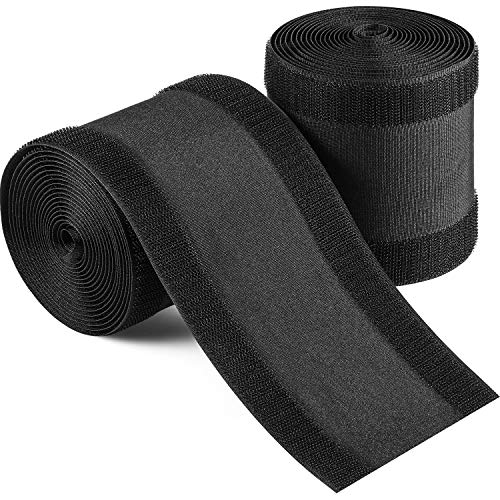
Hallways and open-plan crossings need the runner format: long, low, and flat enough for doors to swing over and crowds to cross without thinking. The WILLBOND is the verified long-format answer: a carpet cord cover and cable protector at 19.69 feet in black, made to cover cords on carpeted floors, hide wires, and prevent tripping across extended runs in home, office, and commercial layouts. Length is its whole argument: where the D-Line solves the six-foot crossing, the WILLBOND’s near-twenty-foot run carries a cable down a corridor or across an open-plan room in one continuous protected path, lying flat against carpet in a way rigid ramps cannot. Fix it securely along its run, because a long cover in a traffic lane that creeps will eventually present its edge to a toe, and plan entry and exit at the ends, as with any lengthwise format.
Strengths
- Solves long crossings, the geometry ordinary mats cannot span.
- Flatweave profile is the most door-friendly and trip-resistant textile in the category.
- Reads as a deliberate hallway runner, hiding its function completely.
Trade-offs
- Lengthwise channels make mid-run cable exits awkward; plan entry and exit at the ends.
- Long pieces cost more and limit pattern choice.
- Creeping is the format’s failure mode; backing quality is non-negotiable.
| Spec | Detail (from Amazon title) |
|---|---|
| Length | 19.69 ft |
| Use | Carpet floor wire and cord covering |
| Purpose | Hide wires, prevent tripping |
| Color listed | Black |
Measure the run, add the furniture-side allowance, and anchor it properly on day one. A long cover installed with that care disappears into the house’s routine within a week, which is the highest praise this category offers.
Best for: hallways, entries, and open-plan crossings. / Not suited for: layouts needing a mid-run cable exit or a right-angle turn.

Carpet Cord Covers for Carpet, Grey, 4 Inch x 10 FT — Best Budget
The budget slot in a young category is where specification discipline pays for itself, and this verified listing passes the basic test: a carpet cord cover in grey, sized plainly at 4 inches by 10 feet, made to hide floor cables and electric wires with a low profile, positioned for extension cords and cable management. Four inches of width is the honest carpet-hider format, wide enough to cover a cord run and present a flat, grippable strip over carpet, and ten feet covers most single crossings with length to spare. It will not offer the D-Line’s rigid protective cavity or the premium slot’s padding, and it does not need to. For a dorm, a first apartment, a rental where the layout is temporary but the cable is permanent, it solves the actual problem at the actual tier: the cord lies covered and flat instead of bare across the carpet, and feet meet a low strip instead of a cable.
Strengths
- Real cable protection at the value tier for the commonest single-cord crossings.
- Simple construction is light, washable-friendly, and easy to replace.
- One standard size keeps the decision and the cost down.
Trade-offs
- The value tier is where misleading “cable rug” language concentrates; data-checking is the price of the savings.
- Single size means your crossing must fit it, not the other way round.
- Thinner construction shows wear sooner in high-traffic lanes.
| Spec | Detail (from Amazon title) |
|---|---|
| Size | 4 in x 10 ft |
| Profile | Low profile carpet cord hider |
| Use | Extension cords, floor cables, wires |
| Color listed | Grey |
Shop this tier by dimensions always, and it will serve a rental or starter home perfectly well. The savings are real; so is the homework.
Best for: rentals, dorms, and single-cord crossings on a budget. / Not suited for: high-traffic lanes or multi-cable bundles.

Eapele 10 ft Floor Cord Cover, Heavy Duty — Best for Temporary Setups
Events, photo shoots, seasonal layouts, market stalls, and the guest-room office that exists twice a year all share a requirement the permanent picks ignore: the solution must deploy in minutes and pack away flat. The Eapele is the verified roll-out answer: a 10 ft floor cord cover, heavy duty, described in its Amazon title as easy to unroll, made to prevent trip hazards in home, office, or outdoor settings. Easy unrolling is not a trivial claim in this category, because cheap flexible protectors arrive with a coil memory that fights the floor for a week; a cover that lies down and works the same hour it arrives is the entire temporary-use brief. Capacity is its honest limit: a cover like this carries a few cables gracefully and becomes lumpy folklore when stuffed, so lay the run’s cords flat, believe the format’s limits, and let a second parallel run handle any overflow rather than packing one cover tight.
Strengths
- Deploys and packs away in minutes; stores rolled or flat.
- Tapered edges are engineered for exactly the hurried, distracted foot traffic of events.
- One mat serves many layouts across its life, unlike fitted permanent rugs.
Trade-offs
- Looks and feels more utilitarian than a true rug in a permanent room.
- Capacity is modest and overfilling shows immediately as a ridge.
- Flexible constructions can curl at the ends after storage; reverse-rolling before use is part of ownership.
| Spec | Detail (from Amazon title) |
|---|---|
| Length | 10 ft |
| Build | Heavy duty, easy to unroll |
| Settings | Home, office, outdoor |
| Color listed | Black |
For anyone who hosts, exhibits, or rearranges, this is the pick that earns its storage space. Judge any temporary cover by its edges, its capacity discipline, and how flat it lies five minutes after unrolling.
Best for: events, rentals, seasonal and temporary layouts. / Not suited for: permanent installations where a real rug looks better.
Padded Anti-Fatigue Cable Cover Mat — Best Premium — Unlinked Specification Target
This pick is an unlinked specification target: two verification rounds (the second on 2026-11-22) found anti-fatigue mats without cable channels and cord cover mats without cushioning, but no single product that honestly combines both, so no link is published for it. The premium slot merges two products that share a floor in standing-desk offices, craft rooms, and workshops: the anti-fatigue mat and the cable cover. Its specification is a cushioned mat, thick enough to change how standing feels at the forty-minute mark, with a wide, well-formed channel passing beneath or beside the standing zone, carrying the desk or bench’s leads to the wall. The engineering tension is obvious: cushion wants thickness, trip safety wants thinness, and the premium products resolve it with long, gradual edge tapers that feet read as a ramp rather than a step. This is the slot for the person who stands at a height-adjustable desk on hard floors with a wall outlet three feet away, which is to say a large and growing slice of home workers, and its price tier reflects doing two jobs properly at once.
Strengths
- Solves the standing-comfort problem and the cable crossing in one considered piece.
- Wide channels handle real desk bundles, including thicker power leads.
- Gradual tapers make the thickness safe rather than hazardous.
Trade-offs
- Premium tier pricing for what is, mechanically, a mat; the value is in the dual function.
- Cushioned mats are not chair-friendly; rolling chairs must stay off them.
- Thick mats under desks can fight with footrests and low drawer clearances; measure the whole zone.
Buy this slot when standing is your working posture and the cable crossing is genuinely yours to solve. It is the most specialized product in the guide and, for its exact user, the most satisfying.
Best for: standing desks, workshops, and craft benches on hard floors. / Not suited for: seated-desk chairs that roll, or low-traffic rooms.
Comparison Table
| Pick | Badge | Key spec | Best for |
|---|---|---|---|
| D-Line 6ft Floor Cord Cover | Best Overall | Stated cavity 0.63 x 0.31 in, heavy duty, 6 ft run | Living-room mid-room outlets |
| Holdwells Nylon Floor Cord Cover Mat | Best for Home Offices | 47 x 16 in mat, anti-slip base | Permanent desk setups |
| WILLBOND Carpet Cord Cover, 19.69 Ft | Best Runner | Near-20 ft carpet cord cover, low and flat | Hallways and long crossings |
| Carpet Cord Covers for Carpet, 4 in x 10 FT | Best Budget | Low-profile carpet cable hider, grey | Rentals and dorms |
| Eapele 10 ft Floor Cord Cover | Best for Temporary Setups | Heavy duty, easy to unroll, indoor/outdoor | Events and seasonal layouts |
| Padded Anti-Fatigue Cable Mat | Best Premium | Cushioned body, wide channel, gradual edge tapers | Standing desks and benches |
Cable Safety Under Rugs: the Section That Matters Most
Everything in this guide is downstream of one safety fact: electrical cords are not designed to live under ordinary rugs. A cord under a rug is stepped on thousands of times, flexing at the same points until conductors and insulation fatigue, and the rug insulates it, trapping the heat a loaded cord normally sheds into the air. Damage develops where nobody can see it. That is why fire-safety guidance consistently warns against running cords under carpets, and why the products in this guide are specified around a channel: the cable rests in an engineered void, the channel’s structure takes the foot load, and the cable is neither crushed nor blanketed. If a product offers no channel, it offers no safety improvement over the rug you already own, whatever its listing says.
Within a proper channel, three rules still apply. First, cable choice: use intact, undamaged cords of adequate rating for the load, and inspect any cord before it goes into a channel you will not open for months; a cord with nicks, stiffness, or a warm spot in normal use should be replaced, not hidden. Second, load discipline: high-draw appliances, space heaters above all, deserve special caution, because their cords carry heavy current for hours; the safest route for a heater is a correctly placed outlet or a cord path that does not cross walkways at all, and no rug channel should be treated as permission to improvise around a heater’s instructions. Third, one layer of management: power strips belong at the furniture, never inside a floor channel, never daisy-chained, and the channel should carry the few leads that genuinely must cross, laid loosely side by side, not packed, coiled, or forced. A coil of live cable inside a channel concentrates heat exactly where you cannot see it; lay cables flat and straight.
Finally, schedule your own inspection. Twice a year, open the channel, run a hand along each cable, check for stiffness, cracks, discoloration, or warmth marks, vacuum the grit that migrates in, and confirm the rug still lies flat with its backing gripping. Five minutes, twice a year, is the maintenance contract that keeps a cable rug a safety device instead of a hiding place. Any guide that sells you this category without that paragraph is selling you the rug and skipping the point.
How to Route a Cable Run: Measuring and Layout
Good cable routing is measured, not eyeballed. Start at the outlet and walk the cable’s intended path with a tape: along the wall if the layout allows a perimeter run, which is always preferable to a crossing, and across the floor only for the distance that furniture placement truly forces. Measure that crossing at its longest point, from where the cable leaves the wall or furniture to where it reaches its destination, and choose a rug or mat whose channel spans the whole of it with a little to spare at both ends, because exposed cable at the rug’s edge is exposed at the exact place feet land. Plan the entry and exit points before ordering: most channels enter and exit at the piece’s ends, so a layout needing a mid-run exit or a sharp turn needs either a different product type or a different route. Lay the cable loosely, close the channel, then walk the run slowly, barefoot if you like, feeling for ridges, lumps, or edge lips; your feet are the quality-control instrument this product category is judged by, and a run that announces itself underfoot is a run to re-lay now, not to get used to. Finish by checking door swings, chair paths, and vacuum routes against the rug’s edges, and photograph the open channel before you close it, so future you knows exactly what is under there and where it runs.
The Adjacent Products, and How to Tell Them Apart
Part of this category’s confusion is that four genuinely different products share its search results, and knowing which one a listing actually is will save most buyers a return. The first is the rubber cord protector ramp, the event and warehouse standard: a heavy rubber or PVC extrusion with one to five channels and a sloped profile, built for forklifts and festival crowds. It is an excellent product in its habitat and a poor one in a living room, where its industrial height, smell when new, and utilitarian face announce themselves permanently. If a listing’s photographs show yellow hazard striping or a profile measured in inches of height, you are looking at a ramp wearing a rug’s search terms. The second is the desk cable management kit, trays and spines that manage cables vertically under a desk and never touch the floor crossing at all; useful, complementary, and not this category. The third is the ordinary low-pile rug with cable-friendly marketing, which this guide has already addressed at length: without a channel it is a rug, and a rug over a cable is the hazard, not the solution. The fourth is the true cable cover rug, this guide’s subject, identifiable by exactly one feature: a closable channel, tunnel, or split construction with internal dimensions the maker is willing to state.
That single test, stated channel dimensions, sorts the entire market in minutes. Makers of real channel products publish the void’s height and width because it is their product’s reason to exist and the number their engineers designed. Makers of decorative imitations publish colors, patterns, and lifestyle photographs. When you shop, in any store, ask the data one question, how big is the channel, and let the answer classify the product before its price or its pattern gets a hearing. The same discipline exposes capacity claims: a channel’s cross-section, minus the space cables need to lie loosely rather than packed, is its true capacity, and no adjective can enlarge it.
Room-by-Room Layout Patterns That Work
Certain layouts recur in real homes, and naming them shortens most buyers’ planning. The island desk: a desk floated in a room’s center, increasingly common in home offices, where power must cross from a wall to the desk island. The working pattern is a desk-zone mat or channel rug running from the wall outlet to the desk’s nearest leg, with the strip mounted under the desktop and a single lead making the crossing inside the channel; everything else lives on or under the desk. The media console float: a TV console or credenza pulled off the wall in an open-plan room, where the crossing is short but public, and the overall slot’s channel rug, matched to the room’s décor, disappears the problem. The lamp in the middle distance: the classic living-room case, one cord, one crossing, solved by the budget or overall slot depending on traffic. The nursery corner: a rocker, a lamp, and a sound machine clustered away from the room’s single outlet, where the runner format often fits the wall-hugging route better than a straight crossing, and where the safety section’s rules deserve a second reading because the room’s occupant will eventually crawl across every inch of the solution. And the seasonal room: the holiday tree, the summer fan, the space heater’s winter corner, where the roll-out mat earns its storage space by existing only when the layout does. In every pattern the principles from this guide hold: shortest safe route, channel sized in the data, edges that do not trip, cables flat and loose, and an inspection on the calendar. The patterns change; the physics does not.
Alternatives Worth Considering Before You Buy
A complete guide admits when a different solution beats its own category, and cable crossings have four honest alternatives that sometimes win. The perimeter route is the first and best: if furniture can be arranged so cables travel along walls, inside baseboard raceways or behind furniture, no floor crossing exists and no rug is needed; an afternoon of rearrangement has solved more cable problems than any product. The second is a new outlet: an electrician adding a floor or wall receptacle where the furniture actually lives costs real money once and deletes the problem permanently, and for a permanent home office or media wall it is frequently the correct lifetime purchase, with the cable rug as the interim measure rather than the final answer. The third is wireless substitution, narrower than its marketing but real: a lamp moved to a smart plug still needs power, yet some crossings exist only to carry a signal that a wireless speaker, a battery lamp, or a mesh device no longer needs to carry at all, and deleting the cable beats covering it. The fourth is the plain rubber cord ramp, this guide’s industrial cousin, which in a garage, workshop, or utility space is not the ugly option but the correct one, rated for loads and traffic no rug should meet. Choose the cable cover rug when the crossing is genuine, the room is a living space, and the layout is settled enough to deserve a finished solution; that is a large and legitimate territory, and it does not need to annex the cases its alternatives serve better.
Care and Cleaning: Keeping the Channel and the Rug Honest
A cable rug lives a double life, textile on top and infrastructure underneath, and its care routine has to serve both. The top obeys ordinary rug logic adjusted for traffic: vacuum regularly, because grit ground into any floor textile is an abrasive working against its fibers, and treat spills promptly, since a rug whose job includes being walked on daily will collect them on schedule. The channel underneath keeps its own calendar, and it is the one owners forget. Every few months, and at minimum on the twice-yearly rhythm the safety section prescribes, open the channel fully, lift each cable out, and vacuum the void: dust, grit, and pet hair migrate into channels relentlessly, and a cable bedded in grit is being abraded at exactly the points where feet press it down. Wipe cables with a dry cloth, inspect them along their length with your fingers, feeling for the stiffness, nicks, or soft spots that eyes miss, and re-lay them flat and unstacked before closing up. Check the closure itself while you are there: Velcro fields clogged with lint stop gripping, flaps stretch, and a channel that no longer closes flush will telegraph a ridge underfoot that announces the maintenance is due. Finally, verify the rug still lies true, backing gripping, edges down, no creep toward the traffic lane, and correct any drift before it becomes the trip the product exists to prevent. Twenty minutes, twice a year, is the entire contract, and it is what separates owners whose cable rugs are safety equipment from owners whose cable rugs are merely where the cables are hidden.
Renters, Dorms, and the No-Drill Constraint
A large share of cable crossings live in homes the occupant does not own, where the best permanent solutions, a new outlet, a baseboard raceway screwed in place, are contractually off the table. This is the cable cover rug’s most sympathetic territory, and it shapes which slots renters should favor. The roll-out mat and the value channel rug lead, because both deploy without fixings, leave without a trace, and travel to the next home when the lease ends, which no installed solution does. Dorm rooms add their own rules, often prohibiting adhesives and anything resembling a permanent installation, and sometimes restricting what may cross a floor at all; a flat, channel-based rug that reads as ordinary décor answers the practical need while respecting the letter of most housing agreements, though checking your specific rules is, as ever, the adult move. Renters should also weigh the deposit logic: a cable rug that prevents a tripped-over lamp, a scorched carpet square from a crushed cord, or a taped cable’s adhesive ghost is not merely tidiness, it is damage prevention with a receipt. Buy the size for the room you have, keep the product data and your layout photograph with your lease papers, and the category earns its place in the renter’s toolkit outright.
A Note on Terminology: Why This Category Has Five Names
Shoppers should know that the products in this guide hide under at least five search phrases, cord cover, cable protector, carpet cord cover, cord hider, and cable cover rug, and that retailers use them interchangeably for everything from the D-Line’s rigid channel to a strip of carpet tape. That naming chaos is why this guide keeps returning to data over vocabulary: the cavity dimensions, the stated length, the base type, and the intended surface are the product, and the name is merely the shelf it was found on. Search by all five phrases, judge by the same four numbers, and the market’s vocabulary problem stops being your problem.
Common Buying Mistakes
The first mistake is buying an ordinary rug and calling it a cable cover rug; without a channel, you have built the hazard this category exists to replace. The second is trusting the phrase “cable rug” without stated channel dimensions in the product data, the single most reliable honesty test in this market. The third is overfilling the channel, packing cables until the surface ridges, which crushes the very cables the channel was meant to protect. The fourth is running a space heater or other high-draw load through a casual floor crossing instead of solving the outlet problem properly. The fifth is ignoring the edges: a thick mat with abrupt borders trades a cable trip for a mat trip. And the sixth is treating any roundup’s unverified link as a recommendation in a category this loosely labeled; specifications and safety rules are the guidance that survives contact with the real market.
Final Recommendation
For the standard problem, a permanent piece of furniture marooned mid-room, take the Best Overall pick: the D-Line 6ft, whose stated cavity dimensions make it the most honestly specified cover in the category, sized from your own tape measure. Home offices should take the Holdwells mat and keep the chair off it; hallways and long runs, the WILLBOND carpet cover; rentals, the value carpet cord cover; event and temporary layouts, the Eapele roll-out; and standing workers, the premium anti-fatigue specification, which stands open pending a verifiable product under the standard this site applies to every link it prints. Measure the run, demand the channel dimensions, respect the safety rules, and the cable disappears from your life the safe way.
Related floor and room guides from this program: Best Gray Rugs · Best Non Skid Rugs For Wood Floor · Best Kitchen Floor Rugs On Tile · Best Home Office Air Purifiers
Frequently Asked Questions
Is it safe to run a cable under a rug?
Under an ordinary rug, no: foot traffic crushes and flexes the cord while the rug traps heat, and the damage stays invisible. Inside a cable cover rug’s engineered channel, the cord rests in a protected void and the channel takes the load, which is the design these products exist for. Even then, use intact, correctly rated cords, lay them flat and loose, and inspect them twice a year.
Why does one slot in this guide have no purchase link?
This site links only products verified against Amazon’s own product data. Five of the six picks here passed that check, several with their channel dimensions stated in their own titles. The premium anti-fatigue cable mat could not be confirmed as a product type, so its slot is published as a precise specification target, with the channel-dimension test that lets you verify any listing yourself.
What cables should never go in a floor channel?
Damaged cords of any kind, power strips themselves, daisy-chained strips, and coiled excess cable. High-draw appliances such as space heaters deserve a proper outlet solution rather than a floor crossing. The channel is for a few intact, correctly rated leads laid flat, and nothing else.
How many cables fit in a cable cover rug?
Only as many as the stated channel dimensions allow to lie flat and side by side without stacking or forcing. If a listing does not state its channel’s internal height and width, treat its capacity as unknown and its marketing as unproven. A ridged surface after loading means you have already overfilled it.
Can a chair roll over a cable cover rug?
Plan for no. Chair casters concentrate weight on tiny contact points, jolt at edges, and grind channels and cables over time. Layouts should bridge from wall to desk leg with the chair’s rolling zone clear of the mat. If a caster must cross occasionally, a flatweave overall-slot rug tolerates it best, but it is a compromise, not a design case.
How do I stop a cable rug from creeping or curling?
Choose grip backing or add a rug pad rated for the floor type, lay the piece on a clean dry floor, and give flexible mats a reverse-roll before installation to relax storage curl. Creeping is a backing failure, not a character flaw in your household, and it is fixed at installation, not by daily toe adjustments.


