Disclosure: airfryerkitchensupply.com is reader-supported. When you buy through links on our site, we may earn an affiliate commission at no extra cost to you.
Where to Buy
All six blankets in this guide are sold through Amazon, where you can check price on Amazon for the size and colour you need before ordering. The verified line-up: the Pendleton National Park Blanket for heritage wool warmth, the Arcturus Bighorn 100% Virgin Wool Blanket as the heavyweight bed and cabin blanket, the Woolly Mammoth Merino Wool Blanket for camping and the car kit, the Mambe Extreme Weather Sideline Cape as the waterproof, windproof hooded option, the Sunbeam Royal Luxe Heated Blanket for powered indoor warmth, and the Bedsure Fleece Bed Blanket as the budget layering base.
How to use this page: Quick Picks for the shortlist by use case, the reviews for the honest limits of each material, and the buying guide before ordering — because ‘extreme cold’ exposes weak blankets in specific, predictable ways, and the difference between wool, fleece, and a powered blanket is not a detail; it is the whole decision.
Introduction: What ‘Extreme Cold’ Actually Demands of a Blanket
Choosing the best extreme cold weather blankets means separating three jobs that ordinary blanket marketing happily confuses. Job one is insulation that keeps working when conditions are hostile: damp air, wind, a cold cabin, a car stranded at the roadside. That job belongs to wool, the fibre that insulates when damp, resists wind in a dense weave, and has been the extreme-cold answer for centuries for physical reasons, not nostalgic ones. Job two is weatherproofing: blocking wind and shedding water entirely, which is the modern waterproof-blanket category — the hooded cape in this guide — built for stadiums, sidelines, and exposed outdoor sitting. Job three is active heat: a powered blanket that manufactures warmth indoors, superb on a bed or sofa and useless in a power cut, which is why it is ranked here as an indoor specialist and never as survival gear. A fleece blanket, finally, is a layer — light, cheap, washable, and genuinely warm in still indoor air — that earns its place as part of a system rather than as the system.
Every blanket below was verified against Amazon’s catalogue data through this site’s verification system, and the material claims in the reviews — 100% wool, virgin wool, waterproof and windproof construction, heat settings and dimensions of the powered pick — come from those verified listings. One safety framing applies to the whole guide: a blanket is one layer of cold protection, not a substitute for shelter, appropriate clothing, or emergency preparation, and the heated pick carries the usual electrical cautions — follow the maker’s instructions, never use a powered blanket as an outdoor or survival blanket, and do not leave it running unattended. Within those honest bounds, these six cover the realistic map of extreme-cold blanket needs: bed, cabin, campsite, car, stadium, and sofa.
In this guide
Quick Picks
- Pendleton National Park Blanket — Best Heritage Wool. 100% wool with the line’s iconic park stripes; the beautiful, durable, gift-grade expression of wool’s extreme-cold competence. Check on Amazon
- Arcturus Bighorn Virgin Wool Blanket — Best Heavyweight Bed Blanket. 100% virgin wool positioned by its listing as heirloom-quality bedding for home and cabin — thick, warm, durable. Check on Amazon
- Woolly Mammoth Merino Wool Blanket — Best for Camping and the Car Kit. A merino wool camping blanket sized for the outdoors kit and the emergency bag. Check on Amazon
- Mambe Extreme Weather Sideline Cape — Best Waterproof and Windproof. A hooded, 100% waterproof and windproof blanket-cape with fleece lining, built for cold-weather sports spectating and exposed sitting. Check on Amazon
- Sunbeam Royal Luxe Heated Blanket — Best Powered Indoor Warmth. Queen 90×84, 12 heat settings, dual controllers per its verified listing — the bed-warmer for cold houses. Check on Amazon
- Bedsure Fleece Bed Blanket — Best Budget Layer. A queen 90×90 fleece positioned as a soft, cozy winter blanket — the inexpensive layer that makes every other blanket warmer. Check on Amazon
How These Picks Were Chosen
Four filters. First, verified identity and materials: each blanket’s fibre and construction claims had to appear in its verified Amazon listing — 100% wool means the listing says so, waterproof means the listing says so — with no credit given for warmth adjectives. Second, extreme-cold competence by category: wool picks were judged on fibre purity and weight class, the weatherproof pick on its wind and water claims, the heated pick on settings and size from its listing, and the fleece pick honestly as a layer rather than a standalone extreme-cold solution. Third, use-case coverage: the six slots deliberately span bed, cabin, camp, car, stadium, and budget layering, because a guide that recommended six near-identical bed blankets would fail the search’s actual range of intent. Fourth, care realism: wool needs different care from fleece, and each review states its blanket’s care character so the purchase includes its maintenance honestly.
Excluded: thin ’emergency’ foil blankets as primary picks (they are a different, last-resort product class — worth owning in a car kit alongside, not instead of, a real blanket), down-filled throws whose listings could not support their claims in verification, and any blanket whose warmth case rested purely on marketing language. No fixed warmth ratings are quoted, because blanket warmth has no standardised consumer rating to quote honestly; comparisons here are material-and-construction arguments, stated as such.
The 6 Best Extreme Cold Weather Blankets

1. Pendleton National Park Blanket — Best Heritage Wool
The Pendleton National Park blanket is the pick for buyers who want wool’s extreme-cold competence in its most considered form: its verified listing confirms 100% wool with a napped texture, positioned around the line’s iconic National Park stripes — a design heritage that also makes it the most giftable and most displayable blanket in this guide. Underneath the aesthetics sits the serious point: pure wool in a dense, napped weave is a genuine cold-weather material — it insulates in damp conditions that defeat cotton and cheap synthetics, it breathes enough to avoid the clammy overheat of sealed fabrics, and a well-made wool blanket’s service life is measured in decades, which reframes its premium tier as a cost-per-year argument.
Strengths
- 100% wool — the fibre that keeps insulating when damp, in a dense napped weave.
- Heirloom positioning with iconic designs: the blanket that lives on the sofa and gets inherited, not stored.
- Versatile across bed, cabin, and cool-evening outdoor use within one purchase.
Trade-offs
- Premium tier — the most expensive way in this guide to buy wool warmth.
- Wool care applies: gentler washing discipline than any synthetic here, per the care section below.
- It is an insulating blanket, not a weatherproof one — wind and rain at a stadium argue for the Mambe below.
Who it suits: the buyer furnishing a cabin or a cold-climate home for the long term, and anyone giving a blanket as a serious gift. Who should look elsewhere: campers who need a blanket that can be abused and machine-washed without thought (the Woolly Mammoth’s camping brief), and budget-first buyers, for whom the Bedsure layer plus a mid-tier wool elsewhere is the more proportionate system.
Best for: long-term home and cabin warmth with heirloom quality. / Not suited for: rough camping duty or strict budgets.
Check on Amazon — check the current price on Amazon before ordering.

2. Arcturus Bighorn 100% Virgin Wool Blanket — Best Heavyweight Bed Blanket
The Bighorn is the workhorse aristocrat of this line-up: its verified listing specifies 100% virgin wool and positions it as heirloom-quality bedding for home and cabin — warm, thick, and durable, in a queen size. ‘Virgin wool’ means wool that has not been recycled from reclaimed textiles, and in blanket terms the practical reading is a dense, heavy, consistent weave — the kind of blanket whose weight you feel as reassurance in a cold bedroom and whose warmth does not depend on loft that compresses away. For an unheated or lightly heated bedroom in real winter, this is the guide’s most direct answer: a serious wool bed blanket, bought once.
Strengths
- 100% virgin wool in a thick, heavy construction — maximum passive insulation in the guide.
- Queen sizing suits real beds, couples, and cabin bunks without compromise.
- Durability positioning matches wool’s nature: this category of blanket outlasts synthetic equivalents by years.
Trade-offs
- Heavy means heavy — in the wash, on the line, and in storage; plan laundry accordingly.
- Wool care discipline required; it is not a tumble-and-forget blanket.
- Its virtues are indoor and camp-cabin virtues; for exposed weather, pair it with or defer to the weatherproof pick.
The Bighorn’s buyer is solving a specific problem — a cold bed in a cold house — and should judge it exactly there. Paired with ordinary sheets and a duvet, a blanket of this class changes what ‘warm enough’ means in January without a watt of electricity, which is also its quiet emergency virtue: in a power cut, the household that owns heavy wool sleeps; the household that owns only a heated blanket improvises. That asymmetry is worth weighing before choosing which premium pick earns your money.
Best for: cold bedrooms, cabins, and power-cut resilience. / Not suited for: anyone wanting featherweight or carefree laundering.
Check on Amazon — check the current price on Amazon before ordering.

3. Woolly Mammoth Merino Wool Blanket — Best for Camping and the Car Kit
The Woolly Mammoth’s verified listing positions it plainly: a merino wool camping blanket. Merino is the finer, softer branch of the wool family, and a camping blanket is wool deployed where wool’s properties matter most — outdoors, where temperatures swing, dew falls, and a blanket that insulates while damp earns its pack space night after night. This is the pick for the camp kit, the overland box, the festival field, and — the use this guide most wants to encourage — the car emergency kit, where a real wool blanket is the difference between a miserable roadside wait and a manageable one. Confirm the exact dimensions on the listing for your intended carry, since camping blankets in this class are sized for one-to-two-person wrap duty rather than bed coverage.
Strengths
- Merino wool: softer hand-feel than coarse utility wool, with wool’s damp-insulation character intact.
- Camping positioning means a size and weight meant to be carried, rolled, and lived with outdoors.
- Doubles as the car-kit and emergency blanket — the highest-value second life any blanket can have.
Trade-offs
- Not a bed blanket: camping dimensions will disappoint anyone expecting queen coverage.
- Wool care still applies, and camp use tests it — budget the occasional careful wash.
- Softer merino is less abrasion-proof than the coarsest utility weaves; it is a blanket, not a groundsheet.
Every cold-climate household should own one blanket whose job is to leave the house — in the boot all winter, at the campsite all summer. The Woolly Mammoth is this guide’s candidate for that role, and its merino softness means it will also be borrowed for sofas and passenger seats, which is fine: a blanket that is used is a blanket that is where you need it when the weather turns.
Best for: campers, road-trippers, and car emergency kits. / Not suited for: buyers wanting full bed coverage.
Check on Amazon — check the current price on Amazon and the listed dimensions before ordering.

4. Mambe Extreme Weather Sideline Cape — Best Waterproof and Windproof
The Mambe is the only pick that takes the keyword literally in its name: an ‘Extreme Weather’ hooded blanket-cape whose verified listing claims 100% waterproof and windproof construction with a warm fleece lining, designed for cold-weather sports spectating. The concept answers the failure mode of every ordinary blanket outdoors — wind strips a blanket’s warmth by moving air through and under it, and rain ends the argument entirely. A waterproof, windproof shell worn as a hooded cape seals both leaks: the shell stops the weather, the fleece lining holds the warmth, and the hood protects the head and neck where spectators actually lose comfort first. For parents on metal bleachers from October to March, this is not a novelty; it is the difference between watching the game and enduring it.
Strengths
- Waterproof and windproof shell — the only pick that defeats weather rather than merely insulating against cold.
- Hooded cape format stays on while standing, cheering, and carrying cocoa — a blanket’s warmth with a garment’s manners.
- Fleece lining provides the insulation layer inside the sealed shell.
Trade-offs
- A spectator’s tool: it is not a bed blanket, a sleeping solution, or camp bedding.
- One-size cape format suits sitting and standing spectating, not active movement or work.
- Shell fabrics need their own care discipline to keep waterproofing honest — follow the maker’s instructions.
Judge the Mambe by hours of outdoor sitting in your life: youth sports seasons, stadium games, bonfire nights, fishing piers, parade routes. If those hours are many, no insulating blanket in this guide will serve you as well outdoors, because insulation without weather sealing is a fair-weather friend. If those hours are few, it is a specialist you can admire and skip.
Best for: sports parents, stadium fans, and anyone sitting still outdoors in bad weather. / Not suited for: bedding, sleeping, or camping duty.
Check on Amazon — check the current price on Amazon before ordering.
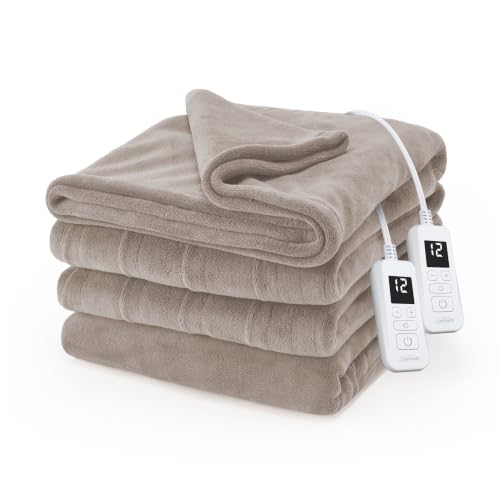
5. Sunbeam Royal Luxe Heated Blanket — Best Powered Indoor Warmth
The Sunbeam Royal Luxe is the indoor specialist: its verified listing specifies a queen 90×84 electric blanket in microplush, with 12 heat settings and dual controllers. Translate that into lived experience: a bed pre-warmed before you get in, two sleepers choosing different warmth on the same blanket, and a cold house’s heating bill argued down by warming the bed instead of the building. Twelve settings is a genuinely wide dial — the difference between ‘take the chill off’ and ‘properly warm’ is several stops, and dual control ends the thermostat negotiation that single-controller blankets impose on couples. The boundaries are equally clear and stated without embarrassment: it needs mains power, it is an indoor bed appliance, and it must be used and stored per the maker’s safety instructions — never as camping or emergency gear.
Strengths
- Active heat on demand: pre-warms the bed, which no passive blanket can do.
- 12 settings and dual controllers — the widest, most couple-friendly control in this guide.
- Queen 90×84 sizing covers real beds properly.
Trade-offs
- Useless in a power cut — pair it with a passive wool layer if outages are your concern.
- Electrical care rules apply: inspect cords, follow washing instructions exactly, retire damaged units.
- Microplush synthetic hand-feel is a preference apart from wool’s — some sleepers run hot under powered microplush even at low settings.
The heated blanket’s real competition is the household heating system, and in that comparison it is a bargain of physics: warming two people in one bed takes a fraction of the energy of warming a house. Bought for that job — and respected as an appliance rather than a textile — the Royal Luxe is the most immediately luxurious pick in this guide on a January night.
Best for: cold houses, couples with different warmth preferences, and bed pre-warming. / Not suited for: camping, emergencies, or off-grid use of any kind.
Check on Amazon — check the current price on Amazon before ordering.

6. Bedsure Fleece Bed Blanket — Best Budget Layer
The Bedsure fleece is the honest budget pick, and its honesty is its placement: its verified listing describes a queen 90×90 fleece blanket, soft and cozy, positioned as a warm winter blanket — and within a layering system, that is a real job done well. Fleece traps still air in its pile, washes and dries without ceremony, weighs little, and costs a fraction of any wool here, which makes it the layer you add under a duvet, over a sheet, across a sofa, and in a guest bed without a second thought. What it is not is a standalone extreme-cold answer outdoors or in an unheated space: fleece loses its battle to wind, compresses under body weight where you lie, and cannot match wool in damp air. This guide ranks it sixth and recommends it warmly — as the layer, not the plan.
Strengths
- Budget tier with genuine utility: the layering component every cold bed benefits from.
- Machine-friendly and quick-drying — the lowest-maintenance blanket in the guide.
- Queen 90×90 dimensions give full bed coverage at the lowest commitment.
Trade-offs
- Wind and damp defeat it; it is an indoor, still-air insulator.
- Fleece pile flattens and pills with age and washing — expect a service life, not an heirloom.
- Static and pet hair cling are fleece’s known household manners.
The smart budget system this pick enables deserves spelling out: a Bedsure layer on the bed now, while the household saves toward or waits for the right wool — because a fleece under a duvet tonight is warmer than a perfect blanket next month. And once the wool arrives, the fleece does not retire; it becomes the washable shield between the wool and daily life, extending the heirloom’s intervals between careful washes. Budget picks that stay useful after the upgrade are the only kind worth recommending.
Best for: layering systems, guest beds, sofas, and budget-first warmth indoors. / Not suited for: standalone outdoor or unheated-space use.
Check on Amazon — check the current price on Amazon before ordering.
Comparison Table
| Pick | Badge | Key spec (verified) | Best for |
|---|---|---|---|
| Pendleton National Park Blanket | Best Heritage Wool | 100% wool, napped texture, park stripes | Home and cabin, long term |
| Arcturus Bighorn Wool Blanket | Best Heavyweight Bed Blanket | 100% virgin wool, queen size | Cold bedrooms, cabins |
| Woolly Mammoth Merino Blanket | Best for Camping and Car Kit | Merino wool, camping format | Camp kits, car emergencies |
| Mambe Extreme Weather Cape | Best Waterproof and Windproof | 100% waterproof/windproof, hooded, fleece lined | Spectating in bad weather |
| Sunbeam Royal Luxe Heated | Best Powered Indoor Warmth | Queen 90×84, 12 heat settings, dual controllers | Bed pre-warming, couples |
| Bedsure Fleece Blanket | Best Budget Layer | Fleece, queen 90×90 | Layering, guests, sofas |
How to Choose the Best Extreme Cold Weather Blankets
Choose by scenario before material, because the scenarios in this search barely overlap. Sleeping in a cold bed: passive insulation rules — heavyweight wool (Bighorn) for the coldest rooms, heritage wool (Pendleton) where the blanket also lives a visible life, a heated blanket (Sunbeam) where power is reliable and pre-warming is the luxury you actually want, and fleece as the layer inside any of those systems. Sitting still outdoors: only weather sealing works — the Mambe’s waterproof, windproof shell exists because insulation alone fails in wind, and any spectator who has tested a lovely wool blanket on a metal bleacher in sleet already knows it. Moving and camping: carried wool (Woolly Mammoth) balances warmth, damp tolerance, and packability. Emergencies: the car kit wants wool for its damp reliability, and the home power-cut plan wants the heaviest passive blanket you own — the two scenarios where the heated pick, for all its nightly virtues, contributes nothing.
Then apply the material logic honestly. Wool insulates by fibre crimp and trapped air, keeps working when damp, resists odour across long use, and asks for careful washing in return. Fleece insulates by pile-trapped air in still conditions, washes like a t-shirt, and surrenders to wind and compression. Waterproof shells do not insulate at all by themselves — they protect the insulation (here, a fleece lining) from the weather that would defeat it. Powered blankets replace insulation with generation, superbly, within reach of a socket. Size is the last check and the most often fumbled: match the stated dimensions to the bed or body — queen blankets for queen beds, camping dimensions for camping bodies — because a too-small blanket in extreme cold is not a partial solution; the uncovered part of you will deliver the review. Buy the largest your scenario allows, and when two scenarios compete, buy for the colder one.
How to Layer Blankets for Extreme Cold
1. Start closest to the body with the layer that manages comfort: ordinary bedding, or in camp, your sleep clothing — blankets work as a system, and the base layer decides whether the system feels clammy or dry.
2. Add the fleece layer next in a bed system: its pile traps the first body-warmed air cheaply and washably, protecting the serious blanket above it from nightly laundering.
3. Place the heavyweight wool as the main insulating layer — on the bed, over the sleeper in camp. Weight and density are virtues here; the blanket should settle, not float, because settled contact is what keeps warmed air from escaping at the edges.
4. Seal the edges. Tuck the bed’s blankets at the foot and sides; in camp or a car, wrap the wool under the feet and around the shoulders. Most ‘this blanket is not warm’ reports are edge-leak reports.
5. Outdoors, add the shell: the waterproof cape over everything when sitting, because stopping wind multiplies every layer beneath it.
6. Keep the system dry. A damp system insulates poorly in every material except wool, and even wool prefers dry; air blankets after use, and never seal a damp blanket in a car boot or storage bag.
Common Buying Mistakes
The first mistake is buying a heated blanket for an emergency kit — the scenario where it is guaranteed useless — instead of for the nightly bed duty where it excels. The second is expecting fleece to perform outdoors: wind passes through pile like a rumour, and the disappointed reviews write themselves every November. The third is buying wool by romance rather than weight class — a thin fashion throw in pure wool is still a thin throw — when the extreme-cold job needs the dense, heavy end of the category. The fourth is size optimism: twin dimensions on a queen bed, camping dimensions for a couple, each discovered at the coldest moment. The fifth is washing wool like fleece and shrinking an heirloom into a pet blanket; the care section below exists because this mistake is irreversible. And the sixth is owning no car blanket at all in a cold state — the cheapest insurance in this entire guide is a wool blanket in the boot, and the night it matters, it matters completely.
Final Recommendation
For the cold bed: the Arcturus Bighorn for maximum passive warmth, the Sunbeam Royal Luxe where powered pre-warming is the point, and the Bedsure Fleece as the layer inside either system. For the home’s visible, long-term blanket: the Pendleton National Park. For the kit that leaves the house: the Woolly Mammoth Merino. For the bleachers: the Mambe Extreme Weather Cape, without a close second. Match blanket to scenario, layer with intent, and extreme cold becomes a condition you are dressed — and blanketed — for.
Related guides on this site: Best Eco Friendly Blankets · Best Electric Warming Blankets · Best Faux Fur Blankets Queen · Best Fleece Swaddle Blankets For A 2 Month Old
Wool, Decoded: Fibre, Weight, and Weave
Wool blankets look simple and are not, so a short decoder serves every pick in this guide. Fibre first: ‘virgin wool’ — the Bighorn’s claim — means wool not recycled from reclaimed cloth, which generally buys consistency and resilience; ‘merino’ — the Woolly Mammoth’s — names a breed family whose finer fibres feel softer against skin, the camping choice for a blanket that touches faces and hands all night; and a heritage mill blanket like the Pendleton stakes its case on fibre quality plus weave density plus finishing, the napped surface in its listing being the visible sign of a fabric brushed to raise softness and trap air. Weight second: in wool, warmth tracks the amount of fibre per area more honestly than any adjective — a heavy blanket is a warm blanket, other things equal, which is why this guide describes the Bighorn as the maximum passive insulation here and treats thin wool throws as a different, lesser product whatever their fibre purity. Weave third: dense weaves block wind better and wear longer; looser weaves drape softer and breathe more, suiting indoor layers. None of this requires expertise to use at the listing page: fibre named, weight class evident from the description’s own language, and a weave you can infer from whether the blanket is sold for beds, camps, or sofas. What it does require is refusing to compare a featherweight fashion throw against a bed blanket as if the shared word ‘wool’ made them rivals.
Cold-Sleep Troubleshooting: When the Blanket Is Not the Problem
Sometimes the blanket is blamed for the room. If you wake cold at 3 a.m. under an adequate blanket, the suspects, in order, are: the mattress, which conducts heat away beneath you all night — an insulating layer under the sleeper (a wool pad, a spare blanket under the sheet) fixes more cold beds than any upgrade above the sleeper; the room’s air leaks, especially at the bed’s head near windows, where a draught defeats insulation by movement rather than temperature; the bedding’s dampness, because a system that never fully airs slowly loads with moisture and insulates worse each week — the layering section’s ‘keep it dry’ step is a warmth step, not housekeeping; and the sleeper’s own fuel and fatigue, which no product page can fix and which hot drinks and actual food address better than retail. In vehicles and camps the same list applies with the under-layer point doubled: cold ground and cold car seats drain heat by conduction faster than cold air does, and the wool blanket belongs under the sleeper as readily as over. Diagnose before you buy; the Bighorn cannot fix a draught, and the Sunbeam cannot warm a mattress’s cold sink through a winter in an unheated room without its own running hours. The right blanket in a diagnosed system is the warmest purchase in this guide; the right blanket in an undiagnosed one is a lottery ticket with good fibre.
Buying for Children, Elders, and Guests: Different Cold, Different Blankets
One household contains several cold-weather problems wearing the same name. Children generate heat, kick coverings off, and need blankets that are washable without ceremony and sized to be dragged — the Bedsure fleece’s tier and temperament, with the Woolly Mammoth as the camping upgrade they will claim as their own; heavyweight wool on a small child’s bed is weight without benefit, and a heated blanket belongs to adult beds under adult supervision, per its maker’s rules. Older sleepers run colder, rise at night, and value warmth that is already there rather than warmth that must be generated or arranged: the pre-warmed bed (the Sunbeam’s ritual, on its maker’s safety terms) or the settled weight of the Bighorn, with edges tucked by someone who loves them, serves this reader best — and a lightweight fleece within reach for the night journey to the bathroom is a kindness with a safety dimension, because cold, hurried, and half-asleep is a fall’s favourite recipe. Guests are the third case: the spare bed should promise warmth without instruction, which means passive layers in obvious order — fleece, then wool — and not the household’s heated blanket with its controller etiquette and care rules. A guest who must be taught the blanket has been given homework, not hospitality. Writing the household’s cases out like this usually reveals that the correct purchase is a system assembled across this guide’s tiers over a season or two — fleece now, wool when the budget turns, the cape when the sports calendar demands it — rather than a single heroic blanket asked to be all things to all sleepers. Systems forgive; heroes disappoint.
Storing Blankets Through the Warm Months
Extreme-cold blankets spend most of the year in storage, and storage is where good blankets quietly die. The rules are material-specific. Wool’s enemies are moths and damp: store it clean (soiled wool is moth food with a menu), fully dry, in a breathable container with air around it, in the driest cupboard the house offers — never sealed in plastic in a hot attic, where trapped moisture and heat conspire. Fleece is hardier and asks mainly to be clean, dry, and uncompressed enough to keep its pile’s dignity. The heated blanket stores as an appliance: cords loosely coiled without sharp bends, never folded against its internal wiring in tight creases, and inspected at autumn’s first use before it is trusted again — a unit that has been crushed under storage boxes all summer deserves its maker’s pre-use check, every year, without exception. The weatherproof cape wants its shell clean and dry and its waterproofing respected in storage, hung or loosely rolled rather than stuffed. A seasonal ritual binds it together: blankets out in the first cold week get an airing and an inspection; blankets away in the first warm week get washed or aired, checked for damage while repairs are still a leisure activity, and stored labelled by bed and duty. Households that keep the ritual find their blankets ageing like the Pendleton promises — by decades. Households that skip it buy replacements and blame the fibre.
Blankets at Work: Cabins, Watch Floors, and Outdoor Jobs
A last territory deserves its due, because extreme-cold blankets earn their keep far from beds. The cabin and the holiday rental are the Bighorn’s and Pendleton’s second home: properties that sit cold between visits, heat slowly, and greet arrivals with rooms at outdoor temperature — a heavy wool blanket over the bed for the first night is the difference between sleeping and shivering through the heating system’s warm-up act, and owners of such properties learn to keep the good wool on site rather than travelling with it. Night-shift and watch-floor work — security posts, site cabins, harbour and depot offices — runs on the same logic with the Woolly Mammoth’s portability: a personal wool blanket that lives in a locker outperforms every communal thin blanket ever issued. Outdoor workers who sit — market traders, ticket staff, event stewards, anglers on a chair — are the Mambe’s unadvertised constituency, because their problem is identical to the sports parent’s: stillness in weather, for hours, where wind finds every gap in ordinary layers. Even the car blanket graduates in working life: delivery and service drivers in cold states keep wool in the cab for breakdowns and long waits, treating it as equipment rather than comfort. The pattern across all of it is the guide’s thesis in work clothes — match the material to the exposure, respect wool where damp and stillness rule, seal against wind where sitting is the job, and never ask a powered blanket to do a passive blanket’s work away from its socket.
Gifting Blankets in Cold Country: A Short Etiquette of Warmth
Blankets are among the oldest gifts humans give, and in cold climates they remain among the most useful — provided the giver matches blanket to recipient with the same scenario discipline this guide applies to buyers. For the new homeowner in a cold state, the Pendleton is the heirloom gesture: beautiful enough to be displayed, serious enough to be used, and priced like the landmark purchase it commemorates. For the student leaving for a cold campus, the Woolly Mammoth travels, survives dorm and car and field, and asks for no coddling — a blanket that will come home at graduation with stories in its fibres. For grandparents, warmth plus lightness plus simplicity governs: the fleece for everyday reach, the heated blanket only where its operation will genuinely be learned and its safety rules respected, and never a heavyweight wool whose laundry becomes a burden disguised as a present. For the sports parent in your life, the Mambe is the gift that gets used forty weekends a year and mentioned at most of them. And for the household that has everything, the honest gift may be the system’s missing layer rather than another headline blanket — the Bedsure that completes a layering set is a more thoughtful present than a third hero blanket competing for the same job. A blanket given with its scenario understood is warmth; a blanket given without it is storage. Choose like a local.
Frequently Asked Questions
Why is wool better than fleece for extreme cold?
Wool’s crimped fibres trap air in a structure that survives damp and compression better than fleece pile, and wool continues to insulate when damp, where fleece and cotton lose most of their value. Fleece remains excellent as a light, washable indoor layer — which is exactly the role this guide assigns it.
Can a heated blanket be used for camping or emergencies?
No — it requires mains power and is designed and certified as an indoor bed appliance. For camping and emergency kits, choose passive insulation: the wool picks in this guide, which work in a power cut, a tent, or a stranded car.
How do I wash a wool blanket without ruining it?
Follow the maker’s label first. The conservative pattern for quality wool: infrequent washing, cool water, gentle cycle or hand wash with a wool-appropriate detergent, no wringing, and drying flat or on a line away from fierce heat. Wool’s odour resistance means it needs washing far less often than synthetics — airing handles most weeks.
What size blanket do I need for a queen bed?
Match the stated dimensions to the mattress with overhang to spare: the Bighorn and the Sunbeam in this guide are queen-sized (the Sunbeam’s listing specifies 90×84), and the Bedsure fleece specifies 90×90. Undersized blankets leak warmth at every edge.
Is a waterproof blanket worth it if I already own wool?
For sitting still outdoors in wind or rain, yes — the waterproof, windproof shell protects both you and the insulation beneath it, which is why the Mambe cape exists as a separate category. For bed and cabin use, wool alone is the right tool and the shell adds nothing.
How many blankets does a cold-climate household actually need?
Count by scenario rather than by bed: one serious insulating layer per bed (wool or a heated-plus-layer system), one travelling blanket per car, one weatherproof option if anyone sits outdoors, and one washable fleece per sofa or guest duty. Most households discover they own enough blankets and the wrong distribution — three thin throws and nothing that can handle a power cut — which is why this guide keeps assigning each pick a scenario instead of a room.
What belongs in a car emergency blanket kit?
A real wool blanket (the Woolly Mammoth’s role), because wool insulates when damp and asks nothing of a dead battery. Keep it dry in the boot, check it seasonally, and treat it as one part of a kit that also covers water, light, and visibility — a blanket is essential, not sufficient.
One sentence to carry into the cold months: warmth is a system — fibre, weight, sealing, layering, dryness — and the households that sleep warm in extreme weather are not the ones with the single most expensive blanket, but the ones whose blankets each have a job and do it. This guide has assigned the jobs; the winter will do the inspecting.
Stay warm out there: layer with intent, keep the system dry, and let each blanket do the job it was bought for.
For the reader furnishing a first cold-climate home from an empty linen cupboard, the purchase order this guide implies is worth stating outright: the fleece layer first, because it works tonight; the heavyweight wool second, because it anchors the bed for a decade; the travelling wool third, because the car and the campsite will ask; the weatherproof cape when the calendar of outdoor sitting fills; the heritage piece when the home deserves its ornament; and the heated blanket when the bedroom’s cold becomes a nightly negotiation rather than a season’s inconvenience. Bought in that order, each purchase makes the next one clearer — which is what a system, as opposed to a pile of blankets, actually means.


