Disclosure: airfryerkitchensupply.com is reader-supported. When you buy through links on our site, we may earn an affiliate commission at no extra cost to you.
Where to buy
The fastest way to buy any of the best leaf blowers vacuums below is Amazon, where stock, colour and size options are widest and returns are straightforward if a pick does not suit your space. Linked picks go straight to the verified product page — check price on Amazon on the listing itself, because options and availability change often.
- WORX Trivac 40V 3-in-1 Cordless Leaf Blower/Vacuum/Mulcher WG588.1 (Best Overall): cordless 3-in-1 on the WORX PowerShare platform — 600 CFM, 20:1 mulching, brushless, with four 4.0 Ah batteries and charger included.
- WORX WG512 Trivac 2.0 Electric 12-Amp 3-in-1 Vacuum Blower/Mulcher/Vac (Best Budget): the corded 12-amp Trivac with the LeafPro universal leaf collection system.
- EGO Power+ LV5000 Leaf Vacuum and Mulcher with 500 CFM Blower (Best for Large Gardens): the 56V high-voltage class — 500 CFM, sold as tool only for existing EGO owners.
- Sun Joe 24V IONMAX Work Shop Blower and Vacuum (Best for Patios and Decks): a compact 24V vacuum-first collector with two debris bags and precision nozzles.
- BLACK+DECKER 3-in-1 Leaf Blower, Leaf Vacuum and Mulcher with Backpack Bag (BEBL7000) (Best for Acreage): a corded 3-in-1 whose reusable collection bag wears as a backpack — 250 MPH, 400 CFM.
- Greenworks 40V Leaf Blower / Vacuum, 340 CFM (Best Low-Noise): a moderate 340 CFM cordless 3-in-1 with 4.0 Ah battery and charger, judged on half-speed manners.
A note before the picks: every linked pick in this guide has been cross-checked against Amazon’s catalogue data for this site (verified 2026-11-22), and each pick below also states the specification pattern it satisfies — what to check and what to avoid — so the advice still works if a listing changes or sells out and you need to judge a substitute by the same standard.
Leaf blower vacuums — the 3-in-1 tools that blow, vacuum and mulch — solve a specific problem: leaves that land where you cannot rake or blow them away, on gravel, decking, beds and paths. If your leaves fall on open lawn, a mower with a collector or a plain blower is honestly faster. If they fall everywhere else, a vacuum that mulches ten bags of leaves into one bag of compost-ready shred is one of the most satisfying tools in the shed.
The six picks below cover the formats that actually exist — cordless convertible, corded value, high-voltage heavy duty, vacuum-first patio collector, backpack-bag scale and the quiet neighbourhood class — with the specification that matters in each case stated plainly. No prices are printed; check price on Amazon against the specification checklists in the buying guide.
Check on Amazon — check the current price on Amazon.
Check on Amazon — check the current price on Amazon.
Check on Amazon — check the current price on Amazon.
Check on Amazon — check the current price on Amazon.
Check on Amazon — check the current price on Amazon.
Check on Amazon — check the current price on Amazon.
In this guide
Quick Picks
- WORX Trivac 40V 3-in-1 Cordless Leaf Blower/Vacuum/Mulcher WG588.1 — Best Overall. The modern default, on WORX’s PowerShare platform: 600 CFM, a 20:1 mulching ratio, brushless motor and four 4.0 Ah batteries in the box — judge it by mulching ratio and bag capacity, not headline air speed. Check price on Amazon.
- WORX WG512 Trivac 2.0 Electric 12-Amp 3-in-1 Vacuum Blower/Mulcher/Vac — Best Budget. Unlimited runtime and the lowest entry cost in the category — a corded 12-amp 3-in-1 with the LeafPro collection system, for small gardens near an outdoor socket. Check price on Amazon.
- EGO Power+ LV5000 Leaf Vacuum and Mulcher with 500 CFM Blower — Best for Large Gardens. Bigger gardens need the high-voltage platform class — EGO’s 56V vacuum and mulcher with a 500 CFM blower, sold as tool only for owners already holding EGO batteries. Check price on Amazon.
- Sun Joe 24V IONMAX Work Shop Blower and Vacuum — Best for Patios and Decks. On hard surfaces a vacuum-first tool beats a blower: this compact 24V collector, with two debris bags and tethered nozzles, picks leaves from decking, steps and garage floors instead of scattering them. Check price on Amazon.
- BLACK+DECKER 3-in-1 Leaf Blower, Leaf Vacuum and Mulcher with Backpack Bag (BEBL7000) — Best for Acreage. For large properties the honest answer is carrying the collection on your back: this corded 3-in-1 (250 MPH, 400 CFM) wears its reusable bag as a backpack, so long vacuum sessions stop loading one shoulder. Check price on Amazon.
- Greenworks 40V Leaf Blower / Vacuum, 340 CFM — Best Low-Noise. Early-morning and close-neighbour gardens need the quiet class: a moderate 340 CFM cordless 3-in-1 that does its best work below full throttle, with no petrol roar at 8 a.m. Check price on Amazon.
How These Picks Were Chosen
Because every pick below also has to satisfy a stated specification pattern, the choosing method matters even more than usual, so here it is in full. Formats were ranked by the surface they serve: vacuums earn their keep on hard surfaces and in beds, blowers on open ground, and any tool claiming to be best at both was treated with suspicion until its conversion design and mulching figures justified it.
Mulching ratio and impeller material were the hard filters. A stated ratio under 10:1 makes the vacuum mode a bag-filling exercise rather than a volume solution, and plastic impellers were marked down for any garden with trees that drop twigs, acorns or conkers — which is most gardens that have a leaf problem in the first place.
Weight, runtime honesty and bag design formed the third filter. Published runtimes assume the gentlest speed; vacuum mode at working speed is the figure that matters and the one least often published, so the patterns below tell you how to sanity-check it from battery capacity instead of trusting the box.
The 6 Best Leaf Blower Vacuums
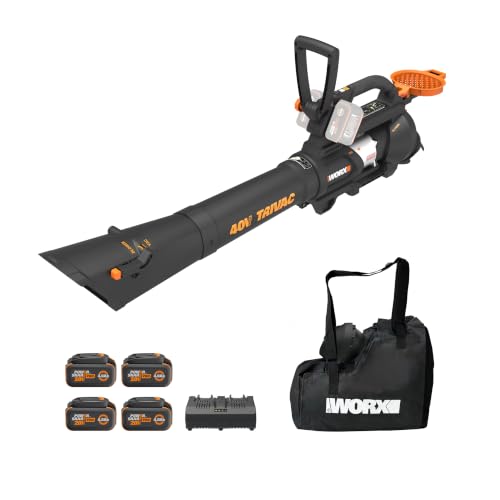
WORX Trivac 40V 3-in-1 Cordless Leaf Blower/Vacuum/Mulcher WG588.1 — Best Overall
This is the pick most households should end up with: a cordless blower that converts to a vacuum with a mulching impeller, on one of the large tool battery platforms. The WG588.1 states its case plainly — 600 CFM, a 20:1 mulching ratio (double the 10:1 floor this guide sets), a brushless motor, three-speed control, and four 4.0 Ah PowerShare batteries with charger in the box. If you already own WORX PowerShare batteries from a drill or mower, this is where your money goes furthest.
Strengths
- One tool blows, vacuums and mulches, so leaf season needs a single purchase
- Platform batteries are shared with other garden tools you may already own
- Mulching shrinks a bag of leaves to a fraction of its loose volume
Trade-offs
- Vacuum mode is slower than raking for very large, open lawns
- Battery runtime in vacuum mode is the shortest of the three modes
- Plastic impellers on budget models dislike stones and twigs
Conversion design is the detail that decides daily happiness. The good tools swap from blower to vacuum in under a minute without tools, keep the bag hanging comfortably from a shoulder strap, and put the speed control where a gloved thumb can reach it. The bad ones need a screwdriver and a YouTube video — and a tool that is annoying to convert is a tool that stays in blower mode while leaves rot on the path.
Mulching ratio is the second honest number. A 10:1 ratio means ten bags of loose leaves become one bag of mulch you can compost or bin; 16:1 designs exist and are worth it for gardens under mature trees. What the ratio never tells you is impeller material — metal impellers shrug off the odd twig and acorn, plastic ones chip, so wooded gardens should pay for metal.
Best for: most suburban gardens with a platform battery already in the shed / Not suited for: farms and very large plots where a petrol or backpack machine still rules

WORX WG512 Trivac 2.0 Electric 12-Amp 3-in-1 Vacuum Blower/Mulcher/Vac — Best Budget
The corded pick is the value anchor of this category: the WG512 Trivac 2.0 is a 12-amp mains-powered blower vacuum with variable speed and WORX’s LeafPro universal leaf collection system, which routes mulched leaves straight into a refuse bin — the bag-emptying chore, designed away. It suits small front gardens, courtyards and driveways within cable reach of an outdoor socket, and owners who would rather manage a cable than a stable of batteries. Runtime anxiety disappears; in exchange, the cable sets your boundary, and working around trees and furniture with a trailing lead is a skill you learn in the first hour.
Strengths
- Lowest purchase cost of any format, with no batteries to replace later
- Unlimited runtime for long autumn sessions
- Usually the lightest full-size format, which wrists appreciate
Trade-offs
- Cable reach limits you to gardens near a socket
- Trailing leads snag on furniture, pots and shrubs
- Not suited to wet-leaf work in the rain, like all mains tools outdoors
Judge corded models by cable management details: a built-in cable strain relief, a hook that keeps the plug from pulling out mid-pass, and a bag zip that opens wide. Those three things decide whether the tool feels like a bargain or a punishment by its third use.
Power figures on corded tools are more comparable than cordless marketing numbers, so use them: for vacuuming damp leaves off gravel and decking, torque at low speed matters more than peak blowing speed. A variable-speed dial you can feather is worth more than an extra burst of top-end air you will only use on dry leaves.
Best for: small gardens and courtyards within cable reach of a socket / Not suited for: large or awkwardly shaped gardens with no outdoor power

EGO Power+ LV5000 Leaf Vacuum and Mulcher with 500 CFM Blower — Best for Large Gardens
The EGO LV5000 covers the heavy cordless class built on the higher-voltage garden platforms — in EGO’s case the 56V Power+ system — sold for properties where a standard cordless runs out of breath or battery before the job is done. It is a dedicated leaf vacuum and mulcher with a 500 CFM blower, sold as tool only: battery and charger are not included, which is honest pricing for owners already on the platform and a real extra cost for everyone else. The tells of the class: sustained airflow figures quoted alongside peak figures, collection bags at the top of the size range, brushless motors, and batteries in the largest capacities the platform offers. It suits homes under mature trees, long driveways and anyone whose leaf season is measured in trailer loads rather than bags.
Strengths
- Sustained airflow moves wet, matted leaves that defeat lighter tools
- Large bags and strong mulching cut emptying trips
- Brushless motors handle long sessions without fading
Trade-offs
- Heaviest format — shoulder and arm fatigue on long jobs
- Batteries in this class are a serious investment on their own
- Still not a substitute for a backpack blower on acreage
Be honest about the weight. A high-voltage tool with its biggest battery and a full bag of damp mulch is a real load, and the last third of a big garden is cleared with tired arms. A shoulder strap for vacuum mode and a second battery rotating on the charger are not accessories in this class; they are how the job gets finished.
Also check the platform’s other large tools before committing. In this class the battery is the ecosystem — if the same platform powers a mower or chainsaw you plausibly need, the blower vacuum becomes the cheap part of the system, and the decision makes itself.
Best for: large gardens under mature trees with long leaf seasons / Not suited for: small plots where the weight and cost buy nothing

Sun Joe 24V IONMAX Work Shop Blower and Vacuum — Best for Patios and Decks
Blowers are the wrong instinct on hard surfaces — they scatter leaves off decking into the beds and blast gravel everywhere. This pick is the vacuum-first handheld: Sun Joe’s 24V IONMAX workshop blower and vacuum — light, quick to grab, with two speed modes, two debris bags and three tethered nozzles that work along decking boards, steps, garage floors and greenhouse paths. It suits balconies, patios, pool surrounds and the perpetual leaf drift in doorways and corners where a full-size tool is overkill. Many owners pair one with a simple blower rather than buying a convertible at all.
Strengths
- Collects rather than scatters on decking, gravel and steps
- Light enough for two-minute tidy-ups that actually happen
- Reaches corners and stairs a full-size vacuum cannot
Trade-offs
- Small bag or bin fills quickly under a heavy leaf fall
- Not a lawn tool — grass vacuuming is slow and clog-prone
- Suction drops sharply on wet leaves
The use case that justifies this class is frequency, not power. Leaves on a path are a daily small annoyance; a tool that takes twenty seconds to grab gets used daily, while the big convertible in the shed gets used monthly. If your leaf problem lives on hard surfaces, this light collector plus an occasional borrowed blower beats one heavy compromise.
Check the nozzle design before anything else: a flat, slightly flexible edge rides decking boards without catching, and a see-through collection bin tells you when to empty before suction fades. Those two details matter more than any airflow number in this class.
Best for: patios, decks, steps and balconies with constant leaf drift / Not suited for: lawns and beds, where blowing or raking is faster
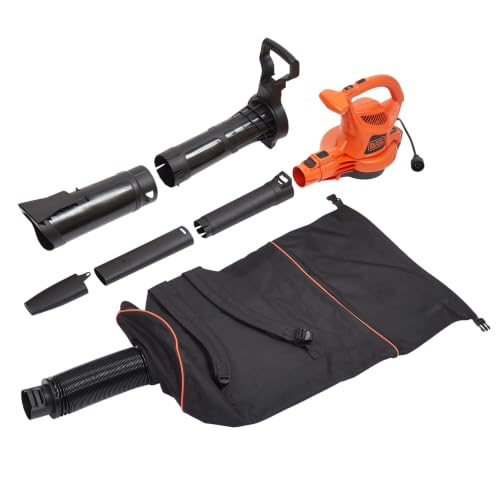
BLACK+DECKER 3-in-1 Leaf Blower, Leaf Vacuum and Mulcher with Backpack Bag (BEBL7000) — Best for Acreage
This pick exists to stop a common overspend in the wrong direction: no handheld blower vacuum, at any price, is the right primary tool for an acre or more of leaf fall. The BEBL7000 answers the scale problem differently — it is a corded 3-in-1 (250 MPH, 400 CFM) whose reusable collection bag is worn as a backpack, so the weight of a long vacuum session rides on both shoulders and the bag stops dictating your posture. It suits large gardens, long drives and shared grounds where leaf season is a logistics exercise rather than a chore, within reach of outdoor power.
Strengths
- Backpack format carries the weight on hips, not arms
- Moves leaf volume at a rate no handheld matches
- Blows, vacuums and mulches in one tool — no second machine to store
Trade-offs
- Corded power still ties you to outdoor sockets across a big property
- The backpack bag helps posture, but a full bag is still a real load
- Storage space and maintenance are real commitments
Scale honesty saves money twice: once by not buying a handheld that will be destroyed by a job it was never sized for, and again by not buying a backpack for a courtyard. Measure your leaf problem in bags per autumn. Single figures suit the convertible patterns above; dozens of bags point here.
If you do go this route, hearing protection and a collection plan come with it: where the piles go — compost, municipal green waste, a burning-free disposal route — decides your workflow more than the machine does.
Best for: properties with dozens of bags of leaf fall each autumn / Not suited for: any garden a convertible can clear in an afternoon

Greenworks 40V Leaf Blower / Vacuum, 340 CFM — Best Low-Noise
The last pick is for terraced streets, flats with shared gardens and anyone who clears leaves early: Greenworks’ 40V blower/vacuum is a cordless 3-in-1 of deliberately moderate output — 340 CFM with a 4.0 Ah battery and charger included — chosen for its low-speed manners rather than its peak blast. Electric tools are all quieter than petrol, but the spread inside the electric class is wide, and a tool that does its best work at moderate speed — good mulching, effective vacuum pickup without full throttle — is the one neighbours never complain about. It suits considerate owners in close housing and anyone who gardens at the edges of the day.
Strengths
- Electric running is far quieter than petrol equivalents
- Moderate-speed effectiveness suits early and late sessions
- Mulching keeps green-waste volume down in small bins
Trade-offs
- Peak power is traded away — wet drifts take patience
- Low-noise designs still whine at full throttle
- Runtime discipline matters on small batteries
Judge this class by what it does at half speed. Vacuum pickup of dry leaves, mulching quality and bag behaviour at moderate settings are the real specification; the top-speed figure is the one thing you are buying this class not to use. Reviews that only quote peak numbers tell you nothing about the tool you will actually live with.
Timing helps too: leaves vacuum best dry, and mid-morning after dew lifts is both the quietest-socially and the most effective window. A quiet tool used at a sensible hour is a combination no neighbour objects to.
Best for: close housing, shared gardens and early-morning gardeners / Not suited for: heavy wet leaf fall where full power is unavoidable
Comparison Table
| Pick | Badge | Key spec | Best for |
|---|---|---|---|
| WORX Trivac 40V WG588.1 | Best Overall | Cordless 3-in-1; 600 CFM, 20:1 mulching, brushless, 4 batteries included | most suburban gardens with a platform battery already in the shed |
| WORX WG512 Trivac 2.0 | Best Budget | Corded 12-amp 3-in-1; LeafPro collection system | small gardens and courtyards within cable reach of a socket |
| EGO Power+ LV5000 | Best for Large Gardens | 56V cordless; 500 CFM; battery and charger not included | large gardens under mature trees with long leaf seasons |
| Sun Joe 24V IONMAX Blower and Vacuum | Best for Patios and Decks | Vacuum-first handheld; 2 speeds, 2 debris bags, 3 nozzles | patios, decks, steps and balconies with constant leaf drift |
| BLACK+DECKER BEBL7000 | Best for Acreage | Corded 3-in-1; 250 MPH, 400 CFM, backpack collection bag | properties with dozens of bags of leaf fall each autumn |
| Greenworks 40V Blower / Vacuum | Best Low-Noise | Cordless 3-in-1; 340 CFM, 4.0 Ah battery and charger included | close housing, shared gardens and early-morning gardeners |
Short on time? Start with the Best Overall pick, then use the table to check whether a specialist badge matches your actual room, routine or household better before you check price on Amazon.
How to Choose the Best Leaf Blower Vacuums
Start with your surfaces, not with power. Leaves on decking, gravel, steps and beds need vacuum collection; leaves on lawns need blowing into piles or mowing up. Most gardens need both, which is why the convertible 3-in-1 is the default recommendation — but if your leaf fall is 90 percent lawn, skip the vacuum entirely and buy a better plain blower for the same budget.
Next, the power source. Corded tools are the value and runtime champions for small gardens near a socket. Standard cordless platforms suit most suburban plots and share batteries with your other tools. High-voltage cordless and petrol are for scale. The expensive mistake is buying a big platform for a small garden, or a small platform that needs three battery swaps to clear one autumn Saturday.
Then check the three specifications that predict satisfaction: mulching ratio (10:1 minimum, more for heavy tree cover), impeller material (metal for gardens with twig and nut fall), and conversion time between modes (tool-free, under a minute, or you will stop converting). A tool that scores on all three will be liked in year three; a tool bought on peak air speed alone usually is not.
Mulching Ratios and Impellers, Explained Honestly
A mulching ratio compares loose leaf volume to shredded volume: 16:1 means sixteen bags of whole leaves become one bag of mulch. The ratio is measured on dry leaves in test conditions, so treat it as a comparison between tools rather than a promise — wet leaves mulch worse on every machine. Even discounted, the difference between 8:1 and 16:1 is the difference between constant bag-emptying and finishing the garden on two bags.
Impellers do the shredding, and material is destiny. Plastic impellers are light and cheap and chip on stones, twigs and acorns — all of which arrive mixed into real leaf piles. Metal impellers cost more and weigh more and survive them. If your garden includes a gravel drive or nut-bearing trees, metal is not an upgrade; it is the requirement.
Batteries, Runtime and the Vacuum-Mode Trap
Every cordless runtime claim in this category is made in blower mode at gentle speed, because that is the flattering number. Vacuum mode works the motor harder, and mulching wet leaves harder still — expect real vacuum runtime to land well under the box figure. The sanity check is battery capacity in watt-hours divided by the tool’s working draw; sellers who publish both numbers are the ones not afraid of the arithmetic.
The practical answer for plots bigger than a courtyard is two batteries rotating — one working, one charging — which is why platform choice outranks tool choice. A blower vacuum on the platform of your mower and drill is a cheaper system than a marginally better tool on an orphan platform with one battery.
Noise, Weight and Working Like a Neighbour
Petrol blowers are the loudest tools in the garden and the reason some streets informally ban them before ten on Sundays. Electric tools are dramatically quieter, but full-throttle vacuum mode still carries, so the considerate pattern is dry leaves, mid-morning, moderate speed — which happens to be the most effective pattern too, since dry leaves vacuum and mulch best.
Weight deserves a test lift before purchase if you can manage one, with the biggest battery fitted and a mental bag of damp mulch added. Catalogue weights quote the bare tool. The last paths of a big garden are cleared by tired arms, and a kilogram saved at purchase is worth more than a small spec advantage on paper.
How to Vacuum and Mulch Leaves Without Clogging the Tool
Most clogs are technique, not machinery. Work this sequence and a mid-range tool outperforms a premium one used carelessly.
- Blow or rake leaves into loose, shallow piles on a hard surface first — vacuums pick up best from a surface, not from deep drifts on grass.
- Work on dry leaves whenever possible; if the fall is damp, wait for a dry mid-morning rather than forcing wet leaves through the impeller.
- Feed the nozzle at the edge of the pile in slow passes, letting the tool chew at its own pace instead of plunging it into the pile’s centre.
- Pause at twigs, stones and acorns: pick them out by hand or blow them aside — they are what chip impellers and jam housings.
- Empty the bag at three-quarters full; suction and mulching quality both fall off as the bag packs tight.
- Finish by running the tool empty for ten seconds to clear the housing, then store it dry with the bag unzipped and aired.
A bag of fresh leaf mulch is garden gold: spread it on beds as a winter mulch, layer it into compost with greener material, or bag it loosely to rot down into leaf mould. The mulching you did at the tool is what makes all three uses possible without a separate shredder.
Matching the Tool to Your Trees: A Leaf-Volume Audit
Before choosing any pattern in this guide, audit your leaf problem for one minute. Count your mature trees, note their species, and estimate bags of loose leaves per autumn. Oaks and planes drop late and heavy; birches drop light and early; conifers drop needles that vacuums dislike and blowers merely relocate. A garden under two small ornamentals and a garden under six mature oaks are different product categories wearing the same name, and most buying regret in this aisle is a mismatch between the two.
Species also decides mulching value. Oak, beech and hornbeam leaves rot into excellent mulch and leaf mould; horse chestnut and walnut are slower and best composted hot or collected by the council. If your trees produce the good mulching species, the vacuum-mulcher’s output is a garden input worth having — another reason the mulching ratio matters beyond tidiness.
Needles and pine cones deserve their own sentence: vacuum impellers hate cones, and needle mats are a rake-and-blow job. Gardens under pines should weight the blower half of any convertible and treat the vacuum as a path-and-patio tool only, which is precisely the vacuum-first pattern’s home ground.
The Second-Hand and Hire Options, Honestly Weighed
Leaf season is short, which makes this category unusually suited to hiring and sharing. A street or a family can split a high-quality convertible between three gardens and each clear leaves on a rota of autumn weekends — the tool works a dozen days a year in any case. Hire centres stock the heavy classes for the one-weekend blitz, which suits the backpack pattern’s job better than ownership for most households.
Second-hand purchases carry one specific risk here: impeller and housing wear is invisible from outside, and a mulcher that has eaten a season of stones may be near failure while looking tidy. If you buy used, run the vacuum mode before paying, listen for rattles that suggest impeller damage, and check the bag’s seams and zip — the bag is the consumable that reveals how the tool was treated.
Whichever route you take, the specification discipline of this guide still applies: mulching ratio, impeller material, bag size, conversion design. A shared or hired tool that meets the pattern serves better than an owned tool that does not.
A Worked Example: Specifying a Convertible for a Typical Suburban Garden
Take the common case: a back garden of a few hundred square metres, two mature trees, a patio, a gravel path and a lawn. The specification that serves it, following this guide’s patterns, reads like this — cordless convertible on the household’s existing battery platform; metal impeller, because the gravel path guarantees stones in the leaf stream; mulching ratio of at least 12:1, because two mature trees produce more volume than a 10:1 tool empties comfortably; bag in the upper size range with a wide zip; tool-free conversion, tested in the shop if possible.
Runtime planning completes the spec: two batteries, the larger capacity the platform offers, rotated across the session. With that set, the garden clears in one autumn morning — patio and path vacuumed, lawn blown into piles and the piles vacuumed up from the patio edge, bags of mulch to the compost. Every element of that morning traces to a specification decision, none of them the headline air speed.
Now shrink the garden to a courtyard and watch the spec change honestly: corded power, smaller bag, ratio less critical, weight paramount. The patterns in this guide are templates for this reasoning, and a reader who can re-derive the spec for their own garden no longer needs the linked edition at all — which is the point of publishing the method.
Seasonal Rhythm: Using a Blower Vacuum Across the Whole Year
Autumn is the headline act, but a blower vacuum earns its storage space across the calendar. Spring: vacuuming overwintered leaves from beds and gravel before mulching, and blowing paths clear of blossom fall. Summer: patio and deck tidying after storms, garage and greenhouse floors, and clearing grass clippings from paths after mowing — the vacuum-first pattern’s weekly work.
Winter is maintenance season for the tool itself: impeller inspected for the chips autumn dealt it, bag washed and dried, batteries stored at partial charge indoors rather than in a freezing shed, and the housing cleaned of the damp mulch that corrodes over months. Twenty minutes in January is the difference between a tool that starts its fifth autumn like its first and one that rattles into retirement.
Kept on that rhythm, a mid-tier convertible serves the better part of a decade. The category’s waste problem is not fragile tools; it is tools bought wrong — wrong platform, wrong impeller, wrong scale — and replaced while still working. Specify once, maintain lightly, and the leaf problem becomes the most solved problem in the garden.
Technique Masterclass: Clearing a Real Garden in One Session
Begin with the wind, because professionals do and amateurs pay for ignoring it. A light breeze is a free conveyor belt: blow with it and every pile travels further for the same battery; blow against it and you will re-clear the same leaves three times while the garden watches. On a still day, create the conveyor yourself by always working from the far boundary toward your collection point, so finished ground is never crossed by unfinished leaves again.
Divide the garden into the three material zones and work each with its own method. Hard surfaces — patio, paths, steps, the drive — are vacuum territory from the start: collect directly, mulch as you go, no intermediate piles. Beds are blow territory at gentle speed, lifting leaves out from around plants without blasting soil and mulch across the paths you just vacuumed; a hand rake beats any machine among delicate planting. Lawn is bulk territory: blow or rake everything onto the nearest hard surface and let the vacuum do the collecting there, where it is fast and clog-free.
Sequence the session to protect the machine. Dry leaves first, while the morning’s dew has lifted and before any rain; the damp drift in the shaded corner last, fed slowly, or left for tomorrow’s dry hour without guilt. Empty the bag at three-quarters, rotate the battery at the first fade rather than the final cough, and pick out the twigs and stones at each pile rather than through the impeller. None of this is talent — it is order, and order is what makes a mid-priced tool clear a garden like a premium one.
Finish with the two-minute close-down that decides next autumn: run the tool empty, brush out the housing, unzip and air the bag, and note — actually note, on the shed wall or a phone — which battery felt weaker and whether the impeller took a knock. Leaf season forgives almost everything except being forgotten about for eleven months, and the gardens that clear easiest each year belong to owners who treat the last session of one autumn as the first act of the next.
Value, Longevity and the Cost of a Clear Garden
Price a blower vacuum across its realistic decade: the tool, two batteries if cordless, one replacement bag, and the impeller inspection you may need after a stony season. Against that total, set the alternative costs — a gardener’s autumn visits, a separate shredder for leaf volume, or the slow cost of leaves rotting on paths and lawns through winter. Specified correctly, the convertible is not an indulgence; it is the cheapest of those options by a wide margin, which is why the specification matters more than the sticker.
Longevity in this category is impeller-deep. A metal impeller, fed with the shallow-pass technique this guide teaches and spared the gravel stream, can outlast the tool’s motor. A plastic impeller fed on stones may not outlast its second autumn. The price gap between the two at purchase is small; the lifespan gap is the product. Buy the impeller, and the rest of the tool follows.
And keep the receipt of your reasoning, not just the tool’s: the pattern you chose, the ratio and bag size you required, the platform you committed to. When the tool eventually retires, that note turns its replacement from a research project into a reorder — the final dividend of buying by specification instead of by season’s marketing.
Common Buying Mistakes
Vacuuming wet leaves
Wet leaves mat together, clog housings and mulch into sludge that rots in the bag. Patience — waiting for a dry spell — is the highest-performance accessory in this category, and it is free.
Buying on peak air speed alone
Blowing speed is the least relevant number for a vacuum-led tool. Mulching ratio, impeller material, conversion design and bag quality decide satisfaction; speed decides almost nothing after the first week.
Plunging the nozzle into deep piles
Deep feeding overwhelms the impeller and causes the clogs people blame on the tool. Shallow passes at the pile’s edge clear faster in total, with no stops to unjam.
Ignoring the platform when buying cordless
A lone tool with one small battery is a system designed to frustrate. Buy into the battery platform you already own, or budget for two batteries from day one.
Storing the tool with a full, damp bag
Damp mulch in a closed bag grows mould and corrodes fittings over winter. Empty, air the bag, and store dry — two minutes that doubles the bag’s life.
Final Recommendation
Most households should shortlist the cordless convertible pattern first — on their existing battery platform, with a metal impeller and a mulching ratio of at least 10:1 — and only move away from it for a stated reason: a small garden near a socket (corded), acreage (backpack), hard surfaces only (vacuum-first), or close neighbours (the quiet class).
Every linked pick above has passed exactly the filters the patterns describe — mulching ratio stated, conversion design, bag and battery honesty. When you judge any substitute listing, shop the specification, not the marketing — and if a listing will not state its mulching ratio, impeller material and bag size, that silence is itself a review.
Best Leaf Blowers Best Cordless Leaf Blowers Best Leaf Vacuums Best Garden Vacuums Best Electric Leaf Blowers Best Backpack Leaf Blowers
Frequently Asked Questions
Is a leaf blower vacuum better than a separate blower and rake?
For leaves on hard surfaces, beds and gravel, yes — vacuuming collects what raking scatters. For open lawn, a mower or plain blower is faster. Most mixed gardens are best served by the convertible 3-in-1, which is why it anchors this guide.
What mulching ratio should I look for?
At least 10:1 for a typical garden, and higher — 14:1 to 16:1 class — under mature trees with heavy fall. Treat ratios as comparisons between tools rather than exact promises, since they are measured on dry leaves.
Can I vacuum wet leaves?
You can try, and the tool will tell you not to: wet leaves clog, mulch badly and rot in the bag. Wait for a dry spell and the same job takes half the time with no unjamming stops.
Corded, cordless or petrol — which is right for me?
Corded for small gardens near a socket, cordless on a platform you own for most suburban plots, high-voltage cordless or petrol only when the leaf volume genuinely demands it. Scale honesty saves money in both directions.
How were the products in this guide verified?
Our rule is that linked picks must first be cross-checked against Amazon’s catalogue data for this site,. All six picks above passed that check on 2026-11-22, and each review also states the specification pattern the product satisfies, so you can judge a substitute listing by the same standard if stock changes.
Will a leaf vacuum pick up twigs and acorns too?
Small debris rides along, but twigs and nuts are what chip plastic impellers. Gardens with heavy twig and nut fall should choose a metal impeller and still clear the worst debris by hand first.
Can I use a leaf blower vacuum on gravel?
Vacuuming gravel is the classic impeller-killer: the tool cannot tell a leaf from a stone at speed. Blow leaves off gravel gently into a pile on a hard surface and vacuum them from there, or rake the gravel section by hand.
What happens to the mulched leaves — can I compost them?
Yes, and you should: mulched leaves compost far faster than whole ones. Mix them with greener material, keep the heap damp, or bag them loosely to rot into leaf mould for beds. The mulching at the tool is what makes small compost systems cope with autumn volume.
How long should a blower vacuum session take?
For a typical suburban garden worked in the order this guide describes — hard surfaces vacuumed, lawn blown to the patio, piles mulched — an autumn session runs one to two hours including bag emptying. Sessions that run twice that are usually fighting wet leaves, a clogging technique, or a tool undersized for the garden.
Can a blower vacuum damage plants or beds?
At full blast, yes: soil, mulch and seedlings all move. Work beds at gentle speeds, keep the blower nozzle moving, and switch to a hand rake among delicate planting. The vacuum should never be dragged across soil, where it will ingest stones and clog — collect from hard surfaces instead.
Should I wear ear protection with an electric model?
Electric tools are far quieter than petrol, but vacuum mode at working speed is still a sustained noise at arm’s length. Light ear protection is a reasonable habit for long sessions, and essential with any petrol machine — hearing damage is cumulative and this is a tool used for hours at a time.
Are battery leaf tools powerful enough for wet autumn leaves?
For most gardens, yes, with technique doing part of the work: dry-hour timing, shallow feeding and piles staged on hard surfaces let a mid-range cordless handle leaves that defeat a careless user of a stronger tool. The honest exception is the large, tree-heavy property, where this guide’s high-voltage and backpack patterns exist precisely because battery handhelds reach their limit.
How do I store leaf tools over winter?
Clean and dry, bag emptied and aired, impeller inspected, and cordless batteries brought indoors at partial charge rather than left in a freezing shed. Twenty minutes of winterising is the difference between a tool that starts its next autumn sharp and one that spends it being repaired.


