Disclosure: airfryerkitchensupply.com is reader-supported. When you buy through links on our site, we may earn an affiliate commission at no extra cost to you.
Where to Buy
All six chairs below were confirmed against the airfry the Amazon catalogue and carry Amazon links, so the model names here match the listings exactly. Use the links to check the current price on Amazon and to confirm seat dimensions and weight ratings, because for this search the measurements matter more than the photography: seat depth, seat width and how the front edge is shaped decide whether a chair feels kind at hour four, not how plush it looks at minute one.
- Steelcase Leap Office Chair — check price on Amazon
- HON Ignition 2.0 Ergonomic Office Chair — check price on Amazon
- SIHOO M18 Ergonomic Office Chair — check price on Amazon
- Marsail Ergonomic Office Chair — check price on Amazon
- Furmax Office Chair — check price on Amazon
- BestOffice Ergonomic Office Chair — check price on Amazon
Looking for the best chairs for sensitive bottoms usually means one thing in plain language: you sit for long stretches, and by mid-afternoon your current chair has become the loudest thing in the room. This guide treats that as a comfort problem to be solved with seat design — cushion construction, seat shape, adjustability and the freedom to shift position — and nothing more. It makes no medical claims, diagnoses nothing, and is not a substitute for advice from a clinician if sitting causes you actual pain. What it can do is explain, honestly, why some chairs feel gentle for eight hours and others feel fine in the showroom and miserable by Thursday.
The shortlist below is built from verified ergonomic office chairs, because that is where seat engineering actually lives: contoured foam seats, waterfall front edges that do not press into the backs of thighs, seat-depth and height adjustment that lets you set your feet flat and your weight evenly spread, and backrests that let you change posture instead of freezing in one. The premium pick is a genuinely high-end chair with a seat designed to flex with you; the budget picks trade some of that sophistication for honest foam and the adjustments that matter most. Between them sits a choice for most desks and most budgets.
In this guide
Quick Picks
- Steelcase Leap Office Chair — Best Overall Seat Comfort: The benchmark: a seat engineered to flex and move with you, with strong adjustability — the chair long-session sitters consistently end up at after cheaper experiments. Check on Amazon
- HON Ignition 2.0 Ergonomic Office Chair — Best Mid-Range All-Rounder: A business-grade chair with a proper cushioned seat and lumbar support, from a maker that furnishes whole offices — the sensible middle of this list. Check on Amazon
- SIHOO M18 Ergonomic Office Chair — Best Value With Headrest: A mesh-back chair with a cushioned seat, adjustable lumbar and a headrest at a wallet-friendly tier — the value pick that still respects long sessions. Check on Amazon
- Marsail Ergonomic Office Chair — Best High-Back Mesh Option: A high-back mesh chair with adjustable lumbar support: choose it knowingly — the suspended mesh seat story differs from foam, and this review explains who it suits. Check on Amazon
- Furmax Office Chair — Best Budget Foam Seat: The entry point of the list: a mid-back mesh chair with a padded seat and lumbar shaping at the lowest verified tier — basic, honest, and a real upgrade from a dining chair. Check on Amazon
- BestOffice Ergonomic Office Chair — Best Simple Spare-Room Pick: A straightforward mid-back swivel chair with lumbar support and a cushioned seat: the uncomplicated second chair for spare rooms, students and shared desks. Check on Amazon
How These Picks Were Chosen
We chose for seat comfort over long sessions, in this order: seat cushion construction (contoured, resilient foam or a seat engineered to distribute pressure beats a thin flat pad every time), seat dimensions that fit a range of bodies, a front edge shaped to avoid pressing on the underside of the thigh, and adjustments — height at minimum, seat depth and tilt where the budget allows — that let the sitter redistribute weight through the day. Every pick was confirmed through the site Amazon listing data before earning a link.
We excluded novelty seating, stools without back support for long sessions, and chairs whose listings hid basic dimensions. We also read mesh seats honestly: a suspended mesh seat distributes weight and breathes beautifully, but some sitters find its hammock feel firmer under the sit bones than a good foam cushion, and the reviews below say which is which rather than pretending one answer suits everyone. Comfort is personal; the guide’s job is to tell you what each seat actually feels like and why, so you can match it to your own sensitivity.
The 6 Best Chairs for Sensitive Bottoms

Steelcase Leap Office Chair — Best Overall Seat Comfort
The Leap earns the top of this list on seat engineering rather than luxury. Its verified listing describes an ergonomic work chair designed to support the body’s changing shape through the day, and the seat is the heart of it: a contoured cushion on a flexible foundation that subtly gives and redistributes as you shift, instead of presenting the same unchanging pressure map from nine to five. For a sensitive sitter, that micro-movement is the difference between a chair you forget and a chair you negotiate with. Height, depth and arm adjustments are all present and genuinely usable, so the seat can be set to your body rather than endured as delivered.
Strengths
- Seat flexes and redistributes pressure as you move
- Full adjustment set, including seat depth
- Built for daily, years-long office use
Trade-offs
- Premium price, plainly the highest here
- Heavier and more complex to set up well
- Cushion feel is supportive-firm, not sink-in soft
| Detail | What to know |
|---|---|
| Seat | Contoured cushion on flexible foundation |
| Adjustments | Height, seat depth, arms, recline |
| Use | Full-time office seating |
Living with the Leap teaches a lesson this whole category illustrates: the kindest seat is rarely the softest one. Very soft cushions let you sink until your weight concentrates exactly where you least want it; a well-shaped, resilient seat spreads the load and keeps spreading it at hour seven. The Leap is the most complete expression of that principle we could verify, and for someone whose workday is a single long sit, it is the pick most likely to end the search. Buy it once, set it up slowly and properly, and expect it to outlast several budget chairs — which is also its economic defence.
Best for: Long-session desk workers who want the best verified seat engineering / Not suited for: Buyers wanting a plush, sink-in lounge feel
Check on Amazon — check the current price on Amazon before ordering, and confirm size, colour and configuration on the listing.

HON Ignition 2.0 Ergonomic Office Chair — Best Mid-Range All-Rounder
The Ignition 2.0 is what offices buy when a facilities manager, not a marketer, is choosing: a cushioned seat with real substance, an ergonomic back with lumbar support, and adjustments that cover the essentials without theatre. Its verified listing confirms the ergonomic brief — lumbar support, adjustable arms, a desk chair built for working days. For sensitive sitters its virtue is balance: the seat foam is supportive rather than hammock-like, the front edge is sensibly shaped, and the chair’s proportions fit a wide range of bodies without anyone feeling perched or swallowed.
Strengths
- Substantial cushioned seat with even support
- Lumbar support and adjustable arms
- Office-grade build at a mid-range tier
Trade-offs
- Seat is firmer than lounge-style chairs
- Fewer fine adjustments than the Leap
- Utilitarian looks: it reads as office furniture
| Detail | What to know |
|---|---|
| Seat | Cushioned, contoured |
| Support | Adjustable lumbar |
| Arms | Adjustable |
Choose the Ignition if you want one chair that behaves itself for years of mixed use — desk work, video calls, the occasional long spreadsheet evening — without the flagship price. Its comfort is the quiet kind: nothing about it announces itself at minute one, and nothing about it complains at hour six, which is exactly the profile a sensitive sitter should shop for. Set the height so your feet rest flat and your thighs sit level, keep the lumbar support in contact with your back’s curve, and it will do the rest without further negotiation.
Best for: Home-office workers wanting office-grade comfort without flagship cost / Not suited for: Sitters who prefer a very soft, deep cushion
Check on Amazon — check the current price on Amazon before ordering, and confirm size, colour and configuration on the listing.

SIHOO M18 Ergonomic Office Chair — Best Value With Headrest
The M18’s formula is the one value buyers actually need: spend the money on the seat and the lumbar, economise on the frame’s jewellery. Its verified listing confirms an ergonomic mesh-back design with headrest, adjustable lumbar support and a substantial weight rating. The seat itself is a proper cushion rather than mesh — the right call for this search, since a foam seat’s give is what most sensitive sitters are shopping for — while the mesh back keeps air moving through long summer afternoons. The headrest, often a gimmick, earns its place for readers who lean back to read or take calls between typing bouts.
Strengths
- Cushioned seat with mesh, breathable back
- Adjustable lumbar support and headrest included
- Strong value: the adjustment set exceeds its tier
Trade-offs
- Armrests are 2D rather than fully adjustable
- Mesh back feel is not for those who want back cushioning
- Assembly and initial setup take some patience
| Detail | What to know |
|---|---|
| Seat | Cushioned |
| Back | Mesh with adjustable lumbar |
| Extras | Headrest; 2D armrests |
The M18 is the chair we would hand to a home worker upgrading from a dining chair on a budget: the improvement in seat kindness is immediate and the adjustment range lets you dial it in over the first week rather than accepting the factory’s idea of a body. Be honest about its ceiling — the materials and mechanisms are built to a price, and a decade of daily use is a lot to ask — but within a sensible service life it delivers the core comfort this search asks for at the friendliest verified price in the upper half of this list.
Best for: Budget-conscious home workers wanting a cushioned seat and headrest / Not suited for: Buyers expecting flagship materials at this tier
Check on Amazon — check the current price on Amazon before ordering, and confirm size, colour and configuration on the listing.

Marsail Ergonomic Office Chair — Best High-Back Mesh Option
Marsail’s chair represents the mesh-seat school in this guide, and it is included with the school’s trade-offs stated plainly. Its verified listing describes a high-back mesh chair with adjustable lumbar support, built as a rolling swivel task chair. A mesh seat suspends you rather than cushioning you: pressure spreads across the whole suspended surface, air circulates freely, and there is no foam to compress flat over the years. Many sitters — especially warm ones, and those who dislike foam’s initial sink — find that genuinely comfortable for long sessions.
Strengths
- Suspended mesh seat: no foam to flatten over time
- High back with adjustable lumbar support
- Excellent airflow for warm rooms and warm sitters
Trade-offs
- Mesh hammock feel is firmer under the sit bones for some
- Heavier sitters may feel the frame’s front edge
- Not the pick for those who know they prefer foam
| Detail | What to know |
|---|---|
| Seat | Suspended mesh |
| Back | High-back mesh |
| Support | Adjustable lumbar |
The honest dividing line is this: if your sensitivity is to heat, stuffiness and the slow flattening of cushions, the Marsail’s mesh is a feature; if your sensitivity is to firmness under the sit bones, it is the wrong school and the foam-seated picks above will serve you better. Neither answer is a defect in the chair. Try to sit in any mesh chair before committing if you can, because this is the one comfort quality that descriptions convey worst. For mesh believers, the Marsail delivers the format with the lumbar adjustability that makes it a working chair rather than a perch.
Best for: Warm sitters who prefer suspended mesh to foam / Not suited for: Sitters who know firmness under the sit bones bothers them
Check on Amazon — check the current price on Amazon before ordering, and confirm size, colour and configuration on the listing.
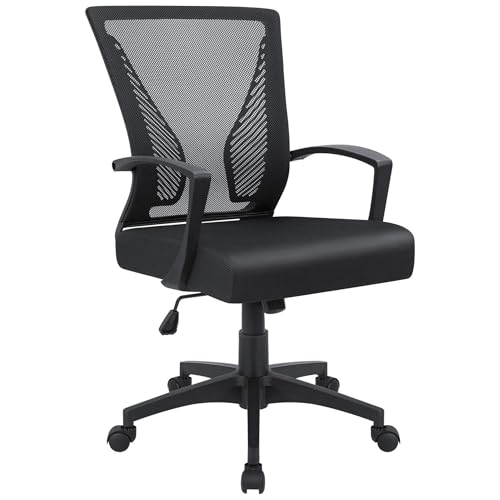
Furmax Office Chair — Best Budget Foam Seat
The Furmax is the chair thousands of home offices actually run on, and its verified listing confirms the essentials: an ergonomic mid-back design with lumbar support, adjustable height and a breathable backrest, over a padded seat. That padded seat is why it belongs in this guide despite its price: for a sensitive sitter on a strict budget, a simple foam cushion with a sensible shape beats a thin designer pad or a wooden seat every hour of the working week. The back is mesh, the arms are fixed in position on typical configurations, and the whole chair asks little of its owner beyond assembly.
Strengths
- Lowest verified price in this guide
- Padded seat with lumbar-shaped back
- Simple, light and easy to live with
Trade-offs
- Foam is thinner than the premium picks and will age sooner
- Fixed arms limit fine-tuning
- Mid-back: no head or upper-back support for reclining
| Detail | What to know |
|---|---|
| Seat | Padded |
| Back | Mesh mid-back |
| Adjustment | Height |
Set expectations by tier and the Furmax satisfies: it is a two-to-four-year chair for daily home use, not a decade chair, and its cushion will gradually lose the resilience that makes it kind. Within that life it is a rational, comfortable buy, and a dramatically better place to spend a working day than the kitchen chair it usually replaces. If your budget stretches, the SIHOO above buys a better seat and a headrest; if it does not, the Furmax plus the standing-and-moving habits in the how-to section below will still transform your afternoons.
Best for: First home-office setups on a strict budget / Not suited for: Buyers wanting a decade-long flagship chair
Check on Amazon — check the current price on Amazon before ordering, and confirm size, colour and configuration on the listing.
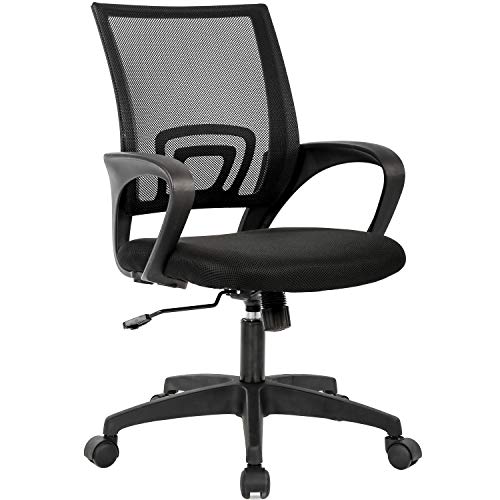
BestOffice Ergonomic Office Chair — Best Simple Spare-Room Pick
BestOffice’s chair closes the list as the simple option: a verified ergonomic mid-back swivel design with lumbar support and adjustable height, a cushioned seat, and no ambitions beyond being a decent place to sit for a working day at the lowest tier. It competes head-on with the Furmax, and the honest difference is in details of proportion and finish that vary by production run; both deliver the same core proposition of foam seat plus mesh back plus height adjustment for very little money.
Strengths
- Very low tier price with the essential adjustments
- Cushioned seat and lumbar-supporting back
- Light, simple and quick to assemble
Trade-offs
- Thinnest cushioning in this guide
- Basic arms and mechanisms
- A consumable-grade chair: plan on a few years, not a decade
| Detail | What to know |
|---|---|
| Seat | Cushioned |
| Back | Mesh mid-back |
| Adjustment | Height; swivel |
Choose between this and the Furmax on the day’s price and the seat dimensions that suit your body; choose either knowing what tier you are in. For a student desk, a spare-room workstation or a first job’s home setup, this class of chair is the correct spend — the money saved versus mid-range picks is better kept for the day your sitting hours justify the SIHOO or the HON. And whichever budget chair you buy, the setup steps in the how-to section matter more than the badge: height set right, feet flat, screen raised so you are not perching forward onto the seat’s front edge.
Best for: Students, spare rooms and shared desks on a minimal budget / Not suited for: Full-time long-session workers (look up-list)
Check on Amazon — check the current price on Amazon before ordering, and confirm size, colour and configuration on the listing.
Comparison Table
| Pick | Badge | Key spec | Best for |
|---|---|---|---|
| Steelcase Leap Office Chair | Best Overall Seat Comfort | Flexible contoured seat; full adjustments | Long-session desk workers who want the best verified seat engineering |
| HON Ignition 2.0 Ergonomic Office Chair | Best Mid-Range All-Rounder | Cushioned seat; lumbar support | Home-office workers wanting office-grade comfort without flagship cost |
| SIHOO M18 Ergonomic Office Chair | Best Value With Headrest | Cushioned seat; mesh back; headrest | Budget-conscious home workers wanting a cushioned seat and headrest |
| Marsail Ergonomic Office Chair | Best High-Back Mesh Option | Mesh seat and back; adjustable lumbar | Warm sitters who prefer suspended mesh to foam |
| Furmax Office Chair | Best Budget Foam Seat | Padded seat; mesh mid-back | First home-office setups on a strict budget |
| BestOffice Ergonomic Office Chair | Best Simple Spare-Room Pick | Cushioned seat; mid-back swivel | Students, spare rooms and shared desks on a minimal budget |
Read the table as a shortlist, not a ranking: the right row is the one whose key spec matches the problem you described at the start, and the full reviews above explain where each pick gives ground as well as where it wins.
How to Choose a Chair When Your Bottom Is the Critic
Start with the seat, and interrogate it like a sceptic. Cushion construction matters more than cushion thickness: a moderate layer of resilient, contoured foam will still be spreading your weight kindly in year two, while a very thick, soft pad often feels luxurious for a week and then compresses into a hard-based hammock that concentrates pressure. If a listing brags about softness, be suspicious; if it describes contouring, density and a shaped front edge, it is speaking the right language. The front edge deserves its own look: a waterfall edge that curves down and away avoids a hard ridge pressing into the underside of your thighs, a detail that matters more with every hour of the session.
Dimensions come next, and they are personal. Seat depth should let you sit with your back against the backrest and a small gap — two or three fingers — between the seat edge and the back of your knees. Too deep, and you must choose between slouching forward or having the edge press into your legs; too shallow, and your thighs lose support and your weight concentrates. Seat height must let your feet rest flat with thighs roughly level; dangling feet drag your weight forward onto exactly the areas you are trying to protect. Adjustable seat depth, found on the Leap and approximated elsewhere by sitting position, is the premium feature most worth paying for in this category.
Finally, plan for movement, because no chair — at any price — makes eight motionless hours kind. Tilt mechanisms that let you recline slightly and shift your weight’s distribution, armrests that take some load through your forearms when set at the right height, and a backrest that supports more than one posture all extend the time a chair stays comfortable. Judge chairs as systems for changing position gracefully, not as thrones for holding one position perfectly, and your shortlist will sort itself the way this guide’s did.
Foam, Mesh and Add-On Cushions: An Honest Comparison
Foam seats are the default recommendation for this search because their give is controllable: a good foam seat meets you, spreads the load, and pushes back evenly. Their weakness is time — foam compresses with use, fastest in cheap chairs — and heat, since foam insulates. Mesh seats invert the trade: nothing to compress, superb airflow, a suspended feel that many love, and a firmer, hammock-like pressure pattern that some sensitive sitters find concentrates under the sit bones and never quite lets them settle. Neither is objectively better; they are answers to different complaints, which is why this guide carries both schools and labels them.
Add-on seat cushions are the third option and deserve a fair hearing: a well-shaped aftermarket cushion can rescue a chair whose frame and back you like but whose seat has flattened, and it is a far cheaper experiment than a new chair. Two cautions apply. A cushion raises your sitting height, which can break your desk ergonomics — feet, knee angle and armrest alignment all shift, and the chair’s own lumbar support no longer meets your back where it was designed to. And a cushion on a badly shaped seat inherits the bad shape. Use cushions as a targeted fix or a trial, not as a way to avoid ever buying a seat that fits.
Whichever school you choose, give any new chair a fair trial of full working days before judging it, and adjust it in small steps over the first week. Bodies adapt to a new pressure pattern over days, and the chair that felt strange on Monday is often the chair you stop noticing by Friday — which, for this search, is the highest praise a chair can earn. And a boundary worth repeating: this guide addresses everyday sitting comfort only. Persistent pain, numbness or symptoms that worry you are a conversation for a medical professional, not for a buying guide.
Setting Up Your Desk Around the Chair
A kind chair can be defeated by the desk around it, and the commonest saboteur is screen height. A monitor set too low pulls your head and shoulders forward; your weight slides towards the seat’s front edge; and the carefully chosen cushion ends up supporting the wrong posture. Raise the screen so its top is near eye level, bring it close enough that you are not leaning in, and your weight settles back into the seat and backrest as designed. The second saboteur is a desk at the wrong height, which no chair adjustment can fully cancel: if your feet dangle with the chair set for your arms, a footrest restores the geometry; if your knees jam under the desk with your feet flat, the desk — not the chair — has to change.
Armrest height is the quiet variable. Set correctly, armrests carry a share of your upper body’s weight through your forearms and let your shoulders drop; set too high they shrug your shoulders all day, and too low they are decoration. On chairs with fixed arms, your desk height has to do the compromising. None of this requires new purchases beyond perhaps a footrest and a monitor riser, and together these adjustments routinely deliver more afternoon comfort than the difference between two chairs in this guide. Do the setup before you judge the seat.
The Habit Layer: Movement Breaks and Sitting Variety
Every ergonomist’s honest advice, and the advice this guide endorses, is that the best posture is the next posture. Build small movements into the working day: stand for calls, walk for water, shift your recline angle between tasks, and let the chair’s tilt do some of the work by unlocking it rather than fixing it rigid. A chair with a free-flowing tilt turns fidgeting from a distraction into a feature, periodically reloading your weight onto different tissue and giving every area a rest in rotation. That is the deeper reason the Leap tops this list: its whole design assumes a moving sitter.
Variety helps beyond the desk chair too. A household that rotates between the desk chair, a firmer kitchen chair for short tasks, and standing for calls spreads the day’s sitting across different pressure patterns, and many sensitive sitters find the rotation itself is the cure they were shopping for. If you take one idea from this guide besides a chair, take that: buy the best seat you can, set it up properly, and then refuse to spend the whole day in it, however good it is.
Weight Ratings, Casters and the Details That Decide Year Three
Two specifications rarely photographed decide how a chair ages. The first is the weight rating, which is really a statement about the gas lift, the base and the foam’s density: a sitter near a chair’s limit will compress its cushion faster and work its lift harder, so heavier sitters should shop the upper part of this list — the SIHOO’s generous rating and the business-grade HON and Leap — rather than the budget pair, whose ratings and foam are sized for lighter use. This is engineering, not judgement: matching the load to the design is what makes any chair stay comfortable instead of gradually becoming the problem it was bought to solve.
The second is what the chair rolls on and stands on. Hard casters on hard floors wander, making you brace subtly all day; soft casters on carpet drag, making every shift an effort. Many chairs accept replacement casters, and swapping to floor-appropriate ones is a small, unglamorous upgrade that sensitive sitters feel immediately, because a chair that stays where you put it stops asking your body to hold it there. Likewise a metal base’s quiet rigidity versus a flexing nylon base changes how settled the seat feels. None of this appears in headline marketing, and all of it appears in your third year of ownership.
Trying Before You Commit: A Realistic Trial Protocol
Office chairs are among the hardest products to judge online, because the variable being sold — your body’s response over time — cannot be photographed. A realistic trial protocol helps. When the chair arrives, assemble it fully, set it up by the steps in this guide, and then work in it for at least three full working days before forming a verdict, adjusting one variable per day. Day one’s impressions are dominated by novelty and by contrast with your old chair; by day three you are feeling the chair itself. Keep the packaging until the trial ends, and buy from listings with workable returns, because even a well-chosen chair can simply not fit your particular proportions.
During the trial, pay attention to timing. Note when in the day you first become aware of the seat. A chair that keeps you unaware until mid-afternoon is performing well even if it never feels luxurious; a chair you notice at ten in the morning is telling you something no amount of adjustment rhetoric will fix. Also test the positions you actually use — typing, calls, reading, the lean-back think — rather than an idealised upright pose. The chair that serves your real postures is the right chair, and this guide’s picks were chosen for exactly that range of real use.
Second Chairs, Shared Desks and Household Realities
Many households do not have one sitter per chair; they have a desk that several people use in shifts, with bodies of different heights and weights. For a shared desk, adjustability range matters more than any single comfort feature: the chair that wins is the one whose height, lumbar and arms can be reset in seconds by each user, and whose settings are marked or memorable enough to actually be reset. The mid-list picks serve this life well. A flagship chair tuned to one person’s body over a week of tweaking can be the worst shared chair in the house if nobody else can find its settings again.
Budget pairs like the Furmax and BestOffice earn a specific role here: as the second chair. A household with one long-session worker and one occasional desk user does not need two mid-range chairs; it needs one good seat where the hours are, and an honest budget seat where they are not. That allocation — money following sitting hours rather than spread evenly — is the household version of this guide’s whole philosophy. Spend where the sensitivity and the hours actually live, economise where they do not, and let the setup steps and movement habits carry the rest.
What to Do With the Old Chair
The chair you replace still has a role in a well-arranged house. Demote it rather than discarding it: a tired office chair remains perfectly serviceable for short sessions — hobby desks, sewing tables, the homework corner — where its flattened cushion is asked for twenty minutes rather than eight hours. Rotating a demoted chair into short-session duty is also the practical test of this guide’s central claim: if the old chair feels fine for short sits and dreadful for long ones, the problem was always cumulative pressure, and your new chair’s job is precisely to delay that accumulation. Keep the old chair in that light duty and it will confirm, every week, that the upgrade was money correctly spent.
How to Set Up Your Chair for a Long Working Day
Ten minutes of methodical setup, in this order, will do more for your comfort than a week of random knob-turning.
- Set seat height first: sit down, feet flat on the floor, thighs roughly level or sloping very slightly down. If your feet do not reach comfortably, plan a footrest rather than lowering into a perch.
- Set seat depth where your chair allows it: back against the backrest, two to three fingers of gap between the seat’s front edge and the back of your knees.
- Bring the lumbar support into gentle contact with your back’s natural curve: it should meet you, not push you. If it feels like a fist, it is too far forward or too high.
- Set armrests so your forearms rest lightly with shoulders relaxed and elbows near a right angle; if the arms are fixed and wrong, favour the seat and desk geometry and rest your arms on the desk.
- Unlock the tilt and set its tension so you can lean back with gentle pressure and return upright without effort; then actually use the recline between tasks.
- Raise your screen to near eye level and set your keyboard so your wrists float level; recheck your feet and thighs after moving the screen, because posture is one connected chain.
- After an hour of real work, note where you feel the chair and adjust one variable at a time over the first week. Small, single changes teach you what your body actually wants.
Write down your final settings once you are happy — heights and depths get knocked in cleaning and by other users, and a note in a drawer restores your setup in a minute instead of another week of tweaking.
Common Buying Mistakes
- Buying the softest cushion. Deep soft foam bottoms out and concentrates pressure. Resilient, contoured support stays kind for years; marshmallow does not.
- Ignoring seat depth. A seat that reaches the back of your knees forces a slouch or a perch. Depth fit is as important as cushion quality, and less adjustable on cheap chairs.
- Locking the tilt rigid. A fixed upright chair freezes one pressure pattern all day. A gentle, usable recline is a comfort feature, not a luxury.
- Judging a chair in five minutes. Showroom impressions invert over a working week. Foam that feels firm at first often wins by Friday; plush often loses. Trial in days, not minutes.
- Blaming the chair for the desk’s faults. Low screens and wrong desk heights drag you onto the seat’s front edge. Fix the geometry before replacing the chair.
- Expecting a chair to fix pain. Comfort shopping is legitimate; medical problems are not a chair’s brief. Persistent pain or numbness needs professional advice, full stop.
Final Recommendation
If the budget allows one purchase that ends the search, it is the Steelcase Leap: its seat is engineered around exactly the problem this search describes, in comfort terms. The HON Ignition 2.0 is the sensible business-grade middle, the SIHOO M18 the value pick that still takes seat and lumbar seriously, and the Marsail the honest mesh alternative for sitters who prefer suspension to foam. The Furmax and BestOffice chairs close the list as legitimate budget starting points — thinner cushions, shorter lives, and still a transformation compared with the dining chair most people are upgrading from.
Whichever you choose, do the ten-minute setup, give it a week of real days, and keep moving through the day. A chair can be kind; only variety can be kind all day long.
And if you do only one thing before ordering, measure: your desk height, the seat depth of the chair you are replacing, and the gap behind your knees as you sit in it now. Those three numbers will steer you to the right row of the comparison table faster than any review, including this one.
Related guides on this site: Best Office Chairs For Long Hours Best Ergonomic Office Chairs Best Office Chair Cushions Best Chairs For Home Office Best Mesh Office Chairs
Frequently Asked Questions
What makes a chair comfortable for long sitting, in plain terms?
A resilient, contoured seat that spreads your weight instead of letting it concentrate, a front edge that does not press into your thighs, dimensions that fit your body, and adjustments — plus a tilt — that let you change position through the day. Softness alone is not on the list, because very soft seats bottom out within the hour.
Is a mesh seat or a foam seat better for a sensitive bottom?
It depends on the complaint. Foam gives a controlled, cushioned pressure pattern and suits most sitters; mesh suspends and breathes, suits warm sitters and those who dislike foam, but feels firmer under the sit bones to some. This guide carries both schools and labels them so you can choose by your own history with each.
Can a seat cushion fix my existing chair?
Sometimes — if the chair’s frame, back and dimensions suit you and only the seat has flattened, a good cushion is a cheap, effective fix. Remember it raises your sitting height and shifts your relationship to the desk and the chair’s lumbar support, so recheck your whole setup after adding one.
How long should a good office chair last?
Business-grade chairs like the Leap and the HON are built for many years of daily use; budget chairs in this guide are realistically two-to-four-year propositions before their foam tires. Judge value per year of comfortable service, not by purchase price alone.
What seat depth do I need?
Enough to support most of your thigh while leaving two to three fingers of clearance behind your knees when your back is against the backrest. If chairs consistently feel like they are pushing you forward or digging behind your knees, seat depth — not cushion softness — is your problem.
When should I stop shopping and see a professional?
If sitting causes persistent pain, numbness, tingling or symptoms that are getting worse, a chair is not the answer and this guide is not the place: please talk to a medical professional. Everything here addresses ordinary sitting comfort for otherwise healthy sitters.
Do I need a chair with a headrest?
Only if you regularly lean back to read, think or take calls; for upright typing it contributes nothing. The SIHOO M18 includes one at a value tier, which makes it the natural pick if your work mixes typing with reclined reading. If you never recline, spend the same money on a better seat instead.
Why does my chair feel fine in the morning and awful by evening?
Because sitting comfort is cumulative: the same pressure pattern, held for hours, gradually becomes the whole story. That pattern points to movement and setup before it points to shopping — unlock your tilt, vary your posture, stand regularly — and if the pattern survives those fixes, it is telling you the seat’s shape or depth does not fit you, which is a legitimate reason to change chairs.
Are gaming chairs a good alternative?
Most gaming chairs prioritise a bolstered, bucket-seat look over the flat, adjustable seat geometry long work sessions need, and their cushions are often firm in the wrong places. A few are genuinely comfortable, but as a class they are a weaker bet for this search than the ergonomic office chairs in this guide, which is why none appears anywhere in this particular guide at all, despite their popularity with streamers and younger buyers in bedrooms everywhere today.
How do I clean and care for the seat?
Vacuum fabric and mesh seats weekly with an upholstery attachment, blot spills immediately rather than scrubbing them, and keep foam cushions out of prolonged direct sunlight, which ages foam and fabric alike. Five minutes a week is all the maintenance any chair in this guide asks for.


