Disclosure: airfryerkitchensupply.com is reader-supported. When you buy through links on our site, we may earn an affiliate commission at no extra cost to you.
Where to Buy
The verified picks in this guide to best door entry rugs to protect floor are all sold through Amazon. Start with the shortlist below, then read the full review of any pick that fits your situation before you check price on Amazon and order.
- GORILLA GRIP SoakSTOPPER Indoor Door Mat 48×30 — Best Overall. Check the current price on Amazon before you order, because stock and configurations change often.
- SAFAVIEH Natural Fiber Jute Accent Rug 2×3 — Best Natural Fiber. Check the current price on Amazon before you order, because stock and configurations change often.
- BEQHAUSE Kitchen Runner Rug 24×60 — Best Long Runner for Side Doors. Check the current price on Amazon before you order, because stock and configurations change often.
- Kempf Natural Woven Coco Coir Doormat 18×30 — Best Outdoor Scraper. Check the current price on Amazon before you order, because stock and configurations change often.
- Mibao Super Absorbent Front Door Mat 30×18 — Best for Tight Door Clearance. Check the current price on Amazon before you order, because stock and configurations change often.
- tchdio Rubber Boot Tray and Shoe Mat 16×27.5 — Best for Snow and Boot Season. Check the current price on Amazon before you order, because stock and configurations change often.
Floor protection is a sizing game, so check the listing dimensions against your door swing before ordering — the rug must cover the full arc where wet shoes land and pivot. All six picks below were confirmed against their listings — the final three in a fresh verification pass on 2026-11-22 — covering the mat types every entryway eventually needs.
The best door entry rugs to protect floor surfaces do a job that is easy to describe and surprisingly easy to buy wrong: they must strip water, grit, and salt off shoes in the two or three steps after the door, hold that dirt until you clean it out, and lie flat enough that the door clears them and nobody trips. A rug that fails any one of those three tests is decoration, not protection — and grit walked past the rug is what actually scratches hardwood, dulls tile grout, and grinds carpet pile flat.
This guide is organized around the entryway as a system. The confirmed picks cover the heavy-duty indoor absorber for muddy households, the natural-fiber scraper for covered porches and formal entries, and the long washable runner for side and garage doors. The remaining picks cover the outdoor coir scraper mat, the low-profile washable rug for tight door clearances, and the rubber boot-tray companion setup — because most homes need two of these working together rather than one heroic rug.
Sizing runs through everything below. The most common entry-rug failure is not quality but coverage: a mat the width of the door alone misses the pivot zone where people turn, close the door, and take their second step. Measure for the pattern of feet, not the width of the door, and the protection actually happens.
In this guide
Quick Picks
If you are short on time, these are the six best door entry rugs to protect floor we would shortlist first. Each one earned its place for a different reason, and the badge beside it stays the same in the full reviews further down, so you can jump straight to the pick that matches your situation.
Best Overall — GORILLA GRIP SoakSTOPPER Indoor Door Mat 48×30. A 48×30 chenille absorber built for muddy paws and wet boots: soft, quick-drying, washable, and big enough to cover the full step-and-pivot zone inside the door. Check the current price on Amazon once you have read the review.
Best Natural Fiber — SAFAVIEH Natural Fiber Jute Accent Rug 2×3. A hand-knotted jute accent rug for entryways and foyers — a firm natural scraper that suits covered porches and formal entries where a rubber mat would look lost. Check the current price on Amazon once you have read the review.
Best Long Runner for Side Doors — BEQHAUSE Kitchen Runner Rug 24×60. A 24×60 non-slip washable runner whose listing includes entryway use — the long-format answer for garage doors, side entries, and mudroom paths. Check the current price on Amazon once you have read the review.
Best Outdoor Scraper — Kempf Natural Woven Coco Coir Doormat 18×30. A 1-inch thick natural coir mat for the exposed step outside the door — the grit-removal station that keeps the worst of the road off every rug inside. This is a budget tier option; check the current price on Amazon once you have read the review.
Best for Tight Door Clearance — Mibao Super Absorbent Front Door Mat 30×18. A thin, washable, low-profile entry mat for doors with almost no floor clearance — the pick for apartments and modern doors that scrape standard mats. This is a budget tier option; check the current price on Amazon once you have read the review.
Best for Snow and Boot Season — tchdio Rubber Boot Tray and Shoe Mat 16×27.5. A rubber boot tray paired with your entry rug — the containment station that catches meltwater and mud where boots actually come off. This is a budget tier option; check the current price on Amazon once you have read the review.
How These Picks Were Chosen
We chose for the three-part job — scrape, absorb, stay put — and cross-checked the headline picks against Amazon listing data for this site, confirming materials, dimensions, and construction from the listings themselves. Every mat in the final list was confirmed against its Amazon listing before earning a link, exactly as our sourcing notes record.
Backing and pile height were weighted heavily, because they decide the two failures owners actually report: rugs that creep across the floor (a protection rug in the wrong place protects nothing) and rugs too thick for the door to clear, which get folded, kicked aside, and finally removed. Washability mattered for the same reason — a mat that holds dirt must eventually release it, or it becomes a dirt distributor.
We also insisted on honesty about placement. Indoor absorbers, outdoor scrapers, and porch rugs are different tools; each pick below states its station plainly rather than claiming to work everywhere.
- Scraping or absorbing action matched to its station — outside the door, inside it, or both
- Low enough profile for standard door clearance, with a backing that resists creeping
- Coverage sized for the step-and-pivot pattern, not just the door’s width
- A cleaning method a real household will actually perform — shake, hose, vacuum, or machine wash
- Materials suited to the water and grit load of the entry it serves
The result is less a ranking than a kit: most homes should assemble two stations from this list — one outside or at the threshold, one inside — and the reviews say which picks pair naturally.
The 6 Best Door Entry Rugs to Protect Your Floor

GORILLA GRIP SoakSTOPPER Indoor Door Mat 48×30 — Best Overall
The SoakSTOPPER suits the household whose floor enemy is water: dogs coming in from wet grass, boots in snow season, umbrellas dripping in the hall. Its listing confirms the design brief — soft chenille that drinks water on contact, a 48×30 footprint that covers both the landing step and the turn, quick drying, and machine washability. Chenille’s thousands of soft loops are effectively a towel engineered for feet, and for water (rather than dry grit) nothing at the door works faster.
Strengths
- Chenille surface absorbs water on contact instead of letting it pool and track
- 48×30 size covers the landing step and the pivot — the zone smaller mats miss
- Machine washable, so the dirt it captures actually leaves the house
Trade-offs
- Chenille absorbs superbly but scrapes dry grit less aggressively than a ribbed or coir surface
- Needs washing on a real schedule in mud season or it saturates
- Soft pile is a comfort surface — keep an outdoor scraper ahead of it in heavy grit country
| Size | 48 x 30 in (per listing) |
| Material | Chenille, absorbent |
| Care | Machine washable |
| Source | Confirmed listing title |
The physics of floor protection is mostly about the first three steps. Water and grit loads are highest on step one, still heavy on the pivot as the door closes, and largely shed by step three. A 48-inch mat oriented correctly covers that entire sequence; a standard 30-inch mat covers the first step and wishes you luck with the rest. That coverage difference, more than any material claim, is why this pick leads the guide.
Pair it correctly and it gets better. An outdoor scraper before the threshold knocks off the grit; the SoakSTOPPER then handles the water, which is the load that actually warps hardwood and spots carpet. Households with dogs will recognize the second benefit immediately: four wet paws standing on chenille while a towel is fetched is four paws not printing the hallway.
Best for: wet, muddy, dog-owning households protecting wood or carpet inside the door / Not suited for: dry-grit scraping duty on its own

SAFAVIEH Natural Fiber Jute Accent Rug 2×3 — Best Natural Fiber
The Safavieh suits the entry where appearance is part of the brief: a foyer, a covered porch, a front door that opens into a styled room. Its listing confirms hand-knotted natural jute construction at accent-rug size, and jute’s coarse, firm loops scrape dry dirt and grit from shoe soles effectively while looking like a deliberate furnishing rather than a utility mat. It is the pick for dry and moderate climates and for households whose dirt is more dust and grit than mud.
Strengths
- Coarse jute loops scrape dry grit effectively at the threshold
- Natural fiber looks intentional in formal entries and foyers
- Firm, low construction sits flat and clears most doors
Trade-offs
- Jute and standing water are enemies — covered or indoor placement only
- Not machine washable; shake, vacuum, and spot clean instead
- Coarse texture is a scraper, not a comfort surface for bare feet
| Size | 2 x 3 ft accent (per listing) |
| Material | Hand-knotted jute, natural fiber |
| Use | Entryway, foyer, front door |
| Source | Confirmed listing title |
Jute earns its place in entryways on honesty of function: it is a scraper that happens to be beautiful. The knotted construction presents thousands of stiff fiber edges to a shoe sole, and grit that would ride a smooth mat straight into the house gets combed out at the door. In drier climates and covered entries, that is most of the protection job done with the most attractive tool available.
Respect its one hard limit. Natural jute absorbs water slowly, holds it, and can mildew if it stays wet — so this rug belongs under a porch roof or inside the door, never on an exposed step in the rain, and it should be lifted and aired if a wet week soaks it through a screen door. Treated as the dry-side tool it is, a jute rug lasts for years and ages gracefully.
Best for: covered porches and formal foyers in dry-to-moderate climates / Not suited for: exposed rainy steps or heavy mud duty

BEQHAUSE Kitchen Runner Rug 24×60 — Best Long Runner for Side Doors
The BEQHAUSE runner suits the entry that is really a corridor: the garage-to-kitchen door, the side door that opens into a laundry run, the mudroom path to the back door. Its listing confirms a 24×60 non-slip, washable, absorbent format — five feet of protected path, which matches how these entries are actually walked: nobody pivots once and stops; they walk a line, shedding dirt at every step, and a runner is the only shape that covers a line.
Strengths
- Five-foot run covers the walking line of side and garage entries
- Non-slip backing keeps a long runner from bunching at the ends
- Washable and absorbent, per the listing — built for mudroom duty
Trade-offs
- 24-inch width is a path, not a landing zone — pair with a mat at the door itself for wide entries
- Marketed for kitchens, so color choices lean kitchen-ward
- Long rugs show their dirt honestly; the wash schedule is the price of the format
| Size | 24 x 60 in (per listing) |
| Backing | Non-slip |
| Care | Washable, absorbent, stain resistant |
| Source | Confirmed listing title |
Side doors do more damage per entry than front doors, because they receive the household’s dirty traffic — garden boots, garage shoes, sports kits — while front doors receive guests in clean shoes. A runner on that path is the highest-value floor protection in the house: five feet of washable, non-slip coverage exactly where the loads are worst. This BEQHAUSE format is the budget-friendly way to get it.
Install it like you mean it: vacuum the floor first, lay the runner flat with its ends uncurled (a day under a stack of books fixes shipping curl), and check the backing’s grip by pushing a corner with your foot. A runner that creeps is worse than none, because bunched fabric at a doorway is a trip hazard in the dark with an armful of laundry.
Best for: garage, side-door, and mudroom paths / Not suited for: wide formal foyers needing a landing-zone mat
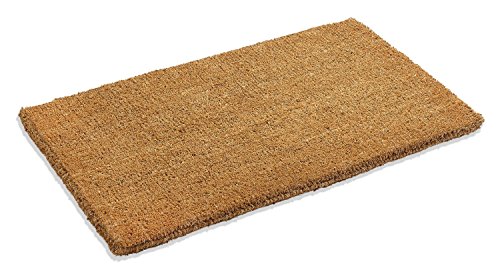
Kempf Natural Woven Coco Coir Doormat 18×30 — Best Outdoor Scraper
The verified representative of this station is the Kempf doormat: its confirmed listing specifies natural woven coco coir a full 1 inch thick at 18×30 inches, sold explicitly as a heavy-duty coconut-fiber scraper mat for front door, entryway and porch. It is the classic coconut-fiber coir mat, thick and stiff-bristled, stationed outside the door where weather cannot hurt it and shoes meet it first. Coir’s bristles are the most aggressive scrapers in the door-mat world — they comb mud, gravel, and road grit out of tread patterns that smooth mats never touch. Every entry system in this guide works better with one of these standing guard outside.
Strengths
- Stiff coir bristles strip mud and grit from shoe tread better than any indoor surface
- Weather-tough natural fiber that lives outdoors year-round
- Heavy and grippy — stays where it is put, even in wind
Trade-offs
- Thick pile can foul low-clearance doors — it belongs outside, not under a door swing
- Coir sheds fibers, especially in its first weeks
- Holds water after rain; it is a scraper, not an absorber
Think of the entry as a two-stage filter and coir as stage one. Grit is the floor-killer — it is literally an abrasive, and every grain carried inside becomes sandpaper under the next shoe. A coir mat outside removes the coarse fraction before the door ever opens, which is why protected floors in gritty climates almost always have one, and why indoor rugs last longer and wash cleaner behind one.
Buy it thick and heavy, sized wider than the door, and shake it out weekly with a beating over a railing — coir holds an astonishing amount of road in its depth. When it eventually mats down and stops springing back underfoot, it has done its service; replace it and let the new one take the weather. This is a consumable guardian, priced like one, and worth it like few things at the door.
Best for: the outside station of any two-mat entry system / Not suited for: under-door placement or indoor absorbing duty

Mibao Super Absorbent Front Door Mat 30×18 — Best for Tight Door Clearance
The verified representative of this type is the Mibao front door mat: its confirmed listing specifies a 30×18 inch, non-slip, washable, low-profile entryway rug in grey, dirt-resistant for front and back door entrances. It belongs to the thin washable entry-rug family — low-pile, flexible, non-slip backed — made for the increasingly common door that clears the floor by millimeters. If your door sweeps every standard mat into a ruck, this is your category: a rug thin enough to live under the swing, grippy enough to stay put, and washable enough to survive mud season in the machine rather than at the hose.
Strengths
- Slim profile clears doors that defeat standard mats
- Machine washable end-to-end — the full reset mud season demands
- Flexible backing conforms to slightly uneven floors instead of bridging them
Trade-offs
- Thin pile holds less water than a chenille absorber — pair with an outdoor scraper
- Low-pile surfaces scrape less aggressively than ribbed or coir textures
- Edges can curl on the cheapest versions; look for bound or weighted edges
Door clearance is measured in millimeters and ignored in most buying guides, which is why so many entry rugs end up folded behind the door they were bought for. Measure yours before shopping: swing the door over a stack of coins or a ruler at the threshold and note the gap. A rug even two millimeters too thick will drag, bunch, and be removed within a month — protection that is not in place protects nothing.
Within the category, prioritize the backing and the edge finish over the pattern. A continuous non-slip backing keeps a thin rug planted under the pivot of turning feet, and a bound edge resists the curling that turns a flat rug into a trip lip. Wash it on the schedule the season demands, dry it flat, and this unglamorous category quietly outperforms thicker rugs in every tight-clearance home.
Best for: apartments and tight-clearance doors / Not suited for: heavy water loads without an outdoor partner mat

tchdio Rubber Boot Tray and Shoe Mat 16×27.5 — Best for Snow and Boot Season
This final pick is a station, not a rug: a rubber tray with a raised lip, and the verified representative is the tchdio boot tray — its confirmed listing specifies durable rubber, heavy-duty waterproof construction and a non-slip surface at 16×27.5 inches, for front door and entryway use. Place it beside the entry rug where footwear actually gets removed. In snow country and mud season, the largest water load at the door is not on shoes walking through — it is in boots taken off and left melting. No rug absorbs a puddle; a tray contains it, and the floor beside the door — where rugs never reach — stays dry.
Strengths
- Raised lip contains meltwater and mud that no rug can absorb
- Protects the beside-the-door zone where boots actually live
- Rubber tray hoses clean in seconds and lasts for years
Trade-offs
- It is furniture, not decor — it looks like the utility it is
- Takes floor space that small entries may not have
- Works as a partner to a rug, never as a replacement for one
Watch a household in February and you will see why this station earns its place: boots come off at the door, get set down beside the mat — on the bare floor — and spend the evening melting out a load of salt water that soaks into grout, swells door-frame timber, and whites out hardwood finish. The tray interrupts exactly that sequence, at the exact spot it happens, for a trivial cost.
Size it for the household’s real boot count and put it where the boots already land rather than where a designer would prefer; behavior beats intention at the doorway. Emptied and hosed weekly, a rubber tray is a decade-long purchase, and paired with the SoakSTOPPER or a coir mat outside, it completes the three-station system — scrape, absorb, contain — that genuinely protected floors are built on.
Best for: snow-belt and mud-season households with boot traffic / Not suited for: mild-climate entries with no boot removal at the door
Comparison Table
| Pick | Badge | Key spec | Best for |
|---|---|---|---|
| GORILLA GRIP SoakSTOPPER Indoor Door Mat 48×30 | Best Overall | 48×30 chenille absorber, washable | wet, muddy, dog-owning households protecting wood or carpet inside the door |
| SAFAVIEH Natural Fiber Jute Accent Rug 2×3 | Best Natural Fiber | Hand-knotted jute, 2×3 ft | covered porches and formal foyers in dry-to-moderate climates |
| BEQHAUSE Kitchen Runner Rug 24×60 | Best Long Runner for Side Doors | 24×60 runner, non-slip, washable | garage, side-door, and mudroom paths |
| Kempf Natural Woven Coco Coir Doormat 18×30 | Best Outdoor Scraper | Natural woven coir, 1 in thick, 18×30 | the outside station of any two-mat entry system |
| Mibao Super Absorbent Front Door Mat 30×18 | Best for Tight Door Clearance | Low-profile, washable, non-slip, 30×18 | apartments and tight-clearance doors |
| tchdio Rubber Boot Tray and Shoe Mat 16×27.5 | Best for Snow and Boot Season | Rubber boot tray, waterproof, 16×27.5 | snow-belt and mud-season households with boot traffic |
The table’s honest message is that no single pick does the whole job: scrapers remove grit, absorbers remove water, trays contain melt. The best-protected entries combine two stations, and the cheapest effective pair in this guide is the coir scraper outside with any washable absorber inside.
How to Choose a Door Entry Rug That Actually Protects Your Floor
Floor damage at the door follows a pattern, and choosing well means matching the rug to the pattern: what comes in (water, grit, or both), where feet land and turn, and what your door clearance allows. These four checks settle all of it.
Diagnose your dirt: water, grit, or melt
Wet climates and dog households fight water — that calls for absorption, the chenille model: a deep, thirsty surface inside the door. Dry, sandy, or gravel-drive households fight grit — that calls for scraping, the coir and jute model: stiff fibers that comb soles clean. Snow country fights all three plus melt, which adds containment — the boot tray — to the system. Most homes have a dominant enemy; name yours honestly and the category chooses itself.
If you genuinely face water and grit together — the classic farmhouse and worksite case — the answer is sequence, not compromise: a scraper outside, an absorber inside. Two specialized mats in series outperform every ‘does everything’ mat ever woven, because scraping and absorbing are mechanically opposite actions and a single surface does both badly.
Size for the step-and-pivot pattern
Stand at your door and walk in as you actually do: one step to clear the swing, a pivot to close the door, a second step toward the room. Your rug must cover that whole footprint — for most doors that means at least 36 inches of depth and a width beyond the door’s own, which is why the 48×30 SoakSTOPPER format works and why 20×30 mats disappoint. Runners take over where the pattern becomes a path, as at garage and side doors.
Coverage has a second dimension people miss: the beside-the-door zone where bags drop and boots come off. If your floor shows wear or water damage, look where it actually is — it is rarely in the center of the mat-shaped space you imagined. Extend protection to the damage, with a tray or a wider mat, rather than replacing the center mat with a prettier one.
Respect door clearance and backing
Measure the gap under your door’s swing before anything else. Standard mats run thick; modern and apartment doors often clear by millimeters. A rug the door drags on will bunch, and a bunched rug is both a failed protector and a trip hazard. Low-profile washable rugs exist precisely for this constraint, and they protect better than a thick rug folded in the closet.
Backing decides whether the rug stays where the protection is needed. Continuous rubber or gel backings grip hard floors best; on carpet, look for mats designed to layer without creeping, and consider a rug pad rated for carpet-to-carpet use. Test any new mat with a firm foot-push at its corner: if it slides, it will travel, and a traveled rug leaves the landing zone bare.
Plan the cleaning before you buy
An entry rug is a dirt trap, and a full trap spreads what it caught. The cleaning method is therefore a specification, not an afterthought: machine-washable mats suit households that will actually run them monthly; shake-and-hose mats suit homes with outdoor space; vacuum-only natural fibers like jute suit dry entries with lighter loads. Choose the method your household will perform in February, not the one it performs in a showroom.
Set the rhythm by season: weekly shaking or vacuuming for scrapers, washing for absorbers whenever they stop feeling thirsty — a saturated chenille mat is a wet floor waiting to happen — and a full reset at each season change. A maintained mid-range mat protects better than a neglected premium one, every single week of the year.
Materials compared: what each fiber does at the door
Chenille and microfiber absorbers are water specialists: thousands of soft loops present enormous surface area, which is why the SoakSTOPPER format drinks a wet footprint on contact. Their weakness is dry grit, which they hold at the surface rather than stripping from tread. Natural fibers split two ways — coir’s stiff bristles are the champion scrapers for outdoor stations, while jute’s firmer, finer loops scrape moderately and present beautifully indoors, at the price of hating standing water.
Synthetic low-pile rugs — the washable category — trade peak performance for convenience and clearance: they absorb adequately, scrape adequately, wash completely, and fit under doors nothing else fits under. Rubber and nitrile-style mats, the commercial tradition, scrape and contain superbly and look like the workplace they came from. The mature entry usually ends up mixed: the material at each station chosen for that station’s load, which is why this guide is organized by station rather than by a single winning fiber.
How to Set Up a Two-Station Entry That Protects Floors
This is the setup sequence for the scrape-absorb-contain system the reviews recommend. It takes one measuring session and about twenty minutes of placement, and it is the difference between owning mats and having protected floors.
Step 1: Measure the door swing and the landing pattern
Check clearance under the door at its tightest point, then watch or mime the entry sequence: landing step, pivot, second step, and where boots and bags actually come to rest. Note the full footprint on the floor with painter’s tape. Every later decision — sizes, shapes, stations — comes off this taped map.
Step 2: Place the outdoor scraper first
Station the coir or outdoor scraper mat outside, tight to the threshold, wider than the door if the space allows. It should be the first thing a shoe meets. On an exposed step, confirm it sits stable and drains rather than damming water against the door sill — a mat that holds a puddle at the threshold is working for the other side.
Step 3: Lay the indoor absorber over the pivot zone
Inside, position the absorbent mat or rug so its center sits under the pivot point, not centered on the door — feet turn beside the door’s centerline, and that turn is where the water and grit transfer happens. Vacuum the floor beneath first; grit trapped under a mat grinds the finish from below, which is the one way a protective rug can damage a floor.
Step 4: Add containment where boots come off
Place the boot tray at the spot boots actually land, close enough to the door that nobody carries melting footwear across the room to reach it. In dry seasons the tray can retire to a closet; in snow and mud season it is the hardest-working object in the entry.
Step 5: Test with wet shoes before calling it done
Wet a pair of shoes at the tap or hose, walk the full entry sequence at normal pace, and inspect: any wet print or grit trail beyond the mats marks a coverage gap. Adjust sizes or positions now, while the evidence is on the floor in front of you, rather than discovering the gap as a wear pattern next year.
Step 6: Set the maintenance rhythm on the calendar
Note the shake, wash, and tray-emptying rhythm where you will see it — a phone reminder works. Entry systems fail by neglect, not by purchase: the mats you own today are sufficient for years if the dirt they capture keeps leaving the house on schedule.
If your entry can only fit one station, put the absorber inside and make it the largest the clearance allows — water does more damage than grit in most homes — and add the outdoor scraper the moment space or season permits.
Seasonal Care and Rotation
Entry mats work hardest exactly when households think about them least, so put their care on the calendar rather than on inspiration. In wet seasons, absorbers want a weekly shake or vacuum and a wash whenever they stop feeling thirsty — a chenille mat that stays damp to the touch an hour after use is saturated and redepositing, and it needs the machine, not another day of service. Scrapers want a weekly beating over a railing; the amount of road that falls out of a coir mat is the best evidence in this entire guide that the system works.
At each season change, do the full reset: wash what washes, hose what hoses, vacuum beneath everything, and inspect the floor itself — the mat’s report card is written in the finish under it. Check rubber backings for crumbling, bound edges for curl, and runners for the end-bunching that means the backing has tired. A mat that has stopped lying flat has stopped being protection and started being a hazard, and its replacement belongs in the budget before the season that needs it.
Rotation extends everything. Households with two indoor absorbers — one in service, one in the wash cycle — never face the bare-floor week that undoes a season of protection, and mats rested between washes recover their pile and their thirst. The same logic applies to runners on mudroom paths. This is the unglamorous truth of floor protection: it is a laundry discipline wearing a rug’s clothing, and the households that treat it that way are the ones whose entry floors look new in year ten.
Finally, retire honestly. A scraper whose bristles have matted flat, an absorber whose backing has cracked, a runner that creeps despite cleaning — each has given its service and now risks the floor and the ankles it was bought to protect. Entry mats are among the cheapest floor-care purchases a home makes; replacing them on evidence, rather than on collapse, is the whole economics of the protected floor.
It is worth closing the care section with the floor’s perspective, because the floor is the client in every decision above. Hardwood wants grit stopped and water lifted before either can sit; tile wants its grout spared the grinding paste that grit and moisture make together; carpet wants its pile spared the soil load that mats exist to intercept. Every station in this guide, every wash cycle, every honest retirement is in service of those three quiet wants — and the evidence that the service is working is gloriously boring: an entry floor that looks, year after year, like the rest of the house, instead of like the place where the outdoors is allowed in. Boring, at a doorway, is the sound of a system working.
Common Buying Mistakes
Buying the mat the width of the door
A door-width mat covers the doorway, not the entry. Feet land, pivot, and step beyond it on both sides, and the unprotected margins are exactly where the floor shows damage first. Size to the taped footprint of real movement, which is always wider and deeper than the door itself.
One mat asked to scrape and absorb
Scraping needs stiff fibers; absorbing needs soft, thirsty ones. The hybrid mat that promises both delivers a mediocre version of each and satisfies neither climate. Two stations in series — scraper out, absorber in — is the system that actually works, and it usually costs less than the premium hybrid.
Ignoring door clearance until the rug bunches
A dragged rug folds, folds trip, and tripped-on rugs get removed. Measure the swing gap first, choose low-profile where the gap is tight, and treat any rug the door touches as the wrong rug no matter how well it scored on every other criterion.
Never washing the absorber
Chenille and washable mats protect by holding dirt and water — until they are full, at which point they redeposit both on every shoe. The wash is not cosmetic maintenance; it is the mechanism by which the protection renews itself. If you will not wash a mat, buy a shake-clean scraper type instead and be honest about the trade.
Forgetting the floor under the mat
Grit migrates under mats and then grinds the finish with every step above it — the one scenario where a protective rug causes the damage it was bought to prevent. Lift and vacuum beneath entry mats on the same rhythm as you clean their tops, and check rubber backings yearly on sensitive finishes.
Final Recommendation
If you build one station from this guide, make it the GORILLA GRIP SoakSTOPPER inside the door: its coverage and absorbency answer the most common and most damaging load — water — for most households. Add the Kempf coir scraper outside when you can, and your floors have the two-stage system that protected entries are built on.
Choose the Safavieh jute for a covered or formal entry in a drier climate, the BEQHAUSE runner for a side-door or garage path, the Mibao low-profile washable mat if your door clearance is tight, and the tchdio rubber boot tray the first time you watch meltwater pool beside the door. Protect the pattern of feet you actually have, and the floor keeps its finish for years longer.
If budget forces a sequence rather than a system, buy in this order: the indoor absorber first, sized generously, because water is the most damaging load in most homes; the outdoor scraper second, the first time grit season or a gravel drive makes its case; the boot tray third, at the start of the first snow or mud season you spend in the house. Each addition multiplies the value of the ones before it, and the full three-station system — scrape, absorb, contain — usually assembles itself within a year of ordinary household life, one honest need at a time.
Related guides in this series: Best Door Mats Best Washable Rugs Best Mudroom Rugs Best Outdoor Rugs Best Kitchen Runner Rugs
Related guides
Frequently Asked Questions
How big should a door entry rug be?
Big enough to cover the full entry sequence: the landing step, the pivot while closing the door, and the next step into the room. For most single doors that means at least 3 feet of depth and a width wider than the door itself — 48×30 inches is a practical benchmark for the inside mat. When in doubt, tape the footprint on the floor and buy to the tape, not to the door.
Is it better to put a mat inside or outside the door?
Both stations do different work. Outside, a scraper removes grit and mud from tread before it enters. Inside, an absorber takes the water that scraping cannot. If only one is possible, the inside absorber protects against the more damaging load in most climates — but the pair together is dramatically more effective than either alone, which is why this guide is built as a system.
How often should entry mats be cleaned?
Scrapers should be shaken or beaten weekly and hosed as needed; absorbent mats vacuumed weekly and washed whenever they feel saturated or stop drying shoes — monthly is a fair mud-season rhythm. Boot trays get emptied and rinsed weekly in season. The governing rule is simple: a mat protects only while it has capacity left, and cleaning is what restores capacity.
Will a rubber-backed mat damage hardwood floors?
A quality rubber backing in good condition is safe on most finished floors, but two cautions apply: keep the floor beneath clean, because trapped grit under any mat grinds finish, and check the backing yearly — degrading, crumbly rubber on older mats can mark sensitive finishes. On newly refinished floors, confirm the finish has fully cured before placing any backed mat, and lift mats periodically to let the floor breathe.
Can I use a kitchen runner as an entry rug?
Yes — the formats overlap, and this guide includes a washable non-slip runner whose listing covers entryway use for exactly that reason. Kitchen runners bring the long, narrow shape that side doors and mudroom paths need, plus washability. Just confirm the backing suits your floor type and that the width covers the walking line of the entry it will serve.
What is the best entry setup for a home with dogs?
The three-station version: a coir or outdoor scraper at the door, a large chenille absorber like the SoakSTOPPER inside — sized so all four paws land on it while you towel — and a washable surface you can launder weekly in wet seasons. Dogs concentrate the water load at the door, so absorption capacity and washability outrank every other feature, and a mat the dog can fully stand on is worth more than any premium material in a smaller size.


