An outdoor rug turns a bare patio or deck into a place you actually want to sit. It also protects your feet from hot boards and cuts down on the dirt tracked inside. The catch is that outdoor rugs live a hard life: sun, rain, mildew and furniture dragging across them all take a toll, so material is the thing to get right.
These six rugs take different approaches, including recycled plastic straw mats, woven polypropylene and a classic printed indoor/outdoor style. We have not used them ourselves. No outdoor rug is fully waterproof in the way a tarp is, so check each listing for what the maker says about drying and UV, and confirm the size and weight before you order.
As an Amazon Associate we earn from qualifying purchases. Links below are affiliate links, and they do not change the product information we give.
What to Look For
| Feature | Why it matters |
|---|---|
| Fiber | Polypropylene and recycled plastic shed water and resist mildew better than cotton or jute |
| Drainage | A rug that lets water through dries faster on a deck or patio |
| UV resistance | Fade-resistant dyes keep color in full sun |
| Pile | Flat weaves are easy to hose off; thick piles hold moisture |
| Backing | Non-slip backing helps, but check it suits your surface |
In this guide
Specs at a Glance
| Rug | Material | Style | Notes |
|---|---|---|---|
| Safavieh Courtyard | Polypropylene | Pattern collection | Indoor/outdoor use |
| Nourison Aloha | Polypropylene | Flat or low pile | Indoor/outdoor use |
| Mad Mats Mixed Tropical | Plastic (eco-friendly, per the title) | Reversible, tropical pattern | UV-resistant; easy-clean |
| Ottomanson Jardin | Synthetic | Patterned | Indoor/outdoor use |
| Liora Manne Carmel | Synthetic | Bold designer pattern | Designed for outdoor use |
| Safavieh Veranda | Synthetic | Traditional pattern | Indoor/outdoor use |
The 6 Best Outdoor Rugs

Top pickBest for patios and decks
1. Safavieh Courtyard Collection
A long-running range of polypropylene rugs made for indoor and outdoor use, offered in many patterns and sizes. It is one of the first places to look if you want a rug for a covered patio or deck.
Suits: patios and decks. Strengths: a large choice of sizes. Weaknesses: not a plush feel. Skip it if you want a thick pile.


Best for relaxed outdoor seating
2. Nourison Aloha Indoor/Outdoor Rug
A longstanding polypropylene line from a major rug maker, offered in solids, stripes and subtle patterns. The designs are calm and flexible, which makes them easy to pair with outdoor furniture.
Suits: relaxed outdoor seating. Strengths: restrained, versatile looks. Weaknesses: thinner than an indoor rug. Skip it if you want a bold statement.


Best for patios, decks and poolside areas
3. Mad Mats Mixed Tropical Reversible Outdoor Rug
A reversible plastic outdoor mat listed in an 8 x 10 ft size, described as UV-resistant, water-repellent and easy to clean. It is a practical pick for patios, decks and other wet-weather areas.
Suits: patios, decks and poolside areas. Strengths: reversible, easy to clean and made for outdoor use. Weaknesses: a plastic mat feels firmer underfoot than woven rugs. Skip it if you want softness.

Best for balconies and small porches
4. Ottomanson Jardin Collection
A budget-minded indoor/outdoor line with printed or woven patterns. It is a sensible way to dress a small balcony without spending much.
Suits: balconies and small porches. Strengths: an affordable price tier. Weaknesses: less durable than heavier weaves. Skip it if the area gets full sun all day.
View Ottomanson Jardin Collection on Amazon

Best for statement patios
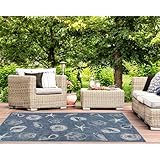
5. Trans-Ocean Liora Manne Carmel
A designer outdoor line with strong, graphic patterns. It is made for exterior use and is the choice if the rug is meant to be the focal point of the space.
Suits: statement patios. Strengths: bold design. Weaknesses: a higher price tier. Skip it if you want a plain background.

Best for screened porches
6. Safavieh Veranda Collection
A traditional-pattern range designed for indoor or covered outdoor rooms, such as a sunroom or screened porch. It gives an oriental look in a weather-friendly fiber.
Suits: screened porches. Strengths: classic patterns. Weaknesses: best under cover. Skip it if the rug will be fully exposed to rain.

Care and Setup
- Hose the rug down and let it dry fully in the sun before rolling it up.
- Lift the rug now and then so the surface beneath can dry.
- Use a breathable pad, not solid rubber that traps moisture.
- Store the rug rolled, and indoors, over winter if you can.
Mistakes to Avoid
- Putting an indoor-only rug outside.
- Leaving a wet rug on a wooden deck for long periods.
- Ignoring sun exposure when choosing a dark color.
- Buying a size that leaves furniture legs half on and half off.
Questions to Ask Before You Buy
- Will the rug sit under a roof, in full sun or fully exposed to weather?
- What surface goes underneath: wood decking, stone, concrete or grass?
- Does the listing say how the rug dries and how it should be cleaned?
- Is the edge finish likely to catch on chair legs or sandals?
- Will I fold or roll it for the colder months, and where will it go?
- Does the maker mention a pad or gripper for outdoor use?
Matching It to Your Patio or Deck
Outdoor spaces behave differently from living rooms. Begin by marking the area where furniture will sit and decide whether all the legs should be on the rug or just the front ones. A slightly oversized piece usually looks more settled than one that floats in the middle. Leave room at the edges for drainage and for sweeping, because leaves and grit gather quickly.
Light and heat deserve thought. Dark colors absorb warmth, so bare feet may find them uncomfortable in midday sun. Lighter tones show dirt more readily but stay cooler to the touch. Pattern can disguise everyday wear.
Who Should Skip One
If your outdoor area is very small, a rug can crowd the floor and trap debris under furniture. Homes in places with heavy, frequent rain should think about drainage, since water can pool beneath a rug on a flat surface. Anyone who dislikes seasonal chores may prefer bare boards or pavers rather than lifting and drying a rug repeatedly. Renters with delicate flooring should read the maker’s instructions before placing any backing material on it.
Polypropylene, Recycled Plastic and Natural Fibers
The fiber is the single biggest decision with an outdoor rug, because it decides how the rug copes with water and sun. Polypropylene is a synthetic that is widely used for indoor and outdoor rugs; it does not soak up water the way cotton does, so it tends to dry faster and resist mildew. Woven versions have a fabric-like feel and come in a wide range of patterns. They are usually thin and can feel flat underfoot.
Mats made from recycled or extruded plastic straw are a different style. They are often reversible, hose off easily and let water pass through, which suits a deck or poolside area. The surface is firmer and has more of a woven-mat texture, so it is less of a lounge-on-the-floor rug. Check the listing to see how the maker describes the material and care.
Natural fibers such as jute, sisal and cotton bring a warm look, but they hold moisture and can darken, smell musty or break down when left outdoors. They are better kept to a fully covered porch or a sunroom, and many makers advise against them in damp areas. Polyester and nylon blends sit in between, and their performance depends on the construction, so read what the listing says about outdoor use. When a listing says only indoor, treat that as a firm sign to keep it inside.
Sizing and Furniture Placement
Size an outdoor rug to the seating group, not to the empty patio. Start by arranging the chairs, sofa and table in the position you will use, then measure the outer edge of that arrangement. Choose a rug large enough that at least the front legs of every seat rest on it. Fully inside the rug is the most settled look, but half-on, half-off is the most common compromise. What you want to avoid is chair legs that straddle the edge, which makes seating wobble and can trip people.
For a dining set, measure the table and add room for chairs to be pulled back, since a chair that slides off the rug edge catches on the border. Rectangles suit most patios, but round rugs can soften a corner or sit under a bistro table. Runners work for a narrow walkway or a long balcony.
Leave a margin of bare floor around the rug so water can run off and so you can sweep. Check the listing for the exact dimensions and for any note about trimming or edge finish. If the rug arrives rolled, give it time to relax flat before judging the fit, and follow the maker’s instructions for unrolling in warm weather.
Underlay, Surface and Drainage Considerations
What goes under the rug can matter more than the rug itself. A rug sitting on a wooden deck can trap moisture against the boards if it stays wet, and over time that can stain or discolor the surface. Lifting the corners now and then lets air in, and allowing the rug to dry fully after rain helps protect the wood. On stone, concrete or tile, grit under the rug can wear on the backing, so sweep both surfaces occasionally.
A pad can add grip and cushioning, but not every pad is meant for outdoor use. Solid rubber or foam can trap water and may react with some sealants or finishes. A open-weave, breathable grip is usually the safer pick when the maker recommends a pad. Always check the rug maker’s care notes and the surface manufacturer’s guidance, especially on stained or sealed wood, painted concrete or composite decking.
Slope and drainage deserve a look as well. If water pools in one spot on your patio, a rug will sit in that puddle. A slightly raised lip or a spot that gets runoff from a gutter is a poor place to lay a rug. In windy areas, consider whether the edges might lift; furniture legs on the corners help, and some owners use outdoor-safe tape or weights, as long as the maker’s instructions allow it.
Cleaning, Drying and Off-Season Storage
Outdoor rugs need a bit of routine care to keep their look. For everyday dirt, a stiff broom or a handheld vacuum used on a low setting removes leaves, pollen and grit. When the surface looks dingy, hosing the rug down and scrubbing gently with mild soap and a soft brush is a common approach; always check the listing or label before using any cleaner, and test a small hidden patch first.
Drying is the step people skip. After washing, drape the rug over a rail or lean it against a wall so air can reach both sides, and lay it flat only when it is dry. Damp rugs rolled up or left on a deck are the usual cause of mildew smells and stained boards. If you see spotting, treat it early with the cleaning method the maker suggests.
In regions with freezing winters or heavy rain seasons, storing the rug saves wear. Clean it, let it dry fully, then roll it loosely with the pile facing out to reduce creasing, and keep it indoors in a dry spot. Avoid sharp folds, since they can leave lasting lines. For sun, rotate the rug now and then so one edge does not fade faster, and consider moving it into shade during the hottest stretches if the listing warns about heat.
Signs Your Outdoor Rug Needs Replacing
Even a well-made rug has a limited outdoor life, and knowing the signs saves you from a slippery or unsightly surface. The first is persistent odor. If a musty smell returns after cleaning and thorough drying, moisture may have settled into the fibers or backing. A second sign is a stiff, brittle feel, especially along folds, which suggests sun has broken down the material.
Look at the edges. Fraying that keeps spreading can become a trip hazard, and loose threads can snag on chair legs or sandals. Curling corners that no longer lie flat after a day in the sun may need replacement or a trim if the maker allows it. Faded patches are mostly cosmetic, but when the color has washed out unevenly, the rug can make a nice patio look tired.
Check the underside too. If the backing is cracking, flaking or leaving residue on your deck, stop using it where it touches a finished surface. A rug that slides around despite a pad may have lost grip. Finally, if the surface stays slick or shows mold spots that return, cleaning may no longer be enough. A small repair or a rug moved to a covered spot might extend its life, but when safety or hygiene is in question, replacing it is the sensible call.
Choosing an Outdoor Rug by Where It Will Sit
An outdoor rug faces conditions that an indoor one never meets: sun, rain, dirt, furniture legs and sometimes standing water. The same rug that looks perfect on a covered porch might struggle on an open deck or beside a pool. Decide where it will live first, and the material choice becomes much easier.
| Location | What to prioritize |
|---|---|
| Covered porch | Pattern, softness and easy sweeping |
| Open deck | Fade resistance and quick drying |
| Patio pavers | Flat weave that lies smooth over uneven joints |
| Poolside | Fast drainage and a texture that stays comfortable underfoot |
| Balcony | Light weight and a thin profile that clears the door |
Look at the fiber named in the listing. Polypropylene and polyester are common outdoor choices and tend to handle moisture well, while natural fibers like jute usually prefer protected spots. Check whether the maker describes the rug as suitable for outdoor use, and read any note about direct sunlight.
Size matters as much as material. A common approach is to choose a rug large enough that the front legs of every seat sit on it, so chairs do not tip on the edge. Measure your furniture group first, then add a margin on each side. In tight spaces, leave a little bare floor around the border so the rug looks intentional rather than crowded.
Keeping Your Rug Looking Good Season After Season
Outdoor rugs are built to be tougher than indoor ones, but a little routine care extends their life. Shake or sweep the surface regularly so grit does not grind into the fibers. Rinse with a hose when it gets dusty, and lift the rug now and then to let the ground beneath dry out.
- Sweep or shake out loose debris every week or two.
- Spot clean spills quickly with mild soap and water, following the care label.
- Rinse and let both sides dry fully before laying it back down.
- Rotate the rug occasionally so sunlight wears it evenly.
- Store it rolled, not folded, if you put it away for a harsh season.
Moisture trapped underneath can leave marks on wood or concrete, so consider a breathable pad designed for outdoor use. If a rug develops a musty smell, drying it thoroughly in open air is usually the first fix. For anything unusual, such as stubborn staining, check the maker’s cleaning guidance before using strong products.
Mistakes to Avoid When Ordering a Rug Online
Buying a rug you cannot touch brings a few risks, and most of them come down to size and surface. Photos can make a pile look softer or a color richer than it is, so lean on the written description of the weave, pile height and material. Read the dimensions carefully, because a rug listed as an area rug may be much smaller than you picture once it sits on a large patio.
- Skipping a tape measure and guessing at the footprint of your seating group.
- Choosing a thick pile for a spot where water will pool.
- Ignoring the edge finish, which affects how well the rug resists fraying.
- Forgetting to check whether the seller describes it as suitable for outdoor use.
Check the return terms before you order, in case the color or scale is not what you pictured.
Choosing With More Care: The Details That Decide Satisfaction
Choosing outdoor rugs well begins with the room, not the rug. Measure the space properly and decide what the rug needs to do there: gather a seating group together, soften a hallway, protect a busy floor or simply make a room feel finished. A rug that is slightly too small can make furniture look stranded, while one that crowds every edge can overwhelm a small room. Sketch the layout, note where doors swing and where feet actually travel, and let those practical lines set the size before you fall for a pattern.
Material and construction come next, judged against your household rather than an ideal one. Think about shoes or bare feet, children, pets, food, muddy weather and how often you realistically clean. Some rugs forgive daily life gracefully and some demand gentle treatment from day one, and neither is wrong until it is matched with the wrong home. The reviews above are most helpful when you read them with your own floors, habits and tolerance for upkeep clearly in mind.
Matching Your Choice to Real Life
Picture the busiest day the rug will face. In a living room that hosts film nights, games and naps, comfort underfoot and a forgiving surface matter most. In an entry or dining space, easy cleaning and a low enough profile for chairs and doors take priority. In a quiet bedroom, softness for the first steps of the morning may be the whole point. Naming the main scenario stops you buying a rug for an imaginary room and then being annoyed by it in the real one.
Households with dogs, children or regular guests should also plan for accidents as a certainty rather than a possibility. A rug you are afraid to live on will slowly resent its owners, and they it. Choose a style whose care routine you can genuinely keep up, keep the cleaning supplies you need somewhere sensible, and accept that a lived-in rug in a happy room beats a pristine rug in a room nobody uses. Practical confidence is a design feature in its own right.
Using It Well From the First Day
When the rug arrives, unroll it and give it time to settle before judging it. Creases and curled edges from packing usually relax with time, gentle weight and normal use, and the maker guidance for your rug will say what helps. Position it, walk on it for a few days and check that doors clear it, chairs move over it as expected and nobody catches a toe on an edge. Small adjustments in these first days are normal and far easier than they will be once heavy furniture is settled.
Think about what goes under and around the rug as part of using it well. A suitable pad, where appropriate, can steady the rug, cushion footsteps and protect the floor beneath, while a rug left to slide becomes both an annoyance and a hazard. Keep the main walking paths in mind: a rug that shifts under daily traffic needs attention to its placement or its backing, not just straightening every morning. A stable rug disappears into daily life, which is exactly what it should do.
Care, Cleaning and Keeping It at Its Best
Regular, gentle care beats occasional heroic cleaning. Frequent vacuuming or shaking out, done in the way the maker recommends for your rug type, lifts grit before it works down into the fibres and wears them from within. Attend to spills promptly by blotting rather than scrubbing, working from the edge of the mark towards the middle so it does not spread, and test any cleaning product in an inconspicuous spot first. Sunlight matters too: rotating the rug occasionally evens out fading and wear.
Deeper cleaning should follow the guidance for the specific material and construction of your rug, because methods that suit one rug can damage another. Some rugs can be washed, some spot-cleaned only, and some are best entrusted to a professional, particularly large, heavy or delicate pieces. Whichever route applies, make sure the rug dries completely before putting it back, since a damp rug against a floor helps neither of them. A rug that is cleaned appropriately, rather than aggressively, keeps its looks far longer.
How the Picks in This Guide Compare
The picks in this guide, Safavieh Courtyard Collection, Nourison Aloha Indoor/Outdoor Rug, Mad Mats Mixed Tropical Reversible Outdoor Rug, Ottomanson Jardin Collection, Trans-Ocean Liora Manne Carmel and Safavieh Veranda Collection, were chosen to cover the situations most buyers actually face rather than to repeat the same idea several times over. Read their individual reviews above side by side and you will notice that each one leans towards a different strength: a different balance of comfort, practicality, ease of care and suitability for a particular setting. That spread is deliberate, and it means the best choice for you depends less on which pick is strongest in the abstract and more on which strength matches the job waiting for it in your home.
A useful way to compare them is to hold your main scenario steady and test each pick against it. Picture the same ordinary day, the same room, the same people and the same weather, and ask of each option in turn how it would cope. The pick that handles your ordinary day gracefully will almost always serve you better than the one that shines only in an ideal scenario. Where two picks seem close, let the care routine decide: the one whose cleaning, storage and upkeep fit your real habits is the one that will still please you in a year.
It also helps to decide in advance what would make you return or replace a purchase, because that reveals your real priorities. If the answer is about fit, measure twice and order once. If it is about upkeep, re-read the care sections of the reviews above before choosing. If it is about how the pick suits a particular person, involve that person in the decision now rather than after delivery. Clear priorities turn a long shortlist into a short decision, and they protect you from being swayed by whichever listing you happened to read last.
Reading Listings and Product Pages Critically
Listings for outdoor rugs are heavy on styled photographs and light on the details that decide satisfaction, so read them in a deliberate order: dimensions, material, construction and care instructions first, beauty second. Check whether the size quoted includes any border or fringe, and compare it with your measured space rather than a guess. A photograph of a rug in a huge styled room can make a modest size look generous, and the tape measure is the only honest translator.
Also separate the rug itself from how it is presented. Colours shift between screens and lighting, patterns can look bolder or quieter at home, and a pattern that hides daily life in a photograph may do exactly that in your room too, which is often a virtue. Check the return terms before ordering, keep the packaging until you have lived with the rug for a few days, and judge it in your own light, at different times of day, before deciding it is wrong.
Mistakes That Only Appear After a Few Weeks
The most common mistake is ordering by eye from a photograph without measuring, then discovering the rug is lost in the room or crowding the walls. The second is ignoring the floor and the traffic: a delicate rug in a muddy entry, or a thick rug under a door that then scrapes across it, will frustrate you daily no matter how beautiful it is. Both mistakes are made before the rug arrives, which is good news, because both are entirely preventable with a tape measure and an honest minute of thought.
Care mistakes shorten more rug lives than wear does. Scrubbing a spill spreads it and damages fibres, soaking a rug that should never be soaked invites shrinking, bleeding colours or a backing that never recovers, and putting a rug back while it is still damp traps moisture against the floor. When in doubt, do less, blot gently, and check the maker guidance before reaching for stronger measures. A calm first response saves most rugs from most accidents.
Building a Routine That Lasts
A light weekly rhythm keeps a rug looking like itself. Vacuum or shake it as the maker recommends, straighten edges and check that it has not crept across the floor, and deal with small marks while they are still small. Every few months, rotate the rug if the room allows it, look underneath for trapped grit or damp, and check the floor beneath for any surprises. These few minutes, repeated, are what separate a rug that ages gracefully from one that quietly deteriorates.
Seasonally, adjust for what the weather brings through your door. Wet seasons mean more grit and moisture arriving on shoes and paws, so a mat at the entry and a slightly more frequent clean will protect the rug without drama. In drier months, sunlight through windows can fade one side while the other stays rich, which rotation quietly corrects. Letting the seasons prompt these small habits keeps care effortless and the rug consistently presentable.
When to Repair, Replace or Rethink
A rug is ready to retire when it no longer lies flat, no longer cleans up, or has worn thin in the paths where feet travel most. Curling edges that resist every remedy are a trip hazard rather than a cosmetic flaw, and a backing that crumbles or a smell that survives proper cleaning are honest signals that the rug has finished its work. Fading alone, by contrast, is often just character, and many households happily live with a softened pattern for years.
When you replace a rug, let the old one mark your homework. Note where it wore, where it stained, what size the room truly wanted and how its care routine fitted your life. Buy the next rug for the household you have now, with those lessons applied, rather than simply reordering the same thing and hoping for a different result. The second rug in a room, chosen with evidence, is usually the one that stays for a very long time.
A Practical Decision Worksheet
Start by writing your requirements down before you look at another listing. Divide a page into three short lists: what the purchase must do, what would be nice, and what you know you do not need. Be specific in the first list, because vague wishes produce vague purchases. Include the room or situation, the people involved, the surfaces and conditions it will face, and the care effort you can honestly sustain. Then read the reviews in this guide once more, scoring each pick only against your first list. Picks that fail a must-have leave the shortlist immediately, however appealing their extras, and what remains is usually a choice between two or three genuinely suitable options.
Now test that shortlist against the least convenient day, not the best one. Imagine the purchase in use when you are tired, rushed, short of space or dealing with guests, bad weather or a spill, because that is when design weaknesses stop being theoretical. Ask where it will be stored on that day, who else will handle it, and what could go wrong that a little planning would prevent. This unglamorous exercise is where experienced buyers earn their reputation: they do not buy for the photograph, they buy for the Tuesday evening when everything else is going wrong as well.
Planning Around Seasons and Household Changes
Seasons change what a home asks of its contents, and a wise purchase anticipates the change rather than discovering it. Think about the wettest, hottest, busiest and quietest times of your year and how this choice behaves in each. Some purchases work hardest in one season and rest in another, which is fine as long as storage and care for the resting months are planned. Others are asked to perform identically all year, which raises the bar for durability and for a care routine you can keep up when motivation dips in the middle of winter.
Households change too, sometimes gradually and sometimes overnight. Children grow, relatives visit or move in, pets arrive, jobs change the shape of the day, and a purchase that fits this year may be tested by next year circumstances. You cannot plan for everything, and you should not try, but favouring adaptable, forgiving choices over narrow, precious ones gives your home room to evolve. When you read the picks above, give a quiet bonus to the option that would still make sense if your household looked a little different in two years time.
Troubleshooting and the Long View
When something disappoints after purchase, troubleshoot before you replace. Most disappointments have a simple layer underneath: the wrong position, the wrong routine, the wrong pairing with another item, or expectations set by a photograph rather than by the job at hand. Change one variable at a time and live with the change for a few days before judging it, because several changes at once teach you nothing. Keep notes if the problem is subtle. A surprising share of purchases are rescued by a mat, a hook, a different wash, a moved shelf or a clearer house rule.
Finally, keep the long view. The purchases that serve a home best are rarely the most exciting ones; they are the ones still quietly working years later, maintained by habits so small they feel like nothing. Judge your shortlist by asking which option you would be happiest to clean, repair, store and rely on in three years, with its novelty long gone and its usefulness proven daily. That question cuts through presentation faster than any other, and it is the question this guide was written to help you answer well.
Outdoor Rugs FAQ
Can outdoor rugs stay out in the rain?
Many can get wet, but they should be able to dry. Leaving them in standing water is the problem.
What is the best material for a deck?
Recycled plastic and polypropylene are common choices because they dry quickly and resist mildew.
Do indoor/outdoor rugs fade?
Sun will eventually dull most colors. Look for fade-resistant claims on the listing.
Can I put an outdoor rug on a wood deck?
Usually yes, but moisture trapped under a wet rug can mark or discolor the boards. Let the rug dry fully after rain and lift it now and then so the deck can breathe.
Do I need a rug pad outdoors?
Not always. If the maker recommends one, choose a breathable pad made for outdoor use rather than solid foam that holds water.
What size rug works under a patio dining table?
Measure the table, then add room on every side for pulled-out chairs so the seats stay on the rug. Check the listing for exact dimensions before ordering.
Will a dark rug get hot in the sun?
Dark colors absorb more heat, so they can feel warm underfoot at midday. A lighter shade or a shaded spot is more comfortable for bare feet.
How do I keep an outdoor rug from blowing away?
Put furniture legs on the corners and choose a heavier build. If you use weights or tape, make sure the maker's instructions allow it for your surface.
Can I use an indoor rug on a covered porch?
Only if the listing says it is suitable for outdoor use. Indoor-only rugs may hold moisture and can mildew or fade quickly.
How do I remove mildew from an outdoor rug?
Follow the care instructions on the listing. A gentle scrub with mild soap and thorough drying in the sun is a common starting point, and a rug that stays smelly may need replacing.
One More Consideration Before You Decide
The value question deserves a calm answer, because the most expensive option is rarely the one with the highest ticket and the cheapest is rarely the one bought twice. Think in terms of cost per year of good service: how long this purchase will realistically last in your home, how much effort it asks of you each week, and how likely you are to still be pleased with it once the novelty has gone. A choice that fits your routine so well that you stop thinking about it has usually earned whatever it cost, while a bargain that fights your habits charges you a small toll of annoyance every single day.
Accessibility is easy to overlook until it matters. Consider everyone who will use this purchase, including visitors, older relatives and anyone recovering from an injury or managing tired joints, and ask whether the choice works for them as well as for you. Height, weight, grip, balance and the amount of bending or reaching involved all change the experience for different bodies. A purchase that the whole household can use confidently is worth more than a slightly finer one that quietly excludes somebody.
Keep the paperwork and the proof. Save the maker instructions, the care guidance and your order details somewhere you can find them in a year, because the moment you need them is never the moment you expect. A note of when you bought the item, what you chose it for and any lesson from the first weeks turns future decisions, replacements, spare parts, cleaning questions and warranty conversations into simple lookups instead of guesswork. Households that keep this small record rarely repeat a buying mistake, because the evidence of the last one is sitting in the drawer.
Share what you learn with the people who share your home. A purchase used by several people succeeds when everyone knows the simple rules around it: where it lives, how it is cleaned, what it should never be asked to do and who to tell when something seems wrong. Two minutes of explanation at the start prevents the slow damage done by well-meaning misuse, and it turns care from one person burden into a household habit. Write the essentials on a card kept nearby if the routine has more than a couple of steps.
Give the decision a night to settle if you can. A shortlist that still looks right the next morning, checked once more against your must-have list and your least convenient day, is very unlikely to disappoint you. Urgency is usually a property of the listing, not of your life, and the few purchases that genuinely cannot wait are obvious. Calm, measured choosing is the whole method behind this guide, and it works just as well for the next purchase as it does for this one.
Finally, think about the footprint of the choice in your home and beyond it. Prefer the option you will keep for years over the one you will replace quickly, keep packaging only until you are sure the purchase is right, and pass on or recycle what you retire where you can. Durable, well-matched purchases are the simplest form of sustainability available to a household: fewer deliveries, fewer returns, less clutter, and a home filled with things that were chosen once and chosen well.
More Questions Buyers Ask
How long should I live with a new rug before judging it?
Give it at least a few days of normal life. Packing creases need time to relax, colours need to be seen in your own morning and evening light, and the whole household needs to walk its usual paths across it. Judge it after that settling period, in its real position, rather than in the first hour when it still looks and feels like a parcel.
What should I do the moment something spills?
Act promptly but gently. Lift away any solids, then blot the liquid with a clean cloth, working from the outside of the mark inwards so it does not spread. Avoid scrubbing, which pushes the spill deeper and roughens the fibres. Once you have blotted up what you can, follow the care guidance for your rug material, and test any cleaner somewhere hidden first.
Does my rug need a pad underneath?
Many rugs benefit from a suitable pad: it reduces slipping, adds cushioning and can protect both rug and floor. Whether yours does depends on its backing, its size and where it sits, and the maker guidance is the place to check. On stairs, runners and busy paths, preventing movement matters most. Choose a pad made for your floor type and trim it slightly smaller than the rug so it stays hidden.
How do I stop the edges curling?
Start with patience, since new rugs often relax on their own. Reverse rolling, gentle weight on the curled edge and time in normal use all help, following the maker suggestions for your rug. If an older rug begins to curl as its backing ages, treat it seriously: a curled edge that catches feet is a hazard, especially on stairs and in homes with children or older relatives.
Can I put a rug over carpet or heated floors?
Often yes, but check both the rug maker guidance and what your flooring requires. Some combinations trap heat or moisture, some backings can mark the surface beneath, and a rug over deep carpet can creep and wrinkle. A suitable pad made for the combination helps in many cases. When the guidance is unclear, asking the maker before you buy is wiser than discovering a problem afterwards.
Why does my rug shed or look different from the photo?
New rugs commonly shed loose fibres for a while, which gentle regular vacuuming gradually settles. Colour differences are usually about light: screens, shop lighting and your room all render the same rug differently, and natural materials vary subtly between pieces. Live with it in your own light for a few days before deciding, and follow the maker care advice if shedding seems excessive rather than settling.
The Short Version
For range, the Safavieh Courtyard. For calm style, the Nourison Aloha. For wet weather, the Blue Nile Mills. For budget, the Ottomanson Jardin. For a statement, the Liora Manne. For covered porches, the Safavieh Veranda.