Disclosure: airfryerkitchensupply.com is reader-supported. When you buy through links on our site, we may earn an affiliate commission at no extra cost to you.
Where to buy
Every purifier below was confirmed through Amazon’s catalog data before being included, and the links point to the exact models reviewed. Replacement filters are part of the ownership cost of any purifier — check the listing for the filter model your shortlist uses.
- LEVOIT Core Mini-P Air Purifier — Check on Amazon
- Medify MA-14 Air Purifier with HEPA Filter — Check on Amazon
- GermGuardian AC4100CA Tabletop Tower Air Purifier, 11″ — Check on Amazon
- LEVOIT Core 200S-P Smart Air Purifier — Check on Amazon
- WINIX A230 Air Purifier — Check on Amazon
- LEVOIT Core 300-P Air Purifier — Check on Amazon
The best small air purifiers solve a specific problem: the air in one small room — a bedroom, a nursery, a home office, a dorm — where a full-size tower would dominate the floor plan and a gadget-grade desktop trinket would do nothing measurable. This guide is written in honest comfort and air-quality terms. A good small purifier captures airborne particles — dust, pollen, pet dander, smoke particles — and reduces the odours and stuffiness that make a small room feel stale, so the room feels fresher and the air feels cleaner to breathe. It is not a medical device, it carries no clinical endorsements, and this guide makes no promises about treating allergies, asthma, or any other health condition, nor about preventing illness of any kind; what it can do, measurably, is lower the particle load in a small enclosed space, and for many households that difference in everyday air comfort is exactly what they are shopping for.
The six picks divide by the small-room jobs that actually exist. The Core Mini-P is the true desktop-and-nightstand class: tiny, quiet, and cheap to run. The Medify MA-14 puts a serious HEPA filter in a compact tower for people whose priority is particle capture per inch of shelf. The GermGuardian tabletop tower adds a UV-C light and a slim 11-inch profile for desks and counters. The Core 200S-P adds smart control for bedrooms that run on schedules. The WINIX A230 is the upper edge of “small” — a compact tower with an air-quality sensor and auto mode for larger bedrooms. And the Core 300-P is the small-room heavyweight, for buyers whose “small room” is a primary bedroom or a combined living space and who want AHAM-verified performance in a still-modest footprint. Prices are not printed; each pick sits in its tier, and filters — the real running cost of the category — are discussed frankly in the buying guide and the running-costs section further down, because a purifier’s second year costs more than its first in everything except regret.
In this guide
Quick Picks
- Best Overall Small: LEVOIT Core Mini-P — genuinely tiny, whisper-level nightstand manners, and a fragrance sponge for stale-room odours. Check on Amazon
- Best Particle Capture: Medify MA-14 — a HEPA filter rated by its maker for rooms up to 470 sq ft per hour, in a compact tower. Check on Amazon
- Best Tabletop Tower: GermGuardian AC4100CA — an 11-inch slim tower with HEPA filtration and UV-C, made for desks and counters. Check on Amazon
- Best Smart Small: LEVOIT Core 200S-P — app and voice control, AHAM verified, with a quiet HEPA sleep mode for bedrooms. Check on Amazon
- Best for Larger Bedrooms: WINIX A230 — a compact tower with air-quality monitor and auto mode that adjusts itself. Check on Amazon
- Best Small-Room Power: LEVOIT Core 300-P — AHAM-verified coverage up to 1,073 sq ft in a footprint still at home in a bedroom. Check on Amazon
How These Picks Were Chosen
Size came first, with a strict definition: a small purifier must live on a nightstand, desk, shelf, or a modest patch of floor without rearranging the room. That filter removed the large-room towers that dominate best-seller lists, however good they are. Filtration came second: every pick uses a real filter system — HEPA or HEPA-type media at its core — rather than relying on ionisation alone, because filters are what physically remove particles from a room’s air. Each candidate was confirmed against Amazon’s catalog data, and where a maker publishes third-party verification (AHAM Verifide ratings appear on the LEVOIT picks), we favoured it, because verified clean-air delivery is the difference between a purifier and a fan with a filter glued to it.
One further criterion separated the final six from a longer list of near-misses: the maker’s filter catalogue had to be a going concern. Small purifiers are replaced rarely and fed constantly, and the market is littered with handsome units whose filters vanished from sale within two years, converting a durable appliance into landfill on a schedule set by a warehouse decision. Every brand in this guide sells its filters through multiple channels and has done so across model generations — an unglamorous credential that will matter more in year three than any feature compared on day one.
We also weighted the ownership realities of small rooms: noise at sleep distance, since most of these will run within a few feet of a bed; filter availability and replacement rhythm, since a small purifier with an orphaned filter is a disposable; and controls a person can operate half-asleep. No health claims were used as selection criteria, and none are made in the reviews — comfort, freshness, dust reduction, and odour control are the honest currencies of this category, and the picks were judged in them.
The 6 Best Small Air Purifiers

LEVOIT Core Mini-P Air Purifier — Best Overall Small
The Core Mini-P is what most people picture when they say “small air purifier,” and it earns the top spot by being honest about its scale. It is a genuinely compact cylinder that sits on a nightstand or desk corner without negotiation, draws air through a 3-stage style filter suited to dust, dander, and everyday particles, and runs quietly enough to live a metre from a pillow — the placement where small purifiers either prove themselves or get exiled to a cupboard. Its small signature extra is a fragrance sponge in the base: a drop of essential oil turns the outflow into a gentle scent diffuser, which in a stale dorm or a guest room that sits closed all week is a real quality-of-life feature rather than a gimmick. For a single small room whose problem is dust, mild odours, and general stuffiness, this is the proportionate answer.
Strengths
- Truly small footprint — nightstands, desks, dorm shelves, nursery corners
- Quiet operation suited to sleep-distance placement
- Fragrance sponge for odour freshness in closed-up rooms
Trade-offs
- Small filter means small-room duty only — it will not condition a living room
- No smart controls or air-quality sensor at this size and tier
- Heavy smoke or strong odours overwhelm a unit this compact; ventilate first
The Mini-P is also the easiest recommendation in the guide to live with financially: the unit sits in the budget tier and its filters are correspondingly modest, so the running cost matches a student’s or a guest room’s budget. Buy it for the room it fits, run it continuously rather than in heroic bursts — particle control rewards constancy — and it will keep that room’s dust film and stale smell noticeably down.
Best for: bedrooms, dorms, nurseries, and desks — one small room, fresher air / Not suited for: open-plan spaces or heavy smoke environments
Sits in the budget tier. Check the current price on Amazon

Medify MA-14 Air Purifier — Best Particle Capture
Medify builds purifiers with a medical-equipment sensibility — the brand’s larger units are common in clinics and offices — and the MA-14 is that philosophy shrunk to a compact tower. Its HEPA filter is the centre of the design, rated by the maker to cover rooms up to 470 square feet per hour, which for a small purifier is serious throughput: in a typical bedroom it exchanges the room’s air multiple times an hour, and particle counts — dust motes in a sunbeam, the visible haze after vacuuming — fall accordingly. The controls are deliberately plain, the tower footprint is shelf-and-floor friendly, and the whole unit reads as equipment rather than decor, which for its buyer is a compliment.
Strengths
- HEPA filtration with high clean-air throughput for its size class
- Compact tower suits bedrooms and offices up to mid-size
- Simple, durable, equipment-grade design and controls
Trade-offs
- Plainer styling than the LEVOIT designs — function over form
- No app control or smart scheduling
- At full speed it is audible; sleep users will run it lower overnight
Choose the MA-14 when the room’s problem is particles first — a bedroom over a busy road, a home office where dust settles visibly on the desk by Friday, a room shared with a pet whose dander coats surfaces. Its comfort promise is the category’s most defensible one: less airborne dust in the air you sit in for eight hours, delivered by the strongest filter in this guide’s small class.
Best for: dust-heavy bedrooms and offices wanting maximum filtration in a compact tower / Not suited for: buyers wanting smart features or a design object
Sits in the mid-range tier. Check the current price on Amazon
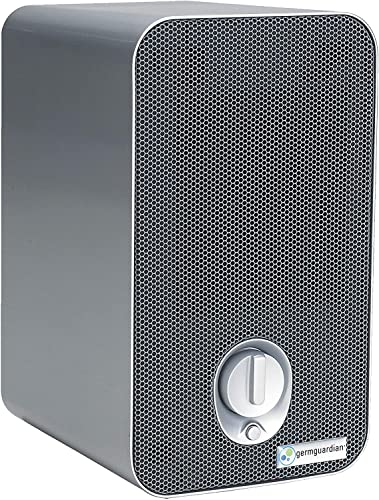
GermGuardian AC4100CA Tabletop Tower, 11″ — Best Tabletop Tower
The GermGuardian’s distinction is shape and one extra technology. At 11 inches tall in a slim tower, it is designed to stand on a desk, counter, or dresser rather than the floor, which in small rooms is often the only free real estate — and its filter stack combines HEPA filtration with a UV-C light, which the maker includes to help reduce airborne germs and mould spores, alongside a charcoal layer for odours. Guardian Technologies lists it as zero-ozone verified, a detail worth checking on any UV or ionising product. For a desk worker whose “room” is really a corner, or a kitchen counter battling cooking smells in a studio flat, the tabletop form factor is not a compromise but the point.
Strengths
- Slim 11-inch tabletop tower — lives on desks and counters, not floor space
- HEPA plus UV-C plus charcoal: particles, and odour control in one stack
- Zero-ozone verified, per the catalog listing
Trade-offs
- Coverage suits small rooms and personal spaces — up to 375 sq ft per hour per the maker
- UV-C bulb is an additional consumable alongside the filter
- Tabletop placement means it treats the air near it first; whole-room effect builds with run time
Its longevity in the market deserves a mention of its own: the AC4100 design has been sold, with running refinements, for years, which means its filters and bulbs are stocked everywhere purifier consumables are sold and its failure modes are known quantities rather than first-generation surprises. In a category where models churn annually and yesterday’s purifier is today’s orphan, a design with that kind of tenure is a feature — arguably the feature — for a buyer who intends to keep a unit on a desk for the better part of a decade.
The honest way to think about this pick is as a personal-space purifier with whole-small-room reach: strongest at the desk or bedside where you actually breathe for hours, adequate across a small room given continuous running. In a studio apartment, one on the counter and a bedroom pick from this list make a coherent two-zone system for less than one large tower.
Best for: desks, counters, studios, and small rooms where floor space is spoken for / Not suited for: larger bedrooms wanting fast whole-room turnover
Sits in the budget-to-mid tier. Check the current price on Amazon

LEVOIT Core 200S-P Smart Air Purifier — Best Smart Small
The 200S-P takes the small-bedroom brief and adds a brain. It is AHAM Verifide, runs a 3-in-1 filter with a HEPA sleep mode the maker rates as very quiet, and connects to an app and voice assistants — which sounds like a luxury until you live with a bedroom purifier, when it becomes the feature you use daily: run it hard while you shower and dress, drop it to sleep mode from the bed, schedule it silent during the baby’s nap and active before bedtime, all without touching the unit. In a small footprint suited to bedrooms and dorms, it is the most complete small-room package in this guide, and its pet-oriented positioning in the catalog listing reflects a filter tuned for hair, dander, and litter-box-adjacent odours.
Strengths
- App and voice control with scheduling — genuinely useful at bedtime
- AHAM Verifide performance; quiet HEPA sleep mode
- Compact footprint for bedrooms and dorm rooms
Trade-offs
- Smart features need Wi-Fi setup — overkill for a guest room
- Small-room coverage; not a living-room solution
- App-dependent features are only as durable as the maker’s software support
Choose the 200S-P when the purifier will live in your own bedroom and be run on your rhythm for years. The schedule is the feature: particle control is a game of hours-run, and the purifier that runs itself on a timetable quietly out-cleans a stronger unit that waits to be switched on.
Best for: primary bedrooms and dorms wanting set-and-forget scheduled purification / Not suited for: technophobe households or rooms without reliable Wi-Fi
Sits in the mid-range tier. Check the current price on Amazon
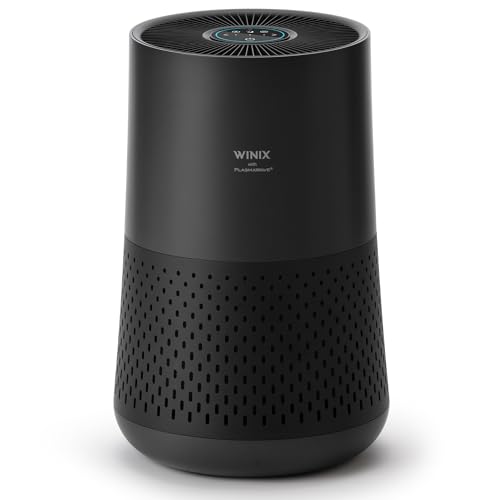
WINIX A230 Air Purifier — Best for Larger Bedrooms
The A230 sits at the top of this guide’s definition of small: a compact tower, but one with a full-size purifier’s manners — an air-quality monitor that reads the room, an auto mode that raises and lowers fan speed in response, and a filter stack combining True HEPA with a carbon filter for odours, in a unit the maker rates for rooms up to about 1,110 square feet in an hour. In practice that makes it the pick for the larger primary bedroom, the bedroom-plus-dressing-room suite, or the small living room, where the truly small picks would run at full speed forever and still lag. WINIX’s PlasmaWave technology is part of the package; as with all such additions, the filter stack is doing the measurable work, and the auto sensor is the feature owners actually praise.
Strengths
- Air-quality monitor with auto mode — responds to cooking, vacuuming, and open windows by itself
- True HEPA plus carbon filtration in a still-compact tower
- Coverage headroom for large bedrooms and small living rooms
Trade-offs
- The largest footprint here — measure your nightstand or floor corner
- Mid-to-premium tier pricing and filters to match
- Auto mode’s fan surges can startle light sleepers; sleep mode exists for a reason
The A230 is the bridge pick: buy it when you suspect your “small room” is really a medium one, or when the purifier must handle a bedroom that doubles as a home office with a dog in it. It asks for more space and money than the minis and returns a purifier you will not outgrow if the next home’s bedroom is bigger.
Best for: large bedrooms, suites, and small living rooms wanting sensor-driven auto operation / Not suited for: nightstand-scale spaces or minimal budgets
Sits in the mid-to-premium tier. Check the current price on Amazon

LEVOIT Core 300-P Air Purifier — Best Small-Room Power
The Core 300-P is the best-known small purifier in the world for a reason: it packs AHAM-verified performance — the maker rates it for rooms up to 1,073 square feet — into a cylinder still modest enough for a bedroom floor, with a quiet sleep mode, a HEPA filter stack aimed at pet hair, dander, dust, and smoke particles, and a filter ecosystem so widely stocked that replacements are never a scavenger hunt. It is the largest unit in this guide and still smaller than the “large room” class; think of it as the ceiling of small. For a primary bedroom, a nursery that will become a child’s room, or a small apartment’s single purifier, it is the safest long-term buy here.
Strengths
- AHAM Verifide with the strongest verified coverage in this guide
- Quiet sleep mode for bedroom duty; pet-oriented filter options
- Ubiquitous replacement filters — the lowest orphan risk in the category
Trade-offs
- Floor-standing size — not a nightstand or desk unit
- No smart controls on this variant; the smart sibling is the 200S-P class
- Filter replacements are a real recurring cost at this performance level
There is a reason this model anchors so many households’ first step into air purification: it is big enough to matter and small enough to place, verified enough to trust and common enough to maintain. If the guide’s smaller picks feel like experiments, the 300-P is the conservative institution — buy it, run it on sleep mode nightly and medium by day, and change the filter when the indicator says so.
Best for: primary bedrooms and small apartments wanting one verified, maintainable purifier / Not suited for: desks and nightstands, or buyers wanting app control
Sits in the mid-range tier. Check the current price on Amazon
Comparison Table
| Pick | Badge | Key spec | Best for |
|---|---|---|---|
| LEVOIT Core Mini-P | Best Overall Small | Desktop size, quiet, fragrance sponge | Nightstands, dorms, nurseries |
| Medify MA-14 | Best Particle Capture | HEPA, up to 470 sq ft/hr per maker | Dust-heavy bedrooms and offices |
| GermGuardian AC4100CA | Best Tabletop Tower | 11″ slim tower, HEPA + UV-C + charcoal | Desks, counters, studios |
| LEVOIT Core 200S-P | Best Smart Small | AHAM Verifide, app/voice, sleep mode | Scheduled bedroom purification |
| WINIX A230 | Best for Larger Bedrooms | Sensor + auto mode, True HEPA + carbon | Large bedrooms, small living rooms |
| LEVOIT Core 300-P | Best Small-Room Power | AHAM Verifide up to 1,073 sq ft per maker | Primary bedrooms, small flats |
Read the table by room, not by rank: the right purifier is the one whose coverage matches your room with headroom to run below full speed, because a purifier at medium is quiet and a purifier at maximum is a housemate.
How to Choose a Small Air Purifier
Match coverage to the room with headroom. Makers rate purifiers by the room size they can cycle in an hour; for continuous comfort you want the unit to handle your room at a middle speed, not its loudest. So take your room’s square footage and choose a pick rated comfortably above it — a 150-square-foot bedroom is well served by the Mini-P or 200S-P class, a 250-square-foot bedroom wants the MA-14 or 300-P, and anything approaching a living room wants the A230 or 300-P at minimum. Undersizing is the category’s most common disappointment: the purifier works, the room is simply bigger than its lungs, and the owner concludes purifiers do nothing.
Filtration type is the second decision, and the hierarchy is simple. A true filter — HEPA or high-grade HEPA-type media — physically captures particles, and every pick here is built on one. Carbon layers add odour and gas adsorption, valuable in kitchens, pet rooms, and city flats. UV-C and ionising additions are secondary technologies: they may contribute at the margins, they should never be the whole product, and on any ionising device the zero-ozone verification noted on the GermGuardian is the credential to look for. If a product’s marketing leads with ions and whispers about its filter, put it back.
Noise is the third decision and the one reviews underweight. A bedroom purifier lives three feet from a sleeper; its sleep-mode loudness matters more than its maximum power. All six picks offer a genuinely quiet low mode, but they differ in character — some hum, some whoosh — and light sleepers should favour the models whose reputation is built on sleep mode, the LEVOITs especially. Place any purifier with clearance around its intake, away from the wall and curtains, or even the quietest unit works harder and louder than it should.
Finally, price the filters before the unit. A purifier is a subscription wearing an appliance’s clothes: filters last months, not years, and their cost and availability decide the true price of ownership. The LEVOIT ecosystem’s ubiquity is a genuine feature; the Medify and WINIX filters are quality parts with quality-part pricing; the GermGuardian adds a UV bulb to its consumables. None of this is a reason to avoid any pick — it is a reason to buy with open eyes and a spare filter in the cupboard.
How to Set Up and Run a Small Air Purifier
Placement decides half the performance. Put the purifier where the room’s air actually circulates — not inside a cupboard, not hard against a wall, not behind a curtain — with the intake unobstructed on all sides; in bedrooms, the corner between the bed and the door usually wins, and on desks, the GermGuardian belongs at the back edge rather than beside your face, so it treats the room rather than blowing its outflow directly at you. Keep it away from humidifiers’ mist, which filters dislike, and from direct draughts that short-circuit its intake with outdoor air.
Run it continuously at the highest speed you can tolerate, which for most people means medium by day and sleep mode by night — particle levels are a bathtub that refills from every door opening, shoe, and pet, and intermittent heroic blasts lose to steady quiet work every time. Use auto mode, where fitted, as the honest broker: the A230’s sensor will surge after you vacuum or cook and settle when the room is clean, which is the pattern you would choose manually if you had the patience. Change filters on the indicator or the maker’s interval, vacuum the pre-filter monthly where the design allows, and wipe the exterior’s intake grille when you dust the room — a purifier is a dust collector by profession, and its own surfaces join the job.
Common Buying Mistakes
- Undersizing for the room. A desktop mini in a living room is decor, not purification. Match rated coverage to your room with headroom to run below full speed.
- Buying ioniser-only gadgets. No filter, no particle capture. If it does not name its filter media, it is a fan with a story.
- Expecting medical outcomes. Purifiers improve everyday air comfort — dust, dander, odours, stuffiness. They are not treatments, and this guide recommends them for comfort, not health conditions.
- Ignoring filter costs. The unit is the deposit; filters are the rent. Check replacement price and availability before choosing.
- Running it only when the room feels stuffy. Particles are invisible before they are noticeable. Continuous low-speed running beats occasional blasts.
- Sealing it into a corner. Blocked intakes strangle performance and raise noise. Give the unit air on all sides.
Final Recommendation
For one small bedroom, dorm, or nursery, buy the LEVOIT Core Mini-P and run it constantly — it is the proportionate, quiet, inexpensive answer to everyday dust and staleness. If particles are the priority, step up to the Medify MA-14; if your only space is a desk or counter, the GermGuardian tabletop tower is built for it. Bedrooms that run on routine deserve the Core 200S-P’s scheduling, larger bedrooms deserve the WINIX A230’s sensor and headroom, and anyone buying one purifier to anchor a small home should take the verified, maintainable Core 300-P. Size honestly, filter first, run continuously — the air in a small room is a small problem, and these six solve it at six sensible scales.
One final piece of shopping advice, because this category attracts more misleading listings than most: judge every purifier — including these six — by its filter and its verified delivery, never by its silhouette or its app. A beautiful cylinder with a token filter is a lamp that hums. The picks above were chosen because their filtration stories check out in the makers’ own catalog data and, where it exists, in third-party verification; if a future model tempts you away from this list, ask it the same questions this guide asked — what filter, what verified coverage, what does the replacement cost, and how loud is it at the speed you will actually sleep through — and it will sort itself into the right tier of your shortlist without any help from its marketing.
Related reading in this program: Best Air Purifiers · Best Air Purifiers For Bedrooms · Best Air Purifiers For Dust · Best Air Purifiers For Pets · Best Desktop Air Purifiers
What a Small Air Purifier Can and Cannot Do
Honesty about limits is what separates a buying guide from a brochure, so here is the plain ledger. A small purifier can: reduce airborne particle counts in an enclosed small room — dust, pollen grains, pet dander, and smoke particles that pass through its filter; slow the rate at which dust films form on surfaces; adsorb a share of everyday odours through carbon media; and make a closed room feel fresher, because the air has literally been scrubbed of part of what made it feel heavy. Run continuously and sized correctly, these effects are consistent and noticeable, and they are the entire basis on which this guide recommends the category.
A small purifier cannot: treat or prevent any medical condition; remove gases and chemicals beyond its carbon layer’s modest capacity; clean the air of a whole home from one bedroom; substitute for ventilation, which remains the only cure for carbon dioxide build-up in a sealed room; or compensate for a source left running — a purifier beside a litter box helps, a purifier instead of cleaning the litter box does not. It also cannot work instantly: a room’s air turns over through the filter over tens of minutes, which is why the guide insists on continuous running and why “I turned it on and felt nothing in five minutes” is a measurement error, not a product failure. Buy within the first ledger and these six picks deliver; expect the second and no purifier at any size will save the purchase.
Small Purifiers, Room by Room
The bedroom is the category’s home turf, because it is a small room occupied for a third of life with the door closed — the exact conditions under which a purifier’s turnover compounds. There, quiet at sleep distance is the deciding spec, and the guide’s order reflects it: Mini-P or 200S-P for standard rooms, MA-14 where dust is the complaint, 300-P where the room is the home’s largest. The nursery adds one consideration — controls a toddler cannot reprogramme and a unit stable enough to ignore small hands — which favours the floor-standing 300-P or a shelf-placed Mini-P over anything with tempting buttons at knee height.
The home office is the second natural habitat: a small room, occupied for the working day, often with a door shut for calls and a desk that shows dust like a scoreboard. Desk-format picks — the GermGuardian, the Mini-P — earn their place here, and the MA-14 serves the office that doubles as a guest room. Kitchens in small flats are the honest edge case: purifiers polish cooking odours but grease aerosol is unkind to filters, so a kitchen unit’s filter will age faster and the A230’s carbon capacity is the proportionate choice, run on auto while you cook and for an hour after. Dorm rooms, finally, are the Mini-P’s manifesto — one room that is bedroom, office, and living room in ninety square feet, where a nightstand purifier running constantly is not an appliance but an atmosphere.
Two-room households should resist the single big unit temptation. Air does not turn corners efficiently, and one large purifier in a hallway cleans the hallway beautifully and the bedrooms barely. Two small units, one per closed room, outperform it at similar total cost — which is, in the end, the whole argument for this category’s existence: purification is local, rooms are local, and the small purifier is the honest scale of the problem.
The Running Costs, Counted Honestly
Since this guide prints no prices, the useful service is to show where the money goes over a purifier’s life, because the pattern surprises first-time buyers. The unit itself is the smallest share over three years of continuous running. Filters are the recurring centre: a small purifier’s filter is a modest consumable, but it returns several times a year, and premium ecosystems price accordingly — the MA-14’s and A230’s filters cost more per change than the Mini-P’s, in proportion to the air they move. Electricity is the quiet third line: these are small fans, and continuous running costs roughly what a modern LED bulb or two costs — real money over a year, but the smallest of the three lines, and never a reason to run the unit less, since an idle purifier has a cost-per-clean-air of infinity.
The practical conclusions follow. First, a purifier you can afford to feed is better than a stronger one whose filter you will stretch past its life — a clogged premium filter underperforms a fresh budget one. Second, buying the spare filter with the unit, when the budget allows, removes the month where the indicator glows and the replacement is “in the basket” while the unit idles. Third, the second-hand market in purifiers is a trap for exactly this reason: a cheap used unit with a spent filter and an orphaned filter ecosystem is not cheap. The six picks were chosen partly on the durability of their filter supply — LEVOIT’s ubiquity, Medify’s and WINIX’s established lines, GermGuardian’s long-running model — because a purifier is a five-year relationship with a filter catalogue, and the catalogue is the relationship.
Seasons and Events: When a Small Purifier Earns Its Shelf
A small purifier’s value is not constant across the year, and knowing its strong seasons helps a buyer judge both the purchase and the unit’s performance fairly. Pollen months are the first: with windows closed against high-count days, a bedroom purifier running continuously keeps the room’s air scrubbed of the pollen that rides in on clothes and hair, and the room feels like a refuge even if the garden is a haze — stated, as throughout this guide, as a comfort observation about particle counts, not a health promise. The practical tip is placement: the purifier belongs in the room where outdoor clothes come off, which is usually the bedroom it already serves.
Wildfire smoke days are the second strong season, and the one where the category’s limits deserve the plainest statement. A HEPA purifier genuinely reduces indoor particle levels during smoke events — the particles are exactly what filters catch — and a small unit will hold one closed room at a noticeably cleaner level than the rest of the house. It will not keep up with a door opened every few minutes, and during severe events the honest advice pairs the purifier with sealing the room’s gaps and staying in it. Winter is the third season: sealed houses accumulate cooking, pet, and human staleness with no window-opening relief, and the carbon layers in these picks earn their keep against the closed-house smell that every host notices in February and no guest mentions.
Events test the category in miniature. A guest room that sits closed for months gets the Mini-P treatment — run it for the day before guests arrive, with the fragrance sponge fresh, and the room greets them aired rather than apologetic. A new-paint or new-furniture room benefits from the carbon-forward picks run hard for the first week, adsorbing the new-product smell at the surface level purifiers can honestly address. And the post-vacuuming hour — when cleaning itself launches the room’s settled dust into the air — is the auto mode’s finest moment on the A230, surging exactly when the air is dirtiest and settling as it clears. A buyer who recognises their household in these scenes is not buying a gadget; they are buying the difference between a room that recovers from life quickly and one that accumulates it.
Frequently Asked Questions
How long should a small air purifier run each day?
Continuously is the honest answer for best results — particle sources never stop, so neither should the cleaning. In practice, medium speed while the room is occupied and sleep mode overnight captures most of the benefit at a noise and energy level households sustain.
Can a small purifier handle pet hair?
It handles the airborne part — dander and floating hair that stays aloft — while floor hair remains the vacuum’s job. The pet-positioned filters on the LEVOIT picks are tuned for exactly that airborne share, and owners notice it most as slower dust build-up on surfaces.
Should I buy one larger purifier or two small ones for two rooms?
Two small ones, in nearly every real floor plan. Purified air does not travel through doorways in useful quantities — a large unit cleans the room it is in and donates a little to the hall, while the closed bedroom behind it stays unfiltered. Two small units, one in each room you actually occupy with the door shut, deliver the benefit where you breathe, at a similar total cost, with the bonus that each room’s unit can run at its own quiet speed. The single large unit wins only in open-plan spaces, where there are no doors to defeat it — and open-plan is precisely where the A230 and 300-P in this guide are aimed.
Do small purifiers help with cooking smells in a studio?
Yes, within limits: carbon filtration adsorbs odours gradually, and a unit like the GermGuardian on the counter or the A230 on auto will clear a studio’s cooking smell noticeably faster than ventilation alone. Ventilate the worst of it first — a purifier is a polisher, not an extractor hood.
How often do filters really need changing?
On the maker’s interval or the unit’s indicator, typically a matter of months in continuous use. A clogged filter strangles airflow and the purifier quietly becomes furniture, so the change is the maintenance that matters most — keep a spare.
Is UV-C or ionisation necessary?
No. Filtration does the measurable work of particle removal, and every pick here is filter-first. UV-C is a secondary addition on the GermGuardian; ionisation is absent from this guide’s picks by preference, and any ionising product should carry zero-ozone verification.
How can I tell if my small purifier is actually working?
Three honest tests, none of which is “hold your hand over it.” First, the dust-film test: clean a shelf or the top of a wardrobe, run the purifier continuously for two weeks, and compare the film’s return against the room’s usual pace — slower accumulation is the visible signature of lower particle counts. Second, the sunbeam test: on a bright morning, the shaft of light that used to sparkle with motes should look visibly emptier after the unit has run overnight. Third, the filter itself: at its first change, a filter that comes out grey and loaded is evidence the particles went into the media instead of the room. If all three tests fail in a correctly sized room, check placement and filter seating before blaming the category — a filter still in its shipping plastic has embarrassed more owners than any design flaw.
Can I run a small purifier in a child’s room safely?
Yes, with the ordinary precautions for any appliance: place it where small hands cannot tip it or reach into the grille, route the cord out of the play zone, and prefer the filter-based designs in this guide, which introduce nothing into the air but cleaned air. The GermGuardian’s UV-C is enclosed within the unit, and the model is listed as zero-ozone verified. As with everything in this guide, the claim made is comfort — a less dusty room — and parents with specific health questions should put them to their clinician rather than to a purifier listing.
Where is the best place to put a bedroom purifier?
On the floor or nightstand with clear space around the intake, typically in the corner between the bed and the door where room air circulates — not against a wall, not behind curtains, and not blowing directly at the sleeper’s face.

