Disclosure: airfryerkitchensupply.com is reader-supported. When you buy through links on our site, we may earn an affiliate commission at no extra cost to you.
Where to buy
Every purifier below was confirmed in Amazon’s catalog data for this site before inclusion, and links point to the exact models reviewed. Coverage figures quoted are the manufacturers’ own room-size claims as listed — useful for comparing models against each other, and a reminder to size a purifier to the room it will actually sit in rather than to the whole home.
- LEVOIT Core 300-P Air Purifier — Check on Amazon
- LEVOIT Core Mini-P Air Purifier — Check on Amazon
- LEVOIT Core 200S-P Smart Air Purifier — Check on Amazon
- COWAY Airmega 50 Air Purifier — Check on Amazon
- BLUEAIR Blue Pure 511 Air Purifier — Check on Amazon
- GermGuardian AC4100CA Tower Purifier — Check on Amazon
The best selling portable home air purifiers earn their sales the unglamorous way: they are small enough to move, quiet enough to sleep beside, and simple enough that people actually keep them running. That last point decides everything in this category. A purifier only cleans the air that passes through it, so the best-selling portable models are the ones that fit real rooms and real habits — carried from bedroom to nursery to home office, left on overnight, and maintained without a fight.
Portable needs defining honestly. Nothing here is battery-powered or pocket-sized; portable means one person can carry it room to room, it fits on a floor corner or a sturdy table, and it does not need ducting, plumbing or installation. Within that definition the six picks split into desktop minis for a single small room, compact bedroom units that can run all night, and larger portables that still move easily but cover open-plan spaces. Choosing among them starts with the room you will use most, not the biggest number on a box.
A framing note that matters more than any specification: air purifiers are comfort and cleanliness appliances. They capture dust, pollen, pet dander and smoke particles from indoor air, and many people find that makes a room feel fresher and easier to live in. They are not medical devices, and no pick here is presented as treating allergies, asthma or any other condition. If you have a diagnosed respiratory condition, follow your clinician’s advice on indoor air — and treat a purifier as one household tool alongside it, not a substitute for it.
In this guide
Quick Picks
Best Overall: LEVOIT Core 300-P Air Purifier — Check on Amazon
The default portable purifier recommendation: a compact HEPA unit with a sleep mode, verified performance claims, and the kind of simple controls that mean it stays switched on.
Best Budget Desktop: LEVOIT Core Mini-P Air Purifier — Check on Amazon
The smallest honest purifier in the guide: a desktop unit for the air immediately around a bed, desk or dorm bunk, at a budget tier and with a fragrance sponge for a light scent if wanted.
Best Smart Portable: LEVOIT Core 200S-P Smart Air Purifier — Check on Amazon
A compact portable with smart scheduling and voice control over a 3-in-1 HEPA filter. The intelligence is genuinely useful here: purifiers work best when they run themselves.
Best Compact Premium: COWAY Airmega 50 Air Purifier — Check on Amazon
A compact premium portable with an air quality monitor, auto mode and a deodorization filter alongside HEPA. The display that shows your air changing is more motivating than it sounds.
Best for Small Bedrooms: BLUEAIR Blue Pure 511 Air Purifier — Check on Amazon
A compact bedroom purifier built around quiet operation and a washable fabric pre-filter that catches the coarse dust and pet hair before it reaches the main filter.
Best Slim Tower for Tight Corners: GermGuardian AC4100CA Tower Purifier — Check on Amazon
An 11-inch slim tower that stands in corners other purifiers cannot use, with HEPA filtration and a listed coverage for small-to-medium rooms. The shape is the feature.
How These Picks Were Chosen
Models were confirmed through this site’s Amazon catalog data, and only genuine purifier units — not replacement filters, car fresheners or plug-in ionisers — were eligible for the six picks. Filtration type was the first filter of our own: true HEPA or verified high-efficiency filtration for particle capture, with carbon stages where odour control mattered.
The judging criteria were room-size honesty, noise at sleep-friendly speeds, filter replacement cost and availability, carry weight and footprint, and whether the controls encourage leaving the unit on — auto modes, timers and dimmable lights all count. Best-selling status was treated as a starting signal, not a verdict: high sales in this category often simply reflect a low price, so each popular model still had to justify itself on filtration and ownership costs.
Badges map to rooms and routines: best overall for the portable that suits most homes, best for bedrooms, best budget desktop, best smart portable, best for pet households, and best compact premium. Start from the room where the unit will spend its nights; that is the room it must satisfy.
The 6 Best Portable Home Air Purifiers

LEVOIT Core 300-P Air Purifier — Best Overall
This is the purifier for the household that wants one unit and wants it to work everywhere it is carried. It is light enough to move nightly if needed, sized for bedrooms and modest living rooms, and its sleep mode keeps overnight noise low while the display can be dimmed — the two details that decide whether a bedroom purifier actually runs at night. Pet hair, household dust and everyday pollen are squarely its job description.
Strengths
- HEPA filtration with a proper multi-stage filter stack
- Sleep mode suits overnight bedroom use
- Compact and light enough for genuine room-to-room use
Trade-offs
- Carbon stage is modest — heavy odours need a carbon-heavy model
- One unit still only cleans the room it is in
- Filter replacements are an ongoing running cost
| Spec | Detail |
|---|---|
| Filtration | HEPA with pre-filter and carbon stage |
| Listed coverage | Up to 1,073 ft² (manufacturer claim) |
| Modes | Sleep mode |
| Verification | AHAM VERIFIDE as listed |
The ownership detail that matters is the filter ecosystem: replacements for this model are widely available and simple to fit, which keeps the total cost of ownership predictable. Purifiers fail their owners when filters become hard to find or disproportionately expensive, and the unit ends up running on an exhausted filter. A best-selling model with a healthy accessory supply avoids that trap entirely.
Position it with clearance around the intake, off thick carpet if the manual advises, and let it run continuously on a low or auto setting rather than in short turbo bursts. Continuous gentle cleaning beats occasional aggressive cleaning for everyday dust and dander, and it is quieter and cheaper in filter life as well.
Best for: Most homes wanting one portable purifier that moves between bedroom and living room / Not suited for: Homes needing heavy smoke or chemical odour removal as the main job
Check the current price on Amazon for the LEVOIT Core 300-P Air Purifier before you decide — check price on Amazon.

LEVOIT Core Mini-P Air Purifier — Best Budget Desktop
Desktop purifiers attract scepticism, and some of it is earned — a tiny fan cannot cleanse a large room. Judged on its actual job, though, this mini makes sense: the air around a pillow or a desk chair, in a dorm room or a small study, moved through a real filter. It is the pick for renters, students and bedside tables where a full-size unit simply does not fit, and its budget tier makes it a low-risk first purifier.
Strengths
- Genuinely small footprint for desks and nightstands
- Budget tier makes it an easy first purifier
- Fragrance sponge adds optional light scent
Trade-offs
- Personal-space coverage only — not a whole-room solution
- Small filter means more frequent replacement in dusty homes
- No smart features or air quality display
| Spec | Detail |
|---|---|
| Format | Desktop / personal space |
| Filtration | Multi-stage filter as listed |
| Extras | Fragrance sponge |
| Use | Dorm, desk, bedside |
Set expectations by physics: air changes per hour in a small, closed room are achievable; the same unit in an open-plan space is decoration. Used in a dorm, a box room or beside a bed with the door closed, it does real work. The fragrance sponge is optional — leave it empty if you prefer clean air without added scent, which many people do.
Because the filter is small, keep the pre-filter area vacuumed and replace the filter on schedule rather than by guesswork. In a dusty or pet-heavy home, a mini’s filter loads faster than a big unit’s, and a loaded filter quietly turns any purifier into a fan.
Best for: Students, desk workers and anyone cleaning the air of one small personal space / Not suited for: Anyone expecting it to serve a full bedroom or living room alone
Check the current price on Amazon for the LEVOIT Core Mini-P Air Purifier before you decide — check price on Amazon.

LEVOIT Core 200S-P Smart Air Purifier — Best Smart Portable
Smart features earn their place in purifiers more than in most appliances, because the ideal purifier behaviour — run harder when the air is dirty or the room is empty, whisper at night, never be forgotten — is exactly what schedules and app control deliver. This compact model brings that behaviour to a bedroom-sized portable: set it to clean the room before bedtime, drop to sleep mode overnight, and check filter life from the app instead of guessing.
Strengths
- Scheduling makes continuous cleaning effortless
- Voice and app control suit bedroom use
- Verified listing claims and HEPA sleep mode
Trade-offs
- App setup is an extra step some buyers will skip
- Smart features are wasted if you prefer a simple dial
- Same ongoing filter costs as any compact HEPA unit
| Spec | Detail |
|---|---|
| Filtration | 3-in-1 with HEPA stage |
| Controls | App and voice control as listed |
| Modes | HEPA sleep mode |
| Verification | AHAM VERIFIDE as listed |
The honest caveat is that smart control does not clean air; the filter does. What the technology changes is compliance — yours. Owners run scheduled purifiers more hours per day, and hours are the currency of clean air. If you know you are a set-and-forget person, this is the right kind of upgrade; if you happily use a timer dial, the Core 300-P serves you as well.
Place it in the bedroom first, even if you bought it for the living room. Night is when a purifier runs longest undisturbed, in the room where you breathe most continuously — and a smart schedule makes that automatic from the first evening.
Best for: Homes that want scheduling, voice control and set-and-forget running / Not suited for: Buyers who prefer purely manual controls and no app
Check the current price on Amazon for the LEVOIT Core 200S-P Smart Air Purifier before you decide — check price on Amazon.

COWAY Airmega 50 Air Purifier — Best Compact Premium
The Airmega 50 is built around information: its air quality monitor shows the room’s particle levels and its auto mode responds to them, so you can watch cooking drift, dust from making a bed, or a window opened onto a busy street register and then clear. For buyers who like evidence that an appliance is working — and who will keep using it because of that evidence — this compact unit is the most satisfying in the guide.
Strengths
- Air quality monitor makes performance visible
- Auto mode responds without manual adjustment
- Deodorization filter helps with everyday household odours
Trade-offs
- Listed coverage suits bedrooms, not big open spaces
- Premium tier for its size class
- Night light will not suit every light-sensitive sleeper
| Spec | Detail |
|---|---|
| Listed coverage | Up to 500 ft² (manufacturer claim) |
| Filtration | HEPA and deodorization filter |
| Display | Air quality (AQI) monitor |
| Modes | Auto mode, night light |
Its size-to-coverage honesty is also a strength: listed for rooms up to 500 square feet, it is specified for the bedrooms and nurseries it will actually serve, rather than inflated claims. In that space, auto mode and a real deodorization stage handle the two commonest bedroom complaints — dust and stale, closed-room air — without nightly attention from you.
Use the air quality readout as a diagnostic, not just a display. If levels spike at the same time daily, you have found a source — a door, a pet routine, a nearby road at rush hour — and sometimes the fix is a habit, not a higher fan speed.
Best for: Bedrooms and nurseries wanting a compact unit with an air quality display and auto mode / Not suited for: Large open-plan rooms beyond its listed coverage
Check the current price on Amazon for the COWAY Airmega 50 Air Purifier before you decide — check price on Amazon.

BLUEAIR Blue Pure 511 Air Purifier — Best for Small Bedrooms
Quiet is this unit’s headline and its honest advantage: listed at very low noise on its gentle settings, it suits the lightest sleepers and the smallest bedrooms, where a louder purifier gets switched off — and an off purifier cleans nothing. The washable pre-filter is the second practical win: in pet households it catches the visible hair and fluff, rinses clean, and stretches the life of the main filter behind it.
Strengths
- Very quiet gentle settings suit light sleepers
- Washable pre-filter reduces main filter loading
- Compact fabric design sits softly in a bedroom
Trade-offs
- No smart scheduling at this level
- Fabric pre-filter needs regular washing to stay effective
- Coverage claims still require sensible room sizing
| Spec | Detail |
|---|---|
| Listed coverage | Up to 907 ft² (manufacturer claim) |
| Filtration | HEPASilent as listed |
| Pre-filter | Washable fabric pre-filter |
| Verification | AHAM Verified, Energy Star as listed |
The fabric pre-filter also changes the look: this is the least appliance-like purifier in the guide, which matters in a small bedroom where the unit is always in view. Treat the pre-filter like a lint filter — wash it on a rhythm, let it dry fully, and the main filter’s replacement interval stays where the manual promises.
Run it continuously at the speed you can sleep through rather than at maximum before bed and off overnight. In a small closed room, hours of gentle filtration exchange the air many times over, which is the entire game.
Best for: Light sleepers and small bedrooms where quiet and low running fuss matter most / Not suited for: Homes wanting app control and detailed air quality data
Check the current price on Amazon for the BLUEAIR Blue Pure 511 Air Purifier before you decide — check price on Amazon.
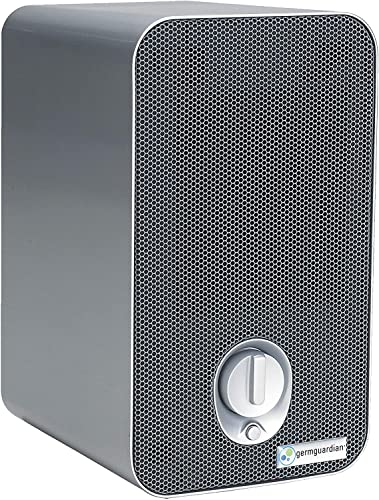
GermGuardian AC4100CA Tower Purifier — Best Slim Tower for Tight Corners
Some rooms defeat standard purifiers not on performance but on geometry: no spare floor square, a nightstand already full, a rental where the only free space is a corner behind a door. This slim tower exists for those rooms. At eleven inches tall and narrow in footprint, it stands on a desk corner, a shelf or a sliver of floor, and its listed coverage suits the small rooms where such compromises happen.
Strengths
- Slim tower fits corners and desks other units cannot
- HEPA filtration in a genuinely small body
- Long-established model with easy filter availability
Trade-offs
- Small size means modest airflow — patience in larger rooms
- UV-C feature is secondary; the HEPA filter does the main work
- Basic controls compared with smart rivals
| Spec | Detail |
|---|---|
| Format | Slim tower, 11 in |
| Listed coverage | Up to 375 sq ft (manufacturer claim) |
| Filtration | HEPA filter with UV-C light |
| Safety note | Zero Ozone Verified as listed |
Judge it as a small-room specialist. In a child’s bedroom, a study or a small flat’s living corner it does honest work; asked to serve a big open room it will run forever and never catch up, which is a sizing error rather than a product failure. The UV-C light is a secondary feature — the HEPA filter is what captures the particles you care about.
Because the tower is light and stable in a corner, it is also the easiest pick here to relocate seasonally — bedroom in pollen season, living room when the wood stove or holiday cooking starts — which is the portable promise kept in its simplest form.
Best for: Tight corners, small flats and rooms where floor space is the constraint / Not suited for: Large rooms or anyone wanting the quietest possible night mode
Check the current price on Amazon for the GermGuardian AC4100CA Tower Purifier before you decide — check price on Amazon.
Comparison Table
Size the purifier to the room it will sleep in, then choose by noise and controls: the Core 300-P is the all-rounder, the Mini-P and 511 serve small spaces quietly, the 200S-P automates the routine, the Airmega 50 shows you your air, and the GermGuardian fits the corner nothing else can.
| Pick | Badge | Key spec | Best for | Link |
|---|---|---|---|---|
| LEVOIT Core 300-P Air Purifier | Best Overall | HEPA filtration, sleep mode, listed up to 1,073 ft² | Most homes wanting one portable purifier that moves between bedroom and living room | Check on Amazon |
| LEVOIT Core Mini-P Air Purifier | Best Budget Desktop | Desktop size, personal-space filtration, fragrance sponge | Students, desk workers and anyone cleaning the air of one small personal space | Check on Amazon |
| LEVOIT Core 200S-P Smart Air Purifier | Best Smart Portable | Smart and voice control, 3-in-1 HEPA filter, sleep mode | Homes that want scheduling, voice control and set-and-forget running | Check on Amazon |
| COWAY Airmega 50 Air Purifier | Best Compact Premium | Listed up to 500 ft², HEPA plus deodorization filter, AQI monitor, auto mode | Bedrooms and nurseries wanting a compact unit with an air quality display and auto mode | Check on Amazon |
| BLUEAIR Blue Pure 511 Air Purifier | Best for Small Bedrooms | Listed up to 907 ft², HEPASilent filtration, washable pre-filter, quiet operation | Light sleepers and small bedrooms where quiet and low running fuss matter most | Check on Amazon |
| GermGuardian AC4100CA Tower Purifier | Best Slim Tower for Tight Corners | 11-inch tower format, HEPA filter, listed up to 375 sq ft, UV-C light | Tight corners, small flats and rooms where floor space is the constraint | Check on Amazon |
How to Choose Portable Home Air Purifiers
Room size and the honest meaning of coverage numbers
Coverage figures are manufacturer claims under test conditions, and they assume the purifier can exchange the room’s air at a useful rate. Treat the listed number as a ceiling, not a target: a unit listed for around 1,000 square feet will serve a normal bedroom superbly and a room of that full size modestly. When in doubt, buy one size up from your room — the larger unit then runs slower and quieter to do the same work.
Measure the room the purifier will live in, not the whole home. Portable units clean one room well; the honest whole-home answer is either moving one unit with discipline or accepting that bedrooms — where you spend the longest continuous hours — come first.
Filtration types without the marketing fog
HEPA filtration is the benchmark for particles: dust, pollen, dander and smoke particles are captured mechanically as air passes the filter, and that capture is the core job. Carbon stages address odours and some gases, and their capacity varies enormously — a thin carbon sheet freshens, while odour-heavy homes need substantial carbon weight. Pre-filters catch hair and coarse dust and protect the expensive stages behind them.
Be wary of purifiers with no replaceable filter at all making equivalent claims, and of ozone: a purifier should not add ozone to a room, so look for zero-ozone verification where a listing mentions ionisation or UV features. The filter stack, stated plainly, is what you are buying; everything else is controls and cabinet.
Noise: the specification that decides everything
A purifier’s loudest speed is nearly irrelevant, because almost nobody sleeps or works beside a unit on turbo. What matters is the noise at the speed that still cleans your room — usually the low or sleep setting. If you are a light sleeper, prioritise models that publish low decibel figures for their gentle modes and offer display dimming, like the bedroom picks in this guide.
Placement helps: a unit on a hard floor in a corner sounds louder than the same unit on a rug mid-room, and a metre from the bed is quieter than thirty centimetres. Continuous low speed also beats intermittent high speed for perceived peace, because a steady sound fades from attention while a cycling one never does.
Running costs: filters, energy and honesty
The purchase is the beginning, not the cost. Every HEPA purifier here needs replacement filters on a schedule, and the annual filter cost of a cheap unit can exceed that of a better one. Before buying, check the replacement filter’s price and availability for your exact model, and set a calendar reminder — a purifier running on an exhausted filter is furniture, not filtration.
Energy use is modest for portables, especially efficient verified models, and running continuously on low typically costs less than people fear. The expensive behaviour is the opposite: buying a unit, finding it loud or fiddly, and leaving it off. Choose for the routine you will actually keep.
A Comfort Appliance, Not a Medical Device
This guide frames purifiers as what they are: appliances that reduce airborne particles indoors and make rooms feel cleaner and fresher. Many people with dust sensitivity find that genuinely improves their comfort at home, and that is a fair and sufficient reason to own one. What a purifier is not is a treatment. Diagnosed allergies, asthma and other respiratory conditions need a clinician’s management plan; a purifier can sit inside that plan as a household measure, but it does not replace medication, medical advice or investigating the sources of indoor pollution.
New or worsening breathing symptoms — persistent cough, wheeze, breathlessness — are a reason to seek medical advice promptly, not to buy a bigger purifier. Keeping that boundary clear protects both your health and your wallet: it stops the appliance being blamed for not doing a job it never claimed to do.
Placement and Habits That Double Effectiveness
The same purifier can be twice as effective with better placement. Give intakes and outlets clearance — not hard against a wall or buried behind curtains — keep doors to the room closed while it works, and vacuum the room itself regularly, because settled dust that is never disturbed is not the purifier’s problem, while dust you raise with a duster is exactly what it can catch if it is running at the time.
Run the unit when the room is dirtiest, not just when you are in it: after making beds, after the dog comes in, during cooking drift. Smart scheduling and auto modes exist precisely to cover those moments without you remembering. The best-selling portables in this guide earned their sales by fitting that rhythm of real life — small, quiet, and always on.
Pollen Season, Pet Season, Smoke Season: One Machine, Three Calendars
A portable purifier earns its place across the year by changing jobs with the seasons. Spring and summer bring pollen through open windows, and the unit belongs in the bedroom, running overnight while counts are high outdoors. Autumn adds the dust of heating systems waking up and, in many regions, wood smoke — the purifier moves toward living spaces and runs harder in the evenings. Winter seals the house, and the enemy becomes the accumulated indoor load: cooking particles, pet dander and the general staleness of unopened rooms.
Portability is what makes that calendar possible with one machine. The discipline is simply to move the unit deliberately rather than randomly: a season per room, a routine per season. Households that buy a second, smaller unit — a mini for the child’s room, say — usually do so after a year of watching the first one’s calendar work, which is the natural order of things.
What the Air Quality Display Is Really Telling You
Models with particle displays, like the Airmega pick, report the concentration of fine particles in the air near the unit, usually as a number or a colour. Read it as a trend, not a verdict: spikes when you shake a duvet, cook, vacuum or open a door are normal life registering, and the useful observation is how quickly the line falls afterwards — that fall is your purifier’s work made visible. A room whose readings never settle may have a source worth hunting: a litter tray too close, a smoker’s doorway, a road-facing window at rush hour.
Do not let the display create anxiety it was meant to relieve. Indoor air varies through every day in every home, and the goal is a good average with quick recoveries, not a permanent zero. If a member of the household has a diagnosed respiratory condition, the display is household information only — management of the condition stays with their clinician, as this guide has framed from the start.
Filters: The Ownership Chapter Nobody Reads First
Every purifier in this guide is, in ownership terms, a filter subscription you manage yourself. The main filter does the capturing; its capacity is finite; and its replacement — on schedule, with the correct part — is the maintenance on which everything else depends. Before buying any model, perform the thirty-second check this guide recommends: find the exact replacement filter, note its price and its stated life, and multiply out three years. That figure, added to the purchase, is the machine’s real cost, and it sometimes reorders the ranking of two otherwise equal models.
Handling matters too. Fit filters with clean hands, note the date on the frame, vacuum pre-filters gently rather than washing what should not be washed, and never run the unit with a filter still in its shipping wrap — the single commonest reason a new purifier ‘does nothing’. A spare filter in the cupboard converts a replacement from a research project into a two-minute task, which is why committed owners keep one.
Renters, Small Homes and Shared Spaces
Portable purifiers suit rented and small homes precisely because they ask nothing of the building: no installation, no ducting, no landlord’s permission, and they leave with you. In a studio or one-bedroom flat, a single compact unit can serve the whole home if it is placed where you sleep and moved to where you sit — the room-to-room habit this category is built around. In shared houses, the bedroom-first rule resolves most disputes: clean the air of your own room thoroughly, and let communal spaces be a negotiation the housemates can join by buying in.
Noise courtesy is the shared-space skill. A unit run on its quiet settings overnight in your room, and on medium while you are out, cleans aggressively without colonising anyone else’s soundscape. The best-selling portables in this guide earned their sales in exactly these homes — small, rented, shared — by being easy to live with as well as easy to buy.
A Word About Second-Hand and Older Models
Best-selling portables have long lives on the second-hand market, and a used unit can be a sensible buy — with two conditions that are not negotiable. First, fit a new filter before first use: a second-hand purifier with its previous owner’s filter is borrowing somebody else’s dust history, and the filter is where the machine’s hygiene lives. Second, confirm the exact model number and that its replacement filters are still sold; a discontinued unit whose filters have vanished is not a bargain at any price, because its remaining life is exactly one filter long.
Older models in your own home deserve the same audit. A purifier that has run for years on faithful filter changes is a known friend; one that has run for years on the same filter is a fan in a nice cabinet. The revival is cheap and immediate — new filter, vacuumed pre-filter, a wipe of the sensor lens where fitted — and owners are routinely surprised by how much of the original performance was waiting behind basic maintenance. Before replacing any purifier in this category, revive it once. If it still disappoints, replace it with the evidence honestly earned.
The Portable Purifier Buyer’s Checklist
Six checks, in the order they should be made, will steer you to the right model in this guide — or expose a listing elsewhere that does not deserve your money. Keep your actual room and your actual habits in front of you as you run them.
- Room measured first. You know the dimensions of the room the purifier will sleep in, and you are matching the manufacturer’s listed coverage to that room with headroom to spare — not to your whole home, and not to the biggest number in the range.
- Filtration stack stated plainly. The listing names its stages — pre-filter, HEPA, carbon — in words you can verify, rather than hiding behind proprietary sparkle. The filter stack is the product; everything else is the cabinet and the controls around it.
- Noise judged at sleep speed. You have looked for the quiet figure — the low or sleep-mode noise — rather than being impressed by maximum power. A purifier that is off cleans nothing, and noise is the reason purifiers get turned off.
- Replacement filter priced and available. You have found the exact replacement filter for the exact model, noted its price and stated life, and added three years of filters to the purchase price in your head. That total is the machine you are really buying.
- Controls matched to your honesty. If you are a set-and-forget person, you have chosen scheduling, auto mode or an air quality sensor to do the remembering. If you are a dial person, you have saved the money. Either is right; pretending to be the other is how purifiers end up in cupboards.
- Placement already imagined. You know where it will stand — clearance around it, door closable, near the bed but not buried in bedding. A purifier with a home planned for it gets unboxed and used the day it arrives.
A model that passes all six in your specific room, with your specific habits, is the right purifier even if a comparison table somewhere ranks another higher. Fit to life is the specification that decides satisfaction in this category.
How to Set Up and Run a Portable Air Purifier
Ten minutes of setup and a simple running rhythm are the difference between a purifier that transforms a room and one that becomes a side table.
- Unpack the filter before first use. Most units ship with the filter sealed in plastic inside the cabinet. Open the panel, remove the wrapping, refit the filter and close up — running a sealed filter is the commonest setup mistake in the category.
- Place it with breathing room. Set the unit on a stable surface with clearance around intake and outlet, away from curtains and not directly against a wall. Bedrooms: near the bed but not touching bedding. Keep it off deep carpet if the manual advises a hard surface.
- Run it continuously on low or auto. Close the room’s door and let the unit work steadily. Use higher speeds for an hour after dust-raising activities — vacuuming, bed-making, pets coming indoors — then return to the quiet setting.
- Use sleep mode and dimming at night. Engage the sleep setting and turn off or dim display lights. A purifier you can sleep beside earns eight hours of cleaning a night; one you switch off earns none.
- Maintain the pre-filter monthly. Vacuum or wash the pre-filter as the manual allows, and let washable pre-filters dry fully before refitting. This small habit protects the main HEPA filter and keeps airflow honest.
- Replace the main filter on schedule. Follow the filter indicator or the manual’s interval, whichever comes first in a dusty or pet-heavy home. Note the date on the new filter as you fit it, and keep a spare if your home relies on the unit daily.
After a fortnight of this rhythm, judge the purifier by the room: dust settling more slowly on surfaces, a fresher smell on entering, and — on models with a display — particle readings that fall after spikes. Those are the honest metrics of a portable purifier doing its job.
Common Buying Mistakes
Buying by the biggest coverage number
Inflated claims reward the wrong choice. Size to your actual room, one step up, and value quiet low-speed performance over a headline figure measured in ideal conditions.
Running it only when you remember
Occasional bursts barely dent a room’s particle load. Purifiers work by accumulation of clean hours — continuous low or auto running is the entire method.
Forgetting the sealed filter
A surprising number of new purifiers run for weeks with the filter still in its shipping plastic. If a new unit seems to do nothing, open the cabinet before blaming the model.
Ignoring filter replacement costs
The cheapest unit with expensive, scarce filters is the dearest over three years. Check replacement price and availability for the exact model before you buy.
Expecting medical results
A purifier improves indoor air cleanliness and comfort. It does not treat respiratory conditions; persistent or worsening symptoms need a clinician, with the purifier as a supporting household measure only.
Final Recommendation
For most homes, the LEVOIT Core 300-P is the portable to buy: verified HEPA performance, a real sleep mode and a size that genuinely moves room to room. Light sleepers and small bedrooms should take the Blue Pure 511’s quiet and washable pre-filter; anyone who knows they need automation should take the smart Core 200S-P and let scheduling do the remembering.
On a budget or in a dorm, the Core Mini-P handles personal space honestly. The Airmega 50 suits buyers who want to see their air quality and let auto mode respond, and the GermGuardian tower remains the answer when the only available space is a slim corner. Whichever you choose, run it continuously, maintain its filters, and size it to the room — those habits matter more than the badge on the front.
- Best Air Purifiers
- Best Air Purifiers For Bedrooms
- Best Air Purifiers For Pets
- Best Air Purifiers For Allergies
- Best Portable Air Purifiers
Frequently Asked Questions
How long should I run a portable air purifier each day?
Continuously, ideally — on a low, quiet or auto setting. Purifiers clean by passing room air through the filter repeatedly, so hours matter more than intensity. A practical minimum is running it whenever the room is occupied and overnight in bedrooms; smart scheduling or auto mode makes that effortless.
What size purifier do I need for my bedroom?
Match the manufacturer’s listed coverage to your room with headroom to spare: a unit listed for two to three times your room’s area will clean it well on a quiet setting. A unit listed for exactly your room’s size will need a louder speed to keep up, which is why one size up is the comfortable buy.
Do portable air purifiers help with pet hair and smells?
They capture airborne dander and the fine particles that carry much of a pet household’s stuffiness, and pre-filters catch visible hair near the unit. They do not vacuum hair off floors or remove odour soaked into fabrics — carbon stages help with airborne smells, but source cleaning does the heavy lifting. Expect fresher air, not a self-cleaning home.
How often do filters need replacing?
Follow your model’s indicator and manual — typically somewhere in the six-to-twelve-month range for a main HEPA filter in normal use, sooner in dusty or pet-heavy homes. Vacuum or wash pre-filters monthly. A filter run far past its life quietly reduces the unit to a fan, so replacements are the real running cost to budget for.
Are air purifiers a treatment for allergies or asthma?
No. They are comfort and cleanliness appliances that reduce airborne particles indoors, and many people find that makes home feel easier to live in. Diagnosed conditions need a clinician’s plan; treat a purifier as a supporting household measure within that plan, and seek medical advice for new or worsening breathing symptoms.
Where should I place a portable purifier?
In the room you occupy longest — usually the bedroom — with clearance around its intake and outlet, on a stable surface, and with the room’s door closed while it works. Avoid corners that block airflow, spots behind curtains, and placing it so close to the bed that bedding can obstruct the intake.

