Disclosure: airfryerkitchensupply.com is reader-supported. When you buy through links on our site, we may earn an affiliate commission at no extra cost to you.
Where to buy
Small freestanding tubs are a considered purchase, and Amazon is where the size range is widest — 48-inch Japanese-style soakers through 55-inch ovals — with dimensions, drain positions and materials stated in the listings. Every tub in this guide was confirmed through the Amazon catalog before publication: the WOODBRIDGE 48-inch Acrylic Freestanding Bathtub as the compact all-rounder, the WOODBRIDGE 48-inch Japanese Soaking Tub with its pre-moulded seat, the Empava 48-inch Air Jetted Bathtub for a spa-style soak, the BCANHOME 51-inch Stone Resin Freestanding Bathtub for a solid-surface feel, the DeerValley 55-inch Acrylic Freestanding Bathtub for a deeper centre-drain soak, and the WOODBRIDGE 55-inch Stone Resin Freestanding Soaking Tub as the premium oval. Check the current price on Amazon for each, and read the measuring section before ordering — with tubs, the tape measure is the whole game.
Introduction: small footprint, deep water — the soaking tub bargain
The best small freestanding soaking tubs solve a problem the standard alcove tub never could: how to get a genuinely deep, shoulders-under soak into a bathroom that does not have six feet of spare wall. The typical built-in tub is long but shallow — you lie back and your knees and chest stay in the air — because it was designed for quick family baths and showers, not for soaking. A small freestanding soaker flips the priorities. At 48 to 55 inches long it fits bathrooms a standard tub cannot, but it is built deep and steep-sided, so the water rises over you instead of spreading out along you. Japanese soaking tubs have worked on this principle for centuries: sit deep, water to the chin, in a footprint smaller than a shower tray.
Freestanding also changes the room. A tub that stands on its own feet or base, visible from every side, turns a plain bathroom into a deliberate space — and because it is not boxed into an alcove, it can sit at an angle, under a window, or in the centre of a larger room. The trade-offs are plumbing and access: a freestanding tub needs its drain and supplies planned around its final position, usually with a floor-mounted or wall-mounted filler, and installation is a professional job for most households. None of that should scare off a renovator — it should simply be budgeted and planned rather than discovered mid-project, and the installation section below walks through what is actually involved.
This guide concentrates on the small end of the freestanding market — 48 to 55 inches — in the two materials that dominate it: acrylic, which is light, warm to the touch and forgiving to install, and stone resin (solid surface), which is heavier, denser and feels like carved stone. All six tubs were verified against the Amazon catalog, with their sizes, shapes and drain configurations taken from the listings themselves. Whether you are converting a tiny ensuite, replacing a hated alcove tub, or building a soaking corner in a primary bathroom that never had room for one, one of these six footprints will fit your floor.
In this guide
Quick Picks
- Best Overall: WOODBRIDGE 48-inch Acrylic Freestanding Bathtub — a compact contemporary oval in white acrylic with brushed nickel drain and overflow; the easiest deep soak to fit into a small bathroom. Check the current price on Amazon.
- Best for Deep Sitting Soaks: WOODBRIDGE 48-inch Japanese Soaking Tub — a square-shape Japanese-style tub with a pre-moulded seat, built for sitting deep in a tiny footprint. Check the current price on Amazon.
- Best Spa Experience: Empava 48-inch Air Jetted Bathtub — a freestanding Japanese soaking tub with seat, 36 air jets and a 20.45-inch deep soak in a 50-gallon acrylic body. Check the current price on Amazon.
- Best Stone Resin Value: BCANHOME 51-inch Stone Resin Freestanding Bathtub — a matte white solid-surface oval that brings the stone feel to a small-bathroom size. Check the current price on Amazon.
- Best Deeper Mid-Size Soak: DeerValley 55-inch Acrylic Freestanding Bathtub — a deep soaking tub with centre drain and integrated overflow in an ergonomic standalone design. Check the current price on Amazon.
- Best Premium Oval: WOODBRIDGE 55-inch Stone Resin Freestanding Soaking Tub — a modern oval solid-surface tub with integrated slotted overflow and drain in matte white. Check the current price on Amazon.
How These Picks Were Chosen
Size discipline came first: every tub here is 55 inches or shorter, the range that genuinely changes what a small bathroom can hold, and each had to be a true soaking design — depth and interior shape intended for immersion — rather than a merely short standard tub. We then verified each model against the Amazon catalog, confirming length, material, shape and drain or overflow configuration from the listing before allowing a link. Only facts the listings state appear in these reviews; where a listing does not publish a figure, we do not guess it.
The six slots were balanced across the real decision axes of this category. Two footprints at 48 inches serve the smallest rooms, in classic oval and in seated Japanese form. One jetted model serves buyers who want the spa experience and accept the extra plumbing and maintenance jets involve. Two stone resin models serve buyers who prioritise material feel and heat retention, at 51 and 55 inches. And one 55-inch acrylic with a centre drain serves taller soakers who need the extra length without stepping up to a full-size tub. Freestanding tubs are heavy, expensive to return and plumbed in place, so this guide leans conservative: established tub makers, standard configurations, and repeated reminders to measure — because the best tub is the one that fits your floor, your doorway and your joists, not the one with the longest feature list.
The 6 Best Small Freestanding Soaking Tubs

1. WOODBRIDGE 48-inch Acrylic Freestanding Bathtub — Best Overall
The WOODBRIDGE 48-inch Acrylic Freestanding Bathtub is the tub we would point most small-bathroom renovators to first. It is a contemporary white acrylic soaker at the shortest length in this guide, supplied with a brushed nickel drain and overflow, in the clean oval form that suits the widest range of bathrooms. Acrylic is the friendly material for a first freestanding tub: it is light enough for two people to manoeuvre through a doorway and up stairs, warm to the touch when you climb in on a winter morning, and forgiving of the knocks that happen during installation. At 48 inches you do not stretch out — you sit, knees bent, in deep water — and for the majority of soakers that posture, water high on the chest, is exactly the experience they were shopping for.
Strengths
- Shortest footprint here — fits bathrooms and ensuites no standard tub can serve.
- Lightweight acrylic is the easiest material to deliver, position and install.
- Contemporary oval shape and brushed nickel fittings suit most modern bathrooms.
Trade-offs
- At 48 inches, tall soakers will sit rather than recline — the Japanese model below embraces this even more deliberately.
- Acrylic can flex slightly underfoot compared with stone resin; correct bedding during install matters.
- Gloss acrylic shows water spots in hard-water areas without a quick wipe-down habit.
Think about who soaks in your house. For one adult of average height, this tub delivers the full ritual — deep water, quiet room, twenty unhurried minutes — in a corner that previously held a linen cupboard or a cramped shower. For couples hoping to soak together, be honest: no 48-inch tub does that comfortably, and the 55-inch models below are the realistic starting point, still small by freestanding standards. As a single-soaker centrepiece for a small bathroom, though, this WOODBRIDGE is the balanced default: reputable maker, standard fittings, no exotic requirements for your plumber.
Best for: small bathrooms and ensuites wanting a true deep soak for one. / Not suited for: couples soaking together or very tall bathers wanting to stretch out. Check on Amazon — check the current price on Amazon.

2. WOODBRIDGE 48-inch Japanese Soaking Tub — Best for Deep Sitting Soaks
The WOODBRIDGE 48-inch Japanese Soaking Tub takes the small-tub idea to its logical conclusion. Its square shape and pre-moulded seat follow the Japanese ofuro tradition: you sit upright on the seat, immersed to the shoulders, in a tub whose footprint is closer to a large shower’s than a bath’s. The upright posture suits people who find reclining in a low tub hard on the back or difficult to get out of — sitting to standing is a far kinder movement than hauling yourself up from a recline — and the moulded seat keeps you positioned rather than sliding. It is supplied with a brushed nickel pop-up drain and overflow option in white acrylic.
Strengths
- Pre-moulded seat makes deep soaking accessible and comfortable in an upright posture.
- Square 48-inch footprint fits corners and tiny ensuites other tubs cannot.
- Easier entry and exit than a deep reclining tub — kind to stiff knees and backs.
Trade-offs
- Upright sitting is a different ritual from reclining; try the posture in a chair-and-footstool sense before committing.
- The square, sculptural shape is a stronger style statement than a soft oval.
- One-person tub by design — no shared soaks.
This is the connoisseur’s small tub. Apartment renovators in particular should look closely: a 48-inch square can claim a bathroom corner that would otherwise hold only a shower, giving a small flat a bathing ritual most small flats simply do not have. The deep, hot, upright soak is also the fastest to fill per degree of immersion — less water spread thin, more water where your body is — which matters in homes with modest water heaters. If your mental image of a bath is lying back with a book, choose the oval above; if it is sinking to your chin and letting the day go, this is your tub.
Best for: deep-soak purists, small flats, and anyone who prefers sitting to reclining. / Not suited for: bathers who want to stretch out or soak with a partner. Check on Amazon — check the current price on Amazon.

3. Empava 48-inch Air Jetted Bathtub — Best Spa Experience
The Empava 48-inch Air Jetted Bathtub adds moving water to the Japanese soaking format: a freestanding acrylic tub with a seat, 36 air jets producing a bubble-massage effect, and a 20.45-inch deep soak in a body of about 50 gallons. Air jets differ from whirlpool water jets in a way that matters for maintenance: they blow warmed air through small holes rather than recirculating bath water through pipes, so there is no loop of pipework holding yesterday’s bath — the hygienic and simpler system for a home tub, and the gentler sensation, a champagne fizz rather than a pummelling. In a 48-inch footprint, that is a remarkable amount of spa to fit into a small bathroom.
Strengths
- 36 air jets deliver a genuine spa soak in the smallest footprint here.
- Air-jet system avoids recirculating bath water — simpler hygiene than whirlpool plumbing.
- 20.45-inch soaking depth with a seat: deep immersion, upright comfort.
Trade-offs
- Jets mean a blower, power supply and more installation scope — budget for an electrician as well as a plumber.
- More components to maintain; follow the maker’s purge and cleaning routine.
- The blower is not silent — the soak is bubbly, not monastery-quiet.
Choose this tub if the soak itself is the event — post-training recovery rituals, end-of-week resets, a home spa corner — rather than a quiet bath. Plan the install carefully: the tub needs electrical provision to code, access to the blower for servicing, and a filler that can keep up with 50 gallons. Households with small water heaters should check recovery capacity, because a deep tub filled two-thirds with hot water is the sternest test a home system gets. None of this is a reason to avoid the Empava; it is a reason to install it once, properly, and then enjoy the most complete small-tub experience in this guide.
Best for: spa-at-home buyers wanting jets in a small footprint. / Not suited for: minimalists, silence-seekers, or bathrooms where adding electrical work is impractical. Check on Amazon — check the current price on Amazon.

4. BCANHOME 51-inch Stone Resin Freestanding Bathtub — Best Stone Resin Value
The BCANHOME 51-inch Stone Resin Freestanding Bathtub is where material becomes the headline. Stone resin — a solid-surface composite — feels fundamentally different from acrylic: denser, cooler and smoother at first touch, with a matte white finish that reads as carved stone and a heft that makes the tub feel planted and permanent. It also holds heat beautifully once warmed, so long soaks stay long. At 51 inches, this oval threads the needle for small bathrooms that found 48 inches just too tight: three extra inches of length, noticeably more room to settle, still a compact footprint by freestanding standards.
Strengths
- Solid-surface stone resin: dense, matte, premium feel with strong heat retention.
- 51-inch length gives a little more settle-room than the 48-inch tubs.
- Matte finish hides water spots and micro-scratches better than gloss acrylic.
Trade-offs
- Stone resin is heavy — check floor structure and plan a multi-person install.
- First touch is cooler than acrylic; run warm water over the surface as you fill.
- Matte surfaces want non-abrasive cleaning products only.
This is the tub for buyers who walk into showrooms and touch things. If the difference between gloss plastic and matte stone registers for you — and for many people it genuinely decides the purchase — the BCANHOME brings that material to a size small bathrooms can actually host. The weight deserves respect in planning: confirm your floor, especially in older homes and upper-storey bathrooms, and confirm the delivery route, because a solid-surface tub does not fold around a tight stair corner the way a light acrylic shell can be tilted and carried. Get those two checks done and the install itself is standard freestanding work.
Best for: material-led buyers wanting stone feel in a small bathroom. / Not suited for: upper floors with doubtful structure or difficult delivery access. Check on Amazon — check the current price on Amazon.
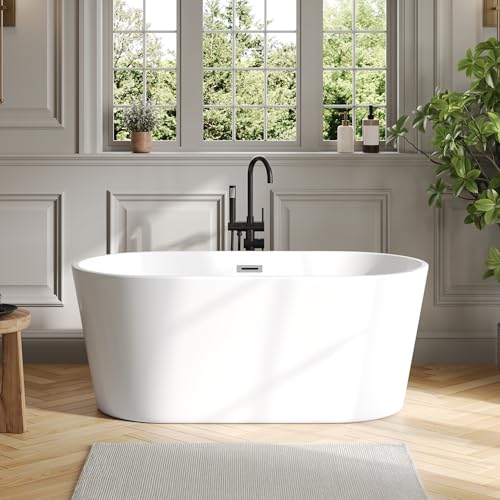
5. DeerValley 55-inch Acrylic Freestanding Bathtub — Best Deeper Mid-Size Soak
The DeerValley 55-inch Acrylic Freestanding Bathtub (model DV-1T0582) is the length upgrade in this guide: a deep soaking tub with a centre drain and integrated overflow, in an ergonomic standalone design. The centre drain is a thoughtful detail at this size — it frees both ends of the tub, so you can recline against either slope without a drain under your back or heels, and it suits bathrooms where the tub sits in the middle of a wall run with plumbing roughed to the centre. At 55 inches, taller soakers gain real leg room over the 48-inch models while the tub remains firmly in small-freestanding territory.
Strengths
- 55-inch length: the most leg room here in acrylic, still compact overall.
- Centre drain frees both ends for reclining and simplifies symmetric layouts.
- Deep-soak design with integrated overflow for a proper immersion.
Trade-offs
- The extra length needs the floor to match — measure the alcove or wall run honestly.
- Centre-drain plumbing must align with your rough-in; confirm position before ordering.
- Acrylic care rules apply: non-abrasive cleaners, wipe-downs in hard-water homes.
Choose the DeerValley when the 48-inch tubs feel like a compromise too far: a household’s taller partner, a preference for reclining over sitting, or a bathroom that has the 55 inches and deserves to use them. The ergonomic shaping matters in a tub this size, because at 55 inches you are between worlds — long enough to recline with bent knees, short enough that the back slope’s angle decides comfort. DeerValley’s design brief is exactly that middle ground, and the centre drain keeps the whole interior usable rather than sacrificing one end to fittings.
Best for: taller soakers and recliners with a mid-size bathroom. / Not suited for: the smallest ensuites — the 48-inch models exist for those. Check on Amazon — check the current price on Amazon.
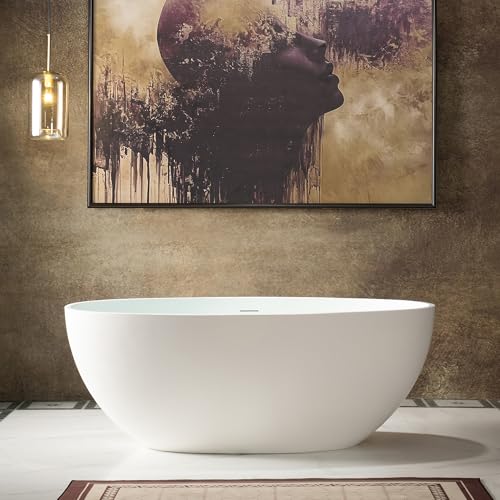
6. WOODBRIDGE 55-inch Stone Resin Freestanding Soaking Tub — Best Premium Oval
The WOODBRIDGE 55-inch Stone Resin Freestanding Soaking Tub (model B0043) is the flagship of this guide: a modern oval in solid-surface stone resin with an integrated slotted overflow and drain, finished in matte white. The slotted overflow is a designer’s detail — instead of a visible overflow plate interrupting the rim, the slot is integrated into the tub wall, keeping the oval’s lines clean from every angle, which matters in a freestanding tub that is seen from all sides. Combined with the 55-inch length, this is the tub that anchors a renovation rather than merely fitting into one.
Strengths
- Premium solid-surface construction with excellent heat retention for long soaks.
- Integrated slotted overflow keeps the oval’s silhouette clean.
- 55-inch length suits taller soakers while staying in the small-tub class.
Trade-offs
- The heaviest class of tub here — floor checks and a planned install are essential.
- Premium tier positioning; this is a renovation centrepiece, not a budget swap.
- Matte solid surface requires the maker’s care guidance — no abrasive pads or harsh chemicals.
If your project is a full bathroom renovation with a designer involved — or a designer living in your own head — this is the tub the mood board wants. It photographs beautifully, feels substantial in person, and holds a long soak’s temperature with the calm of a stone bath in a good hotel. WOODBRIDGE’s presence at both ends of this guide, in acrylic at 48 inches and stone resin at 55, also tells you something about specialisation: this is a maker whose catalogue is tubs, and it shows in details like the integrated overflow. Budget the install properly, confirm the floor, and this tub will outlast several redesigns of everything around it.
Best for: renovation centrepieces and long, hot soaks in a premium material. / Not suited for: tight budgets, weak floors, or quick weekend swaps. Check on Amazon — check the current price on Amazon.
Comparison Table
| Pick | Badge | Key spec | Best for |
|---|---|---|---|
| WOODBRIDGE 48″ Acrylic | Best Overall | 48 in acrylic oval, brushed nickel drain/overflow | Small bathrooms, first freestanding tub |
| WOODBRIDGE 48″ Japanese | Best Deep Sitting Soak | 48 in square acrylic, pre-moulded seat | Upright deep soaking, tiny ensuites |
| Empava 48″ Air Jetted | Best Spa Experience | 48 in acrylic, seat, 36 air jets, 20.45 in depth | Spa rituals at home |
| BCANHOME 51″ Stone Resin | Best Stone Resin Value | 51 in solid-surface oval, matte white | Stone feel in a small room |
| DeerValley 55″ Acrylic | Best Deeper Mid-Size | 55 in acrylic, centre drain, integrated overflow | Taller soakers, reclining |
| WOODBRIDGE 55″ Stone Resin | Best Premium Oval | 55 in solid surface, slotted overflow | Renovation centrepieces |
How to Choose a Small Freestanding Soaking Tub
Depth beats length for soaking. The number that decides your soak is not the tub’s length but the depth of water it holds over your body — governed by the interior depth and the overflow position. A deep 48-inch tub immerses a seated adult better than a shallow 60-inch tub ever will. When comparing listings, look for soaking depth figures and overflow placement, and be sceptical of tubs that publish only exterior dimensions.
Choose the posture you actually want. Reclining ovals, seated Japanese tubs and jetted spa tubs deliver three different rituals. If you have never soaked upright, understand that it is closer to a hot spring than to a hotel bath — deeply relaxing, but different. Households with mobility considerations should weigh the seated designs seriously: a moulded seat and an upright exit are meaningfully easier than rising from a recline in a deep oval.
Material decides feel, weight and install. Acrylic is light, warm and easy — the default for upper floors and DIY-adjacent projects. Stone resin is dense, matte and heat-holding — the choice for ground floors, strong structures and buyers who value material feel. Either can serve for decades; the wrong choice is the one your floor or your delivery route cannot support, which is why the measuring section below includes weight and access, not just floor space.
Plan the filler with the tub. A freestanding tub needs a floor-mounted filler, a wall-mounted spout that reaches, or a hand-shower arrangement — and deep tubs need flow: a slow filler turns a 50-gallon fill into a long wait and a strained water heater. Check your heater’s capacity against the tub’s volume, choose the filler when you choose the tub, and confirm drain position (end versus centre) against your existing rough-in before ordering, because moving a drain is the expensive kind of surprise.
How to Measure and Prepare for a Freestanding Tub Installation
- Step 1 — Measure the floor position. Mark the tub’s footprint with painter’s tape at full size. Walk around it: you need cleaning access on all sides you intend to see, and comfortable entry space on at least one long side.
- Step 2 — Measure the route in. Door widths, hallway turns and stair corners between the kerb and the bathroom decide whether a one-piece tub can arrive at all. Measure the tub’s smallest dimension against your narrowest doorway.
- Step 3 — Check the floor. A filled tub plus a bather is a serious point load. Ground-floor concrete is simple; suspended timber floors, especially upstairs, deserve a structural opinion — essential for stone resin.
- Step 4 — Confirm drain and supply positions. Note whether your chosen tub drains at the end or the centre, and plan the waste run and the filler’s supply lines with your plumber before the tub is on site.
- Step 5 — Check hot water capacity. Compare the tub’s gallon capacity with your water heater’s first-hour rating. A deep soak that runs lukewarm at two-thirds full is the classic small-tub disappointment, and it is a heater problem, not a tub problem.
- Step 6 — For jetted models, plan power and access. The Empava’s blower needs code-compliant electrical provision and service access. Decide both with your installer before tiling or flooring is finalised.
Common Buying Mistakes
- Shopping by length alone. A long, shallow tub soaks worse than a short, deep one. Depth and overflow height are the soaking specs.
- Forgetting the delivery route. The tub that fits the bathroom but not the staircase is a lawn ornament.
- Ignoring floor structure. Stone resin plus water plus bather is heavy; upstairs timber floors need a professional opinion first.
- Buying the tub before the filler. Filler reach, flow rate and drain alignment are part of the same purchase decision.
- Under-sizing the water heater. Deep tubs expose marginal heaters instantly. Check capacity before the first disappointing fill.
- Choosing jets casually. Jetted tubs add electrical work and a cleaning routine; buy them for the ritual, not the brochure.
Final Recommendation
Most small bathrooms should start with the WOODBRIDGE 48-inch Acrylic Freestanding Bathtub — compact, light and genuinely deep for one soaker. Choose the WOODBRIDGE 48-inch Japanese Soaking Tub for an upright, accessible soak, the Empava 48-inch Air Jetted Bathtub for the full spa ritual, the BCANHOME 51-inch Stone Resin Freestanding Bathtub for stone feel at a small size, the DeerValley 55-inch Acrylic Freestanding Bathtub for taller recliners, and the WOODBRIDGE 55-inch Stone Resin Freestanding Soaking Tub as the renovation centrepiece. Measure the room, the route and the floor first — then soak for decades. For the rest of a small-bathroom refit, see Best Small Bathtubs For Small Bathrooms and Best Freestanding Tub Fillers; if space is truly tight, Best Corner Showers For Small Bathrooms is the honest alternative.
Freestanding vs Alcove: What You Gain and What You Give Up
Replacing a standard alcove tub with a small freestanding soaker is the most common route into this category, and it is worth being clear-eyed about the exchange. You gain depth — the alcove tub’s shallowness is its defining compromise — and you gain a room that looks designed rather than fitted. You also gain flexibility of position: a freestanding tub can shift along a wall or angle into a corner in ways an alcove never can. What you give up is the alcove’s built-in practicality. An alcove tub has walls on three sides that catch shower spray, host shelves and bottles, and make shower-over-bath effortless. A freestanding tub has none of that: bottles live on a stool or a caddy, showering over it requires a curtain ring or a tolerant wet-room floor, and the floor area around it must be cleaned on all sides — a small but real weekly task that alcove owners never think about.
The households that thrive with the swap are the ones whose bathing is mostly soaking and whose showering happens in a separate shower, or whose bathroom is being renovated as a wet room where the floor is tanked and drained anyway. Households that shower daily over the bath, bathe children with much splashing, or rely on wall-mounted storage should either keep an alcove for the workhorse duties and add a soaker only if a second bathroom allows it, or choose the seated Japanese format in a wet-room corner, which handles spray more gracefully. None of this diminishes the soaker — it simply places it correctly: a specialist instrument for a beloved ritual, not a universal replacement for the family bath.
Keeping a Small Soak Hot: Practical Heat Craft
The physics of a small deep tub are in your favour — less surface area per litre than a long shallow tub — but technique still separates a twenty-minute soak that stays hot from one that fades at twelve minutes. Start with the tub itself: run the hot filler over the tub’s inner surface as you fill, especially with stone resin, so the material stops taxing the water once you are in. Fill slightly hotter than your target, because the tub, the air and your own entry will each take a degree or two. Keep the bathroom door closed and, in winter, warm the room — a cold room steals heat from the water surface continuously, and the surface is where a deep tub loses most of its warmth.
During the soak, small habits compound. A folded towel across the tub’s rim behind your shoulders keeps the draught off wet skin, which is where most “the water’s gone cold” complaints actually originate — the water is fine; the bather is evaporating. Top up with hot water in short additions rather than one long run, and if your tub has an air-jet system, remember that the bubbles, delightful as they are, move air across the surface and cool the water a little faster; run them in intervals on the longest soaks. Finally, insulate what you cannot see: if your renovation exposes the floor or wall behind the tub’s position, insulation there pays out in every soak for the life of the bathroom. None of this requires equipment — it is simply the craft of a ritual these tubs were designed for.
The Soaking Ritual: Making a Small Tub a Daily Practice
A soaking tub earns its floor space only if it gets used, and used tubs share a pattern: the ritual is prepared before it is needed. Keep the bath caddy, the towel warmer or hook, and your preferred additions within reach of the tub’s position, so starting a soak is a two-minute decision rather than a project. Schedule helps more than willpower — a standing soak after a particular weekly event, a training session or the last work call of the week survives busy lives better than “whenever I feel like it,” which quietly becomes never. Households new to deep soaking should also start shorter and hotter-adjacent: fifteen minutes in comfortably hot water teaches you your own preferences — depth, temperature, seated or reclined — better than any guide, and those preferences should feed back into how you use and accessorise the tub you bought.
One more consideration, especially for the seated Japanese models: the upright soak pairs naturally with contrast — a cool rinse from a hand shower at the end — and with breath-led winding down in a way reclining soaks, which drift toward sleep, do not. Choose your ritual and the tub becomes the room’s anchor. Buyers sometimes worry a small tub will feel like a compromise they settled for; in practice, owners of deep small tubs tend to become the category’s loudest advocates, precisely because the ritual is sized to real life — quick to fill, cheap to heat, easy to keep, and used three times a week instead of three times a year.
Cleaning and Caring for Acrylic and Stone Resin Tubs
Both materials in this guide are low-maintenance by bathroom standards, and both are ruined the same way: abrasive cleaners and scouring pads. Acrylic’s gloss is a surface, and once it is scratched by powders or rough pads it holds dirt in the scratches and dulls permanently; clean it with a soft cloth, warm water and a mild, non-abrasive cleaner, and save stronger products for the taps. Stone resin’s matte finish is more forgiving of micro-wear but equally opposed to harsh chemicals and abrasive tools, and it rewards a simple routine — rinse after use, wipe weekly, and treat any stain promptly with the maker’s recommended cleaner rather than a cupboard experiment. In hard-water homes, a quick squeegee or towel-down of the interior after a soak prevents the mineral tide-marks that make both materials look tired; it takes forty seconds and replaces an hour of descaling later.
Around the tub matters too. Freestanding tubs collect dust and hair along their hidden back edge — build the habit of a weekly wipe around the base when you clean the floor, and the “freestanding is hard to clean” complaint never materialises. Check the silicone or sealant line where the waste meets the floor annually, keep the overflow and drain hair-free (a simple drain cover during hair-washing saves the pipes), and for the jetted Empava, follow the maker’s air-system purge routine on schedule rather than when you remember. Do these small things and either material will look showroom-fresh a decade in — which, for a plumbed-in centrepiece you intend to keep through several redecorations, is exactly the lifespan the purchase price assumes.
Accessories That Complete a Small Soaking Tub
A short list of companions separates a tub that is merely installed from a tub that is loved. A bath caddy or bridge tray sized to your tub’s rim width holds the book, glass and phone at the right distance — measure the rim before buying, because freestanding rims vary and a sliding caddy is worse than none. A simple bath pillow or headrest, in a quick-dry material, transforms the reclining ovals for long soaks and costs very little; for the seated Japanese tubs, a non-slip mat underfoot and a grab point you trust matter more. Keep towels on a hook or warmer within arm’s reach of your exit point, because the coldest moment of any soak is the thirty seconds after it, and a towel three steps away across a wet floor is a small hazard as well as a discomfort. Finally, a stool beside the tub — for bottles, a candle, folded clothes — replaces the alcove ledge you gave up, and in a small bathroom a stool that doubles as a laundry basket or a plant stand earns its footprint twice. None of these are upsells; together they are the difference between a showpiece and a practice.
Related guides
Frequently Asked Questions
Is a 48-inch tub big enough for an adult?
For a seated, deep soak — yes, that is exactly what these tubs are designed for. You sit with knees bent and water high on your chest. What a 48-inch tub cannot do is let a tall adult stretch out flat; if that posture is non-negotiable, look at the 55-inch models or beyond the small-tub class.
Acrylic or stone resin — which is better?
Neither, universally. Acrylic is lighter, warmer at first touch and easier to install, suiting upper floors and simpler projects. Stone resin feels denser and more premium, holds heat longer once warm, and hides wear in its matte finish — at the cost of serious weight. Choose by floor, route and feel, in that order.
Can a freestanding tub replace a shower?
It can host one with a hand shower and a curtain arrangement, but most households keep a separate shower for daily speed and reserve the tub for soaking. In a one-bathroom home, think hard before removing the only shower — and consider the seated Japanese format, which pairs naturally with a shower-over arrangement in wet-room style layouts.
How much water does a small soaking tub use?
Less than most people fear. Deep-but-small tubs concentrate water around the body; the Empava in this guide is listed at about 50 gallons capacity, and you soak in less than a full fill. The real check is your water heater’s ability to deliver that volume hot, not the water bill.
Are air jets hard to keep clean?
Air jets are the low-maintenance jet type because they blow air rather than recirculating bath water. Follow the maker’s periodic purge routine, wipe the tub with non-abrasive cleaners, and the system stays fresh. Whirlpool systems demand more diligence — one reason this guide’s jetted pick uses air.
Will a small soaking tub work for bathing children?
It works, with supervision adjusted to the format. The deep water that makes these tubs wonderful for adults means a seated child is in deeper water relative to their size, so bath seats and constant attendance matter more than in a shallow alcove tub. The seated Japanese models can actually suit family bathing well — the moulded seat gives a child a defined perch — but splash control is poorer than in an alcove, so expect a wetter floor and keep towels positioned for it. Households whose bathing is primarily small children, with adult soaking a rare luxury, should weigh that balance honestly before swapping.
How do I stop a freestanding tub from moving or rocking?
A correctly installed freestanding tub should not move at all. Rocking usually traces to an unlevel floor or feet that were not adjusted at installation: most models have levelling feet or a bedding requirement in their instructions, and setting the tub on a level, properly prepared base — with any specified adhesive or fixing applied — ends the movement permanently. Do not accept a rocking tub as normal and do not shim it casually with folded cardboard; have the installer correct the base. A tub that moves works its waste connection loose over time, and a slow leak under a freestanding tub is exactly the problem you cannot see until it announces itself through the ceiling below. The same logic applies at delivery: inspect the tub thoroughly before the installers leave and before anything is plumbed, because a chip or crack found at that moment is a simple exchange, while the same flaw found after installation becomes a dispute about who caused it. Photograph the tub from all sides on arrival — freestanding tubs are viewed from all sides for their entire lives, and the back deserves the same scrutiny as the front.
Can I put a small freestanding tub where my shower was?
Often, yes — a 48-inch tub’s footprint is close to a large shower tray’s, and shower conversions are a common route into this category. The plumbing changes are real but modest: the waste position may move, and a tub filler replaces the shower valve arrangement. Keep a hand shower in the plan if the bathroom has no other shower, and confirm the floor’s waterproofing extends under the tub’s new position before the old tray comes out.
Do I need a plumber, or can I install a freestanding tub myself?
A confident DIYer can position and level a simple acrylic tub, but the waste connection, supply lines for a floor filler and any electrical work for jets are professional territory in most homes — and in many jurisdictions, regulated work. Budget for a plumber at minimum for connections and inspection; it is the cheapest insurance in the whole project.


