Disclosure: airfryerkitchensupply.com is reader-supported. When you buy through links on our site, we may earn an affiliate commission at no extra cost to you.
Where to buy
Traditional dining chairs in the styles a Duncan Phyfe table calls for are sold through Amazon by furniture brands and reproduction specialists, and four picks below are linked after confirmation against Amazon’s catalog: the Signature Design by Ashley Berringer Dining Chairs, a solid-mahogany Chippendale arm chair by Niagara Furniture, the mahogany Queen Anne side chairs by Fnecan, and the East West Furniture Ipswich upholstered chairs in mahogany. Two picks are written as unlinked selections naming the exact chair style to search for — the lyre-back and the Hepplewhite shield-back — because two rounds of catalog verification found no listing for those specific period styles that we could confirm, and this site does not print links it cannot confirm. The guidance — period styles, scale, wood matching, and measuring — is complete either way. If you want the authentic pairing first, read the lyre-back pick: the lyre-back chair is the table’s own design language, spoken back to it.
Introduction: the table is the brief
Most chair shopping starts with the chair. Shopping for the best chairs for a Duncan Phyfe table starts with the table, because a Phyfe is not a neutral surface — it is one of the most recognizable designs in American furniture: a mahogany pedestal table from the early 1800s (or a faithful revival of one), with a turned and carved central pedestal, splayed legs ending in brass casters or paw feet, and a top whose edge is often reeded. Duncan Phyfe’s New York workshop defined the American Federal and late Neoclassical taste, and his own chair designs — the lyre-back above all — were made to sit at exactly these tables. A chair that ignores that heritage (a chrome cantilever, a farmhouse cross-back, a mid-century shell) does not merely clash; it makes the table look like it wandered into the wrong century.
The good news is that the correct answers form a small, knowable family. The period styles — Chippendale, Hepplewhite shield-back, Phyfe’s own lyre-back, and Queen Anne — share the table’s vocabulary: mahogany and mahogany tones, carved or pierced splats, tapered or cabriole legs, and seat heights proportioned for a table just under thirty inches. This guide walks those styles as six picks: four linked and available now, and the lyre-back and shield-back styles specified precisely enough to fill from any reputable maker, because no confirmable listing for those two styles surfaced in verification. It also covers the unglamorous measurements that decide whether beautiful chairs actually work — seat height against the table’s apron, pedestal clearance for legs and feet, and how many chairs a pedestal table honestly seats — because a period-correct chair you cannot sit in at the table is a sculpture, not a seat.
A note on authenticity and budget, stated early: genuine period Phyfe chairs are antiques with antique prices and fragility to match, and most households are better served by well-made reproductions or period-style chairs that can survive daily dinners, children, and being dragged across the floor by guests. This guide is written for those households — with accessible linked picks for value, period chairs confirmed in solid mahogany, and the two unlisted styles specified at reproduction quality across a wide range of tiers.
In this guide
Quick Picks
- Best Authentic Pairing — Lyre-Back Phyfe-Style Reproduction Chairs: the chair design from Phyfe’s own workshop vocabulary; the most historically fluent match for the table. Covered without a link: no confirmable listing for this style surfaced in verification.
- Best Formal — Niagara Furniture Solid Mahogany Chippendale Arm Chair: a Chippendale arm chair in solid mahogany — the dressiest period answer, bought singly or as a pair for the heads of the table. — check price on Amazon
- Best Light & Elegant — Hepplewhite Shield-Back Chairs: the shield silhouette reads refined and keeps smaller dining rooms from feeling crowded. Covered without a link: no confirmable listing for this style surfaced in verification.
- Best Available Now (Linked): Signature Design by Ashley Berringer Dining Chairs, Set of 2 — traditional wood side chairs in a warm rustic brown that respect the table’s tone at an accessible tier.
- Best Padded Comfort — Fnecan Mahogany Traditional Side Chairs, Set of 2 (Queen Anne): Queen Anne styling in mahogany with upholstered seats — period lines with a cushioned seat for long dinners. — check price on Amazon
- Best for Larger Sets — East West Furniture Ipswich Dining Chairs, Set of 2 (Mahogany): linen-upholstered solid-wood chairs in a true mahogany finish, sold in pairs — the economical way to seat six or eight around an extended Phyfe-style table in a consistent style. — check price on Amazon
How These Picks Were Chosen
The first filter was period fluency: every pick had to speak the table’s design language — traditional silhouettes, carved or shaped backs rather than plain slats, wood tones in the mahogany family, and proportions suited to a formal dining table. Modern, farmhouse, industrial, and mid-century styles were excluded regardless of quality, and so were chairs whose seat heights or bulky arms fight a pedestal table’s apron and leg geometry. Within the period family, we balanced formality (Chippendale at the top), authenticity (the lyre-back), lightness (shield-back), comfort (padded Queen Anne), value (the linked Ashley set), and scalability (the set-of-four slot).
On verification, plainly: this site prints purchase links only for products confirmed against Amazon’s catalog. Two styles — the lyre-back and the shield-back — could not be confirmed in two rounds of fresh catalog searches (the searches returned ladder-backs, slat-backs and cross-backs, but no lyre or shield silhouettes), so they appear as a pick without a link naming the exact style, finish, and configuration to buy — written so the guidance holds whichever reputable maker fills them. No prices are printed anywhere in this guide, and no ratings are quoted; chairs are positioned by tier in words. Measurements given are standard furniture dimensions for the table type and should be confirmed against your own table, which — antique or revival — may vary by an inch in any direction.
The 6 Best Chairs for a Duncan Phyfe Table
Lyre-Back Phyfe-Style Reproduction Chairs — Best Authentic Pairing
Covered without a link: two rounds of catalog verification found no lyre-back chair listing we could confirm, so this pick names the exact style to search for rather than linking a substitute.
If the goal is the pairing a knowledgeable eye recognizes instantly, this is it. The lyre-back — a chair back carved in the shape of a classical lyre, often with brass or carved string details — is Duncan Phyfe’s signature chair motif, designed in his own workshop era for his own tables. A lyre-back reproduction in a mahogany finish does not merely “go with” a Phyfe pedestal table; it completes a documented historical set, and the room reads as curated rather than assembled.
Strengths
- Maximum historical fluency: the chair and table share an actual design origin.
- The pierced lyre splat keeps the set visually light — important when six backs stand around one pedestal.
- Mahogany-finish reproductions are made for daily use in a way genuine period chairs are not.
Trade-offs
- Reproduction quality varies widely by maker; joinery and carving depth are what you are paying for, and photos flatter.
- The formal character commits the room: casual tableware and rustic decor will fight this pairing.
- Usually sold as pairs of side chairs; matching armchairs for the heads of the table may need a separate search.
Buy this style from a maker who shows the chair from the back and side, specifies solid wood in the frame (not merely “wood finish” over composite), and offers the mahogany tone that matches your table’s actual color in daylight — mahogany ranges from orange-brown to deep red-brown, and “close” reads as wrong at dining distance. In tier terms, good lyre-back reproductions sit mid-to-premium, and they are the purchase this entire guide would make first with a serious table and a serious dining room.
Best for: authentic period rooms and Phyfe admirers. / Not suited for: casual dining spaces or mixed-style rooms.
Niagara Furniture Solid Mahogany Chippendale Arm Chair — Best Formal
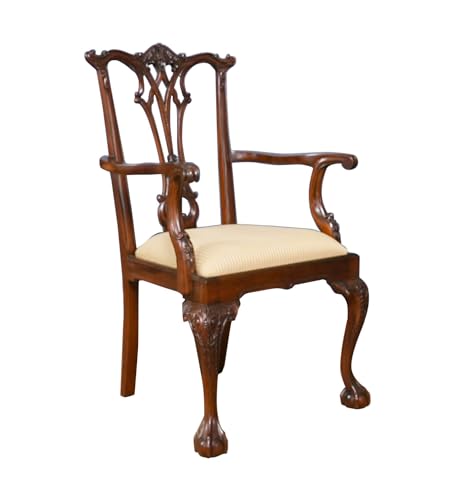
Chippendale is the generation before Phyfe, and its chairs remain the most formal widely available period style. The confirmed example here is a serious one: Niagara Furniture’s Chippendale arm chair in solid mahogany — not a mahogany finish over composite, but the wood itself, which is why it anchors this pick. Around a Phyfe table the pairing is a slight, deliberate anachronism that generations of American dining rooms have endorsed: the Chippendale’s richer carving dresses the table up, and the shared mahogany language keeps the conversation coherent. Choose this pick when the dining room’s ambition is formal — holidays, dinner parties, a chandelier with opinions.
Strengths
- The most carved, ceremonial presence of any slot here; holidays rise to meet it.
- Solid mahogany construction: the weight, repairability and patina trajectory of the table itself.
- Widely reproduced, so completing or expanding a set over time is realistic.
Trade-offs
- Carving collects dust and asks for hand-cleaning; six ribbon-backs are a housekeeping commitment.
- An arm chair’s footprint is wider than a side chair’s — check the count your table’s length honestly seats.
- Seat comfort depends entirely on the drop-in seat’s padding, which varies; budget to re-cover or re-pad if needed.
The classic configuration is side chairs along the table and armchairs at the heads, and that is exactly how to deploy this chair: it is sold singly, so buy one for each head of the table and let the side positions be filled by the lyre-back or shield-back styles — or, at a smaller table, use a pair of these as the principal chairs and simpler traditional sides between them. Match the wood tone as with the lyre-back pick, and consider that the Chippendale’s formality lets the rest of the room relax a little — simple linens and plain china look intentional against carved chairs, which is a decorating economy formal hosts have exploited for two centuries.
| Style | Chippendale arm chair (Amazon title) |
| Material | Solid mahogany (Amazon title) |
| Maker / model | Niagara Furniture NDRAC041X (Amazon title) |
Best for: formal dining rooms and holiday-centered homes. / Not suited for: minimalist rooms or low-maintenance households.
Check on Amazon — check the current price on Amazon, and confirm the size, color and configuration on the listing match what this review describes before ordering.
Hepplewhite Shield-Back Chairs — Best Light & Elegant
Covered without a link: catalog searches for shield-back and Hepplewhite chairs returned no listing at all that we could confirm, so this pick names the exact style to search for rather than linking a substitute.
The shield-back is the Federal period’s answer to Chippendale’s weight: a back shaped like a shield, often with a carved wheat-ear, urn, or Prince-of-Wales feather motif at its center, on tapered legs. Around a Phyfe table — itself a Federal-era design — the shield-back is chronologically seamless, and its open, airy silhouette is the kindest choice for smaller dining rooms, where six carved Chippendales can feel like a crowd but six shield-backs read as a setting.
Strengths
- Lightest visual footprint of the period styles — rooms stay airy, sightlines stay open.
- Period-perfect for a Federal table; no anachronism to explain to the one guest who knows.
- Tapered legs echo the clean lines of Phyfe’s own later work.
Trade-offs
- The shield’s slender members are the most delicate backs here; teenagers leaning back will test them.
- Less physical back support area than a Chippendale or upholstered chair on long evenings.
- Fine reproductions cost like Chippendales; the lightness is in the look, not the invoice.
Shield-backs reward rooms with good light — the silhouette is the decoration — and they pair beautifully with the reeded edges and brass details of a Phyfe top. If your table is a revival piece in a not-strictly-period home, this style is often the sweet spot: historically fluent, visually gentle, and forgiving of the modern elements around it.
Best for: smaller or light-filled dining rooms, Federal-purist pairings. / Not suited for: rough-and-tumble family dining as the only chairs.

Signature Design by Ashley Berringer Dining Chairs, Set of 2 — Best Available Now
The Signature Design by Ashley Berringer Dining Chairs are this guide’s linked, buy-it-today answer: traditional wood side chairs in a warm rustic brown finish, with a shaped slat back and a solid, everyday build from a mainstream furniture brand. They are not period reproductions and this guide will not pretend otherwise — the back is a traditional slat design rather than a carved splat — but their tone, scale, and traditional character respect a Phyfe table far better than the modern chairs most households would otherwise default to, at the most accessible tier in this guide.
Strengths
- Verified and available: the one pick here you can order today with a confirmed listing.
- Warm brown wood tone sits comfortably in the mahogany family at conversational distance.
- Mainstream-brand value and availability in pairs make building a set of six straightforward.
Trade-offs
- Traditional, not period: the slat back lacks the carved splat that defines Slots 1–3.
- The rustic cast of the finish leans slightly casual against a high-formality table and room.
- As a value-tier set, expect honest working construction rather than heirloom joinery.
The Berringer set is the right answer for a real and common situation: you have the table — inherited, found, or loved — and you need chairs this month, at a sane tier, that will not embarrass it while you decide whether the full period project (Slots 1–3) is in your future. Many households will find, honestly, that this is where the project happily ends: traditional wood chairs, the right tone, dinners served. That is a success, not a compromise to apologize for.
Best for: value-first buyers who need chairs now that respect the table. / Not suited for: period-authenticity projects.
Check the current price on Amazon

Fnecan Mahogany Traditional Side Chairs, Set of 2 (Queen Anne) — Best Padded Comfort
Queen Anne styling is the comfort answer among period styles, and the Fnecan set is its confirmed, buyable form here: traditional side chairs in mahogany-toned solid wood, in the Queen Anne manner, with upholstered seats, sold as a set of two. The style predates Phyfe by the better part of a century, but American dining rooms mixed Queen Anne chairs with later tables for generations, and the combination reads as collected rather than incorrect. The upholstered seat is the functional headline: for dinners that run long, padding beats carved wood, and guests’ comfort is a form of hospitality no silhouette can replace.
Strengths
- Padded seat comfort for long meals — the kindest slot here to sit in for three hours.
- Cabriole legs and shaped splats keep the period conversation with the table.
- Upholstery fabric is a design lever: it can bridge the table to a less formal room.
Trade-offs
- Upholstery and food are eternal opponents; choose wipeable or re-coverable fabrics and accept the maintenance.
- The oldest style here — purists may read the mix as eclectic rather than period.
- Padded seats sit slightly differently than drop-in wood seats; confirm seat height after compression when you measure (see the guide below).
Choose fabrics like you mean it: tight weaves, forgiving colors, and ideally seats that unscrew for re-covering, because a chair whose seat can be re-covered in an afternoon is a chair that survives decades of dinners and several decor eras. In tier terms this pick sits in the accessible-to-mid range for period-style chairs, and it is the one most often chosen by households that entertain monthly rather than annually.
| Style | Queen Anne traditional side chair (Amazon title) |
| Material / finish | Solid wood, mahogany (Amazon title) |
| Seat / set | Upholstered seat, set of 2 (Amazon title) |
Best for: long-dinner households and comfort-first hosts. / Not suited for: strict period rooms or white-fabric optimists with toddlers.
Check on Amazon — check the current price on Amazon, and confirm the size, color and configuration on the listing match what this review describes before ordering.

East West Furniture Ipswich Dining Chairs, Set of 2 (Linen Upholstered, Mahogany) — Best for Larger Sets
Extended Phyfe-style tables seat six or eight, and buying period reproductions eight at a time is a serious invoice. This pick is the scaling answer: the East West Furniture Ipswich — traditional side chairs with linen-fabric upholstered seats on solid wood in a true mahogany finish, sold in sets of two at production prices, so you buy two pairs for four chairs or three for six and every chair matches. The silhouette is traditional rather than museum-grade, the comfort is genuinely good, and the per-chair tier drops enough that seating eight stops being a renovation-scale decision.
Strengths
- Pair pricing from a single production line makes six- and eight-chair sets financially sane — and matchable later.
- Fully upholstered comfort in a traditional envelope that respects the table’s tone and era.
- Consistent production means replacements and expansions match — a real advantage over antique hunting.
Trade-offs
- Upholstered backs add visual bulk; around a pedestal table, check the room can carry it.
- Production construction is honest but not heirloom; these are ten-to-fifteen-year chairs, not fifty-year chairs.
- All-upholstered maintenance is the highest here — fabric care joins wood care on the chore list.
The smart configuration for many homes is hybrid: two period armchairs (the Niagara Chippendales) at the heads, and these upholstered side chairs along the sides — the heads carry the authenticity, the sides carry the crowd, and the budget lands where it should. It is how designers solve this exact problem, and it works because the eye reads the heads of the table first.
| Style | Ipswich dining chairs, traditional (Amazon title) |
| Material / finish | Solid wood, mahogany finish (Amazon title) |
| Seat / set | Linen fabric upholstered, set of 2 (Amazon title) |
Best for: seating six to eight consistently and affordably. / Not suited for: small four-chair settings where per-chair quality beats quantity.
Check on Amazon — check the current price on Amazon, and confirm the size, color and configuration on the listing match what this review describes before ordering.
Comparison Table
| Pick | Badge | Key spec | Best for |
|---|---|---|---|
| Lyre-Back Reproduction | Best Authentic Pairing | Phyfe’s own motif, mahogany finish | Period rooms, purists |
| Niagara Furniture Chippendale Arm Chair | Best Formal | Solid mahogany Chippendale arm chair | Formal dining, holidays |
| Hepplewhite Shield-Back | Best Light & Elegant | Shield silhouette, tapered legs | Small, bright dining rooms |
| Ashley Berringer Set of 2 | Best Available Now | Traditional wood, rustic brown | Value, immediate purchase |
| Fnecan Queen Anne Side Chairs, Set of 2 | Best Padded Comfort | Mahogany solid wood, upholstered seat | Long dinners |
| East West Furniture Ipswich, Set of 2 | Best for Larger Sets | Linen upholstered, solid wood, mahogany | Seating six to eight |
How to Choose Chairs for a Pedestal Table: Measure Before Style
Seat height against apron clearance
Phyfe tables stand at classic dining height, roughly 29 to 30 inches to the top. Standard dining chair seats at 18 to 19 inches suit that height for most adults. The measurement that actually bites is the apron: the skirt board under the tabletop. Measure from the floor to the underside of the apron, and confirm that chair arms — if you buy armchairs for the heads — clear it, and that seated thighs clear it with room to cross legs. Padded seats compress an inch or so in use; measure them as they will be sat in, not as they photograph.
Pedestal geometry: knees, feet, and chair count
A pedestal table trades four legs for a central support, which changes seating math in your favor along the sides — no table legs to straddle — and against you at the center, where the pedestal and its splayed feet limit how far chairs can push in and where feet can rest. Count on comfortable seating of two per side on most Phyfe tables, with the ends usable when the pedestal’s footprint allows knees to pass on either side of it. Before ordering eight chairs for a table you have only seated four at, stage the experiment with chairs you own: sit at every position, push in, cross your legs, and let the table tell you its real capacity.
Wood tone: matching mahogany honestly
Mahogany is a range, not a color: aged period pieces deepen toward red-brown, newer pieces can run orange, and finishes named “mahogany” vary by maker more than any other furniture word. Compare in daylight, at dining distance, with the understanding that exact matches are rare and harmonious contrast is respectable — a chair one shade deeper than the table reads as intentional; a chair one shade more orange reads as a mistake. When in doubt, go slightly darker in the chair, and unify the set with seat fabric, which the eye reads as the pairing’s accent.
How many chairs, and which mix
Buy for your real table life: the weekly number of diners, plus two, covers guests without storing a regiment. The classic composition — armchairs at the heads, side chairs along the sides — exists because it works visually and spatially at a pedestal table. If budget forces phasing, buy the side chairs first in the best style you can (they define the set’s rhythm), and add head armchairs when the right pair appears.
How to Set Up and Care for the Pairing
- Protect the floor and the feet. Felt glides under every chair leg, replaced when worn; Phyfe pedestal feet and brass casters deserve the same respect in reverse — a rug under the set should be low and dense enough that casters and chair legs both move without fighting.
- Arrange by the pedestal. Center side chairs between the pedestal’s splay, confirm each position pushes in and pulls out without striking the feet, and only then set the heads.
- Dust carving with soft tools. Ribbon splats and lyre backs collect dust in their piercing; a soft brush weekly beats a damp cloth quarterly, and keeps finishes out of carved crevices.
- Feed the wood, spare the polish. Both table and chairs want stable indoor humidity more than any product; silicone-heavy sprays build films that cloud mahogany’s depth. A barely damp cloth for soil, dry buffing for shine, is the professional rhythm.
- Rotate the chairs. If some seats are used daily and others monthly, rotate positions seasonally so sunlight and wear distribute evenly across the set — matched sets stay matched by management, not luck.
- Tighten and inspect yearly. Traditional chairs loosen at joints with seasons of use; an annual check — and a furniture repairer for anything structural — keeps small movement from becoming failed joinery.
Common Buying Mistakes
- Defaulting to modern chairs. The table’s heritage is the room’s whole point; a chair that ignores it taxes every meal with a small visual argument.
- Buying by photo tone. Mahogany finishes lie under screen lighting. Daylight, real distance, and a return policy are the safeguards.
- Skipping the apron measurement. Beautiful armchairs that cannot push in are sculptures flanking a table. Measure the underside before the style seduces you.
- Overbuying chairs for the pedestal’s real capacity. Stage the seating with chairs you own before ordering eight of anything.
- Demanding an exact wood match. Period rooms were built across decades of purchases. Harmonious tones plus a unifying fabric read as collected; a forced match reads as a set bought in a hurry.
- Putting antiques into daily service. Genuine period chairs are finite and fragile. Reproductions exist so that dinners can be daily and children can be children.
Final Recommendation
If authenticity leads, fill Slot 1: lyre-back reproductions in a mahogany finish are the pairing the table was born for, with Slot 3’s shield-backs as the lighter Federal alternative and Slot 2’s Chippendales when the room wants full ceremony. If the need is chairs now at a sane tier, the linked Ashley Berringer set respects the table’s tone and traditional character today, and nothing about it prevents a period upgrade later. For long dinners choose Slot 5’s padded Queen Anne comfort; for a crowd, Slot 6’s sets of four — ideally flanking two period armchairs at the heads. Whichever path you take, measure the apron, stage the pedestal seating, and match tones in daylight. A Duncan Phyfe table waited two centuries for its chairs; it is worth choosing them on purpose.
Related reading in this series: Best Dining Chairs, Best Wood Dining Chairs, Best Upholstered Dining Chairs, Best Dining Chairs Set Of 4, Best Washable Rugs.
Know Your Table: Period Phyfe, Revival, and Phyfe-Style
The chair decision sharpens when you know which table you actually own. A period Phyfe — made in the early 1800s in or near Phyfe’s New York workshop — is a museum-grade object; most “Phyfe tables” in homes are one of two descendants. Early-20th-century revival pieces, made when Colonial Revival taste swept America, are solid, honest furniture with real age of their own, and they deserve period-fluent chairs as much as the originals do. Later Phyfe-style production tables carry the silhouette at accessible tiers and forgive slightly more casual chair choices — the linked Berringer set lives comfortably here. The practical differences are fragility and finish: the older the table, the more its finish and joints argue for felt glides, stable humidity, and chairs that will not be slammed into the pedestal by enthusiastic children. Style guidance, however, does not change across the three: the same six slots serve all of them, because the silhouette they are answering is the same.
Reading the table’s details
Look at what your table emphasizes and let the chairs rhyme with it. A pedestal with carved paw feet and a reeded top edge is speaking the richer dialect — Chippendale and lyre-back chairs answer in kind. A cleaner turned pedestal with brass caster cups speaks the later, lighter dialect that shield-backs echo. Brass details on the table license brass details in the room — casters, a chandelier, hardware — and a set of chairs with any carved motif repeated from the table’s own carving (a leaf, a reed, a lyre) will look commissioned rather than purchased. These rhymes are small, and guests will never name them, but they are the entire difference between a room that feels assembled and one that feels inevitable. If you take one habit from this section, take this one: before ordering any chair, stand in the dining room doorway with the table in view and hold the chair’s photograph — or the chair itself, if a local seller allows it — at arm’s length against the real table. Silhouette against silhouette settles in three seconds what three hours of specification-reading cannot, because the pairing is fundamentally a visual chord, and chords are heard, not calculated.
Styling the Room Around the Pairing
Chairs and table are the room’s foundation, not its entirety, and a few styling decisions protect the pairing. The rug — if any — should be low and dense (a washable low-pile in a traditional pattern serves beautifully and survives dinners), sized so chair legs stay on it when diners push back; a rug edge under a chair leg is a wobble served nightly. Lighting wants a center fixture scaled to the table, hung low enough to make a pool of light on the top’s polished mahogany — the table is at its most beautiful as a reflective surface under warm light, and carved chair backs read best in that same glow. Walls in period rooms historically carried strong color; if yours are pale and modern, the shield-back and upholstered slots bridge the gap most gracefully. Finally, leave the tabletop mostly bare between meals. A Phyfe top under a rotating clutter of mail and laptops is a masterpiece used as a shelf; a single centerpiece — a bowl, a pair of candlesticks — is all the styling the design asks for, and it leaves the chairs’ silhouettes visible from the doorway, which is where the room makes its first impression. Hosts who entertain often add one more consideration: a clear serving path around the full set with chairs occupied, because a room that seats six beautifully but traps the host behind a wall of chair backs will be rearranged by the second dinner party — usually at the expense of the very symmetry the styling worked to create.
Reproduction Quality: A Buyer’s Checklist for Slots 1–3
Because the period slots will be filled by makers whose names you may not know, judge them by construction evidence rather than brand. Frames should be solid wood in the load-bearing parts — ask, and treat evasive answers as answers. Joints at the back legs and seat rails take the stress of dining life; mortise-and-tenon or doweled-and-blocked construction outlasts simple screwed butt joints by decades. The splat — lyre, ribbon, or shield — should be carved or shaped with depth you can feel, not a flat silhouette with a printed grain pretending to be carving. Seats should be replaceable: drop-in seats that lift out for re-covering turn a twenty-year chair into a forty-year chair. Finish should be even in the crevices, not only on the faces a photograph shows. And the seller should state dimensions completely — overall height, seat height, seat depth — because a maker who measures carefully usually builds carefully. None of this requires expertise to check; it requires only refusing to buy a silhouette without asking what holds it together.
The Economics of Chairing a Phyfe Table
It helps to see the six slots as three financial strategies wearing period clothes. The value strategy — the Berringer set now, nothing else pending — puts a complete, respectful room together at the lowest total cost and leaves every future option open; its risk is only that “temporary” chairs tend to serve for a decade, which, given their honest construction, is a risk most households can live with. The phased strategy buys the period side chairs first (Slots 1–3) and adds head armchairs later, spreading a premium total across seasons while the room looks finished at every stage; this is the strategy we recommend most often, because dining rooms are lived in during the project, not after it. The single-stroke strategy completes the set at once — period reproductions all around, or the hybrid of period heads and Slot 6 sides — and pays for coherence: matched finishes, matched wear, and no years of almost. None of these is the correct answer independent of the household; what is incorrect, and common, is drifting — buying two chairs of one style, tiring of the search, and filling the rest with whatever is on sale in a different century. The table deserves a decision, and any of the three strategies is a decision. Drift is the only failure mode.
One more economic note in favor of reproductions generally: a chair that can be repaired, re-covered, and re-glued by any competent furniture shop — as all traditionally built wooden chairs can — has a cost per decade that production furniture rarely matches, however low its sticker. The Phyfe table itself is the proof of the principle, still hosting dinners two centuries on. Buy its chairs to the same standard your means allow, maintain them on the yearly rhythm this guide describes, and the pairing you assemble this year is plausibly the one your grandchildren argue about keeping. That is not sentimentality; it is the arithmetic of repairable things in a disposable age, and it is the strongest argument this guide can make for choosing the slots above the level of the merely adequate whenever the budget honestly permits.
Seat Fabrics: The Decision That Ages Fastest
Frames outlive fabrics by decades, so choose fabric as a renewable surface rather than a permanent one. For drop-in and upholstered seats in a working dining room, the hierarchy of practicality runs: tight-woven performance fabrics and leather at the top for stain resistance, then dense cotton blends in forgiving mid-tones and small patterns, then — knowingly, for rooms where children are theoretical — silks and pale linens at the beautiful, fragile end. Period rooms historically used horsehair, leather, and figured fabrics including stripes and damasks, so a traditional pattern is not a compromise of the period idea; it is the period idea, executed in materials that survive cranberry sauce. Whatever you choose, buy extra yardage at the same time if the maker allows it, stored flat and dark: the day a seat is ruined in year six, that stored fabric is the difference between a one-afternoon repair and a six-chair re-covering project. And keep the removed fabric from any re-covering you do — future repairs, and the next owner’s gratitude, both begin there.
Leather seats deserve a specific mention
Leather drop-in seats appear on many period reproductions and earn their place in dining service: they wipe clean, age into the room’s patina rather than out of it, and suit both the formality of Chippendale carving and the practicality of family dinners. Their costs are a firmer sit than padded fabric and a colder first contact in winter rooms — both minor, both real, and both reasons the Queen Anne slot’s padded fabric remains the comfort pick while leather serves as the durability pick within any slot that offers the choice. One caution belongs to leather specifically in sunny rooms: prolonged direct sun fades and dries it faster than fabric, so a leather-seated set in a bright dining room wants the same rotation discipline this guide recommends for the chairs themselves, turning each seat’s exposure into an even share rather than a permanent assignment.
A Worked Example: Chairing One Table Three Ways
Abstractions settle when they are priced in decisions, so consider one common table — a revival-era Phyfe pedestal in a suburban dining room, seating six — chaired three ways from this guide’s slots. The value path: three Berringer pairs, ordered this week, felt glides fitted on arrival, done. The room is traditional, warm, and complete by the weekend, and the total outlay stays in the range of a modest appliance. The phased path: two lyre-back pairs now as the side chairs — the room’s rhythm set by the most authentic voice — and a year of watching for the right Chippendale armchair pair for the heads, with two Berringers standing in, unembarrassed, in the meantime. The single-stroke path: lyre-back or shield-back armchairs at the heads, Slot 6 upholstered sides along the table, a low traditional rug beneath, and the project closed in one delivery. All three rooms will host the same dinners. The differences are in how the chairs converse with the table across decades — volume, fluency, and patina — and in which year the household stops thinking about chairs at all. That last difference is underrated: the best chair purchase is the one that ends the topic. There is a corollary worth stating for the indecisive, because Phyfe tables attract researchers: the cost of a good-enough traditional set bought this season is measured in money, but the cost of three more years of folding chairs around a two-century-old table is measured in dinners — and dinners, unlike chairs, do not come back in stock.
One last practical habit ties the whole guide together: photograph your table and its measurements — top dimensions, apron clearance, pedestal footprint — and keep them on your phone. Chair shopping for a table like this happens across months and sellers, in showrooms and listings and estate sales, and the buyer who can check a candidate chair against the real numbers in ten seconds makes better decisions than the buyer working from memory, every single time.
Related guides
- Best Chairs For Black Table
- Best Chairs For Norden Table
- Best Made Table Chairs
- Best Childs Table And Chairs
Frequently Asked Questions
What chair style did Duncan Phyfe himself design?
Phyfe’s workshop is most associated with the lyre-back chair, whose back is carved as a classical lyre, alongside other late-Neoclassical and Federal forms with reeding, carved splats, and tapered or turned legs. Lyre-back reproductions are therefore the most historically direct pairing for his pedestal tables.
How many chairs fit a Duncan Phyfe pedestal table?
Most seat four to six comfortably — typically two per side, with ends depending on the pedestal’s footprint and your diners’ knee room. Extended revival versions seat eight. Stage every position with chairs you own before ordering, because pedestal geometry, not tabletop length alone, decides capacity.
Must the chairs be mahogany?
They must be in the mahogany conversation — a tone that harmonizes with the table’s wood in daylight. Exact matches are rare even among antiques. Slightly deeper chair tones read as intentional, and a unifying seat fabric ties a mixed-tone set together convincingly.
Are armchairs appropriate at the sides?
Traditionally, armchairs (host chairs) sit at the heads and side chairs along the sides — partly ceremony, partly space, since arms consume width and must clear the apron. If your table is wide and your apron clearance generous, arms all around is a modern liberty you may take knowingly.
Can I mix two chair styles at one Phyfe table?
Yes — the head/side composition is itself a sanctioned mix, and pairing period armchairs at the heads with simpler traditional side chairs is a classic budget-and-design solution. Keep wood tones harmonious and one element (fabric, finish, or silhouette) consistent across both styles.
What seat height works with a Phyfe table?
The standard dining seat height of 18 to 19 inches suits the classic 29-to-30-inch table height for most adults. What matters more than the number is the combination with your table’s apron: measure from the floor to the apron’s underside, leave comfortable thigh room above the seated lap, and if you are buying armchairs, confirm the arms themselves pass under the apron or the tabletop edge with clearance to spare.
How do I protect a pedestal table from its chairs?
Felt glides on every chair leg, a low dense rug or none at all, and the household habit of lifting rather than dragging chairs. The pedestal’s splayed feet are the impact zone — check them when you do the yearly chair inspection, and touch up finish nicks early, before they become the table’s biography.
Should I buy antique chairs instead of reproductions?
For a collection, perhaps; for daily dining, reproductions are the practical recommendation. Period chairs are fragile at their joints, expensive to restore properly, and finite. A well-made reproduction gives the room the same visual and historical effect while surviving real life.


