Disclosure: airfryerkitchensupply.com is reader-supported. When you buy through links on our site, we may earn an affiliate commission at no extra cost to you.
Where to buy
Every pick below is sold on Amazon — a mix of seat cushions that upgrade the chair you already own and full chairs built for long, comfortable sitting. Open the listings to confirm dimensions and weight capacities before ordering; a cushion or chair that does not fit your body or your desk is a return waiting to happen. One framing note that runs through this whole guide: these products are about sitting comfort and ergonomics. They are not medical devices, and nothing here diagnoses or treats anything.
- Everlasting Comfort Memory Foam Seat Cushion (Office Chair & Car) — Best Overall Cushion: Check the current price on Amazon
- Purple Royal Seat Cushion (2-Inch GelFlex Grid) — Best for Heat and Airflow: Check the current price on Amazon
- Cushion Lab Pressure Relief Seat Cushion (Extra-Dense Memory Foam) — Best for Long Sitting Hours: Check the current price on Amazon
- ComfiLife Seat Cushion (Gel + Memory Foam) — Best Hybrid Cushion: Check the current price on Amazon
- Marsail Ergonomic Office Chair (High Back Mesh, Adjustable Lumbar) — Best Full Chair — Adjustable: Check the current price on Amazon
- TRALT Office Chair (Ergonomic, Lumbar Support, Headrest, 330 lbs) — Best Full Chair — Big and Tall: Check the current price on Amazon
The best chairs for butt pain start from a simple observation: when sitting becomes uncomfortable — that deep ache in the tailbone and sit bones after an hour at a desk, in a car, or at a kitchen table — the problem is usually the interface between you and the seat. Pressure concentrates on a few small points, the seat is too hard, too flat, too deep, or too low, and your posture compensates in ways that make everything worse by afternoon. Better seating spreads pressure, supports your natural sitting posture, and lets you change position — and for most people, most of the time, that is what sitting comfort is made of.
This guide takes two routes to that goal, and choosing between them is the first decision. Route one is a seat cushion: a shaped memory-foam or gel pad that transforms an existing chair, car seat, or stadium bench for a fraction of a chair’s cost, and travels with you between them. Route two is a full ergonomic chair: adjustable height, lumbar support, a properly shaped seat pan, and armrests that fit your desk. Cushions win on price and portability; chairs win on total adjustability and on fixing problems a cushion cannot reach, like a seat pan that is simply the wrong size for your body.
The honesty paragraph, placed where it belongs: sitting discomfort has many causes, and furniture addresses the ergonomic ones. Discomfort that is severe, that follows an injury or a fall, that comes with numbness, weakness, or pain traveling down a leg, or that simply persists despite better seating and regular movement breaks is a conversation for a clinician, not for a product page. This guide is written for the common, mechanical case — healthy people who sit too long on bad surfaces — and it stays inside that frame deliberately, in the reviews as much as here.
Within that frame, the six picks below were verified against Amazon’s catalog data for this site, and they cover the realistic situations: the desk worker, the driver, the long-meeting sitter, and the home-office chair that needs replacing outright. Every review describes who the product suits, what it does mechanically, and where its limits are — because a cushion that is perfect for a two-hour drive may be wrong for a ten-hour desk day.
In this guide
Quick Picks
Everlasting Comfort Memory Foam Seat Cushion (Office Chair & Car) — Best Overall Cushion. The category’s reference cushion: a contoured memory-foam pad with a tailbone-conscious shape, made for office chairs and car seats — the first upgrade to try before replacing any chair. Check the current price on Amazon.
Purple Royal Seat Cushion (2-Inch GelFlex Grid) — Best for Heat and Airflow. A 2-inch gel grid cushion that flexes under your sit bones instead of compressing like foam — it stays cool, springs back instantly, and has handles for moving between seats. Check the current price on Amazon.
Cushion Lab Pressure Relief Seat Cushion (Extra-Dense Memory Foam) — Best for Long Sitting Hours. A patented, extra-dense memory foam cushion designed specifically for long sitting hours — firmer and more supportive across a full workday than standard foam cushions. Check the current price on Amazon.
ComfiLife Seat Cushion (Gel + Memory Foam) — Best Hybrid Cushion. A gel-enhanced memory foam cushion that splits the difference between the foam and gel camps — foam’s contour with a gel layer’s cooler, firmer top feel, sized for office chairs and car seats. Check the current price on Amazon.
Marsail Ergonomic Office Chair (High Back Mesh, Adjustable Lumbar) — Best Full Chair — Adjustable. A high-back mesh ergonomic chair with adjustable lumbar support — the full-chair answer for buyers whose current seat is the problem a cushion cannot fix. Check the current price on Amazon.
TRALT Office Chair (Ergonomic, Lumbar Support, Headrest, 330 lbs) — Best Full Chair — Big and Tall. A full ergonomic chair with lumbar support and a headrest, rated in the listing to 330 lbs — the chair pick for larger frames that standard task chairs underserve. Check the current price on Amazon.
How These Picks Were Chosen
Each pick was verified against this site’the Amazon catalogue data during this session, so the product names, materials, and dimensions quoted come from the actual current Amazon listings. That matters in this category more than most: seat cushions are sold under waves of near-identical listings, and the differences that decide comfort — foam density, cushion thickness, whether there is a tailbone cutout, cover removability — live in the listing details, not the headline.
The comfort criteria used throughout: pressure distribution (a contoured shape that loads the thighs and sit bones broadly instead of concentrating on the tailbone, with a cutout or channel where the tailbone sits for those who want one); material behavior (memory foam that supports without bottoming out, gel grids that stay cool and spring back, and how each behaves across a full day rather than a first sit); fit (cushion size against your chair’s seat pan and your own frame, chair adjustability against your desk height); and practicalities (non-slip bases, washable covers, weight capacities stated in the listing).
Two deliberate exclusions. First, anything making medical claims: products are described here by what they do mechanically — cushion, distribute, support — never by conditions they promise to affect. Second, novelty seating (kneeling chairs, saddle stools, balance balls) was left out of the main picks: they suit some people well, but they are posture-change tools with real adaptation costs, and the buying guide discusses them honestly instead of ranking them as defaults.
The 6 Best Chairs for Butt Pain

Everlasting Comfort Memory Foam Seat Cushion (Office Chair & Car) — Best Overall Cushion
Buy this if you own a chair that is almost fine. The Everlasting Comfort cushion is the standard first move for desk discomfort: its contoured memory foam reshapes the sitting surface of an ordinary office chair, kitchen chair, or car seat, distributing pressure across the seat instead of concentrating it. It suits the broad middle of buyers — desk workers, drivers, students — who want one cushion that works in several seats.
Strengths
- Contoured memory-foam shape suits the widest range of bodies and chairs
- Works across office chairs, car seats, and dining chairs — one cushion, many seats
- Removable cover and a design refined over many product generations
Trade-offs
- Memory foam softens with body heat over a long day; very long sits may feel less supportive by hour eight
- Adds seat height — check your desk and steering-wheel clearances
- One density fits most, not all: very light or very heavy sitters may prefer a firmer or softer option below
| Material (listing) | Memory foam |
| Use (listing) | Office chairs and car seats |
| Design (listing) | Ergonomic contoured seat cushion |
The reason this cushion is the default recommendation is that it makes the fewest assumptions. Its contour — raised sides, a shaped rear, a surface that loads the thighs and sit bones broadly — improves almost any flat, hard seat it lands on, and memory foam’s slow response spreads pressure evenly rather than pushing back at the bony points. For the classic complaint, ‘my chair is fine for twenty minutes and miserable by lunch,’ that even spread is most of the cure.
Its versatility is a genuine economic argument. One cushion rotates between the desk chair on weekdays, the car on a long drive, and the kitchen chair during a long family dinner, which no replacement chair can do at any price. Owners who travel for work often end up buying a second one to live in the car permanently, which is about the strongest signal a simple product can send.
Know its physics before you buy. Memory foam responds to heat and weight: it molds beautifully, and across a very long, warm day it can feel softer than it did at 9 a.m. Sitters who work ten-hour days in warm rooms should compare the firmer Cushion Lab below. And every cushion raises you by its thickness — measure your desk clearance and your car’s headroom once, rather than discovering the change daily.
Best for: Most desk workers and drivers making their first seating upgrade / Not suited for: Very long, warm workdays where foam softening matters, or seats with no height to spare
Check on Amazon — check price on Amazon before you decide, because configurations and included accessories change between listings.

Purple Royal Seat Cushion (2-Inch GelFlex Grid) — Best for Heat and Airflow
Choose the Purple Royal if memory foam’s warmth and slow sink are what you dislike about cushions. The GelFlex grid is a lattice of gel polymer that buckles locally under pressure points and stands firm elsewhere, so it feels cool, responsive, and nothing like foam. At 2 inches it is the middle of Purple’s cushion range — substantial enough for desk days, portable enough, with its handles, to move to the car or a bench.
Strengths
- Gel grid stays cool where foam traps heat — a real difference in warm rooms and cars
- Instant spring-back: no waiting for the cushion to recover between sits
- Handles and a portable format make it the best multi-seat traveler here
Trade-offs
- The grid feel is distinctive — some sitters never stop noticing it
- Gel polymer costs more than foam at the same size
- Less contour shaping than the foam picks; it distributes by flexing, not by molding
| Material (listing) | GelFlex Grid gel polymer |
| Thickness (listing) | 2 inches |
| Features (listing) | Handles, portable |
| Use (listing) | Car, office chair, stadium |
The grid is a legitimately different mechanism, and the difference is temperature and response. Foam insulates; an open gel lattice ventilates, so on a summer commute or in a warm office the Purple stays neutral where foam grows warm against you. Foam also has memory in the literal sense — it holds your shape and recovers slowly — while the grid flexes and rebounds instantly, which suits people who shift position often and dislike climbing out of a foam crater every time.
Pressure distribution works by local buckling: the grid columns under your sit bones collapse, spreading load to the surrounding lattice, which is why a relatively thin 2-inch cushion can feel more supportive than its height suggests. It is at its best on hard seats — benches, basic office chairs, car seats — where the contrast is immediate. On an already-plush chair, its contribution is smaller and a full chair upgrade may serve you better.
The honest caveat is feel. The grid has a texture and a slight movement to it that divides sitters: many love it, some find it distracting for months. If you are foam-happy, stay with foam; if foam’s heat and sink are your complaint, this is the most credible alternative in the guide, from the company that invented the category.
Best for: Warm rooms, hot car seats, and sitters who dislike memory foam’s sink / Not suited for: Anyone who wants a molded, contoured foam feel
Check on Amazon — check price on Amazon before you decide, because configurations and included accessories change between listings.
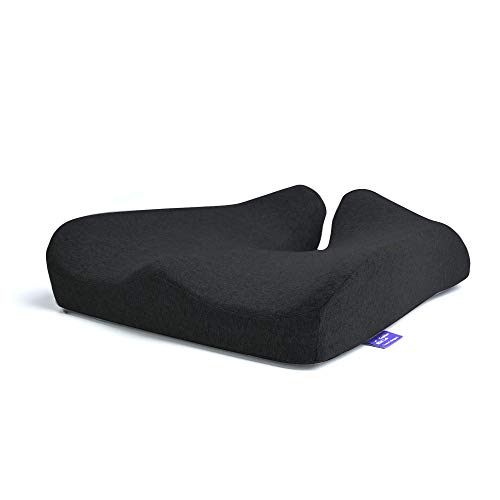
Cushion Lab Pressure Relief Seat Cushion (Extra-Dense Memory Foam) — Best for Long Sitting Hours
Buy the Cushion Lab if your sits are measured in double digits — long workdays, long drives, long study sessions — and standard cushions feel supportive at 9 a.m. and exhausted by 3 p.m. Its extra-dense foam is the point: density is what resists bottoming out over hours, and the contoured shape was designed around pressure distribution for extended sitting. It suits committed desk workers who have already tried a basic cushion and found its limit.
Strengths
- Extra-dense foam holds support across long days instead of fading by afternoon
- Contoured, patented design aimed at pressure relief for long sitting
- The upgrade pick for buyers who found standard cushions too soft
Trade-offs
- Firm is the feature and the risk: sitters who prefer a soft first feel may find it unyielding
- Like all cushions, it adds height to your seat — check desk fit
- Costs more than entry foam cushions, reflecting the denser material
| Material (listing) | Extra-dense memory foam |
| Design (listing) | Patented pressure-relief contour |
| Use (listing) | Long sitting hours, office and home chairs |
Cushion comfort has a time dimension that product pages rarely discuss: a cushion is not supportive or unsupportive, it is supportive for a duration. Light foams feel wonderful in a two-minute showroom sit and compress to near-nothing by hour six, leaving your sit bones on the chair’s hard pan with a thin foam rumor between. Density is the variable that stretches that duration, and the Cushion Lab’s extra-dense formulation is chosen precisely for the all-day case.
The contour works with the density. A shaped surface — supporting the thighs, cradling the sit bones, relieving the tailbone zone — spreads the load so the dense foam’s firmness reads as support rather than hardness. The combination suits the heaviest use case in this guide: the full-time desk worker whose chair is decent but whose days are long. If that description is yours, this is the cushion tier to buy once instead of twice.
Firmness preference is personal enough that this review states the risk plainly: if your taste runs soft, or your sits are short, the Everlasting Comfort above will please you more. Dense foam is a tool for long hours, and like most specialized tools it is worse than the generalist at everything else.
Best for: Full-time desk workers sitting eight-plus hours daily / Not suited for: Short sits, or anyone who prefers a soft, plush first feel
Check on Amazon — check price on Amazon before you decide, because configurations and included accessories change between listings.

ComfiLife Seat Cushion (Gel + Memory Foam) — Best Hybrid Cushion
Choose the ComfiLife if you read the foam-versus-gel debate and wanted both. The gel layer takes the edge off memory foam’s two weaknesses — heat retention and a sometimes-mushy surface — while the foam base keeps the molded contour that pure gel grids do not offer. It suits sitters who found plain foam almost right and want the refined version, in the office or the car.
Strengths
- Gel-plus-foam hybrid: contour below, cooler and firmer feel above
- Versatile sizing for office chairs and car seats
- A considered middle path for buyers torn between the two cushion technologies
Trade-offs
- Hybrids inherit some of both parents’ limits: warmer than a pure gel grid, less molded than pure foam
- Adds seat height like every cushion here
- The gel layer’s benefit is a feel improvement, not a transformation
| Material (listing) | Gel and memory foam |
| Use (listing) | Office chair, car seat |
| Design (listing) | Ergonomic seat cushion with lifting effect |
Hybrid design is sometimes a marketing shrug; here it addresses two specific, real complaints. Memory foam users say: it molds beautifully, and by afternoon it is warm and soft. A gel-infused or gel-layered top moderates both — the surface stays cooler and keeps a firmer, more defined feel — while the foam beneath still does the contouring work that spreads pressure. If your complaint about foam was temperature and fade rather than shape, this is the correction.
It is also the pragmatic car pick. Car seats are where cushions go to be forgotten, baked, and sat on for hours; the ComfiLife’s balance of support and temperature behavior suits long drives, and its form factor fits typical car seat pans. Drivers doing regular multi-hour trips are the quiet constituency that rates hybrid cushions highest, because both of foam’s weaknesses are at their worst in a sun-warmed car.
Set the expectation the review owes you: the hybrid is an refinement, not a revolution. It will not out-cool the Purple’s open grid in a heatwave, nor out-mold a pure foam in a cold room. It is the best-balanced single cushion for mixed use across seasons and seats — which, for many buyers, is exactly the right thing to be.
Best for: Mixed office-and-car use, and foam users bothered by heat and softening / Not suited for: Buyers wanting the coolest possible (pure gel) or softest possible (pure foam) extreme
Check on Amazon — check price on Amazon before you decide, because configurations and included accessories change between listings.

Marsail Ergonomic Office Chair (High Back Mesh, Adjustable Lumbar) — Best Full Chair — Adjustable
Buy the Marsail when the diagnosis is the chair itself: a seat pan the wrong depth, a back that meets your spine nowhere useful, a fixed height that leaves your feet dangling or your knees jackknifed. Its adjustments — seat height, adjustable lumbar support, a high mesh back — let you fit the chair to your body and desk rather than adapting your body to the chair. It suits a dedicated home office where one person sits all day.
Strengths
- Adjustable lumbar support lets you place support where your back actually is
- Breathable high-back mesh suits long days and warm rooms
- A full chair fixes fit problems — seat depth, height, back shape — that no cushion can
Trade-offs
- A chair is a commitment: assembly, floor space, and no portability between rooms
- Mesh seats feel firmer than padded seats; try-before-you-commit matters
- One chair fits one primary user best; shared chairs get readjusted constantly
| Type (listing) | Ergonomic desk chair, high back mesh |
| Support (listing) | Adjustable lumbar support |
| Use (listing) | Rolling swivel task chair for home office |
There is a point where cushioning a bad chair is polishing a structural problem. If your seat pan is too deep, your knees’ circulation pays; too shallow, your thighs go unsupported; if the chair’s height range misses your desk, your shoulders live at your ears. A proper ergonomic chair addresses the geometry itself, and the Marsail’s specification — high mesh back, adjustable lumbar, standard task-chair adjustments — is the correct checklist at an accessible tier.
The adjustable lumbar is the feature to weight most. Fixed lumbar bumps support an average back at an average height; an adjustable one meets your back where it curves, which is the difference between a chair that feels supportive in the shop and one that still feels supportive in month three. The mesh back adds the long-day virtue of airflow: in a warm home office, a mesh back is the difference between finishing the day dry and peeling yourself off vinyl at six.
Set it up with the routine in this guide’s how-to section — feet flat, knees level, lumbar placed, armrests under relaxed elbows, screen raised to match. An ergonomic chair misadjusted is an expensive ordinary chair; the ten-minute fitting is where its value is actually delivered.
Best for: Dedicated home-office workers replacing a chair that does not fit / Not suited for: Anyone needing portability, or a soft padded seat feel
Check on Amazon — check price on Amazon before you decide, because configurations and included accessories change between listings.

TRALT Office Chair (Ergonomic, Lumbar Support, Headrest, 330 lbs) — Best Full Chair — Big and Tall
Choose the TRALT if standard office chairs have always felt like borrowed children’s furniture. Its listing states a 330-pound capacity, and its design adds a headrest to the ergonomic basics — support for leaning back between tasks, which is part of healthy sitting across a long day. It suits larger and taller sitters, and anyone whose workday mixes focused sitting with thinking-back pauses.
Strengths
- 330 lbs capacity per the listing — built for larger frames honestly
- Headrest supports genuine recline breaks, not just upright task posture
- Lumbar support and ergonomic shaping at an accessible chair tier
Trade-offs
- Larger chairs need larger clearances — measure your desk kneehole and room
- Assembly is a two-coffee job; budget the time
- A headrest only helps if it adjusts to your height; check the fit on day one
| Capacity (listing) | 330 lbs |
| Features (listing) | Lumbar support, headrest |
| Type (listing) | Ergonomic desk chair, home office |
Fit is not a luxury variable in seating; it is the variable. A chair rated and sized for a smaller frame puts a larger sitter’s weight on components and geometry that were not designed for it, and the discomfort that follows gets blamed on the sitter. The TRALT’s stated capacity and proportions address the mismatch directly: a seat and structure scaled for the people who actually buy big-and-tall chairs, with the ergonomic features — lumbar support, headrest — that the segment is often asked to go without.
The headrest deserves its sentence. Sitting guidance is unanimous that position change is healthy, and a headrest is what makes the reclined position restful rather than a slump: lean back, let the chair take your head’s weight, look at the ceiling and think. Across an eight-hour day, those minutes are part of how a chair keeps you comfortable — a chair that only supports one posture perfectly supports a habit that no posture survives.
As with the Marsail, the fitting routine matters, and larger sitters should be especially deliberate about seat height and armrest width on day one. Get the geometry right and this is the chair in the guide most likely to end a long search for ‘a chair that fits me’ — a search whose discomfort is real, common, and entirely addressable with the right furniture.
Best for: Larger and taller sitters needing a chair honestly built for their frame / Not suited for: Small rooms, small desks, or petite sitters who would swim in it
Check on Amazon — check price on Amazon before you decide, because configurations and included accessories change between listings.
Comparison Table
| Pick | Badge | Key spec | Best for |
|---|---|---|---|
| Everlasting Comfort Memory Foam Seat Cushion (Office Chair & Car) | Best Overall Cushion | Contoured memory foam, office + car | Most desk workers and drivers making their first seating upgrade |
| Purple Royal Seat Cushion (2-Inch GelFlex Grid) | Best for Heat and Airflow | 2-in GelFlex grid, handles, portable | Warm rooms, hot car seats, and sitters who dislike memory foam’s sink |
| Cushion Lab Pressure Relief Seat Cushion (Extra-Dense Memory Foam) | Best for Long Sitting Hours | Extra-dense memory foam, long-sitting design | Full-time desk workers sitting eight-plus hours daily |
| ComfiLife Seat Cushion (Gel + Memory Foam) | Best Hybrid Cushion | Gel + memory foam hybrid cushion | Mixed office-and-car use, and foam users bothered by heat and softening |
| Marsail Ergonomic Office Chair (High Back Mesh, Adjustable Lumbar) | Best Full Chair — Adjustable | Mesh high back, adjustable lumbar support | Dedicated home-office workers replacing a chair that does not fit |
| TRALT Office Chair (Ergonomic, Lumbar Support, Headrest, 330 lbs) | Best Full Chair — Big and Tall | 330 lbs capacity, lumbar support, headrest | Larger and taller sitters needing a chair honestly built for their frame |
How to Choose Seating for Sitting Comfort
Diagnose before you buy, in this order. First, the surface: if your chair’s shape fits you but the seat is hard or flat, a cushion is the whole answer — do not buy a chair to fix a surface. Second, the geometry: if your feet do not rest flat, your thighs are not supported along their length, or your back meets the chair back nowhere, that is geometry, and only an adjustable chair fixes it. Third, the duration: the longer your sits, the more material quality matters — dense foam over light foam, mesh over vinyl, and real adjustability over fixed shapes. Most buyers’ discomfort is one of these three, and naming yours correctly is worth more than any single product in this guide.
Cushion materials, compared without hype
Memory foam molds: it distributes pressure by conforming, feels warm and enveloping, and softens somewhat across a long warm day — choose standard foam for general use, extra-dense foam for long hours. Gel grids flex: an open lattice that stays cool, springs back instantly, and distributes by buckling under pressure points — choose it for heat, cars, and foam-skeptics. Hybrids layer gel over foam for a middle character. None of these is ‘best’; they are answers to different complaints, and the reviews above are written to match your complaint to the material that answers it.
The tailbone question, in comfort terms
Many sitters find a cushion with a rear cutout or a contoured rear edge more comfortable, because the tailbone then sits over a relief zone instead of bearing load directly on a flat surface. If direct tailbone pressure is your specific discomfort, prioritize contoured designs with that relief shaping — the foam picks here are built that way — and pair the cushion with the sitting habits in the how-to section. And repeat the guide’s standing note: tailbone discomfort that follows a fall or injury, or that persists and worsens, deserves a clinician’s assessment before it deserves a product.
Sitting Habits That Matter as Much as the Chair
No chair or cushion makes eight motionless hours healthy, and this guide would be dishonest to rank products without saying so. The evidence-aligned habits are simple: change position often, stand and move briefly every half hour or so, keep feet supported flat, and set your screen so your neck is not flexed all day. Think of the cushion or chair as making the sitting portions comfortable, and the breaks as making the day sustainable. Buyers who adopt both halves consistently report the combination — not either alone — as the thing that finally made desk work comfortable. That is the honest promise this category can make, and it is a good one.
How to Set Up Your Chair and Cushion for a Comfortable Workday
Whether you bought a cushion or a chair, the fitting takes ten minutes and decides whether the purchase works. Do it once, deliberately, in this order — the sequence builds from the floor up, because each setting depends on the one below it.
Step 1: Set seat height from the floor
Sit down and adjust (or shim with your cushion choice) so your feet rest flat on the floor with knees at roughly hip height or a touch lower. Dangling feet pull on your back; knees jacked too high load your sit bones. If your feet do not reach, a footrest — or a sturdy box — is a legitimate and important accessory.
Step 2: Check seat depth against your thighs
You should be able to sit fully back with a small gap — a few fingers’ width — between the seat’s front edge and the back of your knees. A cushion that is too deep for your chair steals that gap; a chair with the wrong pan depth cannot be cushioned out of it, which is how you know the chair itself was the problem.
Step 3: Place the lumbar support
On an adjustable chair, move the lumbar support until it fills the natural curve of your lower back when you sit back — you should feel supported contact, not a push. On a plain chair with a cushion, sit fully back so the chair’s back and your cushion’s contour work together.
Step 4: Set armrests and desk relationship
Armrests should meet your elbows with your shoulders relaxed and dropped, not shrugged. Then check the desk: with the cushion’s added height, your forearms should still meet the keyboard level without reaching up. Raise the chair or lower your keyboard tray thinking — not your shoulders — through the change.
Step 5: Raise the screen to the new eye line
A cushion raises your eyes by its thickness; a new chair changes them again. Set the top of your screen around eye level at arm’s length, with books or a stand, so your neck stays neutral. More sitting discomfort is neck-and-shoulder than seat, and this step is its fix.
Step 6: Schedule the movement, not just the sitting
Set a repeating timer or use your watch: stand, walk, refill water every half hour or so. Put the reminder somewhere you will actually obey. The best-fitted chair in this guide still expects you to leave it regularly — that is part of the fitting.
Revisit the fitting after a week. Foam settles, cushions compress slightly into their working shape, and your body adapts — a five-minute recheck at day seven catches the small drifts that a day-one fitting cannot predict.
Common Buying Mistakes
Buying a cushion for a geometry problem
If your feet dangle, your seat pan is the wrong depth, or your back touches nothing, no cushion fixes it — you will spend cushion money and keep the discomfort, then conclude cushions do not work. Run the diagnosis in the buying guide first; it takes two minutes and routes you to the right product type.
Judging a cushion in the first five minutes
Foam especially lies at first contact: everything feels supportive for five minutes. Judge a cushion at the end of your longest typical sit, on the third day. Reputable sellers’ return windows exist for exactly this reason — use the full trial honestly rather than the first impression.
Ignoring the added height
Every cushion raises you — into the steering wheel’s space, above your desk’s ergonomic line, closer to the headrest’s wrong zone. Measure before buying, adjust after (the how-to covers it), and never stack two cushions to fix height, which creates an unstable, worse surface.
Expecting furniture to handle a medical question
This guide’s standing rule bears repeating as a mistake because it is the most consequential one: persistent, severe, post-injury, or radiating discomfort is for a clinician. Furniture is for the mechanical comfort of healthy sitters. Confusing the two delays the help that actually fits the problem.
Sitting perfectly still in a perfect chair
The ‘correct posture, frozen’ model is outdated: bodies want variation. The best chair setup includes permission to shift, recline, perch, and leave. Buyers who fit their chair and then move regularly get the outcome; buyers who fit their chair and freeze in it wonder why they still ache by Friday.
Final Recommendation
For most people, start with a cushion: the Everlasting Comfort for the general case, the Cushion Lab if your days are long and standard foam fades on you, the Purple Royal if heat and foam-sink are your complaints, and the ComfiLife hybrid if you split your sitting between desk and car. A cushion is the cheapest honest test of whether your problem is the surface — and for most sitters, it is.
If the diagnosis is geometry — a chair that does not fit your body or your desk — go straight to a chair: the Marsail for its adjustable lumbar and breathable mesh in a dedicated home office, the TRALT for larger frames and its headrest-supported recline.
Whichever route you take, do the ten-minute fitting and keep the movement breaks. Comfort at a desk is a system — surface, geometry, and habit — and this guide’s picks cover the first two as well as products can. The third is yours, and it is the one that makes the other two pay off. And if discomfort persists despite all three, take that information to a clinician; it is exactly the signal worth acting on.
Check the finalists on Amazon: Everlasting Comfort Memory Foam Seat Cushion (Office Chair & Car) · Purple Royal Seat Cushion (2-Inch GelFlex Grid) · Cushion Lab Pressure Relief Seat Cushion (Extra-Dense Memory Foam) · ComfiLife Seat Cushion (Gel + Memory Foam) · Marsail Ergonomic Office Chair (High Back Mesh, Adjustable Lumbar) · TRALT Office Chair (Ergonomic, Lumbar Support, Headrest, 330 lbs).
Frequently Asked Questions
Should I buy a cushion or a new chair first?
A cushion first, unless your chair fails the geometry checks: feet cannot rest flat, seat depth is clearly wrong for your thighs, or the backrest supports nothing. A cushion fixes surface problems — hardness, flatness, pressure concentration — for a fraction of a chair’s cost and moves between seats. Geometry problems need a chair. The buying guide’s diagnosis takes two minutes and tells you which problem you have. It is the cheapest useful test in this entire category.
Do seat cushions really help with sitting discomfort?
For the mechanical causes — hard surfaces, flat pans, concentrated pressure on the sit bones and tailbone — a well-matched cushion changes the sitting experience substantially, by distributing load and reshaping the surface. What a cushion cannot do is address discomfort with non-mechanical causes, or substitute for movement breaks. Judge it as ergonomic equipment, which is what it is, and it performs.
Memory foam or gel grid — which is better?
Neither universally. Memory foam molds to you and feels warm and enveloping, softening slightly across long warm days; extra-dense foam resists that softening. A gel grid stays cool, springs back instantly, and distributes pressure by flexing, with a distinctive feel some sitters love and others notice forever. Hot rooms and cars favor gel; cold rooms and contour-lovers favor foam; the hybrid splits the difference. Match the material to your complaint, as the reviews do.
Why do I still get uncomfortable after several hours in a good chair?
Because duration is its own variable: even perfectly distributed pressure, held motionless, becomes uncomfortable over hours. The fix is behavioral — brief standing and movement breaks, position changes, a recline now and then. A good chair makes the sitting portions comfortable and the breaks restorative; expecting any chair to make eight still hours comfortable is asking furniture to do physiology’s job.
What if my discomfort doesn’t improve with better seating?
Then you have learned something important: the cause is probably not your furniture. Discomfort that persists despite a well-fitted cushion or chair, regular movement, and sensible desk setup — or that involves numbness, weakness, pain traveling into a leg, or a history of injury — should be assessed by a clinician. Bring them the information: what you tried, what changed, what did not. That is a genuinely useful consultation, and this guide’s products will still be there for the ergonomic half afterward.
Can I use these cushions in a car?
Yes — several picks here are designed for both office chairs and car seats, and the reviews note it. Two checks before a long drive: confirm the added height still leaves you proper headroom and a correct view over the wheel, and make sure the cushion sits flat and stable on the car seat’s contours. A cushion that shifts under you while driving is a distraction, not a comfort. On long drives, the movement-break rule applies with extra force: stop, walk, and reset your posture at sensible intervals rather than pushing through discomfort for hours.
Keep exploring: Best Chairs For Butt Pain Best Seat Cushions For Office Chairs Best Ergonomic Office Chairs Best Gel Seat Cushions Best Office Chairs For Long Hours Best Butt Pillows


