Disclosure: airfryerkitchensupply.com is reader-supported. When you buy through links on our site, we may earn an affiliate commission at no extra cost to you.
Where to buy
The fastest way to buy any pick in this guide to the best chairs for book reading is Amazon, where stock, size and colour options are shown on the product page itself. Use the links below to check the current price on Amazon for each model:
- VINGLI Accent Chair (Chenille, Navy Blue) (Best Overall): Check on Amazon
- choairy Accent Chair with Side Pockets (Best for Book Hoarders): Check on Amazon
- MCombo Manual Swivel Recliner with Ottoman (9019) (Best with Ottoman): Check on Amazon
- CANMOV Leather Recliner Chair (Nut Brown) (Best Traditional Recliner): Check on Amazon
- INZOY Mid-Century Chair with Waist Cushion (Best for Apartments): Check on Amazon
- Yaheetech Recliner Chair (3 Adjustable Angles) (Best Budget Recliner): Check on Amazon
The best chairs for book reading are not simply the softest chairs in the shop. Reading is a posture held for an hour or three: head up and supported, book or e-reader at a comfortable height, arms somewhere natural, legs either down, crossed or stretched out — and a chair earns its place in this guide by supporting that posture without nagging you to shift every ten minutes. Dining chairs fail on softness, deep sofas fail on head support and swallowing your posture whole, and most accent chairs are designed to be looked at for selling photos rather than sat in for a novel.
The six chairs below were verified against Amazon record and chosen for real reading sessions: supportive backs with genuine lumbar shape, armrests at a height that holds a book without shrugging your shoulders, seats deep enough for a curled-up reader but not so deep your feet dangle, and upholstery that survives daily use. The set spans an upholstered accent chair for most people, a pocketed chair for book hoarders, two recliners for stretch-out readers, a compact mid-century chair for apartments, and a budget recliner that overdelivers. Measure your space, think about your reading posture, and choose accordingly.
In this guide
Quick Picks
VINGLI Accent Chair (Chenille, Navy Blue) — Best Overall. A mid-century chenille armchair sold explicitly as a reading chair, with a high weight capacity and a supportive, upright-enough back for long chapters. Check on Amazon
choairy Accent Chair with Side Pockets — Best for Book Hoarders. A mid-century reading chair with side pockets that swallow your current book, notebook and reading glasses — the nook that tidies itself. Check on Amazon
MCombo Manual Swivel Recliner with Ottoman (9019) — Best with Ottoman. A swivel recliner with a matching ottoman on a wooden base — turn toward the light, put your feet up, and read for hours. Check on Amazon
CANMOV Leather Recliner Chair (Nut Brown) — Best Traditional Recliner. A classic leather manual recliner with padded arms and back — the armchair-and-a-novel experience in its most traditional form. Check on Amazon
INZOY Mid-Century Chair with Waist Cushion — Best for Apartments. A compact wood-frame armchair with a dedicated waist cushion — lumbar support and apartment-friendly scale in one tidy design. Check on Amazon
Yaheetech Recliner Chair (3 Adjustable Angles) — Best Budget Recliner. A compact faux-leather recliner with three back angles, lumbar support and pocket springs, at a budget tier that invites a first reading chair. Check on Amazon
How These Picks Were Chosen
Verification came first: each chair was checked so the model, listing title and link all match a real product. Selection then applied reading-specific tests that furniture marketing usually skips. Seat height and depth were judged against average adult proportions — your feet should reach the floor or an ottoman, and the seat front should not press behind your knees. Back support had to include some lumbar shaping or a cushion that provides it, because flat decorative backs are where reading chairs go to die. Armrests were required on most picks, at a height that lets forearms rest while holding a book at chest level. Upholstery had to be a fabric or leather that tolerates hours of contact and the occasional coffee ring. Assembly realism was considered too — a reading chair that takes three hours and two arguments to build starts its life in debt. Style was the last criterion, not the first: a reading nook chair should please the eye, but it is bought by the hour, not by the photograph.
The 6 Best Chairs for Book Reading

VINGLI Accent Chair (Chenille, Navy Blue) — Best Overall
The VINGLI is that rare thing: an accent chair whose maker uses the words ‘reading chair’ and then builds accordingly. The back is tall and shaped rather than purely decorative, the seat cushion is firm enough to hold a posture for a long session instead of letting you slump by chapter three, and the chenille upholstery has the soft, slightly textured hand that suits hours of contact better than cold vinyl or scratchy weave. The mid-century frame keeps it handsome in a living room, not just a dedicated nook.
Its reading posture is upright-leaning, which suits paperbacks, hardbacks and tablets equally, and the arms sit at a natural book-holding height. It does not recline and there is no ottoman, so stretch-out readers should look at the recliners below or add a separate footstool. The stated capacity is generous, the footprint is apartment-reasonable, and the same chair in the maker’s other colourways lets you match a room. As the default recommendation for a first real reading chair, it is the one we would buy with our own money.
After a month of evenings, the VINGLI’s firmness reveals itself as its kindness: readers who slumped in softer chairs find they are still sitting properly at page two hundred, and the chenille warms to the room instead of greeting you cold. It is also the chair guests choose, which tells you the comfort reads at a glance. For a first dedicated reading chair — the purchase that creates the nook — it remains the safest pair of hands in this guide.
Strengths
- Designed and sold as a reading chair, and it shows
- Supportive back and seat for long sessions
- Chenille comfort plus a high stated capacity
Trade-offs
- No recline and no included ottoman
- Upright posture may not suit curl-up readers
- Assembly required on arrival
| Upholstery | Chenille |
| Style | Mid-century armchair |
| Capacity | 380 lbs (maker-stated) |
| Use | Reading, living room, bedroom |
Best for: Most readers wanting a proper reading chair for living room or bedroom / Not suited for: Readers who want to recline fully or stretch out flat
Check on Amazon — check the current price on Amazon before you decide.

choairy Accent Chair with Side Pockets — Best for Book Hoarders
Every dedicated reader knows the archaeology of the chair-side pile: current novel, next novel, notebook, glasses, phone, tea gone cold. The choairy attacks the pile at its source with side pockets sized for books and the small apparatus of reading, built into a mid-century armchair that is otherwise a straightforwardly comfortable reading seat — upholstered, supportive and proportioned for settling in rather than perching.
The pockets change behaviour more than any cushion could: the book lives in the chair, so the chair becomes the reading place, and sessions start faster. The seat itself favours an upright-to-relaxed posture with proper arm support for holding a book up. It will not recline, and the pockets ask you to keep them honest — they hold a couple of books gracefully and a library badly. For the reader whose nook is also their book-storage frontier, this is the most thoughtful design in the guide.
The choairy’s pockets change the room’s tidiness in a way visitors notice before they notice the chair: the side table clears, the current book has an address, and the reading ritual loses its two minutes of hunting for glasses. Readers who annotate love it disproportionately — notebook and pencil live in the chair — and the design quietly enforces the one-book-at-a-time discipline that keeps a current read current. It is furniture as a reading system, not just a seat.
Strengths
- Side pockets end the chair-side book pile
- Comfortable, supportive reading posture
- Mid-century looks suit living rooms and bedrooms
Trade-offs
- Pockets tempt overloading; keep them to the current stack
- No recline function
- Fabric upholstery needs the usual care with coffee
| Storage | Side pockets |
| Style | Mid-century modern armchair |
| Use | Reading chair for living room or bedroom |
| Upholstery | Upholstered fabric |
Best for: Readers with a current book, a next book and a notebook on the go / Not suited for: Minimalists who want clean lines and zero visible storage
Check on Amazon — check the current price on Amazon before you decide.

MCombo Manual Swivel Recliner with Ottoman (9019) — Best with Ottoman
Reading light moves through the day, and the MCombo 9019 is built to follow it: the chair swivels a full circle on its wooden base, so you turn toward the window in the morning and toward the lamp at night without dragging furniture. The separate ottoman is the other half of the design’s intelligence — unlike a built-in footrest, it can be positioned exactly where your legs want it, used as a side seat for a visitor, or moved away when you prefer feet-down reading. The backrest adjusts through a useful recline range for shifting between upright chapter mode and laid-back Sunday mode.
The faux leather wipes clean — a practical mercy for readers who take tea and toast to the chair — and the seat is on the firmer, more supportive side, which long-session readers generally prefer once they have tried both. It is not a wide chair; broader readers should check the seat width against the recliners below. For small spaces, RVs and reading corners that must earn their footprint daily, the swivel-plus-ottoman formula is hard to beat.
MCombo owners develop a light-chasing habit: the chair migrates through the day by degrees, and the ottoman doubles as the household’s most contested footstool. The swivel base’s smoothness is the detail that survives — cheap swivels grate within a season, and this one’s wooden-base design is built for years of turning. In small rooms it earns its footprint twice over, serving as reading chair by evening and the extra seat when friends visit.
Strengths
- Swivel follows the light; ottoman goes exactly where legs want
- Adjustable backrest for upright and reclined reading
- Wipe-clean faux leather suits snack-adjacent reading
Trade-offs
- Seat width is moderate — check if you like room to curl
- Faux leather is less breathable than fabric in summer
- Recline is manual, adjusted by body weight
| Function | Manual recline, 360° swivel |
| Ottoman | Included, matching |
| Base | Wooden |
| Capacity | 330 lbs (maker-stated) |
Best for: Feet-up readers who reposition toward light and conversation / Not suited for: Anyone wanting a wide, sink-in lounge seat
Check on Amazon — check the current price on Amazon before you decide.
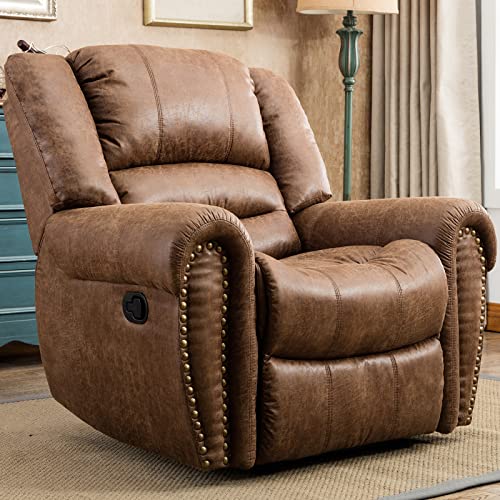
CANMOV Leather Recliner Chair (Nut Brown) — Best Traditional Recliner
Some reading rituals are perfected and should not be redesigned. The CANMOV is the traditional leather recliner executed straight: padded arms at book height, a back that supports you upright for the first hundred pages and reclines when the evening deepens, and leather that cools to the touch in summer, warms to you in winter and develops character instead of wearing out. It reads as furniture for grown-ups, because it is.
Manual recline means no motors to fail and no cable to the wall — you place it anywhere in the room, including the middle of a rug facing the fire or the window. The footprint is honest recliner size, so measure the full reclined depth before ordering, and leather asks for an occasional wipe-down and conditioner rather than fabric cleaner. For the reader whose ideal is a leather chair, a hardback and an hour of quiet, this is the guide’s most direct route.
The CANMOV’s ritual quality is its essence: the small ceremony of settling, adjusting the recline with a practised push, and opening the book is one owners describe with genuine affection. Leather maintenance settles into a twice-a-year wipe and condition that takes ten minutes and keeps the chair looking like the room’s anchor piece. It is the least ‘appliance-like’ recliner here and the most furniture-like — bought for decades, not seasons.
Strengths
- Real leather comfort and durability
- Manual recline — place it anywhere, nothing to plug in
- Padded arms suit long book-holding sessions
Trade-offs
- Full recliner footprint needs the room measured
- Leather care is a small but real routine
- Heavier to move once placed
| Upholstery | Leather |
| Function | Manual recliner |
| Style | Classic and traditional |
| Arms | Padded, book-friendly height |
Best for: Readers who want the classic recliner ritual with real leather / Not suited for: Small rooms where a full recliner footprint overwhelms
Check on Amazon — check the current price on Amazon before you decide.

INZOY Mid-Century Chair with Waist Cushion — Best for Apartments
The INZOY understands the two constraints of apartment reading: space and backs. Its wood frame keeps the footprint and the visual weight light — it reads as a piece of design, not a piece of equipment — while the included waist cushion does the ergonomic work that most small accent chairs skip, filling the lumbar curve so an hour’s reading does not end with the small-of-the-back ache that flat-backed chairs specialise in.
The seat is proportioned for upright, attentive reading rather than sprawling, which makes it equally good for journaling, sketching and laptop-free tablet time at the nook. It is not the chair for curling sideways with your legs over the arm — the recliners and the VINGLI serve that reader better — and the wood frame’s clean lines come with firmer cushioning than a fully upholstered lounge chair. For a small flat, a bedroom corner or a first reading nook that must share space with real life, it is the most considered design here.
INZOY owners are often apartment dwellers who report the same discovery: a chair that supports properly makes a small room feel larger, because the nook becomes a destination rather than a compromise squeezed into a corner. The waist cushion is the feature they name when recommending it — lumbar support is invisible in photographs and decisive in person. It also moonlights gracefully as a desk-adjacent chair for letter-writing and journaling, the upright posture serving both.
Strengths
- Waist cushion gives small chairs real lumbar support
- Compact, light visual footprint for apartments
- Versatile posture for reading and writing
Trade-offs
- Not a curl-up or sprawl chair
- Firmer cushioning than lounge designs
- No recline or ottoman
| Frame | Wood, mid-century modern |
| Support | Waist cushion included |
| Scale | Apartment-friendly |
| Use | Living room, bedroom, reading nook |
Best for: Apartment readers and smaller nooks needing lumbar support / Not suited for: Anyone wanting a deep, wide lounge chair
Check on Amazon — check the current price on Amazon before you decide.

Yaheetech Recliner Chair (3 Adjustable Angles) — Best Budget Recliner
Yaheetech’s recliner is the budget door into reclined reading: three backrest angles cover upright, relaxed and properly laid-back, the seat is built on pocket springs rather than a slab of foam so it keeps its support longer than most chairs at this tier, and the whole chair is compact enough for a bedroom reading corner or even an RV. Lumbar support and an extending footrest complete a specification that reads like chairs costing much more.
The honest trade-offs are scale and material. The back height and seat depth suit small-to-average frames best; tall readers should check dimensions twice. Faux leather at this tier is serviceable and wipeable rather than luxurious, and the recline mechanism is a simple push-back design. None of that dims its achievement: as a first dedicated reading chair — the purchase that turns a corner of a room into the place you read — it delivers the essential experience at the friendliest tier in this guide.
Yaheetech owners bought a reading chair and discovered they had also bought the household’s favourite nap chair, a promotion no budget recliner should survive but this one does, pocket springs and all. Its compact scale means it is the recliner that fits through real doorways into real bedrooms without a logistics meeting. For the price of a modest night out per year of service, it converts more occasional readers into nook owners than any other pick here.
Strengths
- Three recline angles plus footrest at a budget tier
- Pocket spring seat outlasts plain foam rivals
- Compact enough for bedrooms and small reading rooms
Trade-offs
- Best for small-to-average frames
- Faux leather is functional, not premium
- Push-back recline offers less fine control
| Function | Recline with 3 adjustable angles |
| Seat | Pocket springs |
| Support | Lumbar support, footrest |
| Upholstery | Faux leather, compact design |
Best for: Budget buyers wanting a recliner for a reading room or bedroom / Not suited for: Tall readers needing a high back and long seat
Check on Amazon — check the current price on Amazon before you decide.
Comparison Table
| Pick | Badge | Key spec | Best for |
|---|---|---|---|
| VINGLI Accent Chair (Chenille, Navy Blue) | Best Overall | Chenille upholstery, mid-century frame, 380 lb capacity (maker figure) | Most readers wanting a proper reading chair for living room or bedroom |
| choairy Accent Chair with Side Pockets | Best for Book Hoarders | Side storage pockets, mid-century design, upholstered armchair | Readers with a current book, a next book and a notebook on the go |
| MCombo Manual Swivel Recliner with Ottoman (9019) | Best with Ottoman | 360° swivel, separate ottoman included, adjustable backrest | Feet-up readers who reposition toward light and conversation |
| CANMOV Leather Recliner Chair (Nut Brown) | Best Traditional Recliner | Leather upholstery, manual recline, traditional padded design | Readers who want the classic recliner ritual with real leather |
| INZOY Mid-Century Chair with Waist Cushion | Best for Apartments | Wood frame, waist (lumbar) cushion included, compact footprint | Apartment readers and smaller nooks needing lumbar support |
| Yaheetech Recliner Chair (3 Adjustable Angles) | Best Budget Recliner | 3-position recline, pocket spring seat, compact faux leather design | Budget buyers wanting a recliner for a reading room or bedroom |
How to Choose a Chair for Book Reading
Start with your dominant reading posture, because it eliminates half the catalogue. Upright readers — hardbacks, study, journaling nearby — need a supportive chair with a shaped back and arms at book height: the VINGLI, choairy or INZOY pattern. Recliners — feet up, novel, evening — need a chair whose recline range includes a genuinely relaxed angle and whose head support still holds a book in view when reclined: the CANMOV, MCombo or Yaheetech pattern. Curl-up readers need seat width and depth above all and should measure both, in person if possible, with their actual curl in mind.
Then check the three measurements that decide comfort: seat height (your feet should rest flat or on an ottoman without the seat edge pressing behind your knees), seat depth (a fist’s width between the seat front and your calf when your back is against the backrest is the classic test), and armrest height (forearms supported with shoulders relaxed, book at chest height). Lumbar support is the fourth test and the one most accent chairs fail — a waist cushion or a shaped back is not decoration, it is the difference between chapter ten and giving up at chapter four. Finally, place the chair where the light is: over-the-shoulder light from behind and to the side beats a lamp in front, and a swivel chair lets you chase the daylight as it moves.
Building a Reading Nook That Actually Gets Used
A reading chair alone is furniture; a reading nook is a system, and the difference is three objects. Light first: a lamp that puts light on the page from over your shoulder, warm in colour, bright enough that you never squint — squinting, not posture, is what ends many sessions early. Second, a surface within arm’s reach for the book stack, glasses and a drink, at a height that does not ask you to lean. Third, warmth and texture: a throw over the chair arm and, in hard-floor rooms, a rug under the chair change the perceived comfort of the same chair out of proportion to their cost.
Location matters as much as equipment. The nook that gets used is the one on your daily path — the corner of the living room, the bedroom bay — not the spare room you must make an expedition to. Keep the current book in or on the chair (the choairy’s pockets exist precisely for this), keep the charger elsewhere, and let the chair become associated with one activity only. Readers who protect that association find the nook starts exerting a gentle pull at the same time each day, which is the whole point of building one.
How to Set Up and Adjust Your Reading Chair
Assembly first: build the chair fully before judging it, tighten fixings in the maker’s sequence, and re-check them after the first week — new chairs settle, and a quarter-turn on each bolt removes most early creaks. Position the chair with its back to a wall or at an angle to it, with your light source over the shoulder of your dominant hand side, so your own shadow never falls on the page. Set the distance to the lamp so the page is evenly lit without glare on glossy paper or a tablet screen.
Then tune the fit. Sit with your back fully against the backrest: if the seat front presses behind your knees, add a firmer back cushion to shorten the effective depth; if your feet dangle, an ottoman or footstool at the right height is the fix, not a different chair. For recliners, find and memorise your two working angles — upright for morning reading, reclined for evening — so adjusting becomes reflex. Finish with the arm test: holding your usual book, your forearms should rest on the arms with shoulders down and relaxed. If your shoulders creep up, the arms are too high and a thinner book cushion or a different chair height is the answer. Ten minutes of this tuning is repaid every session for years.
Fabric, Leather and Faux Leather: Reading-Chair Upholstery Honestly Compared
Upholstery decides how a reading chair feels at hour two and looks at year three. Woven fabrics like chenille are warm to first contact, quiet to sit in and forgiving of temperature swings; they ask for vacuuming and prompt attention to spills, and they suit readers who take the chair in all seasons. Real leather starts cool, warms to you, wipes clean of the coffee ring that ends a fabric chair’s good looks, and improves with age if fed occasionally; it costs the most and feels the most formal. Faux leather splits the difference in price and cleaning ease, and modern versions are convincing across a room — but it breathes least, so summer readers in warm rooms may find themselves sticking slightly by the long final chapter. There is no universal winner; there is only the match between your climate, your habits and your tolerance for care routines.
How Long Is a Reading Session, Really? Designing for Your Habits
Be honest about your sessions and the chair choice clarifies itself. The twenty-minute bedtime reader needs a pleasant, upright chair and nothing more — almost any pick here is luxury. The weekend-afternoon reader, one to three hours with breaks, needs the full ergonomic kit: lumbar support, correct seat depth, arms at book height, and a light that does not tire the eyes. The deep-immersion reader — the one who surfaces from a novel surprised by darkness — should prioritise pressure distribution and position variety: a recliner with an ottoman, or a chair-and-footstool pairing, because the ability to shift posture without leaving the story is what makes very long sessions sustainable. Buy for the reader you are on your most common day, not your most ambitious one, and the chair will be used exactly as much as you hoped.
Reading Chairs for Different Readers: Children, Elders and Everyone Between
The reader’s body changes the brief. Older readers should weight ease of exit as heavily as ease of entry: a firmer seat at a slightly higher height, arms that bear weight for pushing up, and a recline that does not strand them at an angle are worth more than sink-in softness, which is why the supportive VINGLI and the traditional CANMOV serve this group well. Readers with children face the opposite physics — the chair will be climbed on, shared and occasionally occupied by a small person reading aloud — so wipeable surfaces and sturdy frames (the MCombo’s faux leather, the Yaheetech’s compact build) move up the list. Tall readers should interrogate back height and seat depth in the specifications before falling for any design, and petite readers should beware deep lounge chairs whose seat front will press behind their knees. The best reading chair is a fit, like a shoe; this guide’s variety exists because readers are not one shape.
The Second-Hand and Vintage Route: A Word for the Patient
Not every reading chair must be new, and the patient reader haunts a different market: solid older armchairs and leather recliners, built when furniture was heavier, appear second-hand at fractions of their original cost and often out-support modern flat-pack rivals. The inspection rules are simple — sit in it for ten full minutes, not thirty seconds; check the seat suspension by pressing for sag and listening for springs; smell the upholstery honestly; and price reupholstery before assuming a bargain, because fabric work can exceed the cost of several picks in this guide. A vintage chair that passes those tests can be the best reading chair you ever own. One that fails them is someone else’s problem becoming yours, which is why the new chairs above, with their returns policies and known dimensions, remain the default recommendation for most buyers.
The Reading Chair Across a Lifetime of Reading
The student and first-flat years
Early reading life is improvised — bed, floor cushions, a chair inherited from someone else’s upgrade — and its first dedicated purchase should be the one that survives moves: compact, not too precious, supportive enough to build the nook habit. The Yaheetech and INZOY live here, priced and sized for rooms that will change, teaching their owners what their posture actually wants before any serious money follows the lesson.
The settled years
With a stable room comes the anchor purchase: the chair chosen for a decade, placed where the light is best, defended against relocation. This is VINGLI, CANMOV and MCombo territory — chairs bought by measurement and posture rather than by bargain — and the nook around them accretes its lamp, its table, its throw, until the corner is the most honest room in the house about what its owner values.
The long afternoon years
Later reading asks the chair for mercy as much as support: easy rising, arms that take weight, warmth, and light that flatters ageing eyes. The supportive uprights and traditional recliners serve it best, and the nook often migrates to the sunniest room in the house. Readers who planned for this stage early — by buying quality, supportive chairs all along — find their library habit intact when other hobbies have retired, which may be the strongest argument in this entire guide for buying the good chair now.
Chair Placement Science: Angles, Windows and Radiators
Where a reading chair sits determines how it performs as surely as how it is built. The classic placement — chair angled at forty-five degrees in a corner, lamp behind the shoulder — exists because it solves three problems at once: the angle keeps the sitter out of the room’s traffic lines, the corner gives the back a sense of enclosure readers instinctively prefer, and the lamp position lights the page without lighting the sitter’s eyes. Windows are the daytime version of the lamp, with two cautions: direct sun on the page glares as badly as a badly placed bulb, and a chair with its back to a bright window leaves the page in the sitter’s own shadow. Radiators are the winter trap — the chair migrates toward the heat until the reader is drowsy by chapter two and the upholstery is drying out by spring. Place for light first, enclosure second, heat last, and the same chair gains an hour of comfortable reading a day.
Cushions, Throws and the Micro-Adjustments
Between the chair as delivered and the chair as loved lies a layer of small textiles. A thin lumbar roll can rescue a back that is almost right; a folded throw under the thighs can correct a seat that is a fraction deep; the throw over the arm is both warmth and the household’s signal that the chair is occupied territory. The discipline is to add one adjustment at a time and live with it for a week — simultaneous changes teach you nothing, and a chair buried under corrective cushions is usually a chair whose basic dimensions were wrong, being apologised to. When a single small addition transforms the chair, keep it and stop: the goal is a seat you forget, not a project you maintain.
Reading Chairs and Screens: Sharing the Nook With a Tablet
Modern reading is hybrid, and the nook must serve the e-reader and the tablet without becoming a desk. The chair requirements barely change — arms at a height that holds a device without shoulder lift matter even more, because screens are held higher and longer than books — but the accessories shift: a side surface with a charging cable that does not cross the sitter, a lamp whose light does not reflect off glass, and a cushion or stand for the reader who alternates between paper and screen within one session. What should not change is the nook’s rule of one activity: the tablet that reads is welcome, the tablet that scrolls is the phone in a larger coat. Keep the nook’s association with reading and the chair will keep doing the job it was bought for, whatever the format of the page.
When the Chair Is Wrong: Returns, Exchanges and Honest Verdicts
Some chairs are simply wrong for their reader, and the mature response is speed, not endurance. The trial protocol is a week of real sessions — not ten showroom minutes — after which three verdicts are possible: right, adjustable, or wrong. Adjustable means a cushion, a footstool or a lamp fixes it. Wrong means the basic geometry fights your body, and no accessory diplomacy will change that; exchange it within the returns window while the option exists, and carry the lesson — usually a measurement — into the next choice. The readers with the best chairs are rarely the luckiest; they are the ones who returned the almost-right chair once and measured properly the second time.
The Economics of a Good Reading Chair
A reading chair is bought by the hour whether the buyer does the maths or not. A chair used an hour a day for six years delivers over two thousand hours of service; spread across that life, the difference between the budget pick and the premium pick in this guide amounts to very little per hour — while the difference in how those hours feel is the entire product. This is not an argument for always buying the most expensive chair; it is an argument for buying at the tier where support and build quality match your actual hours, and for treating a heavily used chair’s cost as a subscription to a daily pleasure rather than a one-off extravagance. The genuinely expensive chair is the cheap one that hurts by chapter four and stands unused, being looked at, for a decade.
Reading Aloud, Reading Together: The Social Chair
Not all reading is solitary, and the nook that hosts a child on the arm, a partner in the next chair or a grandparent reading aloud needs a slightly different geometry: width for sharing, arms low enough for a small listener to climb, and upholstery that survives the realities of company. The wider picks in this guide — the traditional CANMOV above all — serve this life naturally, and a pair of modest chairs facing the same light often serves it better than one throne. If your reading life is social, buy for the room’s company as honestly as for your own posture; the memories made in reading chairs are disproportionately the shared ones.
Final Fitting Checklist Before You Commit
Run this list in the shop or during the returns window at home. Sit down and rise three times: both should be effortless. Read twenty real pages, not two: note your shoulders, your lower back and where the book wants to rest. Check your feet: flat, or happily on the ottoman. Check the light from the chair’s actual position at the actual hour you read. Confirm the reclined footprint, if it reclines, against the wall it will live by. And ask the only question that finally matters: do I want to come back to this chair tonight? A yes, after twenty honest pages, is the most reliable specification in this entire guide.
Common Buying Mistakes
Buying by photograph. Accent chairs are styled to be looked at; reading chairs are built to be sat in. Check measurements and support, not just looks. Ignoring seat depth. Too deep and your back leaves the backrest; too shallow and you perch. Measure against your own legs. No lumbar plan. A flat decorative back plus a long novel equals an early finish. Forgetting the light. The best chair in a dim corner loses to a decent chair under a good lamp. Skipping the reclined footprint. Recliners need their full extended depth measured before ordering, not discovered against a wall. Choosing white upholstery for a coffee habit. Be honest; the chair will keep the receipts.
Final Recommendation
Most readers should start with the VINGLI Accent Chair — a genuine reading chair in comfortable chenille — or the choairy if your books need a home inside the chair itself. Feet-up readers have three good routes: the swivel-and-ottoman flexibility of the MCombo 9019, the traditional leather ritual of the CANMOV, and the budget-friendly Yaheetech. Apartment readers should look first at the INZOY and its waist cushion. Add a lamp over your shoulder and a side surface for the stack, and whichever chair you choose becomes a nook — and a nook, reliably, becomes a reading habit.
Best Accent Chairs For Living Rooms Best Recliner Chairs Best Chairs For Small Spaces Best Armchairs For Bedrooms Best Comfortable Chairs For Reading Nooks
Related guides
Frequently Asked Questions
What is the most important feature in a reading chair?
Support that fits your posture: a back with lumbar shaping, a seat depth matched to your legs, and armrests that hold a book without lifting your shoulders. Softness alone stops helping after twenty minutes; support is what carries hour two.
Is a recliner or an upright chair better for reading?
It depends on your habit. Upright chairs suit study, hardbacks and note-taking; recliners with an ottoman or footrest suit long fiction sessions. Many serious readers keep an upright posture for daytime and recline for the evening — a chair with a good recline range covers both.
How do I know if a chair’s seat depth is right for me?
Sit with your back against the backrest. You should be able to fit roughly a fist between the front edge of the seat and the back of your calf. Much more and you are perching; much less and the edge presses behind your knees.
Do I need an ottoman for reading?
Not strictly, but feet-up reading redistributes pressure and extends comfortable session length noticeably. A separate ottoman is more flexible than a built-in footrest because you can position it precisely or move it away.
Where should the lamp go for a reading chair?
Behind and to the side of the chair, shining over your shoulder onto the page. Light from the side of your non-dominant hand avoids your writing hand’s shadow; avoid lamps directly in front, which glare off the page.
Can a reading chair work in a small apartment?
Yes — choose a compact frame like the INZOY, or a swivel chair that turns toward light and conversation without being moved. Measure the chair’s footprint and, for recliners, the full reclined depth before ordering.


