Disclosure: airfryerkitchensupply.com is reader-supported. When you buy through links on our site, we may earn an affiliate commission at no extra cost to you.
Choosing the best cooling towels for outdoor workers is a heat-management decision, not a sports-accessory purchase. The towel has to activate fast at a water point, keep working through long stretches of physical work, survive dust, sunscreen and weekly washing, and fit around hard hats and hi-vis without becoming one more irritation. Every pick below was confirmed through this site’s Amazon product listings before any link was printed — because on a safety-adjacent product, an unverified link is worse than no link.
Two material classes divide the field. Microfiber towels are soft, packable and forgiving; PVA towels feel colder immediately and hold more water but demand storage discipline. This guide reviews both classes for shift work specifically — duration per activation, behaviour under PPE, crew economics and laundry reality — and frames every product as work support inside a proper heat programme of water, rest and shade, never as protection against heat illness on its own.
Where to buy
The confirmed picks in this guide are sold through Amazon, where you can check the current price on Amazon for each model, confirm colours and pack sizes on the listing, and arrange delivery — including bulk orders for crew issue. Start with these confirmed options:
- MISSION Max Plus Cooling Towel — Best Overall: Check the current price on Amazon
- FROGG TOGGS Chilly Pad Cooling Towel — Best PVA Chill: Check the current price on Amazon
- MISSION Original Cooling Towel — Best Under Hard Hats: Check the current price on Amazon
- Sukeen 4-Pack Cooling Towels (40″ x 12″) — Best Crew Value: Check the current price on Amazon
- Ergodyne Chill-Its 6602 Evaporative Cooling Towel — Best Safety-Brand Option: Check the current price on Amazon
- Honoson 20 Packs Cooling Towel (40 x 12 Inch) — Best Bulk Backup: Check the current price on Amazon
Always re-check the listing for the pack size and colour you intend to order. Cooling towels are sold in singles and multi-packs under near-identical names, and crew orders especially should confirm the count in the basket before checkout.
In this guide
Quick Picks
- Best Overall: MISSION Max Plus Cooling Towel — Mission’s long-duration microfiber towel with UPF 50 sun protection — the shift-length pick for roofers, road crews and warehouse teams. — Check the current price on Amazon
- Best PVA Chill: FROGG TOGGS Chilly Pad Cooling Towel — The original PVA chilly towel in hi-vis lime: maximum initial cold, a 33×13 work size, and a colour that belongs on a site. — Check the current price on Amazon
- Best Under Hard Hats: MISSION Original Cooling Towel — Mission’s original evaporative towel in a 10×33 work-friendly size — slimmer in the pack, instant when wet, with UPF 50 cover. — Check the current price on Amazon
- Best Crew Value: Sukeen 4-Pack Cooling Towels (40″ x 12″) — A four-pack of long 40-inch mesh microfiber towels — the economical way to put a towel on every neck and keep spares rotating. — Check the current price on Amazon
- Best Safety-Brand Option: Ergodyne Chill-Its 6602 Evaporative Cooling Towel — The safety-industry staple: an evaporative cooling towel, 13 x 29.5 inches in blue, from the Chill-Its line built for heat-stress programmes. — Check the current price on Amazon
- Best Bulk Backup: Honoson 20 Packs Cooling Towel (40 x 12 Inch) — Twenty microfiber cooling towels at 40 x 12 inches, with bag and clip, as the backup layer of a crew heat programme. — Check the current price on Amazon
How These Picks Were Chosen
Every product named with a purchase link in this guide was checked through this site’s own Amazon product listings, using cache-confirmed listings from this programme’s verified searches, matching brand, model and material in the listing title to the towel being recommended. Every pick — including the safety-channel Ergodyne and the bulk Honoson 20-pack — was matched to a listing whose title confirms its brand, model and format before any link was printed.
Picks were judged for outdoor work specifically: cooling duration per activation, activation effort, sun protection, pack format for crew issue, washability and behaviour under PPE. No fixed prices are printed; check the current price on Amazon for the pack configuration you need.
The 6 Best Options for Best Cooling Towels for Outdoor Workers

MISSION Max Plus Cooling Towel — Best Overall
Outdoor work changes the cooling-towel brief completely. This is not a gym accessory; it is heat management across an eight-to-ten-hour shift, in sun, dust and sweat, with re-wetting available only when the water cooler run allows. The Mission Max Plus is built for that reality: a durable microfiber towel rated by the maker for cooling lasting up to three hours per activation, with UPF 50 sun protection in the fabric itself. Wet it, wring it, snap it to activate, and it goes around the neck or under a hard hat for the long middle of the shift.
Strengths
- Long activation window suits real shifts, not just workouts
- UPF 50 fabric protects the neck it cools — the most sun-exposed skin on most crews
- Machine washable microfiber survives the weekly wash rotation working towels need
Trade-offs
- Microfiber needs a proper wring to activate well; a dripping towel under-activates and soaks shirts
- Peak midday heat in humid climates shortens any evaporative towel’s effective window
- One towel per worker per shift is the minimum; rotation pairs work better in practice
Key specs: Microfiber cooling towel; maker-rated cooling up to 3 hours per activation; UPF 50; machine washable (details from the confirmed listing title).
The activation ritual matters and takes ten seconds: soak, wring until damp rather than wet, then snap or shake the towel to start evaporation. Workers who skip the snap get a damp cloth; workers who do it get a towel that feels genuinely cold against the neck within a minute. Re-snap it when the cooling fades and the effect refreshes without another trip to the water point — a mid-shift advantage that adds up across a hot week.
Durability is the working difference between brands, and microfiber earns its place here. It tolerates the dust, sunscreen and grime of a site, rinses clean at a tap, and survives machine washing that would leave lesser fabrics limp. The UPF rating deserves emphasis for outdoor crews specifically: the back of the neck is where sun exposure accumulates all shift, and a towel that shades while it cools is doing two safety jobs at once.
For supervisors equipping a crew, this is the towel to standardise on: one model, known behaviour, washable in bulk. Issue two per worker where laundry is weekly — one in use, one in the wash — and the system holds through a heatwave without improvisation.
Best for: roofers, road crews, landscapers and warehouse teams working full shifts in sun / Not suited for: workers in very humid conditions who need the PVA alternative’s stronger initial chill
Check the current price on Amazon
FROGG TOGGS Chilly Pad Cooling Towel — Best PVA Chill
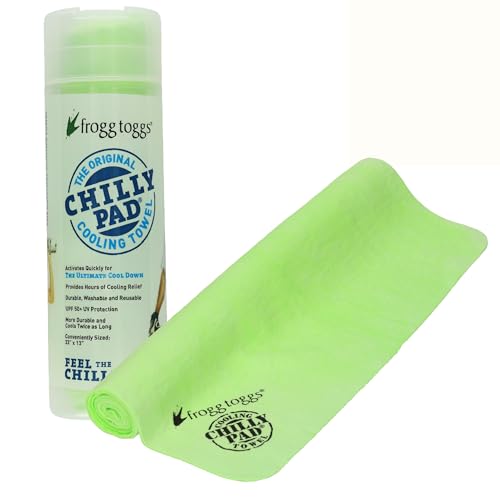
Frogg Toggs’ Chilly Pad is the towel that defined the category, and its PVA material still delivers the most aggressive initial chill of any towel here. PVA works like a synthetic chamois: it absorbs many times its weight in water, holds it without dripping, and feels cold the moment it touches skin. In the hi-vis lime version listed here, it also satisfies the visibility culture of road and construction work. For the hottest, heaviest tasks — asphalt, roofing tear-offs, steel work — that first-contact cold is exactly what a break needs.
Strengths
- PVA delivers the strongest immediate cold sensation in this roundup
- Hi-vis colourway fits site visibility expectations
- 33×13 size covers neck and shoulders properly, not a token strip
Trade-offs
- PVA stiffens when dry and must be stored damp or re-softened before use — a real handling quirk
- Less drapable than microfiber; it sits on the neck rather than wrapping softly
- In high humidity its evaporation advantage narrows, as with all evaporative towels
Key specs: PVA cooling towel; 33 x 13 inches; hi-vis lime green (details from the confirmed listing title).
Handling is the honest trade. A Chilly Pad stored dry goes board-stiff; the routine is to keep it in its container slightly damp, or run it under a tap for a minute at shift start until it softens. Crews who learn the routine stop noticing it; workers who toss it dry into a toolbox curse it once and abandon it. Supervisors issuing PVA towels should teach the storage habit with the towel — the product and the habit are one system.
In use, PVA’s water capacity is its shift advantage. It keeps delivering cool contact through long stretches between water points, and a quick re-soak at break restores it fully. Around the neck it stays put better than its stiffness suggests, and under a hard hat it cushions as it cools. Rinse it at day’s end — site grime loads PVA faster than microfiber — and it rewards the rinse with a long service life.
Choose the Chilly Pad when maximum chill per break matters more than soft drape: the hottest tasks, the heaviest PPE, the longest gaps between water. It is a tool, unapologetically, and on a July roof that is a compliment.
Best for: the hottest outdoor tasks and crews who want maximum initial chill / Not suited for: workers who will not maintain the store-damp routine PVA requires
Check the current price on Amazon

MISSION Original Cooling Towel — Best Under Hard Hats
The Original is Mission’s founding design: an evaporative-cool towel that activates when wet, in a 10-by-33-inch format that packs small and wears neatly. For outdoor workers its virtues are practical — it lives in a tool-bag side pocket without bulk, comes out at the first heat of the day, and its black colourway shows a week’s site dust less accusingly than pale fabrics. UPF 50 protection covers the neck while it works.
Strengths
- Slim format packs into tool bags and belt pouches without complaint
- Instant-when-wet activation with the standard soak-wring-snap routine
- UPF 50 sun protection for the neck and shoulders
Trade-offs
- Standard-duration cooling: plan a mid-shift re-wet on the longest, hottest days
- Black fabric absorbs radiant heat in direct sun when it dries out — keep it activated
- Single-towel packs suit personal issue; crews should order multiples for rotation
Key specs: Evaporative cooling towel; 10 x 33 inches; UPF 50 (details from the confirmed listing title).
Where the Max Plus is the shift marathoner, the Original is the everyday carrier. Its smaller pack size means it is actually present — in the bag, in the van door pocket, in the gang box — when an unseasonable hot spell or an overtime evening arrives. Heat management fails most often through absence, not inadequacy, and the towel you have beats the specification you left at home.
Under PPE it behaves well. The fabric is light enough to sit beneath a hard-hat suspension without creating pressure points, and around the neck it layers under a hi-vis vest without bunching. Workers in full PPE overheat fastest and benefit most from exactly this kind of unobtrusive, always-present cooling — a point safety officers understand and procurement should too.
Care is the microfiber routine: rinse after dusty days, machine wash on the regular rotation, no fabric softener, because softener coats the fibres that do the evaporating. Keep that one laundry rule and the Original will outlast several summers of site work.
Best for: workers who carry their kit and need cooling that is always in the bag / Not suited for: crews standardising on one long-duration towel for extreme heat programmes
Check the current price on Amazon

Sukeen 4-Pack Cooling Towels (40″ x 12″) — Best Crew Value
Crew economics are real: equipping twelve workers with premium towels strains a safety budget, and a towel shared is a towel refused. Sukeen’s four-pack solves the arithmetic — long 40-by-12-inch mesh microfiber towels in a multi-pack that lets a supervisor issue one per worker and hold spares for laundry rotation and new starters. The mesh construction breathes well and dries fast between uses, and the extra length wraps, ties and tucks under PPE more forgivingly than standard sizes.
Strengths
- Four-pack format equips crews and rotation systems at a sensible cost per worker
- Extra 40-inch length ties and tucks securely for active work
- Mesh microfiber dries quickly between shifts and washes
Trade-offs
- Per-towel cooling duration is the standard class, not the Max Plus marathon class
- Mesh texture is less plush against skin than solid microfiber
- Colours and pack mixes vary by listing run — check the variant before ordering for a crew
Key specs: Mesh microfiber cooling towels; 40 x 12 inches; pack of 4 (details from the confirmed listing title).
The rotation system is the real product here. With multiples in hand, a crew can run the discipline that makes any cooling towel work all summer: today’s towel goes to the wash, tomorrow’s comes out clean, and a spare lives in the gang box for the day someone forgets theirs. Hygiene is not a nicety with shared-workforce kit — a towel that smells of last week gets left behind, and a towel left behind cools nobody.
Performance per towel is honestly standard-class: soak, wring, snap, and expect a solid working window before a re-wet, with the mesh’s airflow helping in moving air. The length earns genuine praise from workers — it stays where it is put during bending, lifting and climbing better than short towels that creep and fall, and a fallen towel on a site is a dirty towel.
Foreman’s verdict: if the choice is one premium towel per worker with no spares, or this pack’s system with rotation, the system wins across a season. Heat safety is a logistics problem as much as a fabric problem, and Sukeen sells the logistics. That is not a lesser virtue; across a full summer, logistics is where programmes quietly succeed or fail, and the crew still wearing clean towels in week nine is the crew whose supervisor bought the rotation in week one.
Best for: supervisors equipping whole crews and households of outdoor workers / Not suited for: individual workers wanting the single longest-duration towel available
Check the current price on Amazon

Ergodyne Chill-Its 6602 Evaporative Cooling Towel — Best Safety-Brand Option
Ergodyne’s Chill-Its line is the name safety managers reach for, and the 6602 is its standard issue towel: an evaporative cooling towel whose verified listing title confirms the model, the evaporative mechanism and its 13 x 29.5 inch size, in blue. It is sold through industrial channels as much as through consumer ones, sized for neck wear across a shift, and it belongs in any honest survey of cooling towels for outdoor workers on exactly those terms.
Strengths
- Safety-channel pedigree: designed and sold specifically for industrial heat-stress programmes
- Hi-vis colourways align with site PPE systems
- Evaporative fabric activates with the standard soak, wring and snap — no refrigeration or chemicals
Trade-offs
- Sold singly in this listing, so crew orders mean counting heads and spares carefully
- Needs re-wetting across a long shift like every evaporative towel — plan water points around it
- Industrial-channel distribution can mean pack sizes aimed at procurement, not individuals
In specification terms, expect the evaporative pattern: soak the towel, wring it out, snap it to activate, and re-wet it at breaks as it dries. Where Ergodyne earns its professional following is programme support — a named model with consistent sizing that fits corporate heat-stress policies, and consistency across reorders, which matters when a safety department standardises kit across sites and seasons. The same Chill-Its line is sold in other colourways and multi-packs under near-identical names, so confirm the exact variant in the basket before a crew order.
Workers choosing individually should compare it directly with the Chilly Pad: the Frogg Toggs is a PVA towel with an emphatic first-contact chill, while the Ergodyne is an evaporative fabric towel with the simpler wash-and-hang routine, and the decision comes down to which handling pattern fits the shift. This guide prints no price — check the current price on Amazon from the link, and confirm the exact variant before ordering for a crew.
Check the current price on Amazon
Best for: safety managers and workers who want the industrial-channel standard / Not suited for: buyers who want a multi-pack in a single order — see the bulk pick below

Honoson 20 Packs Cooling Towel (40 x 12 Inch) — Best Bulk Backup
Every experienced crew runs two towel tiers: the issued towel, and the box of inexpensive spares that absorbs forgetfulness, visitors, new starters and laundry failures. This Honoson set is that second tier pinned to a verified listing: twenty microfiber cooling towels at 40 x 12 inches each, with a bag and clip in the pack — the format its listing title confirms. Qualities vary between bulk listings and production runs, so the first pack still earns an inspection before it becomes the crew standard.
Strengths
- Bulk format makes the spare-box system affordable for any crew size
- Mesh towels dry fast, so spares are always ready to issue
- Zero heartbreak when a spare is lost, loaned or retired early
Trade-offs
- Quality varies between listings and production runs — inspect the first pack before scaling up
- Per-towel cooling is basic-class; these are backups, not the issued standard
- Plain utility styling — these are work spares, not the issued standard’s fit and finish
Label the spares by week or colour if your site store allows it, so rotation stays even and no single towel quietly does a season’s work while the rest sit folded. Used correctly, the backup tier protects the whole programme. Heat illness does not schedule around laundry, and the day the issued towels are all in wash is the day the spare box justifies its shelf. Site managers should treat spares as safety stock: count them monthly, retire the tired ones to rag duty without sentiment, and reorder before the box runs dry rather than after.
When buying this pattern, apply simple incoming checks: seams that survive a firm tug, fabric that activates evenly after a soak-wring-snap test, and a length that genuinely wraps a neck rather than decorating it. A cheap towel that passes those checks is a bargain; one that fails them is litter with a barcode. Because bulk runs vary, run those incoming checks on the first Honoson pack before scaling the order up.
For individual outdoor workers, the same logic scales down: one good issued towel from the linked picks above, plus an inexpensive spare in the van, is a more resilient setup than a single premium towel with no backup.
Check the current price on Amazon
Best for: crew spare boxes, site visitors and backup layers in a heat programme / Not suited for: anyone wanting a single verified recommendation rather than a buying pattern
Comparison Table
| Pick | Badge | Key spec | Best for |
|---|---|---|---|
| MISSION Max Plus Cooling Towel (Check price on Amazon) | Best Overall | Microfiber cooling towel | roofers, road crews, landscapers and warehouse teams working full shifts in sun |
| FROGG TOGGS Chilly Pad Cooling Towel (Check price on Amazon) | Best PVA Chill | PVA cooling towel | the hottest outdoor tasks and crews who want maximum initial chill |
| MISSION Original Cooling Towel (Check price on Amazon) | Best Under Hard Hats | Evaporative cooling towel | workers who carry their kit and need cooling that is always in the bag |
| Sukeen 4-Pack Cooling Towels (40″ x 12″) (Check price on Amazon) | Best Crew Value | Mesh microfiber cooling towels | supervisors equipping whole crews and households of outdoor workers |
| Ergodyne Chill-Its 6602 Evaporative Cooling Towel (Check price on Amazon) | Best Safety-Brand Option | Evaporative cooling towel, 13 x 29.5 in | buyers equipping through industrial safety channels |
| Honoson 20 Packs Cooling Towel (40 x 12 Inch) (Check price on Amazon) | Best Bulk Backup | Microfiber cooling towels, 20-pack, 40 x 12 in, with bag and clip | crew spare boxes, site visitors and backup layers in a heat programme |
How to Choose a Cooling Towel for Outdoor Work
Start with your water rhythm. If your work passes a water point hourly, almost any towel here serves; if you are on a roof or a road gang with long dry stretches, duration per activation and water capacity — the Max Plus and PVA classes — become the deciding specs. Match the towel to the longest gap between wettings in your real shift, not to the best-case break pattern in the safety poster.
Then choose the material class by temperament. Microfiber forgives: it stores dry, packs anywhere and tolerates irregular care. PVA performs harder and demands more: damp storage, rinsing, a routine. Crews with a managed laundry system can run either; individuals self-managing kit in a van usually live happier with microfiber, unless their task is hot enough to justify PVA’s discipline.
Activation is a skill, not a step
Every evaporative towel follows the same physics: soak it, wring it to damp, then snap or shake it to start airflow across the fibres. The snap is not marketing theatre — it is the ignition. A towel worn dripping cools poorly and soaks clothing; a towel wrung and snapped feels cold within a minute. Teach the ritual when issuing towels, and re-snap mid-shift to refresh the effect before reaching for more water.
Crew issue: sizes, colours and spares
Standardise on one issued model so behaviour, washing and replacement are predictable, choose hi-vis colourways where site rules reward them, and hold a spare box for laundry gaps and new starters. Two towels per worker is the resilient minimum where laundry is weekly. The per-worker cost of doing this properly is small; the cost of a crew improvising with shared, unwashed towels is measured in towels refused and breaks wasted.
How to Use a Cooling Towel Across a Full Shift
Used well, a cooling towel runs on the shift’s existing rhythm — water breaks, task changes, shade stops — rather than demanding its own schedule. This sequence assumes a standard evaporative towel and a typical outdoor shift.
- Before the shift: soak the towel, wring it to damp, snap it several times, and wear it around the neck as work begins.
- At every water break: re-wet, wring and re-snap, whether or not the towel felt spent — prevention beats recovery.
- Midday peak: swap to your spare towel if you carry one, and let the morning towel air while you work.
- Under PPE: keep the towel at the neck if it alters hard-hat fit in any way; never compromise the hat’s suspension for cooling.
- End of shift: rinse out the day’s dust and sunscreen, then wash or store exactly as the material requires — microfiber dry and clean, PVA damp in its container.
- Weekly: machine wash the rotation with detergent and no fabric softener, and inspect for thinning, seam wear or lingering odour that retirement should answer.
Build the towel into the heat programme rather than treating it as a perk: water first, shade and rest on schedule, towel as the working layer between breaks. A crew that runs all three barely notices a hot day becoming dangerous; a crew relying on any one of them eventually does.
Heat Stress Is a System, Not a Towel
A cooling towel is one layer in a heat-stress system, and this guide would be negligent to sell it as more. The full system is unglamorous: water available and actually drunk, shade or rest areas used without stigma, work-rest cycles that tighten as temperature climbs, acclimatisation for new and returning workers across their first hot fortnight, and a buddy culture where a worker going quiet and clumsy gets noticed. Towels support that system by making breaks more restorative and the neck — dense with blood flow near the skin — cooler between them.
Supervisors should also know the escalation signs that mean a towel is no longer the answer: confusion, slurred speech, hot dry skin or collapse are emergency symptoms requiring urgent medical response, not a wetter towel. Every pick in this guide is a comfort and work-support product. Used inside a real heat programme, they help healthy workers stay comfortable and productive; they are not protective equipment against heat illness, and no honest seller should let them be mistaken for it.
Microfiber Versus PVA: The Two Material Classes, Decided
Microfiber towels — the Mission and Sukeen picks — are soft, drapable, pack small, tolerate being stored dry, and activate with the soak-wring-snap ritual. Their cooling builds over a minute and sustains well, and they forgive rough handling and irregular washing. They are the default recommendation for most workers and most crews.
PVA towels — the Frogg Toggs pick and the Ergodyne class — feel colder immediately and hold more water, which suits the hottest tasks and the longest gaps between water points. Their costs are handling discipline: they stiffen dry, want damp storage, and need rinsing to stay fresh. Neither class is better in the abstract; the match is between the material’s habits and the worker’s routine. A towel whose routine you will not keep is the wrong towel, whatever its first-minute chill.
Washing Working Towels Without Killing Them
Fabric softener is the assassin of cooling towels: it coats the fibres whose evaporation does the cooling, and a softener-washed towel can lose most of its effect while looking perfectly clean. Wash cooling towels with regular detergent, skip the softener and dryer sheets, and rinse site grime out at a tap on dusty days rather than letting it bake in. Microfiber air-dries quickly; PVA should be stored as its maker directs, slightly damp in its container.
Rotation extends life and hygiene together. A towel washed after each shift and rested a day between uses outlasts and out-smells a single towel worked daily. Crew laundry systems should treat towels like the PPE-adjacent kit they are — collected, washed, counted and reissued — rather than leaving hygiene to individual initiative in a shared-risk environment.
Fit, Placement and Wearing Them All Shift
Placement decides performance. Around the neck is the standard for a reason: major blood flow runs close to the skin there, and a cooled neck changes whole-body comfort disproportionately. Under a hard hat, a folded towel cushions and cools the head but must not interfere with the suspension’s fit — if it changes how the hat sits, wear it at the neck instead. Across the shoulders under a vest works for drivers and plant operators whose necks are collared by other kit.
Reactivation is a rhythm to build into the day: re-wet at every water break whether the towel feels spent or not, re-snap after each wetting, and swap to the spare on the longest days rather than nursing a tired towel through the afternoon. Workers who adopt the rhythm stop thinking about the towel at all — which is the definition of kit that works.
Matching Towels to Trades: Roof, Road, Field and Warehouse
Roofing is the extreme case: radiant heat from the surface below, direct sun above, and water access measured in ladder climbs. Roofers should run the longest-duration or PVA class, reactivate at every descent, and treat the towel as part of the harness-era kit check each morning. A towel forgotten at ground level at 7 a.m. is a day of avoidable suffering, so the spare lives in the roof box, not the van.
Road and ground crews live closer to water but move constantly, which favours towels that stay put — longer lengths that tuck and tie, worn at the neck under hi-vis. Agricultural workers add dust and chaff that load fabric fast; their towels need rinsing at every break, and mesh microfiber’s quick drying suits the rhythm. Warehouse and loading crews, working between sunlit yards and hot interiors, benefit most from the always-carried slim towels, because their heat arrives in bursts rather than as one long exposure.
What Supervisors Should Put in the Heat Kit Box
A crew heat box built around this guide’s system holds: issued towels per worker plus the spare multipack layer, a washing rota pinned inside the lid, spare drinking cups where local rules require them, sunscreen for reapplication after towel use and sweating, and a simple log for heat symptoms and near misses. The box is checked weekly like any other safety kit, because heat readiness decays exactly like first-aid readiness — quietly, and only noticed when needed.
The purchasing rule that keeps the box honest is standardisation with a human face: one issued model everyone knows, spares everyone accepts, and a standing invitation for workers to report when a towel stops performing. Feedback from the crew is the cheapest product testing available, and a towel programme the crew trusts is one they will actually use on the day the temperature record falls.
Reading a Towel Listing Like a Safety Officer
Product listings for cooling towels reward a sceptical eye. Duration claims assume test conditions, not your roof in August; translate them into a planning window and rely on reactivation rhythm for the rest. Size claims, by contrast, are checkable facts — measure your current towel, compare honestly, and remember that length is retention on an active worker. UPF claims matter for outdoor crews and should be stated plainly, as the Mission listings here state them, rather than implied by the word outdoor.
Pack arithmetic is the last listing skill: divide by the towels actually in the pack, in the size actually described, and compare systems rather than headlines. A four-pack with rotation included can be the cheaper programme even at a higher basket figure, because the alternative — singles plus emergency spares bought mid-heatwave — costs more in money and in readiness.
Common Buying Mistakes
Wearing the towel dripping wet. Excess water blocks evaporation and soaks clothing. Wring to damp, snap to activate — the ritual is the product.
Washing with fabric softener. Softener coats the fibres and quietly disables the cooling effect. Detergent only, and keep dryer sheets away from the rotation.
Storing PVA bone dry in a hot toolbox. It sets board-stiff and gets abandoned. Store it as directed, slightly damp, and re-soften under a tap when needed.
Treating a towel as heat-illness protection. Towels support comfort inside a system of water, rest and shade. Confusion, collapse or hot dry skin is a medical emergency, not a towel problem.
Issuing one towel per crew. Shared towels fail hygiene and dignity, and get refused. Per-worker issue with rotation spares is the system that survives a summer.
Final Recommendation
For most outdoor workers, the Mission Max Plus is the issued standard: long activation, sun protection and washable durability in one towel. The Frogg Toggs Chilly Pad answers the hottest tasks with PVA’s emphatic chill, the Mission Original is the always-in-the-bag carrier, and Sukeen’s four-pack equips whole crews with rotation built in. The Ergodyne Chill-Its 6602 is the safety-channel standard, and the Honoson 20-pack builds the spare box every crew eventually needs.
Whichever you run, run it as a system: activate properly, re-wet at breaks, wash without softener, and keep water, shade and rest non-negotiable around it.
For roofers, road crews, landscapers and warehouse teams working full shifts in sun, start with the MISSION Max Plus Cooling Towel: Check the current price on Amazon
For the hottest outdoor tasks and crews who want maximum initial chill, start with the FROGG TOGGS Chilly Pad Cooling Towel: Check the current price on Amazon
For workers who carry their kit and need cooling that is always in the bag, start with the MISSION Original Cooling Towel: Check the current price on Amazon
For supervisors equipping whole crews and households of outdoor workers, start with the Sukeen 4-Pack Cooling Towels (40″ x 12″): Check the current price on Amazon
For buyers equipping through industrial safety channels, start with the Ergodyne Chill-Its 6602 Evaporative Cooling Towel: Check the current price on Amazon
For crew spare boxes, site visitors and backup layers in a heat programme, start with the Honoson 20 Packs Cooling Towel (40 x 12 Inch): Check the current price on Amazon
Best Cooling Towels Best Neck Cooling Towels Best Cooling Towels For Construction Best Heat Relief Products For Workers Best Sun Protection For Outdoor Workers
Frequently Asked Questions
How long does a cooling towel actually stay cold?
It depends on the material, the heat and the humidity. Treat any duration figure as a planning guide for a working window rather than a promise: direct sun, physical exertion and still air all shorten it, while shade, breeze and regular reactivation extend it. Experienced outdoor workers stop watching the clock with towels and instead attach reactivation to events — every water break, every task change, every trip past the cooler — which keeps the towel inside its effective window all day without a single deliberate thought about timing. Microfiber towels in this guide are maker-rated for windows of a few hours per activation, and PVA towels feel coldest at first contact. In practice, plan to re-wet at natural breaks; a quick soak, wring and snap restores the effect, and high humidity shortens every evaporative towel’s window.
Do cooling towels work in humid weather?
They work less dramatically, because evaporation — their whole mechanism — slows when the air is already saturated. They still provide meaningful comfort, especially with airflow from movement or a breeze, but in humid heat the wider system matters even more: shade, rest cycles and hydration carry more of the load. Humid regions are also where the PVA class earns reconsideration, because its stored-water cold contact does not depend quite as heavily on evaporation as microfiber’s effect does — the first-contact chill remains emphatic even when the air is heavy, though it too fades faster than in dry heat and needs the same break-time re-soaking discipline.
Can I wear a cooling towel under a hard hat?
Yes, if it does not change how the hat’s suspension fits. Many workers fold a towel over the head under the hat or wear it at the neck. If the towel alters the hat’s fit or stability in any way, move it to the neck — head protection fit always outranks cooling placement.
How do I stop my cooling towel smelling?
Rinse it after dusty shifts, machine wash the rotation regularly with detergent and no fabric softener, and dry or store it exactly as its material requires. If a towel has already been through a softener wash, one or two plain detergent washes usually restore much of its behaviour, so rescue before replacing. Persistent odour after honest washing is the towel announcing retirement: demote it to rag duty and promote a spare, because a towel the crew avoids wearing is a gap in the heat programme wearing a disguise. Odour usually means a towel is being stored dirty or worked too many days between washes — rotation is the cure, not stronger chemicals.
Are cooling towels a substitute for water and rest breaks?
No. They are a comfort layer inside a heat programme whose foundations are hydration, shade, rest cycles and acclimatisation. Any worker showing confusion, slurred speech, collapse or hot dry skin needs urgent medical attention, not a colder towel.
How many cooling towels should one worker have?
Two is the resilient minimum where laundry is weekly: one in use, one washed or spare. Three is the comfortable standard for the hottest regions and the longest shifts, because it allows a midday swap to a genuinely fresh towel rather than a re-wetted one, plus a permanent spare against loss. Towels are among the cheapest items in a heat programme; the rotation is the last place a supervisor should economise, since every other element — water, shade, rest — depends on workers staying engaged with the system, and a clean towel at midday is engagement you can hold in your hand. Crews should also hold a spare box for new starters and forgotten towels. The Sukeen four-pack in this guide is built around exactly that rotation logic.


