Disclosure: airfryerkitchensupply.com is reader-supported. When you buy through links on our site, we may earn an affiliate commission at no extra cost to you.
Where to buy
Dog dander is light, sticky and constantly replenished, so the purifier that matters is the one you can afford to run all day, every day, in the room where the dog actually spends time. Every linked pick below was confirmed as a current Amazon listing through this site’s catalog data before earning a link, and the shortlist deliberately mixes room sizes and filter systems, because a purifier that is oversized for a bedroom gets switched off for noise, and an undersized one in a living room never catches up with a shedding dog.
- Coway Airmega 400 (AP-2015F) — Check the current price on Amazon
- Blueair Blue Pure 511i Max — Check the current price on Amazon
- Coway Airmega 250S — Check the current price on Amazon
- Coway Airmega 100 — Check the current price on Amazon
- GermGuardian Tower with HEPA and UV-C — Check the current price on Amazon
- GermGuardian AC4100CA Tabletop — Check the current price on Amazon
The best dog dander air purifiers are not the ones with the longest feature list; they are the ones whose filters, airflow and noise profile match the way dander actually behaves in a home with a dog. Dander flakes are tiny skin particles that cling to fur, bedding, carpets and upholstery, and every time the dog shakes, jumps off the sofa or gets a brush, a fresh cloud of them goes airborne. A purifier cannot vacuum your rug or wash your dog, and no purifier should be sold to you as a medical fix. What a good unit genuinely does is steadily pull room air through a fine filter so the airborne share of that dander load drops, the room smells fresher, and dust settles more slowly on surfaces.
That framing matters for how you should shop. Homes with dogs are a filtration-endurance problem, not a peak-power problem: a mid-priced purifier with a true HEPA filter, a washable pre-filter that catches hair before it clogs the expensive filter, and a quiet low speed you can live with overnight will outperform a flagship unit that lives in a cupboard because its filters cost too much to replace. This guide is built around that reality. The six picks below cover a large open-plan living space, a bedroom where the dog sleeps on the bed, a small apartment, and tight budgets, and the buying guide explains the filter maths in plain language so you can check any other model against the same standard.
One honest limit up front: air purification is one leg of a three-legged stool. Regular grooming, washing bedding, and vacuuming with a decent machine remove dander at the source; the purifier handles what is floating. Buy it for cleaner-feeling air and less dusting, run it continuously, and it earns its place. Buy it expecting it to cancel out a never-vacuumed carpet, and no model at any price will satisfy you.
In this guide
Quick Picks
- Coway Airmega 400 (AP-2015F) — Best Overall. A big-room workhorse with a washable pre-filter, dual intakes and the filter capacity to run for years in a multi-dog living room without breaking a sweat. — Check price on Amazon
- Blueair Blue Pure 511i Max — Best for Bedrooms. A quiet, fabric-pre-filtered bedroom purifier whose washable outer sock traps dog hair and whose night mode is genuinely sleep-friendly. — Check price on Amazon
- Coway Airmega 250S — Best Smart Features. The connected mid-size option: app control, air-quality history and a washable pre-filter for the living room of a one- or two-dog home. — Check price on Amazon
- Coway Airmega 100 — Best Compact. A small, round, nightstand-friendly purifier for the office, spare room or small flat where the dog follows you from room to room. — Check price on Amazon
- GermGuardian Tower with HEPA and UV-C — Best Tower Design. A slim 22-inch tower that tucks into a corner, with HEPA filtration and a carbon pre-filter layer for everyday dander and odour control. — Check price on Amazon
- GermGuardian AC4100CA Tabletop — Best Budget for Small Rooms. A small tabletop HEPA unit for a single small room — the honest budget way to test whether a purifier helps your home before spending more. — Check price on Amazon
How These Picks Were Chosen
Every pick had to pass four tests. First, filtration: a true HEPA filter or a manufacturer-rated equivalent fine-particle stage, because dander particles sit in the size range that cheap fibrous ‘HEPA-type’ pads capture poorly. Second, hair defence: a pre-filter that can be vacuumed or washed, since dog hair will blind an unprotected HEPA filter in weeks and quietly destroy performance long before the change indicator complains. Third, honest room sizing: we used conservative coverage figures rather than the inflated numbers some brands print, which assume ceiling heights and air-change rates that flatter the machine. Fourth, running cost sanity: replacement filter price and availability were checked for every model, because a purifier is a subscription disguised as an appliance.
Models were excluded if their filters were already hard to source, if the brand published no meaningful particle-capture specification, or if the design had no accessible pre-filter — a fatal flaw in a dog home. Where a well-known model missed the list, it was usually on filter economics rather than cleaning power. All six survivors were then matched to the rooms dog owners actually struggle with: the living room where the dog spends the day, the bedroom, the home office with a dog bed in the corner, and the small flat where one machine has to do everything.
The 6 Best Dog Dander Air Purifiers
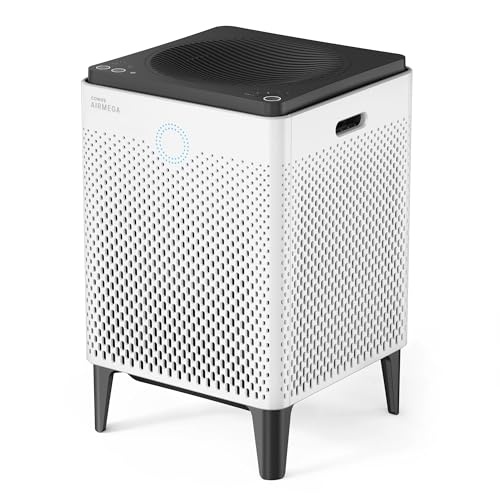
Coway Airmega 400 (AP-2015F) — Best Overall
The Airmega 400 suits the household where the dog problem is a whole ground floor rather than one room: open-plan living areas, more than one dog, or a heavy shedder whose hair reaches every surface. Its dual intakes pull air from both sides, which suits placement against a wall in a busy room, and the sheer filter area means it is not straining at medium speed to move a useful volume of air.
Strengths
- Washable pre-filter catches hair before it reaches the HEPA stage, stretching filter life in dog homes
- Large filter capacity means medium speed — the quiet, sustainable one — still moves serious air
- Air-quality readout and auto mode respond visibly when the dog shakes dust loose
Trade-offs
- Big and heavy; this is furniture, not a portable unit you carry room to room
- Replacement filter sets are a real annual cost to budget for
- Overkill for a single bedroom, where its size crowds the space
Key specs: Dual-intake HEPA filtration with washable pre-filter, air-quality indicator, auto and sleep modes, timer.
What separates the 400 in a dog home is endurance. Dander control is a war of attrition measured in months, and the limiting factor is almost always the filter clogging with hair and household dust. The washable pre-filter here is not a token mesh: kept vacuumed fortnightly, it keeps the main filter doing fine-particle work instead of acting as a hair mat. Owners who skip that two-minute chore will see performance sag on any purifier, but on this one the chore is easy and the payoff is a HEPA stage that lasts as rated.
In auto mode the air-quality sensor reacts to the dust events dog owners know well — the post-walk shake, the cushion plump, the zoomies — and settles back down once the room clears. On sleep mode it is unobtrusive enough for a guest room. If your dog rules one large space and you want one machine, bought once and maintained simply, this is the default recommendation.
Best for: open-plan living spaces with one or more dogs / Not suited for: small bedrooms or anyone who needs to move the purifier between rooms daily
Check the current price on Amazon
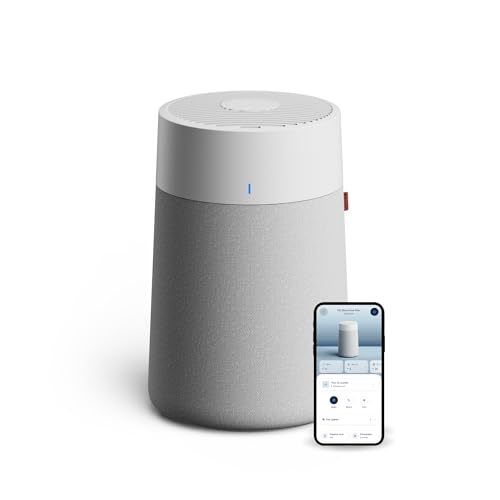
Blueair Blue Pure 511i Max — Best for Bedrooms
The 511i Max is for the bedroom where the dog sleeps — on the bed, beside it, or in a crate in the corner — and where the purifier therefore has to run all night without disturbing anyone. Its fabric pre-filter wraps the whole body of the machine and can be vacuumed or washed, which is exactly the defence a bedroom unit needs against the hair that migrates from bedding.
Strengths
- Fabric pre-filter is washable and doubles as the hair trap — ideal beside a dog bed
- Night mode is quiet enough for light sleepers while still moving air
- 360-degree intake means placement against a wall or in a corner works fine
Trade-offs
- Filtration relies on Blueair consumables; third-party filters are a false economy
- Coverage suits bedrooms and offices, not open-plan living areas
- App features are nice-to-have rather than essential
Key specs: HEPASilent particle filtration, washable fabric pre-filter, 360-degree intake, auto mode, app control, quiet night mode.
Bedroom dander is a concentration problem: two sleepers and a dog in a closed room for eight hours. The 511i Max handles it by being the machine you actually leave on. Its low-speed hush is the headline in practice — purifiers fail in bedrooms by being switched off at 2 a.m., and this one is designed around that human weakness. The washable pre-filter also suits the bedroom reality that the purifier sits near the biggest hair source in the house: the bed.
Auto mode lets it idle near-silently and step up when the dog comes in from the garden trailing dust. For a main bedroom or a nursery-adjacent dog household wanting cleaner-feeling night air without a fan roar, this is the pick. Pair it with weekly bedding washes and it makes a visible difference to morning dust on nightstands.
Best for: bedrooms and nurseries where the dog sleeps nearby / Not suited for: large living rooms or open-plan spaces
Check the current price on Amazon
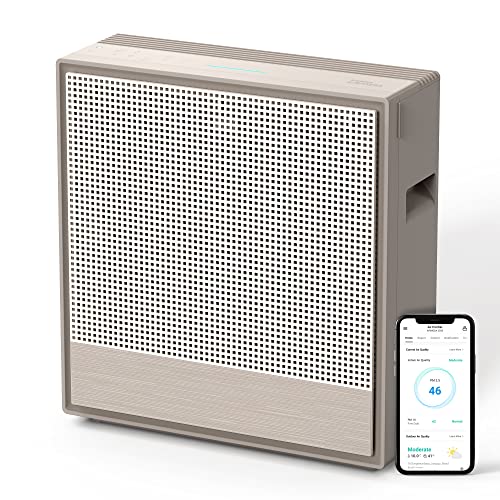
Coway Airmega 250S — Best Smart Features
The 250S fits the main living room of a typical one- or two-dog home where you want set-and-forget operation with visibility. The app sounds like a gimmick until you use its air-quality history to learn your own house: you can see the spike when the dog comes in muddy, how long the room takes to settle, and whether the unit is placed where it actually helps.
Strengths
- App control and air-quality history make placement and schedules easy to optimise
- Washable pre-filter handles the hair load before the HEPA stage
- Slimmer footprint than the Airmega 400 while covering a proper living room
Trade-offs
- Wi-Fi setup adds a step some buyers will never use
- Filter replacements remain a recurring cost, as with all true-HEPA machines
- Less filter capacity than the 400 for very heavy multi-dog shedding
Key specs: HEPA filtration with washable pre-filter, app and Wi-Fi control, air-quality indicator, auto and sleep modes.
Smart features earn their keep here in one specific way: scheduling around the dog. Run the 250S harder in the hour after walks and grooming, let it cruise overnight, and boost it from your phone when a shedding breed is being brushed indoors. That responsiveness, plus a pre-filter you can rinse, is the practical core of dander management — catching the peaks, not just averaging the day.
Build quality and the air-quality display put it a class above budget towers, and its auto mode is well judged rather than twitchy. Choose it over the 400 when your room is large but not vast, and over the Blueair when the machine lives in the living room rather than beside the bed.
Best for: living rooms where you want app visibility and scheduling / Not suited for: buyers who want zero apps and purely manual controls
Check the current price on Amazon

Coway Airmega 100 — Best Compact
The Airmega 100 is the second-room machine: the home office with a dog bed under the desk, the spare room that doubles as the dog’s daytime den, or the small flat where one compact unit covers the main living-sleeping space. Its round footprint sits happily on the floor in a corner, and the night light can be dimmed or used as a hallway glow.
Strengths
- Compact size fits rooms where a tower would dominate
- Air-quality monitor and auto mode keep it responsive without fiddling
- Carbon stage helps with general dog odour between washes
Trade-offs
- Small filters mean more frequent changes in heavy-shedding homes
- Not sized for open-plan living areas
- Night light will not suit everyone, though it can be turned down
Key specs: HEPA and carbon filtration, air-quality monitor, auto mode, timer, filter indicator, night light, compact round body.
Compact purifiers often disappoint because their filters are tiny and their coverage claims heroic. The Airmega 100 is honest mid-ground: placed in a genuinely small room with the door mostly closed, it cycles the air often enough to keep on top of the dander a single dog produces there. The filter indicator matters at this size, because a small HEPA stage loaded with hair loses ground faster than a big one.
Think of it as the specialist for the room the big purifier does not reach. Many dog homes end up happiest with exactly this pattern — one serious living-room machine and one compact unit where the dog sleeps or where you work. On that basis the 100 earns its slot.
Best for: offices, spare rooms and compact flats / Not suited for: whole-floor coverage or heavy multi-dog shedding on its own
Check the current price on Amazon

GermGuardian Tower with HEPA and UV-C — Best Tower Design
This GermGuardian tower suits the room where floor space is the constraint: a narrow living room, a hallway-adjacent dog corner, or a rented flat where a wide console purifier will not fit. The tower format stands in a corner, pulls air through a charcoal pre-filter that takes the first hit of hair and odour, and asks very little of the room’s layout.
Strengths
- Slim tower footprint fits corners and tight rooms
- Charcoal pre-filter tackles hair and everyday dog smell before the HEPA stage
- Simple three-speed controls — no app, no fuss
Trade-offs
- Tower airflow is modest; best in one closed room, not open-plan
- UV-C bulb is a replaceable part to keep track of
- Pre-filter needs regular vacuuming in shedding season
Key specs: HEPA filtration with charcoal pre-filter, UV-C light, three fan speeds, slim tower format.
Towers trade raw airflow for placement, and in real homes placement often wins: a purifier that fits the room gets used, while a bulky one gets exiled. The GermGuardian’s pre-filter discipline is the thing to respect — vacuum it when you vacuum the dog’s corner and the HEPA filter behind it keeps doing fine work for its rated life. Its three speeds are honestly judged, with the middle one the everyday setting.
The UV-C stage is a bonus feature rather than the reason to buy; the reason to buy is a HEPA tower that disappears into a corner and quietly lowers the dust-and-dander background of a single room. For renters and small rooms, that is a genuinely useful combination.
Best for: small rooms, rentals and corner placement / Not suited for: large open spaces or buyers wanting smart features
Check the current price on Amazon
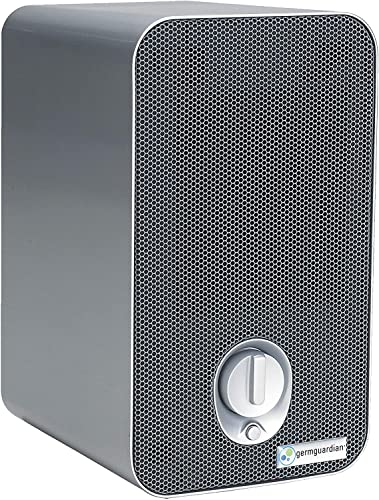
GermGuardian AC4100CA Tabletop — Best Budget for Small Rooms
The AC4100CA is the starter purifier: one small bedroom, a box room office, or a trial run before committing to a bigger machine. At eleven inches tall it sits on a dresser or desk, and its job is deliberately narrow — keep the air in one small, mostly closed room fresher while the dog naps there. Judged on that job, it is honest value; judged as a whole-house solution, it would be the wrong tool.
Strengths
- Low commitment way to cover one small room properly
- Tabletop size fits desks, dressers and shelves
- Simple operation suits a spare room or a teenager’s bedroom
Trade-offs
- Small filter loads quickly in a heavy-shedding home — keep spares in mind
- Coverage is one small room only; do not stretch it
- No auto mode or air-quality sensor at this level
Key specs: HEPA filtration, UV-C light, compact tabletop body sized for a single small room.
Budget purifiers fail in two ways: fake filtration or heroic coverage claims. This one avoids both traps by pairing a genuine HEPA filter with a modest room rating. In a small bedroom with the door shut, it turns the air over often enough to matter, and its running costs stay proportionate. The discipline it demands is filter honesty — when the filter is grey and loaded, change it, because a clogged small filter is just a fan.
Buy it as a room solution or a trial, and it is a sensible spend. Buy two for two problem rooms before buying one oversized unit for a hallway — purifiers work where the air is, and dander is where the dog is.
Best for: one small room, first-time purifier buyers / Not suited for: living rooms, open-plan spaces or heavy shedders as the only machine
Check the current price on Amazon
Comparison Table
| Pick | Badge | Key spec | Best for |
|---|---|---|---|
| Coway Airmega 400 (AP-2015F) | Best Overall | Dual-suction HEPA, washable pre-filter, large-room coverage | open-plan living spaces with one or more dogs |
| Blueair Blue Pure 511i Max | Best for Bedrooms | HEPASilent filtration, washable fabric pre-filter, 360° intake | bedrooms and nurseries where the dog sleeps nearby |
| Coway Airmega 250S | Best Smart Features | HEPA + washable pre-filter, app control, AQI display | living rooms where you want app visibility and scheduling |
| Coway Airmega 100 | Best Compact | Compact HEPA + carbon, AQI monitor, night light | offices, spare rooms and compact flats |
| GermGuardian Tower with HEPA and UV-C | Best Tower Design | Tower HEPA, carbon pre-filter, UV-C light, 3 speeds | small rooms, rentals and corner placement |
| GermGuardian AC4100CA Tabletop | Best Budget for Small Rooms | Tabletop HEPA, UV-C, single small room | one small room, first-time purifier buyers |
How to Choose the Best Dog Dander Air Purifiers for Your Rooms and Your Dog
Start with the room, not the dog
Purifiers are rated by the room they can cycle, so measure the room where the dog spends the most hours and choose for that space first. A machine sized exactly to the room on paper will spend its life on its loudest setting; sizing one step up lets it do the same work on a quieter, cheaper-to-run speed. Closed rooms are far easier to keep clean than open-plan spaces, which is why two right-sized machines beat one giant one in most dog homes.
True HEPA is the non-negotiable line
Dander particles are small, and the filter has to be rated to catch them. Look for a true HEPA filter or a manufacturer-published fine-particle efficiency you can verify, and be wary of unqualified ‘HEPA-type’ or ‘HEPA-style’ language, which usually signals a looser pad. The filter is the product; the fan and the plastic are delivery. Every pick in this guide clears that bar, and any model you consider elsewhere should be held to it.
The pre-filter decides whether it survives a dog
Hair is the silent killer of purifier performance. A washable or vacuumable pre-filter catches hair and large dust before they mat into the HEPA stage, and in a shedding home it needs attention every couple of weeks. If a model hides its pre-filter behind screws or offers none at all, cross it off for a dog household, however impressive its headline numbers look.
Budget for filters, not just the machine
A purifier’s real cost is the machine plus a filter every six to twelve months, every year. Before buying, price the replacement filter and check it is actually in stock from more than one seller. A cheap machine with expensive, scarce filters is the most expensive option on this page over three years, and a clogged filter left in service quietly turns any purifier into an ornament.
Noise, Placement and the Settings You Will Actually Use
The best setting is the one left on. In bedrooms, that means judging a purifier by its lowest-speed noise and whether its lights can be dimmed; in living rooms, by whether medium speed disappears under conversation and television. Auto mode with an air-quality sensor is genuinely useful with dogs because dander arrives in events — a shake, a brush, a wrestling match — and a responsive machine surges for the event and relaxes after it.
Placement follows airflow, not furniture styling. Give the intake clearance from walls and curtains, keep the unit in the room where the dog spends time rather than a hallway serving nowhere, and avoid tucking it behind a sofa where it recirculates the same pocket of air. Corner placement is fine for 360-degree and dual-intake designs; single-intake boxes want a few inches of breathing room on the intake side.
Finally, think in systems. The purifier handles airborne dander; grooming removes it at the source; washing bedding and vacuuming carpets remove what has settled. Owners who run all three consistently report the biggest change in how a room feels and how often they dust. The purifier is the always-on background worker in that system, which is precisely why quiet, cheap-to-run and easy to maintain beat raw power in this category.
What a Purifier Can and Cannot Do About Dander, Dust and Odour
It helps to separate the three complaints dog owners bundle together, because a purifier treats each differently. Airborne dander — the fine flakes still floating — is the purifier’s home turf: given continuous running in the right room, a HEPA machine steadily draws that load down, and the clearest sign is slower dust accumulation on hard surfaces near the unit. Settled dander is a different problem entirely. Once flakes land in carpet pile, sofa fabric or the dog’s bed, no airflow device retrieves them; only vacuuming, washing and grooming do. Owners who judge a purifier while skipping those chores are measuring the wrong half of the system.
Odour sits in between. A carbon stage adsorbs some of the volatile compounds behind everyday dog smell, which is why several picks here pair HEPA with carbon, but carbon saturates and its effect is moderation, not elimination. A room that smells strongly of dog needs its soft furnishings washed and its dog bathed on a sensible schedule; the purifier then keeps the refreshed room fresher for longer. Understanding these boundaries is not pessimism — it is how you spend money once, on the right machine, and feel the benefit you paid for.
There is also a seasonal rhythm worth planning around. Shedding peaks, muddy-paw weeks and the closed-window months all raise the indoor load, and that is when pre-filter discipline and a step up in fan speed pay off. In quieter months the same machine coasts on auto. Buying a purifier with a little headroom — the size-up principle from the buying guide — is what makes that seasonal flexibility possible without noise becoming the tax on clean air.
Sizing Worked Examples for Typical Dog Homes
One dog, one bedroom, doors closed at night
A single small or medium dog sleeping in a main bedroom is the easiest case in this guide. A bedroom-rated machine like the Blue Pure 511i Max, run on auto through the night, cycles a closed bedroom’s air many times over and keeps on top of the load one dog produces there. Add the tabletop GermGuardian pattern instead if the room is a small box room — the principle is the same: modest room, honest sizing, continuous running.
A shedding family dog in an open-plan living space
Open-plan is the hard case, because the effective room is your whole ground floor. This is where the Airmega 400’s filter capacity earns its price: place it near the dog’s main daytime zone rather than centrally, run it continuously, and accept that the goal is a strong local effect around the living area rather than laboratory air at the front door. A second compact unit in the bedroom completes the pattern most families end up with.
Two dogs, a home office and a spare-room den
Multi-dog homes should think in zones. The living room gets the serious machine — the 250S if you want scheduling and app visibility — the office gets a compact Airmega 100 under or beside the desk, and the spare room where the dogs den gets whatever capacity is left, even a tower in the corner. Zone by zone, each room’s machine is right-sized, filters last as rated, and no single unit is asked to perform a whole-house miracle it cannot deliver.
Matching the Machine to Coat Type and Shedding Level
Double coats and seasonal blowouts
Breeds with dense double coats produce dander and hair in pulses: quiet weeks, then a blowout where every surface wears a film. For these homes the pre-filter is the whole game — choose a washable design, keep a fortnightly rhythm in normal weeks and a weekly one during a blowout, and favour filter capacity over gadgetry. The Airmega 400 and 250S patterns suit this load precisely because their pre-filters are easy to service and their HEPA stages are sized to survive between services.
Short coats, low visible hair, steady dander
Short-coated dogs mislead owners into under-buying: the hair is less visible, but dander production is steady and the flakes are fine. Here the bedroom machine matters most, because exposure is about hours in a closed room rather than visible hair on the sofa. A quiet bedroom unit on auto, plus bedding washed weekly, addresses the real load better than a large living-room machine bought to fight hair you can see.
Puppies, seniors and multi-pet households
Puppies add accidents, shredded toys and general dust-raising chaos; senior dogs add more indoor hours and more bedding time; multi-pet homes simply multiply everything. In all three cases the answer is zoning and carbon: a carbon-equipped machine near the main living zone for odour moderation, a quiet unit where the animals sleep, and pre-filter discipline treated as part of pet care rather than appliance maintenance. Scale the system to the household you have, not the one-pet picture on the box.
Filter Economics: The Three-Year View
Run the numbers before you fall for a headline price. A purifier’s three-year cost is the machine plus two or three main-filter changes plus any pre-filter or bulb replacements, and in dog homes the main filter may cycle at the fast end of its rated life. Models in this guide were chosen partly because their filters are mainstream, stocked and predictably priced; a machine whose filter is only available from one seller at a volatile price is a liability however well it cleans in month one.
The cheapest filter strategy is protecting the expensive stage. Every hour a washable pre-filter spends catching hair is an hour the HEPA filter spends doing fine-particle work it was designed for, at full airflow. Owners who service pre-filters on rhythm routinely get the rated life from their main filters; owners who do not, replace early and blame the brand. When you compare two machines, compare them as systems: machine, filter price, filter availability and the effort of keeping the pre-filter clean. That is the honest league table, and it is the one this guide used.
When to Add a Second Machine — and When to Stop
There is a point of diminishing returns in every dog home, and recognising it saves real money. One well-sized machine in the dog’s main room, run continuously with a serviced pre-filter, captures the large majority of what purification can do for that household. A second machine in the bedroom is the next best spend, because it covers the long, closed-door night hours. A third machine is justified only when a third room has its own dog story — a den, an office the dog owns, a spare room kitted out for an elderly pet.
Beyond that, the marginal machine cleans air that was already acceptable, while the money usually works harder elsewhere in the system: a better vacuum for the carpets, spare washable covers for the dog’s bed, or simply the next two years of filters bought without stress. Judge your setup by outcomes you can see — dust settling more slowly, the room smelling fresher when you come home, bedding staying pleasant longer between washes — and stop adding hardware when those outcomes plateau.
If outcomes never improve, troubleshoot before upgrading. Check the filter is unwrapped and seated, the pre-filter is clean, the unit is in the dog’s room rather than a corridor, and it is actually running overnight. Most disappointing purifier stories are placement and maintenance stories wearing a product costume. Fix the system first; the picks in this guide have the capacity to reward you when you do.
How to Set Up and Maintain a Dog Dander Air Purifier
Setting up a purifier in a dog home takes twenty minutes and a little honesty about where the dog actually spends time. Work through these steps in order and the machine will start from the best possible position.
- Unpack the filters before first use: most purifiers ship with the HEPA filter sealed in plastic inside the unit, and running it sealed does nothing at all.
- Place the unit in the dog’s main room, on the floor for tower and console models, with the intake clear of walls, curtains and the dog bed itself — close to the dog’s zone, not inside it.
- Run the purifier on its highest setting for the first hour to pull down the existing airborne load, then switch to auto or a medium setting for continuous use.
- Set a fortnightly reminder to vacuum or wash the pre-filter; in heavy shedding season, do it weekly. This single habit protects the expensive HEPA filter behind it.
- Vacuum the room and wash the dog’s bedding on the same day you service the pre-filter, so settled dander is removed rather than re-launched into cleaned air.
- Check the filter indicator monthly and order the replacement when it warns, not months later — a loaded filter quietly stops protecting the room.
- Reassess placement after a month: if dust still settles fast on one side of the room, move the unit closer to the dog’s bed, crate or favourite chair.
Maintenance really is the product here. Every purifier in this guide will keep a room noticeably fresher if its pre-filter is kept clean and its HEPA filter is changed on schedule, and every one of them will disappoint if it is sealed in a corner and forgotten. Treat it like the dog’s grooming routine — small, regular, non-negotiable — and it will repay you in air that simply feels easier to live in.
Common Buying Mistakes
Buying for the whole house instead of the dog’s room
Dander concentrates where the dog lives. One purifier sized for an entire floor, parked in a hallway, cleans nowhere well. Size machines per room, starting with the room the dog sleeps in and the room it spends the day in, and add coverage only where the dog actually goes.
Ignoring the pre-filter until the HEPA filter dies
Hair mats into an unprotected HEPA filter within weeks in a shedding home, throttling airflow long before the change light appears. If you will not vacuum a pre-filter fortnightly, choose a model with a washable one you can rinse under a tap — but do not choose a model with no pre-filter at all.
Stretching filters far past their life to save money
A loaded filter does not filter less obviously — it filters less, full stop, while the fan noise stays reassuringly normal. The saving is illusory and the room quietly returns to its old dust levels. Put the replacement date in your calendar when you install a filter.
Running the purifier only when the room feels stuffy
Dander control is cumulative. A purifier run for an hour a day never gets ahead of a dog that sheds for twenty-four. Continuous running on a low or auto setting costs little and is the entire basis on which these machines work.
Expecting the purifier to replace grooming and cleaning
No purifier vacuums a rug, washes a dog blanket or brushes a double coat. Owners who treat it as a substitute for those chores blame the machine for a system problem. Run all three together and each makes the others look better.
Final Recommendation
For most dog homes, start with the room that matters most. The Coway Airmega 400 is the confident default for a large living space or a multi-dog household; the Blueair Blue Pure 511i Max is the bedroom specialist, quiet enough to forget and washable where it counts; the Coway Airmega 250S adds app visibility for a main living room. The Airmega 100 covers the office or spare room, the GermGuardian tower fits the corner nothing else fits, and the tabletop GermGuardian is the honest budget start for one small room.
Whichever you choose, commit to the routine with it: pre-filter care every couple of weeks, HEPA changes on schedule, continuous running. That routine, plus grooming and bedding washes, is what actually changes the air in a dog home — the purifier is simply the part that never sleeps.
Start tonight, in the room that matters most.
- Coway Airmega 400 (AP-2015F) (Best Overall) — Check the current price on Amazon
- Blueair Blue Pure 511i Max (Best for Bedrooms) — Check the current price on Amazon
- Coway Airmega 250S (Best Smart Features) — Check the current price on Amazon
- Coway Airmega 100 (Best Compact) — Check the current price on Amazon
- GermGuardian Tower with HEPA and UV-C (Best Tower Design) — Check the current price on Amazon
- GermGuardian AC4100CA Tabletop (Best Budget for Small Rooms) — Check the current price on Amazon
Related reading on this site: Best Air Purifiers For Pet Hair, Best Air Purifiers For Smokers, Best Vacuums For Pet Hair, Best Washable Dog Blankets, Best Air Purifiers For Bedrooms, Best Pet Hair Removers For Furniture
Frequently Asked Questions
Do air purifiers really help with dog dander?
Yes, within honest limits. A true-HEPA purifier steadily removes airborne dander particles from the room it runs in, which lowers how much settles on surfaces and how dusty the air feels. It does not remove dander already in carpets or bedding, so it works best alongside vacuuming, grooming and regular bedding washes.
Where should I put a purifier in a home with a dog?
In the room the dog spends the most time, with the intake unobstructed — not in a hallway and not behind furniture. Near the dog’s bed or favourite chair, but not so close that bedding blocks the intake, is the sweet spot. Bedrooms where the dog sleeps are usually the highest-value placement.
How often do filters need changing with a dog in the house?
Follow the maker’s schedule as the outer limit, and expect the pre-filter to need vacuuming or washing every two weeks, weekly in shedding season. Homes with heavy shedders may find the main filter loads faster than the rated life; a visible grey mat or reduced airflow is your cue regardless of the calendar.
Is one big purifier better than two smaller ones?
Usually two right-sized machines win, because dander is produced in specific rooms and purifiers only clean the air around them. One unit for the living room and one for the bedroom covers most dog homes better than a single oversized machine in between.
Can a purifier reduce dog smell as well?
A carbon filter stage helps with everyday odour between washes, and several picks here include one. It moderates background dog smell rather than eliminating it; the source controls — washing bedding, bathing the dog appropriately, cleaning soft furnishings — still do the heavy lifting.
Should I run the purifier all night in the bedroom?
Yes — continuous low or auto running is how these machines maintain cleaner air, and bedroom models here are designed to be quiet enough for sleep. Eight closed-door hours with the dog in the room is exactly the exposure window a bedroom purifier is best at improving.
Will a purifier help in a home with hardwood floors instead of carpet?
Hard floors hold less dander in reserve than carpet, so a purifier’s effect is easier to notice: there is less settled material being re-launched by footsteps. Keep up hard-floor vacuuming or damp mopping, since flakes that land on wood still become airborne again until they are physically removed.


