Disclosure: airfryerkitchensupply.com is reader-supported. When you buy through links on our site, we may earn an affiliate commission at no extra cost to you.
Where to buy
Every model in this guide is sold through Amazon, and that is where we recommend buying: the listings carry the genuine replacement filters you will need later, the model numbers are easy to double-check before checkout, and returns are painless if a unit arrives with a rattling fan. Start with our Best Overall pick, the Levoit Core 300-P — check price on Amazon, or step up to whole-room coverage with the WINIX 5510 — check price on Amazon. If your room is small and your budget is smaller, the COWAY Airmega 50 — check price on Amazon is the compact option to look at first. Prices on air purifiers move constantly with promotions, so we do not print fixed prices here — check the current price on Amazon for the exact model named in each review below.
Introduction
Shoppers hunting for the best and affordable air purifiers usually discover the same problem within ten minutes: the category is split between tiny desktop gadgets that barely move air and premium towers that cost as much as a sofa. The good news is that the middle of the market is genuinely strong right now. Established brands such as Levoit, WINIX, COWAY and BLUEAIR all sell compact, properly filtered machines at the affordable end of their ranges, and those machines share the features that actually matter — a sealed HEPA filter, a washable pre-filter that stretches the main filter’s life, a quiet sleep mode, and replacement filters that are easy to find a year from now.
This guide focuses on everyday air quality and comfort: less visible dust settling on furniture, fewer lingering cooking and pet odors, and a bedroom that simply feels fresher when you wake up. An affordable purifier is not a medical device, and we make no health claims for any model here. What a good budget purifier does deliver is cleaner-feeling air in the rooms where you spend the most time, and it does it quietly enough that you forget it is running. The six picks below cover small bedrooms, pet-heavy living rooms and open-plan spaces, and each one was chosen because its filters, coverage rating and running costs make sense at an affordable price tier — not because it was the cheapest box on the page.
In this guide
Quick Picks
- Best Overall: Levoit Core 300-P — the proven compact all-rounder for bedrooms and home offices. Check price on Amazon
- Best Budget Smart Pick: Levoit Core 200S-P — app and voice control in the smallest, cheapest body here. Check price on Amazon
- Best for Pet Hair and Odors: LEVOIT Vital 100S-P — washable pre-filter and a smart air quality monitor. Check price on Amazon
- Best Compact for Small Bedrooms: COWAY Airmega 50 — a small footprint with an air quality display and auto mode. Check price on Amazon
- Best Affordable Pick for Large Rooms: WINIX 5510 — big-room coverage and a serious carbon filter without flagship pricing. Check price on Amazon
- Best Quiet Splurge: BLUEAIR Blue 311i Max — whisper-quiet running and a washable fabric pre-filter. Check price on Amazon
How These Picks Were Chosen
Affordable only means something if the machine still does the job, so every pick had to clear the same bar. First, filtration: each model uses a true HEPA-grade main filter paired with a pre-filter, because a pre-filter that catches hair and large dust is what keeps the expensive HEPA element working for months instead of weeks. Second, honest coverage: we matched each purifier’s rated room size to a realistic room — a purifier rated for a large space at its highest, loudest fan speed will clean a bedroom gently at a lower speed, and we say so where that matters. Third, running costs: replacement filters must be widely available and reasonably priced for the tier, because a cheap machine with hard-to-find filters is not affordable for long. Fourth, noise: a bedroom purifier that drones will be switched off, so sleep modes and low-speed quietness carried real weight. Finally, every product name and ASIN in this article was cross-checked against the manufacturer’s listings before a buy link was added, so the link you click is the exact model reviewed. Models that failed any of these checks — no-name units with unverifiable filter claims, machines with discontinued filters, designs with no sleep mode — were cut, however low the sticker price looked.
The 6 Best and Affordable Air Purifiers

Levoit Core 300-P — Best Overall
The Core 300-P is the purifier we point to when someone asks for one affordable machine that simply works. It suits bedroom and home-office owners who want cleaner-feeling air without learning a new gadget: the controls are a simple touch panel, the footprint is about the size of a small waste bin, and the cylindrical design pulls air in from every side, so it does not sulk when placed near a wall. It is less suited to very large open-plan rooms, where its compact fan has to work at higher, louder speeds to keep up.
Strengths
- Quiet HEPA sleep mode that dims the display for bedroom use
- AHAM VERIFIDE rating, so the coverage claims are independently checked
- Replacement filters are inexpensive for the tier and sold everywhere
Trade-offs
- No app or voice control on this version
- Compact size means modest coverage compared with tower models
- Filter replacements are an ongoing cost to budget for
Key specs: 3-stage filtration with HEPA filter; quiet sleep mode; AHAM VERIFIDE; designed for bedrooms and medium rooms.
In daily use the Core 300-P earns its keep in the unglamorous ways that matter. Dust on a dark dresser builds up more slowly, cooking smells from the evening before are gone by morning, and the sleep mode is quiet enough that light sleepers leave it running all night — which is the whole point, because a purifier only cleans the air while it is on. The top handle makes it easy to move between a bedroom and a nursery or office, and the filter-change indicator removes the guesswork from maintenance. Owners stepping up from a no-name desktop unit notice the difference immediately: this is a sealed, properly gasketed filter path, not a fan blowing past a pad. For most households buying their first purifier, this is the sensible default.
Best for: first-time buyers and bedroom use / Not suited for: very large open-plan spaces
Check the current price on Amazon

Levoit Core 200S-P — Best Budget Smart Pick
The Core 200S-P is the affordable pick for small rooms and connected homes. It suits dorm rooms, nurseries, desks and spare bedrooms where space is tight and a schedule matters — you can set it to run before bedtime and whisper through the night from the app, or ask a voice assistant to switch it on. It is not the right choice as the only purifier for a big living room; its compact body is built for personal spaces, and Levoit’s own larger models exist for that job.
Strengths
- Smart WiFi with app scheduling and voice control at a budget tier
- Smallest footprint in this guide — fits a nightstand or desk corner
- 3-in-1 filter with HEPA sleep mode for overnight running
Trade-offs
- Coverage is limited to small rooms
- Smart features need a stable home WiFi connection
- Less carbon capacity for strong odors than larger models
Key specs: Smart WiFi and voice control; 3-in-1 filter; HEPA sleep mode; AHAM VERIFIDE; compact bedroom and dorm size.
What makes the 200S-P feel smarter than its price is the scheduling. Students set it to purify during the hour before bed and drop to sleep mode overnight; parents run it in a nursery on a timer without walking in and waking the baby. The air intake wraps around the body, so placement is forgiving, and the display lights can be turned off completely — a detail insomniacs appreciate. Cleaning performance in a small room is convincing: pollen dust on a desk and the stale smell of a closed-up spare room both fade after a few hours of running. Buy it for a small room and it over-delivers; ask it to serve a whole apartment and you will be disappointed, which is a placement problem, not a product flaw.
Best for: dorms, nurseries and small bedrooms on a budget / Not suited for: whole-apartment cleaning
Check the current price on Amazon
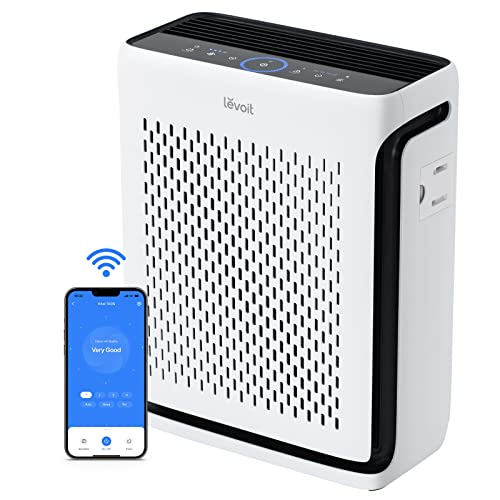
LEVOIT Vital 100S-P — Best for Pet Hair and Odors
If a dog or cat shares your home, the Vital 100S-P is the affordable pick built with you in mind. It suits pet owners whose main complaints are hair tumbleweeds, litter-box drift and that unmistakable wet-dog note after a rainy walk. The washable pre-filter is the headline: it catches the hair and coarse dust first, you rinse or vacuum it clean, and the main HEPA filter underneath lasts far longer than it would unprotected. It is less ideal for smokers’ lounges or very large rooms, where a heavier carbon stage earns its money.
Strengths
- Washable pre-filter cuts replacement costs in hair-heavy homes
- Smart monitor reacts automatically when air quality dips
- Quiet HEPA sleep mode for overnight bedroom use
Trade-offs
- Pre-filter needs regular rinsing to stay effective
- Mid-size coverage — not a whole-house solution
- App setup is one more account for some households
Key specs: Washable pre-filter; smart air quality monitor; quiet HEPA sleep mode; AHAM VERIFIDE; aimed at pet hair, dander and household odors.
The practical difference shows up in the first fortnight. Hair that used to collect along skirting boards gathers instead on the pre-filter, where a quick rinse sends it down the drain. The sensor-driven auto mode is genuinely useful in pet homes because air quality changes in bursts — a shaken dog bed, a freshly opened door — and the machine ramps up for a few minutes, then settles back to a murmur. Odor control is honest rather than miraculous: litter and food smells fade noticeably faster than with ventilation alone, though no affordable purifier erases a strong smell at its source. For the price tier, the combination of washable pre-filter, sensor and sleep mode is hard to beat.
Best for: homes with dogs or cats / Not suited for: very large rooms or heavy smoke
Check the current price on Amazon

COWAY Airmega 50 — Best Compact for Small Bedrooms
COWAY’s Airmega 50 is the small-room specialist from a brand better known for much bigger machines. It suits renters, small bedrooms and nurseries up to roughly a modest single room, where a tower would dominate the corner. The front panel shows air quality at a glance with a color indicator, auto mode adjusts the fan for you, and there is even a gentle night light — a thoughtful touch for a child’s room. It is not suited to open-plan living areas, and buyers wanting app control should look at the smart picks above instead.
Strengths
- Compact, tidy design from a long-established purifier brand
- Air quality monitor with auto mode and filter-change indicator
- Built-in night light suits nurseries and children’s rooms
Trade-offs
- Rated for small rooms only — up to about 500 sq ft at full speed
- No WiFi or app control
- COWAY filters cost a little more than Levoit equivalents
Key specs: Coverage up to 500 ft²; HEPA and deodorization filter; AQI monitor; auto mode; filter indicator; night light.
The Airmega 50 wins on trust and tidiness. COWAY has made purifiers for decades, the filter is a proper sealed unit rather than a loose pad, and the machine feels a notch more finished than most budget rivals — buttons respond cleanly, the casing does not creak, and the fan note stays smooth rather than buzzy at night speeds. In a small bedroom it cycles the air frequently enough that morning stuffiness — that heavy, slept-in feeling — is clearly reduced, and the deodorization stage takes the edge off cooking smells drifting from a nearby kitchen. If your room is small and you value a calm, appliance-like presence over smart features, this is the affordable pick that feels least like a compromise.
Best for: small bedrooms, nurseries and renters / Not suited for: large or open-plan rooms
Check the current price on Amazon

WINIX 5510 — Best Affordable Pick for Large Rooms
The WINIX 5510 is where affordable stops meaning small. It suits living rooms, open-plan kitchen-diners and big primary bedrooms — spaces where compact purifiers have to shout to keep up. This is the new generation of WINIX’s long-running 5500 series, adding app support to a formula owners already trusted: a true HEPA filter, a substantial washable carbon stage for odors, and an auto mode that watches air quality so you do not have to. It is more machine than a studio flat needs, and its taller body needs a proper floor spot.
Strengths
- Large-room coverage rated up to 1,881 ft² in one hour
- High-deodorization carbon filter handles cooking and pet odors well
- Auto mode plus app support for set-and-forget running
Trade-offs
- Bigger footprint and higher filter costs than compact picks
- Overkill for a single small bedroom
- Top fan speeds are audible, as with any large-room unit
Key specs: Coverage up to 1,881 ft² in 1 hr; true HEPA; high-deodorization carbon filter; auto mode; app support.
Coverage ratings need honest reading: that headline figure is at the highest speed, and in real homes the 5510 works best as the purifier for one generous living space, running on auto. There it is excellent — the carbon stage is noticeably deeper than the thin carbon sheets in cheap towers, so frying smells and fireplace drift clear faster, and the sensor responds within moments of a door opening on a dusty day. The washable pre-filter and long-life main filter keep annual running costs reasonable for its size, which is what keeps a large-room machine in the affordable column over years rather than months. If your problem room is big, buying two small purifiers usually costs more and cleans less evenly than this one unit placed well.
Best for: living rooms and open-plan spaces / Not suited for: tiny rooms or tight budgets for filters
Check the current price on Amazon

BLUEAIR Blue 311i Max — Best Quiet Splurge
The Blue 311i Max sits at the top of what still counts as affordable in this guide, and it earns the stretch with quietness and design. It suits light sleepers, design-conscious living rooms and anyone who has returned a purifier before because it sounded like a small fridge. BLUEAIR’s HEPASilent approach pairs filtration with a fan engineered to run at a whisper — the range is rated down to a very low noise floor — and the fabric pre-filter doubles as the machine’s colored skin, washable and replaceable in different colors. It is less suited to bargain hunters; both the unit and its filters sit above the Levoit tier.
Strengths
- Exceptionally quiet running, rated from 23dB on low
- Washable fabric pre-filter extends main filter life
- WiFi and auto mode with a clean, minimal design
Trade-offs
- Highest purchase and filter costs in this guide
- Fabric pre-filter styling will not suit every room
- Performance relies on keeping the fabric pre-filter clean
Key specs: Coverage up to 2,107 ft²; HEPASilent filtration; WiFi and auto mode; quiet from 23dB; washable pre-filter; AHAM Verified.
In a bedroom, the 311i Max disappears in a way few purifiers manage: on its night setting there is effectively no fan note to listen to, just slightly fresher air by morning. In a living room it covers a generous area on auto while looking like a piece of Scandinavian furniture rather than a medical appliance, which matters more than reviewers admit — machines that blend in stay plugged in. Filter changes are tool-free and quick, and the app’s filter-life tracking is honest rather than nagging. Think of it as the affordable end of the premium market: you pay more than for our Best Overall pick, and what you buy is silence, looks and headroom for bigger rooms.
Best for: light sleepers and large, design-conscious rooms / Not suited for: strict minimum budgets
Check the current price on Amazon
Comparison Table
| Pick | Badge | Key spec | Best for |
|---|---|---|---|
| Levoit Core 300-P | Best Overall | HEPA, quiet sleep mode, AHAM VERIFIDE | Bedrooms and first purifiers |
| Levoit Core 200S-P | Best Budget Smart Pick | WiFi, voice control, 3-in-1 filter | Dorms and small rooms |
| LEVOIT Vital 100S-P | Best for Pet Hair and Odors | Washable pre-filter, smart monitor | Homes with dogs or cats |
| COWAY Airmega 50 | Best Compact for Small Bedrooms | Up to 500 ft², AQI display, night light | Small bedrooms and nurseries |
| WINIX 5510 | Best Affordable for Large Rooms | Up to 1,881 ft² in 1 hr, deep carbon filter | Living rooms, open-plan spaces |
| BLUEAIR Blue 311i Max | Best Quiet Splurge | From 23dB, up to 2,107 ft², washable pre-filter | Light sleepers, large rooms |
How to Choose an Affordable Air Purifier
Start with the room, not the price tag. Measure the room where the purifier will live most of the time — usually the bedroom, because that is where you breathe the same air for eight hours — and match it to a purifier whose rated coverage comfortably exceeds it. Manufacturers quote coverage at the highest fan speed; for quiet overnight cleaning, a machine rated for roughly double your room’s size will do the job on a low, near-silent setting. A purifier that is too small is the most common false economy in this category: it runs flat-out, makes noise, and still leaves the air half-cleaned.
Next, look at the filter stack. A washable pre-filter plus a true HEPA main filter is the affordable sweet spot. The pre-filter traps hair and lint for free; the HEPA element captures the fine dust and pollen particles that make air feel gritty. Activated carbon is the third stage that matters if odors are your complaint — cooking, pets, a nearby road — and deeper carbon (a proper granular or thick impregnated stage, as on the WINIX 5510) outperforms the thin carbon sheets in the cheapest towers. Check what a replacement filter costs and how often the maker says to change it before you buy the machine; over three years, filters are a large share of the true cost of any purifier.
Noise deserves a number, not an adjective. Look for a published low-speed decibel figure and a dedicated sleep mode that also dims or kills the display lights. Auto mode with an air quality sensor is worth having in busy homes because it spends energy and filter life only when the air actually needs cleaning — after cooking, vacuuming or a pet’s muddy entrance. Smart app control is a convenience, not a cleaning feature; buy it if scheduling matters to you, skip it happily if it does not. Finally, favor established brands with filters stocked by multiple retailers. An affordable purifier whose filters vanish from sale in eighteen months becomes landfill, and that is the least affordable outcome of all.
Reading Coverage Claims Without Being Fooled
Two numbers on a purifier listing do most of the persuading, and both need translating. The coverage figure — “up to 1,881 ft²” — describes how much air the machine can process in an hour at its highest speed, usually assuming a certain number of air changes. It is a useful ceiling, not a promise: at the quiet speed you will actually sleep beside, the effective coverage is a fraction of the headline. That is why this guide treats headline coverage as headroom. A machine rated far above your room’s size is not wasteful; it is the only way to get thorough cleaning at a whisper.
The second figure, where published, is the clean air delivery rate — how fast the machine delivers cleaned air for dust, pollen and smoke-sized particles. Higher is better, and the honest comparison is between machines at similar noise levels, which listings rarely offer side by side. As a rule of thumb, look for independent verification marks such as AHAM VERIFIDE on the models where it appears in this guide: they mean the coverage and delivery claims were tested by a third party rather than typed by a marketing team. Where a listing shows no verification, no decibel figure and no filter specification — only adjectives — treat the machine as unproven, however attractive the price. Every pick above publishes the numbers that matter, which is itself a large part of why they were picked.
How to Set Up and Maintain Your Air Purifier
Setup takes ten minutes and repays it for years. Unpack the machine and — this is the step people miss — open it up and remove the plastic wrapping from the filter inside before first use; purifiers ship with filters bagged, and a machine run with the bag on cleans nothing. Place the unit on a hard floor with clear space around the intakes, ideally in the room where you sleep, a short distance from the bed rather than jammed behind curtains or furniture that block airflow. Run it on its highest setting for the first hour to clear the room, then switch to auto or a low continuous speed.
Maintenance is a rhythm, not a project. Every two to four weeks, vacuum or rinse the pre-filter (only rinse if the maker says it is washable, and let it dry fully before refitting). Wipe the air quality sensor lens gently every couple of months so auto mode stays honest. Replace the main HEPA filter when the indicator calls for it or at the maker’s interval — stretching a spent filter saves nothing, because a clogged filter moves less air and makes the fan work harder. Keep a spare filter on the shelf if your home has pets or a dusty season; the indicator never lights at a convenient moment. If the machine develops a sour smell, that is the carbon stage saturating — replace the combined filter rather than masking it with sprays, which the purifier then has to clean out of the air.
Pre-Filter, HEPA and Carbon: What Each Stage Actually Does
Understanding the three filter stages tells you exactly where an affordable purifier can cut cost safely and where it cannot. The pre-filter is a coarse mesh or fabric screen whose only job is catching the big stuff — hair, lint, crumbs of household dust. It adds almost nothing to the price, yet it decides how long everything downstream survives, which is why washable pre-filters on the Vital 100S-P and Blue 311i Max are worth real money over a model’s life. A purifier with no accessible pre-filter forces its HEPA element to do the coarse work, and HEPA media clogs fast when it is fed hair.
The HEPA stage is the heart of the machine: a dense mat of fibers that traps fine particles as air passes through, including the dust and pollen-sized particles that make rooms feel gritty and trigger endless dusting. This is where the word “true” matters — a genuine, sealed HEPA filter in a gasketed housing performs very differently from a loose “HEPA-type” pad with gaps around the edges, because air always takes the easiest path and will bypass an unsealed filter entirely. Every pick in this guide uses a properly housed HEPA-grade element; that is the one place we would never accept a cheaper substitute.
Carbon handles gases and smells, the things HEPA cannot touch. Its weakness is capacity: a wafer-thin carbon sheet saturates in weeks in a pet home, while a deep bed of activated carbon — pellets or a thick impregnated block — keeps working for months. If your main complaint is particles, a modest carbon stage is fine and the Core 300-P’s balance is right. If your main complaint is odor, carbon depth should drive your choice, which is why the WINIX 5510, with its high-deodorization carbon filter, is our large-room pick rather than a scaled-up compact. Reading listings with these three jobs in mind turns a confusing spec sheet into a simple question: which stage does this machine invest in, and is that the stage my home needs?
Matching an Affordable Purifier to Your Room
Bedrooms. Quietness outranks raw power, because the machine runs eight hours beside your head. Choose a model with a genuine sleep mode and a display that turns fully off, size it one step up from the room’s area, and let it run continuously at low speed. The Core 300-P and Airmega 50 are shaped by exactly this logic.
Nurseries and children’s rooms. Look for the same sleep mode, plus a night light you can control, no sharp casing edges, and controls a toddler cannot easily reprogram. The Airmega 50’s night light and the Core 200S-P’s app scheduling — run it before bedtime, then whisper mode — both suit this room well. Keep cords routed out of reach, as with any appliance.
Living rooms and open-plan spaces. Coverage and carbon depth lead here. These rooms collect cooking smells, fireplace drift and the dust of constant foot traffic, and they are large enough that a compact purifier on turbo becomes a noise nuisance. A large-room machine on auto, like the WINIX 5510 or Blue 311i Max, cleans more evenly at lower perceived noise than two small units fighting each other.
Pet rooms and litter areas. Place a washable-pre-filter model near — not on top of — the litter or bedding zone, and expect to rinse that pre-filter often; it is doing visible work. The Vital 100S-P was picked for this room precisely because its first stage is a rinse-and-refit screen rather than a disposable pad.
Home offices and desks. A compact cylinder on the floor beside the desk keeps paper dust and the stale smell of a closed room at bay without stealing desk space. The Core 200S-P’s small footprint and scheduling fit office hours neatly — purify before you sit down, idle while you are out.
What Affordable Should Cost You Over Three Years
Run the ownership maths before you fall for a headline price. Take the machine’s price, add a full set of replacement filters for three years at the maker’s stated intervals, and add a rough electricity allowance for continuous running — modest for compact models, since a purifier on low speed draws about as much as a small lamp. That three-year figure is the honest comparison, and it routinely reorders the market: the very cheapest machines, with short-lived proprietary filters sold by a single seller, often land above a Levoit or COWAY once filters are counted. It is also why this guide weighs filter availability so heavily. A model whose filters are stocked by several retailers, in the open, at competing prices, protects you against both price rises and quiet discontinuation. When two machines clean equally well, buy the one whose filters you can still picture buying in 2029.
One more ownership cost hides in plain sight: your time. Machines with tool-free filter doors, clear indicators and pre-filters that rinse in the sink take minutes a month to look after. Machines with screwed-shut housings, vague indicators and pads that must be hunted down online quietly tax you twice a year, every year. When we scored this guide, easy maintenance counted as a budget feature in its own right — an affordable purifier should be cheap to own in attention as well as in money, and every pick here can be opened, cleaned and re-filtered without tools, manuals or frustration.
Where an Affordable Purifier Helps Most — and Where It Does Not
Honest expectations are part of value. An affordable purifier is very good at three things. It steadily reduces the fine dust that settles on surfaces, so cleaning feels less like a losing battle. It shortens the life of everyday odors — last night’s cooking, a dog’s bedding corner, the stale note of a room kept closed — especially when it has a real carbon stage. And it keeps the air in one chosen room feeling fresher through the seasons when windows stay shut, which for many households is most of the year. Those are comfort and cleanliness benefits, and they are the right reasons to buy one.
It is equally important to know the limits. A purifier does not fix a damp problem, remove the source of a strong smell, or substitute for ventilation when you are painting, sanding or using strong cleaning products — open a window for those jobs and let the machine handle the aftermath. It cleans the room it is in, not the whole house through closed doors. And while cleaner-feeling air is a reasonable comfort goal for any household, a purifier is a household appliance, not a medical treatment; anyone managing a health condition should take advice from their clinician rather than from a product listing. Bought with those expectations set, an affordable purifier is one of the more satisfying small appliances a home can own — bought expecting miracles, even a premium one will disappoint.
A Simple Maintenance Calendar
Weekly: glance at the pre-filter in pet homes; shake or vacuum loose hair off before it mats down. Every two to four weeks: clean the pre-filter properly — vacuum it, or rinse it if the maker allows — and wipe dust from the machine’s intake grilles. Every two months: wipe the air quality sensor lens with a dry cloth and check that nothing has crept against the intakes. Every six to twelve months: replace the main filter when the indicator or the maker’s interval says so, noting the date on the new filter with a pen so the next change is easy to judge. Once a year: vacuum the interior cavity while the filter is out, and re-check that replacement filters for your model are still stocked — if a model is being discontinued, that is the moment to buy a spare or plan a successor. This small rhythm is the entire secret to an affordable purifier staying effective for years.
Troubleshooting: When a Purifier Seems to Do Nothing
The room still feels dusty after a week. Check the basics in order: is the filter’s plastic wrap removed, is the machine sized for the room, and is it actually running for most of the day? A purifier cannot clean a room it is switched off in, and dust also settles from soft furnishings continuously — judge it by how much slower dust builds on a cleaned shelf, not by expecting a dust-free home.
A sour or stale smell comes from the machine itself. That is the carbon stage saturated or a pre-filter loaded with organic dust. Rinse or replace the pre-filter first; if the smell persists, the combined filter is spent. Do not spray air freshener near the intake — the machine will simply work to remove it, wasting filter life.
The fan has become louder over time. A clogged filter makes the fan work harder and sound rougher. Clean the pre-filter, check the main filter’s indicator, and make sure nothing has been pushed against the intakes. A purifier that was quiet in month one and noisy in month six is almost always asking for filter maintenance, not replacement.
Auto mode never seems to react. The sensor lens may be dusty — wipe it gently with a dry cloth — or the room’s air may genuinely be steady. Test it by cooking something pungent nearby or shaking a dusty cushion at a safe distance; a healthy sensor ramps the fan within a minute or two.
The air quality reading never improves. Move the machine out of the corner and away from walls, close the room’s windows while it runs, and give it a full day. If readings stay poor in a closed, correctly sized room with a fresh filter, contact the maker — sensors do occasionally fail, and the established brands in this guide have real support channels.
Common Buying Mistakes
Buying by room-size claims at maximum speed. A purifier rated for a huge area on turbo will be too loud to live with at that speed. Size for the low-speed reality, as described above.
Choosing the cheapest unit with the most expensive filters. Sticker price is a one-off; filters are forever. Compare a full year of replacement filters before deciding a machine is affordable.
Expecting odor miracles from a thin carbon sheet. If smells are the main problem, prioritize a deep carbon stage and fix the source — no purifier outruns a full litter tray.
Hiding the purifier in a corner or cupboard. Blocked intakes strangle airflow. A purifier needs breathing room on all sides to clean the room rather than its own corner.
Running it only when the air feels bad. Dust and pollen build invisibly. Continuous low-speed or auto running beats occasional blasts, and costs little energy.
Forgetting the plastic wrap on the filter. It sounds unlikely until you read the return reviews. Always open a new purifier and check the filter before the first run.
Final Recommendation
For most households, the Levoit Core 300-P is the affordable purifier to buy first: proven, quiet and cheap to keep in filters. Small rooms and dorms should take the smart, smaller Core 200S-P, while pet owners get the most relief from the washable pre-filter of the Vital 100S-P. Small bedrooms that prize a calm, established brand fit the COWAY Airmega 50; large living spaces justify the WINIX 5510; and light sleepers with a little more to spend will not regret the near-silent BLUEAIR Blue 311i Max. Whichever you choose, size it generously, run it continuously, and keep the pre-filter clean — those three habits matter more than any single model choice.
Related reading on this site: Best Air Purifiers For Smokers · Best Air Purifiers For Apartments · Best Air Purifiers For Dust · Best Air Purifiers For Pet Hair · Best Air Purifiers For Bedrooms
Frequently Asked Questions
What makes an air purifier genuinely affordable rather than just cheap?
Total cost over time: a fair purchase price, replacement filters that are reasonably priced and easy to find, low energy use from running continuously, and a pre-filter you can clean instead of replace. A very cheap unit with costly, short-lived filters usually ends up more expensive within two years.
How big a purifier does a bedroom need?
Pick a model rated for at least the room’s area, and ideally more, so it can clean effectively on a quiet low speed overnight. A compact model like the Core 300-P suits typical bedrooms; small rooms under about 500 sq ft are the Airmega 50’s home turf.
Should I run my purifier all the time?
Yes — continuous low-speed or sensor-driven auto running keeps dust and odors from building up and uses little electricity. Purifiers only clean the air that passes through them, so an idle purifier cleans nothing.
How often do filters really need changing?
Follow the machine’s indicator and the maker’s interval, and clean the pre-filter every few weeks to protect the main filter. Pet-heavy or dusty homes sit at the shorter end of every interval; quiet, pet-free homes at the longer end.
Will an affordable purifier help with pet smells?
It will reduce them noticeably, especially a model with a real carbon stage and a washable pre-filter for hair. It will not eliminate odors at the source, so litter and bedding hygiene still do most of the work.
Where is the best place to put a purifier?
In the room you occupy most — usually the bedroom — on a hard floor with space around the intakes, away from curtains and corners. Keep doors and windows closed while it runs so it is cleaning indoor air, not the whole street. If you can only afford one machine, the bedroom wins over the living room almost every time, because no other room keeps you breathing the same air for so many uninterrupted hours.


