Disclosure: airfryerkitchensupply.com is reader-supported. When you buy through links on our site, we may earn an affiliate commission at no extra cost to you.
Where to buy
Corded vacuums are the unfashionable, correct answer for whole-house cleaning: full suction from the first room to the last, no battery anxiety, no runtime countdown. Every model below is a corded household machine confirmed through the airfry site’s Amazon listing data before being linked — uprights that lift away, swivel, bag and bagless designs across the tiers. Check the current price on Amazon from each link, and confirm cord length and weight on the listing against your home’s layout.
- Shark Navigator Lift-Away NV360 — Check on Amazon
- Shark Navigator Lift-Away NV352 — Check on Amazon
- Bissell CleanView Swivel Pet 2252 — Check on Amazon
- Hoover WindTunnel 3 Max Performance Pet — Check on Amazon
- Eureka PowerSpeed NEU181A — Check on Amazon
- Kenmore Intuition Bagged Upright BU4022 — Check on Amazon
The best corded household vacuums keep winning the same argument: plug in, and the suction you start with is the suction you finish with, whether the job is one rug or a whole two-story house. Cordless sticks are brilliant for crumbs and stairs, but their batteries fade, their bins are small, and their best performance mode drains them in minutes. A corded upright or canister costs less than a flagship cordless, out-cleans it on deep carpet, and will still be working when a lithium pack would be on its second replacement.
The real choices in this category are about your floors and your tolerance for maintenance. Bagless uprights dominate because they are cheap to run and easy to empty, but they need filter washing and their seals age. Bagged machines — long dismissed as old-fashioned — trap dust better, empty without a plume, and have quietly become the recommendation for allergy-conscious households. Lift-away pods, swivel steering and pet tools decide daily happiness more than headline suction numbers.
This guide ranks six verified corded household vacuums across those philosophies, from a do-everything Shark to a budget Eureka that embarrasses pricier machines on hard floors, and explains how to match cord length, weight and filtration to the house you actually live in.
In this guide
Quick Picks
Shark Navigator Lift-Away NV360 — Best Overall. The default recommendation for most houses: a lift-away pod for stairs, sealed HEPA filtration, and swivel steering that makes a full-size upright feel half its size. Check the current price on Amazon
Shark Navigator Lift-Away NV352 — Best Lightweight Lift-Away. The lighter, larger-bin sibling in the Navigator family: same lift-away trick and HEPA filtration, in a machine that is easier to carry and needs emptying less often. Check the current price on Amazon
Bissell CleanView Swivel Pet 2252 — Best for Pet Hair on a Budget. Bissell’s pet-focused budget upright: a Triple Action brush roll that loosens, lifts and suctions hair, swivel steering, and a big tank for multi-pet homes. Check the current price on Amazon
Hoover WindTunnel 3 Max Performance Pet — Best Deep-Clean Power. Hoover’s heavy hitter: WindTunnel 3 suction channels, a Quick Pass brushroll made to clean in fewer passes, and the long cord big houses need. Check the current price on Amazon
Eureka PowerSpeed NEU181A — Best Budget Pick. The budget benchmark: a lightweight PowerSpeed with a big 2.6L cup, height adjustment for carpet piles, and a pet turbo brush in the box. Check the current price on Amazon
Kenmore Intuition Bagged Upright BU4022 — Best Bagged / Allergy Pick. The bagged renaissance in one machine: sealed bags that empty without a dust plume, HEPA filtration, a lift-up pod and a two-motor system for carpet. Check the current price on Amazon
How These Picks Were Chosen
Corded-only was the entry ticket: every pick plugs in and delivers full power indefinitely. From there we weighed cleaning path versatility (carpet depth adjustment, brushroll shutoff for hard floors), filtration honesty — sealed HEPA systems versus HEPA-style filters in leaky housings — and the ergonomics that decide whether a vacuum gets used: weight, swivel, cord length and how the hose and tools behave on stairs.
Each product and ASIN was cross-checked against the airfry site’s Amazon listing data, matching listed titles to the machines described. Only listing-confirmed vacuums carry Amazon links. We print no prices and no fixed ratings: check price on Amazon, and use the tier language in the reviews — budget, mid-range, premium — to position each machine.
Pet performance was tested as a category of its own, because pet hair is the household load that separates marketing from machinery: it wraps brushrolls, mats filters and hides in upholstery, and the picks below were chosen with dedicated pet tools or designs that cope with it.
The 6 Best Corded Household Vacuums

Shark Navigator Lift-Away NV360 — Best Overall
The NV360 is the vacuum we point at the widest range of homes because its Lift-Away pod solves the corded upright’s oldest problem — stairs and above-floor cleaning — by detaching into a portable canister you carry. On floors it swivels around furniture, shuts its brushroll off for hard surfaces, and its HEPA filtration with a sealed system suits households that care about dust staying in the machine.
Strengths
- Lift-Away pod transforms it for stairs, upholstery and car interiors
- Sealed HEPA filtration — the real thing, not a HEPA-style filter in a leaky body
- Brushroll shutoff protects hard floors and scatter-prone rugs
Trade-offs
- Bagless bin needs regular emptying and the filters need scheduled washing
- Dust cup is mid-sized; big homes with heavy pet hair will empty mid-job
- Hose reach in lift-away mode still tethers you to the pod
Key specs: Lift-Away upright; HEPA filter with sealed system; swivel steering; 0.9-qt dust cup; upholstery and crevice tools included.
Own the NV360 well and it is a decade machine: empty the bin after big jobs, wash the foam filters on the schedule Shark prints, and the suction stays honest. Its versatility is the point — one machine that does carpets deeply, hard floors safely, stairs without wrestling, and the sofa without a second appliance. In a one-vacuum household, that breadth beats a specialist’s extra edge in any single category, which is why it leads this guide.
Best for: mixed-floor homes with stairs and pets / Not suited for: buyers who hate emptying bagless bins and washing filters
Check the current price on Amazon

Shark Navigator Lift-Away NV352 — Best Lightweight Lift-Away
Choose the NV352 when the NV360’s formula appeals but weight and bin trips do not. It keeps the detachable pod and sealed HEPA approach, adds an XL dust cup that suits pet households, and stays light enough that carrying it upstairs is a non-event. It is a long-running, well-understood design — parts, filters and belts are everywhere — which counts for a lot in a machine you plan to keep.
Strengths
- XL dust cup means fewer emptying trips on pet-hair days
- Lightweight for a full-power corded upright
- Mature design with widely available filters and spares
Trade-offs
- Older design lacks the self-cleaning brushroll tech of newer Sharks
- Bagless upkeep applies: wash filters on schedule or suction fades
- Styling and plastics feel a generation behind the newest models
Key specs: Lift-Away upright; XL dust cup; HEPA filtration; swivel steering; crevice and wide upholstery tools.
The NV352 is the value play inside a premium idea. You give up the latest brushroll refinements and keep everything that made the Navigator name: real filtration, a pod that makes stairs civilized, and suction that does not care how long the job runs. For apartments, smaller houses and second-floor duty, its lighter carry weight will be appreciated weekly, long after spec-sheet differences are forgotten.
Best for: smaller homes and anyone who carries the vacuum between floors / Not suited for: large homes wanting the newest brushroll technology
Check the current price on Amazon
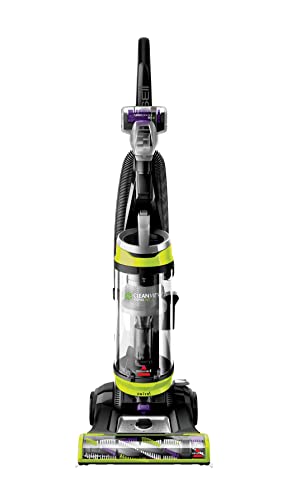
Bissell CleanView Swivel Pet 2252 — Best for Pet Hair on a Budget
The CleanView Swivel Pet exists for one household: pets everywhere, budget finite. Its brush roll is designed to work hair out of carpet rather than skate over it, the scatter-free approach helps on hard floors, and the large dirt tank acknowledges the reality that a shedding dog fills small bins by Tuesday. Bissell’s pet focus also means the included tools are chosen for upholstery and corners where hair migrates.
Strengths
- Brush roll and suction tuned specifically for embedded pet hair
- Large dirt tank suits multi-pet, high-shed households
- Swivel steering keeps a budget upright feeling nimble
Trade-offs
- Filtration is not a sealed HEPA system — allergy households should look at the Sharks or the Kenmore
- Hair wraps the brush roll over time; plan periodic cutting and cleaning
- Lightweight build trades some solidity for the price
Key specs: Bagless upright; Triple Action brush roll; swivel steering; large-capacity dirt tank; pet hair tools included.
Judge this Bissell by cost per clean carpet and it wins its tier easily. It asks for the usual bagless chores — empty the tank, rinse filters, de-hair the brush roll monthly — and in exchange handles the heaviest household load, pet hair, without the premium price. Households with genuine dust allergies should step up to a sealed system; everyone else with a dog and a budget will find this the sensible buy.
Best for: pet households wanting strong hair pickup at a budget tier / Not suited for: allergy households needing sealed HEPA filtration
Check the current price on Amazon

Hoover WindTunnel 3 Max Performance Pet — Best Deep-Clean Power
Pick the WindTunnel 3 Max when the house is big, the carpet is deep, and cleaning speed matters. The WindTunnel design uses multiple suction channels to resist the scatter and fade at the edges of the cleaning path, and the Quick Pass brushroll is tuned to lift debris in fewer back-and-forth trips — a real time saving across a whole house of carpet. HEPA media filtration keeps the exhaust respectable while you work.
Strengths
- Strong, even suction across the full cleaning path
- Quick Pass brushroll reduces the number of passes on carpet
- Long cord and full-size build suit large homes
Trade-offs
- Heavier and louder than the lightweight picks
- HEPA media filtration is not the same as a fully sealed HEPA system
- Bagless maintenance — filters and bin — is on you
Key specs: Bagless upright; WindTunnel 3 technology; HEPA media filter; Quick Pass brushroll; pet tools included.
This is the traditional American upright done properly: powerful, wide-pathed, and built for houses where vacuuming is a weekly event measured in rooms, not minutes. It will feel like overkill in a studio apartment and exactly right in a carpeted family home. Keep the filters clean and the brushroll clear, and its deep-clean performance stays a clear step above budget machines year after year.
Best for: large carpeted homes wanting maximum passes-free cleaning / Not suited for: small apartments where its size and power are wasted
Check the current price on Amazon
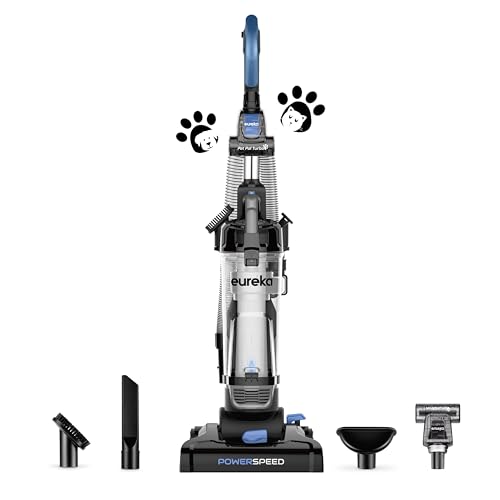
Eureka PowerSpeed NEU181A — Best Budget Pick
The NEU181A is what we recommend when the budget is the budget. It covers the fundamentals surprisingly completely — adjustable height for different carpet piles, a large dust cup that does not need emptying every room, an accessory kit including a pet turbo brush for stairs and upholstery — in a machine light enough for anyone in the house to grab. It is the classic first-home and rental vacuum.
Strengths
- Excellent cleaning coverage for a budget tier
- Large 2.6L dust cup and full accessory kit included
- Lightweight and simple — no learning curve
Trade-offs
- Filtration is basic; allergy households should step up
- Plastics and fit-and-finish reflect the price
- Brushroll and belt are wear items to expect over a long life
Key specs: Bagless upright; 2.6L dust cup; 5 height adjustments (per the PowerSpeed line); pet turbo brush, crevice and upholstery tools.
Budget vacuums fail in predictable places — tiny bins, no tools, suction that gives up on carpet — and the PowerSpeed dodges most of them. Treat it as a maintained appliance rather than a disposable: rinse the filter, clear the brushroll, and it will out-clean neglected premium machines. For a first apartment, a rental, or a second vacuum for the pet floor, it is the easiest recommendation in this guide to defend.
Best for: first homes, rentals and budget buyers who still have pets / Not suited for: households wanting sealed filtration or premium durability
Check the current price on Amazon

Kenmore Intuition Bagged Upright BU4022 — Best Bagged / Allergy Pick
The Intuition is for the household that has emptied one bagless bin into its own face and sworn never again. Bags seal the dirt away — change takes seconds, nothing billows, and filtration stays consistent because a fresh bag is a fresh filter. The lift-up design borrows the lift-away trick for stairs, the two-motor system drives the brushroll independently, and the Pet HandiMate tool handles upholstery hair properly.
Strengths
- Bagged dirt disposal with no dust plume — the cleanest emptying here
- HEPA filtration paired with sealed bags suits allergy households
- Lift-up versatility plus a genuine pet upholstery tool
Trade-offs
- Bags are an ongoing consumable cost
- Bagged capacity means keeping spares on hand
- Heavier in hand than the lightest bagless picks
Key specs: Bagged upright; HEPA filter; lift-up design; 2-motor system; 3-in-1 combination tool and Pet HandiMate.
Bagged vacuums fell from fashion, not from merit, and the Intuition shows why they are returning: consistent suction as the bag fills, hygienic disposal, and filtration that performs in month twelve as it did in week one. Do the honest math on bags per year for your household — for most homes it is a modest running cost traded against filters, mess and dust exposure. For allergy-conscious buyers, this is the first pick in the guide, whatever the badge order says.
Best for: allergy-conscious and dust-averse households / Not suited for: buyers who refuse ongoing bag costs
Check the current price on Amazon
Comparison Table
| Pick | Badge | Key spec | Best for |
|---|---|---|---|
| Shark Navigator Lift-Away NV360 | Best Overall | Lift-Away detachable pod, HEPA filtration, swivel steering, brushroll shutoff | mixed-floor homes with stairs and pets |
| Shark Navigator Lift-Away NV352 | Best Lightweight Lift-Away | Lightweight lift-away design, XL dust cup, HEPA filtration | smaller homes and anyone who carries the vacuum between floors |
| Bissell CleanView Swivel Pet 2252 | Best for Pet Hair on a Budget | Triple Action brush roll, swivel steering, large dirt tank, pet tools | pet households wanting strong hair pickup at a budget tier |
| Hoover WindTunnel 3 Max Performance Pet | Best Deep-Clean Power | WindTunnel 3 technology, HEPA media filtration, Quick Pass brushroll | large carpeted homes wanting maximum passes-free cleaning |
| Eureka PowerSpeed NEU181A | Best Budget Pick | Lightweight bagless upright, 2.6L dust cup, pet turbo brush included | first homes, rentals and budget buyers who still have pets |
| Kenmore Intuition Bagged Upright BU4022 | Best Bagged / Allergy Pick | Bagged with HEPA filtration, lift-up design, 2-motor system, Pet HandiMate | allergy-conscious and dust-averse households |
How to Choose a Corded Household Vacuum
Start with your floors, honestly inventoried. Mostly carpet argues for a strong brushroll upright with height adjustment. Mostly hard floors argue for brushroll shutoff or suction-only cleaning so debris is not scattered. Mixed homes — the majority — want both, plus above-floor tools for the stairs and furniture that occupy half of real cleaning time.
Bagged versus bagless is a lifestyle choice
Bagless saves consumable costs and shows you the dirt, but demands filter washing and dusty emptying. Bagged costs a little per bag and returns sealed, hygienic, consistent performance. Allergy and asthma households should weight bagged or genuinely sealed HEPA bagless systems heavily; everyone else can choose by chore preference. There is no wrong answer — only an answer you will resent weekly if it mismatches your habits.
Cord length and weight decide real-world reach
Measure your longest run from an outlet. A generous cord lets you clean a floor without replugging; a short cord in a big house teaches you to hate a good vacuum. Weight matters most on stairs and for whoever carries the machine — a lift-away or lift-up design effectively splits the weight, which is why those designs dominate this guide.
Filtration language, translated
A HEPA filter in an unsealed housing is a sieve in a leaky bucket: look for the words ‘sealed system’ alongside HEPA. ‘HEPA media’ or ‘HEPA-type’ filters catch plenty but certify less. None of this matters much for general dust; it matters a great deal if someone in the house has diagnosed allergies.
Upright, Lift-Away or Canister: Picking a Format
The classic upright remains the carpet king: one pass, deep clean, simple storage. Its weakness was always stairs and above-floor work, which is exactly what lift-away and lift-up designs fix by letting the motor unit detach into a carried pod with the hose. If your home has stairs, prioritize that trick over almost any spec-sheet number.
True canisters trail behind on a wand, excel under furniture and on hard floors, and store in smaller footprints, but most American households with wall-to-wall carpet still clean faster with an upright. Whichever format you choose, check the tool kit: a crevice tool, an upholstery tool and — for pet homes — a motorized or turbo pet brush are the three that earn their storage space.
Suction, Airflow and Brushrolls: What Actually Cleans a Carpet
Vacuum marketing worships suction, but carpet cleaning is a three-part system. The brushroll agitates, loosening dirt and hair from the pile; airflow carries what is loosened into the bin or bag; suction — really pressure difference — sustains that airflow against resistance. A machine strong in one and weak in another cleans badly in a characteristic way: powerful suction with a lazy brushroll skims surface litter and leaves the grit that wears carpet from inside, while frantic agitation with weak airflow redistributes dirt and calls it cleaning. The picks in this guide were chosen as balanced systems, which is why several mid-priced machines here out-clean flagship novelties.
Carpet itself is the other half of the equation. Deep plush pile needs height adjustment and strong agitation; low loop pile needs gentler treatment and punishes over-aggressive brushrolls; hard floors need the brushroll stopped entirely or it scatters debris and can mark delicate finishes. The height adjustments and brushroll shutoffs sprinkled through the reviews are not feature-list padding — they are the controls that let one machine serve a whole mixed-floor house.
The edge problem nobody advertises
Every upright cleans worst at the edges of its head and along baseboards, where the brushroll ends and airflow drops. Technique beats technology here: slow passes, an overlap of a third of the head’s width, and a final crevice-tool pass along skirting boards on deep-clean days. A vacuum with honest edge performance plus good technique beats a premium machine waved quickly at the middle of the room.
Corded vs Cordless in 2026: An Honest Accounting
Cordless vacuums have genuinely improved, and for a small apartment or a crumbs-and-stairs lifestyle they may be all a household needs. The honest accounting for whole-house cleaning still favors corded on every axis that compounds: purchase price for equivalent cleaning power, runtime (unlimited versus a battery’s budget), bin capacity, deep-carpet performance sustained across a full house, and service life measured in decades of motor-and-belt maintenance rather than battery replacement cycles. A cordless machine’s battery is a consumable with a calendar attached; a corded machine’s consumables are filters and belts that cost little and take minutes.
The cord itself is the entire argument on the other side, and it is a real one: plugging, unplugging and cord management add friction to every session, and friction is why quick messes get left. The households that clean happiest tend to resolve this by role rather than by ideology — a corded main machine for the weekly deep clean, exactly as this guide assumes, with any cordless or handheld device as a spot-cleaning accessory. Buying a cordless stick as your only machine for a large carpeted house remains the most common vacuum purchase regret we encounter.
Environmental accounting points the same way. A corded upright kept for fifteen years with replaceable filters and belts embodies a fraction of the material and battery throughput of three successive cordless machines. Durability is the least marketed and most consequential specification in this category.
Deep-Clean Day: A Room-by-Room Technique That Doubles Your Results
The same vacuum cleans twice as well with technique, and deep-clean day is where corded machines justify themselves. Work in this order: dust surfaces first so debris falls to the floor before you vacuum, not after; clear small items and lift what can be lifted; then vacuum slowly — genuinely slowly — with overlapping passes, because brushrolls need dwell time to work dirt loose and airflow needs time to carry it away. The fast back-and-forth of television commercials is how carpets stay dirty under a clean-looking surface.
Treat high-traffic lanes as their own problem: they hold the ground-in grit that destroys carpet fibers, and they repay extra passes in both directions. Move furniture seasonally and clean underneath — the dust ecology under a sofa is its own argument. Use the crevice tool along every baseboard, the upholstery tool on sofas and mattresses, and the stairs routine with the lift-away pod if your machine has one.
Finish by maintaining the machine while the job is fresh in your mind: empty the bin or check the bag, glance at the brushroll for wrapped hair, and note the filter’s state. Five minutes now is the difference between a vacuum that performs like this every week and one that slowly fades into the appliance you apologize for.
Ownership Economics: What a Corded Vacuum Really Costs Over Ten Years
Sticker prices lie by omission, so let us do the arithmetic this category deserves. A mid-range corded upright’s decade of ownership includes the machine, a handful of filters, a belt or two, and — for the bagged route — a steady but modest stream of bags. A flagship cordless’s decade includes the machine, at least one replacement battery at a sobering price, filters, and a meaningful probability that the whole unit is superseded or fails electronically before the decade ends. Run honestly, the corded decade typically costs a fraction of the cordless one while delivering stronger cleaning in every one of its years — the rare case where the cheaper option is also the better one, with the cord as the only toll.
Repairability compounds the advantage. The corded picks in this guide are built from motors, belts, brushrolls and filters — parts that exist, are priced sanely, and can be fitted with a screwdriver and a video. When a ten-year-old Hoover needs a belt, it gets one; when a sealed electronic appliance fails, it becomes e-waste with a handle. Households that keep machines long enough will feel this difference in their wallets and their consciences alike.
There is also a performance-honesty dividend: a corded machine’s suction in year eight is its suction in week one, provided the maintenance rhythm in this guide is kept, because nothing in its power path degrades on a calendar. Batteries degrade by chemistry whether you use them or not. The corded proposition — full power, forever, for the price of an extension of your arm’s reach — remains the best deal in home cleaning, and the market’s drift away from it says more about marketing than about vacuuming.
Budget guidance follows naturally. Spend first on the machine class that matches your floors, second on the format your stairs demand, and keep a small annual allowance for filters, belts and bags. That discipline, applied to any pick in this guide, produces a decade of clean floors for less than a single flagship cordless replacement cycle — arithmetic worth remembering the next time a runtime countdown tries to sell you a vacuum.
Accessory Literacy: The Tools in the Box and the Ones Worth Adding
Most vacuum dissatisfaction is actually accessory illiteracy: the machine is fine, the job was attempted with the wrong end of it. The crevice tool is not a spare part — it is the baseboard, car-seat-rail and between-cushion specialist, and its narrow concentration of airflow lifts what the wide head cannot reach. The upholstery tool’s lint-picking edges are engineered for fabric; using the bare hose on a sofa is slower and harder on the fabric. The dusting brush, ignored in most cupboards, is the correct way to vacuum blinds, shelves and electronics without scratching or static-chasing the dust elsewhere.
Pet households should know the turbo brush — a small air- or motor-driven head — as the stair and upholstery champion: full brushroll agitation in a tool that fits a stair tread. Several picks in this guide include one; if yours does not, a universal-fit turbo tool is the single best accessory purchase a pet home can make. The second-best is a spare set of filters, which converts filter-washing from a vacuum-down day into a five-minute swap and makes the maintenance schedule in this guide effortless to keep.
Storage decides whether tools get used. A tool that lives in a distant cupboard effectively does not exist; onboard storage, for all its clunkiness, wins in practice. If your machine’s tools have migrated, gather them into a caddy that lives where the vacuum lives. The best accessory system is the one that is attached to the machine when the spill happens — a truth no specification sheet will ever print.
Matching the Machine to the Household: Five Archetypes
The two-person apartment with a cat: floors are mixed, storage is a cupboard, and the vacuum must do stairs to the building’s laundry more often than stairs at home. The NV352’s light weight, big bin and lift-away pod fit this life precisely, and its filtration keeps a small space’s air honest against litter dust. The sprawling carpeted family house: rooms multiply, a dog audits every floor decision, and cleaning is a weekly campaign. Hoover’s WindTunnel 3 Max was built for this map — wide path, long cord, deep agitation — with the Kenmore Intuition as the alternative if a family member’s allergies argue for bags.
The allergy household, stated plainly: filtration is the purchase, everything else is furniture. Bagged-and-HEPA (the Intuition) or sealed-system HEPA bagless (the Sharks) are the only honest shelves to shop, bins should be emptied outdoors or not at all by the allergic person, and the maintenance schedule stops being advice and becomes prescription. The first-home and rental archetype: budget is real, floors are unknown until move-in day, and the Eureka PowerSpeed’s height-adjustable, tool-complete adequacy is exactly the right shape of compromise — it will clean three successive rentals while its owner learns what their permanent floors will demand.
The pet foster and multi-dog household, the heaviest duty there is: bin capacity and brushroll access matter more than any other specification, because the machine will be emptied and de-haired weekly without fail. The Bissell CleanView Swivel Pet’s big tank and pet-first design meet that reality at a price that survives being treated as the hard-worked appliance it will become. Notice the pattern one last time: archetype first, product second. Every archetype above maps to a pick already reviewed — the guide’s structure working as intended, from household to machine rather than from marketing to regret.
Whichever archetype is yours, one closing discipline applies to all: register the purchase, keep the manual’s filter schedule somewhere you will actually see it, and write the date of first use on the box flap stored with the spare bags or filters. Future you, mid-deep-clean in year three, will be quietly grateful for the administration.
Noise, Weight and the Human Factors Nobody Puts on the Box
Two specifications decide whether a vacuum is loved or endured, and neither is suction: noise and weight in the hand. Corded uprights are not quiet machines, and the honest differences between models are measured in tolerance — a vacuum you can run while a baby naps in the next room gets used at better hours than one that clears the house. If your household cleans around sleepers, work, or calls, weight the quieter-running picks and the canister-style lift-away modes, which put the motor at floor level and farther from ears, and accept that no full-power corded machine will ever be a whisper.
Weight in the hand is subtler than weight on the spec sheet. A well-balanced upright feels lighter than a poorly balanced lighter one, because the handle load, not the total mass, is what your arm argues with across a whole house. Swivel steering reduces the wrestling that makes big machines feel heavy; a pod that detaches moves the carrying problem to the stairs, where it is brief. The archetype advice in this guide quietly encodes all of this — light picks for carried lives, heavy picks for rolled ones — and the final discipline is personal: if possible, push the machine, or its closest sibling, in a shop before committing a decade to it.
Storage is the third human factor. A corded vacuum lives somewhere between cleans, and the somewhere decides whether it is grabbed or avoided: a cupboard it fits with its cord wrapped properly, a corner where the lift-away pod does not topple. Measure the storage spot as faithfully as the floors. The best vacuum is the one that is ready, reachable and maintained — the machine in this guide that matches your rooms, your stairs, your arms and your cupboard, in that order.
The Ten-Minute Weekly Reset
Close the ownership loop with the smallest habit in this guide: a ten-minute weekly reset, attached to the deep clean itself so it never needs its own motivation. Empty or check the dirt container while the job’s dust is still the enemy you remember. Glance at the brushroll and cut what the week wrapped around it. Look at the filter and honestly grade it — rinse, swap or schedule its replacement before it becomes next month’s suction mystery. Wipe the cord, coil it loosely rather than in the tight wraps that fatigue its conductors, and park the machine in its measured home with its tools aboard.
Ten minutes sounds like a tax until it is priced against the alternative biography of a neglected machine: the slow fade, the misdiagnosed motor, the replacement bought in frustration at full price. The reset is also a diagnostic — belts, seals and hoses announce their aging to hands that visit weekly, months before they fail mid-clean. Corded vacuums ask so little, and give full power for so long, precisely because owners who keep this appointment never give them the chance to become the other kind of appliance.
A Closing Note on Floors Themselves
The final word belongs to the floors, because they outlast every vacuum. Carpet that is vacuumed slowly and deeply, with grit removed before it can saw at the fibers, lasts years longer than carpet cleaned in a hurry — the vacuum’s real product is not a clean-looking room but a floor covering whose replacement can be postponed again and again. Hard floors ask the opposite virtue: restraint, with brushrolls stilled and suction doing the work, so finishes keep their surface. A corded machine, maintained and matched to its house, quietly delivers both virtues for a decade. That is the purchase this guide has been describing all along, underneath the models and the motors: time, bought back from your own floors.
How to Keep a Corded Vacuum at Full Suction (Maintenance Routine)
A corded vacuum’s great promise — full power forever — holds only if airflow stays free. This simple routine protects it.
- Empty the bagless bin at the fill line, not above it, and change bags before they are packed hard; suction dies quietly in an overfilled machine.
- Wash or replace filters on the manufacturer’s schedule — for most bagless uprights, a monthly rinse of foam filters, dried fully before refitting.
- Flip the machine monthly and cut wrapped hair from the brushroll; check the belt for glazing or slack at the same time.
- Clear the hose and wand path each season: a broom handle pushed gently through finds the sock that has been costing you suction for months.
- Wipe the seals and bin gasket when you empty; grit on a seal is a slow leak that no motor can out-pull.
Follow that rhythm and a corded machine’s year-five performance matches its week-one performance — the entire reason to buy corded in the first place. Neglect it, and you will blame a good vacuum for a maintenance debt it never agreed to carry.
Common Buying Mistakes
Buying cordless runtime logic for a corded job. Whole-house deep cleaning is exactly where cords win. Choosing a weak machine because it feels modern leaves carpet half-cleaned and budgets doubly spent.
Ignoring filtration seals. A HEPA filter badge means little in an unsealed body. Allergy households must buy the system — sealed housing, sealed bags — not the sticker.
Never washing the filters. Most ‘my vacuum lost suction’ stories are filter stories. The fix is a rinse and a full dry, on schedule, forever.
Skipping the stair test. An upright that cannot do stairs forces a second machine. Lift-away designs or a long hose reach should be decided before purchase, not discovered on the first deep clean.
Letting pet hair own the brushroll. Wrapped hair strangles airflow and strains belts. A monthly two-minute cut-and-clear keeps pet homes running at full power.
Final Recommendation
Most households should buy the Shark NV360 and stop researching: lift-away versatility, sealed HEPA filtration and honest all-floor performance in one corded machine. The NV352 trims weight and adds bin capacity for smaller homes. Pet households on a budget get the Bissell CleanView Swivel Pet; big carpeted homes get Hoover’s WindTunnel 3 Max; first homes and rentals get the Eureka PowerSpeed. And allergy-conscious buyers should skip straight to the bagged Kenmore Intuition, whose sealed, plume-free emptying is worth every bag.
Corded is a commitment to maintaining one good machine instead of replacing lesser ones. Keep the filters clean and these picks will repay it for years.
Shop the shortlist: Shark Navigator Lift-Away NV360 — Check on Amazon · Shark Navigator Lift-Away NV352 — Check on Amazon · Bissell CleanView Swivel Pet 2252 — Check on Amazon
Best Vacuums For Pet Hair Best Bagless Upright Vacuums Best Bagged Vacuums Best Vacuums For Carpet Best Vacuums For Hardwood Floors
Frequently Asked Questions
Are corded vacuums really better than cordless?
For whole-house and deep carpet cleaning, yes: suction never fades, bins are bigger, and purchase and lifetime costs are lower. Cordless wins for quick pickups and spot cleaning. Many homes sensibly own a corded main machine and nothing else.
How long a cord do I need?
Enough to cover your largest floor area from one or two outlets. Measure your longest cleaning run; generous cords in this class let most single floors be cleaned with at most one replug.
Bagged or bagless for allergies?
Bagged with HEPA filtration, or a bagless machine with a genuinely sealed HEPA system. Sealed bags empty without a dust plume, which is the moment allergy households suffer most with bagless bins.
Why does my vacuum lose suction over time?
Almost always airflow: a full bin or bag, a clogged filter, hair strangling the brushroll, or a partial blockage in the hose. The maintenance section of this guide addresses each in order.
Can one corded vacuum do stairs well?
Yes, if it is a lift-away or lift-up design, or has a long hose and a stair tool. A fixed full-weight upright is the only genuinely awkward stair machine.
How often should filters be replaced or washed?
Follow the maker’s schedule — commonly a monthly rinse for washable foam filters and periodic replacement for HEPA cartridges. A filter that stays dirty after washing has earned its replacement.
Do corded vacuums work well on stairs?
The lift-away and lift-up designs here are built for it: the pod carries in one hand, the hose and tool work the treads. A fixed upright without a detachable option is the only genuinely poor stair machine.
How long should a corded vacuum last?
With the maintenance rhythm in this guide — filters, brushroll, belts — a quality corded machine commonly serves a decade or more. The motor is rarely the part that ends a corded vacuum’s life; neglect of the small parts is.
