Disclosure: airfryerkitchensupply.com is reader-supported. When you buy through links on our site, we may earn an affiliate commission at no extra cost to you.
Where to buy
Every pick in this guide to the best sewing machine for making large quilts was cross-checked against Amazon’s own catalog data before it earned a link, so the buttons below go to the exact product described — not a look-alike listing. Prices in this category move often, so each pick simply asks you to check the current price on Amazon rather than trusting a number printed here that could be stale by the time you read it.
- Juki TL-2010Q (Best Overall) — Check the current price on Amazon
- Janome 1600P-QC (Best for Speed) — Check the current price on Amazon
- Brother PQ1600S (Best Brother Option) — Check the current price on Amazon
- Janome Memory Craft 6650 (Best Full-Featured) — Check the current price on Amazon
- Juki TL-18QVP Haruka (Best Premium Straight-Stitch) — Check the current price on Amazon
- SINGER Quantum Stylist 9960 (Best Budget All-Rounder) — Check the current price on Amazon
The best sewing machine for making large quilts is decided by one measurement most listings bury: the throat — the open space between the needle and the machine’s right-hand column. A king-size quilt is a rolled-up mattress of fabric, and every inch of it has to pass through that gap while you quilt. Machines with a standard five-inch throat make you wrestle; the straight-stitch and long-throat machines in this guide give the roll somewhere to go, and that difference matters more than stitch counts, decorative patterns or touchscreen size.
This shortlist therefore splits into two honest families. The first is the semi-industrial straight-stitch machines — Juki, Janome and Brother’s high-speed single-stitch platforms — built around big throats, metal frames, knee lifters and feed systems that pull three layers evenly at speed. They do one stitch, perfectly, at up to professional pace, and for machine quilting large quilts that is usually the right trade. The second family is full-featured computerized quilting machines with wide throats and extension tables, for quilters who also piece, appliqué and bind on the same machine.
Every machine below was confirmed against Amazon’s catalog data before receiving a link, and the reviews are frank about the compromises: straight-stitch machines cannot zigzag an appliqué edge, computerized machines cost more of their budget on electronics than on throat, and no domestic machine fully replaces a longarm for a professional quilting business. Match the machine to how you actually quilt — that is the whole game.
In this guide
Quick Picks
If you only have a minute, these are the six shortlisted options for the best sewing machine for making large quilts, each chosen for a different kind of buyer. The full reviews further down explain who each one suits and where each one compromises.
- Juki TL-2010Q — Best Overall. The quilter’s default recommendation for a decade: a fast, metal-bodied straight-stitch machine with a wide flat bed, knee lifter and automatic thread trimmer. — Check price on Amazon
- Janome 1600P-QC — Best for Speed. Janome’s high-speed straight-stitch platform, rated at up to 1,600 stitches per minute with a large throat built for quilts, denim and canvas. — Check price on Amazon
- Brother PQ1600S — Best Brother Option. Brother’s high-speed straight-stitch entry: a long-bed, pin-feed equipped machine aimed squarely at quilters who want speed with Brother’s friendlier setup. — Check price on Amazon
- Janome Memory Craft 6650 — Best Full-Featured. A computerized sewing and quilting machine with a wide throat, hundreds of stitches and a metal interior — the one-machine studio option. — Check price on Amazon
- Juki TL-18QVP Haruka — Best Premium Straight-Stitch. The refined evolution of Juki’s TL line: aluminium portable body, the same lockstitch heart, with modern touches like a larger workspace lighting and sub-tension system. — Check price on Amazon
- SINGER Quantum Stylist 9960 — Best Budget All-Rounder. A computerized all-rounder with 600 stitches, an extension table and 13 feet included — the accessible route into quilting larger pieces without a specialist budget. — Check price on Amazon
How These Picks Were Chosen
Selection started with throat space and harp size, the physical room a quilt roll occupies, and eliminated any machine whose workspace would force a king quilt into a hard fold. Next came feed: large quilts drift and pucker when the feed dogs cannot grip evenly, so machines with strong, adjustable feed, walking-foot compatibility and presser-foot pressure control scored highest. Frame construction mattered too — at quilting speeds, a flexing plastic frame walks across the table and blurs stitch lines, so metal-frame machines dominate this list.
Speed was judged as usable speed, not headline speed: a machine that sews fast but vibrates too much to control is worse than a calmer one. Finally, each candidate had to be a current, catalog-confirmed model with a real quilting user base — large-quilt buyers keep machines for decades, and orphan models with no parts support are a false economy at any price.
The 6 Best Sewing Machines for Making Large Quilts
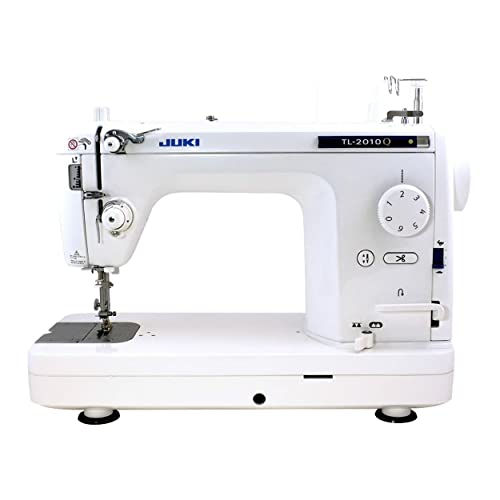
Juki TL-2010Q — Best Overall
The TL-2010Q is what experienced quilters mean when they say ‘just get the Juki.’ It does exactly one thing — a straight stitch — with the speed, even feeding and mechanical confidence of the industrial machines Juki is famous for. The wide, flat work surface and included extension table give a quilt roll room to rest instead of dragging, and the knee lifter keeps both hands on the quilt while you raise the foot at corners. It suits dedicated quilters who piece on anything but quilt on this, and garment sewers who value a perfect straight seam.
Strengths
- Semi-industrial speed and feeding through thick quilt sandwiches
- Knee lifter and automatic thread trimmer keep hands on the quilt
- Aluminium die-cast frame stays planted at speed
Trade-offs
- Straight stitch only — no zigzag or decorative stitches
- Threading is fully manual, industrial-style
- Heavier than domestic computerized machines
| Stitch type | 1-needle lockstitch (straight stitch only) |
| Features | Automatic thread trimmer, knee lifter |
| Frame | Aluminium die-cast body |
On a large quilt, the 2010Q’s virtue is calm: the feed pulls the sandwich straight for hours, the stitch length stays where you set it, and the machine never seems to notice whether it is sewing two layers or five. Pair it with a walking foot for straight-line quilting and a free-motion foot for curves, and there is very little in domestic quilting it cannot do beautifully. It is the machine least likely to be outgrown on this list.
A detail owners mention for years: the TL-2010Q’s stitch stays consistent at the transitions that ruin quilts on lesser machines — crossing a seam intersection, climbing onto a thick binding edge, easing off at a corner. That consistency comes from the feed and the frame working together, and it is why finished quilts from this machine look ‘professional’ in a way that is hard to attribute until you have sewn on both classes. It is not faster hands; it is a machine that stops adding its own errors to yours.
Best for: Dedicated quilters wanting a lifelong straight-stitch workhorse / Not suited for: Sewers who need zigzag, buttonholes or decorative stitches

Janome 1600P-QC — Best for Speed
If the Juki is the calm professional, the 1600P-QC is the eager one. Its headline speed is real, and experienced free-motion quilters use that pace to keep stitch length even while moving a quilt by hand — the faster the needle cycles, the smoother hand-guided work becomes. The large throat swallows rolled quilts, the industrial-style bobbin system is built for long runs, and the whole machine has the unburstable feel of equipment rather than appliance. It suits confident quilters who quilt big and quilt often.
Strengths
- Up to 1,600 stitches per minute for free-motion control
- Large throat sized for rolled king quilts
- Handles denim, canvas and thick sandwiches without complaint
Trade-offs
- Speed demands respect — beginners find it abrupt
- Straight stitch only, like all machines in this class
- Industrial bobbin system is a small learning curve
| Top speed | Up to 1,600 stitches per minute |
| Stitch type | Straight stitch |
| Throat | Large throat for quilts and heavy fabrics |
Judge this machine on a long quilting session, not a test seam. Its party trick is hour three: still cool, still even, still feeding straight while lighter machines are skating on thick batting. The independent bobbin winder and generous accessory ecosystem (it shares feet widely across Janome’s high-speed line) make it easy to live with for years.
The 1600P-QC also deserves its reputation among bag and home-dec sewers who quilt: the same power that pulls a quilt sandwich laughs at eight layers of denim or a canvas tote seam. If your making life spans quilts and heavy utility sewing, this machine covers both without a whimper — one reason its resale market stays strong. Buyers keep these for decades and pass them down; the used listings vanish quickly, which tells you most of what you need about longevity.
Best for: Experienced quilters who free-motion large quilts / Not suited for: Beginners wanting a gentle, feature-guided machine

Brother PQ1600S — Best Brother Option
The PQ1600S brings the semi-industrial formula to buyers who prefer Brother’s ergonomics and dealer network. Its long bed gives quilts room, the pin-feed mechanism helps keep layered fabrics registered — a real benefit on long straight quilting lines where top and bottom layers love to creep apart — and the automatic needle threading softens the industrial character of the class. It suits quilters stepping up from a domestic Brother who want the big-throat experience without changing brands and habits overnight.
Strengths
- Pin feed helps layers stay registered on long seams
- High-speed straight stitch with a long, quilt-friendly bed
- Automatic needle threader — rare in this class
Trade-offs
- Straight stitch only
- Fewer long-term field reports than the Juki/Janome rivals
- Extension table setup matters for full benefit
| Stitch type | High-speed straight stitch |
| Feed | Pin feed for layered fabrics |
| Threading | Automatic needle threader |
The pin feed is the reason to pick this over its rivals: on a 90-inch quilting line, even a few millimetres of layer creep becomes a visible pucker at the far end, and Brother’s system is designed exactly against that. If your quilting style is long straight lines, channels and grids, this machine’s priorities match yours precisely.
Brother’s accessory ecosystem is the PQ1600S’s quiet advantage: feet, guides and tables are widely stocked and plainly documented, and the machine’s controls will feel familiar to anyone arriving from a domestic Brother. The learning curve from ‘good home machine’ to this is the gentlest in the semi-industrial class — an underrated virtue when the alternative is relearning threading rituals and tension instincts from scratch mid-project.
Best for: Brother loyalists and straight-line quilters / Not suited for: Sewers needing decorative stitch capability

Janome Memory Craft 6650 — Best Full-Featured
Not every large-quilt maker wants a single-stitch specialist. The Memory Craft 6650 is for the quilter who pieces intricate blocks, appliqués, binds and quilts on one machine and refuses to keep two. Its throat is generously sized for a computerized model, the stitch library covers everything from utility to heirloom, and the AcuFeed-style layered feeding philosophy runs through its design. It suits versatile sewists whose quilting is one chapter of a bigger sewing life.
Strengths
- Full stitch library plus a genuinely wide throat
- Computerized precision for piecing and appliqué
- Strong layered-fabric feeding for quilt sandwiches
Trade-offs
- Budget goes partly to electronics, not pure throat size
- Slower top speed than the straight-stitch specialists
- More menus and settings to learn
| Type | Computerized sewing & quilting machine |
| Stitches | Full library incl. quilting stitches |
| Throat | Wide harp for a computerized model |
The 6650’s case rests on total workflow: the same machine that pieces a precise block on Monday quilts it on Friday, with the walking foot attached and the throat swallowing the roll better than any standard domestic machine. If your quilting is garment-and-home-dec sewing too, the versatility is worth more than the last increment of straight-stitch speed.
Consider the quilting workflow this machine enables for a charity or group quilter: piecing precise blocks in the morning with its guided features, switching to the walking foot for straight-line quilting after lunch, then binding with the same machine before dinner. A two-machine studio does each stage marginally better; the 6650 does all of them well, in one footprint, with one learning curve. For small sewing rooms, that consolidation is not a compromise — it is the design brief.
Best for: One-machine studios doing piecing, appliqué and quilting / Not suited for: Purists wanting maximum throat and speed per dollar

Juki TL-18QVP Haruka — Best Premium Straight-Stitch
The Haruka takes everything quilters love about the TL-2010Q and polishes the ownership experience — a cleaner industrial design, excellent visibility over the needle area and the same unshakeable straight stitch. It suits quilters who have already decided the straight-stitch life is theirs and want the nicest version of it: retreats and classes included, since the aluminium body keeps it portable by the standards of this class. If you quilt large quilts weekly and keep machines for decades, the premium is easy to justify.
Strengths
- TL-series stitch quality in a refined aluminium body
- Portable enough for classes and retreats
- Superb needle-area visibility and lighting
Trade-offs
- Premium tier position within this guide
- Still straight stitch only
- Accessories and feet are Juki-specific
| Body | White aluminium, portable |
| Stitch type | Lockstitch straight stitch |
| Lineage | Juki TL / QVP quilting line |
Think of the Haruka as the TL-2010Q after a design review: nothing about the fundamental quilting performance regressed, and the daily-grind details — light, visibility, handling — all improved. For a machine you will touch thousands of hours, those details are not luxuries; they are the product.
The Haruka’s portability deserves precision: at this class’s weight it is ‘portable’ the way a good stand mixer is portable — you can take it to class, retreat or a friend’s quilting weekend without drama, and it will sew all weekend like it never left home. Quilting is a social craft, and a machine that travels well gets used socially. That, as much as the lighting and finish, is what the premium buys.
Best for: Committed quilters wanting the polished TL experience / Not suited for: First-time buyers unsure about straight-stitch-only life

SINGER Quantum Stylist 9960 — Best Budget All-Rounder
Honesty first: the 9960’s throat is a standard domestic size, so a king quilt will always be a wrestling match compared with the specialists above. But it earns its place for the many quilters whose ‘large’ means generous throws and full-size quilts made occasionally, and who also sew garments, home decor and gifts on the same machine. The included extension table, walking-friendly accessory set, hard case and metal frame make it the most complete starter quilting package in this guide.
Strengths
- 600 stitches and 13 feet included — huge starter value
- Extension table supports quilt weight while sewing
- Metal frame and hard case included
Trade-offs
- Standard throat — king quilts are hard work
- Not built for daily heavy quilting duty
- Plastic externals versus the semi-industrial picks
| Stitches | 600 built-in, 5 fonts |
| Included | Extension table, 13 presser feet, hard case |
| Frame | Metal frame |
Buy the 9960 as a brilliant generalist and an honest occasional quilter, not as a large-quilt specialist in disguise. Use the roll-and-clip method (roll the quilt tightly, clip the roll, feed it through in sections) and it will finish full-size quilts respectably. If quilting becomes your main craft, this becomes your piecing machine the day a TL-class machine arrives — a natural two-machine evolution, not a wasted purchase.
One more honest use case: the 9960 is the machine to buy a keen teenager or a returning sewer. Its guided features rebuild confidence, its quilting accessories are already in the box, and its ceiling is high enough that the first two years of quilts — throws, lap quilts, a first full-size bed quilt — are all within its honest ability. Machines that get sewn on beat perfect machines that intimidate, every time.
Best for: Versatile sewists quilting throws and full-size quilts occasionally / Not suited for: Regular king-size quilting
Comparison Table
| Pick | Badge | Key spec | Best for |
|---|---|---|---|
| Juki TL-2010Q Check price on Amazon | Best Overall | Straight stitch, knee lifter, auto trimmer | Dedicated quilters wanting a lifelong straight-stitch workhorse |
| Janome 1600P-QC Check price on Amazon | Best for Speed | 1,600 spm, large throat, straight stitch | Experienced quilters who free-motion large quilts |
| Brother PQ1600S Check price on Amazon | Best Brother Option | Pin feed, high-speed straight stitch | Brother loyalists and straight-line quilters |
| Janome Memory Craft 6650 Check price on Amazon | Best Full-Featured | Computerized, wide throat, full stitch library | One-machine studios doing piecing, appliqué and quilting |
| Juki TL-18QVP Haruka Check price on Amazon | Best Premium Straight-Stitch | Aluminium TL platform, portable | Committed quilters wanting the polished TL experience |
| SINGER Quantum Stylist 9960 Check price on Amazon | Best Budget All-Rounder | 600 stitches, extension table included | Versatile sewists quilting throws and full-size quilts occasionally |
How to Choose a Sewing Machine for Large Quilts
Measure the throat first — everything else is secondary. The throat (or harp) is the distance from the needle to the column on the right, and its height matters as much as its width: a rolled king quilt is a fat cylinder, and it needs both. As a working rule, under six inches of throat makes large quilts an endurance sport; the eight-to-eleven-inch class of the straight-stitch machines above turns the same job into ordinary sewing. If a listing hides the throat measurement, that silence is information.
Then decide your stitch philosophy. Straight-stitch specialists (Juki TL, Janome 1600P, Brother PQ) spend every cent on speed, feeding and throat, and quilt superbly — but cannot zigzag, satin-stitch appliqué or sew a buttonhole. Computerized all-rounders quilt well and do everything else. Neither is wrong; the mistake is buying one while secretly needing the other. Many serious quilters end with both: the specialist for quilting, the all-rounder for construction.
Feed systems: why quilts pucker
A quilt sandwich is three layers that want to travel at different speeds. The feed dogs push the bottom, the presser foot drags the top, and the result is puckers and misaligned layers. Three defences exist: a walking foot (even-feed foot) that moves the top layer in step; adjustable presser-foot pressure, so thick batting is gripped rather than bulldozed; and systems like Brother’s pin feed that physically register the layers. For large quilts, plan on a walking foot for straight-line work regardless of machine — budget and storage should assume it.
Tables, weight and the drag problem
More large quilts are ruined by gravity than by machines. A quilt hanging off the table edge drags against every stitch, distorting lines and exhausting the sewer. An extension table — included with several picks here — plus a table arrangement that supports the quilt’s bulk at machine-bed height transforms results on any machine. Heavy machines are a feature in this category: mass absorbs vibration and keeps the machine planted while you haul fabric through it.
Free-Motion vs Walking-Foot Quilting on Big Quilts
Walking-foot quilting moves the quilt in straight or gently curving lines with the feed dogs engaged: controlled, even, forgiving — the right default for modern straight-line designs and ditch work. Free-motion quilting drops the feed dogs and moves the quilt by hand in any direction: it unlocks stippling, feathers and custom work, but stitch length becomes your hands’ responsibility, which is exactly where high-speed machines help — fast needle cycles smooth out hand-speed variation. Large quilts amplify both techniques’ demands; most quilters here will live in walking-foot territory for whole quilts and free-motion for blocks and borders.
Budget Tiers for Large-Quilt Machines, Honestly Framed
Prices in this category span a wide ladder, so think in tiers rather than numbers. The entry tier buys a capable computerized all-rounder (the Singer 9960’s class) that quilts respectably with technique. The middle tier buys the semi-industrial straight-stitch platforms — the best quilting performance per unit of money in the whole market. The upper tier buys refinement: the Haruka’s polish, or computerized flagships with the widest throats electronics can offer. What no tier buys is a longarm; if you plan to quilt for paying clients weekly, save toward that category instead of climbing this ladder twice.
How to Set Up Your Machine for a Large Quilt
Setup decides whether a large quilt is a pleasure or a wrestling match. Run through this routine before the first stitch of every big project.
- Support the bulk. Fit the extension table, then arrange surrounding table space — or a lowered ironing board — so the quilt’s weight rests at bed height on all sides. Nothing should hang off an edge.
- Roll and clip. Roll the quilt from the right side toward the needle area into a tight cylinder and secure it with bicycle clips or large binder clips. Work one section, then re-roll. The roll lives in the throat; that is what the throat is for.
- Fit the right foot and needle. Walking foot for straight lines, free-motion/darning foot for curves. Fit a fresh quilting or topstitch needle sized for your thread — big quilts punish dull needles with skipped stitches at the worst moments.
- Test on a practice sandwich. Make a small sandwich from the same fabrics and batting. Set stitch length and tension there, never on the quilt itself. Check the back — tension sins hide underneath.
- Start in the middle. Quilt from the centre outward in all directions. This pushes fullness toward the edges instead of trapping a bubble of excess fabric in the middle of a king-size field.
- Schedule the session. Large quilts are physical. Work in 45-minute blocks, stand and stretch between them, and stop when your shoulders rise — tired hands make wavy lines no machine can correct.
Finish by checking the back under good light before unclipping anything: it is far easier to unpick one section now than after binding. Then trim, bind, and let the machine cool — it has earned it.
Throat Space, Translated: What the Inches Buy You
Throat measurements abstract badly, so here is the concrete version. A rolled king quilt is a cylinder roughly the diameter of a dinner plate. Through a standard domestic throat it must be compressed, folded and forced — every repositioning risks disturbing the layers you basted so carefully. Through the eight-plus inches of a TL-class machine the same roll sits, turns and feeds like cargo through a tunnel built for it. The quilting stops being about managing the quilt and becomes about the stitching itself, which is the entire creative point.
Height matters alongside width: a tall throat lets the roll pass under the arm of the machine without scraping, which is what makes free-motion work on big pieces physically comfortable over hours. When comparing any two machines for large quilts, compare throat width and height before a single feature — you are buying a workspace that happens to sew, and the workspace is what your quilt lives in.
The Accessories That Actually Matter for Big Quilts
Four accessories earn their storage space. A walking foot, for the reasons covered above — non-negotiable. A free-motion/darning foot matched to your machine, ideally an open-toe design so you can see the needle’s path. A large extension table or a table arrangement that brings surrounding surface to bed height — gravity management again. And quilting gloves or a grip aid: moving a heavy quilt precisely is a friction problem, and grippy palms turn exhausting hauling into controlled gliding.
Two more are worth it for regular large work: a knee lifter if your machine supports one (several picks build it in), and a straight-stitch needle plate for piecing accuracy and free-motion stability. Notice what is not on this list: decorative feet sets, embroidery attachments and novelty rulers. Large-quilt success is a short, physical shopping list — buy the short list well.
Basting and Layer Management: The Unglamorous Half of Big Quilts
No machine quilts a badly basted quilt well. On large quilts, layer management decides the outcome before the needle moves: a flat, taut backing, batting smoothed without stretching, and a top laid without drag — then pin, spray or thread basting dense enough that nothing migrates during hours of handling. The big-throat machines in this guide forgive a great deal, but they cannot forgive layers that were never registered to each other in the first place. Spend the floor time; it is quilting, not preparation for quilting.
Working in sections helps: quilt the centre field first while the quilt is most manageable, then each border zone with the bulk rolled away from the working area. Mark your quilting lines before basting on large open fields — chalk or hera marking on a basted, shifting sandwich is misery — and keep a consistent direction of work so fullness always has somewhere to exit. These habits, plus the workspace the machines provide, are the complete recipe; there is no secret ingredient left.
Maintaining a High-Speed Quilting Machine
Semi-industrial machines reward a simple maintenance rhythm. Lint is the enemy: quilting generates it in industrial quantities, so brush out the bobbin area every session and oil exactly where and as often as the manual specifies — these machines are designed to be oiled by their owners, unlike sealed domestic models. Change needles far more often than instinct suggests; a needle is the cheapest part of a king quilt and the cause of a disproportionate share of its problems.
Once a year, or after any heavy season, a professional service keeps timing and tension honest for the next decade. Budget it as part of ownership the way you budget walking feet and bobbins. The machines in this guide are built to be maintained rather than replaced — that is their economic argument as much as their stitch quality — and owners who keep the rhythm routinely hand these machines down still sewing straight.
Verdict by Quilter Type
The production quilter finishing a quilt a month: the Juki TL-2010Q, without a second thought — it is the machine your output deserves, and its consistency will show in every finished top. The free-motion artist: the Janome 1600P-QC, whose speed turns hand-guided work smooth and whose throat gives your largest pieces room to dance. The brand-loyal upgrader: the Brother PQ1600S, the gentlest step into the semi-industrial world, with pin feed guarding your longest seams. The complete sewist — garments Monday, quilts Friday: the Janome Memory Craft 6650, the only machine here that refuses to make you choose a speciality.
The connoisseur who has already decided: the Juki TL-18QVP Haruka — buy the polished version of the machine you will keep for decades, and take it to every retreat. The beginner with big ambitions and a real budget limit: the Singer 9960, bought honestly as a brilliant all-rounder that will piece and quilt your first years of work, and that graduates to second-machine duties with honour when a specialist eventually joins it.
Whichever row is yours, hold the hierarchy this guide has argued throughout: throat and feed first, frame second, features last. A large quilt does not care how many stitches your machine knows; it cares whether it fits, feeds and finishes. Choose on those terms and the machine will disappear into the work — which is the highest praise sewing equipment can earn.
Renting, Borrowing and Trying Before You Commit
These machines are decade purchases, and the category offers unusually good ways to de-risk them. Many dealers will let you sew a test sandwich on a floor model — bring your own fabrics and batting, the sandwich you actually make, not the shop’s silk demo. Quilt guilds and makerspaces increasingly keep a TL-class machine among their equipment; a weekend on a borrowed Juki teaches you more about your own preferences than a month of reviews. Some longarm studios also rent domestic-machine time alongside their frames, and the comparison itself is educational.
If you buy used — a legitimate route in a category where machines outlive their owners’ quilting years — budget for an immediate professional service, verify the timing on a test seam at speed, and confirm that feet, bobbins and the manual are included or sourceable. The straight-stitch platforms here hold value precisely because they are maintainable; a serviced used TL is a better purchase than a neglected new anything. However you arrive, arrive having sewn: the right machine announces itself in the hands within one quilt block.
A Word on Learning Curve and Confidence
Every machine in this guide can be out-sewn by its owner’s hesitation, so plan the first month deliberately. Week one belongs to the manual and to scrap sandwiches: threading until it is automatic, tension until you can read a stitch’s back as fluently as its front, speed until your hands stop negotiating with the pedal. Week two is a small, finishable project — a table runner or a lap quilt — chosen because finishing teaches more than starting. By the second month, the large quilt you bought the machine for stops being an event and becomes the work.
Two habits protect confidence. Keep a sewing journal for big projects: needle size, thread, tension setting, what the sandwich was — the notebook turns every problem into a solved problem you own, instead of a mystery that recurs. And join other quilters, in person or in a guild, because large-quilt technique is a folk tradition as much as a manual subject: the clip trick, the roll direction, the way to support a border while binding — these travel person to person. The machine is the tool; the tradition is the instruction set, and both are worth acquiring together.
Finally, be patient with the gap between the quilts you can picture and the quilts you can finish. It closes at the rate of roughly one quilt at a time, on every machine ever made, including the finest in this guide. The quilters whose work you admire are not using different equipment — they are using the same equipment, later in the sequence. Your sequence starts with the next seam.
Common Buying Mistakes
Buying by stitch count. Six hundred stitches will not help a quilt through a five-inch throat. For large quilts, workspace and feeding beat features every single time.
Skipping the walking foot. Straight-line quilting a large quilt on a standard foot invites puckers and creeping layers. The walking foot is not an accessory in this category; it is half the system.
Letting the quilt drag. An unsupported quilt pulls against the needle with its full weight. Every wavy line and broken thread that follows gets blamed on the machine, unfairly.
Using the needle the machine came with. The factory needle is a generalist. Quilting layers need a sharp, strong quilting/topstitch needle, changed at least every project — dull needles cause most ‘machine problems’ on big quilts.
Starting at a corner. Quilting from one edge traps fullness in the middle. Centre-out is not a stylistic preference; it is how large flat quilts stay flat.
Final Recommendation
If you quilt large quilts regularly, buy the Juki TL-2010Q and never think about machines again — it is the settled answer for a reason. Speed-focused free-motion quilters should take the Janome 1600P-QC, Brother loyalists the PQ1600S, and quilters wanting the premium version of the same idea the TL-18QVP Haruka. If one machine must do everything in your sewing room, the Janome Memory Craft 6650 is the honest compromise, and the Singer 9960 remains the accessible all-rounder for occasional large work.
Whichever route you take, spend the saved deliberation time on setup: table support, the right foot, a fresh needle and a practice sandwich will improve your quilting more than any further upgrade. Related guides in this program:
Best Sewing Machines For Quilting
Best Quilting Machines
Best Sewing Machine For Beginners
Best Organic Cotton Sheet Sets
Best Buckwheat Pillows Under $50
Frequently Asked Questions
What throat size do I actually need for a king-size quilt?
Plan around the rolled diameter, not the quilt’s flat size. A rolled king quilt needs roughly eight or more inches of throat width and as much height as you can get to move comfortably. It can be done through smaller throats with tight rolling and patience — quilters did it for decades — but the semi-industrial machines in this guide exist because the difference is dramatic.
Can a straight-stitch machine piece quilts too?
Beautifully — piecing is straight stitching. What it cannot do is zigzag appliqué, decorative work or buttonholes. Many quilters piece and quilt entirely on a TL-class machine and keep an inexpensive all-rounder for the occasional zigzag task.
Do I need a longarm instead?
Only if quilting becomes a business or a weekly king-size habit. A longarm’s frame system is a different category of tool and budget. For home quilters finishing their own large quilts, a big-throat domestic machine plus good setup technique covers the overwhelming majority of projects.
Why do my quilting lines come out wavy?
Usually drag, not the machine: unsupported quilt weight pulling against the needle, or hand speed varying during free-motion work. Support the bulk at bed height, roll and clip, and — for free-motion — a faster machine speed smooths stitch length while your hands move steadily.
Is a knee lifter worth caring about?
On large quilts, yes. It raises the presser foot while both hands keep the quilt positioned — at every pivot, corner and repositioning, hundreds of times per quilt. Once you have quilted big with one, machines without it feel oddly slow.
How fast should a quilting machine sew?
Headline speed matters mainly for free-motion control; for walking-foot work, even feeding at moderate speed beats raw pace. The 1,500–1,600 stitches-per-minute class gives experienced quilters room to work; beginners will run any of these machines well below their ceilings, which is exactly right.
Can these machines sew garments as well?
The straight-stitch specialists sew garment seams beautifully but cannot finish them with zigzag or sew buttonholes — most owners pair them with an inexpensive all-rounder or a serger for garment work. The computerized picks (Memory Craft 6650, Singer 9960) handle full garment sewing alone. Buy according to whether garments are a chapter of your sewing or the whole book.
How long will a semi-industrial machine last?
With the oiling, lint and servicing rhythm described in this guide, decades is the honest expectation — these platforms are built to be maintained, and their strong used market exists because old examples keep sewing straight. The limiting factor is almost never the machine; it is whether the owner kept the maintenance rhythm.
What size quilt can a domestic machine realistically handle?
With a big throat, good basting and the roll-and-clip method, king size is genuinely achievable at home — quilters do it routinely on the TL-class machines in this guide. The honest limits are patience and table space, not the machine. Start with a throw, graduate to a queen, and let the king be your third large project rather than your first.
Do I need a special table for a large-quilt machine?
You need surface at bed height around the machine — a proper extension table or a table arrangement that supports the quilt’s weight. Many quilters set the machine into a recessed table or surround it with folding tables. The specific furniture matters less than the physics: nothing hanging, nothing dragging.
Is it worth repairing an old high-speed machine instead of buying new?
Usually yes. These platforms are built to be serviced, parts and feet remain available for the major lines, and a professional service costs a fraction of a new machine. If the frame is sound and the stitch is true after servicing, an old TL or 1600P has years of quilts left in it.
What is the single best upgrade for a quilter who already owns a decent machine?
A walking foot and an extension table, in that order, before any thought of replacing the machine. Those two turn a decent domestic machine into a respectable quilting setup for throws and full-size quilts, and they teach you whether your quilting volume truly justifies a specialist. Many quilters discover it does not — and have spent a fraction of a new machine finding out.


