Disclosure: airfryerkitchensupply.com is reader-supported. When you buy through links on our site, we may earn an affiliate commission at no extra cost to you.
Where to buy
Amazon is the practical place to buy the best freestanding tubs for small spaces, because every pick below was verified against the maker’s own catalog listing for this site before a link was added — the length, material and drain configuration described here are the ones in the listing itself. Use the links to check the current price on Amazon, and confirm the exact dimensions and drain position on the listing before ordering, because in a small bathroom a two-inch misunderstanding is the difference between a spa and a return shipment.
- DeerValley 55 Inch Acrylic Freestanding Bathtub DV-1T0582 — Best Overall for Small Spaces: Check the current price on Amazon
- Empava 59 Inch Freestanding Bathtub, Acrylic Deep Soaking — Best Deep Soak: Check the current price on Amazon
- WOODBRIDGE 59 Inch Acrylic Freestanding Bathtub B0014-MB — Best Contemporary Design: Check the current price on Amazon
- GAOMON 59 Inch Freestanding Acrylic Soaking Tub — Best Value: Check the current price on Amazon
- Cedar Japanese Soaking Tub, Freestanding Wooden Bathtub, 47.24in — Best Ultra-Compact: Check the current price on Amazon
- OGOLUOG Cedar Wood Soaking Tub, Freestanding Wooden Bathtub — Best Wooden Spa Tub: Check the current price on Amazon
A freestanding tub in a small bathroom sounds like a contradiction, and for years it was: the classic slipper and clawfoot silhouettes were designed for rooms with square footage to spare. The best freestanding tubs for small spaces exist because manufacturers finally shrank the footprint without shrinking the soak — compact acrylic shells at 55 to 59 inches that trade length for depth, and Japanese-style soaking tubs that go further, seating you upright in deep water inside a footprint smaller than a shower stall. The trade is real and worth understanding: in a small tub, depth replaces length, posture changes from reclining to sitting, and the details — drain position, overflow height, floor loading, filler reach — matter more than in any big-bathroom purchase. Every tub below was verified on this site’s own Amazon connection before it earned a link, and the guide sections that follow the reviews are written for small rooms specifically: how to measure, where the plumbing fights back, and how to live with the tub you choose.
In this guide
Quick Picks
- DeerValley 55in Acrylic Freestanding Tub — Best Overall for Small Spaces: a true 55-inch footprint with a deep soak, center drain and integrated overflow; the default answer for compact bathrooms. Check the current price on Amazon
- Empava 59in Freestanding Tub — Best Deep Soak: a stated 15-inch deep soak with ergonomic back support and an anti-slip bottom, cUPC certified. Check the current price on Amazon
- WOODBRIDGE 59in B0014-MB — Best Contemporary Design: the established WOODBRIDGE 59-inch shell with matte black overflow and drain trim for a designer finish. Check the current price on Amazon
- GAOMON 59in Freestanding Tub — Best Value: a deep contemporary acrylic tub with non-slip surface and drain included at the accessible end of the category (check price on Amazon). Check the current price on Amazon
- Cedar Japanese Soaking Tub 47.24in — Best Ultra-Compact: a natural cedar ofuro-style tub with lid, bench and headrest that fits where no conventional tub can. Check the current price on Amazon
- OGOLUOG Cedar Wood Soaking Tub — Best Wooden Spa Tub: a cedar double-person soaking tub in 55–63 inch sizing with brass faucet and hand shower included. Check the current price on Amazon
How These Picks Were Chosen
The screen for this list began with a tape measure: every pick had to make an honest small-space claim, meaning a footprint at or under roughly 59 inches for the acrylic tubs, or a genuinely compact alternative format in the Japanese soaking tubs. Length alone was not enough — a short tub that soaks shallowly is a compromise without a payoff — so each pick also had to offer depth, through either a deep-soak design, an upright soaking posture, or both. Drain and overflow arrangements were checked in the verified listings because small bathrooms punish surprises: a center drain behaves differently under a floor than an end drain, and an integrated overflow removes parts a compact install does not have room to improvise.
Every product name and ASIN here was verified: searched by brand and model, the returned listing title matched to the tub described, and only then linked. Specifications in the reviews come from those verified titles — lengths, materials, stated soak depth where given, included hardware — and where a title is silent, the review says what to confirm on the listing rather than inventing a number. Prices are never printed because they move, and tubs are freight items whose delivered cost can vary; each pick says check price on Amazon instead. One category warning up front: freestanding tubs are plumbing projects, not furniture deliveries. Every pick assumes a planned install — floor drain position, filler type, and floor strength all decided before the tub arrives — and the how-to section below walks through that planning in order.
One more small-room truth before the reviews: a freestanding tub changes how a bathroom is cleaned, not just how it looks. You gain floor visibility and lose the sealed edges of a built-in, so dust and water reach places they never used to. Owners who choose slim cleaning tools and keep a hand shower nearby call it a five-minute difference; owners who do not plan for it call it the tub’s hidden cost. Plan for it, and it stays five minutes.
The 6 Best Freestanding Tubs for Small Spaces
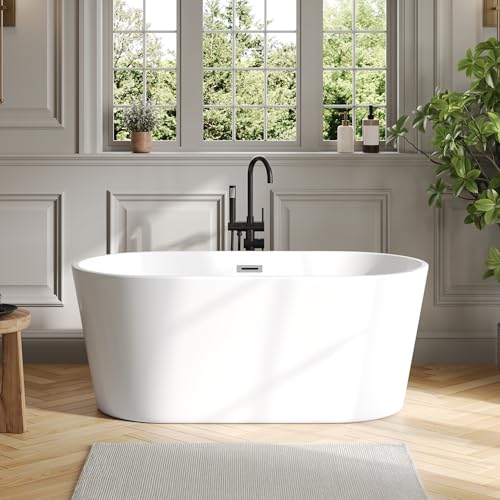
DeerValley 55 Inch Acrylic Freestanding Bathtub DV-1T0582 — Best Overall for Small Spaces
Fifty-five inches is the length at which a freestanding tub stops being a renovation fantasy and starts fitting real bathrooms — the alcove left by a standard tub, the corner of a compact ensuite, the reclaimed half of a laundry-bath combo. DeerValley’s DV-1T0582 builds its case on exactly that footprint, pairing it with a deep-soaking design, a center drain and an integrated overflow per the verified listing. The center drain is a small-space feature in disguise: it lets either end of the tub serve as the backrest end, which gives you freedom in orienting the tub against the room’s constraints, and it suits the shorter, deeper soak posture these tubs are designed around. The ergonomic standalone silhouette keeps the visual lightness that makes a small room feel bigger rather than built-in.
Strengths
- True 55-inch footprint fits alcoves and compact ensuites
- Center drain allows flexible orientation in tight layouts
- Deep-soaking design with integrated overflow
Trade-offs
- At 55 inches, tall bathers soak upright rather than fully reclined
- Acrylic needs non-abrasive cleaning to keep its gloss
- Freestanding filler (floor-mount or wall-mount) is a separate planning item
Key specs (from the verified listing): 55 inches; acrylic; deep soaking; center drain; integrated overflow; white; model DV-1T0582.
This is the default recommendation for the reader this search describes: a small bathroom, a desire for a real soak, and no appetite for structural heroics. It suits bathrooms replacing a standard 60-inch alcove tub where five saved inches buy breathing room, and ensuites where the tub shares space with a vanity and a door swing. It is less suited to bathers over six feet who define soaking as full-length submersion — physics is physics — and to anyone unwilling to plan the filler, because a freestanding tub without a considered filler solution is a beautiful bucket. Measure your space with the method in the guide below, decide the filler before ordering, and this tub is the category’s most reliable answer.
Best for: most small bathrooms wanting a genuine freestanding soak / Not suited for: very tall bathers needing full-length recline
Check the current price on Amazon

Empava 59 Inch Freestanding Bathtub, Acrylic Deep Soaking — Best Deep Soak
If your bathroom can stretch to 59 inches, Empava spends those inches on the dimension small-tub bathers actually feel: depth. The verified listing states a 15-inch deep soak, ergonomic back support, an anti-slip bottom and cUPC certification, with drain and overflow included. Depth is the correct currency in compact tubs because water coverage — not tub length — is what makes a soak feel luxurious; a deep 59-inch tub covers more of a seated bather than a shallow 67-inch one. The ergonomic backrest angle matters in the same way: in a shorter tub you sit more upright, so the back’s slope decides whether the posture feels supported or slumped, and Empava designs explicitly for that seated soak.
Strengths
- Stated 15-inch soak depth — real water coverage in a compact shell
- Ergonomic back support shaped for seated soaking
- Anti-slip bottom and cUPC certification; drain and overflow included
Trade-offs
- 59 inches still excludes the tightest bathrooms — measure first
- Deep tubs are a higher step-over; consider mobility honestly
- Deep soaks use more hot water per bath than shallow ones
Key specs (from the verified listing): 59 inches; acrylic; 15-inch deep soak; ergonomic back support; anti-slip bottom; cUPC certified; drain and overflow included.
Choose the Empava if soaking is a ritual rather than an occasional event — the evening bath as a practice — and your room can give it the 59 inches. It suits average-height bathers best, who get the full benefit of the depth without needing length, and households where the tub doubles as a kids’ bath, where depth plus an anti-slip bottom is a genuinely useful combination. It is less suited to bathers with limited mobility, for whom the deep step-over deserves a frank assessment, and to bathrooms where the extra four inches over the DeerValley simply do not exist. Hot water capacity is the hidden check: a deep tub filled near the overflow can challenge a small water heater, so know your tank before you fall in love with depth.
Best for: devoted soakers with 59 inches to give / Not suited for: limited-mobility bathers or the very tightest rooms
Check the current price on Amazon

WOODBRIDGE 59 Inch Acrylic Freestanding Bathtub B0014-MB — Best Contemporary Design
WOODBRIDGE is one of the names that built the modern freestanding category, and the B0014 in its 59-inch form is its compact standard-bearer — here in the MB configuration, which the verified listing specifies as the white acrylic shell finished with matte black overflow and drain trim. That trim detail is the design story: in a small bathroom, the tub is the room, and hardware finish is one of the few styling levers available. Matte black against white acrylic reads contemporary and deliberate, coordinates with the black-fixture schemes dominating current remodels, and photographs like a boutique hotel. Under the styling, it is the same proven 59-inch contemporary soaking shell the line is known for.
Strengths
- Established freestanding specialist brand and shell design
- Matte black trim delivers a finished designer look out of the box
- 59-inch size balances soak room against small-space fit
Trade-offs
- Matte black fixtures show water spots and soap film more than chrome
- Match your filler finish to the trim or the design effect is lost
- As with all 59-inch tubs, the tightest bathrooms should look at 55
Key specs (from the verified listing): 59 inches; acrylic; contemporary soaking design; white shell with matte black overflow and drain; model B0014-MB.
Buy the WOODBRIDGE when the remodel has a design point of view — black fixtures, a considered palette, a small bathroom meant to feel like a boutique ensuite rather than a compromise. It suits design-led renovators and anyone whose filler and fixtures are already matte black, because the tub completes the scheme instead of interrupting it. It is less suited to chrome-fixture bathrooms (the line offers other trims; check the listing’s options) and to buyers indifferent to finish, who can save with the GAOMON below. Small rooms amplify every finish decision, which is precisely why this pick exists: when the tub is the largest object in the room, its trim is a design decision whether you make it deliberately or not.
Best for: design-led small remodels with black fixtures / Not suited for: chrome schemes or finish-indifferent buyers
Check the current price on Amazon
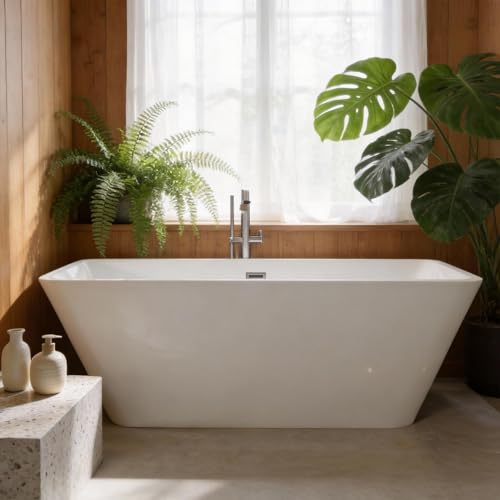
GAOMON 59 Inch Freestanding Acrylic Soaking Tub — Best Value
Not every small bathroom renovation has boutique money left for the tub, and the GAOMON exists for the honest version of the project: a 59-inch contemporary acrylic soaking tub with a non-slip surface and the overflow and drain included, at the accessible end of this category’s pricing (check price on Amazon). The specification covers what matters — deep soaking format, standalone contemporary shape, the wet hardware in the box — without charging for brand heritage or designer trim. In a category where freight and fixtures inflate every budget, a tub that arrives with its drain and overflow included removes two of the surprise line items that ambush first-time renovators.
Strengths
- Accessible tier for a full-size compact soaking tub
- Overflow and drain included — fewer surprise purchases
- Non-slip surface is a practical family feature
Trade-offs
- Less established brand support than the category leaders
- Finish and detailing are a step below the design picks
- Inspect carefully on delivery; value freight items reward a thorough unboxing check
Key specs (from the verified listing): 59 inches; acrylic; deep soaking; non-slip surface; overflow and drain included; contemporary standalone design.
Choose the GAOMON for rental upgrades, first remodels, and any project where the budget is honestly spoken for by plumbing, tile and the filler — the invisible items that decide whether the renovation works at all. It suits landlords converting alcove baths to a more rentable freestanding look and homeowners who would rather spend on installation quality than on a badge. It is less suited to forever-home masterpieces where the tub is a decade-long centerpiece and finish depth matters daily. Whatever tier you buy, the advice is the same: photograph the tub at unboxing from every angle before the installer touches it, because freight claims have deadlines and acrylic flaws are easiest to document in the driveway.
Best for: budget-conscious remodels and rental upgrades / Not suited for: centerpiece forever-bathrooms
Check the current price on Amazon

Cedar Japanese Soaking Tub, Freestanding Wooden Bathtub, 47.24in — Best Ultra-Compact
When even 55 inches is too much, the answer is not a smaller version of a Western tub — it is a different tradition entirely. The Japanese ofuro is a deep, compact soaking vessel designed for sitting immersed to the shoulders, and this cedar example runs just 47.24 inches while including the accessories that define the format per the verified listing: a lid, armrests, a bench and a headrest, with its drain. The bench is the key: you sit on it, upright, in water far deeper than any reclining tub of this footprint could hold, and the soak becomes about immersion and heat rather than length. Cedar adds the sensory dimension — natural wood, warm to the touch, aromatic — that acrylic cannot imitate.
Strengths
- 47.24-inch footprint fits spaces no conventional tub can
- Deep upright immersion — the most water coverage per inch in this list
- Natural cedar with lid, bench, armrests and headrest included
Trade-offs
- Wood requires real care: rinsing, drying and humidity discipline
- The upright seated soak is a different experience from reclining — know your preference
- Not a family or two-person tub; this is a solo ritual vessel
Key specs (from the verified listing): 47.24 inches; natural cedar; freestanding wooden soaking tub; lid, armrests, bench, headrest and drain included.
Buy this tub if your space is genuinely tiny — a converted closet bath, a narrow ensuite, a garden-room spa corner — or if the ofuro ritual itself is the desire: the deep, hot, seated soak as a daily practice. It suits solo bathers, small-statured bathers especially well, and anyone building a Japanese-inspired bathroom where it becomes the room’s soul. It is not suited to households wanting a conventional family tub, to bathers who soak to recline and read, or to anyone unwilling to maintain wood — cedar forgives much, but it asks to be rinsed, aired and respected. In exchange, it offers the deepest soak on this list inside the smallest footprint: the purest expression of what small-space tub design is for.
Best for: the tiniest bathrooms and ofuro devotees / Not suited for: family bathing or low-maintenance briefs
Check the current price on Amazon

OGOLUOG Cedar Wood Soaking Tub, Freestanding Wooden Bathtub — Best Wooden Spa Tub
The OGOLUOG takes the wooden soaking idea and scales it toward the spa end of the market: a cedar freestanding tub sized across a 55–63 inch range in the verified listing, described as a double-person spa bath, and — unusually — arriving with a brass faucet and hand shower included. That inclusion matters more in this category than most: freestanding fillers are a separate, often expensive decision, and a wooden tub with its brass hardware in the box arrives as a coherent object rather than a kit of problems. The cedar construction brings the same warmth and aroma as the compact ofuro, in a form that can anchor a larger small bathroom or a dedicated soaking room.
Strengths
- Cedar spa character in a range of sizes including double-person
- Brass faucet and hand shower included — a complete package
- Wood insulates naturally, keeping soak water warm longer
Trade-offs
- Confirm the exact size variant on the listing before ordering — the range spans 55–63 inches
- Wood care requirements apply, at a larger scale
- A filled double tub is heavy: floor structure must be assessed
Key specs (from the verified listing): cedar wood; freestanding; 55–63 inch size range; double-person spa positioning; brass faucet and hand shower included.
Choose the OGOLUOG for a spa-bathroom project, a primary ensuite with room for the larger variants, or an indoor-outdoor soaking space where cedar’s character belongs. It suits couples who soak together and renovators building a room around the tub rather than fitting a tub into a room. It is less suited to the genuinely tiny bathrooms that are this search’s core — at its larger sizes it exits the small-space brief, so select the smallest variant your space honestly fits — and to low-maintenance households. As with the compact cedar, commit to the wood-care routine described below before you commit to the tub; owners who do find the ritual part of the pleasure, and owners who will not should buy acrylic and be happy.
Best for: spa-style projects and couples’ soaking / Not suited for: the tightest rooms or hands-off owners
Check the current price on Amazon
Comparison Table
| Pick | Badge | Key spec | Best for |
|---|---|---|---|
| DeerValley 55in DV-1T0582 | Best Overall for Small Spaces | 55in acrylic, center drain, deep soak | Most small bathrooms |
| Empava 59in Deep Soaking | Best Deep Soak | 59in acrylic, stated 15in soak depth, cUPC | Devoted soakers |
| WOODBRIDGE 59in B0014-MB | Best Contemporary Design | 59in acrylic, matte black trim | Design-led remodels |
| GAOMON 59in Soaking Tub | Best Value | 59in acrylic, drain included, non-slip | Budget remodels |
| Cedar Japanese Soaking Tub | Best Ultra-Compact | 47.24in cedar ofuro, bench and lid | Tiniest spaces |
| OGOLUOG Cedar Soaking Tub | Best Wooden Spa Tub | Cedar, 55–63in, brass faucet included | Spa projects, couples |
How to Measure a Small Bathroom for a Freestanding Tub
Measure the room, not the hope. Start with the footprint: length and width of the space the tub will occupy, then subtract the clearances a body needs — you must be able to step in and out, towel off, and clean behind and around the tub, which in practice means several inches between tub and wall on at least the access side, and enough room at one end to stand. Mark the tub’s outline on the floor with painter’s tape at the dimensions of the model you are considering — 55, 59 or 47.24 inches from this list — and live with the tape for a day. Walk the room’s real paths: door swing, toilet approach, vanity drawers. Tape is the cheapest renovation tool ever made, and it has saved more small bathrooms than any product.
Then measure the vertical and the invisible. Step-over height matters for every user in the household, and deep small tubs are tall by design. The drain’s position relative to your floor drain decides whether the install is simple or surgical — center-drain and end-drain tubs are not interchangeable without plumbing work, so locate your existing drain and compare before choosing. Floor strength is the third invisible: a filled tub concentrates serious weight on a small footprint, and in older homes or upper floors a quick structural sanity check by a professional is money well spent. Finally, measure the route the tub travels to reach the room — doorways, stair turns, hallway corners. A 59-inch tub that cannot make the turn at the landing is a lawn ornament.
Fillers, Drains and the Plumbing Decisions That Come First
A freestanding tub is only as good as its filler plan, and small rooms narrow the options. Floor-mounted fillers are the showpiece solution — a standing pipe beside the tub — but they need floor space and underfloor access, both precious in compact bathrooms. Wall-mounted fillers with a long spout reach work beautifully when the tub sits near a wall, which in small rooms it usually does, and they keep the floor clear for cleaning. Hand-shower combinations add rinsing and cleaning utility that small-bathroom owners end up valuing daily; note that the OGOLUOG cedar tub includes a hand shower in the box, a package decision worth imitating even if you buy acrylic — plan the hand shower now, not after the tile closes.
Drainage deserves equal foresight. Confirm whether the tub’s drain position can meet your existing waste line with a legal, serviceable connection, and whether the overflow is integrated (as on the DeerValley) or a separate assembly. In small bathrooms, access is the hidden theme of every plumbing decision: the connection you cannot reach is the connection that will eventually leak unobserved. A competent installer who has placed freestanding tubs in tight rooms is worth more than any single product upgrade in this guide — interview for that specific experience, and let their eyes check your tape outline before the tub ships.
Acrylic vs Cedar: Choosing Your Small-Tub Material
Acrylic is the default for good reasons: it is light (which your floor and your delivery route both appreciate), warm to the touch compared with enamelled metal, repairable for minor scratches, and moldable into the deep, compact shapes this category depends on. Its care is simple — non-abrasive cleaners, no scouring pads — and its gloss is the contemporary bathroom look. Four of this list’s six picks are acrylic because for most small bathrooms it is simply the correct answer.
Cedar is the romantic alternative with a real functional case: wood insulates, so soak water holds its heat noticeably longer; the surface is warm and grippy; and the aroma turns a bathroom into a place. The cost is stewardship — rinsing after use, drying discipline, attention to humidity, and acceptance that wood is a living finish that will silver and mark with honorable use. Choose cedar when the ritual is the point and the footprint demands it (the 47.24-inch ofuro) or when the room is a spa project (the OGOLUOG). Choose acrylic when the tub must serve a busy household with minimal ceremony. Neither choice is a compromise; they are different relationships with the same water.
How to Install and Settle a Freestanding Tub in a Small Space
- Confirm the tape outline one last time: tub footprint, clearances, door swing and cleaning access, checked against the delivered tub’s actual dimensions before any plumbing is touched.
- Prepare the floor: level, sound and finished — a freestanding tub shows its floor line, and small rooms show everything. Address slope and squeaks now.
- Set the drain connection: align the tub’s drain with the floor waste using the manufacturer’s specified tailpiece and a flexible or adjustable connector where the design allows, so the tub can be positioned precisely in its tight footprint.
- Level and secure: adjust the tub’s feet or base until it sits perfectly level — an unlevel tub pools water at one end and stresses its drain seal — then secure per the maker’s instructions.
- Connect the filler and test everything: fill to the overflow, hold, and inspect every joint from below or behind before the room is closed up. In a small bathroom, a slow leak has nowhere to hide for long — test like you mean it.
- Seal the base line if specified: some installs call for a bead of silicone where tub meets floor to stop mop water migrating underneath; follow the maker’s guidance for your model.
After installation, live gently for the first week: check under and around the tub after the first few fills, snug nothing that is not meant to be snugged, and keep the installer’s number until the tub has proven itself through a dozen baths.
Caring for Acrylic and Cedar Tubs
Acrylic care is a short catechism: rinse after use, clean with a soft cloth and non-abrasive cleaner, keep gritty powders and stiff brushes for other surfaces, and address scratches early with the maker’s recommended polishing approach rather than household abrasives. In small bathrooms, ventilation is part of tub care — a room that dries fully between baths protects grout, trim finishes like the WOODBRIDGE’s matte black, and the tub’s own seal lines from the mildew that cramped, steamy rooms breed.
Cedar care is a rhythm rather than a chore list. Rinse the tub with clean water after soaking, leave the lid off (or ajar, per the maker’s guidance) until the wood dries, and keep the room’s humidity honest with ventilation. Wooden tubs prefer regular use — a cedar tub left dry for months can open at the seams, while one used weekly stays swelled and true; if the tub must sit unused, ask the maker about their recommended keeping routine. Never use harsh chemical cleaners inside cedar; warm water and a soft brush are the tradition, and the tradition is why old ofuro last decades. Both materials reward the same final habit: fix small things — a dripping filler, a tired seal — immediately, because in a small bathroom every problem is close to everything else.
Small Bathroom Layouts That Make a Freestanding Tub Work
Three layouts account for most successful small-bathroom tub installs, and recognizing yours simplifies every later decision. The alcove conversion is the most common: a standard tub comes out, a 55 or 59-inch freestanding tub goes into the same zone, the wall filler stays on the end wall, and the inches saved become a sliver of storage or simply air. This layout is why the DeerValley and the other compact acrylics exist, and it usually needs the least new plumbing. The corner placement suits square-ish small rooms: tub angled or aligned in a corner, wall-mounted filler on the adjacent wall, and the room’s center kept clear so it breathes. The wet-room layout — tub and open shower sharing a waterproofed zone — is the boldest and often the best for truly tiny bathrooms, because it deletes the shower enclosure entirely and lets the tub occupy space that serves two functions; it demands proper waterproofing and drainage design, so it is a professional’s project, not a weekend one.
Whichever layout you choose, two small-room rules apply. Keep the tub’s long axis parallel to the room’s long axis unless the corner layout genuinely fits better — diagonal tubs in small rooms photograph dramatically and function awkwardly. And protect a dry landing zone: one step’s worth of floor beside the tub where a bather can stand, dry and dress without negotiating fixtures. Rooms that respect the landing zone feel luxurious at any size; rooms that do not feel cramped at any size.
Showering in a Small Freestanding Tub: The Honest Answer
Many small bathrooms ask the tub to double as the shower, and freestanding tubs answer that request grudgingly. A compact deep tub is a wonderful soaking vessel and an awkward shower stall: the footprint is short, the walls are sloped, and without an enclosure the water goes where it pleases. Households solve this three ways. The first is the ceiling- or wall-mounted curtain ring that encloses the tub for showering — functional, a little theatrical, and the standard historic solution. The second is the wet-room approach described above, where escaping water is a design feature rather than a failure. The third, and the one this guide recommends where space allows, is honesty: keep a separate compact shower if the room can hold one, and let the tub be a tub.
If showering in the tub is unavoidable, choose accordingly: a hand shower (included with the OGOLUOG, an easy addition to the acrylics) makes rinsing both bather and tub far more controlled than an overhead spray in a small shell, and an anti-slip interior surface like the Empava’s and GAOMON’s stops being a nice feature and becomes the point. Set the water controls where they can be reached from outside the tub — in a small room that usually means the end wall — and accept a slightly theatrical curtain as the price of a genuine soak the rest of the week. Most owners who plan this way report the compromise fades from notice within a month.
What a Small Freestanding Tub Costs to Own, Beyond the Tub
Budget honesty is a feature of this guide, so here is the whole project in one place — in tiers, not prices, because every figure moves by region and by week. The tub itself is often less than half the project. The filler is the next line: a wall-mounted spout is the economical route, a floor-mounted filler the premium one, and included hardware (as with the OGOLUOG) deletes the line entirely. Plumbing labor follows, scaled by how far the drain and supplies must move — an alcove conversion that keeps every connection in place is a different project from a corner relocation. Floor work ranges from nothing to structural reinforcement. And the finishing layer — the curtain ring or wet-room waterproofing if the tub showers, the sealant, the bath mat that fits the new footprint — is small money that buyers forget until the end.
Ownership costs after install are modest but real: deep tubs use more hot water per soak than shallow ones, so a household of daily soakers should know its water heater’s recovery; acrylic asks for the right cleaners rather than expensive ones; cedar asks for time rather than money. Against those costs, weigh what the category returns: in small homes, a genuine soaking tub is one of the few upgrades that changes how a house feels every single week, and realtors consistently rank a well-executed bathroom among the rooms that carry a resale. Bought with the planning this guide insists on, a compact freestanding tub is not the risky indulgence it appears — it is the rare renovation that pays its owners nightly.
Common Buying Mistakes
- Measuring the tub, not the room: footprint plus clearance plus door swing plus delivery route — all four decide fit. Tape the outline and live with it.
- Choosing length over depth: in small tubs, water coverage comes from depth and posture. A deep 55 can out-soak a shallow 65.
- Forgetting the filler: a freestanding tub with no filler plan is a sculpture. Decide floor-mount, wall-mount or included hardware before ordering.
- Ignoring drain position: center and end drains meet floors differently. Match the tub to your waste line or budget the plumbing change.
- Skipping the floor check: filled tubs are heavy and concentrated. Upper floors and older joists deserve a professional opinion.
- Ordering before the installer sees the room: a site visit costs little and catches the drain offset, the floor dip and the doorway turn that listings cannot. Ship the tub after the room has been approved for it, not before.
- Buying cedar without the care commitment: wood is a relationship. If rinsing and drying discipline sounds like a burden, acrylic will make you happier.
Final Recommendation
For the typical small bathroom, the answer is the DeerValley 55-inch: the footprint that fits, the depth that matters, and the flexible center drain. If you have 59 inches and soaking is your ritual, step up to the Empava for depth or the WOODBRIDGE for design; if the budget is spoken for by plumbing and tile, the GAOMON covers the brief honestly. And if your space defeats even 55 inches — or your heart is set on the deep, seated, steaming soak — the cedar ofuro at 47.24 inches is not a compromise at all, but the original small-space answer, with the OGOLUOG waiting when the project grows into a spa. Measure with tape, plan the plumbing first, and the smallest room in the house can hold its best hour of the day.
Related guides in this series: Best Freestanding Tubs · Best Soaking Tubs · Best Tubs For Small Bathrooms · Best Japanese Soaking Tubs · Best Acrylic Freestanding Tubs
Related guides
Frequently Asked Questions
Can a freestanding tub really work in a small bathroom?
Yes — that is exactly the segment this guide covers. Compact models at 55 and 59 inches fit where standard alcove tubs came out, and Japanese soaking tubs fit in under 48 inches by trading length for depth. The conditions are honest measurement, a planned filler, and acceptance that the soak posture in a compact tub is more upright than in a long one.
Is a 55-inch tub big enough for an adult?
For seated soaking, yes for most adults: small tubs are designed around a semi-reclined or upright posture with deep water coverage rather than full-length floating. Very tall bathers should favor the deepest designs and the ofuro format, where immersion depth compensates for length, and should sit in a showroom equivalent if possible before committing.
What is the difference between a soaking tub and a regular tub?
Depth and intent. A soaking tub is built deeper with a higher overflow so the bather can immerse to the shoulders, usually with a simpler interior shaped for sitting rather than showering. Regular tubs are shallower, longer compromises between bathing and showering. In small spaces the soaking format wins because depth uses vertical room the bathroom already has.
Do freestanding tubs need a special faucet?
They need a filler that reaches them: a floor-mounted freestanding filler, a wall-mounted spout with enough reach, or a tub with included hardware like the OGOLUOG’s brass faucet and hand shower. A standard alcove tub’s wall filler often will not reach a freestanding tub set away from the wall, so the filler must be planned — and budgeted — with the tub.
How heavy is a filled small freestanding tub?
Water dominates the math: even compact tubs hold enough water that tub, water and bather together concentrate several hundred pounds on a small footprint. Most modern floors handle this without drama, but older homes, upper floors and the larger double-person cedar should get a professional structural opinion before installation. It is a cheap check against an expensive regret.
Can I put a freestanding tub where my alcove tub was?
Usually, yes — the alcove conversion is the most common small-bathroom route, and compact 55 and 59-inch models are sized for it. The checks are the drain position (alcove tubs drain at one end; a center-drain freestanding model may need the waste line adjusted), the filler reach from the end wall, and the finished look of the alcove walls, which the freestanding tub will expose rather than hide. None of these is a deal-breaker; all of them belong in the plan before the old tub comes out.
Are wooden soaking tubs hard to maintain?
They ask for rhythm, not labor: rinse after use, let the wood dry between soaks, ventilate the room, and use the tub regularly so the wood stays swelled and sealed. Owners who soak weekly find the routine invisible. Owners who want a fit-and-forget fixture should choose acrylic, which is why this guide offers both and labels the commitment honestly.


