Disclosure: airfryerkitchensupply.com is reader-supported. When you buy through links on our site, we may earn an affiliate commission at no extra cost to you.
Where to buy
Every squeegee in this guide to the best squeegee for bathtubs was cross-checked against the live Amazon catalogue before it earned a place here. Most households should start with the OXO Good Grips Stainless Steel Squeegee; if your tub is deep or your surround tall, go straight to the OXO Good Grips Aluminum Extendable Squeegee. We never print product prices — they change too often to stay honest — so use the check-price links throughout this guide instead.
The Best Squeegee for Bathtubs Is the One That Matches Your Tub’s Shape
The best squeegee for bathtubs is not simply the best shower squeegee with a different label, and the first hundred words of this guide should explain why. A shower door is flat, vertical and easy to reach. A bathtub is none of those things: its inner walls curve, its surround mixes tile, grout and sometimes glass, its far side can be a genuine stretch, and the ledge collects standing water that feeds the pink film and black mildew lines every bather recognises. The right tool depends on which of those problems your bathroom actually has, which is why this roundup is organised by tub problem rather than by brand.
Here is the market reality. Squeegees are sold almost entirely as shower-door tools, so “for bathtubs” is a use you have to read into the specifications: blade material decides whether the edge follows a curve, handle length decides whether you can reach the far wall, and storage decides whether the tool is in your hand after every bath or lost behind the shampoo bottles. A thirty-second wipe after each use prevents more grime than any monthly scrub, because hard-water spots and soap scum are simply water that was allowed to dry in place. Remove the water and the cleaning problem mostly removes itself.
Our six picks cover the full spread: a benchmark all-rounder, a budget metal squeegee, an all-silicone specialist for curved tub walls, a weighted foldaway design for small bathrooms, an extendable model for deep tubs and tall surrounds, and an everyday value pick with the storage hook included. Every one was verified against Amazon’s catalogue; the badges tell you which tub problem each one solves best.
One clarification before the picks: no squeegee cleans a dirty tub. If your surround already carries scale, soap build-up or mildew, clean it properly first — the squeegee’s job begins the day the surface is clean, and its job is to keep it that way with almost no effort. Buyers who expect a blade to undo months of deposits will judge every tool here unfairly; buyers who start clean will wonder why they ever scrubbed.
In this guide
Quick Picks
Best Overall — OXO Good Grips Stainless Steel Squeegee: The benchmark shower squeegee: a flexible silicone blade on a stainless handle that wipes tile, glass and the flat walls of a tub-shower in clean, quiet passes, and hangs from the included suction hook.
Best Budget — Hiware All-Purpose Shower Squeegee, 10 Inches: A stainless-steel squeegee at a fraction of the premium brands’ cost, with a 10-inch blade that covers a tub wall quickly and an adhesive hook for storage.
Best for Curved Tub Walls — MR.SIGA Silicone Squeegee for Shower Doors, 10 Inch: An all-silicone squeegee whose soft, pliable blade bends around the curved inner walls and rounded corners of a bathtub instead of bridging over them.
Best Compact and Weighted — simplehuman Foldaway Shower Squeegee: A die-cast, weighted squeegee that folds flat against the wall, wipes with authority thanks to its mass, and stores on a suction hanger in almost no space.
Best Reach for Deep Tubs and Tall Surrounds — OXO Good Grips Aluminum Extendable Squeegee: OXO’s extendable aluminium squeegee lengthens the handle so you can dry the far wall of a deep tub and the top of a tall surround without climbing in or stretching.
Best Everyday Value with Hook — AmazerBath Squeegee for Shower Glass Door, 10 Inches: A 10-inch all-purpose squeegee with an ergonomic handle and included hook, covering shower doors, tub walls, mirrors and tile at an everyday tier.
How These Picks Were Chosen
We chose these six the way a plumber’s merchant would, not the way an advertising page would. First, every candidate had to be a real, currently listed product, verified with its title matched to the tool we describe — no renderings, no placeholder listings. Second, we weighted blade material above all else, because blade behaviour is what separates a squeegee that dries a tub surround from one that merely pushes water around: silicone edges flex into grout and around curves, firmer rubber edges are crisper on flat glass but skip on texture. Third, we scored the tub-specific factors most roundups ignore — reach across a deep tub, gentleness on enamel and acrylic, and whether storage hardware is included, because a squeegee that lives in the shower gets used and one that lives in a cupboard does not.
We deliberately left out long-handled floor squeegees (wrong tool, wrong angle for tub walls), wooden-handled novelty designs whose blades cannot be assessed, and any listing whose catalogue title did not clearly match a bathroom squeegee. Where a pick has a genuine weakness — a short handle, a firm blade, a premium price — it is stated in its trade-offs, not buried.
We also considered how each tool behaves in the specific geometry of a tub: the end walls of an alcove installation, the ledge where bottles stand, the curve at the base of the surround, and the outer apron of a freestanding tub that drips onto the floor. Picks earned their badges against those surfaces, not against an idealised glass box — which is why a foldaway design and an all-silicone design appear here alongside the conventional leaders.
The 6 Best Squeegees for Bathtubs

1. OXO Good Grips Stainless Steel Squeegee — Best Overall
If your bathtub lives inside a shower — the alcove tub-and-shower combination most homes actually have — this is the squeegee that sets the standard the others are measured against. The blade is soft silicone rather than hard rubber, so it stays supple, hugs slightly uneven tile and grout lines, and does not develop the nicks that make cheaper blades leave streaks after a few months.
Strengths
- Flexible silicone blade conforms to tile, grout and glass without chattering
- Stainless steel handle has real heft, so the blade tracks straight with light pressure
- Suction-cup hook stores it inside the shower, inside arm’s reach of the tub
Trade-offs
- Costs more than the plastic squeegees it outperforms
- Suction hook loses grip on textured tile; a smooth tile or glass surface holds it best
- Blade width suits walls and doors better than the curved floor of the tub itself
| Blade | Silicone, flexible |
| Handle | Stainless steel |
| Storage | Suction-cup hook included |
| Surfaces | Glass, tile, mirror, tub walls |
What separates this OXO from the bargain bin is blade behaviour on real bathroom surfaces. A bathtub surround is rarely one flat plane: it is tile with grout recesses, a tub ledge, a curved transition where wall meets tub deck. A stiff rubber blade bridges those recesses and leaves water behind in every grout line; the OXO’s silicone edge flexes into them, so a single top-to-bottom pass genuinely dries the wall. Used after every shower, that is the difference between a surround that needs a deep clean monthly and one that needs it a few times a year, because hard-water film and soap scum form on water that was left standing. The handle length is the one honest limitation for tub work: it is a wall-and-door tool first, and for scrubbing reach across a wide soaking tub you will lean in. For the standard tub-shower, though, nothing in this roundup balances blade quality, build and storage as completely.
One more ownership point in its favour: the blade is the wear part on any squeegee, and on this OXO the edge holds its profile through years of daily use because silicone does not take a permanent set the way rubber does. Hang it by its hook rather than resting it on the blade and it will still be wiping clean when cheaper tools bought alongside it have been replaced twice. That longevity is the real economy in this category — the cost per year of the benchmark tool is lower than the cost per year of the disposable ones.
Best for: daily drying of a tub-shower surround and glass door / Not suited for: reaching across an extra-deep soaking tub without leaning in
Check on Amazon: OXO Good Grips Stainless Steel Squeegee — check the current price on Amazon.

2. Hiware All-Purpose Shower Squeegee, 10 Inches — Best Budget
Hiware’s 10-inch squeegee is the pick for anyone who wants the metal-build feel of the premium tools without paying premium money. The frame and handle are stainless steel, the blade is a replaceable-style rubber edge, and it ships with an adhesive hook so it can live on the shower wall beside the tub where it will actually get used.
Strengths
- Stainless construction at a budget-tier price point
- 10-inch blade clears a standard tub wall in few passes
- Adhesive hook sticks where suction cups fail, including some textured surfaces
Trade-offs
- Rubber blade is firmer than OXO’s silicone and can skip lightly on heavy grout texture
- Adhesive hook is semi-permanent; repositioning it is a one-way decision
- Handle is short, like most in this class
| Blade width | 10 inches |
| Handle | Stainless steel |
| Storage | Adhesive hook included |
| Surfaces | Glass doors, tile, tub walls, car glass |
The honest question with a budget squeegee is how the blade ages. Firm rubber blades work beautifully when new and gradually harden, especially in bathrooms cleaned with bleach sprays; when this one eventually starts to streak, it will be after long service, and at this tier most owners simply replace the whole tool. In daily use the Hiware feels closer to the OXO than its price suggests: the metal handle keeps the blade planted, the edge is straight and even, and the 10-inch width is the sweet spot for a tub surround — wide enough to be fast, narrow enough to work the corners where the tub meets the wall. Buy it as the household’s second squeegee or the first one for a rental bathroom; it is also cheap insurance to keep one in a guest bath that only gets used when family visits, because a dry surround is what keeps a little-used tub from smelling musty.
A note on sizing for tub work: the 10-inch blade is also the right length for the end walls of a standard alcove tub, where a 12-inch blade fouls the corners and a mini squeegee doubles your passes. If your surround is small mosaic tile, expect the firm blade to need a slower stroke so it can drop into the grout rhythm rather than skating across the tops of the tiles; on smooth porcelain and glass it is as fast as anything here.
Best for: budget-minded owners of a standard tub-shower / Not suited for: buyers who want a soft silicone blade for delicate glass coatings
Check on Amazon: Hiware All-Purpose Shower Squeegee, 10 Inches — check the current price on Amazon.
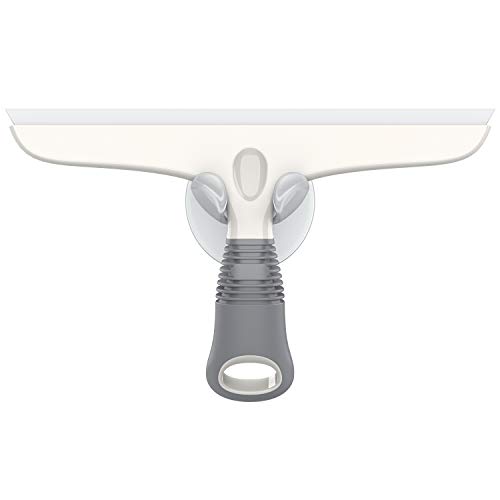
3. MR.SIGA Silicone Squeegee for Shower Doors, 10 Inch — Best for Curved Tub Walls
Most squeegees are designed for flat glass. A bathtub is not flat: its inner walls curve, its corners are rounded, and the apron of a freestanding tub bows outward. MR.SIGA built this tool almost entirely from silicone, so the blade — and to a degree the whole head — flexes as you pull it, following curves that make rigid blades skip and chatter.
Strengths
- Soft silicone blade conforms to curved tub walls and rounded corners
- One-piece silicone construction shrugs off water and resists mildew build-up
- Light and quiet in use; no metal edge to chip enamel if it slips
Trade-offs
- Flex that helps on curves gives slightly less crisp results on large flat glass
- White and grey silicone shows soap film, so it needs a rinse to stay looking clean
- No rigid handle leverage for heavy, dried-on water spots
| Blade | Silicone, 10 inch / 25 cm |
| Body | Silicone over core |
| Colour | White and grey |
| Surfaces | Curved tub walls, glass doors, tile |
Run a rigid squeegee down the inside wall of a soaking tub and watch what happens at the curve: the ends of the blade lift, water escapes underneath, and you make three more passes. The MR.SIGA’s blade keeps contact through that curve, which is why it earns a place here even though it would not be our first choice for a wall of flat shower glass. It is also the gentlest tool in this roundup on delicate surfaces — there is no metal anywhere near your tub’s enamel or acrylic finish, so a slip costs you nothing. Owners of freestanding tubs who wipe the outer apron to stop drips reaching the floor will find the same flexibility useful on the bowed exterior. Think of it as the specialist: if your problem surface is curved, this is the correct tool; if your bathroom is all flat glass and tile, the OXO above is the better all-rounder.
Care is part of this pick’s appeal. Soap film and body oils eventually coat any blade and make it drag; silicone tolerates a wash with ordinary dish soap and a soft cloth, and it does not crack if the bathroom runs cold in winter. The flexible head also makes it the safest choice around children helping with bathroom chores — no rigid edge, no metal, nothing to chip the tub if small hands drop it mid-wipe.
Best for: freestanding and soaking tubs with curved walls / Not suited for: large flat glass panels where a rigid blade is crisper
Check on Amazon: MR.SIGA Silicone Squeegee for Shower Doors, 10 Inch — check the current price on Amazon.

4. simplehuman Foldaway Shower Squeegee — Best Compact and Weighted
simplehuman approached the squeegee as an industrial-design problem: how do you make a tool people leave out in a beautiful bathroom? The answer is a weighted die-cast zinc handle that folds away flat, a blade that does the work with the tool’s own mass rather than your wrist pressure, and a suction hanger that keeps it hugging the wall.
Strengths
- Weighted handle keeps the blade planted with minimal hand pressure
- Folds flat for storage in small tub-showers and on narrow ledges
- Die-cast construction feels like a permanent fixture, not a consumable
Trade-offs
- Premium-tier cost for a hand tool
- Weight that helps on walls is tiring for long overhead reaches
- Fold mechanism is one more joint to rinse free of soap build-up
| Handle | Die-cast zinc, weighted, foldaway |
| Storage | Suction-cup hanger included |
| Blade | Flexible wiping edge |
| Surfaces | Glass doors, mirrors, tub surrounds |
Weight is an underrated squeegee specification. Water removal is about consistent blade contact, and a weighted head supplies that consistency for free: you guide the simplehuman rather than press it, which matters at the end of a long shower when you are wiping a whole tub surround. The foldaway design solves the real reason squeegees end up unused — storage. A tool that lives on the floor of the tub or balanced on the taps gets moved, dropped and forgotten; this one hangs flat against the wall, visibly part of the bathroom. It is the most expensive pick here and we will not pretend otherwise, but it is bought once, and for a primary bathroom renovated with any care it looks and works like it belongs there. For a small guest tub-shower where ledge space is precious, the fold-flat profile alone can justify it.
Ownership running costs are zero beyond the purchase: there is no blade cartridge system, no proprietary refill, nothing to subscribe to. The suction hanger deserves one caution — suction cups hold brilliantly on glass and glazed tile and poorly on matte or textured finishes, so check your wall before assuming the included storage will work; a smooth patch of the tub’s own end wall often serves if the tile will not.
Best for: primary bathrooms and small tub-showers short on storage / Not suited for: shoppers who see a squeegee as a disposable consumable
Check on Amazon: simplehuman Foldaway Shower Squeegee — check the current price on Amazon.

5. OXO Good Grips Aluminum Extendable Squeegee — Best Reach for Deep Tubs and Tall Surrounds
Every other pick in this roundup assumes you can reach the surface. Owners of deep soaking tubs, wide garden tubs and tall shower-over-tub surrounds know that assumption fails: the far wall is a stretch, the top rows of tile never get wiped, and water up there becomes the mildew line you scrub monthly. This OXO extends its aluminium handle to close that distance.
Strengths
- Extendable handle reaches far tub walls and high tile without a step stool
- Aluminium build keeps the longer tool light enough for control
- OXO blade quality: even, flexible edge for streak-free passes
Trade-offs
- Extended length is clumsy in a compact stall shower
- Costs more than fixed-handle models
- Long handle stores less neatly; needs a tall hook spot or the tub ledge
| Handle | Aluminium, extendable |
| Blade | Flexible wiping edge |
| Brand line | OXO Good Grips |
| Surfaces | Tall surrounds, deep tub walls, glass |
Reach changes the cleaning equation in a tub bathroom. The surfaces that grow mildew fastest are the ones that stay wet longest, and the ones that stay wet longest are the ones nobody can reach to dry — the top of the surround, the far wall behind a deep tub, the glass above the shower head’s spray pattern. An extendable squeegee turns a 30-second after-shower wipe into something that covers those zones too, which is worth more than any blade material upgrade. Used at full extension the tool asks for a slower, two-handed stroke; that is a fair trade. It also moonlights outside the bathroom — high windows, a conservatory roof panel, the inside of a car windscreen on a big vehicle — anywhere a short squeegee makes you climb. If your tub is standard depth and your surround standard height, the fixed OXO above is simpler; if you have been ignoring the top two feet of tile for years, this is your pick.
Technique adapts slightly at full extension: choke up on the handle for the lower two-thirds of the wall where you have leverage, then extend fully for the top rows and the far end wall, working in shorter strokes so the blade stays loaded evenly. The aluminium tube keeps the extended tool from feeling like a fishing rod, which is what ruins cheaper telescopic cleaners — flex at the head translates directly into missed water at the blade.
Best for: deep soaking tubs, garden tubs and tall surrounds / Not suited for: compact stall showers where the handle has nowhere to swing
Check on Amazon: OXO Good Grips Aluminum Extendable Squeegee — check the current price on Amazon.

6. AmazerBath Squeegee for Shower Glass Door, 10 Inches — Best Everyday Value with Hook
AmazerBath’s squeegee is the sensible middle of this roundup: a 10-inch blade, a shaped handle that is comfortable for the minute of wiping after a shower, and a hook in the box so it hangs where the habit forms. It is sold for shower doors, but its size and edge make it a natural fit for the walls of a tub-shower.
Strengths
- Comfortable shaped handle for daily one-minute wipe-downs
- Included hook encourages the store-it-where-you-use-it habit
- Versatile across glass, tile, mirrors and tub walls
Trade-offs
- Blade firmness sits between the Hiware and the silicone picks; heavy grout texture needs a second pass
- Hook adhesive performance varies with tile finish
- Less distinctive than the specialists here — a generalist by design
| Blade width | 10 inches |
| Storage | Hook included |
| Handle | Ergonomic grip |
| Surfaces | Glass, tile, mirrors, tub walls, car glass |
The best squeegee is the one that gets used every day, and AmazerBath seems to understand that the battle is behavioural rather than technical. The handle is shaped for a relaxed grip, the tool is light, the hook is in the box, and the whole thing asks nothing of you. Blade performance is honestly mid-pack: it clears flat glass and smooth tile in one pass, wants a second on deeply raked grout, and will not follow a tub curve like the MR.SIGA. But a mid-pack blade used daily beats a perfect blade used weekly, every time, because water spots and soap film are cumulative — they are the sum of what you left behind. Households outfitting two bathrooms often buy this one for the second bath after buying a premium pick for the first, and that is a rational allocation. It also travels well between tasks: bathroom mirror on Monday, car windows on Saturday.
For households comparing this against the Hiware above: the two tools look similar in a product photo and differ mainly in blade firmness and handle shaping over months of use. The AmazerBath’s grip is the more comfortable of the two for smaller hands, and its hook is the more forgiving on imperfect tile. Either is a rational budget buy; this one is the friendlier daily driver, the Hiware the slightly more industrial-feeling tool.
Best for: second bathrooms, rentals and anyone building the daily-wipe habit / Not suited for: curved tub walls, where the silicone specialist wins
Check on Amazon: AmazerBath Squeegee for Shower Glass Door, 10 Inches — check the current price on Amazon.
Comparison Table
| Pick | Badge | Key spec | Best for |
|---|---|---|---|
| OXO Good Grips Stainless Steel Squeegee | Best Overall | Silicone, flexible | daily drying of a tub-shower surround and glass door |
| Hiware All-Purpose Shower Squeegee, 10 Inches | Best Budget | 10 inches | budget-minded owners of a standard tub-shower |
| MR.SIGA Silicone Squeegee for Shower Doors, 10 Inch | Best for Curved Tub Walls | Silicone, 10 inch / 25 cm | freestanding and soaking tubs with curved walls |
| simplehuman Foldaway Shower Squeegee | Best Compact and Weighted | Die-cast zinc, weighted, foldaway | primary bathrooms and small tub-showers short on storage |
| OXO Good Grips Aluminum Extendable Squeegee | Best Reach for Deep Tubs and Tall Surrounds | Aluminium, extendable | deep soaking tubs, garden tubs and tall surrounds |
| AmazerBath Squeegee for Shower Glass Door, 10 Inches | Best Everyday Value with Hook | 10 inches | second bathrooms, rentals and anyone building the daily-wipe habit |
How to Choose a Squeegee for a Bathtub
Choosing for a tub rather than a shower door changes three decisions: blade material, handle length and storage. Get those right for your bathroom and almost any well-made tool will serve you; get them wrong and even an expensive squeegee becomes clutter.
Blade material: silicone for curves, rubber for flat glass
Silicone blades stay flexible for years, flex into grout recesses and follow the curved inner wall of a tub. They are the correct default for bathtubs. Firmer rubber blades can be marginally crisper on a big flat glass door, but they harden with age and chemical exposure, and on tile they bridge the grout lines and leave water standing in every recess — exactly the water that becomes scum. If your surround is smooth large-format tile or glass, either works; if it is small tiles, heavy grout or a curved tub, choose silicone.
Blade width and handle reach
Ten inches is the versatile width: fast on walls, still able to work corners and the tub ledge. Wider blades are quicker on a big glass panel but clumsy around taps and shower fittings. Handle length matters more in a tub bathroom than anywhere else. Measure your real reach: stand where you stand after a bath and check whether you can touch the far wall and the top row of tile. If not, an extendable handle is not a luxury — it is the difference between a surround that gets dried and one that does not.
Storage decides whether you use it
Every pick here includes or supports in-shower storage, and that is deliberate. The after-bath wipe only happens if the squeegee is hanging within arm’s reach. Suction hooks need a smooth surface — glass or glazed tile. Adhesive hooks work on more finishes but commit you to a spot. A fold-flat design suits ledges and narrow tub-shower combos. Choose the storage that fits your wall, and mount it before the squeegee arrives, not after.
Protecting the tub itself
If your tub is acrylic, enamelled steel or a refinished surface, keep metal away from it: an all-silicone tool like the MR.SIGA Silicone Squeegee cannot chip or scratch the finish if it slips from a wet hand. Metal-handled tools are fine on tile and glass, but store them hanging, not resting in the tub.
What about the tub floor and textured anti-slip surfaces?
Do not chase the tub floor with a wall squeegee. Textured anti-slip bases defeat any blade, and standing water there is better handled by the shower’s own drainage and an occasional rinse. The squeegee’s territory is the walls, surround, glass, ledge and the smooth upper inner walls of the tub — the surfaces that dry slowest and show spotting first. Accept that division of labour and the tool will never disappoint you.
One squeegee per bathroom, not per house
Squeegees fail as a system when they are shared between bathrooms, because the tool is never where the wet wall is. They are inexpensive enough — even the premium picks here sit in the small-tools tier — that one per tub or shower is the correct allocation. The second bathroom’s tool can be a budget pick; what matters is that it hangs in that room. Households that adopt the one-per-room rule report the habit sticks; households that share one tool between floors quietly stop wiping altogether within a month.
When to replace the blade or the tool
Judge by the edge, not the calendar. Run a fingertip lightly along the blade: nicks, waves or a hardened, glossy feel all mean the edge is no longer sealing against the surface. Silicone blades typically serve for years; firm rubber blades in hard-water, bleach-cleaned bathrooms may give a year or two. A squeegee that needs three passes where it once needed one is not asking for more pressure — it is asking to be retired.
Why Drying the Tub Works: Water, Minerals and Mildew
Every problem a squeegee prevents starts as standing water. Tap water carries dissolved minerals; as a droplet dries on tile or glass it leaves those minerals behind as a microscopic ring, and thousands of rings become the cloudy film people call water spots. On the tub itself the same evaporation concentrates soap residue and skin oils into the tacky layer that traps dirt and turns grey. None of this requires harsh chemistry to prevent — it requires the water to not be there. A squeegee is a mechanical solution to a chemical problem, which is why it outperforms sprays used occasionally.
Mildew follows the same logic with one addition: it needs a food source and a persistently damp surface. The sealant line where tub meets wall is the classic site because it is the last place to dry and the first place soap residue collects. Wiping that line after each use removes both the moisture and much of the residue, and bathrooms where this is routine simply do not grow the black seam that other households attack with bleach every month. Pink film — actually a bacterial growth that thrives in damp, soapy corners — is controlled the same way.
Hard-water households benefit most of all. The harder the water, the faster mineral film builds, and the more a thirty-second daily wipe outperforms a monthly descale. If your kettle furs up, your tub surround is doing the same thing more slowly; the squeegee is the kettle-descaler habit applied to the bathroom, except it prevents the scale instead of dissolving it.
There is also a grout argument. Grout is porous; water that stands on it soaks in, and damp grout is both the first surface to discolour and the slowest to dry. Cement grout darkens with absorbed grime over years, and no surface cleaner fully reverses it. Drying the wall after each use keeps most water out of the grout entirely, which is why tiled surrounds in squeegee households keep their original grout colour while identical bathrooms without the habit show grey-brown grout lines within a few years. Sealed grout helps; a dry wall helps more, and the two together are close to permanent protection.
Finally, consider the sealant. Silicone sealant at the tub rim fails by mould growing into it from the surface, fed by the soap film and constant damp at that junction. Once mould is inside the silicone, cleaning cannot remove it and the bead must be cut out and replaced. The ledge pass in our how-to section — two strokes along the deck and around the tap base — exists precisely to starve that junction. Thirty seconds of prevention against an afternoon of resealing is the best trade in bathroom maintenance.
How to Use a Squeegee on a Bathtub and Surround
Technique matters more than force. Work in this order after every bath or shower, while surfaces are still wet:
- Start at the top. Begin with the highest tile or glass and pull downward in overlapping vertical strokes, so water always moves toward the tub, never onto a section you have already dried.
- Wipe the blade between strokes. A quick flick or a wipe on the tub edge clears the collected water; a loaded blade redeposits it as streaks.
- Angle the blade slightly. Hold the edge at a shallow angle to the direction of travel — it sheds water to one side and chatters less on grout.
- Follow the tub’s curve last. For the inner tub walls, slow down and let a flexible blade bend through the curve in one continuous pull, from the rim down to the waterline area, pushing water toward the drain end.
- Clear the ledge. Finish with two horizontal passes along the tub deck and around the tap base — the standing water there is what feeds mildew at the sealant line.
- Hang it up wet. Return the squeegee to its hook so the blade air-dries hanging; a blade stored resting on its edge warps over time.
Once a week, rinse the blade itself under the tap and run a finger along the edge. Any nick you can feel will print as a streak; silicone blades tolerate a careful trim of a damaged section, while a hardened rubber blade that streaks everywhere is telling you it is finished.
For a shower-over-tub with a glass screen rather than a curtain, add one habit: wipe the screen’s bottom edge and the seal where it meets the tub rim. That junction traps a line of water that drips onto the bathroom floor for an hour after every shower, and it is the single most-skipped surface in the room.
Troubleshooting, briefly. Problem: the blade squeaks and judders on glass → the surface is too dry or the blade is loaded with soap film; wet the wall and wash the blade. Problem: a single persistent streak line appears in the same place every pass → a nick in the edge at that point; inspect and retire or trim the blade. Problem: water escapes at both ends of the blade on the tub wall → the surface is curved and the blade is rigid; switch to the silicone pick or shorten your strokes and work in sections around the curve.
Common Buying Mistakes
- Buying a floor squeegee for a tub. Long foam floor blades are for pushing water across flat floors; they cannot follow a tub wall or work a surround, and they will disappoint from the first use.
- Pressing harder instead of wiping the blade. Streaks usually mean the blade is carrying water, not that you need more pressure. Excess pressure just wears the edge and your wrist.
- Storing the squeegee in the tub. A blade resting on its edge takes a set and warps; a metal handle resting on enamel risks chips. Hang it.
- Ignoring the top of the surround. The unwiped top rows are where mildew starts. If you cannot reach them, that is a handle-length problem — solve it with an extendable pick, not a step stool in a wet tub.
- Expecting a squeegee to remove existing scale. A squeegee prevents deposits; it does not dissolve them. Descale first with an appropriate bathroom cleaner, then let the daily wipe keep it from coming back.
- Wiping a dry wall. A squeegee is designed for wet surfaces; dragging it over dry glass or tile squeaks, skips and wears the edge. If the wall has already dried with spots on it, mist it with water first or clean it properly and start the habit next shower.
- Buying by blade width alone. The widest blade is not the fastest tool in a real tub surround full of taps, shelves and corners. Manoeuvrability beats width everywhere except a single uninterrupted glass panel.
Final Recommendation
For most tub-showers, buy the OXO Good Grips Stainless Steel Squeegee and mount its hook the day it arrives — it is the balanced tool this category is judged by. Curved soaking and freestanding tubs belong to the MR.SIGA Silicone Squeegee, deep tubs and tall surrounds to the OXO extendable, and tight budgets to the Hiware. Whichever you choose, the tool only earns its keep hanging within reach of the tub.
A last word on expectations: judge your squeegee after two weeks, not two days. The payoff is cumulative and mostly invisible — the deep clean that keeps not being necessary, the sealant line that stays white, the glass that never clouds. That invisibility is the product working as intended.
Related guides in this series: Best Sliding Shower Doors For Bathtubs · Best Glass Cleaner Towels · Best Acrylic Freestanding Bathtubs · Best Freestanding Stone Resin Tubs · Best Anti Odor Bath Towels
Frequently Asked Questions
Is a shower squeegee really suitable for a bathtub?
Yes, with the right blade. The surround, ledge and upper walls of a tub are wiped exactly like shower surfaces. For the curved inner walls of the tub itself, choose a flexible silicone blade that can follow the curve instead of bridging it.
How often should I squeegee the tub?
After every use is the honest answer, and it takes under a minute. The habit prevents water spots, soap film and mildew at the sealant line far more cheaply than periodic deep cleaning removes them.
Silicone or rubber blade — which lasts longer?
Silicone. It stays flexible for years and resists hardening from bathroom chemicals. Rubber blades are effective when new but gradually stiffen, after which they begin to skip and streak on tile and grout.
Can a squeegee scratch an acrylic or enamel tub?
The blade itself will not. The risk is a metal handle slipping and striking the surface, which is why all-silicone tools are the safest choice for acrylic and refinished tubs, and why any squeegee should hang on a hook rather than rest in the tub.
What width is best for a standard tub-shower?
Around 10 inches. It clears a wall quickly, still fits the corners and ledge, and is easy to control with one hand. Wider blades suit large glass panels; smaller ones suit compact stalls.
Why does my squeegee leave streaks?
Usually because the blade is carrying water between strokes, the edge is nicked or hardened, or you are pressing too hard on textured tile. Wipe the blade each pass, lighten the pressure, and inspect the edge — if it feels rough or stiff, replacement time has come.


