Disclosure: airfryerkitchensupply.com is reader-supported. When you buy through links on our site, we may earn an affiliate commission at no extra cost to you.
Where to buy
Start with the Dyson V8 Plus if you want the benchmark brushless-motor cordless vacuum, the Tineco A30S if runtime and suction headline your list, and the Makita XLC11ZW if your home already runs on 18V LXT tool batteries. Every linked pick was verified against Amazon’s catalog before publication. Use the Check on Amazon buttons to check the current price on Amazon — and note which picks are tool-only versus battery-included before comparing them.
Introduction
The best brushless vacuums share a motor technology that quietly changed what cordless cleaning can do. A traditional brushed motor spins by dragging carbon brushes against a commutator — a design that wastes energy as heat and friction, wears its brushes down, and limits how small and powerful the motor can be. A brushless motor replaces that mechanical contact with electronic control: no brushes to wear, less heat, more torque per watt, and a motor that can be made compact enough to sit in a stick vacuum’s hand unit while still pulling serious suction. That is why virtually every serious modern cordless vacuum — Dyson’s digital motors, Makita’s explicitly brushless LXT line, and the current generations from Tineco, Shark, BISSELL, and Levoit — is built around brushless power.
For the buyer, the brushless advantage shows up as three practical things: runtime (more of each battery charge becomes suction instead of heat), suction consistency (electronic control holds performance as the battery drains and the bin fills), and motor longevity (there is no brush wear-out failure waiting in year three). The six picks below are the verified brushless-motor cordless vacuums we would actually buy, badged by household: pet hair, tool-battery ecosystems, runtime, lightweight handling, and all-round performance. If your cordless vacuum dies young, fades fast, or sounds like it is straining, this is the upgrade path.
In this guide
Quick Picks
- Dyson V8 Plus Cordless Vacuum — Best Overall. Dyson’s digital brushless motor, detangling cleaner head, handheld conversion, and up to 40 minutes of fade-free power. Check on Amazon
- Makita XLC11ZW 18V LXT Brushless Stick Vacuum — Best for Tool-Battery Homes. Explicitly brushless, four speeds, cyclonic design, running on the LXT batteries DIY households already own. Check on Amazon
- Tineco A30S Cordless Vacuum — Best Runtime and Suction. High suction output, up to 60 minutes of runtime, a 1L bin, and a tangle-free brush for pet hair. Check on Amazon
- Shark Pet Cordless Stick Vacuum IX141 — Best Pet-Hair Value. 40-minute runtime, XL dust cup, LED headlights, and a removable handheld for carpet and hard floors. Check on Amazon
- BISSELL PowerClean FurGuard — Best for Pet Homes. Cordless stick with HEPA filtration, a fur remover tool, LED headlights, and a removable battery. Check on Amazon
- Levoit Cordless Vacuum LVAC-200 — Best Lightweight. Anti-tangle pet-hair design, up to 50 minutes, and a 180° lay-flat body for under-furniture cleaning. Check on Amazon
How These Picks Were Chosen
The gate for this list was the motor: every pick is a cordless vacuum built on a brushless (digital) motor design, whether the maker brands it “brushless” outright, as Makita does, or as a digital motor in Dyson’s case. Beyond the gate, we weighed the things that decide daily satisfaction: real-world runtime on a usable power setting rather than the eco-mode headline; suction and brush design for the debris homes actually produce — pet hair, litter, cereal, tracked-in grit; bin size and emptying hygiene; filtration quality, with sealed HEPA systems earning their place in pet and allergy homes; weight and balance, since a stick vacuum is a tool you carry at arm’s length; and battery strategy — removable packs, and in Makita’s case, an entire tool ecosystem’s worth of interchangeable batteries.
Every pick was verified, product identity matched against Amazon’s catalog, before receiving a link. We excluded brushed-motor budget sticks whose prices tempt and whose motors fade, and corded machines, because the brushless story in 2026 is a cordless story: the technology’s efficiency is precisely what makes battery cleaning viable. Where a specification in a review comes from the manufacturer’s stated figures — runtimes, suction ratings — we present it as such and anchor our judgments in how the machines compare, not in laboratory theater.
The 6 Best Brushless Vacuums

1. Dyson V8 Plus Cordless Vacuum — Best Overall
The V8 generation is where Dyson’s digital brushless motor formula matured into the category’s reference design, and the V8 Plus carries it forward: a detangling cleaner head for carpet and hard floors, conversion to a handheld for stairs and cars, two power modes, and up to 40 minutes of runtime on the manufacturer’s figures, with suction that stays consistent as the bin fills — the brushless dividend in daily form. It suits mixed-floor homes that want one vacuum for everything and owners who value the engineered details: the hygienic bin emptying, the wall dock, the balanced in-hand feel. It is less suited to very large homes on a single charge, and to buyers who want the absolute longest runtime or the lowest tier in this guide.
Strengths
- Digital brushless motor delivers consistent, fade-resistant suction.
- Detangling head handles long hair and pet fur without constant scissor sessions.
- Converts to handheld; the most polished all-round package here.
Trade-offs
- 40-minute ceiling trails the runtime leaders on this list.
- Premium tier positioning and premium accessory pricing.
- Trigger-style operation is not everyone’s preference for long sessions.
The V8 Plus earns Best Overall on completeness: motor, head, filtration, ergonomics, and ecosystem all pull in the same direction, and its brushless motor’s efficiency is why a compact machine can clean a whole apartment without the performance sag that defined early cordless vacuums. For most households buying one brushless vacuum to do everything, this is the default recommendation — the one against which the specialists below justify their existence.
Best for: mixed floors, all-round use, engineered details. / Not suited for: maximum runtime or budget briefs.
Check on Amazon — check the current price on Amazon.

2. Makita XLC11ZW 18V LXT Brushless Stick Vacuum — Best for Tool-Battery Homes
Makita says the quiet part out loud: this is a brushless cordless cyclonic stick vacuum, a four-speed 18V LXT machine sold as a tool only — because its intended owner already owns LXT batteries for drills and saws, and can feed the vacuum from the same chargers. That ecosystem logic is transformative for the right household: runtime becomes a non-issue when three charged packs live in the garage, and the vacuum inherits the durability expectations of a job-site tool brand. It suits DIY households, workshops, garages, and anyone who values serviceable, professional-grade equipment. It is less suited to buyers without LXT batteries — the tool-only price is not the whole price for you — and to those wanting a plush consumer feature set like self-emptying docks.
Strengths
- Explicitly brushless motor with four-speed control and cyclonic separation.
- Runs on the vast LXT battery platform — swap packs instead of waiting on a charge.
- Tool-brand durability and parts support.
Trade-offs
- Tool only: battery and charger are separate if you are not already in the LXT system.
- Utilitarian design and feature set versus consumer rivals.
- Compact format prioritizes quick cleanups over whole-house deep cleans.
The Makita reframes what a vacuum purchase is: not an appliance with a captive battery, but a tool in a system you already maintain. Brushless motors are the professional standard in cordless tools precisely because they survive daily duty without brush wear, and that heritage shows in this machine’s brief. If your home has a charger wall in the garage, this may be the most rational vacuum on the list — and if it does not, the consumer picks around it will serve you better.
Best for: LXT battery owners, workshops, durability-first buyers. / Not suited for: households without tool batteries.
Check on Amazon — check the current price on Amazon and confirm battery requirements.

3. Tineco A30S Cordless Vacuum — Best Runtime and Suction
The A30S is the specification-sheet champion of this guide: strong stated suction, up to 60 minutes of runtime, a generous 1L dustbin, a ZeroTangle brush head, and cyclonic separation, aimed at pet hair on carpet and hard floors. Big numbers earn skepticism, but the A30S’s combination addresses the three real complaints about cordless cleaning — it dies mid-job, the bin is always full, and the brush is a hair rope — in one machine. It suits larger homes, heavy-shedding pet households, and users who deep-clean in long sessions. It is less suited to buyers who prefer the established service networks of Dyson or Makita, and its top suction figures, like all makers’ figures, describe maximum modes that trade runtime to achieve them.
Strengths
- Up to 60 minutes runtime with a 1L bin — the long-session combination.
- ZeroTangle brush design targets the pet-hair wrapping problem directly.
- Strong stated suction for carpet deep-cleaning in a cordless format.
Trade-offs
- Maximum suction and maximum runtime do not happen simultaneously — physics insists.
- Newer brand than the category’s heritage names.
- Full-featured size is less nimble than the Levoit for quick pickups.
Runtime is where brushless efficiency stops being a spec and becomes a lifestyle: a vacuum that finishes the house on one charge gets used for whole jobs, while one that dies at minute twenty trains its owner to clean less. The A30S’s 60-minute envelope, big bin, and anti-tangle head make it the session cleaner of this list — the Saturday-morning, whole-house, two-dogs machine. For pet households whose shedding outpaces lesser vacuums’ bins and batteries, it is the most direct answer here.
Best for: large homes, heavy shedding, long cleaning sessions. / Not suited for: heritage-brand loyalists.
Check on Amazon — check the current price on Amazon.

4. Shark Pet Cordless Stick Vacuum IX141 — Best Pet-Hair Value
Shark built its cordless reputation on giving pet owners the features they actually use at prices that undercut the premium tier, and the IX141 is that formula in mature form: up to 40 minutes of runtime, an XL dust cup, LED headlights that reveal the hair and grit you were about to miss, a removable handheld, and tools for pet messes on carpet and hard floors. It suits pet households that want strong daily performance without the flagship tax, and homes where the vacuum works every single day. It is less suited to buyers wanting sealed-HEPA allergy-grade filtration as the headline feature, and its runtime, while solid, is mid-pack here.
Strengths
- XL dust cup suits pet hair volume between empties.
- LED headlights genuinely change what you see — and therefore clean.
- Removable handheld plus pet tools cover furniture and car duty.
Trade-offs
- Runtime is mid-pack against the Tineco and Levoit.
- Filtration is good, not the allergy-headline system of the BISSELL.
- Brush maintenance still required in heavy-shed homes, as with all sticks.
The IX141 is the value workhorse: it does the pet-hair job daily, visibly, and without drama, at a tier that makes replacing it in five years painless rather than a financial event. Shark’s design instincts — headlights, big cup, easy handheld conversion — are all aimed at the lived reality of pet ownership rather than at showroom impressions. For most dog and cat households, this is the rational amount of vacuum.
Best for: pet households on a sensible budget, daily use. / Not suited for: allergy-grade filtration briefs.
Check on Amazon — check the current price on Amazon.

5. BISSELL PowerClean FurGuard — Best for Pet Homes
BISSELL’s pet focus is generational, and the PowerClean FurGuard is its brushless-era cordless statement: a lightweight stick with stated long runtime, LED headlights, a fur remover tool, HEPA filtration, and — the detail pet homes appreciate — a removable battery, so a second pack doubles your session and a tired pack years from now is a replacement, not a funeral. It suits pet owners who want filtration taken seriously (dander is the invisible half of pet mess) and anyone burned before by sealed-in batteries dying before the vacuum did. It is less suited to buyers wanting the Dyson’s refinement or the Tineco’s maximum numbers.
Strengths
- HEPA filtration addresses pet dander, not just visible hair.
- Removable battery extends sessions and the machine’s service life.
- Fur-focused tools from a brand that specializes in pet mess.
Trade-offs
- Second battery is an additional purchase to unlock the full runtime story.
- Less refined fit and finish than the premium picks.
- Pet-specialist design is more than non-pet homes need.
The removable battery deserves its badge-level attention: the number one killer of cordless vacuums is not the brushless motor — those outlast everything — it is the battery, and a vacuum whose battery unclips is a vacuum with a future. Combined with HEPA filtration and honest pet tooling, the FurGuard is the pick for pet homes thinking in years rather than seasons.
Best for: pet dander and allergies, long ownership, battery pragmatists. / Not suited for: maximum-refinement shoppers.
Check on Amazon — check the current price on Amazon.
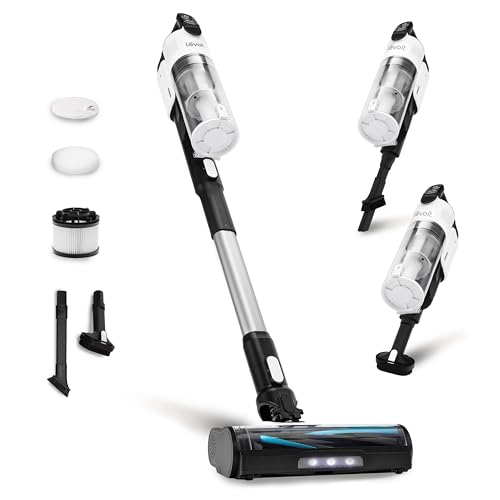
6. Levoit Cordless Vacuum LVAC-200 — Best Lightweight
The LVAC-200 closes the list with the handling brief: a lightweight brushless cordless vacuum with an anti-tangle brush for pet hair, up to 50 minutes of runtime, and a body that lays flat to 180 degrees to slide under sofas and beds — the geography where dust and pet hair actually retire to. It suits apartments, smaller homes, older users or anyone for whom vacuum weight is the barrier to vacuuming at all, and as a household’s quick-cleanup machine. It is less suited to deep-pile carpet estates and maximum-suction briefs, where the Tineco and Dyson carry more muscle.
Strengths
- Lightweight body plus lay-flat design reaches the dirtiest square feet in the home.
- Anti-tangle brush keeps pet hair maintenance low.
- Up to 50 minutes runtime — strong for its weight class.
Trade-offs
- Less deep-carpet muscle than the heavyweight picks.
- Compact bin needs frequent emptying in shedding season.
- Light build prioritizes handling over job-site toughness.
There is a behavioral truth in this pick: the vacuum that gets used is the one that is not a chore to start. The LVAC-200’s weight and lay-flat reach make the five-minute cleanup genuinely five minutes, including the under-sofa territory other vacuums declare off-limits. In apartments and smaller homes, that usability beats headline suction — the cleanest home is the one whose vacuum comes out daily, and this is the daily-driver of the list.
Best for: apartments, lightweight handling, under-furniture reach. / Not suited for: deep-pile or maximum-power briefs.
Check on Amazon — check the current price on Amazon.
Comparison Table
| Pick | Badge | Key spec | Best for |
|---|---|---|---|
| Dyson V8 Plus | Best Overall | Digital brushless motor, detangling head, 40 min | Mixed floors, all-round use |
| Makita XLC11ZW | Best for Tool-Battery Homes | Brushless, 4-speed, 18V LXT platform | DIY households, workshops |
| Tineco A30S | Best Runtime and Suction | 60 min, 1L bin, ZeroTangle brush | Large homes, heavy shedding |
| Shark IX141 Pet Cordless | Best Pet-Hair Value | 40 min, XL cup, LED headlights | Daily pet-hair duty |
| BISSELL PowerClean FurGuard | Best for Pet Homes | HEPA, removable battery, fur tool | Dander, long ownership |
| Levoit LVAC-200 | Best Lightweight | 50 min, anti-tangle, 180° lay-flat | Apartments, quick cleanups |
How to Choose a Brushless Vacuum
Understand first what the brushless motor buys you, so you can judge the rest of the machine on its merits. Brushless efficiency extends runtime and motor life; it does not by itself guarantee good cleaning, which lives in the brush head, the airflow path, and the filtration. So choose in this order: floor mix (hard floors reward soft-roller or multi-surface heads and lay-flat reach; carpets reward powered brush agitation and suction), runtime honesty (compare runtimes at the power level you will actually use — maximum-mode minutes are a fraction of eco-mode minutes, and every maker plays this game), and bin and brush maintenance (pet homes should weight anti-tangle brushes and larger bins heavily, because a vacuum that needs surgery after every session stops being used).
Battery strategy is the fourth decision, and it is a years-long one. Removable batteries (BISSELL’s approach) let you extend sessions with a spare and replace the wear item instead of the machine. Platform batteries (Makita’s LXT) go further, folding the vacuum into an ecosystem you may already own. Sealed batteries (most consumer sticks) are fine machines with a built-in lifespan set by battery chemistry — price them accordingly. Filtration is the fifth: in pet and allergy homes, a sealed system with HEPA exhaust filtration keeps the fine dander you vacuumed from re-entering the room, which matters more than another few minutes of runtime.
Finally, hold the thing — or at least read the weight with your own arm in mind. A stick vacuum is wielded one-handed at shoulder height for ceiling cobwebs and carried between floors; the difference between the LVAC-200’s class and the heavyweight session machines is the difference between a vacuum that comes out daily and one that waits for Saturday. Match the machine to your real cleaning rhythm, not your aspirational one.
How to Maintain a Brushless Cordless Vacuum
The brushless motor itself is nearly maintenance-free — no brushes to replace, ever — which moves all upkeep to the parts that touch dirt. Empty the bin at the maker’s fill line, not when it is packed solid; airflow through a stuffed bin falls, suction follows, and the motor works harder for less. Wash or replace filters on the stated schedule: a clogged filter is the single most common cause of “my cordless lost suction,” and it is a five-minute fix misdiagnosed as a dead machine every day. Keep the brush roll free of hair — anti-tangle designs reduce this chore, they do not abolish it — and check the head’s wheels and seals when performance dips.
Battery care decides the machine’s lifespan. Avoid storing the vacuum fully depleted for long periods, keep it away from heat extremes, and if your model has a removable pack, a spare rotated into service ages more gracefully than one pack deep-cycled daily. Charge on the maker’s dock or charger rather than improvised adapters. Once a season, wipe the cyclone shroud and check the seals around the bin; brushless motors hold their performance for years, and the machines in this guide that disappoint in year three almost always fail at a filter, a seal, or a battery — all maintainable, all cheaper than a new vacuum. Treat those three as the service schedule and the brushless motor will be the last part of the vacuum still performing like new.
Brushless vs Brushed Motors: Why It Matters in a Vacuum
A brushed motor makes its electrical connection mechanically: carbon brushes press on a spinning commutator, sparking microscopically, wearing steadily, and converting a meaningful share of your battery into heat and friction. It is cheap, proven, and finite. A brushless motor moves the switching into electronics: sensors and a controller energize the windings in sequence, nothing rubs, and the motor runs cooler, quieter for its output, and dramatically longer. In a drill, that means professional durability. In a cordless vacuum, it means the three things this category runs on — suction per watt, minutes per charge, and years per motor.
The efficiency point deserves emphasis because it compounds. A cordless vacuum’s entire performance budget is a battery; every watt a brushed motor wastes as heat is a watt not moving air. Brushless designs reclaim that margin, which is why the modern stick vacuum — a format that was a toy with brushed motors — became a whole-home tool in the brushless era. The longevity point compounds too: brush wear was the scheduled death of small motors, and its absence is why a Makita or Dyson motor routinely outlives the battery, the filters, and sometimes the household’s patience with the color. When you pay the brushless premium, you are not buying a buzzword; you are buying the absence of the category’s traditional failure mode.
Stick, Handheld, or Robot: Where Brushless Vacuums Fit in a Whole Cleaning System
The brushless stick vacuums in this guide are the center of most modern cleaning systems, but it is worth being precise about the edges. A stick’s strengths are responsiveness and reach: it lives on a dock or a hook, deploys in seconds, converts to a handheld for stairs, upholstery, and cars, and — in the lay-flat Levoit’s case — goes where uprights cannot. Its structural limits are bin size and session length, which is why the Tineco’s 1L bin and 60 minutes matter: they push the stick format toward whole-house legitimacy. A traditional corded upright or canister still wins one scenario outright — the multi-hour, deep-pile-carpet deep clean, where unlimited power and a large bag beat any battery. Households with wall-to-wall deep carpet should read this guide as their daily-driver selection and keep expectations for the annual deep clean accordingly.
Robots occupy the other flank: they maintain hard floors between real cleans, and their motors, too, are brushless designs for the same efficiency reasons. A robot plus a brushless stick is the combination most pet households converge on — the robot patrols hair daily, the stick handles stairs, furniture, edges, and incidents. What the stick must never be asked to be is a wet cleaner or a construction vacuum: liquids destroy consumer vacuums regardless of motor type, and drywall dust and ash clog fine filters fast enough to strangle airflow. Makita’s LXT line is the partial exception in spirit — tool-brand machines tolerate workshop duty better — but even there, the correct tool for rubble is a shop vacuum, not your household stick. Buy the brushless stick as the system’s quarterback and it will not disappoint; ask it to play every position and it will remind you of the roster.
Understanding Suction Numbers: Air Watts, Pascals, and What to Ignore
Vacuum specifications are a dialect buyers should learn to discount properly. Makers quote suction in air watts (AW) or pascals (Pa/kPa), almost always at maximum mode with a sealed or ideal measurement, which makes cross-brand comparisons approximate at best. A machine advertised with a spectacular kPa figure and a small, restrictive cleaning head may pick up less real debris than a modestly rated machine with a well-designed brush and airflow path — because cleaning happens where air moves dirt, not where a gauge peaks against a blocked hose. The honest use of the numbers in this guide is ordinal: within a maker’s line they rank models; across makers they suggest class, nothing more.
What predicts real performance better is the combination reviewers and owners converge on: sustained suction as the bin fills (where cyclonic design and brushless motor control show their value), brush agitation matched to your floors, and a head that seals reasonably to the surface without pushing debris ahead of it on hard floors. Runtime figures deserve the same translation discipline: divide your home into the minutes a real clean takes you — most people overestimate their diligence and underestimate their square footage — and buy the machine whose mid-power runtime covers that number with margin. The picks here were chosen because their real-world envelopes, not their headline digits, fit the households their badges describe.
Common Buying Mistakes
Comparing maximum-mode suction with eco-mode runtime. No vacuum delivers both at once. Compare machines at matched settings, and weight the mid-power runtime you will actually live with.
Ignoring the battery strategy. The battery, not the brushless motor, sets the machine’s lifespan. Removable or platform batteries are a longevity feature worth paying for.
Buying suction for a hard-floor home. Hard floors need airflow, a suitable head, and reach more than raw carpet-grade suction. Match the head to your floors before chasing numbers.
Neglecting filters, then blaming the motor. Most “dead” cordless vacuums have a clogged filter or a packed bin. Maintenance is minutes; misdiagnosis costs a machine.
Overlooking bin size in a pet home. Hair fills bins fast, and a stuffed bin strangles airflow. Shedding households should buy bin capacity like they mean it.
Assuming tool-only means cheaper. The Makita’s value is real only inside the LXT ecosystem. Without batteries on your shelf, price the whole system before comparing.
Accessories and Attachments: What Each Pick’s Ecosystem Adds
A brushless stick vacuum is a platform, and the attachments decide how much of your home it actually serves. The essential kit is consistent across this list: a crevice tool for edges and car interiors, an upholstery or dusting brush for furniture and shelves, and a mini powered head — the pet tool in the Shark and BISSELL kits — whose small brush agitates stairs and sofas the way the main head agitates floors. Dyson’s ecosystem is the deepest, with specialized heads and tools sold separately at premium prices; that depth is a genuine advantage for households with mixed flooring and a genuine cost to budget honestly. Shark and BISSELL bundle generously in the box, which is part of their value badges. Makita’s accessory world is tool-logical: nozzles, extensions, and floor heads built for utility, purchasable wherever LXT tools live.
Two accessory decisions deserve forethought. First, storage and docking: a wall dock that charges (Dyson’s pattern) makes the vacuum a fixture that is always ready, while a freestanding or closet-stored machine depends on your remembering to plug it in — a small friction that decides whether quick cleanups happen. If your model lacks a dock, designate a charging corner and treat it as the vacuum’s home. Second, the second battery, where the design allows it: for the BISSELL’s removable pack and Makita’s platform batteries, a spare converts runtime from a specification into a non-issue, and it is usually the highest-value accessory purchase available for the machine. Buy it with the vacuum if long sessions are your pattern; discover you need it later and you will have spent the interim rationing a resource you did not have to ration.
Hard Floors, Carpet, and Stairs: Matching the Brushless Pick to Your Surfaces
Hard floors — hardwood, tile, laminate, vinyl — reward airflow and head design over brute suction. A head that seals too aggressively can snowplow debris; the best hard-floor performers keep the brush moving grit into the airstream and, like the Levoit, lay flat to continue under furniture where hard-floor dust migrates. Runtime matters more than peak power here, because hard-floor homes clean often and lightly. Carpet reverses the priorities: agitation and sustained suction do the work, the bin fills with embedded grit you never saw, and the session machines — Tineco’s suction and bin, Dyson’s detangling head — justify themselves. Deep pile remains the cordless format’s honest frontier; expect slower passes and mid-to-high power settings, and budget runtime accordingly.
Stairs are the third surface and the one that sells handheld conversion: every pick here detaches or reconfigures for stair duty, but they differ in how gracefully — weight in the hand, the mini tool’s agitation, and whether the body balances on a tread while you work the next one. Pet households should picture the full circuit honestly: floors daily, stairs weekly, upholstery and the car monthly — and choose the pick whose handheld mode they will actually enjoy using, because the best stair vacuum is the one that leaves its dock. The Shark and BISSELL pet kits, with their dedicated small tools, and the Dyson’s handheld polish, lead this evaluation; the Makita’s tool-grade simplicity serves the garage-adjacent version of the same circuit.
Ownership Costs Over Five Years: Batteries, Filters, and the Motor That Outlives Them
Price a brushless vacuum the way you would price a car: the purchase is the entry fee, and the consumables write the real story. The recurring items are filters (washable where the design allows, replaceable on a cycle), brush rolls in heavy-shed homes, and — the big one — batteries. A sealed-battery stick whose pack fades in year four may need a whole-machine replacement, while the BISSELL’s removable pack and Makita’s platform batteries convert that event into a component purchase. Over a five-year horizon, the mid-priced machine with replaceable wear parts routinely undercuts the bargain machine replaced twice, and it does so while cleaning better in every one of those years — the brushless motor’s longevity only pays out if the parts around it are allowed to be renewed.
The second battery question belongs in the same ledger. For households whose cleans run long — the Tineco’s natural constituency — a spare pack or a big-runtime machine is not an indulgence but the difference between finishing and rationing. Buyers should total the honest system price at purchase: machine, spare battery if the pattern demands it, a year of filters, and any must-have attachments not in the box. Compared on that basis, this list reorders itself interestingly — bundled pet kits (Shark, BISSELL) gain, bare premium platforms show their true cost, and the Makita swings from cheapest to priciest depending entirely on whether LXT batteries already live in your garage. That is not a flaw in the comparison; it is the comparison, done honestly.
A final note for allergy households reading across this list: the vacuum’s job is not finished when the dirt is in the bin — it is finished when the dirt leaves the house without re-entering the air. Sealed HEPA systems (the BISSELL’s headline, and a Dyson strength) matter most at the emptying moment, when a careless bin dump can return a week’s dander to the room in one puff. Empty bins outdoors or into a bag held closed around the bin, wash your hands, and the brushless machine’s work stays done. It is a small ritual that separates households that vacuum from households that merely relocate dust.
Think, too, about who else uses the vacuum. A machine bought for one person’s standards becomes the household’s machine within a month: partners, teenagers, cleaners, and guests all wield it, and they will judge it on weight, simplicity, and whether it is charged. The picks that survive household democracy are the ones with a dock or a designated home, a bin anyone can empty without a manual, and controls that explain themselves. The LVAC-200 and Shark win household votes on approachability; the Dyson wins on dock discipline; the Makita wins wherever the household already speaks LXT. Buy for the household that will actually hold the handle, and the brushless motor’s long life will be spent cleaning rather than sitting in a closet being nobody’s favorite.
Renters and frequent movers, a constituency this category serves better than it advertises: a brushless stick needs no installation, damages no walls if you skip the dock screws and use a leaning corner or adhesive mount where the landlord allows, and moves in a car trunk. For a household that relocates every year or two, the lightweight picks — Levoit first, Shark close behind — are close to perfect appliances: full cleaning capability with zero footprint in the lease. Buy the machine that fits your housing reality as well as your floors.
There is a small environmental ledger worth closing on: a brushless vacuum’s long motor life and (in the better designs here) replaceable batteries and filters mean fewer whole appliances landfilled per decade of cleaning. The greenest vacuum is the one you do not replace, and that is a second, quieter dividend of the brushless design brief — durability as a feature, purchased once and collected for years in both performance and avoided waste.
Whichever pick you take home, run one discipline from day one: empty the bin at the line, rinse the filter on schedule, and park the machine on its charger every night. Brushless motors reward owners who keep the air path clean with years of like-new performance — the technology holds up its end of the bargain precisely as long as the owner holds up theirs. That reciprocity is, in the end, the honest summary of this entire category: the motor stopped being the weak point years ago, and the households that understand that are the ones still vacuuming happily on their first machine while their neighbors shop for a third.
Charge it tonight, empty it at the line, and let the motor do the rest — that is the whole contract, and it is a good one.
That is the brushless bargain in one line: a little discipline, exchanged for years of full-strength cleaning.
Final Recommendation
For most households, the Dyson V8 Plus is the brushless vacuum to buy — the complete, balanced expression of what the technology offers. If you already live in Makita’s battery world, the XLC11ZW is the rational, durable choice. Large and shedding-heavy homes should take the Tineco A30S for its runtime-and-bin combination; pet homes on a budget, the Shark IX141; pet homes thinking in years and allergens, the BISSELL FurGuard with its HEPA system and removable battery; and apartments or anyone who prizes handling, the Levoit LVAC-200. Across all six, the brushless motor is the through-line: more cleaning per charge, and a motor that will not be the reason you replace the machine.
Related guides in this cluster: Best Cordless Vacuums, Best Vacuums For Pet Hair, Best Stick Vacuums, and Best Vacuums For Hardwood Floors.
Frequently Asked Questions
Are brushless vacuums quieter than brushed models?
Generally, per unit of suction, yes: brushless motors eliminate brush friction and sparking noise and run more efficiently at a given output, so makers can reach target performance at lower motor speeds. Total machine noise still depends heavily on the fan, airflow path, and brush head design, so compare models as whole machines — but the brushless transition is one reason modern sticks sound less strained than the cordless vacuums of a decade ago while cleaning considerably better.
How do I know if a vacuum motor is brushless?
Check the maker’s specification for the words “brushless” or “digital motor” — Makita labels its XLC11ZW brushless outright, and Dyson’s digital motors are brushless designs. As a market rule, essentially every current mid-range and premium cordless stick from the major brands uses a brushless motor, because brushed motors cannot deliver competitive runtime; the budget no-name end of the market is where brushed motors still hide, and it is one more reason that end disappoints within a year or two.
What is a brushless vacuum, in plain terms?
A vacuum whose motor uses electronic control instead of carbon brushes to spin. The result is more suction from the same battery, longer runtime, and a motor with no brush wear-out — the technology behind essentially every serious modern cordless vacuum, from Dyson’s digital motors to Makita’s brushless LXT line.
Do brushless vacuums last longer?
The motor does — brush wear was the traditional lifespan limiter, and it is gone. In practice the battery, filters, and seals now set the machine’s lifespan, which is why removable-battery designs and filter discipline matter so much in this category.
Is a brushless vacuum more powerful?
Per watt, yes: less energy is lost to heat and friction, so more becomes airflow and suction. Total power still depends on the specific machine and mode — compare models at matched power settings rather than headline maxima.
Which brushless vacuum is best for pet hair?
For daily pet-hair duty at a sensible tier, the Shark IX141; for maximum session capacity, the Tineco A30S with its big bin and anti-tangle brush; for dander and allergy concerns, the BISSELL FurGuard’s HEPA filtration and removable battery make it the pet-home specialist.
Can a cordless brushless vacuum replace a corded vacuum?
For most homes, yes — modern brushless sticks handle whole-home cleaning on a charge, especially mid-size homes and hard-floor-dominant layouts. Very large homes or deep-pile carpeting may still reward a corded machine or a two-battery cordless setup for uninterrupted deep cleans.
Why does my cordless vacuum lose suction over time?
Almost never the brushless motor. Check, in order: a bin past its fill line, a clogged or overdue filter, hair binding the brush roll, and blocked seals or hoses. Restore those and suction typically returns to new — the motor was waiting patiently the whole time.


