Disclosure: airfryerkitchensupply.com is reader-supported. When you buy through links on our site, we may earn an affiliate commission at no extra cost to you.
Where to buy
Every chair in this guide to the best chairs Ayla swivel glider shoppers are looking for is sold through Amazon and was verified against the live Amazon catalogue before it made the list. Start with the Babyletto Kiwi Electronic Power Recliner and Swivel Glider for the fullest feature set, or the DaVinci Juno Swivel Glider for a pure, compact glider. We never print product prices — they change too often to stay honest — so use the check-price links throughout.
Best Chairs: Ayla Swivel Glider Intent, and What We Found
People searching for the best chairs Ayla swivel glider are usually chasing a specific look and motion: a softly upholstered nursery chair that swivels a full circle, glides back and forth in that long, sleepy rhythm, and — in most versions — reclines for feeding and contact naps. A straight note on the name before the picks: we searched the Amazon catalogue for an Ayla-branded swivel glider, twice, with different queries. No distinct Ayla-branded glider chair came back as a verifiable Amazon listing. Rather than invent one or attach the name to a product that does not carry it, this guide does the useful thing: it rounds up the six best verified swivel glider chairs that deliver exactly the Ayla-style brief — nursery-ready upholstery, 360-degree swivel, smooth glide, recline options at several tiers — from makers whose listings we could confirm.
That honesty matters in this category because nursery gliders are a long-ownership purchase. You will sit in this chair for hundreds of night feeds, and then, if you chose well, for years of bedtime stories after. The differences that decide satisfaction are unglamorous: whether the glide stays silent at 3 a.m., whether the fabric survives spit-up and snack incidents, whether the chair fits through your doorway and leaves room to walk around it, and whether the recline mechanism works one-handed while your other arm holds a sleeping baby. The picks below are badged against those realities.
Every chair was cross-checked against its manufacturer’s Amazon listing, and only listing-confirmed models carry buying links. Certifications mentioned are those stated in the listings themselves. Where a listing did not verify a dimension or mechanism detail, we left it out of the spec box rather than repeat catalogue folklore.
In this guide
Quick Picks
- Best Overall: Babyletto Kiwi Electronic Power Recliner & Swivel Glider — power recline, swivel and glide with water- and stain-resistant fabric. Check the current price on Amazon
- Best Manual Recline: Evolur Raleigh Upholstered Glider Recliner — rocking, 360-degree swivel and smooth glide with manual recline. Check the current price on Amazon
- Best Pure Glider: DaVinci Juno Swivel Glider — a compact 360-degree swivel glider on a metal base, no recline complexity. Check the current price on Amazon
- Best Upholstered Recliner: DaVinci Piper Swivel Glider Recliner — swivel, glide and recline in a plush nursery profile. Check the current price on Amazon
- Best Accessible Tier: CANMOV Swivel Rocker Recliner Chair — nursery glider and manual recliner in one approachable package. Check the current price on Amazon
- Best for Small Rooms: Korser 360 Swivel Rocker Recliner — a compact fabric glider recliner sized for small spaces. Check the current price on Amazon
How These Picks Were Chosen
Motion quality came first. A swivel glider chair lives or dies by its mechanism: the glide should be long, level and silent, the swivel smooth under load, and any recline operable without a wrestling match. We favoured chairs whose listings describe metal-base or otherwise purpose-built mechanisms and treated vague “rocking chair” language with suspicion. Second was certification and materials: GREENGUARD Gold and CertiPUR-US foam certifications, both stated in several listings here, matter in a nursery where the chair off-gasses into a small, closed room and a baby breathes against the fabric for hours. Third was fabric practicality — stain resistance and cleanability outrank showroom softness in a chair destined for milk, puree and worse.
Fourth was footprint honesty. Nursery chairs are routinely photographed in vast rooms and delivered into small ones; compact picks earned badges where their listings support them. Fifth was the chair’s second life: a glider that only suits a nursery is a shorter purchase than one that can graduate to a living room, and several picks here were chosen partly for that range. Finally, the Ayla question itself shaped the list — every pick had to deliver the swivel-plus-glide core that the search term promises, so pure rockers and fixed accent chairs were cut even when they were lovely.
We also listened for what owners complain about after the fact, because nursery chair regrets follow a pattern: the glide that squeaked by month two, the fabric that held a sour-milk smell, the recliner that could not recline against the wall it was bought for. Picks that addressed those failure modes in their design or listing — sealed-smooth mechanisms, resistant fabrics, honest footprints — were ranked above picks with more features and less foresight.
The 6 Best Swivel Glider Chairs

Babyletto Kiwi Electronic Power Recliner & Swivel Glider — Best Overall
The Kiwi is the fullest expression of the brief: an electronic power recliner that also swivels and glides, upholstered in water- and stain-resistant fabric, with GREENGUARD Gold and CertiPUR-US certifications stated in its listing. It suits parents who know they will live in this chair — power recline at the touch of a control is a genuine mercy during a contact nap you dare not disturb — and anyone furnishing a nursery meant to convert to a reading corner later. It does not suit buyers wary of electronics in furniture, or rooms where running power to the chair’s spot is impractical.
Strengths
- Power recline plus swivel plus glide — the complete motion set, operated without effort or noise from a manual lever.
- Water- and stain-resistant fabric faces the realities of feeding without a protective throw over everything.
- GREENGUARD Gold and CertiPUR-US certifications, as stated in the listing, suit a closed nursery environment.
Trade-offs
- Top tier of this guide — the power mechanism and certifications are what you are paying for.
- Needs a power source at the chair; cord management in a nursery needs a moment’s thought.
- Electronic recline is slower than a manual mechanism — a feature for sleep, a frustration for the impatient.
- Motion: Power recline, swivel, glide
- Fabric: Water- and stain-resistant upholstery
- Certifications (per listing): GREENGUARD Gold, CertiPUR-US
What separates the Kiwi from the manual chairs is the quality of stillness it enables. A manual recliner asks for a push, a lever, a small jolt — exactly the movements that end naps. The power mechanism moves at the pace of a settling baby, and the glide continues underneath, so the whole feed-to-sleep transition happens without a single mechanical event. Babyletto’s nursery design language also helps the chair’s second life: it reads as a modern armchair rather than baby equipment, which is why these chairs so often end up as the most contested seat in the living room five years later. If the budget reaches one premium nursery purchase, experienced parents consistently nominate the chair — you will spend more waking hours in it than in any other nursery item.
Best for: heavy-use nurseries and parents who value silent power recline / Not suited for: no-electronics buyers or rooms without a reachable outlet
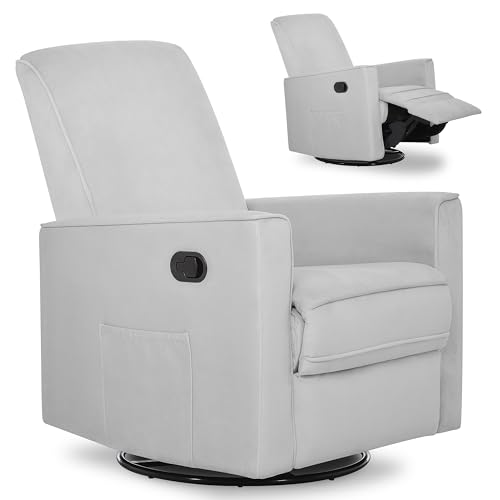
Evolur Raleigh Upholstered Glider Recliner — Best Manual Recline
The Raleigh covers the same motion brief without electronics: rocking and gliding, a 360-degree swivel, and a manual recline, in an upholstered nursery profile with GREENGUARD Gold and FSC certifications stated in its listing. It suits parents who want the full recline-glide-swivel combination but prefer a mechanism with nothing to plug in and nothing electronic to fail in year four. It does not suit anyone who has already decided that one-finger power recline is the point — manual recline asks for a deliberate push.
Strengths
- Complete manual motion set: glide, rock, 360-degree swivel and recline.
- Certifications stated in the listing — GREENGUARD Gold and FSC — for the nursery environment.
- No power requirement: place it anywhere in the room, including the middle.
Trade-offs
- Manual recline needs body English that a power chair does not — relevant with a sleeping baby in one arm.
- Upholstered nursery styling is traditional; ultra-modern rooms may prefer the Kiwi’s lines.
- Like all recliners, it needs clearance behind and in front — measure the full recline footprint.
- Motion: Manual recline, glide/rock, 360-degree swivel
- Certifications (per listing): GREENGUARD Gold, FSC
- Format: Upholstered nursery glider recliner
The Raleigh’s argument is durability of concept. A well-built manual mechanism has no battery to fade, no control board to sulk after a power surge, and a glide that works identically in year one and year ten. Evolur builds for the nursery market specifically, and the Raleigh’s proportions reflect that: supportive enough for long feeds, upright enough that getting up with a baby does not become a core workout. For twins households and grandparents’ houses — the second-chair scenarios — this manual completeness at a mid tier is often the smartest money in the category. It is also the pick we would hand to a buyer who tried a power chair and found the slow recline maddening: some people simply prefer to push.
Best for: buyers wanting full motion without electronics / Not suited for: anyone set on power recline or working with minimal recline clearance

DaVinci Juno Swivel Glider — Best Pure Glider
The Juno strips the brief to its essence: a swivel glider, 360 degrees on a metal base, with no recline mechanism at all. Its listing states GREENGUARD Gold certification with FSC and CertiPUR-US certified materials. It suits buyers who know the glide is the motion that matters — the feeding, soothing, story-reading motion — and who would rather have a compact, simpler chair that does it beautifully than a recliner that does everything adequately. It does not suit contact-nap recliners; if your plan involves sleeping in the chair, buy a recline.
Strengths
- Pure, smooth glide and full swivel on a metal base — the core motions, uncomplicated.
- Compact profile suits small nurseries where a recliner’s footprint will not fit.
- Strong certification set stated in the listing for nursery air quality and foam.
Trade-offs
- No recline — the chair sits, glides and swivels, and that is all.
- Upright posture is a virtue for feeding and a limit for lounging.
- Ottoman not part of the core offer — budget separately if you want feet up.
- Motion: Glide, 360-degree swivel (no recline)
- Base: Metal
- Certifications (per listing): GREENGUARD Gold, FSC, CertiPUR-US
There is a real case that the Juno is the most honest chair in this guide. Recline mechanisms add weight, cost, clearance demands and failure modes; the glide is what soothes babies, and the swivel is what lets a parent reach the side table, the door and the bookshelf without standing. By refusing the recline, the Juno buys compactness and simplicity — it fits the small second bedroom, the corner of the parents’ room, the apartment nursery — and its metal base gives the motion a planted, quality feel that wooden-base gliders often lack. Pair it with a small nursing stool or ottoman and most parents never miss the recline they did not buy. If your nursery is small and your priorities are motion quality and clean air certifications, start here.
Best for: small nurseries and glide-first buyers / Not suited for: anyone planning to nap reclined in the chair

DaVinci Piper Swivel Glider Recliner — Best Upholstered Recliner
The Piper takes DaVinci’s nursery glider formula and adds the recline, in a plush upholstered profile with GREENGUARD and CertiPUR-US certifications stated in its listing. It suits parents who want the cushioned, sink-in feel of a traditional nursery recliner with swivel and glide underneath, and who find the Juno’s minimalism too upright. It does not suit the smallest nurseries — a reclining, upholstered chair needs its clearance — and its softer sit is a matter of taste: some feeders prefer firmer support for long sessions.
Strengths
- Swivel, glide and recline in one plush nursery chair.
- Certifications stated in the listing — GREENGUARD and CertiPUR-US — for the nursery setting.
- Upholstered comfort suits long contact naps and story sessions.
Trade-offs
- Full recline footprint demands wall and front clearance — measure honestly.
- Plush sit can feel warm and soft for buyers who prefer firm, upright support.
- Manual operation, with the usual one-arm caveat during feeds.
- Motion: Recline, glide, swivel
- Certifications (per listing): GREENGUARD, CertiPUR-US
- Format: Upholstered nursery glider recliner
Think of the Piper as the comfort-first counterpart to the Juno’s discipline. Where the Juno is a chair you sit in, the Piper is a chair you settle into, and for the parent who will do the 2 a.m. shift in it nightly, that plushness is not a luxury — it is the difference between dreading the chair and being grateful for it. DaVinci’s nursery pedigree shows in the proportions: the seat height and arm height are arranged for holding a baby at feeding height without a tower of cushions. The recline extends its range to the parent-and-toddler reading pile-up that defines years two through five. Just give it the room it asks for; a recliner wedged against a wall is a glider with its best feature amputated.
Best for: comfort-first parents with a mid-size nursery / Not suited for: tight rooms or firm-seat preferences

CANMOV Swivel Rocker Recliner Chair — Best Accessible Tier
The CANMOV delivers the category’s essential motions — swivel, rocking/gliding and manual recline — in an approachable package positioned as a nursery glider chair. It suits budget-conscious nurseries, grandparents’ houses, and second-chair situations where the full premium feature set is hard to justify. It does not suit buyers for whom certifications and fabric technology are deciding factors; at this tier, the value is in the motion set and the simplicity, and the listing makes fewer of the premium claims the Kiwi and DaVinci chairs carry.
Strengths
- Full motion brief — swivel, rock/glide and recline — at the guide’s most accessible tier.
- Manual mechanism: no power needs, simple ownership.
- Neutral nursery styling that transitions to a spare room or living room corner.
Trade-offs
- Fewer stated certifications and fabric technologies than the premium picks.
- Finish and upholstery refinement are a step below the top tier — the price difference is visible up close.
- Manual recline effort, as with all manual chairs here.
- Motion: Manual recline, swivel, rocker/glider
- Format: Upholstered nursery recliner chair
- Tier: Accessible (qualitative positioning)
The CANMOV exists because the second chair is a real category. The main nursery gets the flagship; the grandparents’ spare room, the downstairs corner for daytime feeds, the holiday house — those get a chair that performs the motions without the flagship invoice. Judged on that job, the CANMOV is well aimed: the motions are all present, the recline works manually, and the styling offends no room. It is also a rational first chair for parents unsure how much nursery-chair life they will actually live — some babies prefer being walked, and a household that discovers that in month one will be glad the chair was the sensible tier. Buy it with clear eyes about finish versus the premium picks, and it will not disappoint.
Best for: second chairs, grandparents’ homes, sensible first chairs / Not suited for: certification-led buyers or flagship finish expectations
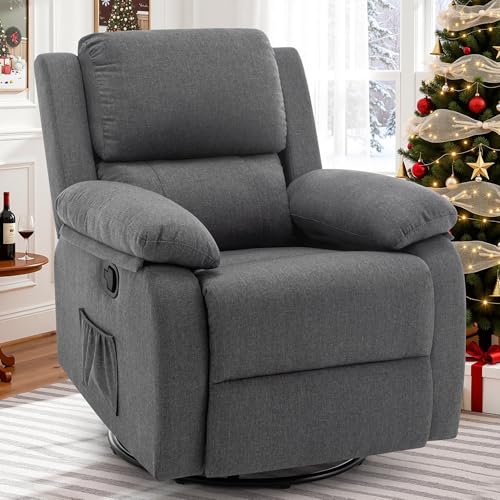
Korser 360 Swivel Rocker Recliner — Best for Small Rooms
The Korser is a compact fabric glider recliner built for small spaces: 360-degree swivel, rocking glide and recline in a footprint aimed at apartments and modest rooms, nursery or living room. It suits city nurseries, studio-adjacent sleeping arrangements, and anyone whose “nursery” is a well-planned corner. It does not suit tall or broad sitters who need a generously scaled chair — compact is the point, and compact has a size limit — nor buyers wanting premium nursery certifications.
Strengths
- Small-space footprint with the full swivel-rocker-recliner motion set.
- Fabric upholstery and neutral styling work in living rooms as readily as nurseries.
- Manual simplicity: no power, no fuss, place it anywhere.
Trade-offs
- Compact seat dimensions — try the measurements against your household’s sitters.
- Positioned as a general small-space recliner rather than a certification-led nursery specialist.
- Recline clearance still applies; small chair, same geometry rules.
- Motion: Manual recline, rocking glide, 360-degree swivel
- Format: Compact upholstered fabric recliner
- Fit: Small spaces, apartments
Small rooms punish furniture that was designed for big ones, and nursery chairs are frequent offenders — wide arms, deep reclines, footprints that eat the room. The Korser’s discipline is that it keeps the three motions while surrendering scale gracefully: the chair turns fully, glides properly and reclines, yet leaves a small room still able to contain a crib, a dresser and a walking path at 3 a.m. That last detail is the real test. A nursery chair you have to squeeze past in the dark is a chair you will curse nightly. For apartment families, the Korser may be the most livable pick in this guide even though it carries none of the flagship badges — fit is a feature, and in a small home it is the first feature.
Best for: apartments and compact nurseries or living rooms / Not suited for: large sitters or certification-first buyers
Comparison Table
| Pick | Badge | Key spec | Best for |
|---|---|---|---|
| Babyletto Kiwi Power Recliner & Swivel Glider | Best Overall | Power recline, swivel, glide; stain-resistant fabric | Heavy-use nurseries, silent recline |
| Evolur Raleigh Glider Recliner | Best Manual Recline | Manual recline, glide, 360° swivel | Full motion without electronics |
| DaVinci Juno Swivel Glider | Best Pure Glider | Glide + 360° swivel, metal base, no recline | Small nurseries, glide-first buyers |
| DaVinci Piper Swivel Glider Recliner | Best Upholstered Recliner | Recline, glide, swivel; plush upholstery | Comfort-first parents |
| CANMOV Swivel Rocker Recliner | Best Accessible Tier | Manual recline, swivel, rocker/glider | Second chairs, grandparents’ homes |
| Korser 360 Swivel Rocker Recliner | Best for Small Rooms | Compact fabric glider recliner | Apartments, compact rooms |
How to Choose a Swivel Glider Chair
Begin with the motions, because they are the chair’s reason to exist. Glide is the non-negotiable: a long, smooth, level back-and-forth that soothes without the rising-and-falling of a rocker. Swivel is the second essential — a full 360 degrees lets you turn toward the door, the shelf or the light without standing. Recline is the negotiable third: wonderful for contact naps and long reads, but it costs money, footprint and clearance. Decide honestly whether you will nap in this chair. If yes, recline is a feature; if no, the Juno’s discipline will serve you better and smaller.
Next, measure like an pessimist. The chair’s footprint is not its recline footprint: a recliner needs space in front for the footrest and behind for the back, and a swivel needs a turning circle free of crib rails and dresser corners. Check the doorway and any turns on the delivery path too — upholstered nursery chairs are bulky, and a chair that cannot enter the room is a return waiting to happen. Then sit-test by proxy: seat height and arm height decide feeding ergonomics. Your forearms will rest on those arms holding a baby for thousands of minutes; arms at the right height are the difference between relaxed shoulders and a chronic ache.
Fabric and foam deserve the third look. In a nursery, certifications stated in these listings — GREENGUARD Gold for low emissions, CertiPUR-US for foam content — are meaningful signals in a small room where a baby breathes against the chair daily. Practically, stain resistance and cleanable weaves outrank delicate showroom fabrics; the Kiwi’s water- and stain-resistant upholstery is the benchmark here. Finally, think about year three: the chair that graduates to story time and then to a living room repays its cost over a decade, while a chair that only reads as baby equipment gets sold or stored. Neutral upholstery and classic proportions are the graduation strategy.
Budget tiers in this category map cleanly onto mechanism and materials, which makes the ladder easy to read. The accessible tier — the CANMOV and Korser territory — buys the full motion set with simpler finishes. The mid tier buys nursery-specialist build, certifications and better upholstery in manual chairs like the Raleigh and Piper. The premium tier buys power and fabric technology in the Kiwi. Because the motions exist at every tier, the honest question is never “which chair can glide” but “which chair’s glide, fabric and finish will I still be pleased with at feed number five hundred” — and that is a question about your household’s intensity of use, not about the catalogue.
How to Set Up and Care for a Nursery Glider
Placement first. Put the chair where the night routine actually happens: within reach of a side table for water, a cloth and the book, near enough to the crib that the transfer is short, and with the swivel circle clear. If the chair reclines, pull it far enough from the wall that the full recline does not kiss the paint — and re-check after the first week, because chairs migrate. Power models get a cord routed where small hands and chair mechanisms cannot reach it; manual models get nothing, which is their quiet charm. A small rug under the chair protects floors from the base and softens the room’s acoustics, but confirm the glide still travels freely on it.
Care is mostly prevention. Keep a washable throw or cover over the arm and headrest zones during the spit-up months — those two patches take ninety percent of the soil, and washing a throw beats cleaning upholstery at midnight. Vacuum the seams weekly with a crevice tool; crumbs and hair migrate to the mechanism side of the cushions. Treat spills immediately with the fabric maker’s method rather than household improvisation. Every few months, work the glide and swivel through their full range and listen: a mechanism that starts to squeak is asking for attention early, when it is cheap, rather than late. And keep the chair’s motions in regular use even after the nursery years — a glider that sits frozen for a year in a garage is a glider whose mechanism ages fastest.
One last setup habit: photograph your room measurements and the chair’s listed dimensions side by side before ordering, and tape the recline footprint on the floor with painter’s tape for a day. Living with the tape outline — walking around it, opening the door against it — reveals problems that numbers on a screen never do, while the fix is still free.
Glider vs Rocker vs Recliner: Which Motion Does a Nursery Actually Need?
The three motions get conflated in listings, so here is the honest separation. A rocker moves on curved rails in an arc — pleasant, traditional, and the arc lifts and drops the sitter slightly with each cycle. A glider moves on a level track, back and forth in a straight line; that level, even motion is why gliders dominate nurseries, because it soothes without the subtle vertical rhythm some babies (and motion-sensitive parents) dislike, and because a glider base stays put on the floor instead of travelling like a rocker can. A recliner adds the back-and-footrest geometry for rest; it is orthogonal to the other two, which is why the best nursery chairs combine recline with glide rather than choosing between them.
Swivel is the fourth motion and the most underrated. Feeding life is full of small reaches — the cloth, the bottle, the phone, the door — and a 360-degree swivel converts them from stand-up events into turns. If you are choosing between two chairs and one swivels, take the swivel. The practical verdict for most nurseries: glide plus swivel is the essential pair, recline is the comfort upgrade, and rocking is the aesthetic preference. Every pick in this guide has the essential pair; the badges tell you which add the rest.
Feeding Ergonomics: Setting Up the Chair for the First Six Months
The chair is only half the feeding station; the setup around it decides whether your shoulders survive the year. Start with the side table: it should hold a water bottle you can open one-handed, a cloth, and the thing you will read, all within swivel reach — if you have to lean, the table is in the wrong place or the chair needs to turn further toward it. Add a small cushion or nursing pillow that lives on the chair rather than being fetched; the best feeding setup is the one that assembles itself at 3 a.m. A footrest or ottoman matters more than it looks: with your feet slightly raised, your lap becomes a stable, angled platform, and the glide turns into the gentle, whole-body rhythm that settles babies fastest. That is the practical reason the Juno, which has no recline, still works beautifully for feeding — an ottoman supplies what the mechanism does not.
Lighting is the overlooked ergonomic. You need light low and warm enough not to fully wake the baby or yourself, positioned so it does not shine into the baby’s face while feeding. Many parents end up with a small dim lamp on the side table rather than the room light, and the swivel earns its keep again — turn toward the light for the latch, away from it for the settle. Finally, plan the exit. The hardest move in nursery life is standing up from a deep, soft chair while holding a sleeping baby without waking them. Firmer chairs and chairs with solid arms you can push against — the Raleigh and Piper style — make that move markedly easier than sink-in designs. If you are choosing between two finalists, simulate the stand-up in the showroom with something fragile in your arms. It feels silly for ten seconds and informs a year of nights.
Fabric Field Guide: What Survives Nursery Life
Nursery chair fabrics face a specific assault course: milk and formula, which sour; puree, which stains in colour; medicines, which stain in worse colours; and the slow abrasion of the same two arm patches every single day. Performance fabrics with water- and stain-resistant treatments — the Kiwi’s upholstery is the example in this guide — handle that course best, because liquids bead long enough to be blotted rather than soaking to the foam. Woven fabrics with tight, flat weaves come next: they release stains more readily and vacuum cleanly. Loose weaves, deep piles and delicate natural fibres are the liabilities; they look wonderful in the listing photograph and tired by month four.
Colour is a fabric decision too. Mid-tone neutrals hide the widest range of nursery evidence; very light fabrics show every spill, very dark fabrics show every crumb and hair. Pattern can help — a subtle texture or heather reads as camouflage — which is one reason nursery chairs so often come in heathered greys and soft beiges rather than nursery-room brights. Whatever you choose, order the chair early enough to let it air out in the room before the baby arrives, keep the maker’s cleaning instructions with the chair rather than in a drawer, and treat the first spill as a rehearsal: blot, do not rub, and learn your fabric’s behaviour while the stain is small.
Power vs Manual Recline: The 3 A.M. Test
Every other comparison in this guide can be settled from a listing; this one is settled by imagining a specific moment. It is 3 a.m. The baby has finally fallen asleep on your chest in the chair, upright. You want the recline — your back is aching, and another forty minutes upright will cost you the rest of the night. With a manual chair, reclining means a coordinated push: lean, press the footrest down or pull the lever, absorb the small jolt as the mechanism engages, and hope the jolt did not register with the small person asleep on you. Sometimes it works. Sometimes you are starting the settle again. With a power chair, you hold a button and the chair breathes into recline over several seconds, glide still available underneath, and the baby notices nothing. That moment, repeated hundreds of times, is the entire case for power — and it is why the Kiwi carries the Best Overall badge despite its tier.
The case for manual is everything outside that moment. Manual chairs are cheaper to buy, lighter to move, free to place anywhere including the centre of the room, and mechanically simpler across a decade of ownership. They also recline at your speed — some parents find power recline’s slow travel genuinely irritating when they simply want their feet up now. Households split predictably: first-time parents planning heavy contact-nap use lean power; experienced parents, second chairs, and grandparents’ houses lean manual. Neither is the wrong answer, but choosing against your actual night pattern is. If your honest expectation is a baby who sleeps in a crib and a chair used for feeds and stories, save the money with the Raleigh or Piper. If your honest expectation is a baby who sleeps on people, the power premium is not a luxury — it is the product.
One Chair or Two? Twins, Siblings and the Grandparent Factor
Some households discover mid-pregnancy that the chair question is plural. Twins parents feed in shifts and in parallel, and the honest setup is often one excellent chair in the nursery plus a second, simpler station where the other parent or a grandparent can settle a baby — which is precisely the flagship-plus-CANMOV pattern this guide’s tiers enable. Siblings change the geometry differently: a toddler will claim the chair, climb the chair, and demand stories in the chair with the baby, so width and sturdiness start to matter, and the plush Piper-style profile earns its keep as the family pile-up seat. In both cases, the swivel becomes a safety feature as much as a convenience — turning to supervise a roaming toddler without standing up mid-feed is a daily event.
Grandparents deserve a specific note, because a nursery chair is one of the most gifted big items and the gifting often goes wrong on ergonomics. Older sitters need a chair that is easy to exit: firmer seat, solid arms at push-up height, and a glide that does not require leg strength to control. Deep, soft, low chairs — however luxurious they photograph — are the hardest to leave with a baby in your arms. If the chair is destined for a grandparents’ house, the Raleigh’s upright support and manual simplicity is usually the kindest choice in this guide, and the CANMOV covers the same job at a gentler tier. Ask who will sit in it most, and buy for their knees as much as for the baby.
Common Buying Mistakes
- Measuring the chair, not the recline. A recliner’s working footprint is much larger than its parked footprint. Measure fully reclined, with swivel clearance.
- Forgetting the delivery path. Upholstered gliders are bulky. Check doorways, hall turns and stairs before ordering, not during the delivery.
- Choosing fabric by photograph. Showroom-soft, delicate fabrics lose to milk and puree. Prioritise stain resistance and cleanability in a nursery chair.
- Skipping certifications in a small nursery. Low-emission and foam certifications matter most exactly where the room is smallest and the baby breathes closest.
- Buying recline you will never use, or omitting it when you will. Be honest about contact naps. The wrong call here is the most common regret in the category.
- Ignoring arm height. Feeding ergonomics live in the arms. Arms too low or too high turn every feed into a shoulder workout.
Final Recommendation
For the flagship nursery chair, the Babyletto Kiwi earns its tier with silent power recline, stain-resistant fabric and the strongest certification story. The Evolur Raleigh is the manual equivalent for buyers who distrust furniture electronics, and the DaVinci Piper is the plush comfort pick. Small nurseries should start with the DaVinci Juno or the Korser compact recliner, and second-chair shoppers with the CANMOV. For the rest of the nursery, see Best Nursery Gliders, Best Swivel Glider Chairs, Best Recliners For Nursery, Best Rocking Chairs For Nursery, Best Nursery Chairs and Best Glider Chairs.
Frequently Asked Questions
Is there an Ayla-branded swivel glider on Amazon?
We searched the Amazon catalogue with multiple queries and could not verify a distinct Ayla-branded swivel glider listing. Rather than guess, this guide recommends verified swivel glider chairs from Babyletto, Evolur, DaVinci, CANMOV and Korser that match the style and motion brief the search describes. If an Ayla model exists through another retailer, compare it against these picks on glide quality, certifications and recline type.
What is the difference between a glider and a rocker for a nursery?
A glider moves back and forth on a level track; a rocker moves in an arc on curved rails. The glider’s level motion is smoother for feeding and soothing, and its base stays in place. Many nursery chairs combine glide with swivel, and some add recline — the combination most parents end up wanting.
Do I need a reclining glider, or is a plain glider enough?
If you plan contact naps or long reading sessions in the chair, recline earns its cost and footprint. If the chair is for feeding, soothing and stories, a pure glider like the Juno is enough and fits smaller rooms. Be honest about the naps — that single answer decides it.
What certifications should a nursery chair have?
GREENGUARD Gold indicates low chemical emissions, which matters in a small, closed nursery; CertiPUR-US certifies the foam’s content and emissions standards. Several picks here state one or both in their listings. They are signals, not guarantees, but in this category they correlate with makers who build specifically for nurseries.
How much space does a swivel glider recliner need?
Plan for the chair’s footprint plus full recline extension in front, clearance behind for the reclining back, and a free turning circle for the swivel. In practice that means pulling the chair well off the wall and keeping the crib and dresser outside the swing. Compact models like the Korser reduce, but do not eliminate, these requirements.
Can a nursery glider move to the living room later?
Yes, and the best ones are bought with that in mind. Neutral upholstery, classic proportions and a complete motion set make a nursery glider a genuinely good living-room chair for reading and relaxing. The Kiwi and Raleigh graduate most easily; character-fabric nursery chairs are the ones that end up sold.
When should I order a nursery glider?
Earlier than feels necessary. Upholstered chairs are bulky freight, delivery windows slip, and you want the chair aired out, positioned and recline-tested before the baby arrives — not assembled during the first week home. Ordering in the second trimester is the common wisdom for a reason; it also leaves time to exchange if the footprint or arm height is wrong for your room or your body.
Is a swivel glider safe to use while holding a newborn?
Yes — it is the chair type designed for exactly that. Sit down first, then have the baby handed to you or pick them up from the adjacent crib using the swivel rather than twisting. Keep the glide gentle while standing is not involved, and never leave a baby unattended in the chair. The mechanism’s smoothness is a safety feature: no sudden jolts, no travelling base like a rocker can have.
What if the glide starts to squeak?
A new squeak usually means the mechanism wants cleaning or the chair has migrated onto an uneven spot — check the floor and rug position first, vacuum around the base, and work the motion through its full range. Persistent noise after that is a warranty conversation with the maker, and it is worth having early: glide mechanisms are the chair’s heart, and makers who build for nurseries generally stand behind them.


