Disclosure: airfryerkitchensupply.com is reader-supported. When you buy through links on our site, we may earn an affiliate commission at no extra cost to you.
Where to buy
Winter quilts sell on photography of snow outside windows, so shop by fill, weight and layering behaviour instead. Every pick below was confirmed in the live catalogue. One honesty note that shapes this whole guide: a quilt alone is rarely enough for a northern US winter — the best winter quilt is the anchor of a layered bed, and these picks were chosen for that job.
- Secgo King Size 100% Cotton Quilt Set (Sage) — Check the current price on Amazon
- EVERGRACEHOME 100% Cotton Modern Lines Quilt Set, King (Birch) — Check the current price on Amazon
- Madison Park Patchwork Farmhouse Quilt Set, King (Red/Black) — Check the current price on Amazon
- SahSahCasa Quilt Set King — 100% Cotton Botanical — Check the current price on Amazon
- palassio 100% Cotton Striped Channel Quilt Set, King (Dusty Blue) — Check the current price on Amazon
- Woolrich Winter Hills Reversible Quilt Set — Check the current price on Amazon
Shopping for the best quilts for US winters runs into a vocabulary problem first: in American bedding, ‘quilt’ means everything from a whisper-thin summer coverlet to a channel-stitched cotton bedspread, and winter is where the difference stops being academic. A true winter-weight quilt is a rare bird — most quilts are built for spring and autumn — so this guide does the honest thing: it selects the heaviest, most layerable quilts we could verify in the live catalogue, and teaches the layering system that makes a quilt-based bed work from a Minnesota January to a Texas cold snap.
The six picks span cotton channel quilts, farmhouse patchwork, botanical cotton sets and a reversible Woolrich lodge quilt — all chosen because their construction (cotton shells, stitched-through quilting, full bed sizes) layers predictably with blankets and duvets. Pure comforter sets that surfaced in the same searches were set aside; this is a quilt guide, and the distinction matters for how a bed breathes and washes.
Regional honesty matters too. ‘US winters’ spans Miami and Minneapolis, which share a flag and nothing else in January. The guide therefore rates each pick by the winter it can actually anchor: mild-winter solo use, mid-latitude layered use, or northern use strictly as the top layer over serious insulation beneath.
In this guide
Quick Picks
Secgo King Size 100% Cotton Quilt Set (Sage) — Best Overall Winter Quilt — check price on Amazon
A full-cotton king quilt at a generous 96-by-108 — the breathable, layerable anchor this guide recommends first.
EVERGRACEHOME 100% Cotton Modern Lines Quilt Set, King (Birch) — Best Modern Cotton — check price on Amazon
Pre-washed cotton with a modern striped line stitch — the contemporary face for a layered winter bed.
Madison Park Patchwork Farmhouse Quilt Set, King (Red/Black) — Best Farmhouse Winter — check price on Amazon
A reversible patchwork farmhouse quilt with diamond quilting — two winter looks and a proven bedding name.
SahSahCasa Quilt Set King — 100% Cotton Botanical — Best Botanical Cotton — check price on Amazon
A full-cotton king quilt pairing a botanical pattern with a solid reverse — soft pattern, serious cotton.
palassio 100% Cotton Striped Channel Quilt Set, King (Dusty Blue) — Best Channel Stitch — check price on Amazon
Channel-stitched cotton in dusty blue with pick-stitch detail — the tailored, hotel-line end of the quilt shelf.
Woolrich Winter Hills Reversible Quilt Set — Best Lodge Reversible — check price on Amazon
A Woolrich lodge-styled reversible quilt — cottage pattern to solid — from the brand that dresses cabins for a living.
How These Picks Were Chosen
Picks were verified by searching the live catalogue for winter quilt sets and cotton quilt sets, then screened for quilt construction — stitched-through layers with cotton or cotton-rich shells — rather than lofty comforter builds. Sets whose own titles declare them lightweight are included only where their layering value is real, and the reviews say so plainly.
We balanced the six across style families (modern channel stitch, farmhouse patchwork, botanical, lodge reversible) and sizes, because a winter quilt is also the bed’s visible face for five months. Warmth strategy — what goes under and over each quilt — is specified per pick, since that system, not the quilt alone, is what a US winter actually tests.
The 6 Best Quilts for US Winters

Secgo King Size 100% Cotton Quilt Set (Sage) — Best Overall Winter Quilt
Cotton is the winter quilt’s correct shell: it breathes against a heated house, layers without sliding, and washes without ceremony. This Secgo set covers a king at 96 by 108 inches — genuine drape, not a centred panel — and its sage tone suits the calm palettes winter bedrooms want.
Strengths
- 100% cotton construction — breathable and layer-friendly
- Oversized 96×108 king coverage with real overhang
- Cotton-on-cotton layering grips blankets instead of skating off
Trade-offs
- Cotton alone is a mid-weight insulator — northern winters still need a blanket beneath
- King-size cotton is a serious laundry load
- Sage is a commitment colour; check it against your room
| Detail | What to know |
|---|---|
| Size | King, 96 x 108 inches (per listing) |
| Shell | 100% cotton |
| Includes | Quilt + 2 shams |
| Layer role | Top/anchor layer |
The winter case for cotton is counterintuitive and correct: in a heated bedroom, the night is not uniformly cold — it oscillates — and a breathable cotton quilt over a warm blanket regulates that swing better than a sealed synthetic shell, which sleeps clammy by 3 a.m. The Secgo’s weight sits in the useful middle: substantial enough to feel like bedding, light enough to be the top of a two-layer system.
Size is its second virtue. Winter quilts that skimp dimensions expose the bed’s edges to every draught; 108 inches of length keeps the foot of a king bed covered when sleepers pull the quilt upward, which is where winter coverage actually fails.
Best for: Layered winter beds in heated homes, king size / Not suited for: Unheated northern bedrooms as the only layer
Check on Amazon — check the current price on Amazon before you decide, because configurations and finishes change.

EVERGRACEHOME 100% Cotton Modern Lines Quilt Set, King (Birch) — Best Modern Cotton
Pre-washing is a small phrase with large consequences: the cotton arrives already softened and pre-shrunk, so the quilt’s hand feel and size on day one are the ones it keeps. The modern lines stitching suits bedrooms that find patchwork too rustic, in a birch tone that layers over any blanket colour.
Strengths
- Pre-washed cotton — soft immediately, size-stable in the wash
- Modern striped stitching suits contemporary rooms
- 100% cotton layers and breathes like the category should
Trade-offs
- A coverlet-weight build — strictly a layering piece in cold states
- Light birch tone shows winter’s muddy paw prints
- King laundry considerations apply in full
| Detail | What to know |
|---|---|
| Size | King |
| Shell | 100% cotton, pre-washed |
| Style | Modern lines / striped stitch |
| Layer role | Top layer over blanket or duvet |
EVERGRACEHOME’s pre-washed cotton answers the two complaints cotton quilts collect: stiffness out of the package and shrinkage at the first wash. Both are solved before the box opens. What remains is a clean-lined top layer that makes a layered winter bed look tailored rather than piled — a real consideration when the bed wears its winter system for months.
Thermally, treat it as the system’s regulation layer: over a wool or fleece blanket it completes a mid-latitude winter bed; over a duvet it is the decorative, breathable finish northern bedrooms want. Solo, it is a southern-winter or heated-room quilt, and the guide will not pretend otherwise.
Best for: Modern bedrooms building a layered winter bed / Not suited for: Solo use in genuinely cold rooms
Check on Amazon — check the current price on Amazon before you decide, because configurations and finishes change.

Madison Park Patchwork Farmhouse Quilt Set, King (Red/Black) — Best Farmhouse Winter
Madison Park is one of the established names in American quilt sets, and this farmhouse patchwork is its winter-appropriate face: diamond-quilted, reversible between a red/black plaid patchwork and its reverse, and sized for a king bed that wants to look like a lodge in January.
Strengths
- Reversible — two distinct winter looks in one set
- Diamond quilting keeps fill evenly distributed
- Established bedding brand with consistent sizing
Trade-offs
- Patchwork farmhouse styling is a strong aesthetic commitment
- A coverlet-weight quilt — layer it in cold climates
- Bold red/black palette limits linen mixing
| Detail | What to know |
|---|---|
| Size | King, 3-piece set |
| Style | Patchwork farmhouse, reversible |
| Quilting | Diamond stitched |
| Layer role | Top layer / mild-winter solo |
Reversibility doubles a winter quilt’s design life: the patchwork face carries the room through the holidays, the reverse carries it through February, and the bed never looks tired. Madison Park’s diamond quilting is the functional half of the design — the stitch grid keeps the inner layer from migrating into corners, which is what makes thin quilts feel thinner by mid-season.
As warmth, place it honestly: a beautiful, well-made top layer for layered beds, and a solo quilt for the milder half of the country’s winters. Farmhouse-style primary bedrooms in the mid-South could hardly ask for a better-matched pick.
Best for: Farmhouse and lodge bedrooms, layered or mild winters / Not suited for: Minimalist rooms or unheated northern beds solo
Check on Amazon — check the current price on Amazon before you decide, because configurations and finishes change.

SahSahCasa Quilt Set King — 100% Cotton Botanical — Best Botanical Cotton
Botanical prints soften a winter bedroom without spring’s fragility, and SahSahCasa prints theirs on a full cotton quilt with a solid reverse for two moods. For rooms that want pattern with restraint — guest rooms especially — this is the set that threads the needle.
Strengths
- 100% cotton shell and construction
- Botanical face with a solid reverse for versatility
- King sizing with bedspread-style coverage
Trade-offs
- Pattern-led design will not suit stark modern rooms
- Cotton mid-weight — layer beneath in cold regions
- Print scale should be checked against your room’s size
| Detail | What to know |
|---|---|
| Size | King |
| Shell | 100% cotton |
| Style | Botanical pattern / solid reverse |
| Layer role | Top layer, guest-room friendly |
Guest rooms are where winter quilts earn or lose their reputation in a single night: a guest cannot rebuild your layering system, so the bed must arrive correct. A cotton quilt of this weight over a proper blanket gives a guest a bed that breathes and adjusts — throw the quilt back if warm, pull it up if cold — with a face that looks considered rather than stored.
The solid reverse is the quiet professional touch: fold the top down and the bed shows a calm band of colour, the way hotels stage quilts. It is a small thing that makes a home guest room feel intentional all winter.
Best for: Guest rooms and pattern-softened primary beds / Not suited for: Ultra-modern minimalist bedrooms
Check on Amazon — check the current price on Amazon before you decide, because configurations and finishes change.

palassio 100% Cotton Striped Channel Quilt Set, King (Dusty Blue) — Best Channel Stitch
Channel quilting — long parallel stitch lines — gives a bed a tailored, architectural calm that patchwork and prints cannot. This palassio set runs those channels in dusty blue cotton with pick-stitch detailing, for bedrooms that dress like good hotels: quiet, layered, exact.
Strengths
- Channel stitching reads tailored and modern
- 100% cotton with pick-stitch hand-finished character
- Dusty blue is a proven winter-bedroom neutral
Trade-offs
- Its own title says lightweight — a layering piece, full stop, in winter
- Channels show creases more than busy patterns do
- Dusty blue pairs best with whites and greys; warm rooms beware
| Detail | What to know |
|---|---|
| Size | King |
| Shell | 100% cotton |
| Stitch | Striped channel, pick-stitch |
| Layer role | Top/regulating layer |
Honesty first, because the listing itself insists: this is a lightweight bedspread-weight quilt. Its winter role is the top of a system — the breathable, beautiful layer over a duvet or heavy blanket — and in that role its cotton channel build is arguably the most elegant option in this guide. Judged as a solo northern quilt it would fail; judged as a winter layer it excels.
Channel stitching also washes and stores better than lofty quilting: it folds flat, dries evenly and never develops the lumpy corners that plague thick quilts after a season. For households that rotate bedding with the calendar, that practicality compounds year after year.
Best for: Tailored bedrooms layering over duvets / Not suited for: Anyone needing one solo heavy quilt
Check on Amazon — check the current price on Amazon before you decide, because configurations and finishes change.
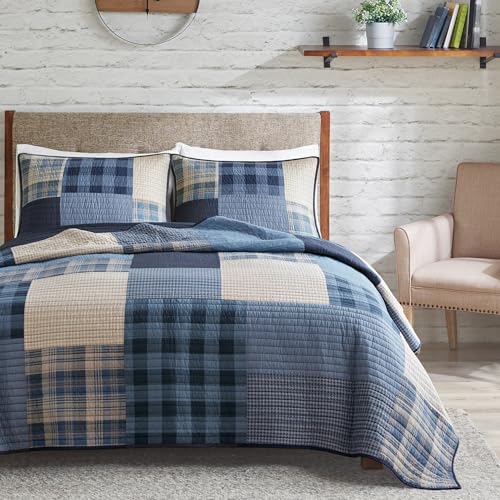
Woolrich Winter Hills Reversible Quilt Set — Best Lodge Reversible
Woolrich’s name is shorthand for American outdoor heritage, and the Winter Hills set applies it to the bed: cottage styling on one face, a solid reverse on the other. It is the quilt for the cabin, the lodge-look bedroom and anyone whose winter aesthetic runs to flannel and timber.
Strengths
- Woolrich heritage styling — the lodge look done by its originators
- Reversible pattern-to-solid doubles its design life
- All-season weight makes it the layering system’s most flexible piece
Trade-offs
- All-season lightweight per its own title — northern winters must layer under it
- Cottage styling is a definite aesthetic direction
- Check the current size options against your bed before ordering
| Detail | What to know |
|---|---|
| Brand | Woolrich |
| Style | Winter Hills cottage, reversible to solid |
| Weight | All-season (per listing) |
| Layer role | Top layer / shoulder-season solo |
Woolrich understands something specific: a quilt in a cold-climate home is seen more than it is slept under alone — it is the bed’s public face over blankets and duvets from November to March. The Winter Hills pattern carries that public role with genuine heritage credibility, and the solid reverse lets the same set calm down when the room needs quiet.
Use it as the system intends: solo through autumn, over a wool blanket in deep winter, and back to solo in spring. Few pieces in a linen closet work three seasons; that versatility is the real value proposition behind the lodge looks.
Best for: Cabins, lodge-style rooms and three-season layering / Not suited for: Solo use in deep-winter northern bedrooms
Check on Amazon — check the current price on Amazon before you decide, because configurations and finishes change.
Comparison Table
| Pick | Badge | Key spec | Best for |
|---|---|---|---|
| Secgo King Size 100% Cotton Quilt Set (Sage) | Best Overall Winter Quilt | 100% cotton king, 96×108 | Layered winter beds in heated homes, king size |
| EVERGRACEHOME 100% Cotton Modern Lines Quilt Set, King (Birch) | Best Modern Cotton | Pre-washed cotton king, modern lines | Modern bedrooms building a layered winter bed |
| Madison Park Patchwork Farmhouse Quilt Set, King (Red/Black) | Best Farmhouse Winter | King patchwork, reversible, diamond quilted | Farmhouse and lodge bedrooms, layered or mild winters |
| SahSahCasa Quilt Set King — 100% Cotton Botanical | Best Botanical Cotton | King cotton, botanical/solid reversible | Guest rooms and pattern-softened primary beds |
| palassio 100% Cotton Striped Channel Quilt Set, King (Dusty Blue) | Best Channel Stitch | King cotton channel stitch, dusty blue | Tailored bedrooms layering over duvets |
| Woolrich Winter Hills Reversible Quilt Set | Best Lodge Reversible | Woolrich reversible lodge quilt set | Cabins, lodge-style rooms and three-season layering |
The Layering System That Makes a Quilt Work in Winter
A winter quilt bed is a system of three jobs. The insulation job belongs to the middle: a wool blanket, a fleece blanket or a duvet, chosen for your climate. The regulation job belongs to the quilt on top: cotton, breathable, heavy enough to hold the system together and stop draughts from tunnelling under the insulation. The comfort job belongs to the sheet against your skin. When a ‘winter quilt’ disappoints, it is almost always a regulation layer asked to do the insulation job alone.
Build by climate. Mild winters (the Gulf Coast, lowland California, the Carolinas): a cotton quilt over a light blanket, or a mid-weight quilt solo. Mid-latitude winters (the mid-Atlantic, the Midwest’s milder band, the Pacific Northwest): quilt plus a proper blanket. Northern winters (the upper Midwest, New England, the mountains): quilt over a duvet, full stop — and be suspicious of any single product, quilt or otherwise, that promises to replace that physics.
Cotton, Microfiber and Wool-Blend Quilts in Cold Weather
Cotton shells dominate this guide deliberately: cotton breathes, grips other layers instead of sliding, washes hot when winter illnesses demand it, and ages gracefully. Its insulation per inch is modest — which the layering system handles — but its regulation is the best of the three. Microfiber shells are lighter and cheaper, sleep warmer initially and clammier by morning, and skate over blankets unless the bed is remade daily.
Wool-blend quilts are the insulation overachievers and the care divas: superb warmth-to-weight, natural temperature regulation, and washing instructions that must be obeyed. They appear less often in verified quilt-set listings than their virtues deserve. If your household runs cold and washes carefully, a wool layer under a cotton quilt from this guide is the connoisseur’s winter bed.
Quilt Weight, Decoded Without a Laboratory
Manufacturers describe quilt weight in adjectives because there is no enforced standard: ‘lightweight’ in one listing can outweigh ‘all-season’ in another. The reliable tells are construction and role. A quilt whose title says lightweight or coverlet is a top layer. A mid-weight cotton quilt with shams is a mild-winter solo or mid-latitude layer. Nothing stitched as thin as a quilt — any quilt — is a northern solo answer, whatever the photography of snow suggests.
Use your own thermostat as the final spec: heated bedrooms at typical night settings need regulation more than raw insulation, which is why cotton quilts over blankets satisfy most US households. Unheated or set-back bedrooms need the duvet under the quilt, and no adjective on a listing changes that.
How to Choose the Best Quilt for Your US Winter
Name your winter honestly first — region, bedroom temperature at night, and whether you sleep hot or cold. Then assign the quilt its job: solo (mild only), anchor over a blanket (most homes), or finish over a duvet (cold homes). Choose cotton for the anchor and finish roles, size up for drape — winter quilts should overhang generously because sleepers pull them — and pick the face you want to see for five months.
Finally, plan the wash: a king cotton quilt needs a large-capacity machine. If that is not your laundry room, a queen on a king bed with extra blankets at the foot is the pragmatic heresy this guide officially permits.
How to Build and Care for a Layered Winter Bed
Assembling the system correctly — and washing its cotton anchor properly — is what turns six good products into one warm winter.
- Start with a fitted cotton or flannel sheet; flannel is the winter upgrade that costs the least and feels like the most.
- Add the insulation layer: a wool or fleece blanket for mid-latitude winters, a duvet for northern ones, spread to the bed’s edges without tucking it rigid.
- Lay the quilt over the top with generous, even overhang on both sides and the foot — overhang is draught-proofing, not decoration.
- Fold the quilt’s top edge down over the insulation layer to lock the system together and show the reverse if your quilt has a good one.
- Ventilate the bed weekly: pull the quilt back for an hour so the layers air — winter beds accumulate humidity from sleepers even in dry houses.
- Wash the cotton quilt on a warm gentle cycle with mild detergent, alone in a large-capacity machine, and dry thoroughly before it returns to the bed.
- Store off-season quilts clean, folded loosely in a breathable bag; a quilt put away clean in April is a quilt that smells like nothing in November.
Sheet, insulation, quilt: three layers, three jobs, one warm bed. Master the system once and every winter after is just choosing which quilt’s face you want to see.
Common Buying Mistakes
Expecting any quilt to solo a northern winter
The category’s founding disappointment. Quilts are regulation layers; deep-winter insulation is a blanket’s or duvet’s job. Layer, and the quilt you love becomes the quilt that works.
Buying by the snow in the product photo
Photography is not a warmth rating. Read the construction — cotton or synthetic, lightweight or mid-weight — and the listing’s own weight words, which are usually more honest than the staging.
Skimping on size to save money
Winter coverage fails at the edges: feet, shoulders, the gap between two sleepers. A quilt with real overhang ends the midnight tug-of-war; a skimped size guarantees it.
Sealing the bed in synthetics
A microfiber quilt over a synthetic blanket over polyester sheets sleeps hot and clammy by 3 a.m. even in January. One breathable cotton layer — ideally the quilt — regulates the whole stack.
Washing a king quilt in a small machine
An overloaded washer cleans nothing and strains both machine and quilt. Use a large-capacity machine or a laundromat trip; winter quilts are washed rarely enough that the trip is worth it.
Final Recommendation
For most US homes, the Secgo cotton king is the winter quilt to build around — full cotton, generous size, born to anchor a layered bed. Modern rooms should take the pre-washed EVERGRACEHOME, farmhouse rooms the Madison Park patchwork, and guest rooms the SahSahCasa botanical, with the palassio channel quilt as the tailored top layer over a duvet and the Woolrich as the three-season lodge all-rounder.
Whichever face you choose, remember the system’s rule: the quilt regulates, the layer beneath insulates. Respect that division of labour and a quilt-based bed will carry you through any winter the lower forty-eight can produce — which is all this guide ever promised, and all it needed to.
Best Amish Quilts Best Children Quilts Best Friend Quilts Best Handmade Turkish Quilts Best Heavyweight Comforter Quilts
Regional Winter Playbooks: One Country, Four Bedrooms
The South’s winter is a quilt’s solo season. From the Gulf Coast through the Carolinas, January nights are cool rather than cold, bedrooms are heated, and a mid-weight cotton quilt — the Secgo or the SahSahCasa from this guide — over a sheet is a complete and comfortable system for most sleepers. The region’s real challenge is variability: a warm week follows a freezing one, and the quilt’s virtue is that it adjusts by being folded back, where a heavy comforter simply evicts itself to the floor.
The mid-Atlantic and the milder Midwest run the classic two-layer playbook: quilt over a blanket, with the blanket chosen by the household’s cold tolerance. This is the largest single winter-bed configuration in the country, and it is why this guide’s cotton anchors are specified so carefully — in a two-layer system the quilt’s breathability and grip decide whether the bed feels composed or chaotic by morning.
The northern tier and the mountains run three layers without apology: sheet, duvet, quilt. There the quilt’s jobs are draught-sealing, weight and beauty, and the picks here were chosen to do those jobs over a duvet without sliding off it in the night — cotton’s grip on cotton being the unglamorous hero. The high desert and the West’s interior valleys add a fourth pattern: cold nights, warm days, and a premium on layers that strip fast, which is the Woolrich reversible’s home terrain. Match the playbook to the map before matching the quilt to the room.
The Quilt as the Bed’s Public Face: Styling a Winter Bedroom
For five months a winter quilt is the largest visible textile in the bedroom, and its styling leverage is total. The tailored route — the palassio’s channels or the EVERGRACEHOME’s modern lines, in birch, dusty blue or sage — makes a layered bed look composed and hotel-calm, especially with the top folded down to show a solid reverse or a contrasting blanket edge. This is the styling that suits primary bedrooms photographed by daylight and judged by adults.
The heritage route — Madison Park’s patchwork, Woolrich’s cottage face — trades calm for warmth of association: the bed becomes the room’s hearth, and everything else in the room can afford to be simpler. Heritage quilts forgive a multitude of bedroom sins, including rental furniture and imperfect paint, because the eye goes to the bed and stays there happily.
Guest rooms deserve the deliberate middle: the SahSahCasa botanical, patterned enough to feel hosted, calm enough to sleep under as a stranger. Whichever route a room takes, one discipline unifies them — the winter bed should look layered on purpose, with each stratum visible at the fold. A bed that shows its system reads as warmth; a bed that hides it reads as a pile.
Quilt Care Through the Season: Washing, Airing, Storing
A winter quilt’s care calendar has three beats. The first is the mid-season refresh: somewhere around January, a cotton quilt that has absorbed two months of heated-house air, skin and sleep benefits from a full wash — warm, gentle, large-capacity, dried completely — which restores both its hygiene and, noticeably, its loft and hand. Quilts washed at this rhythm emerge from winter in better condition than quilts washed only at the ends, because soil never gets a season to set.
The second beat is weekly airing, the most neglected and cheapest care in bedding: an hour with the quilt folded back and a window cracked resets the bed’s humidity and freshness more effectively than any spray. Winter houses are sealed houses, and beds are their most humid furniture; airing is the countermeasure that costs nothing.
The third beat is spring storage, done properly once: wash, dry completely — completely is the operative word, since a quilt stored at ninety-five percent dry mildews at leisure — then fold loosely into a breathable bag with nothing heavier stacked on top. Cotton quilts stored this way emerge in November smelling of nothing and ready for the first cold night, which is the entire goal of the exercise.
Quilts Versus Comforters and Duvets: Settling the Vocabulary
American bedding vocabulary is a swamp, and winter is where shoppers drown in it, so here are the working definitions this guide uses. A quilt is a thin, stitched-through sandwich — top, a light inner layer, back — whose stitching is structural and visible. A comforter is a thick, lofty filled blanket, stitched or baffled to hold its fill, designed to be the bed’s main insulation. A duvet is a comforter’s formal cousin: a fill insert inside a removable cover, European in origin, the insulation layer in this guide’s northern playbook.
The distinctions are functional, not pedantic. Quilts regulate and finish; comforters and duvets insulate. A shopper who buys a comforter expecting a quilt’s breathability gets a clammy bed; a shopper who buys a quilt expecting a comforter’s insulation gets a cold one — and both write reviews blaming the product for the vocabulary. Several listings in this category blur the words deliberately, which is why the reviews above classify each pick by construction rather than by the noun in its title.
Once the vocabulary is settled, the winter decision simplifies into the system this guide teaches: choose your insulation by climate, choose your quilt by cotton, size and face, and let each do the job its construction was born for. Beds built on that clarity stay comfortable from the first frost to the last, in every region this guide covers.
The Foot of the Bed: Where Winter Is Won
Every layered bed has a weak point, and it is the foot. Sleepers pull quilts upward through the night, the foot uncovers, and cold feet — the body’s most honest thermometers — report a cold bed even when the torso is warm. The defences are dimensional and tactical. Dimensionally, length is the specification that matters: the 108-inch length on this guide’s leading pick exists precisely to survive the upward migration with the foot still covered. Tactically, tucking the quilt’s foot under the mattress — the hotel fold — anchors the whole system against the night’s pulling, at the cost of freedom for sleepers who like their feet loose.
Households divided on the tuck should know the compromise: tuck one side only. The foot-loose sleeper keeps their liberty, the system keeps most of its anchor, and the quilt’s generous overhang covers the diplomatic gap. Winter bedding is a long negotiation between physics and preference, and it is won at the foot more often than anywhere else.
Two Sleepers, Two Temperatures: the Split System
The classic winter-bed conflict — one sleeper roasting, one freezing, one quilt — has a structural solution that quilt-based beds handle better than any single comforter: build the shared base, then split the top. A shared sheet and a shared mid-layer keep the bed coherent; above that, each side takes its own weight — the full quilt folded to the cold sleeper’s half, a lighter layer or nothing on the warm sleeper’s. Cotton quilts excel here because they fold and hold a half-bed configuration without sliding into the valley between sleepers.
The diplomatic version of the same system is the double-quilt method: two narrower quilts, one per sleeper, overlapping at the centre. Each sleeper controls their own climate absolutely, the midnight tug-of-war ends by treaty, and the bed still makes up as one handsome layered whole. Couples who discover this arrangement rarely return to the single-quilt constitution, whatever the season.
Quilts in Homes With Pets and Children
Winter quilts in real households are slept on as much as under — by dogs with territorial claims on the foot of the bed and children who regard a made bed as a landscape. Cotton quilts are the correct equipment for this life: they wash hot and whole, they show hair less than dark synthetics, their stitching survives paws that would shred a lofty comforter’s baffles, and a paw-printed cotton quilt reads as charming where a stained luxury textile reads as ruined.
The operational rules are simple. Keep a washable cotton quilt as the top layer precisely because it is the sacrificial surface — that is a design role, not an insult — and wash it on the mid-season rhythm this guide prescribes, or oftener when the household’s four-legged members demand it. The insulation beneath stays clean for seasons; the quilt takes the world on its face and goes through the machine like it was built for it, because it was.
Vintage and Heirloom Quilts: a Word of Respect and Caution
Many American homes own a quilt with a history — a grandmother’s patchwork, a wedding quilt, an Amish-made piece — and winter tempts owners to put heritage to work. The respect first: a well-made hand-quilted cotton quilt is a legitimate winter layer, and using it honours it more than a cupboard does. The caution follows: heirloom stitching and aged fabrics tolerate neither hot washing nor nightly stress indefinitely, and the piece’s value is partly its survival.
The working compromise is rotation: the heirloom takes the bed for the gentle weeks and the guest room’s best nights, while a modern cotton quilt from this guide carries the deep-winter daily duty and the laundry that comes with it. Heritage stays in the family’s life without being spent by it — which is, in the end, what the hands that stitched it would have wanted.
The Spring Audit: Closing the Winter Bed Down
When the season turns, an hour’s audit converts this winter’s lessons into next winter’s comfort. Note which layer actually carried the cold months and which was decorative; note where the quilt wore — the fold line, the foot, the side of the bed’s main sleeper — and whether its stitching held. Wash and store by the care section’s rules, with the audit’s verdict attached: the quilt that regulated beautifully gets its role renewed, and the layer that disappointed gets replaced in the autumn sales rather than rediscovered inadequate in the first cold snap.
Beds, like wardrobes, improve when they are edited seasonally with evidence. The household that audits its winter bed each spring stops buying bedding hopefully and starts buying it knowingly — which is the entire ambition of guides like this one, applied one bedroom at a time.
The Last Layer: What Goes Over the Quilt
Purists will object, but real winter beds often carry one more stratum above the quilt: the throw. A folded wool or fleece throw at the foot is the bed’s adjustable zone — pulled up by the cold sleeper, ignored by the warm one, deployed to the shoulders during a bedtime read and exiled by midnight. It is also the layer that absorbs the household’s life: the dog’s nap, the child’s fort, the tea tray. Keeping that sacrificial role in a washable throw rather than in the quilt itself extends the quilt’s beauty by seasons, which is why so many of the beds in this guide’s imagination end with a folded band of something humble at the foot. Systems thinking, applied to softness.
Buying the Second Quilt: Rotation as a Strategy
Households that fall for the layered system often ask whether one quilt is enough, and the honest answer is that two quilts in rotation out-serve one quilt of double the price. Rotation rests each quilt’s fibres between uses, halves each one’s wash count across a season, gives the bedroom a second face for the holidays-to-February costume change, and means a laundry day never strips the bed bare. The natural pairing is one tailored cotton — the palassio or EVERGRACEHOME — and one character quilt — the Madison Park or the Woolrich — which between them cover every mood a winter bedroom cycles through. Buy the anchor first, live a season, and let the second purchase be informed by the audit rather than by hope. That is how linen closets become collections instead of accumulations.
One Sentence to Carry Out of This Guide
If a cold sleeper retains a single sentence from these thousands of words, let it be the system in miniature: let the layer beneath do the insulating, let the cotton quilt do the regulating, size both generously, and wash the quilt like the workhorse it is — and any winter this country produces becomes a matter of choosing which beautiful face the bed wears while it keeps you warm.
Frequently Asked Questions
Can a quilt alone keep you warm in winter?
In mild-winter regions or well-heated bedrooms, a mid-weight cotton quilt can be enough. In mid-latitude and northern winters, no quilt should work alone — pair it with a blanket or duvet beneath, and the quilt becomes the breathable top layer that makes the system comfortable.
What is the warmest type of quilt for winter?
Warmth in a quilt system comes from the insulation layer beneath it. The quilt’s own contribution is regulation and draught-stopping, where cotton shells excel. A cotton quilt over a wool blanket or duvet is warmer in practice than any single thick quilt.
Are cotton quilts better than microfiber for winter?
For most sleepers, yes: cotton breathes, grips other layers, washes hot and regulates temperature swings through the night. Microfiber feels warm initially but sleeps clammier and slides over blankets.
What size quilt should I buy for a king bed?
Look for true oversize dimensions — around 96 by 108 inches or more — so the quilt overhangs both sides and the foot. Winter sleepers pull quilts upward; the extra length is what keeps feet covered at 4 a.m.
How do I wash a heavy cotton quilt?
In a large-capacity machine, alone, on a warm gentle cycle with mild detergent, then dry it completely before use. Overloading a small machine cleans poorly and can damage both the quilt and the washer.
When should a winter quilt be replaced?
When stitching fails and fill migrates into corners, when the shell thins or tears at the fold lines, or when washing no longer refreshes it. A well-kept cotton quilt serves for many winters before any of those arrive.


