Disclosure: airfryerkitchensupply.com is reader-supported. When you buy through links on our site, we may earn an affiliate commission at no extra cost to you.
Where to buy
Quality in a bath mat is easy to claim and hard to fake for long: it shows up as a backing that still grips after fifty washes, pile that has not flattened into cardboard, and edges that lie flat instead of curling into a trip hazard. Every mat below was verified against its Amazon listing before receiving a link, and the six split across the three constructions that actually last — rubber-backed woven rugs, dense memory foam, and a diatomaceous earth stone mat for people who want dry feet with no fabric at all.
- GORILLA GRIP Bathroom Rug (Best Overall) — Check the current price on Amazon
- OLANLY Thick Memory Foam Bath Mat 30×20 (Best Cushioning) — Check the current price on Amazon
- Genteele Memory Foam Bath Mat 20×32 (Best Large Memory Foam) — Check the current price on Amazon
- Yimobra Chenille Bathroom Rug (Best Absorbency) — Check the current price on Amazon
- Smiry Chenille Bath Mat 30×20 (Best Value Plush) — Check the current price on Amazon
- VEELOIM Stone Bath Mat, Diatomaceous Earth (Best Quick-Drying Stone Mat) — Check the current price on Amazon
The best quality bath mats are not the softest ones in the store on day one — almost every mat feels plush for a week. Quality is what is left after six months of daily showers, weekly washes and a permanently damp floor: the mat that still absorbs instead of smearing water around, still grips instead of skating, and still looks like a bath mat rather than a defeated dish towel. This guide ranks mats by construction and durability signals, not by first-touch softness.
Three constructions dominate the quality end of the market, and they suit different bathrooms. Woven chenille or microfiber rugs with a real rubber backing absorb a lot, wash well, and grip hard floors properly. Memory foam mats trade some absorbency for cushion — the step-out-of-the-shower comfort is genuinely different, but the foam core demands a mat that dries between uses or it stays damp. Stone mats made from diatomaceous earth absorb on contact and dry in minutes, with zero plushness and zero laundry. The six picks below cover all three, in the sizes most bathrooms actually need.
A sizing note that saves returns: measure the floor space in front of your tub or shower before ordering anything. The most common sizes cluster around 30 by 20 inches and 24 by 16 inches, and a mat that overlaps a door swing or bunches against the tub lip will annoy you daily regardless of quality. Buy the construction for your habits, in the size your floor actually has.
Every mat here was verified against its live listing before receiving a link, and the construction details in the spec lines — backing type, size, pile or stone material — are drawn from those verified listings. Where a construction has a genuine weakness, the review names it in the trade-offs rather than leaving you to discover it in month two.
In this guide
Quick Picks
GORILLA GRIP Bathroom Rug — Best Overall. A strong rubber grip backing and OEKO-TEX certified materials — the mat that treats staying put as its main job. Check price on Amazon
OLANLY Thick Memory Foam Bath Mat 30×20 — Best Cushioning. Thick memory foam with a soft absorbent surface — the step out of the shower feels like a different product category. Check price on Amazon
Genteele Memory Foam Bath Mat 20×32 — Best Large Memory Foam. A bigger foam footprint with a velvet-feel surface, for long tubs and double step-out zones. Check price on Amazon
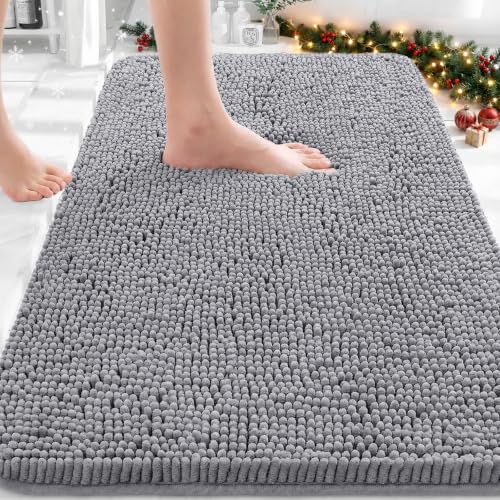
Yimobra Chenille Bathroom Rug — Best Absorbency. High-density chenille pile that drinks water fast — the mat for households where the floor is always wet. Check price on Amazon
Smiry Chenille Bath Mat 30×20 — Best Value Plush. Luxury-feel chenille at the standard 30×20 size, machine washable with a non-slip backing — the sensible plush buy. Check price on Amazon
VEELOIM Stone Bath Mat, Diatomaceous Earth — Best Quick-Drying Stone Mat. No fabric, no laundry: a diatomaceous earth stone that pulls water off feet and dries itself in minutes. Check price on Amazon
How These Picks Were Chosen
Quality was judged on the things that fail first in cheap mats. Backing came first: a continuous rubber or well-bonded grip backing outlasts sprayed-on grip dots, which crack and shed. Pile and core came next — dense chenille and high-density foam hold their structure, while thin foam compresses permanently within months. Washability was treated as a quality feature in itself, because a mat you cannot wash properly becomes a hygiene problem wearing a rug costume.
Every candidate was cross-checked on this site: brand and model searched, the returned listing title matched to the product, and only confident matches received links. Sizes and construction details quoted in the spec lines come from those verified titles. Mats with known weak points — foam mats marketed for steamy bathrooms with no airflow, stone mats with no rubber backing layer — were either cut or carry their warning in the trade-offs where it belongs.
The final six give you a deliberate spread: a rubber-backed all-rounder, two memory foam options at different sizes, two chenille absorbers at different characters, and one stone mat for the no-fabric household. If your bathroom has a specific constraint — a door that swings over the mat zone, a washer too small for bulky rugs, a floor that never dries — one of the six is built around it.
A final filter deserves naming: every mat here had to survive an honest description of its worst day — the fifth shower, the rushed wash, the week it does not get aired. Constructions that only shine in showroom conditions were cut even when their first impression was the softest in the test pool. Quality, as this guide uses the word, is a property of ordinary Tuesdays, and the six picks are the ones whose ordinary Tuesdays stay good.
The 6 Best Quality Bath Mats

GORILLA GRIP Bathroom Rug — Best Overall
Gorilla Grip built its name on the unglamorous end of bath mats: the backing. This rug uses a strong rubber grip backing that holds on tile, vinyl and sealed wood far more stubbornly than the grip-dot mats that start skating after a dozen washes. The pile is a soft, absorbent bathroom rug pile rather than a foam pad, so it behaves like a proper rug — it drinks the water off your feet, lies flat at the edges, and goes through the wash without coming out twisted.
Strengths
- Strong rubber backing grips far longer than grip dots
- OEKO-TEX certified materials for a wet, barefoot product
- Lies flat and washes without twisting
Trade-offs
- Less cushioned than the memory foam picks
- Rubber backing prefers air-drying over high heat
- Serious, plain styling over decorative patterns
Key specs: Strong rubber grip backing, OEKO-TEX certified (per verified listing title)
The OEKO-TEX certification in the verified listing matters more than it sounds: bath mats live wet, warm and barefoot, and certified materials are the ones tested for the substances you do not want in that environment. In daily use the difference this mat makes is mostly about trust — you can step out of the shower onto it without the little sideways test-slide everyone does on a cheap mat. It is not the thickest or the plushest option here, and it does not try to be; it is the one whose fundamentals — grip, absorbency, washability, flat edges — are all correct at once.
Day to day, the Gorilla Grip disappears — which is the compliment. It stays where you put it, drinks the step-out water, and comes out of the wash the same shape it went in. Owners of slick floors notice the difference most: the sideways test-slide everyone unconsciously performs on a new mat simply stops happening. Rotate it with a second mat if you can, dry the rubber backing away from fierce heat, and this is a buy-it-for-years purchase rather than a seasonal consumable.
If you own hard water, an occasional vinegar rinse keeps the pile from going stiff. The mat will not ask for it often, but the difference after is noticeable underfoot.
Best for: most bathrooms that want one mat that does everything properly / Not suited for: anyone shopping mainly for thick cushion

OLANLY Thick Memory Foam Bath Mat 30×20 — Best Cushioning
If your priority is how the mat feels underfoot, this is the pick. OLANLY’s thick memory foam core gives that slow, even sink that hard bathroom floors never offer, topped with a soft absorbent surface so you are not standing in a puddle on top of the cushion. At 30 by 20 inches it covers the step-out zone of a standard tub properly, and the non-slip backing keeps the foam from travelling while you towel off.
Strengths
- Thick foam delivers the best underfoot comfort here
- Soft absorbent top handles the first step-out water
- Non-slip backing keeps a light mat in place
Trade-offs
- Foam needs airflow between uses to dry fully
- Not the fastest-drying pick after back-to-back showers
- Cushion feel divides people — some prefer firm woven pile
Key specs: 30×20 in, thick memory foam, soft absorbent surface, non-slip backing, machine washable (per verified listing title)
Memory foam’s weakness is water management, and it is worth being honest about: foam absorbs through its surface, holds moisture longer than woven pile, and needs airflow between uses. OLANLY counters with a quick-dry positioning and a surface designed to release water, but the mat still rewards a bathroom with a window, a fan, or an owner who drapes it over the tub edge on steamy days. Treat it that way and the foam keeps its bounce for a long time; leave it sodden on a cold floor in a sealed bathroom and any foam mat, this one included, will age early.
The OLANLY becomes a small ritual: step out, feel the foam give, and — on days the bathroom has steamed up — flip it over the tub edge while you dress. That ten-second habit is the difference between a foam mat that stays fresh for years and one that ages in a season. In guest bathrooms it draws comments, because guests judge a bathroom by its towels and its mat, and thick foam reads as a hotel that thought about feet. Keep the surface vacuumed occasionally; foam-top mats hold dust in their texture.
In a household with early and late showers, this mat gets no rest — that is exactly the rotation case. A second mat, even a cheaper one, doubles this one’s effective lifespan.
Best for: comfort-first bathrooms with decent ventilation / Not suited for: sealed, steamy bathrooms with no airflow

Genteele Memory Foam Bath Mat 20×32 — Best Large Memory Foam
Genteele’s mat is the larger-format foam option: 20 by 32 inches of memory foam under a soft velvet-style surface. The extra length matters in real bathrooms — along a long tub, in front of a double vanity where two people step and stand, or anywhere a standard mat leaves the second foot on cold tile. The foam is absorbent and non-slip backed, and the velvet surface feels warmer on first contact than microfiber, which matters on winter mornings.
Strengths
- Larger 20×32 format covers long tubs and double zones
- Velvet-feel surface is warm on first contact
- Long-running model with a proven construction
Trade-offs
- Needs a full-size washer to launder comfortably
- Velvet top dries slower than chenille pile
- Foam care rules apply — airflow between uses
Key specs: 20×32 in, memory foam, non-slip, absorbent velvet surface (per verified listing title)
Genteele has sold this basic design for years, and longevity of the model line is itself a quality signal: the construction has survived a lot of bathrooms. The velvet top dries a touch slower than a woven chenille, and the larger size needs a washing machine with real capacity — check your drum before assuming. In return you get the most generous cushioned standing area in this guide, and a mat that reads as a deliberate, finished piece of the bathroom rather than a utility rectangle.
The Genteele’s size makes it the anchor of a bigger bathroom: it defines the bathing zone visually, warms the whole step-out area, and gives two people room to stand after a shared morning shower rush. It asks for a proper wash drum and a bit of drying patience, and in return it is the mat least likely to be replaced for looking tired — the velvet surface hides wear gracefully. In winter it is the first thing bare feet look for, which is a sentence few bathroom purchases ever earn.
The larger format also works sideways in front of a double vanity, a placement trick that makes two-person mornings measurably less territorial. Measure your vanity run before assuming the standard orientation.
Best for: long tubs, double vanities and bigger step-out zones / Not suited for: small bathrooms or compact washing machines

Yimobra Chenille Bathroom Rug — Best Absorbency
Yimobra’s chenille rug is built around thirst. The high-density chenille pile presents a huge amount of fibre surface to wet feet, so water is pulled off skin and out of the pile’s top layer quickly, and the plush shaggy texture keeps the surface feeling dry longer between showers. It is the right answer for busy family bathrooms where the mat gets used five times before breakfast and a foam mat would still be damp from the first round.
Strengths
- High-density chenille absorbs fast and feels dry longer
- Pile recovers after washing instead of matting
- Built for high-traffic family bathrooms
Trade-offs
- Wash separately the first time for loose fibre
- Plush pile holds pet hair enthusiastically
- Thicker pile can foul a low door swing
Key specs: High-density chenille, soft and absorbent, plush shaggy texture (per verified listing title)
Chenille’s quality questions are shedding and backing, and this is where density earns its price: a high-density weave holds its fibres through washing far better than the sparse, glued-feeling chenille on bargain mats. The first wash may still release loose fibre — wash it separately once, as you would any new plush textile. After that it settles into being the hardest-working mat in the house: absorb, wash, dry, repeat, with the pile bouncing back instead of matting down into lanes where feet always land.
The Yimobra is the household workhorse: it will be stepped on by everyone, washed more than any textile you own, and asked to dry a small flood after a child’s bath. It handles that life well. Give it a first solo wash, shake it outside weekly, and the chenille keeps its thirst. Families often end up with the same mat in the second bathroom once the first proves itself, because a mat that survives a family bathroom has passed the only certification that matters.
Pet owners should know the chenille will collect hair and release it in the wash — a lint roller pass before guests keeps it presentable between washes without a full laundry event.
Best for: busy bathrooms with back-to-back showers / Not suited for: doors with very low floor clearance

Smiry Chenille Bath Mat 30×20 — Best Value Plush
Smiry’s chenille mat is the plush option for people who comparison-shop. It covers the standard 30 by 20 step-out zone, uses a soft absorbent chenille pile that feels a class above its tier, and keeps the practical boxes ticked: non-slip backing, machine washable, quick to dry for a plush mat. If the Gorilla Grip is the engineer’s choice, this is the comfort choice at the same size — softer first impression, slightly less obsessive about grip.
Strengths
- Plush chenille feel above its tier
- Standard 30×20 size fits most tubs
- Machine washable and quick to dry for a plush mat
Trade-offs
- Grip a step below the rubber-backed leader
- Light colours show bathroom grime honestly
- Pile needs a shake-out to look its best
Key specs: 30×20 in, chenille, extra soft and absorbent, machine washable, non-slip (per verified listing title)
Living with it makes the case: the pile is dense enough that feet do not push straight through to the backing, and it comes out of the wash with its texture intact rather than stringy. The backing grips well on smooth floors, though on heavily textured tile the Gorilla Grip’s rubber holds the edge. As a second mat — for the guest bathroom, the kids’ bathroom, the ensuite rotation while the main mat is in the wash — it is hard to argue with, and many households end up standardising on it once the first one proves itself.
The Smiry’s ownership story is quiet competence: it arrives, it is softer than expected, it washes without drama, and a year later it still looks like the photograph. It is the mat most likely to be bought in multiples — one per bathroom, matched colours — because standardising on a known-good mat beats researching the category again for every room. On textured floors its grip is ample; on polished tile it is good rather than absolute, which is the honest summary of a value pick done right.
Buying two at once, in the same colour, is the quiet pro move: the rotation pair problem solves itself, and the second bathroom stops being the room with the disappointing mat.
Best for: comfort value and second-bathroom duty / Not suited for: maximum-grip requirements on slick tile

VEELOIM Stone Bath Mat, Diatomaceous Earth — Best Quick-Drying Stone Mat
The VEELOIM stone mat is the quality pick for people whose quality complaint is different: every fabric mat they have owned stayed damp, smelled sooner or later, and needed washing again. Diatomaceous earth is a naturally porous mineral material; water spreads into the stone’s surface pores and evaporates fast, so footprints visibly fade within moments. The mat includes a non-slip design, feels cool and firm underfoot, and asks for an occasional rinse and air-dry instead of a laundry cycle.
Strengths
- Absorbs on contact and dries in minutes
- No laundry, no damp fabric, no foam to mildew
- Surface can be refreshed with light sanding
Trade-offs
- Zero cushion — firm as tile underfoot
- Must sit flat; can crack if dropped or bridged
- Cool surface feel will not suit everyone in winter
Key specs: Diatomaceous earth stone, fast drying, super absorbent, non-slip design (per verified listing title)
Living with stone is an adjustment. There is no cushion at all — it feels like standing on smooth tile that happens to be dry — and the mat must sit on a flat floor, since stone does not bend and can crack if bridged over a ridge or dropped on a corner. In exchange, the hygiene maths are unbeatable: nothing stays wet, nothing mildews inside a foam core, and a light sanding with fine paper refreshes the surface if absorption ever slows. For minimalist bathrooms, small spaces, and anyone who hates laundry, it is the most rational mat in this guide.
Stone-mat ownership feels strange for a week — the cool, firm surface, the vanishing footprints — and then fabric mats start to feel like the strange ones. Maintenance is a rinse, a full dry, and an occasional light sanding if absorption slows, which owners describe with the satisfaction usually reserved for cast-iron pans. Keep it on a truly flat floor, lift it rather than dragging it, and never drop a heavy bottle on its corner. Treated as stone, it behaves like stone: essentially permanent.
A felt pad under each corner protects delicate floors and silences the small click stone can make on tile. It is a two-minute addition that makes the mat feel engineered rather than placed.
Best for: damp-prone bathrooms and laundry-averse households / Not suited for: anyone who wants cushion underfoot
Comparison Table
Construction decides almost everything about how a mat ages, so the table leads with what each mat is made of and where that construction wins.
| Pick | Badge | Key spec | Best for |
|---|---|---|---|
| GORILLA GRIP Bathroom Rug | Best Overall | Rubber-backed woven rug | most bathrooms that want one mat that does everything properly |
| OLANLY Thick Memory Foam Bath Mat 30×20 | Best Cushioning | Thick memory foam, 30×20 | comfort-first bathrooms with decent ventilation |
| Genteele Memory Foam Bath Mat 20×32 | Best Large Memory Foam | Memory foam, 20×32 large format | long tubs, double vanities and bigger step-out zones |
| Yimobra Chenille Bathroom Rug | Best Absorbency | High-density chenille pile | busy bathrooms with back-to-back showers |
| Smiry Chenille Bath Mat 30×20 | Best Value Plush | Chenille plush, 30×20 | comfort value and second-bathroom duty |
| VEELOIM Stone Bath Mat, Diatomaceous Earth | Best Quick-Drying Stone Mat | Diatomaceous earth stone | damp-prone bathrooms and laundry-averse households |
How to Choose a Quality Bath Mat: The Three Constructions
Rubber-backed woven rugs are the default done right: fibre pile for absorbency, a real rubber layer for grip, and a construction that survives the washing machine. Choose this if your bathroom is ordinary and you want the mat to simply be good for years. Memory foam is a comfort upgrade with a care contract attached — it needs to dry between uses, so it belongs in bathrooms with ventilation, or in homes where draping it over the tub edge is a realistic habit. Stone is the hygiene extreme: no absorbency limit in practice, no laundry, and no softness whatsoever.
Within each construction, density is the quality tell. Dense pile and dense foam cost more because there is literally more material doing the work, and they are what separate a mat that flattens in a season from one that is still working in year three. When a listing talks about density, thickness of the foam core, or a continuous rubber backing, it is pointing at the parts that determine lifespan. When it talks only about softness and colour, it is pointing at the parts that do not.
Backings, Washing and the Real Lifespan of a Bath Mat
The backing is where cheap mats go to die. Sprayed grip dots crack, peel and shed into the wash; thin PVC layers split; only a continuous rubber backing or a well-made stone base stays functional for years. Check the backing before the pile when you shop — it is the component you cannot fix later. Equally, read the wash instructions as a lifespan document: a mat that tolerains regular machine washing and dries reasonably fast will be washed often, and a mat that gets washed often stays hygienic. A fussy mat gets washed rarely, and a rarely washed bath mat is a quality problem no construction can save.
Rotation quietly doubles lifespan. Two mid-priced mats alternating — one in use, one drying or in the wash — will outlast and out-perform one premium mat used continuously, because every construction benefits from full drying time. If you take one tactic from this guide, take that one: buy two of the pick that fits your bathroom, and let them take turns.
Sizing and Placement: The Unglamorous Half of Quality
Measure the step-out zone, not the bathroom. The mat needs to cover where feet actually land: the full length of the tub’s exit side, or the arc in front of a shower door. Undersized mats push water onto the floor at the edges, which then gets blamed on absorbency. Check door clearance with the pile height included — plush chenille and thick foam can both catch a low-swinging door, and a mat that gets kicked aside by the door every morning is a mat that will not be in position when it matters.
On heated floors, prefer woven or stone mats; foam insulates, which is pleasant underfoot but slows its own drying and blunts the floor’s warmth. On slick polished tile, prioritise the rubber-backed picks. On textured stone floors, almost everything grips, so choose by absorbency and drying instead. The right mat is always the one matched to the floor and the room’s airflow, not the one with the longest feature list.
Bath Mats in Rentals and Shared Bathrooms: The Diplomatic Guide
Rental bathrooms add two constraints: the floor is someone else’s asset, and the mat may serve people with different standards. The rotation habit matters doubly here — a mat left permanently damp can mark a floor you do not own, and lifting it to air weekly is deposit protection disguised as laundry. Rubber backings should be checked for any colour transfer on pale vinyl before the first long placement; the picks in this guide are well-behaved, but a rental is the wrong place to discover an exception.
Shared bathrooms — flatmates, family, guests in rotation — reward the forgiving constructions: chenille that dries between users, stone that resets itself in minutes, colours that do not publish every footprint. The mat in a shared bathroom is judged by the last person who used it, not the first, so drying speed quietly outranks cushion for that room. Buy the household’s own bathroom the comfort pick; buy the shared one the mat that is always dry, and both rooms will feel better kept than a single premium mat could make either.
Bath Mats and Safety: The Slip Statistics Nobody Puts on the Packaging
Bathrooms are the home’s most honest injury zone: hard surfaces, water, soap film and bare feet in a hurry. A bath mat is, before it is anything else, the friction layer between a wet foot and a slick floor at the exact moment a person steps out with their weight moving sideways. That is why this guide weighs backing and grip so heavily, and why a worn mat that slides is worse than a bare floor — the bare floor at least announces its danger honestly, while a sliding mat promises grip and withdraws it mid-step.
The safety case sharpens for older households and for children, the two groups whose bathroom falls carry the highest stakes. For them, the rubber-backed picks are not a preference but the point: continuous grip, edges that lie flat and cannot be tripped over, and a size that covers the whole step-out arc so no wet foot lands beyond the mat’s edge. Pair the mat with the habit of hanging it to dry — a mat left damp on the floor can itself become the slick surface — and the bathroom’s most dangerous square metre becomes its safest.
None of this requires the mat to feel clinical. The picks in this guide include plush, velvet and stone precisely because safety equipment that people dislike gets removed, and a removed safety device protects nobody. Buy the mat whose grip you trust and whose feel you enjoy; in this category, unlike most, the enjoyable choice and the safe choice can be the same object, and insisting on both is the entire secret.
The Guest Bathroom Test: What Visitors Actually Judge
Nobody inspects your grout. Guests judge a bathroom by three things they touch: the hand towel, the tap, and the bath mat. A mat that is flat, damp or faintly tired tells them the room is maintained on a schedule that has slipped; a mat with bounce, dryness and clean edges tells them the opposite, at a cost per impression no other bathroom purchase matches. This is why the quality end of this category is worth its modest premium — the mat is the room’s handshake, offered to every bare foot that enters.
It is also why the second-bathroom strategy in this guide matters. The guest bathroom does not need your best mat; it needs a good mat that is always dry, which argues for the fast-drying chenille or the stone there, and your most comfortable mat where your own feet land every morning. Matching the construction to the room’s usage pattern — daily driver, family chaos, guest impression — is the whole of bath-mat wisdom, and it is why this guide ranks six different constructions instead of crowning one material for every floor.
One last practical note: colour is a maintenance decision disguised as a design one. Pale mats show every hair and footprint in a busy bathroom and demand washing on appearance rather than hygiene; mid-tones and heathered greys — which dominate the picks here for a reason — stretch the interval honestly. Choose the colour your household’s traffic can keep looking clean, and the quality you paid for stays visible instead of theoretical.
Bath Mats for Specific Floors: Tile, Vinyl, Wood and Heated Floors
Polished tile is the grip exam: choose the continuous rubber backing of the GORILLA GRIP, and be suspicious of any mat whose grip depends on dots or texture alone. Vinyl and laminate are kinder — every pick here grips them — but they dislike standing water trapped underneath, so lift and air any mat weekly to let the floor dry; the mat that protects the floor should not quietly damage it. Sealed wood wants the same courtesy plus prompt attention to the puddle that escapes the mat’s edge, because wood forgives water slowly.
Heated floors change the ranking: woven and stone mats let the warmth through and dry faster for it, while thick foam insulates — pleasant if you want a cool island, counterproductive if the floor is your dryer. In a heated-floor bathroom the Yimobra chenille or the VEELOIM stone become the connoisseur’s picks. And in a rental, where the floor is someone else’s asset, the rotation-and-airing habit matters more than the mat itself: no construction excuses a permanently damp floor.
How to Wash and Care for a Bath Mat So It Lasts
Most bath mats are not worn out — they are cared to death or neglected to death. This routine keeps any of the fabric picks above performing for years.
- Shake it outside first. Before any wash, take the mat out and shake or beat it. Loose grit in the pile acts like sandpaper in the machine and shortens pile life.
- Wash cool to warm, gentle cycle. Hot water ages rubber backings and foam. Wash the mat alone or with towels — never with delicates it can shed onto.
- Use less detergent than you think. Detergent residue left in dense pile or foam makes mats feel stiff and absorb less. A modest dose and an extra rinse beat a heavy dose.
- Dry with air, not aggression. Air-dry flat or draped, or tumble on low where the care label allows. High heat is the fastest way to crack a rubber backing.
- Give it air between showers. Drape foam and plush mats over the tub edge after the morning rush, especially in bathrooms without a fan. Ten seconds, years of extra life.
- Refresh a stone mat by drying and sanding. If a diatomaceous mat absorbs more slowly over time, let it dry fully, then lightly sand the surface with fine sandpaper to reopen the pores.
- Retire it honestly. When the backing cracks, the edges curl permanently, or the pile stays flat after washing, the mat is done — a slipping bath mat is worse than no mat.
With two mats in rotation and this routine, the quality picks in this guide should give you years of service. The care is minutes per week; the alternative is buying a new mat every season and wondering why they never feel as good as the first week.
Common Buying Mistakes
Judging by first-touch softness. Every new mat is soft. Quality is density, backing and wash survival — judge those, because week one tells you nothing about month six.
Buying foam for a sealed, steamy bathroom. Foam that never dries ages fast and smells sooner. Match construction to your bathroom’s airflow, or choose woven or stone instead.
Ignoring door clearance. A plush mat under a low door gets kicked, bunched and eventually removed. Measure pile height against the door swing before ordering.
Washing hot and drying hotter. Heat is what cracks backings and kills foam bounce. Cool washes and gentle drying are the entire secret to a long-lived mat.
Owning exactly one mat. A single mat never fully dries and gets washed too rarely. Two in rotation outlast one premium mat and stay hygienic.
Final Recommendation
For most bathrooms, the GORILLA GRIP rug is the quality answer: the backing, the materials certification and the wash behaviour are all right at once. If comfort is the point of the purchase, the OLANLY thick foam is the step-out experience to beat, with the Genteele as its larger-format sibling for long tubs and double vanities. High-traffic family bathrooms should look at the Yimobra chenille first, value-focused buyers at the Smiry, and anyone whose fabric mats have all died damp deaths should seriously consider the VEELOIM stone.
Whichever construction you choose, buy two if the budget allows and rotate them. That single habit does more for real-world quality — dryness, hygiene, lifespan — than any upgrade within a construction type. A quality bath mat is not a luxury object; it is a small piece of bathroom infrastructure, and it should be bought like one.
And if the budget stretches to exactly one upgrade beyond the mat itself, spend it on the second mat for rotation rather than on a fancier single mat. Dryness is the daily experience of quality — a good mat that is always dry beats a great mat that is always slightly damp, every single morning.
Start with the GORILLA GRIP Bathroom Rug if its badge matches your situation — check price on Amazon.
Start with the OLANLY Thick Memory Foam Bath Mat 30×20 if its badge matches your situation — check price on Amazon.
Start with the Genteele Memory Foam Bath Mat 20×32 if its badge matches your situation — check price on Amazon.
Best Bath Mats Best Non Slip Bath Mats For Seniors Best Water Absorbent Bath Mats Best Comfy Bath Mats Best Bathroom Bath Mats Best Bath Mats For Not Slipping
Frequently Asked Questions
What makes a bath mat good quality?
Three things: a backing that still grips after many washes, a pile or foam core dense enough to hold its structure, and construction that survives regular machine washing. Softness on day one is not a quality signal — almost every mat is soft in week one. Judge the backing and the density; they decide what the mat is like in month six.
Is memory foam or chenille better for a bath mat?
Chenille absorbs more and dries faster, suiting busy bathrooms. Memory foam feels far better underfoot but holds moisture longer and needs airflow between uses. If your bathroom has a fan or window and comfort is the priority, choose foam. If the mat will be used five times before breakfast, choose chenille.
How often should you wash a bath mat?
Weekly for a household’s main bathroom mat is a sensible rhythm, and it is the strongest argument for owning two mats in rotation — one can always be in the wash without leaving the floor bare. Wash cool to warm on a gentle cycle and dry gently; heat is what ages backings and foam.
Do stone bath mats really work?
Yes — diatomaceous earth is naturally porous, so water spreads into the surface and evaporates quickly, and footprints visibly fade within moments. The trade is feel: a stone mat is firm and cool, with no cushion at all. For damp-prone bathrooms and anyone who hates laundry, that trade is often worth it.
What size bath mat do I need?
Measure the step-out zone in front of your tub or shower, not the whole floor. Most bathrooms suit a mat around 30 by 20 inches; long tubs and double vanities often need a larger format such as 20 by 32. Check door clearance with the pile height included so the door does not kick the mat aside.
When should a bath mat be replaced?
When the backing cracks or peels, when the edges curl permanently, or when the pile stays flat and stops absorbing after washing. A worn-out mat that slips is more dangerous than no mat at all, so retire it honestly rather than demoting it to a thinner-traffic bathroom.
Can you put a bath mat on a heated floor?
Yes — woven and stone mats are the best partners for heated floors because they let warmth through and dry faster for it. Thick memory foam insulates, which slows its own drying and blunts the floor’s heat where the mat sits. If your bathroom floor is heated, rank the Yimobra chenille and the VEELOIM stone higher than their positions in a non-heated room.