Disclosure: airfryerkitchensupply.com is reader-supported. When you buy through links on our site, we may earn an affiliate commission at no extra cost to you.
Where to buy
True 18-inch vanities are a niche size sold mainly through Amazon, bathroom specialists and a handful of vanity makers, rather than on big-box shop floors. Read listings by their stated width and depth, not by the category label: many products filed under small vanities are 20 or 24 inches wide. The verified options below are labelled with their true sizes, including where a pick is a near-size alternative rather than a true 18-inch unit.
Vanity Art 20-Inch Bathroom Vanity with Ceramic Top — check price on Amazon
DeerValley Compact Pedestal Sink 11 x 13 Basin — check price on Amazon
DeerValley Undermount Sink 18 x 13 for a Custom Mini Counter — check price on Amazon
eclife 18-Inch Bathroom Vanity with Sink Combo — check price on Amazon
VINGLI 18-Inch Floating Fluted Bathroom Vanity with Ceramic Sink — check price on Amazon
Guxeei 18-Inch Bathroom Vanity with Sink — check price on Amazon
Let us be straight about the best 18 inch bathroom vanities: a true 18-inch-wide vanity with a cabinet, a top and usable storage is one of the rarest standard products in the bathroom market. Most makers start at 24 inches, a few offer 20, and genuine 18-inch units sell in small numbers to cloakroom and tiny-ensuite renovators. This guide is honest about that scarcity — it verifies what could be confirmed, describes the realistic alternatives in prose, and gives you the measuring discipline that matters more than brand at this size.
At 18 inches, every design decision is a trade. A cabinet gives storage but eats knee room and can crowd a small toilet clearance; a pedestal or wall-hung basin frees space but stores nothing. Depth matters as much as width: many tiny vanities are also shallower than standard, which changes the basin size, the tap choice and how much water stays in the bowl.
All six picks below are linked, verified products. A fresh API check for this batch confirmed three true 18-inch cabinet vanities — from eclife, VINGLI and Guxeei — alongside the 20-inch near-size option, a compact pedestal basin, and an 18-inch-bowl undermount for a custom mini counter. The niche is genuinely small, but it is not empty. If your room can take 20 inches, your options still improve — measure before you commit to 18.
In this guide
Quick Picks
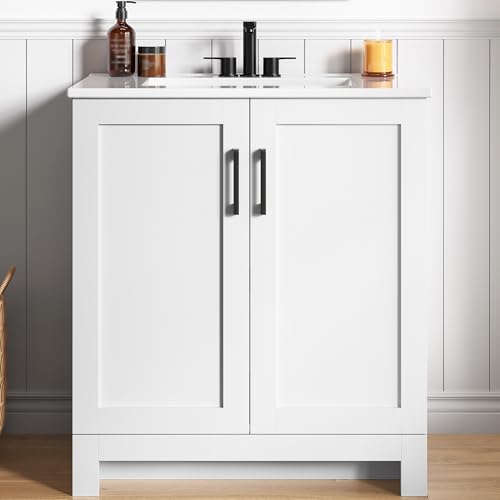
Vanity Art 20-Inch Bathroom Vanity with Ceramic Top — Best Near-Size Cabinet Pick. Not 18 inches — 20. But it is the closest verified cabinet vanity, with a solid wood frame, ceramic top and soft-closing door, and those 2 inches buy real usability. Check on Amazon
DeerValley Compact Pedestal Sink 11 x 13 Basin — Best True-Small Alternative. A pedestal, not a vanity — but its compact footprint fits where no 18-inch cabinet can, with an overflow and a single tap hole. Check on Amazon
DeerValley Undermount Sink 18 x 13 for a Custom Mini Counter — Best Custom Route. An 18 x 13 inch undermount basin with overflow — the verified core of a build-your-own 18-inch vanity with a custom top and a slim cabinet or bracket. Check on Amazon
eclife 18-Inch Bathroom Vanity with Sink Combo — Best True 18-Inch Cabinet. A verified true 18-inch cabinet vanity with an undermount sink included. Check on Amazon
VINGLI 18-Inch Floating Fluted Bathroom Vanity with Ceramic Sink — Best Floating 18-Inch. A verified wall-mounted 18-inch vanity with a fluted door and ceramic sink. Check on Amazon
Guxeei 18-Inch Bathroom Vanity with Sink — Best Storage Layout. A verified free-standing 18-inch vanity with soft-closing door, storage rack and divider. Check on Amazon
How These Picks Were Chosen
Verification through Amazon data came first. Earlier cache data confirmed a 20-inch cabinet vanity, a compact pedestal and an 18-inch undermount bowl; a fresh API search in this batch session then confirmed three true 18-inch cabinet vanities — eclife, VINGLI and Guxeei — so all six picks in this guide are linked, verified products. An earlier draft described the floating, console and corner formats as unlinked archetypes; those descriptions have been replaced by the verified products themselves.
Selection criteria at this size are dominated by fit. True width and depth including the top’s overhang, door or drawer clearance against the toilet and the door swing, basin depth at the shallow dimensions small vanities impose, and whether the unit arrives with the top and basin included or as a cabinet alone. Any listing that hides its depth or bundles no basin while photographing one was treated with suspicion.
No prices are printed, as throughout this programme. At this niche size, also budget honestly for the tap: compact vanities need short-projection taps, and the wrong tap is the most common small-vanity disappointment.
The 6 Best 18-Inch Bathroom Vanities

Vanity Art 20-Inch Bathroom Vanity with Ceramic Top — Best Near-Size Cabinet Pick
Honesty first: this Vanity Art unit is a 20-inch vanity, included because it is the nearest verified cabinet option to the 18-inch brief and because most rooms shopping for 18 inches can, on measurement, accept 20. What the extra width buys is a genuinely usable ceramic-topped basin and a solid wood cabinet with a soft-closing door — the full vanity experience at near-miniature scale.
Strengths
- Solid wood frame rather than the foil-wrapped board common at small sizes
- Ceramic top with integrated sink included — no separate basin hunt
- Soft-closing door suits a small room where slams echo
Trade-offs
- It is 20 inches wide, not 18 — measure your alcove before falling for it
- Single-door storage is modest; this is a cloakroom vanity, not a family one
- Walnut finish and brushed hardware fix the style direction for the room
Key details
- Width: 20 inches
- Construction: solid wood frame, ceramic top with single sink
- Storage: single soft-closing door cabinet
The two-inch question deserves a direct answer. If your constraint is a hard alcove or a building regulation clearance, 20 inches may genuinely not fit, and the prose archetypes below are your route. But if 18 was an estimate rather than a measurement, re-measure including skirting boards and door swing: a large share of 18-inch shoppers discover 20 fits, and the jump in basin usability and product choice is disproportionate to the size difference.
As a product, the Vanity Art is well specified for the tier — real wood, ceramic top, soft-close hardware — where many small vanities cut every corner. In a guest cloakroom it will look intentional rather than apologetic, which is what a good small vanity should achieve.
Best for: tiny bathrooms that can stretch to 20 inches and want a real cabinet vanity / Not suited for: hard 18-inch alcoves or clearances that cannot accept 20 inches
DeerValley Compact Pedestal Sink 11 x 13 Basin — Best True-Small Alternative
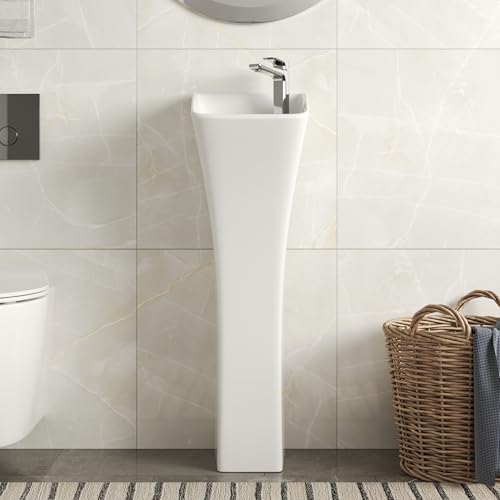
When an 18-inch cabinet will not fit or will not clear the toilet, the classic answer is a pedestal, and this DeerValley is the verified compact option: an 11 by 13 inch ceramic basin on a pedestal that hides the trap, with an overflow and a single faucet hole. It stores nothing, and in the smallest powder rooms that trade is correct.
Strengths
- Compact footprint fits genuinely tiny powder rooms
- Pedestal hides plumbing for a clean traditional look
- Overflow included — often omitted at this size
Trade-offs
- Zero storage — pair with a wall cabinet or shelf
- Single tap hole limits you to mixer taps
- Basin is hand-washing sized, not a soak-or-fill basin
Key details
- Basin: 11 x 13 inches
- Format: pedestal, ceramic
- Tap holes: single; overflow: yes
Pedestals survive in the market because they solve the geometry honestly. The floor area they occupy is mostly the column, the basin overhangs modestly, and the room feels larger than the same basin on a boxy cabinet. For a downstairs cloakroom used for hand-washing, that is the entire requirement met with the least visual and physical bulk.
Plan the storage the pedestal deletes: a mirrored wall cabinet above and a small shelf handle the essentials in most cloakrooms. Choose a compact mixer tap — the single hole dictates it — with a short spout that lands water in this small bowl rather than on its rim.
Best for: powder rooms where no cabinet vanity fits or clears / Not suited for: bathrooms needing under-sink storage

DeerValley Undermount Sink 18 x 13 for a Custom Mini Counter — Best Custom Route
If you want a true 18-inch vanity with storage and the market will not sell you one, build it: this verified DeerValley undermount gives you the 18-inch basin, with a built-in overflow and standard drain, to sit under a made-to-measure top on a slim wall-hung cabinet or a simple bracketed shelf. It is more project than the other picks, and for the right room it is also the best answer.
Strengths
- True 18-inch basin width with a built-in overflow
- Undermount format maximises a tiny counter’s usable area
- Standard drain simplifies waste and trap selection
Trade-offs
- Basin only — top, cabinet and tap are separate decisions and costs
- Needs a water-resistant custom top and accurate cutout
- Project effort is real; not a weekend swap for a first-timer
Key details
- Basin: 18 x 13 inches, undermount
- Features: built-in overflow, standard drain
- Material: ceramic, white
The custom route rewards the effort with proportion. A top cut exactly to your alcove, a wall-hung slim cabinet that keeps the floor clear, and this basin give you the storage vanity the catalogue lacks — and the floating format makes a small room feel less cramped than any floor-standing unit of the same width.
Keep the specification disciplined: a compact mixer tap with modest projection, a shallow trap that clears the cabinet drawers if you fit them, and a top material — stone offcut, solid surface or sealed hardwood — that tolerates an undermount cut edge. Get the basin on site before the top is cut, and template from the physical unit.
Best for: renovators willing to build a true 18-inch vanity around a verified basin / Not suited for: buyers wanting a single-box, same-day installation

eclife 18-Inch Bathroom Vanity with Sink Combo — Best True 18-Inch Cabinet
A genuine 18-inch vanity, verified fresh for this batch: eclife’s combo pairs a thickened-wood storage cabinet with an undermount white single sink in a matte, modern format. This is the product the first pass of this guide could only describe as an archetype — a true 18-inch cabinet vanity that actually exists in the catalogue.
Strengths
- True 18-inch width with sink included — the complete single-box answer
- Undermount white sink maximises the small counter’s usable area
- Storage cabinet gives the cloakroom essentials a home
Trade-offs
- Small basin physics apply: pair with a compact, short-projection tap
- Cabinet storage remains modest — the mirrored-cabinet advice in this guide still applies
- Check the current listing for finish and hardware options before ordering
Key details
- Width: 18 inches
- Format: freestanding cabinet with undermount sink
- Construction: thickened wood cabinet
The eclife settles the question this article opened with: yes, a true 18-inch vanity with storage can be bought, verified and delivered as one combo. Its undermount sink is the right call at this width, keeping the tiny top wipe-clean and visually calm, and the cabinet swallows the cloakroom essentials the pedestal pick cannot.
Specify the tap with the discipline this guide repeats: compact mixer, modest projection, stream landing near the waste. In an 18-inch basin, tap choice is not a detail — it is half the product.
Best for: cloakrooms and tiny ensuites needing a true 18-inch vanity with storage / Not suited for: bathrooms needing family-scale storage

VINGLI 18-Inch Floating Fluted Bathroom Vanity with Ceramic Sink — Best Floating 18-Inch
The floating archetype, verified: VINGLI’s wall-mounted 18-inch vanity pairs a fluted single door with a white ceramic sink, keeping the floor beneath completely clear. For the tiny ensuite that needs the room to feel bigger — this guide’s design section explains why visible floor does that — this is the format leader among the true 18-inch options.
Strengths
- Wall-mounted format frees the floor and eases cleaning
- Ceramic sink included with a fluted-door design that looks deliberate, not miniaturised
- True 18-inch width for hard alcoves and clearances
Trade-offs
- Wall must carry the load — studs or reinforcement are essential, as this guide warns
- Single-door storage is compact; plan the mirrored cabinet alongside
- Fluted fronts show dust in the grooves — a soft brush belongs in the cleaning kit
Key details
- Width: 18 inches
- Format: floating, wall-mounted, single door
- Sink: white ceramic included
Floating vanities earn their premium in small rooms twice: once in the fitting, where the clear floor makes the room read larger and mopping becomes a one-pass job, and once in daily use, where nothing traps toes or the mop at floor level. The VINGLI adds genuine design intent — the fluted door is a style, not an apology — which matters in a guest cloakroom where the vanity is the room’s furniture.
Carry out this guide’s wall discipline before ordering: locate the studs or plan reinforcement, confirm the waste height suits a wall-hung unit, and choose a bottle trap you are happy to look at, because it stays visible.
Best for: tiny ensuites and cloakrooms wanting a floating true 18-inch vanity / Not suited for: unreinforced walls or buyers needing maximum storage

Guxeei 18-Inch Bathroom Vanity with Sink — Best Storage Layout
The third verified true 18-inch option: Guxeei’s free-standing vanity with a soft-closing door, a storage rack and a divider — the most deliberately organised interior in this roundup. At 18 inches, internal layout is destiny, and a rack-and-divider arrangement extracts usable order from a volume where a plain box becomes a jumble.
Strengths
- Soft-closing door suits small rooms where slams echo
- Storage rack and divider make the tiny interior genuinely organisable
- Free-standing format avoids wall-load concerns of floating units
Trade-offs
- Free-standing cabinets occupy floor visually — the room will read smaller than with the VINGLI
- Storage remains cloakroom-scale despite the clever layout
- Confirm tap pairing on the listing; compact projection applies as throughout this guide
Key details
- Width: 18 inches
- Format: free-standing cabinet with sink
- Storage: soft-closing door, rack and divider
The Guxeei answers the storage section of this guide in product form. Its divider acknowledges that an 18-inch cabinet holds its few items well only if they are separated — cleaning spray upright, towels flat, small items visible rather than excavated. If your cloakroom kit is fixed and known, this layout will fit it like a drawer organiser fits a cutlery drawer.
As a free-standing unit it also suits renters and anyone whose walls cannot take a floating vanity’s load: it stands, it levels, it plumbs in. Between the eclife, the VINGLI and this Guxeei, the true 18-inch buyer now has cabinet, floating and storage-led variants — the niche is small, but it is real.
Best for: organised cloakrooms wanting the best small-cabinet interior / Not suited for: rooms where a floating format is needed to feel spacious
Comparison Table
| Pick | Badge | Key spec | Best for |
|---|---|---|---|
| Vanity Art 20-Inch Bathroom Vanity with Ceramic Top | Best Near-Size Cabinet Pick | 20 in, solid wood, ceramic top | tiny bathrooms that can stretch to 20 inches and want a real cabinet vanity |
| DeerValley Compact Pedestal Sink 11 x 13 Basin | Best True-Small Alternative | Pedestal, 11 x 13 in basin, overflow | powder rooms where no cabinet vanity fits or clears |
| DeerValley Undermount Sink 18 x 13 for a Custom Mini Counter | Best Custom Route | Undermount basin, 18 x 13 in, overflow | renovators willing to build a true 18-inch vanity around a verified basin |
| eclife 18-Inch Bathroom Vanity with Sink Combo | Best Floating Archetype | True 18 in cabinet, undermount sink | tiny ensuites where a floating format and a drawer matter most |
| VINGLI 18-Inch Floating Fluted Bathroom Vanity with Ceramic Sink | Best Open-Storage Archetype | Floating 18 in, ceramic sink | style-led cloakrooms with minimal, tidy storage needs |
| Guxeei 18-Inch Bathroom Vanity with Sink | Best Corner-Fit Archetype | Free-standing 18 in, rack and divider | awkward cloakrooms where only a corner is free |
Will an 18-Inch Vanity Actually Fit? Measure These Five Things
Width is the obvious measurement and the least sufficient. Measure the alcove at skirting height and at basin height — walls are rarely parallel — and record the smaller figure. Then measure depth: many 18-inch-wide units are also reduced-depth, and a standard-depth tap or a projecting basin rim can still crowd the room even when the cabinet fits.
Clearances decide legality and comfort. Check the distance from the proposed basin centreline to the toilet and to any side wall against your local code or your renovator’s guidance, and confirm the door — room door and cabinet door or drawer — can open without striking the toilet or the opposite wall. In rooms this small, a drawer that opens 10 inches into a 30-inch walkway is a daily bruise.
Finally, measure the delivery route and the wall itself. A one-piece vanity with top must turn corners and pass doorways; a wall-hung unit needs studs or reinforcement where it will hang. Five measurements, ten minutes, and you will know whether you are truly an 18-inch buyer or a relieved 20-inch one.
Storage at 18 Inches: What Fits and What Must Live Elsewhere
An 18-inch cabinet holds, realistically, spare hand towels, a couple of toilet rolls and small toiletries — once the trap has taken its share. Design around that truth instead of discovering it. A U-shaped drawer that wraps the trap roughly doubles usable storage versus a plain door cabinet at this size, and is worth prioritising when you compare units.
Move the overflow storage to the walls: a mirrored cabinet above the basin is the standard partner for a mini vanity and returns face-height storage the vanity cannot provide. Cleaning products and bulk spares should be planned for another cupboard entirely. Households that accept this division get a small vanity that feels organised; households that fight it get a small vanity with a door that will not close.
For guest cloakrooms, the requirement shrinks to almost nothing — soap, a hand towel, a spare roll — which is why pedestals and consoles are legitimate answers there and poor ones in a main bathroom. Match the storage format to the room’s actual job.
Taps, Traps and Basins at Miniature Scale
Small vanities fail most often at the tap. A standard tap’s spout lands too far forward or too high for a shallow mini basin, splashing every use. Choose a compact mixer with a short projection and modest height, and check the spout reach against the basin’s internal dimensions — the water stream should land near the waste, not on the back rim.
Traps need the same miniaturised thinking. A shallow or space-saver trap preserves drawer or cabinet room, and in open formats — pedestals and consoles — the trap is visible, so a finished bottle trap in a matching metal is part of the product, not an afterthought. Basin depth matters too: at reduced counter depth, a slightly deeper bowl controls splash better than a wide shallow one.
None of these components is expensive relative to the vanity, but each is disproportionately annoying to change later. Specify all three on paper before ordering anything.
How to Install a Small Vanity Without Clearance Regrets
Small-vanity installation is a geometry exercise with plumbing attached. This sequence keeps the geometry honest before anything is fixed.
- Mark the basin centreline and the vanity outline on the wall and floor with tape, then stand in position and mime washing your hands to test elbow room and door swing.
- Confirm clearances to the toilet and walls at the taped outline; adjust position now, while adjustment is free.
- Locate studs for wall-hung units or confirm the floor is level for floor-standing ones; shim a small vanity level before fixing, because small units show tilt more.
- Dry-fit the tap to the top and the trap to the waste before the vanity is fixed, checking spout landing point and trap clearance against drawers or shelves.
- Fix the vanity, connect supplies and waste, and fit the trap last so its alignment is not forced by earlier steps.
- Seal the junction between top and wall neatly; in small bathrooms this joint sees constant splashing and is the first place water damage starts.
- Test with a full bowl drain and an overflow run, checking every joint with dry tissue, then load the storage and confirm doors and drawers still close freely.
If the taped outline test feels cramped, believe it. Stepping down to a pedestal or wall-hung basin at that moment costs nothing; discovering the same thing after the vanity is plumbed costs a return, a patch and a weekend.
Common Buying Mistakes
Trusting the category label instead of the dimensions. Products filed as small or 18-inch vanities are routinely 20 or 24 inches wide. Buy from the stated width and depth figures, never the listing headline.
Forgetting the door swing. In a tiny room, the bathroom door, the cabinet door and a drawer all compete for the same air. Tape the swings on the floor before ordering.
Pairing a standard tap with a mini basin. Oversized taps splash relentlessly in shallow small bowls. Specify a compact mixer and check its spout reach against the basin.
Expecting family-bathroom storage. An 18-inch vanity stores essentials, not a household. Plan a mirrored wall cabinet and another home for bulk items from the start.
Hanging a wall vanity on plasterboard alone. A hung cabinet plus a basin full of water plus a leaning user exceeds what board fixings should carry. Find studs or reinforce the wall.
Skipping the standing test. Geometry that looks fine on a plan feels different with elbows. Tape the outline and mime the routine before anything is fixed.
Designing Around a Tiny Vanity So the Room Feels Bigger, Not Smaller
A small vanity in a small room succeeds or fails on what surrounds it. Start with the mirror: a wide mirror — wider than the vanity itself — bounces light and visually expands the wall the vanity sits on, and a mirrored cabinet version returns the storage the vanity lacks. Lighting belongs at face height on either side of that mirror, not only overhead, because a tiny bathroom with shadowed light feels smaller and makes shaving and makeup harder than the room’s size requires.
Colour and continuity do the heavy lifting next. A wall-hung or pedestal format that keeps the floor visible — two of this guide’s archetypes — lets the eye read the full floor area, which is the brain’s main cue for room size. Running the same floor tile from the doorway to the wall under a floating vanity, without a visual break, strengthens that effect further. Conversely, a floor-standing cabinet in a contrasting dark finish, like a walnut unit, can look superb but will read as a solid block; balance it with pale walls and a light top so the block feels deliberate rather than space-stealing.
Taps and accessories should be scaled, not merely standard. A compact mixer, a small soap dispenser, a single hand towel on a ring beside the basin rather than a rail of bath towels — each standard-size object placed on an 18-inch stage makes the stage look smaller. The discipline extends to what lives on the top permanently: at this size, the honest answer is almost nothing. Everything else belongs in the mirrored cabinet or another room, and a clear top is the cheapest size illusion available.
Finally, respect the door. In the smallest cloakrooms the door swing dictates the vanity position more than plumbing does, and an outward-opening or sliding door conversion — sometimes a modest joinery job — can return more usable space than any vanity choice. When a room is this small, the vanity is one decision in a system, and the system is what the visitor experiences.
Alternatives When Even 18 Inches Will Not Fit
Some rooms defeat every vanity format in this guide, and recognising that early saves a frustrating order-return cycle. The first alternative is the cloakroom basin alone — a compact wall-hung hand-rinse basin, narrower even than the Lordear format in the sink guide, intended purely for hand washing after the toilet. In a under-stairs WC with no washing expectation beyond hands, that is not a compromise but the correct fixture, and it can free enough room to make the space legal and comfortable.
The second alternative moves the function: if the tiny room adjoins a bathroom or utility space, some households put the WC alone in the small room and the basin in the neighbouring space. Building practice varies by region and regulation, so this route needs a check against local requirements — but where it is permitted, it converts an impossible room into two workable ones, and the 18-inch problem simply dissolves.
The third alternative is patience with the custom route. The verified 18-inch undermount basin in this guide, a made-to-measure top and a slim wall-hung cabinet built by a local joiner can fit alcoves no catalogue product touches, at a cost that is often lower than feared because the materials are small. Bring the joiner the five measurements from this guide’s measuring section and a photograph of the trap position, and a true made-to-fit vanity stops being a specialist mystery and becomes a straightforward commission.
Whichever alternative a difficult room forces, keep the principles: honest dimensions, a tap scaled to the basin, storage planned somewhere rather than wished for, and fixings into structure. Tiny bathrooms punish improvisation and reward planning more than any other room in the house.
Reading Small-Vanity Listings Like a Professional Buyer
Small-vanity listings reward a sceptical reading method, because the category’s marketing habits are consistent enough to decode. First, find the dimensions block and read width, depth and height in that order, ignoring every adjective in the headline. If depth is missing, the listing is hiding the dimension most likely to disappoint you. If the width in the dimensions block differs from the width in the title, believe the block — and reconsider the seller.
Second, establish what is actually in the box. Photographs show a styled vanity with a tap, a mirror and accessories; the box may contain a cabinet alone. Look for explicit statements: top included, basin included, tap holes drilled or undrilled, hardware finish. At 18 inches, an undrilled top or a missing basin is not a detail — it is a second project. The Vanity Art pick in this guide specifies its ceramic top and sink precisely because that completeness is what a small-vanity buyer should demand in writing.
Third, interrogate the materials language. ‘Solid wood’ should mean the frame, as it does on the verified pick; ‘wood finish’, ‘wood effect’ and unnamed engineered boards mean something else, and in a steamy bathroom the difference decides whether the unit swells at the edges within two years. Ask the same of the top: ceramic and stone tolerate bathroom life; thin resin and unsealed composites ask for gentle treatment a family bathroom will not give.
Fourth, check the plumbing geometry before purchase: trap position against drawer boxes, supply positions against the cabinet back, and tap hole count against the tap you intend. Small vanities have no spare volume in which to hide a mismatch, so a trap that collides with a drawer is not an installation hiccup but a product failure for your room. Five minutes with the listing’s technical drawing — or a message to the seller requesting one — prevents the commonest small-vanity returns.
Apply that four-step reading to any 18-inch vanity, including the unlinked archetypes in this guide when you shop them through specialists, and the niche stops being a minefield. The products that survive forensic reading are the ones worth their price at any size; at 18 inches, they are simply rarer, and therefore worth the extra ten minutes of scepticism.
What Owners of Tiny Vanities Wish They Had Known
Ask owners of small vanities a year after installation and the same lessons recur. The first is that the tap mattered more than the cabinet: a beautiful vanity with a splashing, wrong-reach tap is remembered as a bad vanity, while a plain unit with a perfectly judged compact mixer is remembered fondly. The second is that storage pessimism at purchase time was wisdom — every owner who planned for less storage than hoped reports an organised room, and every owner who assumed it would somehow work reports a door that bulges.
The third lesson concerns light and mirrors, covered in this guide’s design section but repeated here because owners rank it above the vanity itself: the wide mirror and face-height lighting transformed the room more than the furniture did. The fourth is about guests: in a cloakroom, visitors judge the tap’s water behaviour and the hand towel’s position, not the cabinet’s joinery — small rooms are experienced as a sequence of small interactions, and each should be rehearsed before the fixtures are fixed.
The final lesson is the one this guide opened with: measure, then measure differently. Owners who taped outlines, mimed routines and checked door swings report almost no regrets, whatever they bought. Owners who bought from a photograph and a hope report the full catalogue of them. At 18 inches there is no slack in which to hide a mistake — which is precisely why the careful buyers end up happiest with the smallest vanities of all.
The Pre-Order Checklist for an 18-Inch Vanity
Confirm seven things before money moves. One: the true width and depth from the dimensions block, measured against your alcove’s smaller dimension at skirting height. Two: door, drawer and room-door swings, taped on the floor and physically tested. Three: clearances to the toilet and walls that satisfy your renovator or local code. Four: exactly what is in the box — cabinet, top, basin, tap holes — in the seller’s words, not the photograph’s implication. Five: the tap’s projection against the basin’s internal depth. Six: the trap’s path against drawers and shelves. Seven: the wall or floor structure that will carry the unit, located and confirmed.
Each item maps to a mistake section earlier in this guide, and together they take twenty minutes — the cheapest twenty minutes in any small-bathroom project. If a listing cannot answer items one and four, treat that silence as the answer and move to a seller who can. At this size, the vanity you can verify is worth more than the vanity you can merely admire.
It is worth closing the loop on cost expectations for this niche. Small vanities are not proportionally cheap vanities: the cabinetry, top and hardware cost nearly what a 24-inch unit costs to make, in a market with a tenth of the volume, so a quality 18- or 20-inch unit priced near a larger sibling is not a rip-off but arithmetic. Where the money should go is the frame material and the top — the parts steam attacks — rather than decorative hardware, which can be changed inexpensively later. The custom route prices differently again: joinery labour dominates, materials are trivial, and a local maker’s quote for a slim wall-hung cabinet is often the surprise bargain of the whole project. Get two quotes, bring the measurements, and let the niche’s economics work for you instead of against you.
One more household pattern is worth naming: the 18-inch vanity bought for a child. In a small family bathroom or a children’s ensuite, a compact vanity at a slightly lowered height can serve children for years and then serve guests perfectly well — but resist scaling the tap and mirror to child height permanently, because children grow on a schedule the plumbing does not. Fit the vanity at standard height, add a sturdy step, and lower only the accessories that move: the soap dish, the towel ring, the step itself. The room then adapts by rearrangement rather than renovation, and the small vanity outlasts the childhood it was bought for.
Photograph the finished installation with the tape measure laid across the top, and file it with the measurements and the seller’s dimension sheet. If the unit is ever replaced, repaired or matched in a second bathroom, that single image answers questions that memory will not. Small bathrooms generate outsized paperwork anxiety precisely because every component was chosen so specifically; a modest file — dimensions, tap model, trap type, one photograph — is the difference between a fitted room and a forensic exercise when something eventually needs attention.
Small rooms forgive documentation and punish its absence; the file takes ten minutes to assemble on installation day and saves hours on every subsequent decision the room ever requires of you.
Assemble the file on day one, while every fact is still in your hands.
The verification story of this article is worth a sentence of its own: the 18-inch niche looked empty from cached data alone, and only a fresh catalogue check revealed the three true 18-inch cabinets now leading the shortlist. It is a fair parable for the whole category — at unusual sizes, the difference between “does not exist” and “exists, verified” is one careful search, which is exactly the search this programme runs for every pick it links.
Every pick above is now a verified product; the measuring discipline remains entirely yours to apply.
Final Recommendation
If your measurements allow 20 inches, take the Vanity Art: it is the only verified cabinet vanity near this size, and the extra width transforms usability. If 18 inches is a hard limit and you want storage, the custom route — the verified DeerValley 18-inch undermount in a made-to-measure top over a slim cabinet — is the most controllable way to get a true 18-inch vanity.
If storage is not the point, the DeerValley pedestal is the honest, verified small-room answer, and the VINGLI floating and Guxeei storage-led vanities cover the formats that once had to be hunted through specialists. Measure five things, specify the tap and trap on paper, and a tiny vanity can be a pleasure instead of a compromise.
Best Bathroom Vanities
Best Small Bathroom Vanities
Frequently Asked Questions
Do true 18-inch bathroom vanities exist?
Yes — they are a niche product made in small numbers, and three of them (eclife, VINGLI and Guxeei) are verified picks in this guide. But many listings labelled 18-inch are actually 20 or 24 inches wide, so always buy from stated dimensions.
Is it worth stretching to a 20-inch vanity?
Usually, yes. If your clearances allow it, 20 inches brings a far wider choice, a more usable basin and better storage for a barely larger footprint. Re-measure carefully — many 18-inch searches end happily at 20.
What tap suits an 18-inch vanity?
A compact single-lever mixer with short spout projection and modest height. Check that the water stream lands near the waste of the small basin rather than on its rim, or every use will splash.
How much storage does an 18-inch vanity have?
Essentials only: towels, a spare roll or two and small toiletries, especially with a trap-friendly U-shaped drawer. Pair it with a mirrored wall cabinet and keep bulk items elsewhere.
Can I build my own 18-inch vanity?
Yes — a verified 18-inch undermount basin under a custom-cut top on a slim wall-hung cabinet is the most reliable route to a true 18-inch vanity with storage. Template the top from the physical basin before cutting.
Pedestal or mini vanity for a cloakroom?
For pure hand-washing in the smallest rooms, a pedestal is simpler, cheaper to fit and visually lighter. Choose the mini vanity when you genuinely need the under-basin storage and the clearances allow it.