Disclosure: airfryerkitchensupply.com is reader-supported. When you buy through links on our site, we may earn an affiliate commission at no extra cost to you.
Where to buy
Bathroom sinks are sold on Amazon, through plumbing suppliers and in home-improvement stores. For the verified sinks below, Amazon listings are useful because the bowl dimensions, overflow configuration and mounting type are stated in the listing itself — the three facts that decide whether a sink fits your counter and plumbing. Always confirm the cutout dimensions against your countertop before ordering any undermount model.
KOHLER Ladena 2214-0 Undermount Sink — check price on Amazon
TOTO LT540G Undermount Sink with CEFIONTECT — check price on Amazon
KOHLER Verticyl 2882-0 Undermount Sink — check price on Amazon
DeerValley Undermount Bathroom Sink 21 x 15 — check price on Amazon
Hugsleek Undermount Bathroom Sink 18 x 13 Bowl — check price on Amazon
Lordear Wall Mount Bathroom Sink 21 x 12 — check price on Amazon
Shopping for the best all bathroom sinks means comparing across types rather than within one, because the right sink is decided by your counter, your plumbing and your space before brand ever enters the conversation. This guide therefore covers the main families — undermount, wall-mount and pedestal-style basins — with verified examples of each, and explains honestly which type suits which bathroom instead of pretending one sink wins for everyone.
Undermount basins dominate the roundup because they dominate real renovations: they maximise usable counter, wipe clean with no rim to trap grime, and pair with stone or quartz tops. But a wall-mount sink can be the only sensible answer in a tiny cloakroom, and a well-made rectangular undermount in the wrong cutout size is simply an expensive return shipment. Type first, dimensions second, brand third.
Every linked sink below was verified against the catalogue for this site. Where a popular type — vessel bowls especially — could not be matched to a verified listing in this session, the guide discusses the type in prose rather than attaching an unverified product, so you can still shop the category with clear eyes.
In this guide
Quick Picks
KOHLER Ladena 2214-0 Undermount Sink — Best Overall. Kohler’s curved-bottom rectangular undermount — the reference design for stone-counter bathrooms, sized for a standard vanity. Check on Amazon
TOTO LT540G Undermount Sink with CEFIONTECT — Best Easy-Clean Glaze. TOTO’s large rectangular undermount with the CEFIONTECT glaze that resists waste build-up and cuts cleaning effort. Check on Amazon
KOHLER Verticyl 2882-0 Undermount Sink — Best Compact Undermount. A slightly smaller Kohler undermount at 19-3/4 inches for narrower vanities where the Ladena will not fit. Check on Amazon
DeerValley Undermount Bathroom Sink 21 x 15 — Best Value Undermount. A value-tier ceramic undermount with built-in overflow and splash-conscious depth, in a full 21 x 15 size. Check on Amazon
Hugsleek Undermount Bathroom Sink 18 x 13 Bowl — Best Small-Space Undermount. A compact undermount with an 18 x 13 inch interior bowl for cloakrooms and slim vanities — note the listing’s own wording mixes terms, so check dimensions carefully. Check on Amazon
Lordear Wall Mount Bathroom Sink 21 x 12 — Best Wall-Mount. A wall-hung porcelain basin with overflow that frees the floor entirely — the space-saving answer where no vanity fits. Check on Amazon
How These Picks Were Chosen
Verification came first: each linked sink was cross-checked through Amazon data, matching the maker and model in the returned listing title to the basin described. Sink listings are frequently mislabelled by mounting type in marketplace copy, so the title-level check on dimensions and configuration is what the reviews rely on.
Selection then balanced type coverage against quality signals. The roundup favours vitreous china and ceramic basins from makers with consistent glazing, includes an overflow where the type allows it, and spans the realistic size range from compact cloakroom basins to full 21-inch family-bathroom bowls. Decorative novelty sinks were excluded; this is a working shortlist for real bathrooms.
No prices are printed anywhere in this guide because sink pricing moves with sales and finish options. Use the check-price links for the current figure, and budget separately for the tap, waste and trap, which most sink listings do not include.
The 6 Best Bathroom Sinks of Every Type
KOHLER Ladena 2214-0 Undermount Sink — Best Overall
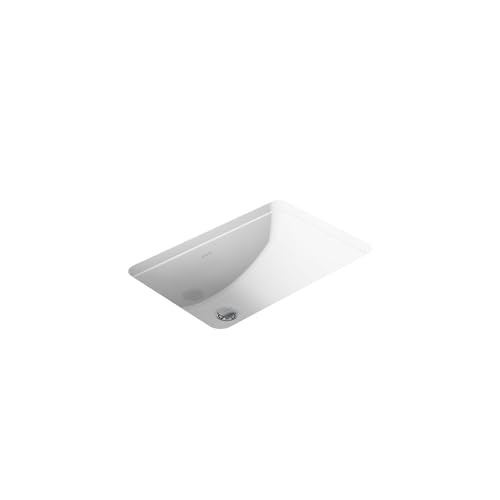
The Ladena is the sink other undermounts get compared to. Its curved bottom is the detail that matters: water and toothpaste rinse toward the drain instead of sitting in flat corners, and the 20-7/8 by 14-3/8 inch footprint suits the standard vanity widths most bathrooms actually have.
Strengths
- Curved basin floor rinses clean instead of trapping residue in corners
- Kohler vitreous china glaze is consistently hard and stain-resistant
- Size fits standard vanity and counter depths without custom cutting
Trade-offs
- Undermount only — needs a solid-surface or stone counter, not laminate with a raw cut edge
- Tap and waste are separate purchases
- Rectangular shape gives slightly less elbow room than an oval of similar width
Key details
- Mount: undermount
- Size: 20-7/8 x 14-3/8 inches
- Material: vitreous china, white
In daily use the Ladena disappears, which is the compliment a sink earns. The counter wipes straight into the bowl, the glaze shrugs off toothpaste and makeup, and the proportions leave useful counter on both sides for a soap dispenser and a toothbrush holder. It is the safe, known-quantity choice for a main bathroom renovation.
Confirm your counter before ordering: undermounts need a finished, water-resistant cutout edge, and the Ladena’s template must match the fabricator’s cut. If your counter is laminate, look at the wall-mount and pedestal-style picks instead rather than forcing an undermount into a top that will swell at the cut edge.
Best for: main bathroom renovations with stone or solid-surface counters / Not suited for: laminate counters or drop-in replacements

TOTO LT540G Undermount Sink with CEFIONTECT — Best Easy-Clean Glaze
TOTO’s LT540G competes with the Ladena on size and wins its place on glaze technology. CEFIONTECT is an extra-smooth ceramic finish that gives toothpaste, soap film and mineral deposits less to grip, so the bowl stays cleaner between cleans — a real benefit in hard-water homes and busy family bathrooms.
Strengths
- CEFIONTECT glaze genuinely reduces scrubbing in hard-water areas
- Generous 21-1/4 inch width suits shared family bathrooms
- TOTO manufacturing consistency is excellent at this tier
Trade-offs
- Premium positioning versus unbranded ceramic undermounts
- Undermount constraints apply — stone or solid-surface counters only
- Cotton White is a specific shade; match it to other TOTO ceramics if pairing
Key details
- Mount: undermount
- Size: 21-1/4 x 14-3/8 inches
- Glaze: CEFIONTECT, Cotton White
The honest difference between this and the Ladena shows up at month three, not day one. Both look identical when new; the TOTO’s glaze keeps limescale and staining at bay longer, which matters if your water is hard and your cleaning is infrequent. In a soft-water home with diligent cleaning, the advantage narrows and the Ladena’s shape may appeal more.
As with any undermount, the installation quality decides the experience: a well-bedded seal and a correctly cut counter matter more than the last increment of glaze technology. Budget for professional templating if your fabricator does not already stock this model’s pattern.
Best for: hard-water homes and family bathrooms that need low-effort cleaning / Not suited for: budget renovations or laminate counters

KOHLER Verticyl 2882-0 Undermount Sink — Best Compact Undermount
Not every vanity can take a 21-inch basin. The Verticyl trims the footprint to 19-3/4 inches while keeping Kohler’s glaze quality and a clean rectangular form, making it the verified answer for 24- to 30-inch vanities and slimmer counter depths.
Strengths
- Compact footprint fits narrow vanities and shallow counters
- Kohler glaze and build quality at the smaller size
- Rectangular form maximises bowl volume for its footprint
Trade-offs
- Smaller bowl splashes more with tall, high-arc taps
- Undermount-only installation limits counter choices
- Less counter-to-bowl balance in very large bathrooms — it can look lost
Key details
- Mount: undermount
- Size: 19-3/4 inches wide
- Material: vitreous china, white
Proportion is the Verticyl’s whole argument. A too-large sink in a small bathroom eats the counter you need for daily items and can crowd the tap into an awkward reach; a correctly sized basin like this leaves the layout breathing. Pair it with a mid-height tap to control splash, since the shallower proportions forgive less.
It is also a sensible second-bathroom and ensuite choice where the main family bathroom takes one of the larger picks. Consistency of brand across a renovation simplifies spares and colour matching, and Kohler whites are reliably consistent between models.
Best for: narrow vanities, ensuites and powder rooms with stone counters / Not suited for: large family bathrooms wanting maximum bowl volume
DeerValley Undermount Bathroom Sink 21 x 15 — Best Value Undermount
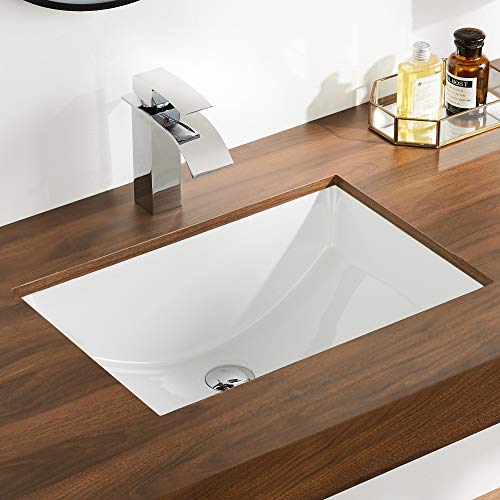
DeerValley is the value play in this roundup: a full-size rectangular ceramic undermount with a built-in overflow and a depth designed to contain splashing, at the tier landlords, flippers and budget renovators actually buy. The listing states its key facts plainly, which is rarer than it should be in this category.
Strengths
- Built-in overflow adds protection against a tap left running
- Full 21 x 15 size at a value tier
- Depth is designed to reduce splash-out in family use
Trade-offs
- Glaze consistency a step below Kohler and TOTO
- Brand support and spares network is thinner than the majors
- Check your unit on arrival — value ceramics reward a pre-install inspection
Key details
- Mount: undermount
- Size: 21 x 15 inches
- Features: built-in overflow, standard drain
For a rental property or a second bathroom, this is the rational spend: the functional boxes — size, overflow, depth, standard drain — are all ticked, and the savings versus the premium picks fund the tap and fitting. Inspect the glaze and rim flatness when it arrives, before the counter is cut, because that is when a swap is free.
In a forever-home main bathroom that you will clean for a decade, the premium glazes above earn their difference. The DeerValley is recommended here for exactly the jobs where value leads, and it does those jobs honestly.
Best for: rentals, flips and budget renovations needing a full-size undermount / Not suited for: buyers wanting the hardest-wearing premium glaze

Hugsleek Undermount Bathroom Sink 18 x 13 Bowl — Best Small-Space Undermount
Small bathrooms need small sinks, and this Hugsleek undermount’s 18 by 13 inch interior bowl is the most compact verified undermount in the roundup. One caution, stated plainly: the listing title mixes ‘vessel’ and ‘under counter’ language, so rely on the stated dimensions and the undermount configuration, and confirm the full exterior measurements before your counter is cut.
Strengths
- Compact bowl suits cloakrooms and 18- to 24-inch vanities
- Porcelain ceramic construction in a clean white finish
- Undermount format keeps a small counter easy to wipe
Trade-offs
- Listing terminology is muddled — verify exterior dimensions before cutting
- Small bowl means splash discipline matters; pair with a low-flow, mid-height tap
- Less suitable as the only sink in a busy family bathroom
Key details
- Mount: undermount
- Interior bowl: 18 x 13 inches
- Material: porcelain ceramic, white
In a cloakroom, this size is not a compromise — it is the correct proportion, leaving counter for soap and a hand towel instead of a basin that swallows the room. The undermount format helps twice in small spaces: no rim to collect grime, and a visual lightness that makes the counter read as one clean surface.
The muddled listing language is worth the warning given in the review. Measure the delivered sink yourself against the template before fabrication. That five-minute check is the difference between a neat installation and an expensive counter mistake, with any brand of compact sink.
Best for: cloakrooms, tiny ensuites and slim vanities with solid counters / Not suited for: family bathrooms or buyers unwilling to double-check dimensions

Lordear Wall Mount Bathroom Sink 21 x 12 — Best Wall-Mount
The Lordear takes the opposite approach to every undermount above: no counter, no cabinet, just a 21 by 12 inch porcelain basin hung on the wall with an overflow. In a narrow cloakroom or an accessible bathroom where knee space under the basin matters, that floating format is not a compromise but the point.
Strengths
- Frees the floor completely — easier cleaning and wheelchair-friendly knee space
- Built-in overflow included, which many wall basins omit
- Porcelain ceramic wipes clean and resists staining
Trade-offs
- No storage — everything a vanity hides must live elsewhere
- Wall must carry the load; studs or proper reinforcement are essential
- Exposed bottle trap becomes a visual feature, for better or worse
Key details
- Mount: wall-hung
- Size: 21 x 12 inches
- Material: porcelain ceramic, with overflow
Wall-mount sinks earn their place in two situations: genuinely small rooms, where a vanity would block the door swing or crowd the toilet, and accessible bathrooms, where the open underside is a functional requirement. The Lordear’s 21-inch width is generous for the type, giving real hand-washing room rather than a token basin.
Installation discipline decides success. The wall must be reinforced or fixed into studs, and the waste needs a neat bottle trap since it stays visible. Get those two things right and a wall-hung basin is the most honest, easiest-cleaning sink in this entire guide.
Best for: cloakrooms, accessible bathrooms and minimalist ensuites / Not suited for: bathrooms needing vanity storage
Comparison Table
| Pick | Badge | Key spec | Best for |
|---|---|---|---|
| KOHLER Ladena 2214-0 Undermount Sink | Best Overall | Undermount, curved bottom, 20-7/8 in | main bathroom renovations with stone or solid-surface counters |
| TOTO LT540G Undermount Sink with CEFIONTECT | Best Easy-Clean Glaze | Undermount, CEFIONTECT glaze, 21-1/4 in | hard-water homes and family bathrooms that need low-effort cleaning |
| KOHLER Verticyl 2882-0 Undermount Sink | Best Compact Undermount | Undermount, 19-3/4 in, compact | narrow vanities, ensuites and powder rooms with stone counters |
| DeerValley Undermount Bathroom Sink 21 x 15 | Best Value Undermount | Undermount, overflow, 21 x 15 in | rentals, flips and budget renovations needing a full-size undermount |
| Hugsleek Undermount Bathroom Sink 18 x 13 Bowl | Best Small-Space Undermount | Undermount, 18 x 13 in bowl, compact | cloakrooms, tiny ensuites and slim vanities with solid counters |
| Lordear Wall Mount Bathroom Sink 21 x 12 | Best Wall-Mount | Wall-mount, 21 x 12 in, overflow | cloakrooms, accessible bathrooms and minimalist ensuites |
Sink Types Explained: Undermount, Vessel, Wall-Mount, Pedestal and Drop-In
Undermount sinks fix beneath a stone or solid-surface counter, leaving a rimless, wipe-straight-in bowl and the most usable counter area. They are the renovation default for good reason, but they demand a water-resistant counter material and accurate fabrication. Drop-in sinks sit in a cutout with a visible rim: cheaper to install, tolerant of laminate counters, but the rim traps grime and steals a little counter.
Vessel sinks sit on top of the counter as a bowl. They make a design statement and need no counter cutout beyond a drain hole, but they raise the working height, splash more, and the exposed exterior needs cleaning. They suit guest bathrooms and style-led ensuites better than a children’s family bathroom. No vessel pick is linked in this guide because no vessel listing could be verified in this session — shop the type with the same dimension discipline described here.
Wall-mount and pedestal sinks free the floor. Wall-mounts maximise space and accessibility; pedestals hide the plumbing in a ceramic column for a traditional look. Both sacrifice storage, which is why they belong in cloakrooms, ensuites and accessible layouts rather than storage-starved family bathrooms.
Measuring for a Bathroom Sink Without Costly Mistakes
Measure the counter or the available wall first, then shop — never the reverse. For undermounts, the fabricator needs the sink’s template and the bowl’s exterior dimensions, and the counter needs enough front rail to support the basin and your hands leaning on it. Leave realistic counter depth in front of and behind the bowl for the tap: a beautiful sink with the tap jammed against the wall is a daily annoyance.
Check the plumbing positions before choosing a type. Wall-hung basins need waste and supplies at heights a vanity would normally hide, and moving them can cost more than the sink. Note overflow configuration too: an overflow needs a slotted waste, and pairing the wrong waste is the classic DIY leak. Finally, measure the route into the room — large one-piece vanity tops with integral sinks fail more deliveries on staircases than on specifications.
Glazes, Materials and Keeping a White Sink White
Vitreous china and glazed ceramic are the mainstream for a reason: hard, non-porous and repairable in appearance for decades. Premium glazes like TOTO’s CEFIONTECT add smoothness that resists deposit build-up, which shows its value in hard-water areas. Resin and stone-composite sinks allow integrated counter designs but can stain and dull; stainless steel is nearly indestructible yet reads commercial in most homes.
Daily care is simple and mostly about avoidance: rinse toothpaste and hair dye promptly, avoid abrasive powders that micro-scratch glaze and give future stains a foothold, and use a limescale remover periodically in hard-water homes rather than scrubbing harder. A sink cleaned gently and often will look new for years; a neglected one scrubbed aggressively will not.
How to Plan a Bathroom Sink Replacement Step by Step
Replacing a sink is a half-day job when the preparation is right and a weekend of leaks when it is not. This planning sequence applies whether you are swapping an undermount during a counter replacement or fitting a wall-hung basin.
- Turn off the water supplies and photograph the existing trap and supply layout before touching anything; the photo is your reassembly reference.
- Confirm the new sink’s dimensions, mounting type and overflow configuration against the counter or wall, and buy the matching waste — slotted for an overflow basin, unslotted otherwise.
- For undermounts, agree the template and cutout with the counter fabricator before the counter is made; never cut first and shop second.
- For wall-mounts, locate studs or fit reinforcement, and confirm the basin’s fixing centres against the wall before drilling tile.
- Dry-fit everything — basin, tap, waste and trap — before applying sealant, checking tap reach over the bowl and clearance for the plug mechanism.
- Bed undermounts on the sealant or clips specified by the maker, support the bowl while it cures, and do not hang weight on it prematurely.
- Reconnect, then test methodically: fill and drain the bowl, run the overflow, and check every joint with dry tissue to reveal slow weeps.
If any step involves moving supply or waste pipework inside a wall, that is the point to bring in a plumber rather than improvise. The sink itself is the cheap part of this job; water damage from a hidden weep is not.
Common Buying Mistakes
Cutting the counter before choosing the sink. Undermount cutouts are model-specific. Fabricating first locks you into whatever fits the hole and turns a simple choice into a custom problem.
Pairing the wrong waste with an overflow basin. Overflow sinks need a slotted waste. The mismatch leaks or disables the overflow, and it is discovered only after installation.
Choosing a vessel for a children’s bathroom. Raised bowls splash, wobble under leaning weight and put the rim at small-child forehead height. Style-led types belong in adult ensuites and guest rooms.
Ignoring tap reach and height. A short tap over a deep bowl, or a tall tap over a shallow one, guarantees splashing. Check tap geometry against the actual bowl, not the showroom pairing.
Hanging a wall basin on an unreinforced wall. Ceramic plus water plus a leaning user is a serious load. Fix into studs or reinforcement, or the basin will eventually move — and crack.
Forgetting storage when removing a vanity. Wall-mount and pedestal sinks delete your storage. Plan where towels, cleaning products and spare rolls will live before the vanity comes out.
Sink Decisions for Specific Rooms: Family Bathrooms, Ensuites and Rental Properties
The family bathroom is the hardest-working sink environment in a home: two people at peak hour, children’s stools changing the effective height, toothpaste and hair products in constant rotation. Here the larger undermounts — the Ladena and the TOTO — earn their place, because bowl volume and an easy-wipe counter matter more than any styling statement, and premium glazes pay for themselves in cleaning minutes across a decade of school mornings. Pair the sink with a tap tall enough for filling a water bottle and washing hair in an emergency; family sinks do jobs the brochure never mentions.
Ensuites reward a different balance. Space is usually tighter, use is single-couple, and the sink is seen from the bed in open-plan layouts — so proportion and quiet operation matter. The Verticyl’s compact footprint preserves counter for the objects two adults actually keep out, and a soft-close, well-sealed installation avoids the drips and echoes that carry into a sleeping space. In an ensuite, also consider splash behaviour honestly: a shallow basin under a high tap will mist the mirror and counter daily, and the fix is tap geometry, not a bigger sink.
Rental properties invert the priorities again: durability, replaceability and cost across multiple units. The DeerValley undermount is the rational landlord pick — full size, overflow protection against a tenant’s forgotten tap, standard drain fittings any plumber can service. What rentals should avoid is the exotic: vessel sinks that chip, unusual wastes that need ordering, and wall-hung basins whose fixings a tenant’s lean can work loose. A sink a local plumber can repair from van stock is worth more than a design feature in a tenanted bathroom.
Guest bathrooms and cloakrooms sit at the far end of the spectrum: low frequency, high impression. This is where a wall-mount like the Lordear, or a style-led vessel shopped with this guide’s criteria, earns its keep — the sink is barely worked but always seen. Even here, keep the discipline: correct waste for the overflow, tap reach checked against the bowl, and fixings into structure, not plaster.
What a Sink Really Costs: Taps, Wastes, Traps and Installation
The basin’s price is only the visible part of a sink project. A realistic budget adds a tap — which ranges from modest mixers to statement pieces costing more than the sink — a waste matched to the overflow configuration, a trap, and, for undermounts, the counter fabrication itself. First-time renovators routinely discover that the ‘sink’ line in their budget should have been a ‘sink station’ line roughly twice as large, and discovering it before ordering is the difference between a plan and a problem.
Installation costs follow the type. A drop-in swap is the cheapest intervention; an undermount arrives with the counter and shares its fitting cost; a wall-hung basin can require wall reinforcement and waste repositioning that exceed the basin’s price. None of this argues against any type — it argues for costing the whole station when you compare types, because a cheap basin on an expensive installation is not a cheap sink.
Running costs are subtler but real. Hard glazes and smooth overflows clean faster and with milder products for years. A sink paired with a water-efficient tap saves water at every use without any behavioural effort. And a standard-size, standard-fitting sink keeps future repairs cheap, because the next owner or the next decade’s plumber will find parts on the shelf. Total cost thinking — purchase, installation, cleaning, repair — is what separates a sink that was good value from one that merely looked it on the listing page.
Sinks and Accessibility: Designing a Basin Everyone Can Use
An accessible bathroom sink is not a special product category so much as a set of decisions the picks in this guide already support. The wall-hung Lordear format leads naturally: no cabinet beneath means a seated user or wheelchair user can approach closely with knees under the basin, and the same openness makes the sink easier to clean around. Lever or sensor taps complete the setup, because a basin that requires a two-handed twist tap has failed its user regardless of its mounting.
Height is the decision to get right at installation, since it cannot be adjusted later without rework. A rim height comfortable for a standing adult is typically too high for a seated user or a child; households planning for ageing in place often choose a compromise height and a basin with a shallow front profile, so reach to the tap stays short from both standing and seated positions. Where two bathrooms exist, setting the ensuite sink for the primary user’s needs and keeping the family bathroom standard is better than compromising both.
Details multiply the benefit. An overflow positioned to prevent a seated user’s lap from being soaked by a forgotten tap, a waste and trap arrangement that leaves knee space genuinely clear rather than technically clear, and insulation or a shroud on hot pipework beneath an open basin all belong in an accessible specification. None requires exotic products — the DeerValley and Lordear class basins in this guide accommodate all of it — but each must be specified deliberately, because installers working from habit will default to the standard layout.
The broader lesson generalises beyond accessibility. A sink is a ten-to-twenty-year fixture used thousands of times, and the households that remain happy with theirs are the ones that specified for their actual bodies, rooms and routines rather than for the showroom photograph. That principle — fit the fixture to the life, not the catalogue — is the thread running through every recommendation in this guide.
Countertops and Sinks as One Decision: Edges, Splash and Seams
An undermount sink and its counter are a single system, and most long-term sink dissatisfaction lives at their junction. The cut edge of the counter must be finished and sealed to the standard of its top surface, because it lives in the splash zone permanently. Stone and solid surface handle this gracefully; timber can, with rigorous sealing and an owner who maintains it; laminate with a raw or poorly sealed cut edge cannot, and will swell — which is why this guide steers laminate counters toward drop-in, wall-mount or pedestal formats instead.
The seam between basin and counter underside deserves the same attention. A well-bedded undermount has a continuous, neat seal that water cannot sit behind; a poorly bedded one has a shadow gap that collects moisture and grows mould invisibly until it smells. If you are having a counter fabricated, the time to discuss the sink is before the slab is cut, with the physical basin or its certified template in the fabricator’s hands — a conversation that costs nothing and prevents the most expensive sink mistake in this entire guide.
Splash behaviour is the third system property, decided jointly by bowl depth, tap height and tap reach. A deep bowl forgives a tall tap; a shallow bowl under the same tap mists the counter at every use. When pairing any pick in this guide with a tap, mentally draw the water’s arc: it should land inside the bowl’s deepest area, clear of the back wall, at the flow rate you will actually use. Showroom pairings are styled, not engineered for your water pressure — the arc test takes ten seconds and is worth more than the display.
A Short History of the Bathroom Sink, and Why the Types Persist
Every sink type in this guide survives because it solved a real problem in its era, and understanding that explains the modern shelf. The pedestal basin hid the ugly trap of early indoor plumbing behind respectable ceramic. The wall-hung basin served small urban bathrooms and hospitals, where floor access for cleaning was hygiene, not style. The drop-in standardised the vanity industry around a forgiving cutout. The undermount arrived with affordable stone counters and the desire for uninterrupted worktop. The vessel is the youngest — a deliberate return of the washstand bowl, riding the boutique-hotel look into homes.
None of these solutions has been obsoleted, because none of the problems has vanished. Homes still have traps worth hiding, floors worth freeing, counters worth wiping and statements worth making. That is why ‘best all bathroom sinks’ cannot crown a single winner, and why this guide is organised by fit rather than by fashion: the right sink in 2026 is the one whose century-old reason for existing matches your bathroom’s actual problem.
It also predicts the category’s future calmly. Sensor taps and integrated counter-basin mouldings will keep arriving at the premium end, but the five basic architectures will persist, because the geometry of washing hands has not changed. Buy the architecture that fits your room, in the best glaze your budget allows, and you have bought a sink the way the satisfied owners in every era bought theirs.
The Pre-Order Checklist Every Sink Buyer Should Run
Before ordering any sink in this guide, confirm eight things in writing. One: the counter material accepts the mounting type, with a sealed cut edge for undermounts. Two: the bowl’s exterior dimensions and template match the fabricator’s plan. Three: the tap’s reach and height suit the bowl’s depth at your water pressure. Four: the waste matches the overflow — slotted for an overflow basin, unslotted without. Five: the trap clears any cabinet, drawer or knee space below. Six: wall fixings for hung basins land in studs or reinforcement. Seven: the delivery route admits the largest single piece. Eight: the total station cost — basin, tap, waste, trap, installation — is the figure you have budgeted, not the basin alone.
That checklist is deliberately unglamorous, because sink regret is unglamorous: it is a weeping joint, a swollen counter edge, a tap that splashes the mirror. Every item on the list corresponds to a failure described somewhere in this guide, and each takes under a minute to verify before the order and hours to remedy after it. Print it, tick it, and the sink you install will be the sink you meant to buy.
One last habit separates satisfied sink owners from the rest: they keep the paperwork. Model numbers, the template, the waste specification and the installer’s notes, filed together, turn every future repair — a cartridge, a seal, a trap — into a parts-counter conversation instead of an archaeological dig. A sink lasts decades; its documentation should too.
Two smaller decisions round out a sink purchase and are worth settling while the checklist is open. The first is the plug and waste finish: it is the one piece of sink metalwork visible inside the bowl every day, and matching it to the tap’s finish — rather than accepting a default chrome against brushed brass — is the difference between a sink that looks specified and one that looks assembled. The second is the soap strategy: a wall-mounted dispenser or a small tray zone planned on the counter keeps the rim and bowl free of the bottles that stain, clutter and, in a family bathroom, fall in. Neither decision costs much; both are conspicuous daily.
And a word for the second-hand route, which suits sinks unusually well. Ceramic basins are nearly immortal unless dropped or cracked, and house renovations release excellent undermounts and pedestals — including premium glazes — at a fraction of their first price. Inspect for hairline cracks around the waste and overflow, check the glaze for the grey crazing that signals a hard life, and confirm the model so a matching waste can be sourced. A verified sound second-hand sink, installed with the same discipline as a new one, is among the best-value objects in a renovation.
Retailers’ showrooms deserve one caution of their own. Sinks are displayed at flattering heights, under warm light, paired with taps chosen for looks, on counters deeper than most homes allow. A basin that seems generous in the showroom can prove shallow at home depth, and a tap that arcs beautifully over a display bowl may land on the rim of yours. Take the bowl’s internal measurements from the specification — never from the display — and, where a showroom allows, ask for the sink to be placed at your counter’s depth before judging its proportions. The tape measure is the only honest showroom lighting.
Likewise, online listings should be read for what they omit. A sink listing without an overflow statement, a template or exterior dimensions is asking you to fund its author’s laziness with your return postage. The verified picks in this guide state those facts in their own titles or listings, which is not a coincidence: makers who dimension their products properly tend to manufacture them properly too. Treat documentation quality as a product feature, because over a twenty-year fixture life, it is one.
Keep the sink’s first photograph. Taken on installation day — basin, tap, counter and all — it becomes the reference for every later question: whether a stain is new, whether a seal has moved, what the waste arrangement looked like before a plumber disturbed it. Renovations generate a hundred small uncertainties over the years, and the household that photographs its finished work argues with none of them. File the photograph with the paperwork this guide advised you to keep, and the sink’s whole life stays documented from a single afternoon’s diligence.
That documentation habit extends naturally to the whole renovation: one folder, physical or digital, holding the sink, tap, waste and counter records together. Future owners of the house will bless it, future plumbers will bill less because of it, and you will never again measure a basin from a ladder of guesswork.
File it once, and every future decision about the room starts from facts instead of recollection.
Final Recommendation
For a main bathroom renovation with a stone or solid-surface counter, the KOHLER Ladena is the default recommendation, with the TOTO LT540G the better choice in hard-water homes or where cleaning effort matters most. The Verticyl covers narrow vanities, and the DeerValley covers the same undermount job honestly at a value tier for rentals and second bathrooms.
For small and accessible spaces, skip the counter entirely: the Lordear wall-mount frees the floor and cleans in seconds. Whatever type you choose, measure first, match the waste to the overflow, and treat the tap pairing as part of the sink decision — those three habits prevent nearly every sink-buying regret.
Best 18 Inch Bathroom Vanities
Best Bathroom Vanities
Best Non Skid Bath Mats Elderly
Frequently Asked Questions
What is the best type of bathroom sink overall?
For most renovations, an undermount ceramic sink under a stone or solid-surface counter: it maximises counter space and cleans easily. In small or accessible bathrooms, a wall-mount basin is better. The best type is the one that fits your counter, plumbing and storage needs.
Are undermount sinks hard to install?
They need an accurately cut, water-resistant counter and proper bedding or clips, so they are usually fitted with the counter rather than as a casual DIY swap. Once installed correctly, they are the easiest type to live with.
What size bathroom sink do I need?
Standard vanities suit bowls around 20-21 inches wide. Narrow vanities and cloakrooms need 18-19 inch basins or wall-mounts. Measure your counter and door swings first, then choose the largest bowl that leaves usable counter on both sides.
Do I need an overflow in a bathroom sink?
It is strongly recommended in family bathrooms: it protects against a tap left running with the plug in. If your sink has an overflow, you must pair it with a slotted waste.
How do I keep a white ceramic sink from staining?
Rinse toothpaste, makeup and hair dye promptly, clean with non-abrasive products, and treat limescale with a suitable remover in hard-water areas. Abrasive scrubbing micro-scratches glaze and makes future staining worse.
Can I replace just the sink without replacing the counter?
Only if the replacement matches the existing cutout and mounting type exactly — most realistic with drop-in sinks. Undermount swaps normally happen with the counter, which is why measuring and templating come first in this guide.