Disclosure: airfryerkitchensupply.com is reader-supported. When you buy through links on our site, we may earn an affiliate commission at no extra cost to you.
Where to buy
An honest note before the picks: Wade Logan is best known as a house brand sold through Wayfair, and in this batch’s Amazon listing data verification pass we could not confirm Amazon listings sold under the Wade Logan name. Rather than invent listings, every slot below is an unlinked specification pick: each describes the Wade Logan size class and configuration to shop for — width, sink count, mounting style, and the construction details that separate a good unit from a flimsy one — so you can match the specification wherever you buy. Check price by searching the exact size and configuration; do not accept a listing that cannot confirm its dimensions and materials.
Vanities are the least forgiving online purchase in the bathroom: freight-sized, heavy, and miserable to return. The measuring and construction checks in this guide matter more than the styling, and they apply to every slot below.
Wade Logan-style 24-inch single vanity with integrated top — unlinked pick in this guide: two Amazon listing data verification passes found no bathroom vanity sold under the Wade Logan brand on Amazon, so shop this specification through the brand’s usual retailers and check the price before you order.
Wade Logan-style 30-inch single vanity, freestanding — unlinked pick in this guide: two Amazon listing data verification passes found no bathroom vanity sold under the Wade Logan brand on Amazon, so shop this specification through the brand’s usual retailers and check the price before you order.
Wade Logan-style 36-inch single vanity with drawer storage — unlinked pick in this guide: two Amazon listing data verification passes found no bathroom vanity sold under the Wade Logan brand on Amazon, so shop this specification through the brand’s usual retailers and check the price before you order.
Wade Logan-style 48-inch double vanity — unlinked pick in this guide: two Amazon listing data verification passes found no bathroom vanity sold under the Wade Logan brand on Amazon, so shop this specification through the brand’s usual retailers and check the price before you order.
Wade Logan-style 60-inch double vanity with stone-look top — unlinked pick in this guide: two Amazon listing data verification passes found no bathroom vanity sold under the Wade Logan brand on Amazon, so shop this specification through the brand’s usual retailers and check the price before you order.
Wade Logan-style floating (wall-mounted) vanity, 30–48 inch — unlinked pick in this guide: two Amazon listing data verification passes found no bathroom vanity sold under the Wade Logan brand on Amazon, so shop this specification through the brand’s usual retailers and check the price before you order.
The best Wade Logan bathroom vanities are bought the way the brand itself sells: by size first and style second. Wade Logan’s catalogue is built around standard North American widths — compact singles for powder rooms, mid-size singles for ensuites, wide doubles for family bathrooms — in a modern-leaning mix of freestanding and floating designs. Shoppers come to the brand for contemporary looks at the accessible end of the market, and the right way to shop it is to fix your width, your sink count, and your plumbing position, then choose the face you like within those rails.
Because we could not verify Amazon listings under this brand name for this batch, this guide works as a specification shortlist rather than a link list. Each of the six slots below is a configuration that exists in the brand’s range style — defined by width class, mounting, storage layout, and top type — with the construction details to verify on any listing you find, whether that is the brand’s usual storefront or a marketplace seller.
What separates a good value vanity from a cheap one is invisible in photographs: carcass material, drawer hardware, whether the top is real stone, engineered quartz, ceramic, or resin, and whether the unit arrives assembled or as a flat-pack of regrets. The reviews and the buying guide below keep returning to those four checks, because they are where this end of the market is won and lost.
In this guide
Quick Picks
Wade Logan-style 24-inch single vanity with integrated top — Best for Powder Rooms. The compact entry point: a 24-inch freestanding single with an integrated ceramic or resin top — the powder-room and small-ensuite configuration this brand sells in volume.
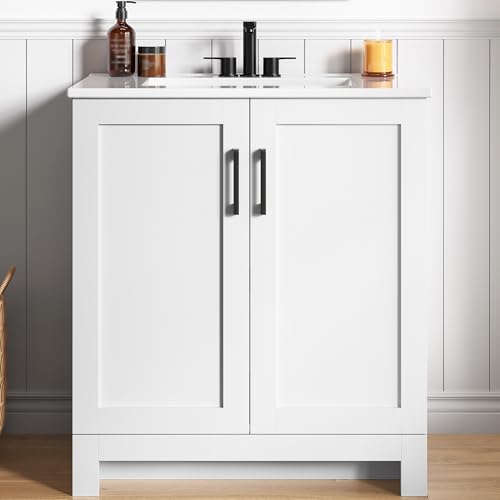
Wade Logan-style 30-inch single vanity, freestanding — Best Small Ensuite All-Rounder. The 30-inch single is the sweet spot of small bathrooms: a real basin, a usable slice of counter, and storage for one person’s full kit.
Wade Logan-style 36-inch single vanity with drawer storage — Best Mid-Size Single. Thirty-six inches of single-sink vanity: counter space that finally breathes, deep drawers, and the largest basin one person reasonably needs.
Wade Logan-style 48-inch double vanity — Best Double for Standard Bathrooms. The family-bathroom standard: two basins in 48 inches, shared drawers between, and an end to the morning elbow war in rooms that cannot fit a 60.
Wade Logan-style 60-inch double vanity with stone-look top — Best Large Family Double. The full-size double: two proper basins, counter that finally deserves the name, and storage for a whole family’s bathroom — the flagship configuration of this brand’s style.
Wade Logan-style floating (wall-mounted) vanity, 30–48 inch — Best Floating Modern. The wall-hung version of the brand’s modern look: a floating drawer unit with an integrated top, floor clear beneath, in single widths from compact to mid-size.
How These Picks Were Chosen
We organised this shortlist by the decisions a Wade Logan shopper actually faces: which width class, single or double sink, freestanding or floating, and integrated top or separate countertop. Six slots cover the catalogue’s centre of gravity — the sizes that fit standard North American bathrooms without custom work — rather than exotic one-offs.
Every slot carries the same construction bar: a carcass in solid wood or quality plywood rather than thin particleboard where the budget allows, soft-close hardware, a top material named honestly in the listing, and interior dimensions that fit standard trap and supply positions. A listing that will not state its carcass material or top composition fails this guide’s test regardless of brand or price tier.
Verification note, stated plainly: this batch’s Amazon listing data searches for the brand returned no listings sold under the Wade Logan name, so no pick here carries a purchase link. That is the honest outcome for a brand distributed mainly through another retailer, and the slots are written to be shopped by specification anywhere.
The 6 Best Wade Logan Bathroom Vanities by Size and Layout
Wade Logan-style 24-inch single vanity with integrated top — Best for Powder Rooms
Twenty-four inches is the width where bathroom vanities stop being furniture and start being plumbing with ambitions, and it is the size powder rooms and small ensuites actually need. In this configuration you are shopping for an integrated top — basin and counter moulded as one piece — because at this width a separate stone top adds cost and seams without adding usable counter. The cabinet below should give you one door with an interior shaped around the trap, or a single deep drawer with a U-shaped cutout; both exist in this class, and the drawer is the more usable of the two.
Verify three things on any listing in this slot: the depth (compact vanities are often shallower than standard, which helps tight rooms but shrinks the basin), the top material named in words — ceramic and stone resin behave very differently over five years — and whether the unit ships assembled. At 24 inches, assembled shipping is common and worth preferring; a flat-pack this size saves little and risks a wobbly result.
Strengths
- Fits powder rooms and ensuites no standard vanity serves
- Integrated top means no seams and easy cleaning
- Drawer-with-cutout versions store more than door versions
Trade-offs
- Counter space is a tap and a soap dish — nothing more
- Shallower basins splash more if paired with a tall tap
- Storage suits one user, not a couple
Key specs
- Specification slot: 24 in wide, freestanding, single sink
- Integrated ceramic or stone-resin top — confirm which
- Confirm assembled shipping and true depth before ordering
Buy this slot for the guest WC, the under-stairs powder room, or the ensuite in a small apartment, and pair it with a mirrored cabinet to recover the storage the width cannot give. It is the wrong buy for a main bathroom, where 24 inches becomes a daily negotiation. Within the brand’s range style, this is the configuration where value is most honest: there is simply less material to fake.
Best for: powder rooms and small ensuites needing a complete compact unit / Not suited for: main bathrooms and anyone needing counter space
Unlinked pick — no Amazon listing under the Wade Logan brand could be confirmed, so check the price through the brand’s usual retailers before you order.
Wade Logan-style 30-inch single vanity, freestanding — Best Small Ensuite All-Rounder
If 24 inches is a compromise, 30 inches is a decision you stop noticing. The basin reaches a size you can wash your face in without choreography, the counter takes a soap dispenser and a glass beside the tap, and the cabinet below can hold one person’s complete daily kit with a drawer to spare. In the brand’s modern styling, this width usually comes as a clean-lined freestanding unit with either two drawers or a door-and-drawer mix.
The construction check that matters most at this size is the drawer hardware. Drawers are where value vanities confess: you want full-extension, soft-close runners and a drawer box in plywood or solid wood, not stapled particleboard. Open the specification and look for those words; a listing that talks only about the finish colour is telling you where the money did not go. Top options widen at this width too — integrated ceramic for simplicity, or a separate engineered stone top if you want the heavier, quieter feel.
Strengths
- Face-washing basin and real counter in a small footprint
- Storage covers one person’s full daily kit
- Widest style and top choice in the compact classes
Trade-offs
- Still a one-person vanity at morning peak
- Drawer quality varies — verify runners and box material
- Separate stone tops add freight weight and cost
Key specs
- Specification slot: 30 in wide, freestanding, single sink
- Two drawers or door-and-drawer storage
- Confirm soft-close, full-extension drawer hardware
This is the slot for the typical ensuite and the small family bathroom used by one adult at a time. It is also the rental-upgrade sweet spot: big enough to feel like a renovation, standard enough to fit existing plumbing without moving pipes. Couples sharing one basin at the same hour should step straight to the 48-inch double slot below and skip the 36-inch compromise unless the room’s width forces it.
Best for: ensuites and small bathrooms serving one person at a time / Not suited for: couples getting ready simultaneously
Unlinked pick — no Amazon listing under the Wade Logan brand could be confirmed, so check the price through the brand’s usual retailers before you order.
Wade Logan-style 36-inch single vanity with drawer storage — Best Mid-Size Single
The 36-inch single is the connoisseur’s width: one basin, but surrounded by enough counter to lay out a full routine, and drawers deep enough for a hairdryer and everything that usually lives in a tangle. In this brand’s style range, the 36 commonly appears with a two-drawer or three-drawer face in flat-front modern or fluted designs, over an integrated or stone-look top.
Two checks define this slot. First, basin placement: some 36-inch units centre the basin and waste counter symmetry, others offset it to create one long work surface — the offset layout is the smarter buy for anyone who actually uses counter space. Second, drawer depth around the trap: the top drawer is always a shallow U around the plumbing, so judge storage by the lower drawers, and confirm their internal height against the tallest bottle you own.
Strengths
- Generous counter for full grooming routines
- Deep lower drawers swallow appliances and bulk items
- Single plumbing set keeps install simple and cheaper
Trade-offs
- One basin still bottlenecks two people at peak hour
- Needs a genuinely 36-inch-plus alcove — measure with trim
- Heavier units; two-person handling on delivery day
Key specs
- Specification slot: 36 in wide, single sink, drawer-led storage
- Prefer offset basin for maximum usable counter
- Confirm lower drawer internal height for bottles and dryer
Choose the 36 when the room fits it and the household’s mornings are staggered rather than simultaneous — you get double-vanity counter with single-vanity plumbing simplicity. If two people truly overlap every morning, width is not your problem, sink count is, and the double slots below are the honest answer even if it means a tighter fit.
Best for: solo users with full routines and staggered-morning couples / Not suited for: simultaneous two-person mornings
Unlinked pick — no Amazon listing under the Wade Logan brand could be confirmed, so check the price through the brand’s usual retailers before you order.
Wade Logan-style 48-inch double vanity — Best Double for Standard Bathrooms
Forty-eight inches is the smallest width where two basins stop being a stunt. Each user gets a compact but real basin and a personal slice of counter, with storage split between under-basin cabinets and a central drawer stack. In the brand’s range style, this is the entry to double-vanity life for standard bathrooms — the size that fits the alcove most family bathrooms actually have.
Be clear-eyed about the compromises, because they are geometric, not qualitative: basins are smaller than a single’s, counter per person is a strip, and two people at the unit means shoulders negotiate. What you are buying is simultaneity, not luxury. Verify the top carefully — at this width, engineered stone and ceramic-integrated tops both appear; a one-piece double integrated top is easier to clean, while a stone top with undermount basins feels more substantial and lets you replace a basin without replacing the whole top.
Strengths
- True two-person mornings in a standard alcove
- Central drawers plus two cabinets organise a couple’s kit
- One-piece top options keep cleaning simple
Trade-offs
- Smaller basins and minimal counter per person
- Two trap sets to plumb — installation costs more
- Crowded if both users spread out full routines
Key specs
- Specification slot: 48 in wide, double sink, freestanding
- Confirm top type: integrated vs stone with undermount basins
- Budget plumbing for two complete trap sets
Buy this slot when the bathroom is 48-to-54 inches of alcove and two people share the morning — it converts the worst ten minutes of the day into a non-event. If your alcove is 60 inches or more, do not settle: the next slot is the same idea with the compromises removed, and the price step is smaller than the daily-life step.
Best for: couples in standard bathrooms with a 48-inch alcove / Not suited for: rooms under 48 inches or solo users wanting maximum counter
Unlinked pick — no Amazon listing under the Wade Logan brand could be confirmed, so check the price through the brand’s usual retailers before you order.
Wade Logan-style 60-inch double vanity with stone-look top — Best Large Family Double
At 60 inches the double vanity stops compromising. Basins reach single-vanity size, each user gets counter worth using, and the storage below can be organised as his, hers, and shared without a treaty. In this brand’s modern idiom, the 60 typically arrives as a flat-front or fluted freestanding unit under a stone-look top — engineered quartz or marble-patterned — with soft-close everything.
The checks scale with the size. Freight delivery and thresholds: confirm the delivery includes room-of-choice or at least doorstep with a plan for the weight, because a topped 60-inch vanity is a two-to-three-person carry. Top honesty: ‘stone-look’ spans engineered quartz, cultured marble, and printed resin, which age very differently — the listing must name the material, and quartz is the one that shrugs off a decade of toothpaste and heat. And measure the route, not just the alcove: hall turns and door widths have ended more 60-inch installations than plumbing ever has.
Strengths
- Two full-size basins with real counter each
- Family-scale storage ends counter clutter
- Stone-look tops in quartz offer the premium feel honestly
Trade-offs
- Freight weight — delivery and route planning are part of the buy
- Highest plumbing and fitting cost in this guide
- Dominates smaller rooms; needs the full 60-inch alcove
Key specs
- Specification slot: 60 in wide, double sink, freestanding
- Top material must be named — prefer engineered quartz
- Confirm delivery terms and carry route before ordering
This is the main-bathroom anchor purchase: the unit the whole room gets designed around, bought once a decade or two. It earns its place in family bathrooms and primary ensuites where two adults and visiting chaos all pass through. If the room cannot take it with clearance to spare, the 48-inch double is the honest fallback — a forced 60 in a tight room makes every other fixture feel like an apology.
Best for: primary bathrooms and families with a true 60-inch alcove / Not suited for: tight rooms, upstairs bathrooms with narrow stairs, solo users
Unlinked pick — no Amazon listing under the Wade Logan brand could be confirmed, so check the price through the brand’s usual retailers before you order.
Wade Logan-style floating (wall-mounted) vanity, 30–48 inch — Best Floating Modern
Floating vanities are the brand’s most contemporary offer and the one that changes a room’s feel most: the floor runs unbroken to the wall, the room reads larger, and cleaning underneath is a mop pass instead of a negotiation. The typical configuration is one or two wide drawers — the top one U-cut around the trap — under an integrated ceramic or resin top, in widths from 30 up to 48 inches as a single.
The conditions are structural and honest. A floating vanity hangs a loaded cabinet, a stone or ceramic top, and a leaning adult’s weight on the wall, so it needs studs or a reinforced fixing zone — this is a during-renovation decision or a stud-finding exercise, never a plasterboard hope. Drawer volume is less than a freestanding unit of the same width, because the drawers are shallower; you are trading storage for air. Buyers who do the storage pile test and pass it get the look without the regret.
Strengths
- Unbroken floor makes small bathrooms feel a size larger
- Easiest floor cleaning of any vanity format
- The most contemporary look in the brand’s style range
Trade-offs
- Needs studs or reinforced wall fixing — not a casual swap
- Shallower drawers store less than freestanding equivalents
- Basin height is set at install; choose carefully for the household
Key specs
- Specification slot: wall-mounted, 30–48 in, single sink
- Confirm fixing requirements against your wall construction
- Integrated top; U-cut top drawer around the trap
Choose floating for a modern ensuite or a small bathroom where floor visibility is worth real money in perceived space, and where the wall can be prepared properly. It is the wrong slot for a storage-maximal family bathroom or a quick weekend swap onto unknown walls. Set the height thoughtfully at installation — a couple of inches above standard suits taller households and cannot be changed later without re-fixing.
Best for: modern ensuites and small bathrooms chasing space and clean lines / Not suited for: storage-maximal family bathrooms and unprepared walls
Unlinked pick — no Amazon listing under the Wade Logan brand could be confirmed, so check the price through the brand’s usual retailers before you order.
Comparison Table
| Pick | Badge | Key spec | Best for |
|---|---|---|---|
| Wade Logan-style 24-inch single vanity with integrated top | Best for Powder Rooms | Specification slot: 24 in single, integrated top, freestanding | powder rooms and small ensuites needing a complete compact unit |
| Wade Logan-style 30-inch single vanity, freestanding | Best Small Ensuite All-Rounder | Specification slot: 30 in single, freestanding, drawer storage | ensuites and small bathrooms serving one person at a time |
| Wade Logan-style 36-inch single vanity with drawer storage | Best Mid-Size Single | Specification slot: 36 in single, deep drawers, offset basin preferred | solo users with full routines and staggered-morning couples |
| Wade Logan-style 48-inch double vanity | Best Double for Standard Bathrooms | Specification slot: 48 in double, central drawers, two cabinets | couples in standard bathrooms with a 48-inch alcove |
| Wade Logan-style 60-inch double vanity with stone-look top | Best Large Family Double | Specification slot: 60 in double, stone-look top, full storage | primary bathrooms and families with a true 60-inch alcove |
| Wade Logan-style floating (wall-mounted) vanity, 30–48 inch | Best Floating Modern | Specification slot: floating drawer vanity, integrated top, 30–48 in | modern ensuites and small bathrooms chasing space and clean lines |
How to Choose a Wade Logan Vanity by Width: The Size Ladder
Width is destiny in vanities, so climb the ladder deliberately. Under 24 inches, you are in hand-washing territory and should be looking at compact singles or even a pedestal. At 24–30, one person gets a complete, workable station. At 36, one person gets a luxurious one. At 48, two people get a workable one. At 60, two people get a comfortable one. Every buyer’s regret in this category is a mismatch between the width bought and the mornings lived — so describe your morning first, then read the ladder.
Measure the alcove at its tightest point, including skirting boards and door trim, and subtract a small fitting tolerance; a vanity that must be forced is a vanity that will be returned or, worse, scribed badly. Then measure the route — front door, hall turns, bathroom door — because the unit has to travel it in one piece. Standard plumbing positions suit standard widths; an unusual width in an old house deserves a plumber’s tape measure before any order.
Carcass, Drawers, and Tops: Where Value Vanities Tell the Truth
Read listings in a fixed order and you will never be fooled. First, carcass material: solid wood and furniture-grade plywood survive bathroom humidity for a decade; particleboard and thin MDF swell at the first leak and never recover. A listing that hides the carcass material behind lifestyle photos is answering your question. Second, drawer hardware: full-extension soft-close runners and real drawer boxes are the daily luxury; side-mounted basic runners are the daily annoyance.
Third, the top, where naming matters most. Engineered quartz is hard, non-porous, and honest. Cultured marble is a gel-coated cast product — attractive, softer, and prone to dulling with abrasive cleaners. Integrated ceramic is the easy-clean classic. Stone resin sits between. Any of them can be the right buy at the right tier; what you must not accept is a listing that will not say which one it is. The same goes for ‘solid wood’ claims that dissolve, on inspection, into wood-look finishes over board.
- Carcass: solid wood or plywood preferred; be wary of unnamed board
- Drawers: full-extension, soft-close, real boxes
- Top: quartz, cultured marble, ceramic, or resin — must be named
- Finish: water-resistant coating, especially at the floor line
- Hardware: soft-close hinges and handles included, not an extra
Freestanding vs Floating: Choosing the Mounting Honestly
Freestanding is the forgiving default: it fits any wall, carries its own weight to the floor, stores more, and installs in an afternoon. Floating is the aesthetic upgrade with structural homework: it needs a wall that can be trusted or reinforced, stores less in shallower drawers, and repays you with space, light, and the easiest floor in the house to clean.
Decide by renovation state. Mid-renovation, with walls open, floating costs little extra to enable and looks a decade newer. In a finished bathroom you are merely refreshing, freestanding respects the room you have. Households with toddlers also lean freestanding — a floor-standing unit shrugs off being climbed; a floating unit’s fixings should never be tested by a determined three-year-old.
Plumbing Fit: Traps, Supplies, and Why Drawers Have U-Shapes
Every vanity drawer that slides under a basin is shaped by the trap, so interior photos matter more than exterior ones. The top drawer in modern units is a U-shaped frame around the waste; judge its usefulness for flat items — trays, brushes, makeup — rather than bottles. Bottle storage lives in lower drawers and door cabinets, so check lower drawer internal height against your tallest bottle before ordering, not during the first unpack.
Supply and waste positions in most houses suit most standard vanities, but floor-entry supplies complicate floating units (the pipes must turn into the wall or be boxed), and widely offset wastes complicate drawer units (the U-cut assumes a roughly central trap). Photograph your pipework, compare it with the unit’s internal diagram — good listings publish one — and involve a plumber early if anything looks non-standard. Moving a waste by two inches is cheap during renovation and expensive after tiling.
Delivery, Assembly, and the First Week
Vanities arrive in three states: fully assembled (best, heaviest), flat-pack (cheapest freight, your weekend), and cabinet-assembled with the top separate (the common middle). Know which you bought. For assembled and topped units, confirm the delivery service level — doorstep freight and a 60-inch topped vanity are a mismatch unless you have help booked — and inspect for transit damage before signing, because top corners and drawer faces are where freight bites.
In the first week, check three things: drawers still soft-close after the unit is loaded (weight reveals weak runners), the top’s sealant line at the wall is continuous, and the trap joints are dry after a filled-basin drain test. Small issues found in week one are warranty emails; the same issues found in month six are arguments.
What Wade Logan Styling Actually Looks Like — and How to Match the Rest of the Room
The brand’s vanity styling sits in the contemporary-mainstream: flat-front or lightly fluted drawer faces, slim or integrated pulls, and a palette that runs from white and grey through oak-look and walnut-look finishes to matte black. It is designed to sit comfortably next to the chrome-and-white or black-and-wood schemes of current bathrooms rather than to dominate them. When you shortlist within a size class, you are mostly choosing among these faces — the cabinet engineering underneath changes less than the photography suggests.
Matching the rest of the room is then straightforward. Chrome taps forgive almost every finish in the range; matte black taps want the black or walnut faces; brushed nickel is the peacemaker for oak and grey. Mirror choice matters more than tap choice at these widths: a mirror the full width of the vanity makes a 30-inch unit feel designed, while a small round mirror over a 60-inch double makes the flagship look like an afterthought. Budget the mirror with the vanity, not after it.
One styling trap deserves naming: trend finishes date faster than cabinet shapes. A fluted oak face is very now; a flat white face is very always. If this vanity is a ten-year purchase in a house you will sell, the quieter face protects the room’s resale feel. If it is your own primary bathroom and you love the trend, buy the trend — you are the one who will see it every morning, and the construction checks in this guide matter far more to your decade than the face does.
Total Cost of the Vanity: The Numbers Beyond the Headline
The vanity’s headline price is roughly two-thirds of the real project. Add the faucets (two on a double), the traps — compact models if you want the drawers to keep their depth — the mirror or cabinet, delivery at the right service level, and the plumber’s install time, which doubles when a single becomes a double. None of this argues against any slot in this guide; it argues for comparing total projects, not headline prices, when two listings look close.
The other hidden number is the making-good: the floor and wall your old vanity was hiding. A new unit a half-inch narrower exposes a line of unfinished floor that no photograph warned you about. Keeping the old unit’s footprint in mind while you shop — or planning a plinth, a bead of trim, or a floor touch-up — turns that surprise into a line item in the budget, which is exactly where surprises of every kind belong in a bathroom project of any size at all, large or small, simple or complicated, in any house, flat, or rental property you care about and want to keep in good order for years.
How to Plan a Vanity Replacement From Measure to First Morning
A vanity replacement is won in the measuring week and merely executed on the day. This is the planning sequence that keeps it that way — with the water work itself left to a qualified plumber.
- Describe your morning honestly: how many people, at once or staggered — that fixes width and sink count.
- Measure the alcove at its tightest point, the plumbing positions, and the full delivery route into the room.
- Choose mounting: freestanding for finished rooms, floating only with a wall you can reinforce or trust.
- Shortlist by construction: carcass material, drawer hardware, and a top whose material is named.
- Compare interior diagrams against your pipework photos; confirm drawer heights against your tallest bottles.
- Order with delivery terms that match the unit’s weight, and book help for the carry if needed.
- On delivery, inspect before signing; on install day, have the plumber level, fix, seal, and drain-test the unit.
- Load it, then re-check drawer action and trap dryness across the first week.
Followed in order, those steps turn the largest, heaviest purchase in the bathroom into a routine one. Skipped, they produce the category’s familiar stories: the vanity that did not fit the alcove, the drawers that met the trap, the top that was not what its name implied.
Common Buying Mistakes
Buying by photograph instead of by width and morning. A beautiful 30-inch single does not survive two people at 7 a.m. Fix the size class from your actual routine first; style choices come after, inside the class that fits your life.
Accepting an unnamed top material. ‘Stone top’ can mean quartz, cultured marble, or printed resin, with a decade of difference in behaviour. If the listing will not name it, the listing is the answer — walk to one that will.
Forgetting the delivery route. Alcoves get measured; hallways, stairs, and door widths get forgotten, and a topped 60-inch vanity does not fold. Walk the route with a tape before ordering the big slots in this guide.
Floating a vanity on an unprepared wall. A loaded floating vanity is a lever full of stone and water. It needs studs or reinforcement, decided before tiling. Plasterboard fixings and hope are not a mounting strategy.
Judging storage by drawer count. Three shallow drawers store less than two deep ones, and the top drawer is mostly a frame around the trap. Judge by internal heights and the lower drawers, against the bottles and appliances you actually own.
Skipping the drain test at install. Fill both basins, drain them together, and check every joint dry before the plumber leaves. A slow trap weep found in week one is a washer; found in month six it is a swollen carcass.
Final Recommendation
Shop this brand the way its catalogue is built: width first, then mounting, then face. Powder rooms take the 24-inch single; ensuites the 30 or the floating range; solo luxury the 36; couples the 48 double in standard rooms and the 60 double where the alcove allows. At every size, hold the construction line — named carcass, named top, real drawer hardware — because that is where value vanities separate into the ones that last a decade and the ones that last a lease.
And keep the verification note in mind as you shop: we could not confirm Amazon listings under this brand name for this batch, so use these slots as the specification to match wherever you buy, and let any listing that cannot confirm its own dimensions and materials in plain writing disqualify itself completely and immediately from your shortlist.
Keep exploring this cluster: Best Bathroom Double Vanities Best Stand Alone Bathroom Sinks Best Bathroom Sink Vanities Best 18 Inch Bathroom Vanities Best Bathroom Vanities Floating Modern Best Bathroom Vanities For Seniors
Frequently Asked Questions
Where are Wade Logan vanities usually sold?
Wade Logan is best known as a house brand of Wayfair, and that is where its full vanity range is normally listed. Marketplace listings under the name do appear from third-party sellers, which is exactly why this guide is written by specification: wherever you buy, the width, construction, and top-material checks in the buying guide are what protect you.
What size vanity do two people actually need?
For simultaneous use, 48 inches is the workable minimum and 60 inches is the comfortable standard. Below 48, a single wide basin with two taps is sometimes the smarter layout. Staggered mornings change the maths entirely — a 36-inch single serves staggered couples better than a cramped double serves simultaneous ones.
Are floating vanities sturdy enough for daily family use?
Properly fixed to studs or a reinforced wall, yes — they are engineered for it and common in hotels that see harder use than any home. The failure mode is never the concept; it is fixing into weak wall material. If your wall cannot be prepared, a freestanding unit of the same width is the sturdy choice for your house.
What is the best vanity top material at this end of the market?
Engineered quartz for durability per dollar: hard, non-porous, and indifferent to toothpaste and heat. Integrated ceramic is the easy-clean budget champion. Cultured marble looks the part but needs gentle cleaners and dulls faster. The rule is not which material, but that the listing names it — unnamed ‘stone’ is the one to avoid.
Can I change just the top on an existing vanity?
Sometimes — if the cabinet is standard width and depth, a replacement top in the same footprint can refresh the whole unit for a fraction of a full swap. It makes sense when the carcass and drawers are sound and only the top is tired or dated. It makes no sense over a swollen or sagging cabinet: a new stone top on a dying base is the most expensive way to own an old vanity.
Do these vanities come with faucets and mirrors?
Typically no: the vanity and top are the product, with basins included when the top is integrated or undermounted. Faucets, mirrors, and traps are separate purchases, and the trap matters more than people expect on drawer units — a compact trap buys drawer room. Budget the full set before comparing headline prices between listings.
How hard is it to replace a vanity with the same size?
Same-width, same-mounting swaps are among the easier bathroom jobs: the plumbing usually lands where the new unit expects it, and the work is disconnect, remove, position, level, connect, and seal. The surprises live in the floor and wall the old unit was hiding — budget a contingency for making good, and photograph pipework before you start.
How long should a vanity at this level last?
The cabinet and top should serve a decade or more; the wear items are drawer runners, hinges, and the top’s surface finish, in that order. That is precisely why this guide weights hardware and named top materials over styling: a vanity rarely dies dramatically — it sags, swells, and dulls. Bought on construction, a value-tier vanity outlasts a style-bought premium one often enough that the checks are worth the ten minutes they take.
What drawer layout is best under a double vanity?
A central drawer stack flanked by two door cabinets is the most flexible pattern: shared items live in the middle, personal kits under each basin. Full-drawer doubles look sleeker and store flat items brilliantly, but bottle storage gets tight. Match the layout to what you own — lay your current contents out and count bottles before choosing.
Why does this guide have no buy links?
Because the brand is the point of the keyword, and honesty has to win over convenience. Wade Logan is a house brand sold mainly through Wayfair and its sister sites; when this guide was re-verified on 22 November 2026, two separate Amazon listing data searches of Amazon’s catalog returned bathroom vanities from other makers — Vanity Art, T4TREAM, Modway and YITAHOME among them — and not one listing sold under the Wade Logan name. Rather than dress another brand’s vanity in this brand’s clothing, every pick above is written as the exact size and configuration class the brand sells, so you can shop it where the brand is actually stocked, or use the specification to judge a comparable vanity anywhere else. If a genuine Wade Logan listing appears on Amazon later, the specification sections here are written so it can be matched against them point by point.