Disclosure: airfryerkitchensupply.com is reader-supported. When you buy through links on our site, we may earn an affiliate commission at no extra cost to you.
The best baby infant tubs are chosen on three things that have nothing to do with color: how safely they support a baby who cannot yet support herself, how honestly their stages match the speed at which babies actually grow, and where the tub will live in your home for the next two years. A newborn needs a reclined cradle that keeps her head up and her body warm in shallow water. A six-month-old needs a seated support that forgives constant lunging at toys. A toddler needs room, sturdiness and a parent who is not fighting the equipment. Every pick in this guide is a format that answers one of those stages best — folding, sling-contoured, sink insert, inflatable, compact Euro-style and temperature-indicating — and five of the six are matched to listings verified on 2026-11-22; the sink-insert pick stands as a format brief, because the listed only bath pads and cushions for it — accessories, not complete tubs — and this program never attaches a purchase link it cannot verify.
One rule stands above every comparison in this article, and it is repeated where it belongs throughout: a baby in water is supervised continuously, at arm’s reach, by an adult whose attention is on the baby. No tub, sling, seat or insert changes that rule or substitutes for it — these products support bathing, they do not perform it. With that understood, the formats below can be judged on their real merits: support geometry, growth honesty, drying and storage, and the daily ergonomics of the parent doing the bathing.
Where to buy
The linked picks below were verified on 2026-11-22; one pick stands as a format brief to shop by name on Amazon. Either way, run the physical checks each review describes — lock and press tests, sling inspection, sink measurements — before the first bath:
- Stokke Flexi Bath Bundle with Newborn Support — Best Overall: a foldable bathtub with newborn support — check the current price on Amazon.
- Fisher-Price 4-in-1 Sling ‘n Seat Tub — Best for Newborns: a 4-in-1 tub with a removable infant sling — check the current price on Amazon.
- A Sink Insert Flower or Cushion Bath — Best for Sink Baths: presented as a format brief below; shop the format by name on Amazon and audit any candidate against the brief.
- Munchkin Inflatable Baby Bathtub — Best for Travel: an inflatable toddler tub for travel, 6-24 months — check the current price on Amazon.
- Shnuggle Newborn Baby Bath — Best Small Footprint: a compact newborn bath with a built-in support bump — check the current price on Amazon.
- Boon Soak 3-Stage Baby Bathtub — Best for Nervous First-Timers: a 3-stage tub with a color-changing drain plug — check the current price on Amazon.
Those checks, in one line: every lock and hinge must hold under a hard press, every sling must support the head without hammock-sagging, every insert must fit your actual sink, and every tub must prove its drain and seals on a test fill of plain water before a baby ever meets it.
In this guide
Quick Picks
- Best Overall: Stokke Flexi Bath Bundle with Newborn Support — The fold-flat tub that serves newborns through toddlerhood and stores in real bathrooms, with a newborn insert included.
- Best for Newborns: Fisher-Price 4-in-1 Sling ‘n Seat Tub — The molded tub with a removable infant sling — maximum support for the first, slipperiest months.
- Best for Sink Baths: A Sink Insert Flower or Cushion Bath — The soft petal or cushion insert that turns a kitchen sink into a newborn bath — presented as a format brief.
- Best for Travel: Munchkin Inflatable Baby Bathtub — The blow-up tub that packs into a changing bag — for travel, grandparents’ houses and small spaces, for 6-24 months.
- Best Small Footprint: Shnuggle Newborn Baby Bath — The compact European-style tub with a built-in support bump and soft backrest — less water, less floor.
- Best for Nervous First-Timers: Boon Soak 3-Stage Baby Bathtub — A three-position tub whose drain plug changes color to signal ideal bath temperature — a confidence tool for the first months.
Five picks are linked to verified listings; the sink-insert brief stands unlinked, for the reason given in its review. In a category where a physical press test on delivery day tells you more than any listing, every review is written as an inspection instrument — buy the format that fits your baby’s stage and your bathroom, then audit the specific product against its brief while returns are still easy.
How These Picks Were Chosen
Formats, not brands, were the unit of selection — an honest reflection of how baby tubs should be bought, with each format then matched to a verified listing where the API offered a true, complete tub. Within a format, execution varies; across formats, the use case is unmistakable. The six formats chosen cover the full map: a daily driver for most homes, maximum newborn support, the sink-bathing first weeks, travel and second homes, small-bathroom and water economy, and temperature confidence for first-timers. A baby’s first two years will likely touch two of these formats in sequence, and the guide says which sequences make sense.
Safety language was treated as specification. Every brief states its supervision and support requirements in the review itself rather than in a footer, because the parent reading about an inflatable tub needs its inflation rule in the same paragraph as its virtues. Water temperature, head support, lock integrity and drying hygiene are treated throughout as product features — because for the person using the tub nightly, they are.
Growth honesty was the third filter. Baby products are chronically marketed with age ranges their dimensions cannot honor, so each brief names the stage where its format genuinely ends — the sink insert’s short career, the compact tub’s toddler limit — and treats a short, excellent career as a virtue rather than a flaw. A product that serves eight weeks perfectly is a better purchase than one that serves two years badly.
Finally, parent ergonomics counted. Bathing a baby nightly is physical work done kneeling, leaning and lifting a wet, moving weight. Formats that raise the bath, contain the splash or fold away one-handed were credited for it, because a tub that hurts to use will be used reluctantly — and babies can tell.
The 6 Best Baby and Infant Tubs

Stokke Flexi Bath Bundle with Newborn Support — Best Overall
Verified pick: Stokke Flexi Bath Bundle with Newborn Support — a foldable bathtub with newborn support, spacious enough for birth to 4 years, lightweight and easy to store.
The workhorse of this category is the folding full-size tub: a rigid or semi-rigid tub that stands in the family bathtub or on a counter, cradles a newborn with an insert or sling, converts as the baby grows into a seated toddler tub, and folds flat enough to hang on a hook or slide beside the washing machine when bath time ends. Storage is not a footnote in baby gear — it is the difference between a product used daily and a product resented daily — and the folding format is the only full-size design that respects apartment and small-bathroom reality.
It is positioned in the mid-range tier. The safety and sizing checks in its deep section are the ones to apply to any candidate, because in this category the checks matter more than the brand.
Strengths
- Folds flat for storage in small bathrooms
- Newborn insert converts to a toddler tub — one purchase, whole infancy
- Full-size basin fits in the family tub or on a stable counter
Trade-offs
- Folding joints and hinges must be inspected for wear and pinch points
- Some folding designs feel flexy when full — stability varies
- Newborn insert quality decides the first months’ experience
Key specs: Folding tub brief: newborn insert included, stated age/weight range, flat fold, drain plug
The safety audit for any folding tub is physical and quick. Open and lock it, then press down hard in the center and at the sides: the locks should hold without creak or give, because a folding mechanism that yields under a parent’s hand will not be trusted under a wiggling toddler. Check that hinges are shrouded where small fingers will explore, that the drain plug seats positively, and that the newborn insert holds a reclined baby with the head supported and the chin up — the posture that keeps water away from ears and face. Then fill it once, empty, before the first bath: every seal and plug should prove itself on water alone.
Used well, the format’s routine is simple: bathe in the family tub for splash containment, drain through the plug, rinse, fold, hang. A tub that stores on a hook dries fully between baths — which, as the towels guide on this site would tell you, is also how plastic gear avoids the mildew that haunts anything stored wet and nested.
Best for: most families, especially with small bathrooms and one tub to serve infancy through toddlerhood / Not suited for: families wanting a permanent, non-folding soaking tub for a large bathroom
Check the current price on Amazon for the Stokke Flexi Bath Bundle with Newborn Support.
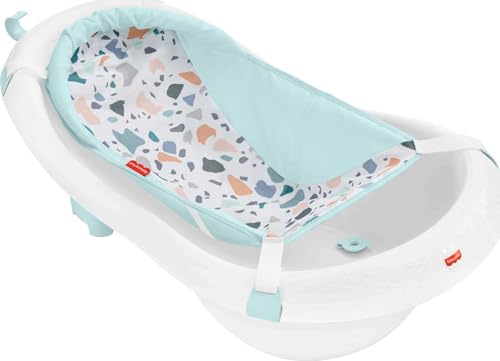
Fisher-Price 4-in-1 Sling ‘n Seat Tub — Best for Newborns
Verified pick: Fisher-Price 4-in-1 Sling ‘n Seat Tub — a baby-to-toddler 4-in-1 tub with a removable infant support and 2 toys, in Pacific Pebble.
Ask any parent about the first bath and they describe the same problem: a newborn is small, slippery, startled by water, and entirely unable to hold up the head that must stay up. The contoured tub with a newborn sling exists for exactly those months. The sling cradles the baby in a supported recline above the tub floor, the molded contours take over as the sling is retired, and a toddler end of the basin — usually with a more upright backrest — finishes the journey. It is the most guided, least improvised bathing format sold, and for first-time parents that guidance is the product.
Positioned in the budget-to-mid-range tier. The sling’s fabric and the contour quality are what to inspect, per the notes below.
Strengths
- Sling supports newborns in a safe, reclined posture
- Molded contours stage the whole first year in one tub
- Guided format reassures first-time parents
Trade-offs
- Does not fold — storage needs a permanent home
- Sling fabric must be dried thoroughly to stay fresh
- Babies outgrow the sling stage faster than the price suggests
Key specs: Contoured tub brief: newborn sling included, two-stage contours, stated weight limit
The sling deserves the scrutiny parents usually save for the plastic. It should support the baby’s whole back and head without hammock-sagging the spine into a curl, its fabric should be a fast-drying mesh rather than a padded sponge — padding holds water, weight and eventually mildew — and its attachment points should be redundant and obvious, because a sling fitted wrong at 2 a.m. is a sling fitted wrong. Remove and hang the sling to dry after every bath; that single habit decides whether it stays pleasant through its short, intense career.
When the sling retires, test the next stage before bath night: sit the baby in the dry tub and check that the contour supports a seated lean without sliding. Babies vote on tub stages with their whole bodies, and a dry rehearsal is the parent’s one chance to hear the review in advance.
Best for: first-time parents and newborns, especially smaller babies who need maximum support / Not suited for: families with no storage space for a rigid tub
Check the current price on Amazon for the Fisher-Price 4-in-1 Sling ‘n Seat Tub.
A Sink Insert Flower or Cushion Bath — Best for Sink Baths
For the first weeks, many families bathe the baby in the kitchen sink: it stands at counter height, saving the parent’s back; it is small, so it feels controllable; and it is already plumbed. The flower or cushion insert is what makes a hard porcelain or steel sink into a newborn-appropriate surface — a soft, petal-shaped cushion that lines the basin, supports the baby, and insulates against the sink’s cold and hardness. Photogenic as they are, the good ones earn their place on ergonomics alone.
Presented as a format brief in the budget tier. Its honest limits are as important as its charms and are stated plainly below: this is a first-stage product with a short, specific career.
Strengths
- Counter-height sink bathing saves parents’ backs
- Soft cushion makes a hard sink safe and warm for newborns
- Tiny storage footprint — hangs or folds away
Trade-offs
- Outgrown quickly — a first-months product, not a full solution
- Cushion must be dried thoroughly or it will mildew
- Only fits sinks of compatible size and shape
Key specs: Sink insert brief: stated sink-size fit, fast-drying cushion material, hanging loop for drying
Fit is the whole purchase. Measure your sink — length, width and depth — and compare it against the insert’s stated range, because an insert floating loose in an oversized basin or crammed into a small one supports nothing properly. Then plan the drying: the insert must hang in moving air after every bath, ideally over the tub or outside in sun when the season allows. A cushion stored damp in a cupboard under the sink is a mildew farm with petals, and the category’s bad reputation comes almost entirely from that cupboard.
Accept the career length when you buy. A sink insert that serves beautifully for eight weeks and then retires to the hand-me-down box has done its job completely — newborn backs, parental and infant, are worth a short-career product. The mistake is expecting it to stretch to month six, when the baby’s length and opinions have both outgrown the sink.
Best for: newborns in the first weeks, sink-bathing families and small homes / Not suited for: anyone wanting a single tub from birth to toddlerhood
Presented as a format brief — positioned in the budget tier by specification and category norms.

Munchkin Inflatable Baby Bathtub — Best for Travel
Verified pick: Munchkin Inflatable Baby Bathtub — an inflatable baby bathtub, a toddler tub for travel, for 6-24 months.
The inflatable tub is the travel and second-location answer: it deflates into a changing bag, inflates at a grandparent’s house, a hotel or a rental, and gives the baby a familiar, contained bath anywhere with a floor and a tap. Many designs add a central inflation bump or saddle that helps a seated baby stay upright, and walls soft enough that the inevitable toddler lurch ends against air rather than porcelain. For families whose lives are split between two homes, it is often the second tub that gets used most.
Positioned in the budget tier. Air and water demand respect for each other’s physics, and the supervision notes below are the strictest in this guide for a reason.
Strengths
- Packs to almost nothing for travel and storage
- Soft walls forgive toddler bumps and lurches
- Ideal second tub for grandparents’ homes and rentals
Trade-offs
- Must be fully and correctly inflated — a soft wall is a hazard, not a feature
- Punctures and slow leaks end its career without warning
- Never a substitute for constant, arm’s-reach supervision
Key specs: Inflatable brief: stated inflated dimensions, saddle or center bump for sitters, repair patch included
The rules for inflatable tubs are absolute. Inflate it fully, every time, and check firmness with a press before water goes in — a half-inflated wall can fold under a leaning baby. Place it on the floor or inside the family tub, never on a raised surface. And hold the category’s central rule, which applies to every pick in this guide and doubles here: a baby in water is supervised at arm’s reach, continuously, without exception — no doorbell, no phone, no sibling errand outranks it, because drowning in inches of water is silent and fast.
Cared for — dried fully before deflating, stored out of sun, patched at the first pinhole — an inflatable serves a family’s whole travel era. It will not be the daily driver for most homes, and this guide does not ask it to be. It is the tub that makes baths possible everywhere else, and that is job enough.
Best for: traveling families, grandparents’ houses and second-home duty / Not suited for: daily primary use where a rigid tub is practical
Check the current price on Amazon for the Munchkin Inflatable Baby Bathtub.
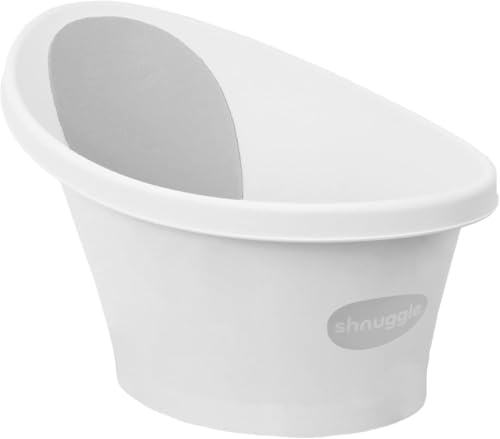
Shnuggle Newborn Baby Bath — Best Small Footprint
Verified pick: Shnuggle Newborn Baby Bath — a compact newborn baby bath with a built-in support bump and soft backrest, with plug, in white with a grey backrest.
The Euro-style compact tub — a taller, smaller-footprint basin in the tradition of European baby baths — makes two arguments American designs rarely do. First, water economy: its compact volume fills fast and uses a fraction of a full-size tub’s water, which matters where baths are nightly and water is metered or heated expensively. Second, posture: its shape supports a more upright seated bath for older babies, in a footprint that fits inside a shower stall, on a stand, or in bathrooms where a long American tub simply has nowhere to live.
Positioned in the mid-range tier. Its compactness is a genuine trade — the notes below mark where it wins and where the full-size folding pick beats it.
Strengths
- Compact footprint fits shower stalls and tiny bathrooms
- Uses far less water per bath than full-size designs
- Upright shape suits seated older babies well
Trade-offs
- Smaller basin is outgrown sooner by tall toddlers
- Less room for bath toys and sibling baths
- Newborn use depends entirely on the insert or support it ships with
Key specs: Euro tub brief: stated internal dimensions, newborn support included or available, stand compatibility
Judge this format by internal dimensions, not external charm: lay a tape measure’s numbers against your baby’s seated height as the months pass, because the compact tub’s career ends when knees and enthusiasm exceed its walls. For the families it fits — small bathrooms, water-conscious households, shower-only homes — it ends the nightly negotiation about where a baby bath can physically happen, which is a quality-of-life purchase disguised as a plastic one.
Stands deserve a mention where the brand offers one: a compact tub on its matched stand, at standing height, inside a shower stall, is the back-friendliest bathing station in this entire guide, and for parents recovering from birth or with back problems it can be the difference between dreading bath time and enjoying it. Verify stand stability with the same press test as any folding lock.
Best for: small bathrooms, shower-only homes and water-conscious households / Not suited for: families wanting one tub to last deep into toddlerhood
Check the current price on Amazon for the Shnuggle Newborn Baby Bath.
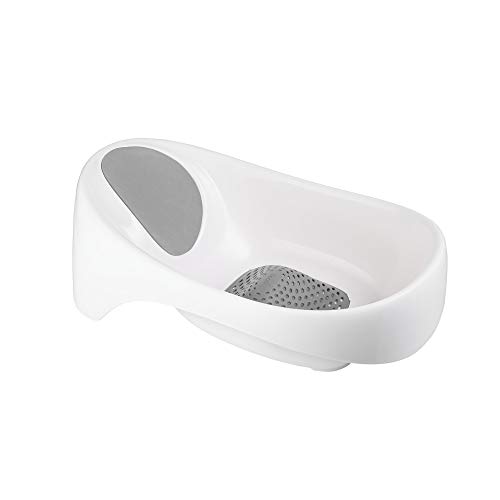
Boon Soak 3-Stage Baby Bathtub — Best for Nervous First-Timers
Verified pick: Boon Soak 3-Stage Baby Bathtub — a 3-stage baby bathtub with three support positions and a color-changing drain plug for ideal bath temperature, for ages 0 to 18 months and up.
Water temperature is the new parent’s first bath-time anxiety, and it is a rational one: a baby’s skin is thinner than an adult’s, the elbow test takes practice to trust, and the safe zone — comfortably warm, around body temperature and a little above — is narrower than a wrist suggests. Tubs with built-in temperature indication, whether a color-change plug or an integrated digital readout, and standalone floating thermometers exist to convert that anxiety into a number while the parent’s own calibration develops.
Positioned in the budget-to-mid-range tier depending on format. The guidance below treats the indicator as a training aid — which is its real value — rather than a permanent necessity.
Strengths
- Takes the guesswork out of bath temperature for new parents
- Color-change plugs need no batteries; digital readouts are precise
- Builds the parent’s own calibration over the first months
Trade-offs
- Indicators can lag or drift — always confirm with wrist or elbow too
- Digital versions add batteries and electronics to a wet product
- Anxiety usually fades by month two, outliving the feature’s value
Key specs: Temperature brief: indicator type stated, readable at a glance, backed by the manual wrist check
Use the indicator as a teacher. For the first weeks, run the bath by its reading and test with the inner wrist every time, noting what the correct temperature feels like on your skin. Within a month most parents find their wrist agreeing with the number before they read it — at which point the feature has done its real work and the tub is simply a tub, which is exactly the outcome to want. Any indicator that disagrees wildly with a comfortable wrist should be distrusted and the wrist believed; skin is the instrument the baby will actually experience.
The rest of the tub still has to earn its place — support, size, storage — because the temperature feature rides on formats from folding to contoured. Choose the format by the earlier picks’ logic, then let the indicator break ties. A great thermometer on the wrong tub is still the wrong tub, at the exact age when baths are nightly and opinions — the baby’s — are forming.
Best for: first-time parents who want objective reassurance on water temperature / Not suited for: experienced parents whose wrist is already calibrated
Check the current price on Amazon for the Boon Soak 3-Stage Baby Bathtub.
Comparison Table
| Pick | Badge | Key spec | Best for |
|---|---|---|---|
| Stokke Flexi Bath Bundle with Newborn Support | Best Overall | Folding tub brief: newborn insert included, stated age/weight range, flat fold, drain plug | most families, especially with small bathrooms and one tub to serve infancy through toddlerhood |
| Fisher-Price 4-in-1 Sling ‘n Seat Tub | Best for Newborns | Contoured tub brief: newborn sling included, two-stage contours, stated weight limit | first-time parents and newborns, especially smaller babies who need maximum support |
| A Sink Insert Flower or Cushion Bath | Best for Sink Baths | Sink insert brief: stated sink-size fit, fast-drying cushion material, hanging loop for drying | newborns in the first weeks, sink-bathing families and small homes |
| Munchkin Inflatable Baby Bathtub | Best for Travel | Inflatable brief: stated inflated dimensions, saddle or center bump for sitters, repair patch included | traveling families, grandparents’ houses and second-home duty |
| Shnuggle Newborn Baby Bath | Best Small Footprint | Euro tub brief: stated internal dimensions, newborn support included or available, stand compatibility | small bathrooms, shower-only homes and water-conscious households |
| Boon Soak 3-Stage Baby Bathtub | Best for Nervous First-Timers | Temperature brief: indicator type stated, readable at a glance, backed by the manual wrist check | first-time parents who want objective reassurance on water temperature |
Linked rows name the verified product; the sink-insert row is a format brief to shop and inspect against. ‘Best for’ names the stage and household each format genuinely serves; the supervision rule — an adult at arm’s reach, continuously — applies identically to every row of this table.
How to Choose a Baby or Infant Tub
Match the format to the stage you are actually in
Babies pass through three bathing stages faster than marketing suggests. The newborn stage — roughly the first months, until head control and trunk strength arrive — demands reclined support: a sling, an insert or a contoured cradle, in shallow water, with the head held clear. The sitter stage needs a basin that supports a seated baby who lunges, splashes and attempts escape as a hobby. The toddler stage needs room, sturdiness and splash tolerance. Buy for the stage you are entering, with one eye on the next — the folding and contoured picks in this guide span stages by design, while the sink insert honestly serves only the first, and serves it beautifully.
Weight and length limits on listings deserve more respect than age labels: babies grow at wildly different rates, and a tub outgrown by weight is outgrown whatever the box’s month range claims. Check your baby’s trajectory against the stated limits before buying any stage-spanning design, and expect the real career to be shorter than the printed one. That is not a scam; it is pediatrics.
Support geometry: what ‘safe’ actually looks like
For a newborn, look for a recline that holds the baby’s head and back in one supported line, chin up and away from the chest, ears above the waterline at the shallow fill you will actually use. Slings should support without hammock-sag; molded cradles should prevent sideways slide without hard ridges against the spine. For a sitter, look for a backrest angle that supports without strapping, a base wide enough to resist enthusiastic rocking, and surfaces that stay grippy when soapy — because everything in a baby bath is soapy, including the baby.
Then apply the universal audit on delivery day: assemble or unfold the tub, lock everything, and press — hard — where the baby’s weight will go. Locks should engage positively and hold silently. Seams and hinges should not flex, creak or pinch. Fill it, drain it, and inspect the plug. A tub that passes a parent’s deliberate abuse in the dry kitchen will be trusted correctly at bath time; one that fails gets returned while the lesson is still free.
Water, temperature and the nightly routine
Fill shallow: a few inches of water bathes a baby completely, warms fast and is the depth every safety guideline assumes. Temperature should be comfortably warm — around body temperature, a touch above — tested on the inner wrist or elbow, where skin is sensitive enough to judge; it should feel warm, never hot. The temperature-indicating pick in this guide exists to calibrate new parents’ wrists, and its review explains how to let the number teach the skin rather than replace it.
Sequence the bath like a ritual and the baby will learn it as one: everything gathered before the water runs — towel, washcloth, clean clothes, diaper — the room warm, the phone elsewhere. A baby is never left, for seconds, for any reason; if the doorbell rings, the baby comes with you, wrapped in the towel. This guide repeats the rule because repetition is what safety rules are for.
Drying, storage and the mildew question
Plastic tubs live wet, and what lives wet grows mildew unless it dries. Choose formats your home can actually dry: a folding tub hung on a hook dries completely; a sling removed and hung dries by morning; a cushion insert left in a cupboard does not dry at all. Rinse the tub after each bath, upend or hang it in moving air, and inspect seams, plugs and fabric weekly — mildew found early is a cleaning event, mildew found late is a replacement.
Storage is the sister question. Measure where the tub will live before buying it: the rigid contoured formats need a permanent home, the folding and inflatable formats need a hook or a drawer. A tub stored in the family bathtub itself — the commonest outcome — is moved twice a day by every showering adult, and households should choose that arrangement knowingly rather than discovering it. The best tub is the one whose daily logistics your household can sustain for two years without resentment.
Bath Time as the Baby Grows: a Stage-by-Stage Reality Check
The first baths are medical in character: the cord stump, where present, dictates sponge baths until it heals and your clinician clears immersion — follow your own clinician’s guidance over any product’s marketing, always. When tub baths begin, they are short, warm and businesslike, and the baby’s opinion is usually loud. This is the sling and sink-insert era, and its brevity surprises parents who expected the expensive stage-spanning tub to matter immediately. It matters soon enough.
The middle months are bath time’s golden age: the baby sits, splashes with intent, and treats the bath as the day’s best entertainment. This is when basin room, sturdiness and toy tolerance earn their keep, and when the folding and contoured formats justify themselves nightly. It is also when complacency is most dangerous — a confident, mobile, slippery baby in a familiar routine is exactly the combination that fills accident statistics, and the arm’s-reach rule matters more, not less, as baths get fun.
Toddlerhood converts the tub into a splash facility with a person in it. Many families graduate to bathing the toddler directly in the family tub, with the baby tub retired or demoted to a toy basin — a natural end that no product prevents and none should promise to. Plan the purchase with that arc in mind: the right total spend covers two formats across two years, not one miraculous object across all of it, and hand-me-down value favors the sturdy, simple designs that survive to bathe a sibling.
How to Give a Safe, Calm Baby Bath
This sequence works with every format in this guide. It assumes the rule that governs all of them: the baby is supervised at arm’s reach, continuously, from first water to final towel.
- Gather everything before water runs. Towel, washcloth, mild baby cleanser if you use it, clean diaper and clothes, and the tub itself — all within reach of the bathing spot. Once the baby is in water, nothing may be fetched. If something was forgotten, the baby comes out and comes with you.
- Prepare the room and the water. Warm the room, place the tub on a stable surface or in the family tub, and fill shallow — a few inches. Test the temperature on your inner wrist: comfortably warm, around body temperature. Swirl the water to even out hot spots from the tap.
- Lower the baby in, supported, feet first. Support the head and back with one hand and arm as you lower the baby in feet first, keeping the head supported until the sling, insert or contour takes over — and keeping a hand on the baby throughout, whatever the support promises.
- Wash in a calm order, keeping the baby warm. Wash face first with plain water, then body, keeping exposed skin covered with a warm wet washcloth against the chill. Keep the bath short in the newborn weeks; longer, playful baths belong to the sitter stage and beyond.
- Lift out straight into the towel. Lift the baby out with both hands — wet babies are at their slipperiest — directly onto the open towel, wrap, and dry thoroughly, especially in the folds. The bath ends when the baby is dry and dressed, not when the water stops.
- Rinse, drain and dry the equipment. Rinse the tub and any sling or insert, drain fully, and hang or stand everything to dry in moving air. Two minutes of equipment care after each bath is what keeps plastic and fabric fresh across two years of nightly use.
If bath time consistently distresses your baby, shorten it, warm the room further, and bathe at the baby’s calmest time of day — and raise any persistent concerns, skin reactions or feeding-and-bathing questions with your clinician, whose advice outranks any product guide, including this one.
Common Buying Mistakes
Leaving the baby ‘for just a second’. The unforgivable mistake, stated plainly: babies drown silently, in shallow water, in seconds. No errand, call or doorbell justifies it. If you must move, the baby moves with you, in the towel. Every other mistake in this list is recoverable; this one is the list’s reason to exist.
Buying by age range instead of size and stage. Printed month ranges flatter every tub. Judge by your baby’s weight, length and stage against the stated limits, and expect real careers to be shorter than printed ones — especially for sink inserts and compact designs.
Skipping the delivery-day press test. Locks, hinges and seams that fail under a parent’s deliberate press in the kitchen would have failed under a wiggling baby in water. Assemble, lock, press, fill and drain before the first bath, while the return is free.
Storing the tub and sling wet. Mildew is a storage decision. Gear rinsed and hung in moving air stays fresh for years; gear nested damp in a cupboard sours within weeks, whatever it cost. Drying is part of the product’s design — use the hooks and loops it ships with.
Making the water too deep or too hot. More water is not more bath. A few inches, comfortably warm on the inner wrist, is the standard every guideline assumes. Deep, hot water adds risk and discomfort and nothing else — babies are bathed, not soaked like laundry.
Expecting one tub to serve birth to toddlerhood perfectly. Stage-spanning designs compromise somewhere, and single-stage designs end. Budget and plan for the honest arc — a newborn solution, then a sitter solution — rather than forcing one product across stages it serves badly.
Final Recommendation
For most families, the folding full-size tub is the daily driver to build around: it spans the stages, stores honestly and survives the press test that matters. First-time parents of newborns should look hard at the sling-contoured brief for the guided first months, and sink-bathing families will find the cushion insert the back-saving joy its reviews promise — for exactly as long as it fits, and no longer. The inflatable owns travel and grandparents’ houses, the Euro compact owns small bathrooms and water economy, and the temperature-indicating designs own the first nervous month, after which they retire gracefully into being simply good tubs.
Five picks are linked to verified listings and one stands as a format brief. What does not wait is the knowledge that keeps babies safe and parents sane: support geometry, stage honesty, shallow warm water, relentless supervision, dry storage. Buy the format that matches your baby and your bathroom, audit it on delivery day like you mean it, and bath time becomes what it should be — the calmest, warmest ritual of the baby’s day.
Related guides on this site: Best Baby Blankets Organic; Best Baby Washcloths And Hooded Towels; Best Baby Large Blankets; Best Baby Receiving Blankets.
Related guides
Frequently Asked Questions
When can my baby start using a bath tub?
Sponge baths are the usual practice until the umbilical cord stump has healed and your clinician clears immersion — follow your clinician’s timing, not a product’s. Once tub baths begin, use a format that supports the newborn recline: a sling tub, a contoured cradle or a sink insert, in a few inches of comfortably warm water, with your hand on the baby throughout.
How deep and how warm should the bath water be?
Shallow — a few inches is a complete baby bath — and comfortably warm, around body temperature or a touch above, tested on your inner wrist or elbow where it should feel warm but never hot. Temperature-indicating tubs can help new parents calibrate, but the wrist check remains the standard the baby actually experiences.
Can I leave the baby in the tub for a moment if the water is shallow?
No. Not for a moment, not in shallow water, not in any support or seat. Babies drown silently and in seconds, in very little water. Supervision means an adult at arm’s reach with attention on the baby, continuously, from the moment water is involved until the baby is dry and dressed. If you must move, the baby comes with you in the towel.
How long will a baby tub last before it is outgrown?
It depends on the format, and honest expectations help: sink inserts serve the first weeks to a few months; compact tubs serve until a tall toddler’s knees object; folding and contoured stage-spanning designs serve deepest into toddlerhood, when many families graduate to the family tub anyway. Judge by your baby’s size against the stated weight and length limits, not by printed age ranges.
How do I stop a baby tub or sling from going moldy?
Dry it — completely, after every bath. Rinse the tub, remove and hang slings and inserts in moving air, upend or hook the tub itself, and inspect seams and plugs weekly. Mildew is a storage outcome, not a product defect: gear stored damp will sour at any price, and gear dried nightly stays fresh for years.
Is a folding tub as safe as a rigid one?
It can be, if its locks pass the only test that matters: assemble it, engage every lock, and press hard where the baby’s weight will sit. Positive, silent, flex-free locks are a safe tub; any creak, give or partial engagement is a return. Apply the same audit to stands and hinges, and re-check locks periodically across the tub’s life, because mechanisms wear.


