Disclosure: airfryerkitchensupply.com is reader-supported. When you buy through links on our site, we may earn an affiliate commission at no extra cost to you.
Where to buy
Every pick in this guide to the best bagged vacuums for allergies was verified against a live Amazon listing in this session before it earned a link. This is a category where the headline word — HEPA — is only the beginning of the truth, so read the reviews with one question in mind: is the whole machine sealed, or only the filter? Before ordering, confirm the bag type the model uses and that genuine bags for it are readily available from more than one seller (a vacuum, honestly bought and honestly maintained, is a ten-year relationship with its consumables, and the relationship should not depend on a single listing), note the floorhead included in the box against your dominant floor, and check price on Amazon for the exact configuration.
Miele Guard L1 Allergy Bagged Canister Vacuum with HEPA Filter · Kenmore 600 Series 81615 Bagged Canister Vacuum with Pet PowerMate · Simplicity S20EZM Allergy Bagged Upright Vacuum · Kenmore Intuition Bagged Upright Vacuum with HEPA Filter · Miele Classic C1 Pure Suction Bagged Canister Vacuum · Oreck HEPA Upright Vacuum Cleaner
Why Allergy Households Keep Choosing Bags
The best bagged vacuums for allergies rest on a simple mechanical argument that bagless marketing has never quite answered. A vacuum’s job, for an allergy household, is not only to pick dust up but to keep it — through the cleaning, through the carrying, and through the emptying, which is where bagless designs quietly return a visible plume of the finest particles to the room and to the person emptying them. A bagged machine seals the debris inside a multi-layer bag that is also the primary filter; when it is full, the bag’s collar closes and the whole package leaves the house without a dust event. Add a HEPA exhaust filter behind a sealed housing — so the air that exits has actually passed through the filtration rather than around it, gasket by gasket and seam by seam — and the machine stops being a dust redistribution system with a suction feature and becomes what the allergy household actually ordered: a sealed container that happens to move itself around the house picking up what it contains.
Two honest qualifications frame everything below. First, no vacuum treats allergies; these machines reduce the dust, dander, and pollen load that cleaning itself stirs up, which is the contribution a vacuum can truthfully make — the rest belongs to bedding routines, household humidity, ventilation, and your clinician, in proportions no appliance purchase can rearrange. Second, “HEPA” on a box spans a spectrum from a true sealed HEPA system to a HEPA-type filter in a leaky housing; the picks here were chosen from the sealed, serious end of that spectrum, and the reviews say plainly where each machine’s claim rests. Format divides the list: canisters, which keep the carried weight low at the wand and follow you through the house like a well-trained animal, and uprights, which drive their brushroll into carpet with the authority of their own full weight. Allergy logic, honestly applied, does not prefer one — your floors, your stairs, and your arms do, and this guide lets them vote.
In this guide
Quick Picks
Best Overall for Allergy Households: Miele Guard L1 Allergy Bagged Canister Vacuum with HEPA Filter — Bagged canister, HEPA filtration, allergy-focused model. Check the current price on Amazon.
Best Canister for Pet Homes: Kenmore 600 Series 81615 Bagged Canister Vacuum with Pet PowerMate — Bagged canister, HEPA filter, 2 motors, Pet PowerMate, retractable cord. Check the current price on Amazon.
Best Upright for Allergies: Simplicity S20EZM Allergy Bagged Upright Vacuum — Bagged upright, certified HEPA, multi-surface, pet-capable. Check the current price on Amazon.
Best Upright for Mixed Floors: Kenmore Intuition Bagged Upright Vacuum with HEPA Filter — Bagged upright, lift-up canister, 2-motor, HEPA, pet tools. Check the current price on Amazon.
Best for Hard Floors: Miele Classic C1 Pure Suction Bagged Canister Vacuum — Bagged canister, pure suction, hard floors and low-pile carpet. Check the current price on Amazon.
Best Lightweight: Oreck HEPA Upright Vacuum Cleaner, Lightweight Bagged — Bagged upright, HEPA media filtration, two-speed control. Check the current price on Amazon.
How These Picks Were Chosen
Filtration integrity came first, in the order the air itself experiences it as it travels through the machine: a quality multi-layer bag as the primary capture, a housing and hose path sealed well enough that unfiltered air does not bypass, and a HEPA-grade exhaust stage to finish the job. We weighted the emptying moment as heavily as the cleaning moment — heavier, if anything — because that is where bagless and badly bagged machines lose the allergy argument entirely, in a single visible second, after an hour of doing everything else right. Second came floor reality: powered brushrolls for carpeted homes, suction-only gentleness for hard floors and delicate rugs, and honest multi-surface designs for the mixed houses most people live in. Third, ownership economics: bag capacity and availability, filter replacement intervals, cord length and rewind, weight on stairs, and the brand’s record of supporting a model with parts for a decade — an allergy vacuum is a health-adjacent appliance, and orphans help no one. Finally, every product had to be confirmed as a current Amazon listing in this session; in a category full of similar model names, anything unverifiable was excluded rather than guessed at.
The 6 Best Bagged Vacuums for Allergies

Miele Guard L1 Allergy Bagged Canister Vacuum with HEPA Filter — Best Overall for Allergy Households
The Miele Guard L1 Allergy is the purpose-built answer: a bagged canister from the manufacturer that has made sealed filtration its identity for decades, in the variant explicitly tuned for allergy households, with HEPA filtration finishing a system designed so the air path is the filtration path. The canister format keeps the carried weight at the wand rather than in your arm, the bag capacity means the emptying event happens rarely, and when it does, Miele’s self-sealing bag collar closes over the contents as the bag lifts out — the detail that sounds like marketing until the first time you change a bag without the puff.
Strengths
- Purpose-built allergy variant with HEPA filtration in a sealed system
- Self-sealing bag change — the emptying moment stays clean
- Canister format is kind to stairs, furniture, and long sessions
Trade-offs
- Premium tier in both machine and consumables — budget for genuine bags
- Canister trailing takes a hallway or two of getting used to
- Floorhead choice matters: match it to your carpet depth when ordering
Miele ownership is a known quantity: the machines are built for a twenty-year horizon, the bags and filters are engineered rather than improvised, and the filtration claims are the conservative kind. For an allergy household buying one vacuum to anchor a decade of cleaning, this is the reference pick — the one against which the value of everything below is measured. Choose the floorhead for your dominant surface — the powered head if carpet rules the house, the parquet-minded head if hard floors do — and the Guard L1 simply removes vacuuming from the list of things that make the house feel worse before it feels better, which for an allergy household is not a convenience but the entire definition of the job done right.
Best for: best overall for allergy households / Not suited for: buyers wanting a bagless machine — this guide’s whole point is the bag. Check on Amazon — check price on Amazon.
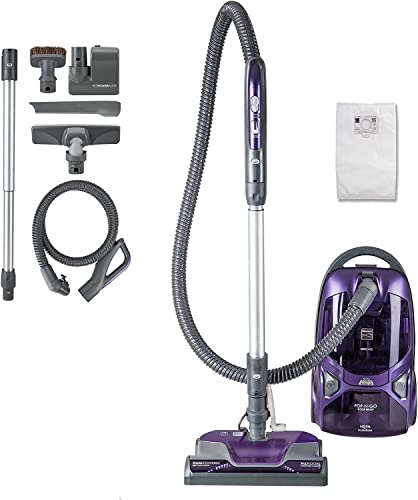
Kenmore 600 Series 81615 Bagged Canister Vacuum with Pet PowerMate — Best Canister for Pet Homes
The Kenmore 600 Series is the canister for homes where allergies and animals coexist, which is most allergy homes. The HEPA-filtered bagged system handles the containment job this guide exists for, and the Pet PowerMate — a motorized miniature brush tool — handles the upholstery, stairs, and car interiors where pet dander actually accumulates and where a floorhead cannot go. Two motors, a retractable cord, and a telescoping wand round out a specification that reads like it was written by people who clean houses with animals in them.
Strengths
- HEPA bagged containment plus a motorized pet tool for upholstery and stairs
- 2-motor system with powered floorhead for carpet duty
- Retractable cord and telescoping wand — the daily-use courtesies
Trade-offs
- Heavier in the hand than the suction-only picks
- Kenmore bags are a specific type — stock a spare pack from day one
- Pet homes will fill bags faster; that is the system working, not a flaw
The strategic point of this pick is coverage: dander does not live on the open floor, it lives in the sofa, the stair treads, and the dog’s favorite rug, and a vacuum system that only cleans floors addresses the minority of the problem. The 600 Series with its powered hand tool is a whole-house answer at a whole-house price well below the premium tier. For pet-owning allergy households, this is very likely the correct first choice — the Miele above is the finer instrument by every filtration measure, but the Kenmore brings the tool the pet problem actually requires, at the price point that lets the household also afford the year of genuine bags that makes any of these systems honest.
Best for: best canister for pet homes / Not suited for: buyers wanting a bagless machine — this guide’s whole point is the bag. Check on Amazon — check price on Amazon.

Simplicity S20EZM Allergy Bagged Upright Vacuum — Best Upright for Allergies
Simplicity is the allergy specialist’s upright: a bagged machine from a brand sold for years through vacuum dealers to people who ask filtration questions, with certified HEPA filtration in the S20EZM and a multi-surface brief that covers carpet, rugs, and hardwood in one pass. The upright format puts the machine’s weight behind the brushroll where carpet wants it, and the bagged design keeps the emptying event sealed and rare. For households whose floors are mostly carpet and whose patience for canister trailing is short, this is the format-correct allergy pick.
Strengths
- Certified HEPA filtration in a sealed bagged upright
- Multi-surface design — carpet, rugs, and hard floors
- Dealer-brand build quality and parts support
Trade-offs
- Upright weight is carried by the user on stairs
- Bag and filter ecosystem is brand-specific — buy genuine spares
- Less nimble under furniture than a canister and wand
The S20EZM rewards the buyer who vacuums the way allergy management actually requires: often, thoroughly, and on a schedule rather than in a crisis. Its filtration credentials are the headline, but the ownership experience is the argument — a machine built to be serviced, with bags and belts and filters that remain available, in a category where a discontinued consumable turns a good vacuum into a garage ornament. Carpet-dominant allergy homes should start here, run the comparison honestly against the canisters on weight-over-stairs and under-furniture reach, and compare everything else in the category against it before spending a dollar anywhere else.
Best for: best upright for allergies / Not suited for: buyers wanting a bagless machine — this guide’s whole point is the bag. Check on Amazon — check price on Amazon.

Kenmore Intuition Bagged Upright Vacuum with HEPA Filter — Best Upright for Mixed Floors
The Kenmore Intuition splits the difference between upright drive and canister flexibility: a bagged upright with HEPA filtration whose canister lifts up for stairs, above-floor cleaning, and the under-furniture work uprights traditionally surrender. The 2-motor system separates suction from brushroll drive, the pet tools address the upholstery problem, and the bagged containment keeps the allergy brief intact throughout. For mixed-floor homes — carpet in the bedrooms, hard floors in the traffic lanes — it is the one-machine answer that does not ask the house to pick a side.
Strengths
- Lift-up canister converts upright drive to portable cleaning
- HEPA bagged system with 2-motor power
- Pet tools included for the dander that lives on furniture
Trade-offs
- Convertible designs carry more joints and weight than pure formats
- Bag changes and filter care are a routine to learn, not skip
- Check the exact tool set on the listing — bundles vary
Versatility is the Intuition’s claim and its risk: convertible machines must do two jobs without doing either badly, and this one succeeds because the lift-up portion is a genuine cleaning tool rather than a gimmick — light enough to carry, powered enough to matter. Mixed-floor allergy households that would otherwise buy an upright and then borrow a canister for the stairs should consolidate here. It is the pragmatic pick of this guide in the best sense of the word: not the finest instrument in any single dimension, and proud of it, but the one whose total coverage of a real, mixed, lived-in house — floors, stairs, furniture, and the corners where the dog actually sleeps — is the hardest on this list to beat.
Best for: best upright for mixed floors / Not suited for: buyers wanting a bagless machine — this guide’s whole point is the bag. Check on Amazon — check price on Amazon.

Miele Classic C1 Pure Suction Bagged Canister Vacuum — Best for Hard Floors
The Classic C1 Pure Suction is Miele’s bagged discipline in its most focused form: a compact canister, a sealed bagged system, and suction-only cleaning tuned for hard floors and low-pile carpet — which describes the allergy-friendly house more often than carpet marketing admits, since hard floors hold less dust in reserve than any carpet can. Without a powered brushroll there is less to maintain, less weight at the head, and a gentleness that delicate rugs and old hardwood reward. Miele’s bags and filtration standards apply in full; the savings come from the floorhead you are not buying.
Strengths
- Miele sealed bagged system at the focused end of the line
- Suction-only head is ideal for hard floors and low-pile carpet
- Compact, light, and simple — fewer parts to maintain
Trade-offs
- No powered brushroll — deep carpet is not its brief
- HEPA exhaust upgrades and bags are ongoing Miele consumables
- Low-pile limit is real; shag and plush carpets need a different pick
This is the pick for the house that has already made its biggest allergy decision — hard floors — and needs the vacuum to match it. Suction-only cleaning on hard floors is not a compromise; agitation is what carpet needs and what hard floors merely tolerate, and a pure-suction head glides, seals, and picks up without scattering. If your home is wood, tile, and flat-weave rugs — with the bedroom rugs low and the hallway runner lower — the C1 Pure Suction delivers the complete Miele containment argument at its most attainable point in the line, and the guide’s premium pick becomes a comparison to appreciate rather than a requirement to fund.
Best for: best for hard floors / Not suited for: buyers wanting a bagless machine — this guide’s whole point is the bag. Check on Amazon — check price on Amazon.

Oreck HEPA Upright Vacuum Cleaner, Lightweight Bagged — Best Lightweight
The Oreck HEPA upright makes a single, compelling argument: the best vacuum for an allergy household is the one that gets used constantly, and constant use follows light weight more faithfully than any other specification. This bagged upright pairs HEPA media filtration — the bag and filter system trapping the fine particles — with the featherweight handling Oreck built its name on, plus two-speed control so bare floors get a gentler pass than carpet. Stairs stop being an expedition, closets stop being a negotiation, and the quick daily vacuum — the one that actually manages a home’s dust load — becomes a five-minute habit instead of a weekend production.
Strengths
- Genuinely lightweight — the vacuum that gets used daily
- HEPA media bagged filtration in an upright format
- Two-speed control for carpet and bare floors
Trade-offs
- HEPA media filtration is a step below the sealed-system picks in ultimate containment
- Slim profile trades bag capacity — changes come sooner
- Upright format still asks the user to carry it, however lightly
Honesty about the filtration tier is this pick’s price of admission, and we pay it gladly, because the trade it represents is real: a slightly less absolute filtration system that runs daily will hold a home’s dust load lower than a perfect system that runs monthly because it is a chore to haul out. For smaller homes, older users, and anyone whose current vacuum’s weight is the reason the floors wait, the Oreck is not the compromise pick — it is the behavioral pick, and behavior is what allergy management is made of.
Best for: best lightweight / Not suited for: buyers wanting a bagless machine — this guide’s whole point is the bag. Check on Amazon — check price on Amazon.
Comparison Table
| Pick | Badge | Key spec | Best for |
|---|---|---|---|
| Miele Guard L1 Allergy Bagged Canister Vacuum with HEPA Filter | Best Overall for Allergy Households | Bagged canister, HEPA filtration, allergy-focused model | Best Overall for Allergy Households |
| Kenmore 600 Series 81615 Bagged Canister Vacuum with Pet PowerMate | Best Canister for Pet Homes | Bagged canister, HEPA filter, 2 motors, Pet PowerMate, retractable cord | Best Canister for Pet Homes |
| Simplicity S20EZM Allergy Bagged Upright Vacuum | Best Upright for Allergies | Bagged upright, certified HEPA, multi-surface, pet-capable | Best Upright for Allergies |
| Kenmore Intuition Bagged Upright Vacuum with HEPA Filter | Best Upright for Mixed Floors | Bagged upright, lift-up canister, 2-motor, HEPA, pet tools | Best Upright for Mixed Floors |
| Miele Classic C1 Pure Suction Bagged Canister Vacuum | Best for Hard Floors | Bagged canister, pure suction, hard floors and low-pile carpet | Best for Hard Floors |
| Oreck HEPA Upright Vacuum Cleaner | Best Lightweight | Bagged upright, HEPA media filtration, two-speed control | Best Lightweight |
How to Choose a Bagged Vacuum for Allergies
Interrogate the seal, not the sticker. True allergy-grade filtration is a system property: a multi-layer bag, gaskets and housing that do not leak unfiltered air around the filter, and a HEPA exhaust stage. “HEPA-type” and “HEPA media” describe filter material; a sealed HEPA system describes the machine. The picks here are labeled with their tier in plain language — match the tier to the sensitivity of your household, and be skeptical of any machine that headlines the filter and hides the housing.
Choose the format by your floors and your stairs. Carpet-dominant homes get their deepest clean from an upright’s driven brushroll or a canister with a powered head. Hard-floor homes are best served by suction-only canisters that do not scatter what they should be swallowing. Every household with stairs should carry the machine before committing — in the store, on the first day at home, anywhere but for the first time with a full bag at the top of a flight.
Price the consumables into the decade. Bags and filters are the subscription this category runs on. Genuine bags filter better and fit the seals the system depends on; off-brand bags are the classic false economy in a sealed machine. Check that your model’s bags are stocked by multiple sellers and buy a spare pack with the machine — a full bag discovered on cleaning day, with no spare in the closet, is how good systems get run past their capacity and start leaking the performance you paid for.
Vacuum like it matters: slowly, twice, and on a schedule. Filtration cannot help the dust the vacuum never reaches. Slow passes — slower than feels natural, at roughly the pace of a thoughtful walk — let airflow do the work the brush starts; a second pass in a crosshatch pattern picks up what the first pass loosened and stood upright; and a standing schedule — high-traffic areas twice a week, bedrooms weekly — holds the load down instead of staging monthly rescues. The machine in this guide is half the system; the routine is the other half, and it is free.
How to Maintain a Bagged Allergy Vacuum
The discipline is short and non-negotiable. Change the bag when it is genuinely full — most systems signal by suction loss or a bag indicator — and never run a sealed system on an overfilled bag, because the pressure finds the seams you paid to seal. Replace or wash filters exactly as the manufacturer directs and on their schedule, not when they look dirty; a HEPA stage loaded past its life is a restriction the motor pays for in heat. Check the brushroll monthly for hair and thread, which strangle airflow and stress belts. Wipe the bag compartment when you change bags, since the dust that escapes during a change should not greet the new bag. Store the machine with the cord loosely coiled, the hose unstressed and unkinked, and the bag compartment closed against the garage dust that would otherwise become the next session’s first breath. None of this takes an afternoon; all of it together is the difference between a filtration system and a vacuum-shaped object with a HEPA sticker, five years in.
Common Buying Mistakes
Buying the filter instead of the system. A HEPA filter in an unsealed housing is a brochure, not a filtration system. Ask where the air can leak, and let the answer rank the machine.
Choosing bagless for an allergy house to save on bags. The emptying plume is the allergy cost, paid at the worst moment by the person doing the cleaning. Bag costs are small, predictable, and the entire point.
Running cheap off-brand bags in a sealed machine. Poorly fitting bags bypass the seals the system was engineered around. Genuine consumables are part of the filtration you bought.
Matching the floorhead to the photograph instead of the floor. Powered heads for carpet, suction for hard floors — the mismatch in either direction cleans badly and, on hard floors, scatters dust ahead of the machine.
Expecting the vacuum to do the whole allergy job. A vacuum manages floors and upholstery. Bedding hygiene, humidity control, and medical care are separate fronts; the vacuum’s honest contribution is not stirring up what it removes.
Final Recommendation
For the household that wants the filtration argument settled at the highest standard, the Miele Guard L1 Allergy is the anchor pick — sealed, HEPA-filtered, and built for the long term. Pet-owning allergy homes should take the Kenmore 600 Series for its powered pet tool and whole-house coverage, and carpet-dominant homes the Simplicity S20EZM for certified HEPA in an upright that drives deep. Mixed-floor houses consolidate on the Kenmore Intuition; hard-floor homes simplify beautifully with the Miele Classic C1 Pure Suction; and anyone whose current vacuum loses to its own weight should buy the Oreck and enjoy the radical allergy strategy of vacuuming all the time — briefly, constantly, and without the dread that turns a filtration system into a closet monument. Frequency is the variable the spec sheets cannot sell you, and the lightweight pick is the one that delivers it. Whichever you choose: genuine bags, a real routine, and a machine matched to your floors — that system, and not any single specification, is what an allergy household is actually buying.
Related guides in this series: Best Bagged Vacuums For Allergies · Best And Lightest Miele Vacuums · Best All Around Vacuums · Best Affordable Upright Bagless Vacuums · Best 12volt Vacuums
The Bedroom-First Strategy: Where an Allergy Vacuum Earns Its Keep
If a whole-house routine feels daunting, allergy logic prioritizes ruthlessly: start with the bedroom, because it is the room where a person spends eight consecutive hours breathing at floor level’s mercy. The bedroom’s dust reservoir is specific — the mattress and pillows (which belong to bedding hygiene, not vacuuming), the carpet or rug beside the bed where bare feet land, the upholstered chair that collects clothes and dander, and the floor under the bed, which in most homes is a pristine archive of everything the room has shed for a year. A bagged vacuum with a powered hand tool — the Kenmore 600 pattern — works that whole list: floorhead for the open floor, hand tool for the chair and the mattress surface (a legitimate vacuum job, distinct from washing the bedding), crevice tool for the baseboards where dust composes itself undisturbed. Do the bedroom weekly with the door closed and a few minutes for the air to settle afterward, and the room’s load drops out of all proportion to the effort.
The rest of the house follows a traffic logic. Entryways and living areas collect the outdoor load — pollen and dust ride in on shoes, coats, and the dog — so they repay twice-weekly attention during pollen season and weekly otherwise. Upholstery everywhere is a dander bank that pays out into the air every time someone sits down; the powered hand tool is the withdrawal mechanism. Kitchens and hard floors want the suction-only pass that does not scatter. None of this requires heroics; it requires the machine to be pleasant enough to use at that cadence, which is why this guide weights handling, weight, and cord management as allergy features rather than conveniences. In an allergy house, ergonomics is filtration by other means — the vacuum that runs is the vacuum that filters.
Bags and Filters: The Consumable Ecosystem, Decoded
Every pick in this guide commits you to a consumable ecosystem, and choosing it knowingly is half of ownership. The bag is the primary filter and the containment vessel in one: modern synthetic multi-layer bags capture far finer particles than the paper bags of memory, hold their airflow as they fill (so suction stays honest to the end of the bag’s life), and seal at the collar on removal in the better systems. Capacity is the hidden variable — a large bag in a pet home is not a luxury but the difference between a monthly routine and a weekly chore, and the canister picks here carry generously for exactly that reason. The exhaust filter is the second stage: HEPA-grade on the sealed picks, replaced on a schedule measured in bags rather than months — count bags, not calendar pages, because filtration life is a function of throughput.
Two ownership rules protect the whole investment. First, genuine consumables: a sealed system is engineered around its bag’s fit and media, and an off-brand bag that gaps at the collar quietly converts a sealed machine into an unsealed one at the exact point of highest dust concentration. The savings are small; the bypass is total. Second, spares on hand: a full bag with no replacement in the house leads to the shaken-out, reused, or overfilled bag — each a small betrayal of the system you bought. Buy the machine and a year of bags in the same order, store them together, and the routine never has an excuse. This is unglamorous advice, and it is the difference between owning a filtration system and owning a vacuum with filtration features.
What About Robot Vacuums and Stick Vacuums? An Honest Word
Allergy households reasonably ask whether the newer formats can take over, and the honest answer is: as supplements, sometimes; as the system, not yet. Robot vacuums run daily, which is their genuine allergy virtue — frequency is a real variable — but their bins are small, bagless in most models, and emptied by hand into the room’s air, and their filtration rarely reaches the sealed standard of this guide’s picks. A robot maintaining hard floors between weekly sessions with a sealed bagged machine is a defensible system; a robot alone, emptied daily over the kitchen bin, is a dust redistribution schedule. Cordless sticks share the pattern: wonderful for the five-minute crumb emergency, bagless almost by definition, and dependent on the same hand-emptying moment. The households that manage allergies best tend to converge on the architecture this guide recommends — a sealed bagged machine as the foundation, frequency and convenience tools around it — because the foundation is where the containment lives. Buy the foundation first; accessorize after.
Vacuuming Someone Else’s Sensitivity: Kids, Guests, and the Person Holding the Vacuum
One perspective this category rarely takes is the cleaner’s. In most allergy households, the person vacuuming is either the sensitive person — absorbing the session’s stirred dust at closest range — or their partner, doing a kindness whose quality determines its value. Three practices protect the operator regardless of which machine from this guide is in hand. Vacuum with the sensitive people out of the room and, where possible, out of the house’s shared air for a short while afterward; even the best sealed system works in a room whose dust has been disturbed, and time is a filtration stage too. Run the machine’s exhaust away from your own breathing zone on stairs and in small rooms — a detail canister users control naturally with the body behind them. And keep the emptying ritual outdoors or in the garage where the house allows it; the sealed bag makes the moment clean, and distance makes it cleaner. These are small courtesies of technique, and together with the sealed hardware they are the complete system: machine, consumables, routine, and operator, each doing a quarter of the work.
Seasonality deserves its paragraph, because allergy vacuuming has a calendar. Pollen seasons load the entryways and the rooms with open windows; the vacuum schedule should tighten then, not after symptoms announce the fact. Winter closes the house and concentrates the indoor load — dander, dust, and everything the heating system circulates — which argues for the upholstery and under-bed work that open-window months let slide. Guests and holidays add bodies, coats, and luggage to the reservoir. None of this requires a different machine; it requires the machine you bought to be run like the system it is, with the calendar as its scheduler. The picks in this guide were chosen to still be pleasant in week forty of that calendar — in weight, in consumable cost, in the small courtesies of cords that rewind and wands that telescope — because an allergy vacuum’s real specification is not its first-week performance but its fiftieth.
Finally, a note on expectations, offered in the spirit of this guide’s honesty about what vacuums cannot do. A sealed bagged system will make cleaning day stop feeling like a setback, will hold the house’s dust load measurably lower across a season, and will do it without the small degradations — the plume at the bin, the filter rinsed in the sink, the suction quietly dying — that bagless ownership normalizes. It will not renovate a house’s air by itself, and any guide that promises a vacuum will end anyone’s allergies is selling something. What is on offer here is more modest and more durable: the right machine, honestly tiered, run on a real routine, as the foundation of a house that is easier to breathe in. For the households this search describes, that is not a small thing. It is, most weeks, the whole project.
The used-market question arises with the premium picks and deserves a direct answer: a secondhand Miele or Simplicity can be excellent value, because these machines were built to be serviced — but only if the consumable ecosystem is intact, the seals are supple rather than perished, and the machine has not spent years running off-brand bags that let dust into its motor compartment. Inspect the bag chamber of any used machine with a flashlight; a clean chamber tells the machine’s whole history, and a dusty one tells it just as clearly. New buyers without the appetite for that archaeology should buy new from this list and become the careful first owner someone else will one day thank.
Renters and apartment dwellers, a constituency this category quietly serves well, should note the format implication: a canister stores in a closet corner and navigates small floor plans without the upright’s turning circle, while the lightweight Oreck answers the walk-up problem directly. Noise is the apartment variable nobody lists — evening vacuuming in a thin-walled building is a social act — and the canister picks, with their motors trailing behind and their suction-only heads on hard floors, are the considerate neighbors of this list. None of that changes the filtration ranking; it changes which sealed machine a given household will still be happily running in year three, which is the only ranking that finally counts.
Frequently Asked Questions
Are bagged vacuums really better for allergies than bagless?
For the emptying moment, decisively: a sealed bag leaves the house with its contents trapped, while a bagless bin releases a plume of fine particles when emptied, however careful the technique. During cleaning, a sealed bagged system with HEPA exhaust filtration also controls bypass better than most bagless designs. That combination is why allergy-focused buying keeps returning to bags.
What does HEPA actually mean on a vacuum?
HEPA describes a filter standard for capturing very fine particles. The important distinction is between a machine with HEPA filtration as a sealed system — where all exhaust air passes through the filter — and one with a HEPA-type filter in a housing that leaks around it. This guide labels each pick’s tier plainly so the claim can be weighed rather than merely read.
How often will I change bags, and what do they cost?
A typical household changes a bag every one to three months depending on size, pets, and cleaning frequency; pet homes sit at the fast end. Bags are a modest, predictable running cost — budget for genuine bags for your model, keep a spare pack in the closet, and treat the expense as the price of the sealed emptying that makes the category worthwhile.
Canister or upright for an allergy household?
Filtration decides the allergy question; format decides the cleaning one. Uprights drive brushrolls into carpet with their full weight and suit carpet-dominant homes. Canisters carry lighter, reach further, and with powered heads match uprights on carpet while beating them on stairs and furniture. Mixed homes often land on a lift-up design like the Kenmore Intuition.
Do I still need an air purifier if I buy one of these?
They do different jobs. The vacuum removes dust and dander from floors and upholstery before it becomes airborne; a purifier addresses what is already in the air of a specific room, typically the bedroom. Many allergy households run both, with the vacuum as the foundation — but the purifier decision belongs to your symptoms and your clinician’s advice, not to a vacuum guide.
Will a bagged vacuum help with pet dander specifically?
It helps with the reservoir: dander accumulates in carpets, rugs, and upholstery, and a sealed bagged system removes it without re-aerosolizing it at emptying time. The pet-specific picks here — the Kenmore 600 with its powered hand tool above all — exist because the upholstery and stairs are where dander concentrates and where a floorhead alone cannot reach.
How do I know when the bag is really full?
Trust the machine’s signals in order: the bag-change indicator where fitted, a noticeable loss of suction or pickup, and finally the bag’s own feel — a full bag is firm and heavy, not soft. Running past full is the classic way to defeat a sealed system, because pressure seeks the seams. When in doubt, change it; a bag changed slightly early costs little, and a bag changed late costs the filtration the machine was bought for.
Are these vacuums good for homes without allergies too?
Yes — the sealed bagged system is simply good vacuuming with the emptying problem solved, and plenty of households choose it for the cleanliness of bag changes and the depth of the clean alone. The allergy framing sharpens the selection criteria; it does not limit the audience. If anything, non-allergy households benefit from reading this guide’s filtration tiers in reverse: buy the tier your dust tolerance actually needs, which for many homes is exactly the honest middle of this list.

