Disclosure: airfryerkitchensupply.com is reader-supported. When you buy through links on our site, we may earn an affiliate commission at no extra cost to you.
Where to buy
All six chair sets below are sold through Amazon, where each listing shows the current finish options, set configurations, and construction details. Check the current price on Amazon for each pick before ordering:
- NAFORT Walnut Wood Dining Chairs, Set of 4 — check price on Amazon
- DUHOME Wood Cross Back Dining Chairs, Set of 4 — check price on Amazon
- Signature Design by Ashley Berringer Dining Chairs, Set of 2 — check price on Amazon
- COSTWAY Dining Chairs with Solid Rubber Wood Legs, Set of 4 — check price on Amazon
- DUMOS Upholstered Dining Chairs, Set of 2 — check price on Amazon
- VASAGLE Upholstered Kitchen Chairs, Set of 2 — check price on Amazon
The best built kitchen chairs are the ones you stop thinking about. That is not rhetoric. A kitchen chair is the most abused furniture in the house: sat on three times a day, leaned back in, dragged across floors, stood on to reach high shelves, climbed by children, and wiped down after every spill — and a badly built one announces its failures in sequence, first a wobble, then a creak, then a loosened joint, then a collapse nobody forgets. We read this search the way it is most plausibly meant — best-built, as in best-constructed — and this guide judges chairs the way a furniture maker would: by their materials (solid wood and steel over hollow substitutes), their joinery and leg construction, their stated load capacity where the maker publishes one, and the honesty of their design for daily kitchen service. Style is covered, because a chair you dislike looking at is its own kind of failure, but it is deliberately ranked second to structure.
There is a reason this guide keeps returning to structure while the rest of the internet argues about style: a kitchen chair is sat on roughly a thousand times a year, and across a decade that is ten thousand load cycles, ten thousand drags-or-lifts, ten thousand small tests of every joint. Furniture that passes that audit is not a matter of luck or of buying the most expensive object in the room — it is a matter of materials and joinery chosen for the audit, which is knowable in advance and printed, for the chairs below, in their own listings.
In this guide
Quick Picks
- NAFORT Walnut Wood Dining Chairs, Set of 4 — Best Overall Build. Solid rubber wood legs, a maker-rated high load capacity, and a ladder-back farmhouse form. Check the current price on Amazon
- DUHOME Cross Back Chairs, Set of 4 — Best Farmhouse Build. Vintage walnut finish and the cross-back structure that braces a chair against racking. Check the current price on Amazon
- Ashley Berringer Chairs, Set of 2 — Best Heritage Brand. Spindle back, saber legs, and a cushioned microfiber seat from a major furniture maker. Check the current price on Amazon
- COSTWAY Chairs, Set of 4 — Best Mid-Century Build. Solid rubber wood legs under a curved-back, wide-seat modern form. Check the current price on Amazon
- DUMOS Upholstered Chairs, Set of 2 — Best Upholstered Comfort. Padded high-back fabric chairs on wooden legs for long meals. Check the current price on Amazon
- VASAGLE Upholstered Chairs, Set of 2 — Best Budget Upholstered. PU leather over steel legs — the wipe-clean, hard-wearing combination. Check the current price on Amazon
How These Picks Were Chosen
Construction evidence came first, and we weighted what can be verified from a listing over what can only be claimed. Solid wood legs — rubber wood specifically, a dense hardwood that the industry uses precisely because it takes screws and resists splitting — outrank hollow or purely decorative legs. Published load capacities counted, because a maker who rates a chair is a maker who tested it. Back design counted structurally, not just aesthetically: cross-backs and ladder-backs brace a chair against the side-to-side racking that loosens joints, and spindle backs distribute load across many small members. Upholstered picks were judged on their frames and leg materials first and their fabrics second, because fabric can be cleaned or eventually re-covered, while a weak frame is forever.
We should also be transparent about what a listing-based evaluation cannot do: it cannot sit in the chair. Sag in a cushion at month six, a finish’s behavior under a year of wiping, a joint’s silence at year three — these are earned by ownership, not inspection. What inspection can do, and what this guide has done, is verify that every pick’s structure belongs to the classes of construction that produce those long-term results, from makers whose specifications can be checked. Where a pick trades ultimate longevity for price or comfort, the review says so in plain language, because a knowingly chosen trade-off is good buying and an unknowing one is a future wobble.
We also required kitchen realism: finishes that survive wiping, seats at standard dining height, and sets sized the way kitchens actually buy — fours for family tables, pairs for additions and breakfast nooks. Every product was verified against its live Amazon listing before earning a link in this article.
The 6 Best Built Kitchen Chairs
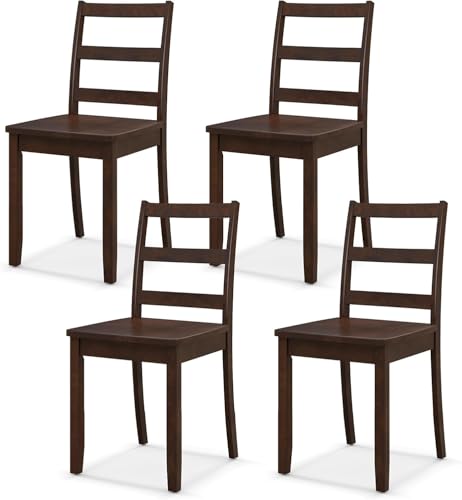
NAFORT Walnut Wood Dining Chairs, Set of 4 — Best Overall Build
The NAFORT set leads this guide because its listing leads with structure: solid rubber wood legs, non-slip foot pads, and a maker-stated maximum load of 400 pounds — a figure that, whatever margin it includes, signals a chair engineered well past the loads a kitchen chair normally meets. The form is a farmhouse ladder-back in a walnut finish, armless for easy table fit, with a seat height in the standard dining range. Rubber wood deserves its reputation here: it is a genuinely hard, dense timber, and in legs it resists the two classic leg failures — splitting at the fastener and snapping at the taper — better than the softwoods and hollow composites that fill the budget tier.
Sit in it mentally for a moment, as a buyer should: the ladder back meets a tall sitter’s shoulder blades rather than abandoning them mid-back, the wood seat is honest about being wood — firm, cool, wipeable — and the whole chair has the planted, slightly heavy feel that makes a household stop being careful with it. That last quality is underrated. Chairs that feel fragile get treated as fragile, which in a family kitchen means they get resented; chairs that feel indestructible get used fully and, paradoxically, last longest. It suits family kitchens that need four matching, hard-working chairs; heavier users who have learned to read load ratings; and farmhouse and transitional rooms. It is less suited to buyers wanting arms or upholstery, and to formal dining rooms where the ladder-back’s country character is off-brief.
Strengths
- Solid rubber wood legs with a published 400 lb maker load rating
- Ladder back braces the frame and gives tall users real support
- Non-slip foot pads protect floors and stop the scoot that loosens joints
Trade-offs
- Unpadded wood seat — long dinners may want a cushion
- Armless design only in this set
- Assembly required; joint quality depends partly on careful assembly
That assembly point applies to every flat-pack chair and is worth internalizing: a well-built chair assembled carelessly becomes a mediocre chair. Tighten fasteners in sequence, seat the chair on a level floor, load it with your weight, and re-tighten — then check again after the first week of use, when the joints have settled. Do that, and a set built like this one should give a decade of silent service.
Best for: family kitchens wanting maximum structural confidence / Not suited for: buyers needing arms or padding
Check the current price on Amazon

DUHOME Wood Cross Back Dining Chairs, Set of 4 — Best Farmhouse Build
The cross-back is not a styling affectation — an X across a chair’s back is a brace, triangulating the frame against the racking forces that are a chair’s true long-term enemy. DUHOME’s set builds that structure in wood with a vintage walnut finish, armless, in a set of four aimed at kitchens, breakfast nooks, and bistros. The farmhouse look is the popular one, but the reason cross-back chairs fill cafés — buildings that abuse chairs professionally — is the structure, and it is the reason this set ranks here.
It suits farmhouse, rustic, and café-style kitchens; nooks where armless chairs must tuck fully under the table; and buyers who sit sideways, lean, and perch — the cross-back tolerates informal sitting better than a straight ladder-back. It is less suited to users who want a flat, wide backrest to lean into for hours, and to ultra-modern rooms.
Strengths
- Cross-back bracing resists racking and joint loosening
- Solid wood construction in a warm vintage walnut finish
- Armless profile tucks completely under tables and counters
Trade-offs
- The X-back’s contact pattern is not for everyone during long sits
- Wood seat without padding in this configuration
- Farmhouse styling is a definite direction for the room
Café logic is the right lens for kitchen chairs generally: a café chair is sat in by hundreds of different bodies, dragged, stacked, and hosed down, and the designs that survive that life — cross-backs prominent among them — are pre-tested for the home kitchen’s gentler version of the same abuse. Buying the café pattern is buying the experiment’s result.
Best for: farmhouse kitchens, nooks, and informal heavy use / Not suited for: long formal dinners
Check the current price on Amazon

Signature Design by Ashley Berringer Dining Chairs, Set of 2 — Best Heritage Brand
Ashley’s Berringer brings a major furniture maker’s version of the rustic kitchen chair: a spindle back — many slender vertical members sharing the load and flexing slightly as a system — saber legs that flare for stability, and a cushioned microfiber seat in a rustic brown palette. The spindle back is one of the oldest chair technologies in continuous use, and its presence here matters structurally: a back built from many small, well-fitted members tolerates the leaning and twisting of daily use gracefully, and the cushioned seat makes this the most comfortable unpromoted chair in the guide’s wood category.
It suits buyers who trust established furniture brands and their parts-and-service ecosystems, kitchens that double as homework and laptop stations (the cushion earns its keep at hour two), and transitional rustic rooms. Sold as a pair, it is also the natural way to add two chairs to an existing set or furnish a small table. It is less suited to buyers who need four-plus matching chairs on a strict budget, since pairs price accordingly, and microfiber, while durable, asks for prompt spill attention in a kitchen.
Strengths
- Spindle-back construction from a major furniture manufacturer
- Cushioned microfiber seat — the comfort pick among the wood chairs
- Saber legs and rustic finish suit transitional kitchens
Trade-offs
- Sold in pairs — outfitting a six-seat table means three sets
- Microfiber needs quicker spill response than wood or PU leather
- Traditional styling will not suit modern-minimal rooms
The brand factor is real in furniture: a large maker’s chair comes with consistent finishing across sets bought months apart, available replacement parts, and a warranty operation that answers. For a household furnishing a kitchen once and expecting to keep it, those unglamorous virtues are part of “best built” in the fullest sense.
Best for: brand-confidence buyers and comfort-seeking kitchens / Not suited for: bulk outfitting on the tightest budget
Check the current price on Amazon

COSTWAY Dining Chairs, Set of 4 — Best Mid-Century Build
COSTWAY’s set pairs the guide’s recurring structural hero — solid rubber wood legs — with a mid-century form: a curved backrest that meets the sitter’s back properly and a wide seat that accommodates real bodies, in a black-and-walnut two-tone. The curved back is a comfort structure as much as a style: a backrest shaped to the spine’s curve distributes contact, so the chair feels supportive without padding. In a set of four at a mainstream tier, this is the modern-looking option that did not sacrifice its legs to get there.
It suits modern, Scandinavian, and mid-century kitchens; households that find flat backs fatiguing; and buyers furnishing a full table in one purchase. It is less suited to farmhouse rooms, and the wide seat should be checked against narrow tables and tight chair spacing — measure the table’s apron width per place setting before ordering any set of four.
Strengths
- Solid rubber wood legs under a modern design
- Curved backrest and wide seat — genuine seated comfort without upholstery
- Set of four in a coordinated two-tone finish
Trade-offs
- Wide seats need generous per-place table width
- Unpadded seat and back — comfort is by shape, not cushioning
- Two-tone finish narrows the tables it matches
A measurement habit this pick forces, to every buyer’s benefit: chairs are bought by the set but used by the place setting. Twenty-four inches of table edge per chair is the comfortable standard; a wide-seat set at a small table crowds elbows and guarantees the chairs get dragged and banged — the wear pattern that kills even well-built chairs early.
Best for: modern kitchens wanting structure with style / Not suited for: small tables or farmhouse rooms
Check the current price on Amazon

DUMOS Upholstered Dining Chairs, Set of 2 — Best Upholstered Comfort
When a kitchen hosts the long dinners — the homework sessions, the holiday meals that migrate from the dining room — upholstery stops being decoration and becomes endurance equipment. The DUMOS pair offers a padded seat and a high fabric back on wooden legs, in a beige farmhouse-modern palette. The high back matters: it supports the shoulder blades, which is where un-padded short backs abandon a sitter at the ninety-minute mark. The wooden leg construction keeps the chair’s foundation in the guide’s approved material class while the upholstery handles comfort.
It suits eat-in kitchens that host, home-office-kitchen hybrids, and anyone whose household lingers at the table. It is less suited to homes with toddlers in the spaghetti era — fabric asks more of cleaning than wipeable surfaces — and to buyers who need a full set of six at once, since pairs accumulate cost.
Strengths
- Padded seat and high back — the long-meal comfort pick
- Wooden legs keep the structure honest beneath the upholstery
- Neutral beige fabric suits farmhouse and modern rooms alike
Trade-offs
- Fabric upholstery needs prompt spill care and occasional deep cleaning
- Sold as a pair
- Upholstered chairs are bulkier — check storage and spacing
One more comfort truth about high backs: they change a room’s sightlines, reading as more formal and substantial than low-profile chairs. In an open-plan kitchen that is usually a virtue — the chairs hold their own against cabinetry — but in a very small kitchen, try the pair at the table’s ends first and live with the look for a week before committing to a full set. Care is the honest price of upholstered kitchen chairs, and it is manageable: vacuum the fabric with an upholstery tool weekly (crumbs migrate into seams), treat spills immediately by blotting rather than rubbing, and consider a fabric protector applied before first use. Households willing to do that much get, in exchange, the only chairs in this guide that guests compliment at hour three.
Best for: hosting kitchens and long meals / Not suited for: maximum-mess households wanting zero fabric care
Check the current price on Amazon

VASAGLE Upholstered Kitchen Chairs, Set of 2 — Best Budget Upholstered
VASAGLE’s pair takes the opposite route to upholstered durability: PU leather over steel legs. Steel is the leg material that simply does not loosen, split, or wobble — the frame’s failure modes are engineered away — and PU leather wipes clean with a damp cloth, which in a kitchen is a daily-use superpower. The curved backrest, in a caramel-brown and ink-black combination, gives the pair a designed look well above its tier. For rental kitchens, first apartments, and family kitchens in the high-spill years, this combination of steel and wipe-clean surfacing is arguably the most practical build in the entire guide.
It suits budget-conscious buyers, renters, and spill-heavy households. It is less suited to buyers who want natural materials throughout — PU leather and steel are honest synthetics and industrial materials, presented as such — and to formal traditional rooms.
Strengths
- Steel legs — no loosening, splitting, or wobble failure mode
- PU leather wipes clean in seconds after spills
- Curved backrest and two-tone design above its tier
Trade-offs
- PU leather ages differently from real leather — expect eventual surface wear in high-use years
- Steel-leg chairs can feel firmer and cooler than wood equivalents
- Sold as a pair; matching across separate orders should be checked promptly
The rental-kitchen case deserves emphasis, because it is where “best built” means something specific: chairs that survive being moved, stored, re-assembled, and used by successive households without a repair budget. Steel and PU leather are that answer, and a pair bought for a first apartment commonly ends up, years later, as the indestructible extras every house keeps.
Best for: budgets, renters, and spill-heavy family kitchens / Not suited for: natural-material purists
Check the current price on Amazon
Comparison Table
| Pick | Badge | Key spec | Best for |
|---|---|---|---|
| NAFORT Walnut Chairs x4 | Best Overall Build | Solid rubber wood legs, 400 lb maker rating, ladder back | Family kitchens |
| DUHOME Cross Back x4 | Best Farmhouse Build | Cross-back bracing, vintage walnut | Farmhouse, nooks |
| Ashley Berringer x2 | Best Heritage Brand | Spindle back, cushioned microfiber seat | Brand confidence, comfort |
| COSTWAY Chairs x4 | Best Mid-Century Build | Solid rubber wood legs, curved back, wide seat | Modern kitchens |
| DUMOS Upholstered x2 | Best Upholstered Comfort | Padded high back, wooden legs | Long meals, hosting |
| VASAGLE Upholstered x2 | Best Budget Upholstered | PU leather, steel legs, curved back | Renters, spill-heavy homes |
How to Choose Well-Built Kitchen Chairs
Before the structural interrogation, settle the room’s arithmetic: how many seats the table genuinely holds at twenty-four inches per person, whether chairs must tuck fully beneath the apron, and how much walk-around space remains with chairs occupied — a chair pulled out with a person in it extends roughly two feet from the table’s edge, and rooms that ignore this produce chairs that are crashed into daily, which is a build-quality test no chair should have to pass. Measure the table, the apron height, and the room’s clearances, and let those numbers veto candidates before aesthetics gets a vote.
Interrogate the legs and joints before anything else, because chairs die from the bottom up. Solid wood and steel legs are the durable classes; ask what the legs are made of and be suspicious of listings that will not say. Where fasteners are used, larger and more numerous beats minimal; where traditional joinery is used — mortise and tenon, dowels, corner blocks — the chair is built to be repaired and re-glued rather than discarded. A published load capacity is a useful honesty signal: it means the maker tested a number and is willing to print it. When a chair arrives, the wobble test is immediate and non-negotiable — a chair that rocks on a flat floor on day one will not improve, and it should go back while returning is easy.
Match the back to the sitting your kitchen actually hosts. Ladder-backs and spindle backs support upright eating and perching; cross-backs tolerate informal, sideways, leaned-back sitting; curved backs reward longer sits; high upholstered backs are for households whose table is a second living room. Then match the seat: wood for wipe-clean speed and durability, cushioned fabric for comfort with a cleaning commitment, PU leather for the middle path. Seat height is standardized around 18 inches for standard tables — verify it if your table is counter-height, because kitchen chairs and counter stools are different products that listings occasionally blur.
Budget tiers in chairs buy identifiable structural goods, and knowing the ladder prevents both overspending and false economy. The value tier, represented here by the VASAGLE pair, buys honest industrial materials — steel and PU leather — with simple joinery and a shorter cosmetic lifespan. The mid tier buys solid wood legs and braced backs in sets of four, the category’s value sweet spot for family kitchens. The upper tier buys heritage manufacturing, cushioned comfort, and consistency across repeat purchases. What no tier buys is immunity from the maintenance routine: a neglected premium chair and a neglected value chair converge on the same wobble, one merely arriving with better stories. Spend at the tier your household’s use justifies, then keep the ten-minute tightening habit that protects the spend.
Count honestly. A family table used daily wants chairs bought as a coordinated set — mixing singles invites mismatched heights and a room that never looks settled — while a pair is the right unit for a nook or an addition. Buy one spare if your household is hard on chairs and the set is a design you love; models are discontinued, and a spare in the garage has saved many a matched set. Finally, weigh the floor: hard floors want foot pads (included with the NAFORT pick) to prevent both floor damage and the scooting that works joints loose; carpeted kitchens want glides that slide rather than catch.
Anatomy of a Chair That Lasts: Reading Construction Like a Maker
To judge build quality in a listing photograph, learn to look at the four places makers cannot hide their decisions. First, the leg-to-seat junction: a lasting chair shows substance there — thick legs meeting a real seat frame, corner blocks visible in underside photos, fasteners with some size to them. spindly legs screwed into a thin seat board are the silhouette of a two-year chair. Second, the stretchers — the rungs between legs. Stretchers are not footrests that happen to exist; they triangulate the leg assembly and are the difference between a frame that racks and one that cannot. A chair with stretchers on three or four sides is engineered; a chair with none is hoping. Third, the back’s attachment: backs that continue the rear legs in one piece, or that are joined with visible joinery, outlast backs that are surface-screwed onto the seat. Fourth, the finish’s honesty — a finish that shows wood grain is usually on wood; a finish that looks like a photograph of wood sometimes is.
Load ratings deserve a nuanced word, because they are the only numbers in this category and numbers invite misuse. A maker’s maximum load is a static figure — a person sitting still, centered — while real chair abuse is dynamic: dropping into the seat, leaning back on two legs, a child standing and bouncing. A generous rating like the NAFORT’s 400 pounds is therefore best read as headroom: the chair was engineered with margin, and margin is what absorbs dynamics. Read low or absent ratings the opposite way — not as proof of weakness, but as an absence of evidence, which in a structural purchase should shift your choice toward the chair that offers evidence.
Finally, weight itself is a clue. Within a material class, a heavier chair usually contains more material — thicker legs, a denser seat, real stretchers — and heft in the hand correlates with the solidity you feel when you sit. It is not a guarantee, and it should never override the four checks above, but when two otherwise similar chairs differ noticeably in weight, the heavier one is very often the better-built one, and the lighter one has its savings hidden exactly where a chair can least afford them.
Chairs for Real Households: Kids, Guests, and Heavy Use
Households are not showrooms, and three real-world profiles deserve direct advice. Households with children should weight wipeability and stability above all: wood or PU leather seats, backs without delicate spindles for climbing footholds (or with them, if your children are past climbing), and a strict no-standing rule backed by an actual step stool kept in the kitchen — children stand on chairs because the stool is in another room. The steel-legged VASAGLE pair and the solid wood sets are this profile’s natural picks.
Households that host often need two things: chairs comfortable at hour three, and a plan for the extra seats. The upholstered DUMOS pair anchors the hosting end of the table — put the upholstered chairs at the heads and the wood chairs along the sides, a mixed arrangement that looks deliberate and puts the padding where the hosts sit longest. For overflow guests, a matched set bought with one spare, as the buying guide suggests, beats borrowing chairs from three rooms.
Heavier users and multigenerational households should read the guide’s structural sections literally: published load ratings, solid legs, stretchers, and arms where rising from the chair needs assistance — and if arms are essential, note that this guide’s sets are armless by kitchen convention, so shop the same makers’ armchair variants with the same construction checklist in hand. A chair that a grandparent trusts is a chair that has passed the only review that matters, and it is passed on structure, not on style.
How to Assemble and Maintain Kitchen Chairs So They Stay Tight
Most chair failure is maintenance failure on a delay. The routine that prevents it:
- Assemble on a level surface, tighten fasteners in an alternating sequence, then sit in the chair with your full weight and re-tighten — joints seat under load, and the second tightening is the one that lasts.
- Re-check every fastener after the first week and after the first season change; wood moves with humidity, and a quarter-turn in time prevents the wobble that wallows out a joint permanently.
- Lift chairs to move them; dragging is the single most destructive habit, racking every joint and tearing foot pads off in the process. Teach it to the household as a house rule.
- Never stand on a kitchen chair unless its rating and your judgment both allow it — and prefer a step stool, which is the tool actually built for the job.
- Wipe wood with a damp cloth and dry it; soak up spills on upholstery by blotting immediately; keep chairs out of standing water from mopping by lifting them or mopping around them.
- At the first creak, find the joint and tighten or re-glue it that week. A creak is a joint asking for help while help is still cheap; a wobble is the same joint after the request was ignored.
Repair or Replace? The Economics of a Good Chair
A well-built chair is repairable, and knowing the repair ladder extends its life by years at trivial cost. A loose fastener joint wants tightening, then, if it recurs, a drop of wood glue in the hole or a slightly larger screw. A loose dowel or tenon joint wants to be opened, cleaned of old glue, re-glued, and clamped overnight — a repair any household can perform with one clamp and patience. A worn cushion or tired PU surface wants re-covering or a seat pad, not a new chair. The failures that justify replacement are frame failures: a cracked leg at a knot, a seat frame split along its grain, metal fatigued at a weld. Everything short of those is maintenance wearing a disguise, and the chairs in this guide were chosen partly because their construction keeps them on the repairable side of the line — solid materials take glue and screws gratefully, while hollow composites, once failed, are simply done.
Common Buying Mistakes
Buying by photograph without checking leg material. The legs carry everything and fail first. “Wood-look” and solid wood are different products at different lifespans.
Ignoring the wobble window. A chair that rocks on day one is a return, not a project. Test all chairs the week they arrive, while the remedy is free.
Mismatching seat height to the table. Standard chairs at a counter-height table — or the reverse — make every meal slightly wrong. Measure table height and apron clearance first.
Crowding wide chairs at a small table. Chairs need roughly 24 inches of table edge each. Crowded chairs get banged, dragged, and loosened ahead of their time.
Choosing fabric for a high-spill household without a care plan. Upholstery is a commitment. If the household will not blot spills promptly, wood or PU leather is the honest choice.
Assembling once and never re-tightening. The ten-minute re-tightening routine in this guide is the difference between a five-year chair and a fifteen-year chair at every tier.
Final Recommendation
For most kitchens, buy the NAFORT set of four: solid rubber wood legs, a published load rating, and a form that suits the majority of rooms — it is the structural safe choice. Farmhouse kitchens should take the DUHOME cross-backs, modern kitchens the COSTWAY set, and brand-and-comfort buyers the Ashley Berringer pair. Households that linger at the table belong in the DUMOS upholstered pair, and renters and spill-heavy families in the VASAGLE steel-leg pair. Whichever you choose, assemble carefully, re-tighten on schedule, and lift rather than drag — the best-built chair still rewards the owner who treats it like it was built well. Order with the delivery week in mind, too: unbox and test every chair while the return window is wide open, because the wobble test is only free while the boxes are still in the garage.
Related guides in this series: Best Wooden Dining Chairs · Best Upholstered Kitchen Chairs · Best Farmhouse Dining Chairs · Best Dining Chairs For Small Kitchens
Buy the structure first and the style second, assemble like it matters — because it does — and your kitchen chairs will quietly disappear into the background of a thousand meals, which is the highest compliment this category offers.
Related guides
Frequently Asked Questions
Is it worth paying more for solid wood chairs?
For a kitchen you will use daily for years, generally yes — the premium buys the structural classes (solid legs, braced backs, repairable joinery) whose lifespan is measured in decades rather than seasons, and the cost per year of service ends up lower than the budget alternative replaced twice. The exception is a genuinely temporary household — a one-year rental, a dorm — where the steel-and-PU value tier’s durability-per-dollar is the rational buy and longevity beyond the stay has no value. Match the chair’s horizon to your own.
What is the most durable material for kitchen chairs?
For legs and frames, solid hardwood — rubber wood in several of this guide’s picks — and steel are the durability leaders, for different reasons: hardwood takes fasteners well, can be re-glued and repaired, and ages gracefully; steel simply removes most failure modes but cannot be repaired as casually. For seats, solid wood wipes clean and lasts indefinitely; PU leather is the durable wipeable upholstery; fabric trades some durability for comfort and needs prompt spill care.
How much weight should a kitchen chair hold?
A well-built chair should be rated comfortably above the heaviest user in the household, with margin for the dynamic loads of sitting down hard and leaning back. Makers’ published ratings vary; the NAFORT pick in this guide is rated by its maker at 400 pounds, which is generous for the category. Whatever the number, treat it as a ceiling with respect — and never as a step-stool specification.
Should kitchen chairs have arms?
Arms help people rise — a genuine benefit for older users and anyone with knee or hip limitations — and they cost space: armchairs need more table edge each, and the arms must clear the table’s apron or the chair cannot tuck in. Most kitchen sets, including all six picks in this guide, are armless for tucking and density. If arms matter in your household, shop the same construction classes with arms, and measure the arm height against your table’s apron before ordering — that single measurement decides whether an armchair is a comfort or a daily collision.
Why do kitchen chairs get wobbly?
Joints loosen under racking — the side-to-side forces of dragging, leaning, and uneven sitting — accelerated by humidity cycles that swell and shrink wood. The defenses are structural (braced backs, corner blocks, quality fasteners), behavioral (lift, don’t drag), and maintenance-based (re-tighten at the first creak). A chair that is re-tightened on schedule can stay tight for decades; one ignored for a season can wallow its joints beyond a simple fix.
Are sets of 2 or 4 better value?
Sets of four usually price better per chair and guarantee a matched set, which is why family tables should start there. Pairs suit nooks, additions, and premium brands whose chairs are bought deliberately. If you may expand later, buy from a line likely to remain available, and consider a spare chair at the original purchase — matching a discontinued finish later is the classic frustration.
What should I check in the first week after buying chairs?
Three things. First, the wobble test on your hardest, flattest floor — any rock is a return-or-repair decision to make while it is easy. Second, a fastener re-check after several days of real sitting, when the joints have seated under load. Third, a floor audit: look for the first scratches or pad failures now, while the fix is a fresh set of pads rather than a refinishing conversation. A chair set that passes its first week with a re-tightening is almost always a set that will pass its first decade.
Can kitchen chairs be used at a dining room table?
Yes — “kitchen chair” and “dining chair” describe marketing more than engineering, and the picks in this guide are sold across both labels. What matters is seat height (around 18 inches suits standard tables in both rooms), the table’s apron clearance for your thighs and the chair’s arms if any, and roughly 24 inches of table edge per chair. Check those three and the rooms are interchangeable.
How long should well-built kitchen chairs last?
A solid wood or steel-legged chair, assembled carefully and re-tightened on the schedule in this guide, should serve a household for ten to twenty years, with upholstery or cushions as the only wear items likely to need renewal along the way. Chairs built from hollow or composite substitutes typically show joint failure within a few years of family use. The price difference between the classes, divided by the years, almost always favors the better-built chair — which is the economic form of this entire guide’s argument: in chairs, you pay for construction once, or you pay for replacement repeatedly, and the second bill is always larger than the first.
Are rubber wood legs actually strong?
Yes. Rubber wood (from the para rubber tree, harvested for timber after its latex years) is a dense, genuine hardwood with good screw-holding and splitting resistance — which is why it appears in the legs of several picks in this guide and across the quality end of flat-pack furniture generally. It is not a softwood substitute or a composite; treat its presence in a listing as a legitimate quality signal, especially combined with stretchers and sensible joinery.
How do I stop chairs from scratching my floor?
Fit every leg with a pad — felt for hard floors, rubber or silicone where grip is wanted — and replace pads when they wear or fall off, because a bare leg end is a scratch waiting for its moment. The NAFORT pick includes non-slip foot pads from the factory. Beyond pads, the lift-don’t-drag rule protects floors and chairs simultaneously; most floor damage attributed to chairs is dragging damage.


