Disclosure: airfryerkitchensupply.com is reader-supported. When you buy through links on our site, we may earn an affiliate commission at no extra cost to you.
Where to buy
Every organizer below is sold through Amazon, where the listings show the current set configurations and finishes. Check the current price on Amazon for each pick before ordering:
- Vtopmart 5-Piece Bathroom Countertop Organizer Set — check price on Amazon
- Vtopmart Clear Stackable Storage Drawers, Set of 5 — check price on Amazon
- 4-Pack Qtip Holder Dispensers with Bamboo Lids — check price on Amazon
- 4-Pack Acrylic Qtip Holder Dispensers — check price on Amazon
- Forbena 2-Tier Bathroom Countertop Organizer — check price on Amazon
- Asayuee 360 Rotating Organizer, 2 Tier — check price on Amazon
The best storage containers for bathroom counters do something deceptively simple: they give every small, loose, perpetually migrating object in your bathroom a fixed address. Cotton swabs escape their cardboard box. Cotton balls colonize the counter’s back corner. Toothbrushes multiply. Hair ties achieve a kind of ambient distribution across every surface. The counter looks cluttered not because you own too much, but because none of it has a container that matches its size, its frequency of use, and the wet reality of a bathroom. This guide is organized around that matching problem. The six picks below cover the five container families that actually work on a bathroom counter — lidded apothecary jars, stackable drawers, tiered trays, rotating organizers, and coordinated sets — and the buying guide explains how to audit your own counter and assign each category of clutter to the family that handles it best.
It is worth saying what this category is not. Counter containers will not rescue a bathroom with no other storage at all — if the room has no cabinet, no closet, and no shelf, the counter becomes the warehouse no matter what you buy, and the correct first purchase is a piece of closed storage furniture, with the containers in this guide as its finishing layer. Nor will containers fix a routine problem: products nobody uses anymore, duplicates bought because the originals were buried, and hotel-toiletry collections all survive every organizational system until someone decides they go. The containers below are excellent at their job; the audit described later in this guide is what makes their job possible.
Two principles run through everything that follows.
First, bathrooms are wet and steamy, so container materials and lids matter more here than in any other room: clear acrylic and plastic that can be wiped and washed beat porous or rust-prone alternatives for most jobs. Second, a container earns its counter space only if it makes the daily routine faster — if you have to open, unstack, or excavate to reach a cotton swab, the container has become the clutter. Every pick was verified against its current Amazon listing before receiving a link, and the sources file with this article records the exact listing titles. Read the picks as a system rather than a ranking — most real counters will end up with two or three of these families working together.
In this guide
Quick Picks
- Vtopmart 5-Piece Countertop Organizer Set — Best Overall. A divided tray plus four lidded jars that solves the standard counter in one purchase. Check the current price on Amazon
- Vtopmart Clear Stackable Drawers, Set of 5 — Best Drawer Storage. Five clear stacking drawers that turn vertical counter space into sorted, visible storage. Check the current price on Amazon
- 4-Pack Qtip Holders with Bamboo Lids — Best Apothecary Jars. Ten-ounce lidded jars that keep cotton goods clean, dry, and good-looking. Check the current price on Amazon
- 4-Pack Acrylic Qtip Holders — Best Clear Acrylic. Thick, highly clear canisters with labels for swabs, balls, pads, and floss picks. Check the current price on Amazon
- Forbena 2-Tier Organizer — Best Tiered Tray. A two-level wood-and-gold tray that lifts bottles off the counter and doubles usable surface. Check the current price on Amazon
- Asayuee 360 Rotating Organizer — Best for Skincare Collections. A two-tier spinning organizer that brings the back row to the front with a turn. Check the current price on Amazon
How These Picks Were Chosen
We started by listing what actually lives on bathroom counters: cotton swabs, cotton balls and pads, floss picks, toothbrushes and toothpaste, skincare bottles, makeup, hair accessories, medications, and the miscellaneous small hardware of grooming. Then we matched container families to those contents by physics. Small dry goods want lidded jars — lids keep bathroom humidity and dust off things that go on your face. Mixed small items want drawers, because drawers sort by category and hide visual noise. Tall bottles want tiers or rotation, because a single layer of bottles consumes the whole counter while two layers or a turntable consume half. Daily-grab items want open trays within arm’s reach of the sink.
We also applied a one-week realism test in our heads to every candidate: does this container still make sense on the seventh day, when the novelty is gone, the counter has been splashed daily, and a family member has put something back in the wrong place? Containers that depend on perfect behavior — fiddly lids, fragile finishes, arrangements that collapse if one piece moves — failed that test regardless of how they photographed. The six survivors are deliberately forgiving: lids that lift with one motion, drawers that close however they are pushed, trays that look fine at eighty percent full. Organization systems are used by tired people at 6 a.m.; they should be designed for exactly that user.
Material filters came next. Every pick is acrylic, clear plastic, wood, or a combination — materials that tolerate splashes, wipe clean, and will not rust at the seams the way cheap wire organizers do. We favored sets and systems over one-off novelties, because a counter organized in one visual language looks calm, and calm is half the product being bought.
The 6 Best Storage Containers for Bathroom Counters
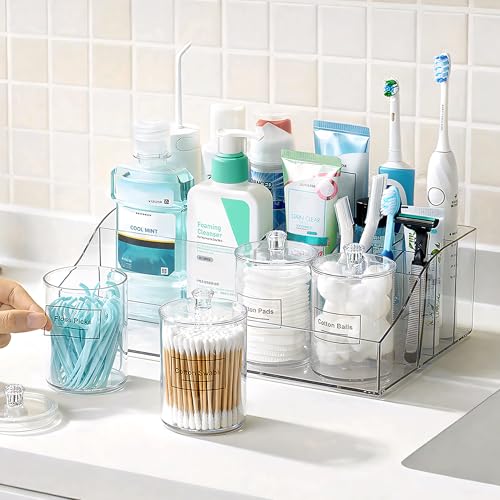
Vtopmart 5-Piece Bathroom Countertop Organizer Set — Best Overall
Most bathroom counters need the same five things, and this set simply bundles them: one divided tray and four clear qtip-holder jars with lids. The tray corrals the daily-grab items — toothbrush, toothpaste, the bottle you reach for twice a day — while the four jars take the cotton goods and small consumables that otherwise live in torn-open retail packaging. Because the pieces share one clear material and one design language, the counter reads as organized the moment they are placed, before you have sorted a single object. That instant-coherence effect is why a coordinated set beats a drawer of mismatched containers gathered over years.
In practice, the set’s best feature is how it handles the Sunday reset: everything lifts, the counter wipes down in one pass, everything returns to a layout that needs no thought because the tray and jars define it. Systems that survive cleaning day survive, period — and most improvised arrangements die exactly there, scattered during a clean and never reassembled. It suits the majority of households doing a first real counter organization, guest bathrooms that need to look intentional quickly, and anyone whose clutter is the standard mix rather than a specialist collection. It is less suited to serious skincare or makeup collections, which outgrow four jars and a tray (see the rotating and drawer picks), and to buyers who want a decorative material like ceramic or stone — this set’s aesthetic is clean transparency, not ornament.
Strengths
- Complete standard solution in one box — tray plus four lidded jars
- Lids keep cotton goods dry and dust-free between uses
- Clear construction shows contents and fill levels at a glance
Trade-offs
- Fixed set composition — you cannot choose your own jar sizes
- Clear plastic shows water spots; a weekly wipe keeps it crisp
- Not sized for tall bottles or large collections
The deeper virtue of starting with a set is that it imposes a capacity discipline: four jars is a decision about how much countertop consumable a household needs at hand, with the bulk refills living in a cabinet or linen closet where they belong. Most “cluttered counter” problems are actually “warehouse on the counter” problems, and a right-sized set quietly fixes the inventory policy, not just the arrangement.
Best for: first-time counter organization and standard family bathrooms / Not suited for: large skincare or makeup collections
Check the current price on Amazon

Vtopmart Clear Stackable Storage Drawers, Set of 5 — Best Drawer Storage
Drawers are the strongest tool in counter organization because they do two things at once: they sort, and they conceal. This set of five clear stackable drawers builds a small chest of drawers on the counter or under it, each drawer a category — hair accessories in one, first-aid in another, nail care, medications, makeup spares — visible through the clear fronts so nothing becomes a mystery bin. Stacking uses the one dimension a counter has in surplus, height, and the modular format lets you split the set between two bathrooms or add the stack beside the sink where the counter is deep enough.
It suits households whose counters hold many small categories, shared bathrooms where each person can claim a drawer, and under-sink or linen-closet overflow as well as the counter itself. It is less suited to items used with wet hands dozens of times a day — those belong in open trays — and to very narrow counters where a drawer stack’s footprint crowds the sink.
Strengths
- Five sorted compartments end the single junk-drawer pattern
- Clear fronts keep contents visible — no label maker required
- Stackable and splittable across rooms or zones
Trade-offs
- Drawers add a step between you and the contents — wrong for the highest-frequency items
- Stack height should stay modest on a counter for stability and looks
- Clear plastic needs occasional washing to stay truly clear in a steamy room
A usage pattern that works well: reserve the top drawer for the week’s daily items and let the lower drawers hold the weekly and monthly categories. That gradient — frequency decreasing with depth — mirrors how kitchen drawers succeed, and it keeps the stack from becoming five layers of equally ignored storage. Measure your counter’s depth before stacking all five in one tower; in many bathrooms, two stacks of two and three read better and wobble less.
Best for: many-category counters and shared bathrooms / Not suited for: the few items you grab constantly with wet hands
Check the current price on Amazon
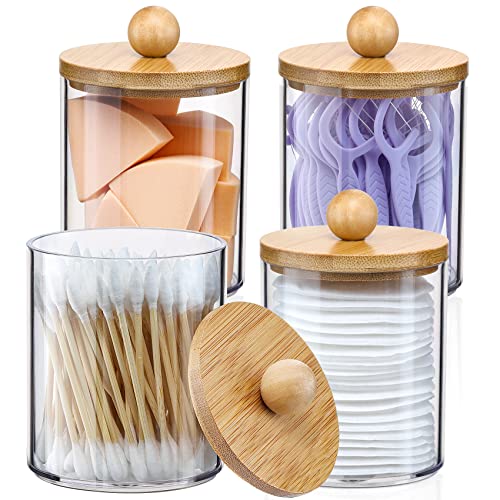
4-Pack Qtip Holder Dispensers with Bamboo Lids — Best Apothecary Jars
The apothecary jar is the bathroom counter’s oldest container, and this four-pack updates it sensibly: clear ten-ounce canisters with bamboo lids, sized for cotton swabs, cotton balls, cotton pads, and floss picks. The lids are the functional heart of the product. Cotton goods are used on skin and in ears; leaving them open to a bathroom’s humidity, dust, and aerosol spray is quietly unhygienic, and a lid that lifts off in one motion solves it without slowing the routine. The bamboo adds the warmth that all-clear sets lack, letting the jars sit comfortably in natural, spa, and farmhouse bathrooms where pure acrylic reads too clinical.
It suits buyers who want their storage to double as decor, guest bathrooms and primary baths with a natural material palette, and anyone whose main clutter is the cotton-goods family. It is less suited to buyers who want to see fill levels instantly from across the room (the bamboo lid is opaque, though the clear body still shows contents), and to households that will put the jars in the dishwasher — bamboo lids prefer a hand wipe.
Strengths
- Lidded hygiene for cotton goods, with one-motion access
- Bamboo lids warm up the look beyond basic plastic
- Four matched jars cover the standard cotton-goods categories
Trade-offs
- Bamboo lids should be kept from standing water and hand-wiped, not soaked
- Ten-ounce size suits countertop quantities, not bulk storage
- Round jars use slightly more counter depth than square formats
Placement advice that elevates these from storage to styling: group the jars on a small tray rather than scattering them, odd numbers read better than even, and keep the tallest jar at the back. It takes thirty seconds and is the difference between “containers on a counter” and the composed look that made you want apothecary jars in the first place.
Best for: cotton-goods storage with a natural, styled look / Not suited for: bulk storage or soak-washing households
Check the current price on Amazon

4-Pack Acrylic Qtip Holder Dispensers — Best Clear Acrylic
Where the bamboo-lidded set leans decorative, this four-pack leans laboratory-clear: thick acrylic canisters, highly transparent, sold with labels for the standard contents. Thick acrylic matters — it has the weight and clarity of glass without the breakage risk, and on a wet counter beside a ceramic sink, “unbreakable” is a safety specification, not a convenience. The included labels finish the system: swabs, balls, pads, and floss picks each get a named home, which is what keeps a shared bathroom’s containers from slowly cross-contaminating into four jars of everything.
It suits modern and minimalist bathrooms, households with children (no glass to break), and shared bathrooms where labeled order survives multiple users. It is less suited to buyers wanting a warm or vintage look, and to anyone who dislikes seeing contents — these jars display everything, which is the point and also the aesthetic commitment.
Strengths
- Thick acrylic clarity with glass-like presence and no shatter risk
- Labels included — the system stays sorted in shared bathrooms
- Lidded, washable, and sized for standard cotton goods
Trade-offs
- Fully transparent storage shows clutter if you overfill — keep levels tidy
- Acrylic can scratch if scoured; wash with soft cloths
- Cold, modern look may not suit traditional decor
A small systems note: labels work because they convert a decision into a rule. Without them, every user re-decides where things go, and entropy wins within a month. With them, the container set becomes self-maintaining — which, for a shared family bathroom, is worth more than any single jar’s capacity.
Best for: modern bathrooms, families, and shared counters / Not suited for: buyers who prefer contents hidden
Check the current price on Amazon

Forbena 2-Tier Bathroom Countertop Organizer — Best Tiered Tray
Tiered trays attack the counter’s core scarcity — flat area — by building a second floor. The Forbena’s two levels, in a white-and-gold finish on a wood tray format, lift perfumes, skincare, and daily bottles into a compact footprint, with the upper tier keeping smaller items visible above the tall ones below. It is marketed across vanity, kitchen, and coffee-bar uses, and that versatility is honest: a tiered tray is a generic surface-multiplier. On a bathroom counter it earns its place by turning a sprawling single layer of bottles into a composed, two-level arrangement that leaves room for the sink to be a sink.
It suits bottle-heavy counters — skincare routines, fragrance collections, couples’ combined daily products — and bathrooms where the counter is wide but not deep. It is less suited to cotton goods and tiny items, which need lids and walls rather than open tiers, and to very steamy bathrooms where any wood component should be wiped down regularly, as noted in its trade-offs.
Strengths
- Roughly doubles the usable surface of its footprint
- Open tiers give instant, one-motion access to bottles
- White-and-gold finish reads as decor, not just storage
Trade-offs
- Open storage — no dust or splash protection for contents
- Wood elements prefer wiping over soaking in a steamy room
- Tall bottles on the lower tier must clear the upper tier’s height
Loading discipline makes or breaks a tiered tray: heaviest and tallest below, lightest above, and nothing stored behind anything else. The moment a tiered tray develops a hidden back row, it has recreated the original problem at a higher elevation. Loaded with discipline, it is the most beautiful of the six picks and the one guests notice.
Best for: bottle collections and styled vanities / Not suited for: cotton goods and tiny loose items
Check the current price on Amazon

Asayuee 360 Rotating Organizer, 2 Tier — Best for Skincare Collections
Rotation solves the deepest problem of bottle storage: the back row. The Asayuee spins 360 degrees across two tiers, bringing every bottle to the front with a fingertip turn, which means a serious skincare collection can live in a single compact circle of counter instead of a parade across the backsplash. The two-tier format separates the routine — daily products below, occasional treatments above, or any split your regimen suggests — and the large capacity suits the buyer whose bathroom counter currently looks like a cosmetics counter because, functionally, it is one.
It suits skincare enthusiasts, makeup-heavy routines, and shared vanities where two people’s products must coexist in one footprint. It is less suited to minimal counters (it is a presence), to households with small children who will treat it as a merry-go-round, and to very tall pump bottles that exceed the tier clearance.
Strengths
- Full rotation eliminates the unreachable back row
- Two tiers sort a large collection by frequency or owner
- One compact footprint replaces a counter-wide bottle spread
Trade-offs
- Needs a clear circle of counter to spin — measure the diameter
- Open tiers offer no dust protection
- Very tall bottles may fit only on the top tier
The honest test for this pick: count your bottles. Under six, a tray is enough and rotation is a gimmick. Over ten, rotation stops being a novelty and becomes the only geometry that keeps every product reachable — at which point this organizer is not an indulgence but the correct tool, and the counter space it returns is measurable in inches of reclaimed sink surround.
Best for: skincare and makeup collections of ten-plus products / Not suited for: minimal counters or toddler households
Check the current price on Amazon
Comparison Table
| Pick | Badge | Key spec | Best for |
|---|---|---|---|
| Vtopmart 5-Piece Organizer Set | Best Overall | Divided tray + 4 lidded jars | Standard counters, first organization |
| Vtopmart Stackable Drawers x5 | Best Drawer Storage | Five clear stacking drawers | Many small categories |
| Qtip Holders with Bamboo Lids x4 | Best Apothecary Jars | 10 oz lidded jars, bamboo tops | Cotton goods, styled baths |
| Acrylic Qtip Holders x4 | Best Clear Acrylic | Thick clear canisters with labels | Modern and family bathrooms |
| Forbena 2-Tier Organizer | Best Tiered Tray | Two-level wood tray, white/gold | Bottle collections |
| Asayuee Rotating Organizer | Best for Skincare | 360° spin, 2 tiers, large capacity | Ten-plus product routines |
How to Choose Storage Containers for a Bathroom Counter
Begin with an audit, not a shopping cart. Empty the counter completely — everything, including the things that “live” there by habit — and sort the pile into four groups: daily (used at least once a day), weekly, rare, and homeless (items with no real bathroom job). The rare and homeless groups leave the counter permanently, to a cabinet, a closet, or the trash; no container system can organize items that should not be there, and most failed organizations are actually failed audits. What remains, the daily and weekly groups, is what you are containerizing, and it is almost always smaller than the pile you started with.
Now assign families by frequency and physics. Daily items that you grab with wet hands — toothbrush, toothpaste, the morning skincare steps — belong in open containers: the divided tray of the Vtopmart set, a tier of the Forbena, the front of the Asayuee. Daily dry goods that must stay clean — swabs, pads — belong in lidded jars, opened one-handed and closed by habit. Weekly items belong in drawers, where the small effort of opening is repaid by a calm counter. This frequency gradient is the entire science of the category; every successful bathroom counter in the world is arranged by it, whether its owner knows the term or not.
Materials come next, judged against the bathroom’s realities: standing water, steam, dropped objects, and cleaning chemicals. Acrylic and quality plastic win most matchups — waterproof, washable, unbreakable, and clear where clarity helps. Glass is beautiful and heavy and one slip from a barefoot emergency; reserve it for adult-only, low-traffic baths if at all. Bamboo and wood bring warmth and need a wipe-dry habit. Metal wire rusts at its joints in steam unless it is genuinely stainless or coated, which is why no wire organizer appears in this guide. Whatever you choose, prefer containers that can be fully washed in the sink — a container you cannot clean becomes, in a bathroom, a container you should not own.
Think about refills before you commit to a system, because containers create a restocking rhythm. Jars sized for a week or two of cotton goods mean the bulk package lives elsewhere and the counter stays light; drawers sized for categories mean a new purchase has to displace something or go to the cabinet, which is a healthy friction. The households whose counters stay organized longest are not the ones with the most containers — they are the ones whose containers quietly enforce a stocking policy every time someone tries to overfill them. When you choose sizes, you are really choosing that policy, so choose it for the counter you want to live with, not the haul you just brought home.
Size with the same discipline. Measure the counter’s depth and the zones beside and behind the faucet, and buy containers whose footprints fit those zones with room for hands and a hand towel. The most common failure is a beautiful organizer two inches too deep, exiled to sit diagonally forever. And keep the system’s visual language unified: one material family, one lid style, one label style. A counter can hold a surprising amount of storage and still look serene if everything matches; it looks cluttered with half as much if nothing does.
Counter Zones: A Layout That Stays Organized
Containers fail when they are placed by leftover space instead of by zone. A bathroom counter has four natural zones, and assigning each container to its zone is what makes the system self-explanatory to everyone who uses the room. The wet zone is the sink’s immediate surround: nothing stored here survives gracefully except the soap dispenser and the toothbrush holder, both of which expect to be wet. The daily zone sits within arm’s reach to your dominant-hand side — this is where the divided tray and the current skincare lineup belong, because the morning routine should never require a step or a stretch. The dry zone is the counter’s far corner, away from the splash, and it is the natural home of lidded jars and anything paper-labeled or wooden. The display zone — often the wall-adjacent strip behind the faucet — holds the tiered tray or the prettiest jars, visible in the mirror and mostly decorative in function.
Zones also explain most container disappointments. A bamboo-lidded jar that mildewed was almost always a dry-zone object living in the wet zone. A rotating organizer that feels awkward is usually a daily-zone tool exiled to a corner by a prettier tray. When a system “stops working” a month in, the contents have usually drifted across zones one small exception at a time. A two-minute zone reset during the weekly clean — everything back to its zone, containers wiped as you go — is the entire maintenance program, and it is why organized counters stay organized in households that do it and mysteriously collapse in households that rely on the containers alone.
Special Cases: Tiny Counters, Double Sinks, and Kids’ Bathrooms
A tiny counter — a pedestal-adjacent slab, a narrow vanity in a half bath — cannot host a system, and pretending otherwise produces a crowded mess in miniature. For these, the correct purchase is one container, chosen ruthlessly: usually a single lidded jar set or a slim divided tray holding only the true daily items, with everything else relocated to a wall shelf or an over-toilet cabinet. The picks here scale down gracefully — the acrylic jar four-pack alone, for instance, can be a tiny counter’s entire storage story — and the discipline of one container forces the audit that larger counters let you postpone.
A double-sink counter has the opposite problem: abundance that invites sprawl. The working pattern is symmetry with a shared center. Each sink gets its own daily zone and tray; the center holds the shared consumables in labeled jars; drawers or the rotating organizer anchor one end rather than the middle, so both users’ territories stay legible. Couples who skip the center-sharing design usually end up with two of everything and a counter that reads as two cluttered singles rather than one composed double.
Kids’ bathrooms rewrite the material rules: unbreakable everything, lids that small hands can actually open, and containers at heights children can reach without climbing the vanity — a fall risk that outweighs any organizational benefit. The clear drawer stacks work well here because children can see their categories, and the acrylic jars survive being dropped in a way glass never will. Expect the system to be simpler than an adult bathroom’s — two or three categories, visibly labeled, at child height — and expect to re-audit it as the children grow, because a container system that fit a seven-year-old’s routine will quietly fail a twelve-year-old’s.
How to Organize a Bathroom Counter in One Session
With the audit done and containers in hand, the setup itself takes under an hour if you follow the order that professionals use:
- Clean the bare counter thoroughly and let it dry — containers placed on a damp, grimy surface start their life dirty.
- Place the largest anchor first: the drawer stack, the rotating organizer, or the tiered tray, in the zone furthest from the splash area that still keeps it reachable.
- Set the lidded jars as a group, on a tray if you have one, in the counter’s calmest corner — away from the faucet’s direct splash.
- Load by frequency: daily items at the front and in open containers, weekly items in drawers and back positions. Resist filling any container beyond about eighty percent; the last twenty percent is what makes it usable rather than stuffed.
- Decant the cotton goods from their retail packaging into the jars, and move the bulky refill packages to a cabinet or closet the same day — the counter keeps working quantities only.
- Label anything shared or non-obvious. Labels are what make the system survive other people’s good intentions.
- Live with it for a week before buying anything else. The gaps that remain after a week of real use are the true remaining needs; the gaps you imagine on day one usually are not.
A Note on Medications and Small Valuables
Two counter categories deserve deliberate thought rather than default containers. Medications are bathroom-counter regulars, yet bathrooms are humid — and many medicines prefer cool, dry storage, which argues for keeping only the current week’s doses at the counter, in a closed drawer of a stackable set, with the supply bottles in a dry cabinet elsewhere. Households with small children should treat that drawer as a minimum, not a solution: child-resistant storage out of reach governs, and no counter container in this guide is a child-safety device. Small valuables — the ring that comes off for hand washing, the watch, the earrings — deserve one fixed, memorable home: a small tray in the dry zone, used every single time. Jewelry is lost at bathroom counters more than anywhere else in the home, almost always because it was set down “for a second” in a place that was not its place. A five-dollar tray habit prevents the five-hundred-dollar loss, which makes it the highest-return container decision in this entire guide.
Common Buying Mistakes
Buying containers before auditing. Containers sized for clutter you should have discarded just preserve the clutter in nicer boxes. Audit first, measure second, buy third.
Open storage for cotton goods. Swabs and pads sit in bathroom air all day, every day. Lids are hygiene, not fussiness.
One giant organizer for everything. A single cavernous container recreates the junk drawer at counter scale. Categories need compartments; sorting is the service you are buying.
Glass beside the sink in a family bathroom. Wet hands, hard floors, bare feet. Acrylic gives the same clarity without the risk.
Ignoring the splash zone. Anything within the faucet’s splash radius gets wet daily. Paper labels, unwrapped wood, and open jars placed there all degrade; position is a specification.
Filling every container to the brim. A container at one hundred percent is a container you cannot use one-handed. Working storage lives at eighty percent.
Final Recommendation
Most households should start with the Vtopmart 5-Piece Set — it resolves the standard counter in one coordinated purchase — and add the stackable drawers when the small-category count grows. If your clutter is specifically the cotton-goods family, choose the bamboo-lidded jars for a warm look or the labeled acrylic set for a modern one. Bottle-heavy counters belong to the Forbena tiered tray, and serious skincare collections to the Asayuee rotating organizer. One final encouragement: organize for the household you have, not the one in the photograph. A system that holds a family’s real routine — slightly fuller jars, a drawer that is more useful than beautiful — will still be working in a year, while a system arranged for a picture tends to be quietly abandoned by February. The picks here were chosen to survive real use; meet them halfway with honest quantities, and your counter will stay the calmest surface in the house. Whatever combination you land on, do the audit first — the containers in this guide are good, but the system of daily-open, weekly-drawered, and bulk-elsewhere is what actually keeps a counter clear.
Related guides in this series: Best Narrow Bathroom Sinks · Best Custom Bathroom Vanities · Best Bathroom Shelves For Small Bathrooms · Best Water Absorbent Bath Mats
And if the counter still feels crowded after all of it, the answer is almost never another container — it is a harder audit. Every organized bathroom has a small pile of exiles living in a cabinet somewhere, and that pile, not the counter, is where good intentions go to be stored. Start with the audit this weekend, and the counter you have been wiping around for years becomes the counter you actually wanted.
Frequently Asked Questions
How do I stop containers from sliding or tipping on a wet counter?
Weight, footprint, and grouping are the fixes. Heavier materials like thick acrylic stay put better than thin plastic; wide, low containers resist tipping better than tall narrow ones; and grouping containers on a tray — especially a silicone or otherwise grippy tray, like the silicone tray set some households add beside the sink — turns several light objects into one stable arrangement. If a single light container still wanders, a small dot of reusable mounting putty under its base, kept out of standing water, ends the problem without marking the counter.
Should bathroom counter containers have lids?
For anything that touches skin or goes in ears — cotton swabs, balls, pads — yes. A bathroom’s air carries humidity, dust, and aerosolized product, and lidded storage keeps those consumables clean between uses. For bottles and tools you grab constantly, open trays and tiers are better, because a lid you must remove fifty times a week is a lid that ends up left off.
Acrylic, glass, or plastic — which is best for bathroom storage?
Thick acrylic is the best all-around answer: glass-clear, much lighter than glass, and effectively unbreakable in counter service. Quality plastic (like the clear drawer and set pieces in this guide) is close behind and often more economical. Glass looks premium but is the risky choice anywhere wet hands and hard floors meet. Whichever you choose, confirm it can be washed fully — bathroom containers need real washing, not just dusting.
How do I keep clear containers from looking cloudy?
Wash them with warm water, mild soap, and a soft cloth — never scouring pads or abrasive powders, which micro-scratch clear plastics and acrylics. Dry with a soft towel rather than air-drying in hard water, which leaves mineral spots. A monthly wash keeps a clear system genuinely clear; neglected for a season, the cloudiness is usually surface film and still washes off with patience.
What size jars do I need for cotton swabs and cotton balls?
The ten-ounce class featured in this guide’s jar picks is the working sweet spot: it holds a useful supply of swabs or balls without dominating the counter, and it refills on a natural rhythm of every week or two. Cotton balls are bulky and light, so they fill a jar faster than expected — if your household goes through them quickly, dedicate two jars to balls and one to swabs rather than buying oversized canisters. Oversized jars are the classic mistake here: they invite warehouse quantities onto the counter and swallow the visual calm the jars were bought to create.
How much storage should live on the counter versus in cabinets?
Working quantities on the counter, bulk in the cabinet. A good test: the counter should hold about a week to a month of consumables — one jar of swabs, not the warehouse pack — and only the current lineup of daily products. Everything else is inventory, and inventory stored on the counter is what makes a bathroom feel like a stockroom. The sets in this guide are sized to working quantities on purpose.
Can I use these organizers in a kitchen or bedroom too?
Yes — the drawer stacks, tiered tray, and rotating organizer in this guide are all sold for multi-room use, and the same frequency logic applies at a vanity desk or a coffee station. The bathroom-specific picks are the lidded cotton-goods jars, whose sizes assume bathroom consumables. If you replicate the system elsewhere, keep each room’s set visually separate; matching containers across rooms is fine, but a single system stretched across two rooms usually ends up migrating and collapsing.
How often should bathroom containers be cleaned?
Wipe the exteriors during your regular weekly bathroom clean — it takes a minute when done weekly and an afternoon when deferred for months. Wash interiors monthly, or whenever you refill a jar: the moment a container is empty is the natural, zero-effort time to wash it before refilling. Toothbrush-area containers deserve the most frequent attention since they live in the splash zone. Containers that cannot survive this routine — anything that rusts, warps, or cannot be immersed — are telling you they were not really bathroom containers.
Do I need a tray under my jars and bottles?
Not strictly, but a tray is the cheapest upgrade in this entire category. It groups separate containers into one visual object, catches the drips and rings that otherwise mark the counter, and — most underrated — lets you lift the whole arrangement off the counter in one motion when you clean or when a plumber needs the sink surround. The Vtopmart set builds a tray into its design for exactly these reasons, and adding a simple silicone or wood tray under the jar sets in this guide pays for itself at the first deep clean.
What is the best container setup for a shared bathroom?
Zones and labels. Give each person a defined zone — a drawer each from a stackable set, or a side of a tray — and use labeled jars for the genuinely shared consumables like swabs and cotton pads. The Vtopmart drawer set and the labeled acrylic jars in this guide are the strongest shared-bathroom tools because they make ownership and categories visible at a glance, which is what keeps a shared system sorted without negotiation.

