Disclosure: airfryerkitchensupply.com is reader-supported. When you buy through links on our site, we may earn an affiliate commission at no extra cost to you.
Where to buy
Every machine below was confirmed against Amazon’s catalog data before inclusion, and each link points to the exact model reviewed. Sewing machines are frequently bundled with different accessory kits under the same model name, so check the listing title for the configuration described in the review.
- Brother CS7000X Sewing and Quilting Machine — Check the current price on Amazon
- SINGER Quantum Stylist 9960 — Check the current price on Amazon
- Brother XR9550 — Check the current price on Amazon
- SINGER 4452 Heavy Duty Bundle — Check the current price on Amazon
- Janome HD3000 Heavy-Duty — Check the current price on Amazon
- Janome 3160QDC-G — Check the current price on Amazon
The best inexpensive sewing machine that sews and quilts has to pass a harder test than a cheap machine that merely sews. Garment sewing asks for tidy stitches on two layers of cotton; quilting asks the same machine to push a needle through a sandwich of top fabric, batting, and backing, to feed three shifting layers evenly for the length of a bed quilt, and to offer enough workspace to the right of the needle — the throat — that a rolled quilt can pass through without a wrestling match. Plenty of budget machines sew beautifully and quilt badly. This guide was built by filtering the inexpensive end of the market through quilting’s actual demands: a wide or extension table, a walking-foot-friendly feed system, a free-motion capability for quilting designs, enough motor honesty for thick seams, and a free arm and stitch library that keep garment work pleasant the rest of the year.
The honest headline is encouraging: the inexpensive quilting-capable machine is a real category, not a marketing fiction, because the big makers — Brother, SINGER, and Janome all appear below — compete hard at exactly this tier. What separates the six picks is emphasis. Two Brothers bring computerized ease and included quilting tables at friendly prices. The SINGER 9960 brings the deepest feature set in the class. Two heavy-duty machines, one SINGER and one Janome, trade stitch libraries for the power and durability that thick quilt sandwiches and denim-weight projects demand. And the Janome 3160QDC-G is the lightweight quilter’s machine, built to travel to classes. Each review says plainly where the inexpensive part shows — because it always shows somewhere — so you can choose which compromise fits your sewing.
In this guide
Quick Picks
- Best Overall: Brother CS7000X — 70 stitches, LCD, wide table, and 10 included feet: the complete inexpensive sew-and-quilt package. Check price on Amazon
- Best Feature-Rich: SINGER Quantum Stylist 9960 — 600 stitches, extension table, and 13 presser feet for sewers who want everything in one machine. Check price on Amazon
- Best Stitch Library Value: Brother XR9550 — 165 built-in stitches with wide table and LCD at a wallet-friendly tier. Check price on Amazon
- Best for Thick Quilt Layers: SINGER 4452 Heavy Duty Bundle — heavy-duty motor and frame with extension table for dense sandwiches and denim. Check price on Amazon
- Best Mechanical Durability: Janome HD3000 — a simple, metal-hearted heavy-duty machine with hard case, built to be kept for decades. Check price on Amazon
- Best Lightweight for Classes: Janome 3160QDC-G — a quilting-focused machine with bonus quilt kit that is genuinely portable. Check price on Amazon
How These Picks Were Chosen
All six machines were verified against Amazon’s catalog, so model names, configurations, and included accessories come from the listings themselves. The quilting filter was then applied in a specific order. First, workspace: a wide table or extension table had to be included or the machine’s throat had to be honest about quilt bulk, because quilting a throw on a bare machine bed is how new quilters quit. Second, layer handling: feed-dog quality, presser-foot pressure or walking-foot compatibility, and the motor strength to cross bulky seam intersections without skipped stitches. Third, free-motion readiness — drop feed or a darning plate and a compatible foot — because machine quilting designs are half the hobby.
Garment sewing was the second scorecard: a usable stitch library (not a padded one), a one-step or genuinely easy buttonhole, a free arm for sleeves and cuffs, and needle threading that does not require tweezers and prayer. Finally, the inexpensive constraint was treated as a design brief rather than an apology — plastic where plastic is fine, metal where stress lives, and no pick whose cheapness hides in the one component quilting stresses most. Where a machine’s weakness sits exactly on a quilting demand, its review says so and names the buyer who will not care.
The 6 Best Inexpensive Sewing Machines That Sew and Quilt
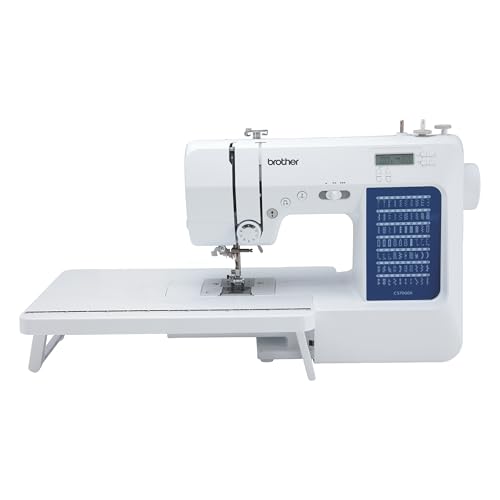
Brother CS7000X — Best Overall
The CS7000X is the machine this search seems to have been written for. Seventy built-in stitches cover garments completely and quilting comfortably; the included wide table gives a quilt somewhere to live while you sew; the LCD screen and push-button controls make stitch selection a glance rather than a dial-guessing exercise; and the box includes 10 presser feet, which quietly removes the accessory spending that makes “inexpensive” machines expensive by month two. It is computerized without being fragile about it, and its automatic needle threader and drop-in bobbin are the two conveniences beginners feel every single session.
Strengths
- Wide table and 10 included feet make it quilting-ready out of the box — no immediate accessory purchases.
- Automatic needle threader, drop-in bobbin, and LCD stitch selection minimize beginner friction.
- Balanced stitch library serves garment sewing, piecing, and decorative quilting stitches without bloat.
Trade-offs
- The throat space is compact-machine sized; a king quilt can be done, but you will roll and manage it deliberately.
- Very thick seam intersections — denim-weight or many-layered — reward a slower hand than the heavy-duty picks below.
- The frame uses more plastic than the Janome HD3000; it is a modern appliance, not an heirloom.
For the typical buyer of this guide — first serious machine, quilts up to throw and twin size, garments in between — the CS7000X’s balance is the story. Piecing is precise, the feed handles the quilt sandwich evenly for straight-line and walking-foot quilting, and free-motion work is accessible with the feed dropped. It is the recommendation to give a friend, because its weaknesses appear only at the extremes of quilt size and fabric weight that most home sewers visit rarely.
Best for: most beginners and intermediates quilting up to twin size and sewing garments year-round. / Not suited for: king-size quilts weekly, or heavy denim and canvas as a staple. Check the current price on Amazon

SINGER Quantum Stylist 9960 — Best Feature-Rich
The 9960 answers a different question: how much machine can the inexpensive tier possibly contain? Six hundred stitches, an extension table, 13 presser feet, a hard case, automatic thread cutting, and electronic controls that include stitch memory and mirroring — a specification that reads like a machine from a higher shelf. For the sewer who quilts and also embellishes, monograms, and sews garments with decorative ambitions, the 9960 collapses several machines’ worth of capability into one purchase, and its long tenure in SINGER’s lineup means tutorials and community knowledge for it are everywhere.
Strengths
- The deepest stitch and feature library in this guide — decorative and quilting stitches for years of projects.
- Extension table and 13 feet included; the quilting workspace is there from day one.
- Automatic thread cutter and programmable features genuinely speed repetitive piecing and quilting work.
Trade-offs
- Feature depth means menus; sewers who want three dials and no screens should take the Janome HD3000 instead.
- It sits at the top of this guide’s inexpensive band — still value-dense, but not the cheapest door in.
- Like the Brother, its throat is standard-size; large quilts need rolling and patience.
The 9960 suits the ambitious learner best: the person who suspects, correctly, that they will outgrow a basic machine within a year and would rather learn one deep machine than buy twice. Its quilting manners are polished — even feeding, good stitch formation through the sandwich — and the included feet cover walking-foot-style quilting and free-motion basics without a second order. Buy it for the library, keep it for the competence.
Best for: ambitious sewers who want one deep machine for quilting, garments, and decorative work. / Not suited for: minimalists, or buyers at the strict bottom of the budget band. Check the current price on Amazon

Brother XR9550 — Best Stitch Library Value
The XR9550 is Brother’s value play in the same family as the CS7000X, trading a little refinement for a much larger stitch count: 165 built-in stitches, an LCD display, a wide table, and 8 included feet. The practical difference shows in decorative range — more quilting stitches, more heirloom and embellishment options for garment work — at a tier that frequently undercuts its sibling. For a sewer whose projects lean decorative, or a quilter who pieces precisely and decorates generously, the XR9550 is the arithmetic winner of the Brother pair.
Strengths
- 165 stitches is the largest library at this tier in the guide — decorative quilting and garment options abound.
- Wide table included, so the quilting workspace argument is settled in the box.
- LCD selection and Brother’s familiar drop-in bobbin keep the learning curve gentle.
Trade-offs
- Fewer included feet than the CS7000X, so a walking foot purchase may arrive sooner for dedicated quilters.
- Shares the family throat size — big quilts remain a management exercise.
- Stitch quantity outruns most users’ needs; the value is real only if you will actually use decorative range.
Choose between the Brothers by project diary: if your quilting is straight-line and your garments are classic, the CS7000X’s extra feet serve you better; if your Pinterest board is full of decorative stitching, appliqué, and embellished everything, the XR9550’s library is the better buy at a similar spend. Either way you are inside the same well-supported ecosystem of feet, needles, and tutorials.
Best for: decorative-leaning sewers and quilters who want maximum stitch range per dollar. / Not suited for: buyers who will use six stitches forever — save with a simpler model. Check the current price on Amazon
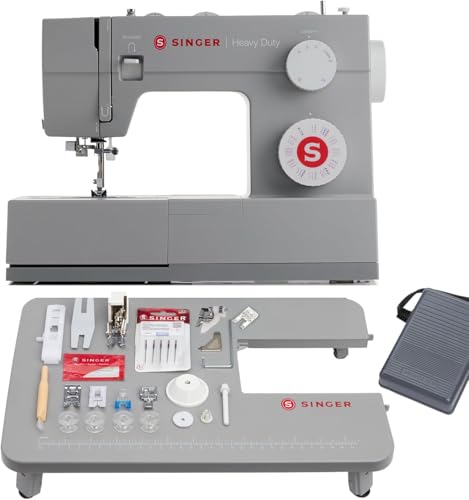
SINGER 4452 Heavy Duty Bundle — Best for Thick Quilt Layers
The 4452 is the muscle pick. SINGER’s Heavy Duty line is built around a stronger motor and a metal frame, and this bundle pairs the machine with an extension table and extra presser feet — the two additions quilting actually needs. Thirty-two built-in stitches is a modest library, deliberately: this machine spends its budget on penetration and speed rather than decoration. Where it earns its place is the moment a quilt sandwich crosses a bulky seam intersection, or a denim quilt or canvas project arrives — the moments lighter machines hesitate, skip, or break a needle.
Strengths
- Heavy-duty motor and frame power through thick quilt sandwiches, denim quilts, and layered seams.
- Bundle includes the extension table quilting requires, plus extra feet.
- High sewing speed makes long straight quilting runs and big piecing sessions shorter.
Trade-offs
- Thirty-two stitches is a working library, not a decorative one — embellishers should look at the 9960 or XR9550.
- Mechanical character: fewer computerized conveniences, no thread cutter, more hands-on operation.
- Power and speed demand respect from beginners; the learning curve is about control, not menus.
The 4452 is the right answer for a specific and common quilting story: the denim-and-flannel quilt, the T-shirt quilt with stabilizer, the upcycled everything. It is also the machine most likely to be borrowed by the whole household for repairs — jeans, curtains, upholstery — and to survive the borrowing. If your quilting dreams are delicate and decorative, its virtues are wasted on you; if they are sturdy, it is the least expensive machine here that will never make you apologize for its motor.
Best for: thick-fabric quilters, denim and upcycled projects, and households wanting one tough machine. / Not suited for: decorative stitch enthusiasts or buttonhole-heavy garment sewists wanting automation. Check the current price on Amazon

Janome HD3000 Heavy-Duty — Best Mechanical Durability
The HD3000 is the anti-disposable machine: 18 built-in stitches, a hard case, an aluminum-hearted heavy-duty build, and a control scheme of dials that a owner can understand completely in an afternoon and service-minded shops can maintain for decades. Janome’s feed quality is its quiet glory — stitches form evenly and layers track straight, which is why this simple machine quilts better than its stitch count suggests. It will not embroider your initials. It will piece a quilt top with watchmaker consistency and then sew your curtains, and it will very likely do both for the next twenty years.
Strengths
- Heavy-duty metal construction and Janome feed quality — the durability and stitch-formation pick.
- Dead-simple dial controls; nothing to update, crash, or menu-dive.
- Hard case included, and a long production history means parts, feet, and knowledge are permanently available.
Trade-offs
- Eighteen stitches and no extension table in the box — quilters should budget for a table surface solution.
- No automatic thread cutter or computerized conveniences; threading and cutting are manual rituals.
- Its price reflects build quality — inexpensive for a Janome of this class, not the cheapest machine in the guide.
Buy the HD3000 if your relationship with tools is buy-once. It suits quilters whose work is piecing-true and straight-line quilted, garment sewers who value a perfect straight stitch over a hundred decorative ones, and anyone burned before by a plastic machine that died at year three. In a guide about inexpensive machines, it makes the deepest argument: the cheapest machine is the one you never replace.
Best for: buy-once buyers, piecing purists, and sewers who prefer dials to screens. / Not suited for: decorative stitchers, or anyone wanting a quilting table included. Check the current price on Amazon

Janome 3160QDC-G — Best Lightweight for Classes
The 3160QDC-G was designed by people who understand that modern quilting is social: it is a quilting-focused computerized machine light enough to carry to classes, retreats, and guild sew-days, and this listing bundles a bonus quilt kit with it. Sixty-stitch-class capability, Janome’s smooth feed, a start/stop button and speed control for pedal-free sewing, and an extension-friendly design make it the machine quilters buy as their travel-and-class companion — or as a main machine when the sewing space is a dining table that must be cleared by dinner.
Strengths
- Genuinely portable for a quilting-capable machine — classes and retreats are its home turf.
- Quilting-focused features and the bonus quilt kit start projects immediately.
- Janome stitch quality and feed smoothness in a computerized, button-controlled package.
Trade-offs
- It sits above the strict budget band — you pay for the portability engineering and the Janome badge.
- Compact throat, like all portables: home quilting of large quilts still means rolling and patience.
- At home full-time, a heavier machine’s stability can feel preferable on long quilting runs.
If your quilting life happens in community — and for many quilters the community is the point — the 3160QDC-G is the pick that respects it. It also serves apartment sewers whose machine must disappear into a closet between sessions. Judge it as what it is: the most quilting competence Janome could fit into a carry-able weight, at a price that reflects the engineering.
Best for: class-going quilters, retreat sewers, and small-space households. / Not suited for: strict budgets, or stationary sewists who never move their machine. Check the current price on Amazon
Comparison Table
| Pick | Badge | Key spec | Best for |
|---|---|---|---|
| Brother CS7000X | Best Overall | 70 stitches, wide table, 10 feet, LCD | Most beginners and intermediates |
| SINGER Quantum Stylist 9960 | Best Feature-Rich | 600 stitches, extension table, 13 feet | One deep machine for everything |
| Brother XR9550 | Best Stitch Library Value | 165 stitches, wide table, LCD | Decorative range per dollar |
| SINGER 4452 Heavy Duty Bundle | Best for Thick Quilt Layers | Heavy-duty motor/frame, extension table bundle | Denim quilts, dense sandwiches |
| Janome HD3000 | Best Mechanical Durability | 18 stitches, metal build, hard case | Buy-once mechanical reliability |
| Janome 3160QDC-G | Best Lightweight for Classes | Quilting-focused, portable, bonus quilt kit | Classes, retreats, small spaces |
How to Choose an Inexpensive Machine That Truly Quilts
Start with the three quilting non-negotiables and refuse to compromise on any of them. The machine must manage the sandwich: even feeding across three layers, which in practice means good feed dogs, a walking foot included or affordable, and presser-foot lift high enough to slide the sandwich under without forcing it. It must give the quilt somewhere to rest: a wide or extension table, because a quilt dragging off a small bed pulls stitches crooked and exhausts your arms. And it must let you quilt designs, not just lines: feed dogs that drop or cover, plus a free-motion or darning foot path, because the first time you want to stipple or echo-quilt, a machine that cannot free-motion becomes a machine you resent.
Then weigh the garment half honestly against your actual sewing diary. Buttonholes matter if you sew shirts and dresses; they are dead weight if you make quilts and tote bags. Stitch counts beyond the first forty are decoration — pleasant, sometimes inspiring, but never the reason a project succeeds. What succeeds is stitch formation: a straight stitch that is actually straight, at the same length, through the layers you actually sew. That is why the mechanically simple Janome HD3000 belongs in this guide beside machines with thirty times its stitch count, and why the heavy-duty SINGER earns its place for thick work despite a working library.
Throat size deserves a realistic paragraph. Every machine here has a compact-to-standard throat, because genuinely large-throat machines live at higher prices — that is the true boundary of the inexpensive quilting category. The workable truth is that technique substitutes for space up to a point: roll the quilt, support its weight on the table so nothing drags, quilt from the center outward in sections, and throws and twins are comfortable, queens are possible, and kings are a commitment. If your quilting ambition is specifically large quilts, save toward throat space rather than stitches — but know that generations of quilters produced bed quilts on machines exactly this size.
Finally, count the whole first-year cost, not the sticker — and include the class, the fabric for the first quilt, and the cutting tools if you are starting from an empty sewing box, because the machine is the anchor purchase of a small ecosystem, not the whole of it. The machine plus a walking foot if it is not included, a quarter-inch piecing foot, decent thread, and a table solution if the box lacks one — that total is the real price of quilting readiness. The picks above were chosen partly on how small they keep that second number: the Brothers and the 9960 include the table and most feet; the 4452 bundle includes its table; the Janomes ask for a little more patience and repay it in build.
Matching the Machine to Your First Three Projects
A practical way to choose among these six is to write down the first three projects you genuinely intend to make — not the aspirational list, the real one — and read the reviews against them. If the list is a baby quilt, a throw for the sofa, and hemming curtains, the Brother CS7000X covers it so completely that deliberation beyond it is entertainment rather than shopping. If the list is a denim quilt from outgrown jeans, a flannel rag quilt, and repairing work clothes, the SINGER 4452’s motor is not a luxury but the entire point, and its small stitch library will never once inconvenience you. If the list is a class project, a guild challenge, and a quilt that must travel to a retreat in October, the Janome 3160QDC-G’s weight is the specification that matters, because a machine left at home quilts nothing.
The exercise also exposes the two seductive wrong purchases. The first is buying the deepest stitch library for a project list that is ninety percent straight seams — the 9960 is a wonderful machine, but its value concentrates in the hands of a sewer whose list actually includes decorative and garment variety. The second is buying the toughest machine for a list of delicate quilts, where the HD3000’s stitch formation or the Brothers’ gentleness would serve better than horsepower. Inexpensive machines reward honesty about your sewing life more than expensive ones do, because each has traded something away — and the art is ensuring the thing traded away is the thing you never use.
How to Set Up Your Machine for Its First Quilt
Begin before the quilt exists: piece a test sandwich from your actual fabrics and batting, twelve inches square, and keep it beside the machine permanently as your tension and stitch-length reference. Set the machine for piecing first — a quarter-inch foot if you have one, stitch length slightly shorter than your garment default — and sew two test seams, pressing them the way you will press the quilt. Accurate piecing is mostly this: a consistent seam allowance, verified on the test piece rather than assumed from the foot’s marketing.
For the quilting itself, prepare the sandwich properly, because no machine compensates for a badly basted quilt: smooth the backing taut, layer batting and top without wrinkles, and pin or spray-baste densely enough that layers cannot creep. Fit the walking foot for straight-line and grid quilting, lengthen the stitch so it sits handsomely on the sandwich rather than perforating it, and start quilting from the center outward so any fullness works toward the edges. Support the quilt’s weight on the table and your lap — never let it hang off the edge, because drag is the invisible cause of most wavy quilting lines.
When you graduate to free-motion, drop or cover the feed dogs, fit the darning foot, and practice on the test sandwich until your hands learn the governing rule: the machine sets the needle speed, your hands set the stitch length by how fast you move the fabric. Ten minutes of practice per session, on scraps, builds the coordination faster than any single long struggle. Finish every session by cleaning the lint from the bobbin area — quilting generates lint at a rate garment sewing never approaches, and most “my machine is failing” moments in a quilting household are lint asking to be removed.
Common Buying Mistakes
- Buying stitch count instead of workspace. Six hundred stitches will not hold your quilt up; a table will. Workspace and feeding beat library size for quilting every time.
- Assuming any machine that sews can quilt. The sandwich is the test: feed, lift, and motor strength decide. A garment-only machine makes quilting a fight.
- Forgetting the second receipt. Walking foot, piecing foot, table — if they are not in the box, they are in your budget. Price the first year, not the first day.
- Skipping the test sandwich. Tension and stitch length tuned on scraps save quilts. Tuning them on the quilt itself is how puckers happen.
- Blaming the machine for lint. Quilting fills the bobbin area with fluff. A two-minute clean restores most “broken” machines.
- Oversizing the first quilt. A first king-size quilt on a compact-throat machine teaches frustration, not quilting. Start with a throw; the skills transfer upward, the machine’s limits reveal themselves gradually instead of all on one Saturday, and a finished small quilt teaches more than an abandoned large one ever will. Ambition is a wonderful second project.
Stitch Quality, Tension, and the Three-Layer Problem
New quilters often blame their machine for puckered quilting and wandering seams that are actually physics asking for adjustments, so it is worth understanding what the machine is managing. A stitch forms when the needle thread and bobbin thread lock inside the fabric layers; through a quilt sandwich, that lock point sits somewhere inside the batting, and its position is governed by tension on both threads. Too much top tension and the sandwich puckers into gentle hills; too little and loops appear on the underside. Every machine in this guide adjusts top tension, and the skill is not avoiding adjustment but expecting it: change the sandwich — thicker batting, denser quilting cotton, a layer of stabilizer in a T-shirt quilt — and the correct tension changes with it. The test sandwich in the setup section exists precisely so these experiments happen on scraps.
Feeding is the second half of the problem. Feed dogs move only the bottom layer; the presser foot’s job is to keep the stack compressed so all layers travel together, and a walking foot improves the system by moving the top layer in step. When a quilt’s top creeps longer than its backing across a long seam — the classic beginner result — the cause is almost never the machine’s quality; it is feeding physics, answered by the walking foot, by basting density, and by not pushing or pulling the quilt through. Let the machine feed. Your hands steer and support; the moment they haul, stitch length becomes your arm’s decision instead of the machine’s, and the seam records it.
Needles are the third variable and the cheapest fix in all of sewing. A quilting or topstitch needle, sized to the thread and changed on a schedule rather than after a break, transforms stitch formation through thick layers more reliably than any setting. Dull needles deflect, skip, and shred thread, and they do it gradually enough that owners blame tension for a week before replacing a part that costs very little. In an inexpensive-machine household, fresh needles and a clean bobbin area solve the overwhelming majority of “quilting problems” — which is good news, because both are habits rather than purchases.
Keeping an Inexpensive Machine Sewing for Years
The economics of this category only work if the machine lasts, and longevity at this tier is mostly owner behavior. The first behavior is cleaning: quilting cotton and batting shed lint continuously, and the bobbin area of a hard-working machine should be brushed out every few sessions, with the needle plate removed periodically for the felted layer that forms beneath it. The second is oiling only as the manual directs — many modern machines in this class are designed to be oiled sparingly or by a technician, and enthusiastic oiling of the wrong points does harm. The third is respect for the machine’s weight class: an inexpensive machine will sew a denim hem, but ramming it through eight layers at full speed is how feed mechanisms and needle bars suffer. Slow down, use the handwheel over the thickest intersections, and let the heavy-duty picks in this guide do the household’s genuinely heavy work if that work is frequent.
Storage and small kindnesses compound. Keep the machine covered from dust — a hard case, as the Janome and SINGER 9960 include, or a simple cover — because dust in a sewing room is lint looking for a mechanism. Use quality thread, not because the machine is precious but because cheap thread sheds more lint, breaks more often, and varies in thickness enough to make tension a moving target. Surge protectors matter for the computerized picks, whose boards are their most expensive component. And once a year, or before a big quilt, run the test sandwich and listen: a machine that sounds different is telling you something early, when the fix is a cleaning or a needle rather than a repair bill. Treated this way, the inexpensive machines in this guide routinely serve a decade — at which point their cost per quilt becomes almost embarrassingly small.
What “Inexpensive” Buys You — and What It Honestly Gives Up
It is worth naming precisely where the money went in the machines above, because the pattern explains every review. At this tier, makers spend on the sewing itself — motor, feed, stitch formation — because a machine that sews badly is returned, and they save on the theater around it: throat size stays standard, frames mix metal at the stress points with engineered plastic elsewhere, lighting and screens are functional rather than luxurious, and the accessory box, while genuinely useful in these picks, will not include every specialty foot a quilter eventually covets. Nothing in that list prevents excellent quilts. What it prevents is pretending a compact-throat machine is a longarm, or expecting a value-tier buttonhole to rival a dedicated garment machine’s — which is why this guide keeps routing buyers by project rather than by superlatives.
The used market deserves one honest paragraph, because every inexpensive-machine shopper hears the advice to buy a vintage all-metal machine instead. The advice is not wrong — a well-kept mechanical machine from a quality maker can out-sew anything here for piecing — but it carries hidden costs a beginner cannot easily judge: unknown wear, missing feet and bobbins in discontinued sizes, no manual, no warranty, and no walking foot in the drawer. For an experienced sewer who can evaluate a machine in five minutes, the vintage route is a genuine alternative. For the first-time quilter this guide mostly serves, a new machine from the list above — with its table, feet, manual, and return window — is the safer inexpensive, even when the sticker is a little higher than a gamble.
And a word about the next tier up, since some readers will wonder whether to stretch. Stretching buys three things in this category: throat space, which is the one upgrade that changes what quilts are comfortable rather than merely possible; presser-foot and harp lighting and workspace polish; and, in the computerized lines, larger screens and stitch-editing depth. If your quilting ambition is a steady output of bed quilts, the throat argument is real and worth saving toward. If your output is throws, baby quilts, table runners, and garments — the honest majority of home sewing — the machines in this guide are not a compromise you will feel. They are the category’s sweet spot, and the quilts will not know the difference.
Final Recommendation
For most buyers, the Brother CS7000X is the inexpensive sew-and-quilt machine to beat: complete in the box, gentle to learn, and honestly capable through twin-size quilts. Take the SINGER 9960 if you want one deep machine whose library you will grow into for years, or the Brother XR9550 if decorative range at a value tier is your priority. Choose the SINGER 4452 bundle when your quilts are thick, denim, or upcycled, and the Janome HD3000 when you want a mechanical machine you will hand down rather than replace. If your quilting life travels to classes, the Janome 3160QDC-G was built for your tote bag. The category’s secret is that inexpensive no longer means incapable — it means choosing, deliberately, which strength you are buying and which extreme you are happily giving up.
Related guides in this series: Best Sewing Machine For Making Clothes And Quilts, Best Sewing Machine For Making Large Quilts, Best Affordable High Quality Sheet Sets, Best King Size Sheet Sets
Frequently Asked Questions
Can an inexpensive machine really quilt a bed-size quilt?
Yes, with technique. Throws and twins are comfortable on every machine here; queens are achievable by rolling the quilt, supporting its weight so nothing drags, and quilting from the center outward in sections. Kings are possible but genuinely laborious on a compact throat — if king quilts are your main ambition, throat space is the feature worth saving for.
Do I need a walking foot for quilting?
For straight-line and grid quilting through a sandwich, a walking foot is close to essential — it feeds all three layers together so the top does not creep ahead of the backing. Check whether your chosen machine includes one; the picks above note where feet are bundled and where a walking foot is the first accessory to add.
What is the difference between piecing and quilting on the machine?
Piecing sews the quilt top together, seam by seam — two layers, precision seam allowances. Quilting sews through the finished sandwich of top, batting, and backing to hold it together and add texture. A machine can be pleasant at one and poor at the other; this guide selected for both, which is why workspace and feeding matter as much as stitch quality.
Computerized or mechanical — which is better at this price?
Computerized machines (the Brothers, the 9960, the 3160QDC-G) give you easy stitch selection, needle positioning, and conveniences like automatic threading and cutting. Mechanical machines (the HD3000, and the 4452 in character) give you simplicity and durability. Neither is better absolutely; match the control style to your temperament and the build to your fabrics.
How many stitches do I actually need?
Fewer than marketing suggests. A straight stitch, zigzag, a few utility stitches, a good buttonhole, and a handful of decorative stitches cover nearly all home sewing and quilting. Beyond that, stitches are inspiration, not capability — buy them if the library genuinely excites you (the XR9550 and 9960 exist for that buyer), but never at the expense of table, feed, or motor.
Is a sewing machine with a wide table really better for quilting than a bigger machine without one?
For most home quilting, yes — and this surprises people. The table’s job is to keep the quilt’s weight supported and level with the needle plate so the feed dogs, not gravity, control the fabric. A heavier, more powerful machine with a small bed still fights a dragging quilt on every seam, while a lighter machine with its wide table sews the same quilt calmly. That is why the table’s presence in the box was a first-order selection criterion in this guide, ahead of stitch count and ahead of raw motor claims: workspace is a quilting feature, not an accessory.
Can these machines sew stretch fabrics and knits for garments?
Yes — every pick here includes the zigzag and stretch stitches garment sewing with knits requires, and the computerized models make selecting them trivial. The technique matters more than the machine: a ballpoint needle, a slightly lengthened stitch, and letting the feed dogs move the fabric without stretching it by hand. Quilting buyers sometimes forget the garment half of this search entirely, but a machine that pieces beautifully and then cannot hem a T-shirt would fail the brief; all six were checked against both halves.
How long will an inexpensive machine last if I quilt regularly?
With the maintenance habits described in this guide — lint cleaned from the bobbin area every few sessions, needles changed on schedule, heavy layers sewn at a respectful speed — the machines here routinely serve many years of regular quilting, and the mechanical Janome HD3000 is built for decades. The computerized models’ long-term question is their electronics rather than their mechanics, which is one reason surge protection and dust covers are worth the small trouble. In cost-per-quilt terms, even a machine replaced after five active years has usually earned its keep several times over against the price of a single professionally quilted bed quilt.
What size quilt should a beginner make first on one of these machines?
A throw — roughly fifty by sixty inches — is the ideal first quilt on any machine in this guide. It is large enough to teach real sandwich management, basting, and binding, small enough that the compact throat never becomes the story of the project, and useful the day it is finished. Follow it with a twin if the first went well. The quilters who stall are usually those whose first project was a queen chosen for the bed rather than for the learning; the machines here can do that quilt, but the second or third time, not the first.
What else should I budget for besides the machine?
A walking foot if not included, a quarter-inch piecing foot, quality thread, spare needles in quilting-appropriate types, and basting supplies. If the machine lacks a wide table, a table solution joins the list. The guide’s picks were chosen to keep this second list short — the Brothers and the bundled SINGER include the most in the box.


