Disclosure: airfryerkitchensupply.com is reader-supported. When you buy through links on our site, we may earn an affiliate commission at no extra cost to you.
Where to buy
The fastest way to buy any pick in this guide to the best air purifiers for baby room is through Amazon, where each verified listing shows its current availability and delivery options. Start with our top pick, the LEVOIT Core 300-P Air Purifier (Check on Amazon — check price on Amazon), and compare it against the other five below before you commit. Prices change, so we never print a fixed figure here; the listing itself is the only number worth trusting on the day you order.
Introduction
Choosing the best air purifiers for baby room use starts with a different question from every other purifier guide: not ‘how powerful is it’ but ‘can it run all night, every night, three feet from a sleeping baby, without disturbing that sleep or the parents checking a display at 3 a.m.?’ A nursery purifier is a night-shift appliance. It must be quiet at its working speed — not just at its lowest showroom setting — it must not blast a draft across the crib, its lights must dim or die completely, and its filtration must be genuine HEPA-grade, because the whole point is capturing the fine particles, pollen, dust and dander that drift through a home.
Two honest cautions frame this guide. First, a purifier improves the air in a room; it does not sterilise it, and it is not a medical device — we make no health claims for any model here, and babies with respiratory concerns belong in a clinician’s care, with a purifier as household support at most. Second, ozone: some air-cleaning technologies generate it, and a nursery is the last place for experimental air chemistry. Every pick below uses mechanical HEPA-style filtration — the boring, proven kind — and none is an ioniser-first design.
All six models were verified against Amazon’s catalogue data, most through this site’s earlier verified purifier cache, re-confirmed for this guide. Room-size ratings in listings assume high speed; for a nursery, what matters is the clean-air delivery at a speed quiet enough to sleep beside, so we discuss real nursery sizing rather than headline numbers.
In this guide
Quick Picks
- LEVOIT Core 300-P Air Purifier — Best Overall for Nurseries: The proven bedroom cylinder: HEPA filtration, a real sleep mode and a footprint that fits beside any crib. (Check on Amazon — check price on Amazon)
- BLUEAIR Blue Pure 511i Max — Best Quiet Performance: A 19 dB night mode and HEPASilent filtration — the quietest serious cleaning in this guide. (Check on Amazon — check price on Amazon)
- LEVOIT Vital 100S-P Air Purifier — Best Smart Value: Air-quality monitoring, a washable pre-filter and a quiet sleep mode in a compact smart package. (Check on Amazon — check price on Amazon)
- WINIX A230 Air Purifier — Best for Pet Households: True HEPA plus a proper carbon filter and auto mode — built for nurseries in homes with animals. (Check on Amazon — check price on Amazon)
- LEVOIT Core 300S-P Smart Air Purifier — Best App Control: The Core platform plus WiFi, app schedules and voice control — set it from the hallway, never the doorway. (Check on Amazon — check price on Amazon)
- BLUEAIR Blue 311i Max — Best for Larger Nurseries: The step-up Blueair: more capacity at a still-sleepable 23 dB, for big nurseries and shared rooms. (Check on Amazon — check price on Amazon)
How These Picks Were Chosen
We verified each purifier on this site’s own Amazon connection — these models come from the site’s verified air-purifier cache, with titles matched to the exact model variants before linking. Purifier line-ups are full of near-identical siblings, so model-level matching mattered.
Judging criteria were nursery-specific. Noise at low and medium speed first, because a purifier that is only quiet on its lowest setting will be run too low to matter or switched off entirely. Filtration second: true HEPA or HEPA-style filters with a carbon stage for household odours. Third, light discipline — dimmable or extinguishable displays, since a glowing box fights the darkness a nursery needs. Fourth, size honesty: enough capacity to clean a typical nursery on a quiet speed. Fifth, running practicality: filter availability, footprint, and controls a sleep-deprived parent can operate in the dark.
The 6 Best Air Purifiers for a Baby Room

LEVOIT Core 300-P Air Purifier — Best Overall for Nurseries
The Core 300-P has become the default nursery purifier for good reasons: it is compact, its sleep mode is genuinely quiet and dims the display, and its filter ecosystem is everywhere. In a typical nursery it runs on low or sleep through the night and steps up during the day when the door is open and the household is active. It suits first-time purifier buyers who want the known quantity. It is not the pick for a huge open-plan space, where its quiet speeds cannot turn the air over fast enough — that is the Vital 200S or Blue 311i’s job.
Strengths
- Sleep mode is quiet enough for a crib-side placement and kills the display light
- AHAM-verified performance claims you can compare honestly
- Replacement filters are widely available and simple to change
Trade-offs
- Headline room rating assumes full speed; nursery speeds cover nursery-sized rooms
- No air-quality sensor on this base model — you set the speed manually
- Cylindrical design draws air from all sides, so it needs clearance around it
Key specs: HEPA filtration with sleep mode; AHAM verified; rated up to 1,073 sq ft at full speed
Nursery purifiers fail socially before they fail technically: if a parent switches a unit off because it hums, glows or blows on the crib, its specifications become irrelevant. The Core 300-P survives the social test — it is the rare appliance that disappears into a nursery’s night routine. Run it on sleep mode overnight, medium during daytime play, and clean or replace the filter on the maker’s schedule, and it will quietly do the one job it has. Its lack of a sensor is, in a nursery, almost a feature: you choose the speed, it stays there, and nothing in the room starts glowing because the dog walked past. For most families this is the correct first and only nursery purifier.
Best for: Most nurseries — the default recommendation / Not suited for: Very large open-plan nursery and living spaces
Check on Amazon — check the current price on Amazon.
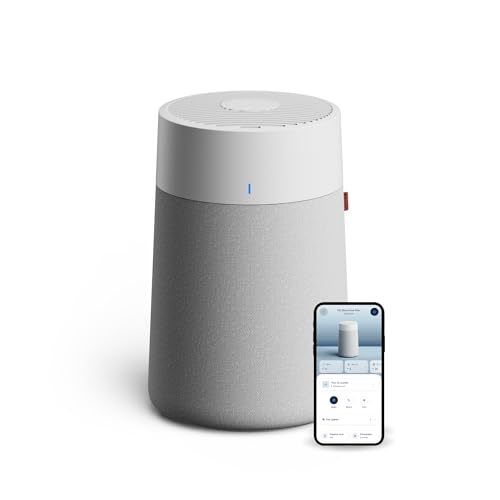
BLUEAIR Blue Pure 511i Max — Best Quiet Performance
Blueair’s party trick is filtration that cleans hard at noise levels other brands reach only on their weakest setting, and the 511i Max’s night mode — rated at a whisper-level 19 dB on the listing — is built for exactly the room this guide is about. The auto mode reads the air and adjusts, and the app lets a parent change settings from the hallway without opening the nursery door, which any parent who has finally achieved a nap will recognise as a serious feature. It suits smaller to mid-size nurseries. App-averse households should take the Levoit instead and lose nothing essential.
Strengths
- Exceptionally quiet night mode for a genuinely powerful cleaner
- Auto mode plus app control means fewer nursery-door openings
- Washable fabric pre-filter catches the dust and hair before the main filter
Trade-offs
- Connected features are wasted if you prefer fully manual appliances
- Replacement filters sit at a premium tier
- Fabric pre-filter needs regular vacuuming or washing to stay effective
Key specs: HEPASilent filtration; 19 dB night mode; auto mode; WiFi app; 360-degree intake
The 511i Max is what happens when a purifier is designed by people who understand that the product’s real competitor is the off switch. Its HEPASilent approach blends mechanical and electrostatic capture to move air quietly, the 360-degree intake forgives placement against a wall, and the night mode respects the nursery’s darkness as well as its silence. In auto, it will ramp up after you vacuum the hallway or open a window on a pollen day, then settle back down — behaviour you feel as a parent mostly by never thinking about the machine at all. That invisibility, at this cleaning level, is the premium you are paying for, and in a baby’s room it is a rational premium.
Best for: Light-sleeping babies and parents in the same room / Not suited for: Buyers avoiding app-connected appliances
Check on Amazon — check the current price on Amazon.
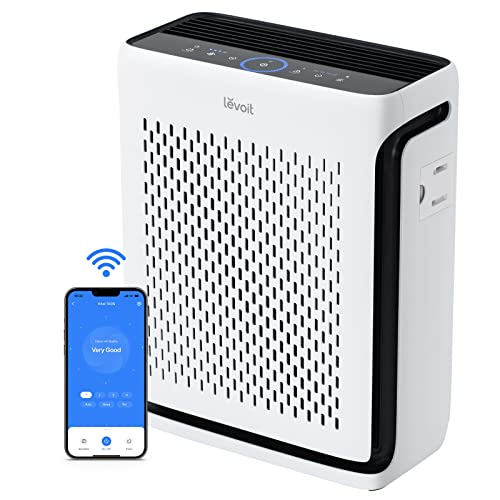
LEVOIT Vital 100S-P Air Purifier — Best Smart Value
The Vital 100S-P is for the parent who will absolutely check the air-quality readout at 2 a.m. and feel better for it. Its sensor shows the room’s particle level, its auto behaviour responds to real events — a door left open, a dog shaking off — and the washable pre-filter stretches the main filter’s life in pet households. The footprint suits a standard nursery. It shares the Core 300’s honest caveat: ratings assume full speed, so size it for a nursery, not a floor of the house. Fully manual households should take the 300-P and ignore the telemetry.
Strengths
- Air-quality display turns invisible air into a checkable number
- Washable pre-filter cuts running costs in dusty and pet homes
- Sleep mode keeps nights quiet and dark
Trade-offs
- Sensor and display are features you must remember to dim at night
- Smart features add cost over the simpler Core 300-P
- Main filter still needs scheduled replacement — washable is only the pre-filter
Key specs: HEPA filtration; air quality monitor; washable pre-filter; sleep mode; AHAM verified
There are two kinds of nursery purifier owners: those who want to forget the machine exists and those who want evidence it works. The Vital 100S-P serves the second kind properly. Watching the readout fall after you close a window on a high-pollen day is genuinely reassuring, and the auto mode converts that information into action without a parent adjudicating speeds at midnight. The washable pre-filter is the quiet money-saver — in a home with a shedding dog, it intercepts the hair and dust that would otherwise choke the main filter early. Set the display to sleep with the baby, keep the pre-filter clean, and this is the smartest value in the guide.
Best for: Parents who want the purifier to tell them what it is doing / Not suited for: Anyone who wants zero sensors and zero app
Check on Amazon — check the current price on Amazon.
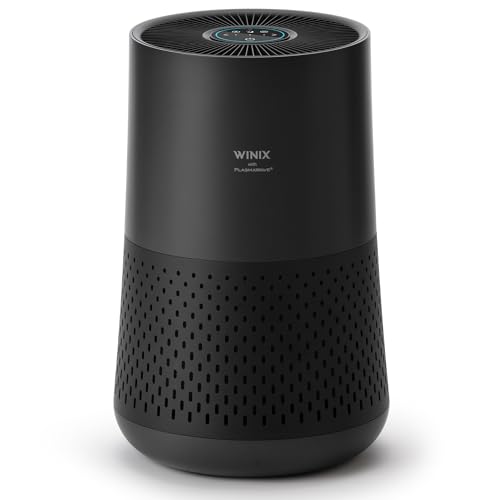
WINIX A230 Air Purifier — Best for Pet Households
A baby room does not exist in isolation — it exists in a house with a cat who considers the nursery hers and a dog whose dander tours every room. The A230 answers that reality with True HEPA for the particles and a substantial carbon stage for the odours that make a closed nursery smell like a closed nursery by morning. Auto mode with a quality monitor runs the show sensibly. It is a slightly larger presence than the Levoit cylinders, so tiny nurseries should measure the corner it will live in. Pet-free small rooms can take a smaller pick and save the space.
Strengths
- True HEPA plus carbon handles both particles and household odours
- Auto mode with a real air-quality monitor
- Strong pet-dander performance for animal-owning households
Trade-offs
- Larger footprint than the compact cylinders
- Carbon filter adds to the replacement schedule and cost
- Display needs managing at night like all sensor models
Key specs: True HEPA; carbon filter; air quality monitor; auto mode; bedroom sizing
Winix built its name on exactly this combination — honest HEPA, real carbon, sensible automation — and the A230 packages it at bedroom scale. In a pet household, the carbon stage is not a luxury: nappy pails, night feeds and a closed door concentrate smells, and a purifier that only catches particles leaves the room’s air technically cleaner and experientially identical. The monitor-driven auto mode also suits the nursery rhythm — quiet through the night, responsive when the household wakes and starts moving dust around. Keep up with the combined filter changes and it will serve from newborn nights through the toddler years without drama.
Best for: Nurseries in homes with cats and dogs / Not suited for: Minimalists who want the smallest possible unit
Check on Amazon — check the current price on Amazon.
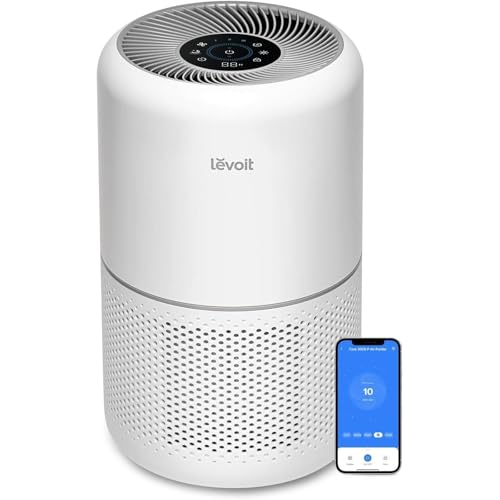
LEVOIT Core 300S-P Smart Air Purifier — Best App Control
The 300S-P takes the Core 300 formula and adds the thing tired parents actually use connectivity for: control without entering the room. Schedules that drop the unit to sleep mode at bedtime, a speed change from your phone during a nap you refuse to endanger, a voice command from the kitchen — that is the real feature list. The filtration is the proven Core story, quiet at sleep settings and AHAM verified. It suits households already running a smart home. If your nursery philosophy is deliberately screen-free and switch-simple, the base 300-P is the same cleaner with fewer radios, and you should buy that one instead.
Strengths
- App and voice control protect naps — no door opening required
- Schedules automate the day/night speed rhythm
- Same proven, quiet Core filtration platform
Trade-offs
- Connectivity is pointless cost if you will never open the app
- WiFi setup is one more account in a new parent’s life
- Sensor-free design means speeds are yours to schedule
Key specs: HEPA filtration; WiFi app and voice control; quiet sleep mode; AHAM verified
Smart features earn their keep in a nursery in one specific way: they move interactions with the machine out of the room. Every purifier adjustment that happens from a phone in the hallway is a creaking door that never happened. The 300S-P’s scheduling makes the ideal pattern automatic — medium through the day, sleep mode and dark display at night, a boost after cleaning — and its sleep-mode noise is rated low enough for crib-side duty. Everything else about it is the dependable Core platform: honest filters, available everywhere, at a running cost you can predict. For connected households this is the most complete nursery package here.
Best for: Connected-home parents who run schedules for everything / Not suited for: Anyone deliberately keeping the nursery low-tech
Check on Amazon — check the current price on Amazon.

BLUEAIR Blue 311i Max — Best for Larger Nurseries
Some nurseries are not small: a converted primary bedroom, a shared room for siblings, a nursery corner of an open-plan floor. The 311i Max is the pick for those spaces — roughly double the 511i’s cleaning capacity while keeping its low-speed noise at a sleep-compatible level, with the same auto mode, app control and washable pre-filter. It is overkill for a standard small nursery, where its little sibling does the same job in less space, and its filter costs scale with its size. Buy capacity honestly: measure the room, then choose.
Strengths
- Serious cleaning capacity that stays quiet at nursery speeds
- Auto mode and app control scale to bigger, busier rooms
- Washable pre-filter keeps the big main filter efficient longer
Trade-offs
- Oversized — in cost, footprint and filters — for a standard nursery
- Premium tier across purchase and running costs
- App ecosystem required to get the full value
Key specs: HEPASilent filtration; 23 dB low operation; auto mode; WiFi; AHAM verified; washable pre-filter
Capacity is the nursery’s invisible variable: an undersized purifier on a quiet speed barely turns a large room’s air over, so it cleans the corner it sits in and little else. The 311i Max exists to make the quiet speed sufficient in a big room — more air moved per hour at the same hush — and that is the correct way to size any purifier you intend to sleep beside. Everything good about the smaller Blueair carries up: the auto behaviour, the pre-filter discipline, the app that keeps you out of the room. If your nursery is genuinely large, this is not the extravagant pick; it is the correctly sized one, and the 511i is the false economy.
Best for: Large nurseries, shared sibling rooms and open-plan spaces / Not suited for: Small nurseries, where the 511i Max is the right size
Check on Amazon — check the current price on Amazon.
Comparison Table
| Pick | Badge | Key spec | Best for |
|---|---|---|---|
| LEVOIT Core 300-P Air Purifier | Best Overall for Nurseries | HEPA filtration with sleep mode; AHAM verified; rated up to 1,073 sq ft at full speed | Most nurseries — the default recommendation |
| BLUEAIR Blue Pure 511i Max | Best Quiet Performance | HEPASilent filtration; 19 dB night mode; auto mode; WiFi app; 360-degree intake | Light-sleeping babies and parents in the same room |
| LEVOIT Vital 100S-P Air Purifier | Best Smart Value | HEPA filtration; air quality monitor; washable pre-filter; sleep mode; AHAM verified | Parents who want the purifier to tell them what it is doing |
| WINIX A230 Air Purifier | Best for Pet Households | True HEPA; carbon filter; air quality monitor; auto mode; bedroom sizing | Nurseries in homes with cats and dogs |
| LEVOIT Core 300S-P Smart Air Purifier | Best App Control | HEPA filtration; WiFi app and voice control; quiet sleep mode; AHAM verified | Connected-home parents who run schedules for everything |
| BLUEAIR Blue 311i Max | Best for Larger Nurseries | HEPASilent filtration; 23 dB low operation; auto mode; WiFi; AHAM verified; washable pre-filter | Large nurseries, shared sibling rooms and open-plan spaces |
Nursery Air Beyond the Purifier
A purifier works on the air in the room; the room’s contents decide how much work it has to do. The biggest particle sources in a nursery are textiles and traffic: carpet and rugs hold dust that every footstep launches, bedding sheds fibres and collects skin cells, soft toys accumulate dust in their pile, and every door opening imports the rest of the house. None of this argues against comfort — it argues for rhythm. Vacuum the nursery with the baby elsewhere, ideally with a HEPA-filtered vacuum; wash bedding weekly in the baby’s own routine; keep crib soft toys to the safe-sleep minimum anyway; and wipe hard surfaces with a damp cloth, which traps dust instead of relocating it into the air the purifier then has to catch.
Ventilation is the other half of the system, used with judgement. On days when outdoor air is clean and pollen is low, an open window exchanges a room’s air faster than any purifier — then close it and let the machine maintain the result. On high-pollen days, wildfire-smoke days or beside a busy road, the windows stay shut and the purifier carries the whole load, which is exactly when its quiet-speed capacity matters. Parents who run both halves of this system — source control plus steady filtration — get results no single appliance can deliver, and the purifier’s own air-quality behaviour, on the sensor models here, will show the difference within a day.
From Nursery to Child’s Room: The Long Service Life
A nursery purifier is one of the few baby purchases that does not expire. The room becomes a toddler’s, then a child’s; the crib leaves, the bed arrives, but the air questions persist — dust from play, pollen through school years, the dog who has finally been granted sleeping rights in the big kid’s room. The models in this guide were chosen partly for that arc: standard filter ecosystems that will still be sold in five years, footprints that suit any bedroom, and controls a child can eventually be taught to leave exactly as they are. When you cost a purifier, cost it across that service life rather than the baby year alone, and the premium picks’ arithmetic changes considerably.
The maintenance habit transfers too. A family that logs filter dates for the nursery keeps logging them when the unit moves rooms, and a purifier maintained on schedule in year four cleans like the one unboxed in year one. If a second child arrives, the calculus inverts happily: the proven unit goes to the new nursery, and the older child graduates to whichever pick suits their bigger room. Few objects in the baby catalogue earn a second tour of duty; a well-chosen purifier is one of them, which is worth remembering when the tier differences in this guide feel abstract at the checkout.
Pollen, Smoke Days and the Seasonal Purifier
A nursery purifier earns its keep unevenly across the year, and understanding its seasons helps parents run it well. Spring and autumn pollen peaks are its busiest honest work: windows closed on high-count days, the unit on auto or medium, and the room’s air kept ahead of what clothing and hair import. Wildfire smoke days — now a recurring season in many regions — are its most serious duty: the purifier becomes the room’s primary defence, run on higher speeds with the door kept shut, and its filter will age faster in a smoky month than in a clean quarter, which parents should budget for rather than discover.
Winter is the quiet season of closed houses and recirculated air, where the purifier’s job is the household’s own dust and dander at low, steady speeds. Summer splits by climate: air-conditioned homes keep windows shut and the purifier relevant, while mild-climate homes with open windows all day should accept that the machine maintains the night, when windows close, rather than fighting the daytime outdoors. Running the right expectation per season — and stepping the speed up when the season demands instead of leaving the unit on sleep mode through a smoke event — is the difference between owning a purifier and benefiting from one.
Twins, Siblings and Shared Rooms: Sizing Up Honestly
Shared rooms multiply everything: two sleepers breathing, two sets of bedding shedding, double the door openings, and usually a larger room to begin with. The sizing rule from the main guide applies with double force — choose by the quiet speed’s capacity, and in a shared room that almost always means stepping up a class, to the 311i Max end of this guide, rather than asking a compact unit to serve two children from a corner. Placement also matters more: central to the room’s breathing zones rather than beside one favoured crib, with the intake clearance that crowding furniture tends to steal.
Twins add a rhythm consideration: the room’s door opens twice as often, night feeds happen in shifts, and the purifier’s night manners — dark display, no sudden auto ramps beside a finally-sleeping baby — become decisive. Sensor models should be set to their sleep behaviour explicitly rather than left to react to every feed-time door opening. Get the sizing and the night pattern right, and one well-chosen unit serves a shared room as faithfully as it serves a single nursery; get them wrong and no quantity of smaller units in corners will add up to the same result.
Second-Hand Purifiers and Hand-Me-Down Air
Purifiers pass between families constantly — a sibling’s nursery unit, a marketplace find — and they are among the safer baby items to accept second-hand, with one non-negotiable condition: the filter. A used purifier should be treated as a housing for a filter you have not bought yet; price any second-hand unit as though a new filter set is part of the purchase, because it is. Clean the exterior and the pre-filter area thoroughly, inspect the intake for the dust felt that accumulates in fan housings, and run the unit in another room for a day before it joins the nursery. Models from this guide are good hand-me-down candidates precisely because their filters remain standard, stocked items years later — one more dividend of choosing a mainstream platform. What should not be handed down is a unit with a damaged cord, a rattling fan or an ozone-generating design of uncertain vintage; the nursery’s air equipment should be boring, intact and fully knowable, which a sound used HEPA box, freshly filtered, entirely is.
Guests, Grandparents and the Purifier’s Social Life
A nursery purifier eventually meets the household’s social reality: the grandparent who unplugs it to charge a phone, the cleaner who moves it and blocks its intake with the laundry basket, the guest who finds its hum worth a complaint. The fixes are social, not technical. Put the unit on an outlet nothing else wants, label its plug if the household is forgetful, and include it in the two-sentence briefing every carer gets — it stays on, its light stays dark, its corner stays clear. In return the purifier does quiet social work of its own: the guest room that hosts a visiting baby inherits it for the weekend, the relative with hay fever claims the nursery chair is the one seat in the house that does not make them sneeze, and the machine becomes part of how the home cares for people. Appliances that are understood by the whole household get maintained by the whole household, and a purifier’s filter schedule, as this guide has insisted, is where its real performance lives.
One Last Check Before You Click
Before ordering, confirm the five nursery essentials this guide has built toward: capacity sized by the quiet speed rather than the headline; genuine HEPA-style mechanical filtration with no ozone-generating extras; night manners — a sleep-quiet working speed and a display that goes fully dark; a filter ecosystem you can still buy in five years, with its replacement date headed for your calendar the day the unit arrives; and a placement with intake clearance and a cord routed out of reach from day one. A purifier chosen on those five points will not be the loudest, brightest or cleverest object in the nursery. It will simply be the one still running, quietly and correctly, when the baby it was bought for is old enough to ask what it is.
How to Choose an Air Purifier for a Baby Room
Size by the quiet speed, not the headline. Listings rate room coverage at maximum speed, which in a nursery is a speed you will use while the baby is elsewhere. The useful question is how much air the unit cleans on its sleep or low setting — that is the setting that will actually run for twelve hours a night. For a typical nursery of 100 to 150 square feet, the compact picks in this guide are honestly sized; for large or shared rooms, step up to the 311i Max rather than running a small unit on a loud speed and teaching yourself to switch it off.
Filtration should be mechanical and boring: a HEPA or HEPA-style main filter for fine particles, a pre-filter for dust and hair, and a carbon stage if your home has pets or a nappy pail living in the room. Avoid technologies that generate ozone or rely on ionisation as the main event in a baby’s room — the established, filter-in-a-box approach is what paediatric-adjacent guidance consistently points to, and it is what every pick here uses. Check filter availability and replacement intervals before buying; a purifier with an unobtainable filter is a countdown to landfill.
Then judge the night manners. Noise at the working speed, a display that fully darkens, no status light bright enough to read by, and controls — or an app — that never require opening the nursery door at the wrong moment. Placement matters too: near the crib but not blowing across it, with clearance around the intake, away from the corner where it would clean only its own pocket of air. Run it continuously rather than in bursts; steady cleaning at a quiet speed beats heroic cleaning twice a day.
What a Purifier Can and Cannot Do in a Nursery
A purifier reduces airborne particles in the room — dust, pollen tracked in on clothes, pet dander, the fine material that sunlight reveals in a shaft across the crib. It can take the edge off household odours with a carbon filter. That is the honest capability list, and it is genuinely useful in a room where a baby breathes for most of the day and night.
It does not sterilise air, remove the need to clean, or treat any medical condition, and any product implying otherwise should be distrusted on sight. Babies with breathing difficulties, persistent congestion or diagnosed conditions need clinical care; a purifier is a household appliance that supports a clean-air environment, nothing more and — used steadily — nothing less. Pair it with the unglamorous basics: vacuum with the baby out of the room, wash bedding regularly, keep soft toys in the crib to the safe-sleep minimum, and ventilate the room when outdoor air is good.
Running Costs and Filter Discipline
A purifier’s purchase tier is only half its cost story. Filters are consumables: pre-filters wash or vacuum clean, main HEPA filters replace on a schedule of months, carbon stages exhaust and quietly stop absorbing odours while looking identical. Set a calendar reminder when you install the unit, because a purifier running on an exhausted filter is furniture that hums. Models with washable pre-filters — both Blueairs and the Vital 100S-P here — stretch the main filter’s life in dusty and pet homes, which is real money across years of nightly running.
Energy use at sleep speeds is small — these are fan appliances, not heaters — so continuous running is the correct and affordable pattern. The false economy is the undersized unit: bought cheap, run loud or not at all, replaced within a year. Size it right once, keep its filters current, and a nursery purifier is one of the longest-serving appliances in the baby’s room, still useful when the room becomes a toddler’s, then a child’s.
How to Set Up a Purifier in a Baby Room
- Choose the spot: Place the purifier on the floor near the crib’s side of the room but not aimed across it, with clear space around the intake — not sealed in a corner, not behind the nursing chair.
- Remove every film and bag: New filters ship wrapped. Open the unit and unwrap the filter before first use — running a purifier with a bagged filter is the most common setup error in the category.
- Run a daytime boost first: Run the unit on a higher speed for an hour before the baby’s first sleep in the room, to turn the room’s air over several times.
- Set the night pattern: Choose sleep or low speed for the night, dim or extinguish the display fully, and — on smart models — schedule the pattern so no one has to remember it.
- Close the loop on the room: Purifiers work on room air: keep the door mostly closed at night and windows shut on high-pollen days, or the unit fights the whole outdoors.
- Log the filter date: Write the install date on the filter or set a phone reminder for its replacement window the day you set the unit up.
- Review monthly: Vacuum or wash the pre-filter monthly in pet and dust homes, and check that the intake has not been blocked by the migrating furniture of baby life.
Set up this way, the purifier becomes part of the room’s furniture of habits: always on, never noticed, filters changed on schedule. That unglamorous consistency — not any single feature — is what actually keeps nursery air clean.
Common Buying Mistakes
Sizing by the headline room rating
Coverage figures assume maximum speed. A unit that covers your nursery only on turbo will be run on low and under-clean the room, or run loud and get switched off. Size for the quiet speed you will actually use at night.
Buying ioniser-first designs for a nursery
Technologies that generate ozone or rely on ionisation do not belong in a baby’s room. Mechanical HEPA filtration is the established, verifiable approach — if a listing leads with ions and cannot name its filter, walk away.
Leaving the filter in its shipping bag
It happens constantly: the purifier runs, the air does not improve, the filter is still sealed in plastic inside the unit. Unwrap the filter at setup, every time.
Parking it in a blocked corner
A purifier cleans the air it can draw in. Sealed behind furniture or hard against a wall on its intake side, it polishes a pocket of air and ignores the room. Give the intake clearance and keep it near the breathing zone it serves.
Forgetting the filter schedule
An exhausted HEPA filter and a spent carbon stage look exactly like fresh ones. Without a calendar reminder, most households run dead filters for months. Log the date at setup and honour it.
Expecting it to replace cleaning
A purifier handles what floats; it does nothing for dust settled in carpet, bedding and soft furnishings, which re-launches into the air daily. Vacuum and wash bedding as if the purifier were not there — because for settled dust, it effectively is not.
Final Recommendation
Most nurseries should buy the LEVOIT Core 300-P: quiet, dark, proven and honestly sized for a standard room. Light sleepers and door-averse parents get the BLUEAIR 511i Max and its remarkable night mode; data lovers get the LEVOIT Vital 100S-P; pet households get the WINIX A230 and its carbon stage; connected homes get the LEVOIT Core 300S-P; and genuinely large nurseries get the BLUEAIR 311i Max, sized correctly instead of loudly. Whichever arrives, unwrap its filter, place it with clearance, set the night pattern once, and let it disappear into the routine — that disappearance is the product working.
Complete the nursery’s air-and-sleep system with our textile guides: Best Crib Toddler Sheet Sets for what the baby sleeps on, and Best Baby Washcloths And Hooded Towels for bath time at the other end of the day.
- LEVOIT Core 300-P Air Purifier — Best Overall for Nurseries: Check on Amazon
- BLUEAIR Blue Pure 511i Max — Best Quiet Performance: Check on Amazon
- LEVOIT Vital 100S-P Air Purifier — Best Smart Value: Check on Amazon
- WINIX A230 Air Purifier — Best for Pet Households: Check on Amazon
- LEVOIT Core 300S-P Smart Air Purifier — Best App Control: Check on Amazon
- BLUEAIR Blue 311i Max — Best for Larger Nurseries: Check on Amazon
Best Crib Toddler Sheet Sets Best Baby Washcloths And Hooded Towels Best Air Purifiers Best White Noise Machines Best Baby Blankets
Related guides
Frequently Asked Questions
Should a baby room purifier run all night?
Yes — continuous running at a quiet speed is the correct pattern. Air does not stay clean; particles enter with every door opening and rise from bedding and carpet with movement. A purifier on sleep mode all night maintains the room’s air steadily, and its energy use at that speed is small.
Where should I place a purifier in the nursery?
On the floor in the crib’s half of the room, with clearance around its intake, not blowing directly across the crib and not sealed behind furniture. Keep cords completely out of the baby’s reach as they grow — route them behind furniture from day one so the habit is built before the baby is mobile.
Is HEPA necessary, or is a basic filter enough?
For the fine particles that are the point of a nursery purifier — pollen, dander, fine dust — HEPA or HEPA-style filtration is the meaningful standard, and every pick in this guide meets it. Basic foam or mesh filters catch lint and hair only; they are pre-filters, not the main event.
Are air purifiers safe around babies?
Mechanical filter purifiers of the kind in this guide are household appliances designed for bedrooms and are widely used in nurseries. Choose HEPA-based models without ozone-generating features, place the unit and its cord out of reach, and remember a purifier supports a clean-air environment — it is not a medical device and does not replace clinical care for any breathing concern.
How often do nursery purifier filters need changing?
Follow the maker’s schedule for your model — typically months for a main HEPA filter, sooner in dusty or pet-heavy homes, with pre-filters vacuumed or washed monthly. Write the install date on the filter at setup; memory is not a maintenance system.
Can a purifier help with nappy pail smells?
A model with a real carbon stage — the WINIX A230 in this guide — will reduce nursery odours noticeably. Particle-only filters do nothing for smells. Carbon exhausts over time, so a purifier that once handled odours and no longer does is telling you its carbon stage is spent.


