Disclosure: airfryerkitchensupply.com is reader-supported. When you buy through links on our site, we may earn an affiliate commission at no extra cost to you.
Where to buy
For an asthma household, buy for the bedroom first — that is where the purifier runs longest and where night-time air matters most — and size it for the room with headroom to spare. All six picks below were confirmed cache, so every one carries a link; check the current price on Amazon and confirm the filter type on the listing before ordering.
LEVOIT Core 300S-P Smart Air Purifier — Check the current price on Amazon
BLUEAIR Blue 211i Max Air Purifier — Check the current price on Amazon
COWAY Airmega Mighty AP-1512HH(W) Air Purifier — Check the current price on Amazon
WINIX 5510 Air Purifier — Check the current price on Amazon
Medify MA-40 Air Purifier — Check the current price on Amazon
Austin Air HealthMate Plus Air Purifier, White, Model B450 — Check the current price on Amazon
The best air purifiers for asthmatics are chosen differently from general-purpose purifiers, and this guide will be plain about the boundary: a purifier is not a medical device and does not treat asthma. What it can do is reduce airborne particles — dust, pollen, pet dander, and smoke — in the room where it runs, and many households find that worthwhile as part of a cleaner-air routine alongside their clinician’s advice. The features that matter are true HEPA filtration, enough clean-air delivery to turn the room’s air over several times an hour, quiet sleep operation, and sealed construction so air cannot bypass the filter. The six verified picks below are judged on exactly those points.
In this guide
Quick Picks
LEVOIT Core 300S-P Smart Air Purifier — Best Overall for Bedrooms. A compact smart purifier with HEPA filtration, an AHAM-verified rating, and a genuinely quiet sleep mode — the sensible default for a bedroom-first strategy.
Check the current price on Amazon
BLUEAIR Blue 211i Max Air Purifier — Best for Large Rooms. High clean-air delivery for large living spaces with HEPASilent filtration and auto mode — the pick when one machine must cover the room where the household actually lives.
Check the current price on Amazon
COWAY Airmega Mighty AP-1512HH(W) Air Purifier — Best Proven All-Rounder. A long-established HEPA model with an air-quality monitor, auto and eco modes, and a multi-year warranty — the safe pair of hands in this category.
Check the current price on Amazon
WINIX 5510 Air Purifier — Best for Odours and Smoke Drift. True HEPA plus a heavy deodorising carbon filter and app support — for homes where particles arrive with smells attached: cooking, wood smoke, or a smoker nearby.
Check the current price on Amazon
Medify MA-40 Air Purifier — Best Value Coverage. Generous stated coverage and HEPA filtration aimed at pollen, smoke, and pets — a workhorse choice for a main living space or a wildfire-smoke season.
Check the current price on Amazon
Austin Air HealthMate Plus Air Purifier, White, Model B450 — Best Long Filter Life. A steel-bodied, four-stage purifier with a carbon-and-zeolite stage and a filter life measured in years — the low-maintenance, buy-it-once end of this category.
Check the current price on Amazon
How These Picks Were Chosen
We required true HEPA filtration or an equivalent high-efficiency sealed system, and treated ionisers and ozone-generating features as disqualifying — ozone is an airway irritant, which is the opposite of what this category is for. We sized each pick by its stated room coverage and preferred models with an auto mode driven by a particle sensor, a genuine sleep mode quiet enough for a bedroom, and widely available replacement filters, because a purifier with an exhausted filter is furniture.
The 6 Best Air Purifiers for Asthmatics
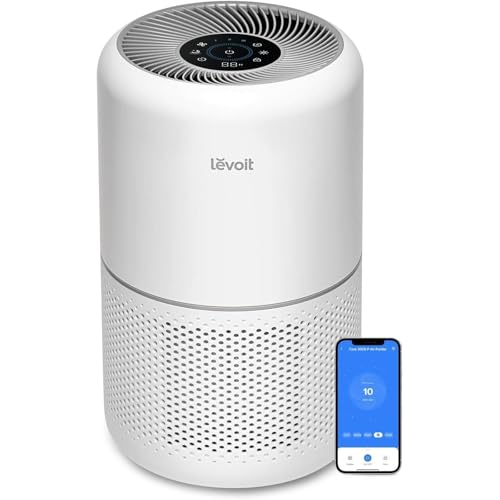
LEVOIT Core 300S-P Smart Air Purifier — Best Overall for Bedrooms
Check the current price on Amazon
Bedrooms reward quiet and consistency more than raw power, and this model is built around both: it can run all night at a low, steady level, respond automatically when particle levels rise, and be checked or scheduled from an app so it is actually used rather than forgotten in a corner.
Strengths
- HEPA filtration with AHAM-verified performance for the stated room size
- Sleep mode aimed at quiet night operation, as stated in the listing
- Smart and voice control make daily use and scheduling effortless
Trade-offs
- Compact coverage suits bedrooms and smaller living spaces, not open-plan floors
- Smart features are useless if you dislike apps — the manual controls still work, but you pay for connectivity
- Filters are a recurring cost; check replacement availability before committing
Key details: HEPA filtration, AHAM Verified, smart WiFi and Alexa control, sleep mode (from the Amazon listing title).
Run this purifier the way asthma households get the most from any purifier: continuously, at the highest speed you can sleep through, rather than in bursts at turbo. Air cleaning is cumulative — the benefit comes from the room’s air passing through the filter many times a day. Place it clear of walls and curtains, away from the corner, with its intake unobstructed, and keep the bedroom door closed at night so the machine is cleaning a defined volume rather than the whole house badly. Replace the filter on the indicator or schedule, not when it looks dirty, because particle loading is invisible long before it is visible.
Best for: bedrooms and nurseries-sized rooms where quiet, always-on running matters most / Not suited for: large open-plan living areas, which need a higher-capacity model

BLUEAIR Blue 211i Max Air Purifier — Best for Large Rooms
Check the current price on Amazon
Open-plan rooms defeat small purifiers: the air volume is simply too large to turn over. This model is sized for that job, with coverage figures aimed at big rooms and a filtration approach designed to move a lot of air without sounding like it. Its auto mode and washable pre-filter suit a busy family room.
Strengths
- Coverage aimed at large rooms, with AHAM verification stated in the listing
- HEPASilent filtration designed for quieter high-volume cleaning
- Washable pre-filter catches hair and dust before the main filter
Trade-offs
- A large-room machine is physically bigger and costs more to filter over time
- HEPASilent is a proprietary approach — read the listing’s filtration description carefully if you want strictly traditional HEPA
- Overkill for a small bedroom, where the Levoit or Coway 50 fits better
Key details: Large-room coverage, HEPASilent filtration, WiFi, auto mode, washable pre-filter (from the Amazon listing title).
For a large room, placement decides whether the capacity on the box becomes capacity in the air. Put the unit where air circulates — not inside a shelving nook — and run auto mode so it responds to cooking, vacuuming, and the dog shaking itself, the three events that spike particle levels in a family room. The washable pre-filter is a real running-cost feature: vacuum or wash it on the maker’s schedule and the main filter behind it lasts as intended rather than clogging early with hair and lint.
Best for: large living rooms and open-plan spaces in an asthma-aware household / Not suited for: small bedrooms or anyone wanting the lowest possible filter costs

COWAY Airmega Mighty AP-1512HH(W) Air Purifier — Best Proven All-Rounder
Check the current price on Amazon
The Mighty has been a default recommendation in this class for years because it does the fundamentals without fuss: real HEPA filtration, a particle-driven auto mode, a filter indicator you can trust, and coverage that suits a bedroom or a modest living room. The eco mode, which pauses the fan when the air stays clean, suits always-plugged-in use.
Strengths
- True HEPA filtration with air-quality monitoring and auto mode
- Eco mode reduces fan running when air is already clean
- A stated multi-year warranty, longer than most in this class
Trade-offs
- The design has been around a long time and looks it next to newer models
- No smart app control in this configuration
- Mid-sized coverage — measure your largest room before assuming one unit does it all
Key details: HEPA filter, coverage up to the stated large-room figure, auto and eco modes, filter indicator (from the Amazon listing title).
This is the purifier to buy when you want to stop researching. Set it to auto, close the bedroom door at night, and let the sensor do the thinking; check the filter indicator monthly. Its longevity in the market also means replacement filters are easy to find, which matters more in year three than any launch-day feature. Households sensitive to noise should still test sleep on its lowest setting during the returns window — ‘quiet’ is personal, and the bedroom is the one room where a wrong noise judgement cannot be worked around.
Best for: buyers who want a proven HEPA all-rounder for a bedroom or mid-sized living room / Not suited for: anyone who wants app control or the newest industrial design

WINIX 5510 Air Purifier — Best for Odours and Smoke Drift
Check the current price on Amazon
Particles and odours are different problems. HEPA handles the particles; gases and smells need carbon, and in quantity. This model’s emphasis on deodorisation makes it the pick for the asthma household whose triggers include smoke drift from a neighbour, a wood stove, or heavy cooking — always alongside ventilation, never instead of it.
Strengths
- True HEPA filtration for particles, pollen, and dander
- High-deodorisation carbon stage for smoke and cooking odours
- Auto mode and app support for set-and-forget running
Trade-offs
- Carbon filters saturate and need replacing on schedule or the odour benefit fades
- Larger-room sizing is bigger and heavier than a bedroom-only unit
- No purifier makes indoor smoking safe — this reduces drift and residue, nothing more
Key details: True HEPA, high-deodorisation carbon filter, auto mode, app support, large-room coverage (from the Amazon listing title).
Be precise about what this machine can and cannot do in a smoky environment. It will clear visible haze and reduce lingering smell in a closed room, and its particle sensor will show you the effect of opening a door to a smoky hallway in real time — which is genuinely useful information for managing an asthma household’s routines. It does not make a room where someone smokes a healthy room. Use it for drift, for the day after, and for cooking and stove smoke, keep up source control first, and budget for carbon filter replacements as a running cost, not an afterthought.
Best for: homes dealing with smoke drift, wood stoves, or heavy cooking odours / Not suited for: anyone expecting a purifier to neutralise active indoor smoking

Medify MA-40 Air Purifier — Best Value Coverage
Check the current price on Amazon
The MA-40’s case is coverage per purchase: a big stated room figure and a filter aimed at the standard asthma-relevant particles — pollen, dust, dander, and smoke. It suits the household that wants one capable machine for the living room now and may add a small bedroom unit later.
Strengths
- Large stated coverage for a main living space
- HEPA filtration described to 0.3 microns in the listing
- Aimed squarely at smoke, pollen, and pet particles
Trade-offs
- Coverage claims are stated for one hour — real rooms need the turnover thinking in the guide below
- Fewer smart features than the app-connected picks
- Confirm the exact filter designation when ordering replacements
Key details: HEPA filter, large stated coverage, particle removal to 0.3 microns per the Amazon listing title.
Wildfire and high-pollen seasons are where a machine like this earns its shelf space: windows closed, purifier running continuously on a medium setting, and the indoor air kept measurably cleaner than the outdoor air for the days that matter. Outside those seasons, auto or low running keeps the baseline down without the fan becoming the loudest thing in the house. As with every pick here, keep the intake clear, vacuum the room regularly — purifiers clean air, not carpets — and treat the filter schedule as part of the purchase price from day one.
Best for: main living spaces and households in wildfire-smoke or high-pollen regions / Not suited for: buyers who want app control and the quietest possible bedroom unit

Austin Air HealthMate Plus Air Purifier, White, Model B450 — Best Long Filter Life
Check the current price on Amazon
Most purifiers ask for a filter every six to twelve months. This one is built around a large filter rated in years, with a heavy carbon blend aimed at gases and odours as well as HEPA particle filtration. For an asthma household tired of consumable schedules — or managing a purifier for a relative — that changes the ownership experience completely.
Strengths
- Four-stage filtration including activated carbon and zeolite for gases and odours
- Filter life stated in years rather than months
- Sturdy, simple construction with no app or smart features to fail
Trade-offs
- The highest commitment up front of any pick here, even without printing a figure
- Large and heavy — it lives where you place it
- No sensor-driven auto mode of the kind the Coway and Winix offer
Key details: 4-stage filtration, activated carbon and zeolite, stated coverage up to 1,500 sq ft, 5-year filter life (from the Amazon listing title).
Judge this machine on cost and effort per year, not on purchase day. A household that will genuinely forget quarterly filter changes — which is most households — may get cleaner air from a filter that lasts years than from a technically finer machine running on an exhausted cartridge. Its gas-phase stage also suits homes near traffic or with strong indoor odour sources, where particle-only filtration leaves half the problem untouched. Place it once, place it well, run it steadily, and let its simplicity be the feature it was bought for.
Best for: low-maintenance households and anyone prioritising gas and odour filtration with years-long filter life / Not suited for: buyers who want smart features, portability, or a small footprint
Comparison Table
| Pick | Badge | Key detail | Best for |
|---|---|---|---|
| LEVOIT Core 300S-P Smart Air Purifier | Best Overall for Bedrooms | HEPA, AHAM Verified, smart sleep mode | bedrooms and nurseries-sized rooms where quiet, always-on running matters most |
| BLUEAIR Blue 211i Max Air Purifier | Best for Large Rooms | Large-room HEPASilent, auto mode | large living rooms and open-plan spaces in an asthma-aware household |
| COWAY Airmega Mighty AP-1512HH(W) Air Purifier | Best Proven All-Rounder | HEPA, auto/eco, long warranty | buyers who want a proven HEPA all-rounder for a bedroom or mid-sized living room |
| WINIX 5510 Air Purifier | Best for Odours and Smoke Drift | True HEPA + heavy carbon stage | homes dealing with smoke drift, wood stoves, or heavy cooking odours |
| Medify MA-40 Air Purifier | Best Value Coverage | HEPA, large stated coverage | main living spaces and households in wildfire-smoke or high-pollen regions |
| Austin Air HealthMate Plus Air Purifier, White, Model B450 | Best Long Filter Life | 4-stage, carbon/zeolite, 5-year filter | low-maintenance households and anyone prioritising gas and odour filtration with years-long filter life |
LEVOIT Core 300S-P Smart Air Purifier — check price on Amazon
BLUEAIR Blue 211i Max Air Purifier — check price on Amazon
COWAY Airmega Mighty AP-1512HH(W) Air Purifier — check price on Amazon
WINIX 5510 Air Purifier — check price on Amazon
Medify MA-40 Air Purifier — check price on Amazon
Austin Air HealthMate Plus Air Purifier, White, Model B450 — check price on Amazon
How to Choose an Air Purifier for an Asthma Household
Start with filtration, and be specific. You want true HEPA — a sealed system that traps the fine particles that matter — and you want no ozone: avoid ioniser and plasma features that can generate ozone, and treat any purifier marketing ‘activated oxygen’ as a product to skip for this use. Carbon is the second stage worth paying for if odours, traffic fumes, or smoke are part of your environment; it does nothing for pollen, and HEPA does nothing for smells, so match the stages to your actual air.
Size by turnover, not by the box’s biggest number. Coverage figures are usually stated for a set number of air changes per hour; for a bedroom in an asthma household you want the machine to be able to cycle the room’s air several times an hour on a speed you can tolerate all night. That almost always means buying the model whose comfortable, quiet speed covers your room — not the model whose turbo speed just reaches it. Measure the room, note the ceiling height, and choose with headroom.
Noise is a medical-adjacent feature here, whatever the brochures say, because a purifier that is too loud gets switched off at 2 a.m. and cleans nothing. Look for a dedicated sleep mode, test the machine in your bedroom during the returns window, and remember that continuous medium running beats intermittent turbo for keeping particle levels low and stable.
Finally, cost the filters before you cost the machine. Every pick in this guide has a consumable schedule; the Austin Air stretches it to years, the compact models ask more often. A purifier you cannot afford to re-filter is a purifier with a six-month working life, so read the replacement price and interval on the listing and put the first replacement date in your calendar on the day the machine arrives.
Where Purifiers Fit in an Asthma Routine — Honestly
A purifier reduces airborne particles in the room where it runs. It does not remove dust already settled in bedding and carpets, it does not address mould growing in a wall, and it does not replace prescribed medication, trigger management, or a clinician’s plan. Used honestly — bedroom door closed, machine running continuously, bedding washed hot and regularly, soft furnishings vacuumed with a HEPA vacuum — it is one layer among several, and for many households a worthwhile one, particularly at night and during pollen and wildfire seasons. If symptoms change, that is a conversation for a clinician, with the purifier as context, never as the treatment being adjusted.
How to Set Up and Run a Bedroom Purifier Properly
Place the unit on the floor or a low, stable surface with clear space around its intake and outlet — not in a corner, not behind curtains, and not inside a shelving unit. Air needs a path through the room and through the machine.
Remove every film and bag from the filter before first use. A surprising number of purifiers are run for weeks with the filter still sealed in its shipping plastic; the fan works, the lights glow, and nothing is cleaned.
Run it continuously. Set auto mode if the model has it, or the highest speed you can sleep through, and keep the bedroom door closed at night so the machine treats a defined volume of air.
Vacuum the room and wash bedding on your normal rhythm — the purifier handles what is airborne, and your cleaning handles the reservoir it came from. Vacuum the purifier’s pre-filter, where fitted, on the maker’s schedule.
Calendar the filter. Note the replacement interval from the manual, set the reminder the day you install the machine, and order the replacement by name and model number — third-party filters of uncertain sealing are a false economy in this category.
Common Buying Mistakes
Buying an ioniser or ozone purifier for an asthma room. Ozone irritates airways. For this category, sealed HEPA filtration is the requirement and ozone-generating features are a reason to reject a product outright, whatever else it promises.
Sizing by the headline coverage figure. A machine that covers your room only at turbo will be run at quiet speeds and under-clean the air. Buy so that a tolerable speed still turns the room over several times an hour.
Running the purifier only when symptoms flare. Particle levels build continuously and cleaning is cumulative. Intermittent, reactive running gives the worst of both worlds — the noise and cost without the stable, low baseline.
Forgetting the filter inside its plastic — or forever. Filters ship bagged and die quietly. Unbag on day one, calendar the replacement, and treat an exhausted filter as the end of the product’s usefulness until it is changed.
Expecting the purifier to replace cleaning and medical care. Settled dust, bedding reservoirs, mould sources, and prescribed treatment are outside a purifier’s reach. It is a layer in a routine, not the routine.
Final Recommendation
For most asthma households, start in the bedroom with the LEVOIT Core 300S-P for quiet, smart, always-on running, or the COWAY Mighty if you prefer a proven, app-free all-rounder. Step up to the BLUEAIR 211i Max for a large living space, the WINIX 5510 when odours and smoke drift ride along with the particles, the Medify MA-40 for generous living-room coverage, and the Austin Air HealthMate Plus when years-long filter life and gas filtration matter most. Whichever you choose, run it continuously, size it honestly, and keep it inside a cleaning routine and a clinician’s plan — never instead of them. Related reading in this programme:
Start with the LEVOIT Core 300S-P Smart Air Purifier if it matches your situation — check price on Amazon and confirm the size, finish, or configuration on the listing before ordering.
Start with the BLUEAIR Blue 211i Max Air Purifier if it matches your situation — check price on Amazon and confirm the size, finish, or configuration on the listing before ordering.
Start with the COWAY Airmega Mighty AP-1512HH(W) Air Purifier if it matches your situation — check price on Amazon and confirm the size, finish, or configuration on the listing before ordering.
Start with the WINIX 5510 Air Purifier if it matches your situation — check price on Amazon and confirm the size, finish, or configuration on the listing before ordering.
Start with the Medify MA-40 Air Purifier if it matches your situation — check price on Amazon and confirm the size, finish, or configuration on the listing before ordering.
Start with the Austin Air HealthMate Plus Air Purifier, White, Model B450 if it matches your situation — check price on Amazon and confirm the size, finish, or configuration on the listing before ordering.
Best Air Purifiers For Smokers Best Alarm Clocks That Wake You Up With Light Best Antifungal Bath Towels Best Bathroom Storage For Small Apartment
Room by Room: Where the Machines Earn Their Keep
The bedroom is the first room, for the arithmetic of exposure: it is where a person spends the longest continuous stretch, breathing the room’s air at rest, with the door closable and the volume definable. One correctly sized machine there, running all night, does more for an asthma household than a larger machine shared between hallways. If a second machine ever joins the house, it goes to the room where the person spends their days — a home office, a living room — in that order.
A child’s bedroom adds two considerations: noise sensitivity at sleep onset, and a machine that cannot be easily knocked, opened, or reprogrammed by curious hands. The compact smart picks suit this room well, with their controls lockable through an app and their sleep modes genuinely quiet; place the unit where a waking child will not trip over its cable in the dark, and treat the filter indicator as the parents’ job on a calendar, not a hope.
The living room is the hardest room to serve honestly: it is large, open to other spaces, and full of particle sources — cooking nearby, pets, doors opening. This is the room the BLUEAIR and Medify specifications exist for, and even they work best with expectations set correctly: they lower the room’s baseline and respond to events, they do not create a sealed clean zone in an open plan. Closing doors during a high-pollen day or a smoky evening converts them from helpful to genuinely effective.
Kitchens defeat purifiers placed inside them, because the source rate during cooking overwhelms any domestic machine and grease coats filters. The useful pattern is a purifier in the adjacent living or dining space, run up during and after cooking, with extraction at the hob doing the first work. The WINIX’s carbon stage earns its place in exactly this geography, handling the odour half of the cooking plume that drifts through the house long after the particles have settled.
For a home office, the calculation is about a seated person in one spot for hours: a compact machine near the desk, on a low continuous setting, cleans the air of the one breathing zone that matters in that room. The LEVOIT’s app control suits this pattern — scheduled to start before the workday, quiet enough for calls, and checked from the desk rather than by crawling to a corner unit.
Whatever the room, keep the machine’s relationship with soft furnishings honest: curtains, bedding, and upholstery are reservoirs that release particles whenever they are disturbed. The purifier handles the airborne fraction; washing bedding warm and regularly, vacuuming with a sealed HEPA vacuum, and keeping humidity in the range where dust mites and mould both struggle are the other halves of the same job, and no machine in this guide substitutes for them.
Understanding the Numbers on the Box
Coverage figures describe a room size at a stated number of air changes per hour, and the unstated part matters: a machine claiming a large room at two changes an hour may be claiming your bedroom at five. For an asthma household, more changes are better, which is why this guide advises sizing so the machine achieves several changes hourly at a tolerable speed. Clean-air delivery rate, where stated, is the comparable number across brands; room-size claims are the marketing translation of it, and translations vary.
Filter descriptions deserve the same scepticism. ‘HEPA-type’ and ‘HEPA-style’ are not true HEPA; the listing for every pick in this guide states its filtration plainly, and that plainness is itself a quality signal. Carbon weight matters more than carbon presence for odour work — a carbon-impregnated mesh and a deep carbon bed are different products wearing one word. And a filter-life claim assumes average conditions: a house with pets, smokers nearby, or wildfire seasons will consume filters faster, which is another reason the indicator and the calendar, not the brochure, should run your replacement schedule.
Questions to Ask Before You Spend Anything
Ask which particles you are actually fighting, because the answer chooses the machine. Pollen is seasonal and bedroom-centred. Pet dander is year-round and follows the pet’s geography. Dust is a cleaning problem with an airborne fraction. Smoke — from wildfires, stoves, or neighbours — arrives in episodes and rewards capacity and carbon. A household that names its enemy buys one right machine; a household that buys for a generic idea of purity often buys a machine sized for the wrong room and the wrong season.
Ask how the machine will be run, honestly, on a tired Tuesday in February. If the answer is ‘on auto, forever, with the door shut’, the sensor-driven picks will shine. If the answer is ‘someone will turn it on when they remember’, choose simplicity and a machine whose default behaviour is useful — and accept that the routine, not the specification sheet, is now the limiting factor. The best purifier is the one whose running pattern matches the household’s real discipline.
Ask what the filters will cost over three years, and write the number next to the purchase price before deciding. In this category the machine is the down payment and the filters are the mortgage; the Austin Air’s years-long filter exists precisely because some households prefer the arithmetic the other way round. Neither is wrong — but the comparison is only honest when both totals are on the page.
Ask where it will stand, and go and look at the spot. Is there a socket, clearance for the intake, and a path for air that does not involve a curtain? Will its cable cross a night-time walking route? A surprising number of purifiers underperform because their only available corner is exactly the corner the guide warns against, and knowing that in advance argues for a different size or shape of machine, chosen for the room as it is.
Ask who maintains it — whose calendar holds the filter date, who vacuums the pre-filter, who orders the replacement. In a household managing a relative’s asthma from a distance, the low-maintenance specification is not a luxury but the difference between a working system and a machine that ran for one filter’s life and then became a fan. Assign the job by name before the box is opened.
And ask what else in the room is working against it: bedding washed rarely, a pet that sleeps on the pillow, a window opened onto a pollen-heavy garden at the worst hour, humidity that feeds the reservoir no filter can reach. The purifier is a powerful layer, and layers work when they are stacked deliberately. The household that asks these questions first will get more clean air from a mid-priced machine than a careless household gets from the most expensive one here.
Key Takeaways for Cleaner Bedroom Air
A purifier’s value is decided by sizing, placement, and running pattern long before it is decided by brand: enough clean-air delivery to turn the bedroom over several times an hour at a sleepable speed, clear space around the intake, the door closed, and the machine running continuously rather than heroically. Get those four right and every pick in this guide performs; get them wrong and none can save you.
Filtration claims deserve plain reading. True HEPA in a sealed unit for particles, real carbon weight for odours and gases, and no ozone-generating features anywhere near an asthma household. The listings in this guide state their filtration in words that can be checked, and that checkability is itself the quality signal to shop by.
Filters are the product’s second price, payable forever. Calendar the replacement on installation day, buy the named cartridge, and weigh the Austin Air’s years-long filter honestly against the compact machines’ more frequent ones — the cheapest purifier to run is the one whose filter schedule your household will actually keep.
Finally, keep the machine in its place in the larger routine: bedding washed warm, floors vacuumed with sealed HEPA filtration, humidity managed, sources controlled, and medication and clinical advice untouched by anything in this guide. A purifier is a strong layer in that stack — used as a layer, it earns its shelf, its socket, and its filter budget every night.
A Final Word on Value in This Category
Value in purifiers is measured over years of nights, and the arithmetic includes the filters, the electricity of continuous running, and — hardest to price — the nights the machine was off because it was too loud, too fiddly, or waiting on a part nobody ordered. The cheapest machine to own is routinely the one whose ownership was planned whole: sized right, placed right, filtered on schedule, and quiet enough to disappear.
Spend first on the bedroom machine, sized with headroom, and let the second room wait until the first is proven in your household’s actual routine. A single well-run purifier teaches you your home’s particle patterns — the cooking spikes, the pollen weeks, the pet’s contributions — and that knowledge makes the second purchase, if it ever happens, a precision instrument instead of a guess.
Resist both false economies: the undersized bargain that runs at turbo and still under-cleans, and the feature-laden flagship whose filters cost a compact machine every year. The middle of this market — true HEPA, honest coverage, a sleep mode you can sleep through — is where the guide’s picks cluster, because that is where the value has always been.
Buy the machine your household will run every night, calendar its filter before the box is recycled, and let it be boring. In this category, boring is the sound of air being cleaned while everyone sleeps — and that, sustained over years, is the entire return on the investment.
One last practical note before the questions below: during the first week with a new purifier, keep a simple diary — sleep quality, morning symptoms as you perceive them, the machine’s own particle readings if it shows them, and what the day held: windows open, dog on the bed, cooking marathon, high-pollen afternoon. A week of that diary teaches a household more about its own air than any specification sheet, and it converts the purifier from a hopeful appliance into an instrument you understand. Share the pattern with your clinician if it surprises you; adjust routines — door discipline, bedding rhythm, the pet’s sleeping arrangements — where the diary points. The machine cleans the air it is given; the diary tells you what air that actually is, hour by hour, in the rooms where your family breathes. That knowledge, once gained, makes every later decision in this category — a second machine, a filter upgrade, a room rearrangement — an informed one rather than another hopeful purchase.
A closing thought on expectations, because this category suffers from both hype and cynicism: a well-chosen purifier, run properly, makes a measurable difference to the air of the room it serves, and no difference at all to the rooms it does not. Judge it there — in its room, over its season, against its diary — and you will neither over-credit it for a good week nor blame it for the hallway. Precision about what a tool does is what turns a purchase into equipment, and equipment, quietly maintained, is what an asthma household actually needs from this guide.
In short: true HEPA, sized with headroom, placed with clearance, run continuously, filtered on schedule, and kept inside a cleaning routine and a clinician’s plan. Six commitments, none of them complicated, each of them doing work the others cannot — together, they are the difference between owning a purifier and actually breathing cleaner air.
Related guides
- Best Air Purifiers For Parrots
- Best Fans And Air Purifiers
- Best Holmes Air Purifiers
- Best Humidifiers Air Purifiers
Frequently Asked Questions
Do air purifiers help with asthma?
They reduce airborne particles such as dust, pollen, and dander in the room where they run, and many households include one in their routine for that reason. They do not treat asthma, and they are not a substitute for prescribed medication or a clinician’s advice. Think of a purifier as environmental housekeeping, not therapy.
What filter type should I look for?
True HEPA in a sealed unit, so air cannot bypass the filter. A substantial activated-carbon stage is worth adding if odours, traffic fumes, or smoke are part of your environment. Avoid ionisers or any feature that generates ozone in an asthma household.
What size purifier does a bedroom need?
Enough to cycle the room’s air several times an hour at a speed you can sleep through. Check the model’s coverage or clean-air delivery against your room’s floor area, allow headroom, and favour the machine whose medium or sleep-adjacent speed still covers the room.
Should the purifier run all the time?
Continuous running at a tolerable speed keeps particle levels low and stable, which is the point. Auto modes that respond to a particle sensor are a good compromise, idling quietly and rising when cooking, vacuuming, or a pet raises the level.
Where should I place the purifier?
In the room where the person sleeps, with clear space around the intake and outlet, away from corners and curtains, and with the door closed at night. One well-placed machine in the bedroom beats a larger machine in a hallway serving nowhere in particular.
How often do filters need replacing?
It varies by model from months to — in the Austin Air’s case — a stated filter life of years. Follow the maker’s interval and the machine’s indicator, calendar it on installation day, and use the correct named replacement so the seal and efficiency you bought are preserved.

