Disclosure: airfryerkitchensupply.com is reader-supported. When you buy through links on our site, we may earn an affiliate commission at no extra cost to you.
Where to buy
Pool vacuums split into three technologies at three very different running costs, and every pick below is sold on Amazon. Use the links to check the current price on Amazon for the exact model, and confirm hose length and pool-type compatibility on the listing before ordering — suction cleaners in particular depend on your pump and plumbing being a match.
- Dolphin Automatic Robotic Pool Vacuum (In-Ground, up to 40 ft) — Best Robotic Overall: check the current price on Amazon.
- Dolphin Nautilus CC Robotic Pool Vacuum — Best for Smaller Pools: check the current price on Amazon.
- Zodiac G3 Suction-Side Pool Cleaner — Best Suction-Side Value: check the current price on Amazon.
- VINGLI Automatic Suction Pool Cleaner — Best Budget Suction Cleaner: check the current price on Amazon.
- WYBOT C1 Cordless Robotic Pool Vacuum — Best Cordless Robotic: check the current price on Amazon.
- S1 Pro Cordless Robotic Pool Cleaner — Best Cordless for Above-Ground Pools: check the current price on Amazon.
The best affordable pool vacuums share one philosophy: they spend money only where cleaning actually happens. At the affordable end of the pool market there are three honest technologies. Suction-side cleaners borrow your existing pump and cost the least to buy. Entry robotics from proven brands cost more but clean independently, scrub actively and keep debris out of your main filter. And the new cordless robotics trade run time and navigation smarts for a cable-free life at prices that keep dropping.
What affordable cannot mean is a cleaner that does not match your pool. A suction cleaner on an underpowered pump wanders; a floor-only robot in a pool with algae-slick walls disappoints; a small cordless unit in a big in-ground pool runs out of breath. This roundup therefore organises by pool type and cleaning style as much as by technology, and every pick was confirmed before earning a link. Match the cleaner to your pool first — the savings follow automatically.
In this guide
Quick Picks
Six cleaners across the three affordable technologies: two proven Dolphin robotics at the sensible end of robotic pricing, two suction-side cleaners that run off the pump you already own, and two cordless robotics that cut the cord and the cost of entry.
- Best Robotic Overall: Dolphin Automatic Robotic Pool Vacuum (In-Ground, up to 40 ft) — a wall-climbing Dolphin robot with a scrubbing brush and smart navigation, sized for in-ground pools up to 40 feet. Check the current price on Amazon.
- Best for Smaller Pools: Dolphin Nautilus CC Robotic Pool Vacuum — the Nautilus CC — a wall-climbing Dolphin with top-load filter access, sized for smaller in-ground and above-ground pools. Check the current price on Amazon.
- Best Suction-Side Value: Zodiac G3 Suction-Side Pool Cleaner — the long-running G3 suction cleaner with one moving part and a 36-fin disc, for in-ground floors, walls and steps. Check the current price on Amazon.
- Best Budget Suction Cleaner: VINGLI Automatic Suction Pool Cleaner — a wall-climbing suction crawler supplied with 33 feet of hose, for above-ground and in-ground pools on the tightest budgets. Check the current price on Amazon.
- Best Cordless Robotic: WYBOT C1 Cordless Robotic Pool Vacuum — a cordless robot rated for long runtimes across in-ground and above-ground pools, with multi-surface 4-in-1 cleaning. Check the current price on Amazon.
- Best Cordless for Above-Ground Pools: S1 Pro Cordless Robotic Pool Cleaner — a cordless robot built for above-ground pools, with a 130-minute rated runtime and coverage rated to about 1,292 square feet. Check the current price on Amazon.
How These Picks Were Chosen
We defined affordable by total cost of ownership, not sticker alone. A suction cleaner is cheap to buy but spends your pump’s electricity and filter capacity; a robot costs more up front and then sips power while keeping grit out of the main filter, extending its life. Both can be the affordable answer depending on the pool, so the roundup carries both, with the running-cost logic stated in each review.
Cleaning claims were read sceptically. Wall climbing matters only if the cleaner also scrubs at the waterline; navigation matters only in pools with obstacles and ladders; runtime matters only against your pool’s actual floor area. We favoured established mechanisms — Dolphin’s tracked scrubbing robots, the Zodiac G3’s single-moving-part diaphragm design, VINGLI’s hose-driven crawler — and treated the newest cordless models as what they are: promising, convenient, and best matched to smaller pools.
The 6 Best Affordable Pool Vacuums

Dolphin Automatic Robotic Pool Vacuum (In-Ground, up to 40 ft) — Best Robotic Overall
This is the affordable-robotic benchmark: a Dolphin with wall climbing, an active scrubbing brush and smart navigation, built for in-ground pools up to 40 feet. Dolphin’s robots are the ones pool owners measure others against, and this model sits at the sensible end of the range — the point where you get the brand’s cleaning mechanics without paying for app ecosystems and multi-programme theatre.
Strengths
- Active scrubbing brush loosens algae and biofilm that suction alone glides over
- Wall climbing extends cleaning beyond the floor, where most visible dirt lives
- Independent filtration keeps debris out of the pool’s main filter system
Trade-offs
- Costs more up front than any suction cleaner — the case is running cost and results
- A cable-managed robot needs a power supply position within reach of the pool
- Filters need rinsing after cycles; it is low maintenance, not no maintenance
| Type | Robotic, corded |
| Pool | In-ground, up to 40 ft |
| Cleaning | Floor and walls, scrubbing brush |
| Navigation | Smart navigation |
The scrubbing brush is the whole argument for robotic money. Leaves and grit are easy; the green-brown film that bonds to plaster and vinyl is what makes pools look tired, and only mechanical scrubbing shifts it before it becomes an algae bloom. This Dolphin climbs, scrubs and vacuums in one pass, then holds the debris in its own filter basket, which is why owners consistently report their main filter needing less attention after switching.
Affordability here is a two-season argument. The purchase is the largest in this roundup, but the robot runs on a low-voltage sip compared with running a full pump for a suction cleaner, and it replaces the manual vacuuming hours entirely. For an in-ground pool that is cleaned weekly, the labour maths alone usually closes the gap; the cleaner water is the dividend.
A usage pattern that maximises the big Dolphin: run it on a schedule tied to your pool’s debris rhythm rather than your own. Pools under trees want a cycle after windy nights; desert and garden pools want one after watering days stir the grit. The robot does not care when it works, which is precisely the advantage — set the routine to the dirt’s calendar and the pool is never more than a day from clean.
One more Dolphin dividend: because the robot keeps debris out of the main filter, the whole pool system ages slower — filter cleans stretch out, pump baskets stay clearer, and the water’s polish improves in a way owners notice as sparkle rather than as any measurable number. It is the kind of benefit that never appears on a spec sheet and dominates owner satisfaction surveys anyway.
Best for: in-ground pools whose owners want set-and-forget cleaning / Not suited for: above-ground pools with soft walls
Check on Amazon — check price on Amazon before you decide; sizes and finishes change between listings.
Dolphin Nautilus CC Robotic Pool Vacuum — Best for Smaller Pools
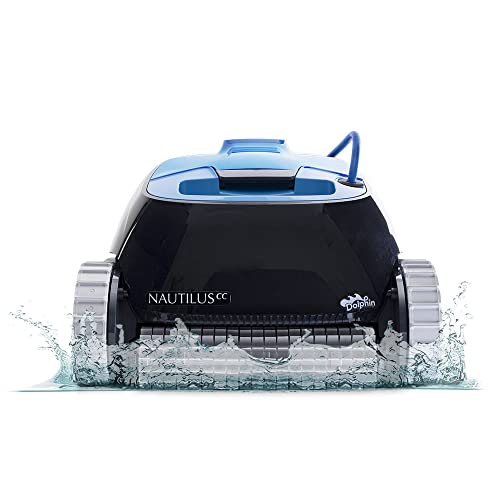
The Nautilus CC is the Dolphin for modest pools: the same wall-climbing, scrubbing-brush formula in a lighter unit with top-load filter access, aimed at smaller in-ground pools and the larger above-ground installations. If the flagship pick above is more robot than your pool needs, this is the same idea correctly sized — and correct sizing is what affordable actually means.
Strengths
- Top-load filter access makes the rinse-out a one-minute, no-flip job
- Wall climbing and scrubbing retained from the bigger Dolphins
- Lighter unit is easier to lift out of the water, especially for smaller owners
Trade-offs
- Coverage class is smaller pools — oversizing the pool undersizes the clean
- Cable length matches its class; measure your pool before assuming reach
- Like all robots, steps and tight corners get a lighter touch than open floor
| Type | Robotic, corded |
| Filter | Top-load access |
| Cleaning | Floor and walls, scrubbing brush |
| Class | Smaller pools |
Top-load filtration sounds like a spec-sheet detail and turns out to be the feature owners mention most, because maintenance friction decides whether a robot gets used weekly or abandoned by August. Lift the lid, lift the basket, hose it out, done. The Nautilus CC keeps the essential Dolphin behaviours — tracked drive, active brush, wall climbing — so the clean itself is not the compromise; only the coverage envelope is.
Buy it for the pool you have. In a compact pool it will finish with time to spare and the water will show it. Ask it to cover a big in-ground rectangle and the cycle ends before the far corners do, which is not a product failure but a sizing failure. Measure, match, and this is the sweet spot of the robotic market for a large number of households.
The Nautilus CC’s lighter build has an accessibility dimension worth stating: lifting a waterlogged robot out of a pool is a genuine strength task, and the smaller unit is meaningfully kinder to smaller or older owners. If the person who maintains the pool has any shoulder or back limitation, the correctly-sized lighter robot is not the budget compromise — it is the correct specification, and the big Dolphin is the wrong one.
The Nautilus CC is also the right answer for a specific common pool: the small in-ground pool in a rental property or a second home, where the cleaner must be effective, simple and hard to misuse by whoever is on site. Top-load access, one-button habits and Dolphin reliability make it the landlord’s and the caretaker’s robot — the one that gets used correctly by people who did not choose it.
Best for: smaller pools that still want real robotic scrubbing / Not suited for: large pools beyond its coverage class
Check on Amazon — check price on Amazon before you decide; sizes and finishes change between listings.

Zodiac G3 Suction-Side Pool Cleaner — Best Suction-Side Value
The Zodiac G3 has been cleaning in-ground pools for years with a design of beautiful simplicity: one moving part — a diaphragm that pulses the cleaner across floors, walls and steps — driven entirely by the pump you already own. In an affordable roundup, proven simplicity is a feature: fewer parts, fewer failures, and a generation of pool shops that know it on sight.
Strengths
- One moving part is a reliability argument nothing else here can match
- Runs on existing pump suction — no power supply, no cable, no charging
- 36-fin disc keeps the seal and manoeuvres around steps and fittings
Trade-offs
- Cleaning power is your pump’s power; a tired pump makes a tired cleaner
- Debris goes to your main filter, which will need the attention the robots spare it
- Heavy leaf fall can choke a suction cleaner where a robot’s basket would cope
| Type | Suction-side |
| Drive | Diaphragm, one moving part |
| Coverage | Floors, walls, steps |
| Pool | In-ground |
The G3’s diaphragm design deserves respect: instead of gears and wheels, a flexible diaphragm pulses with the pump’s suction, inching the cleaner forward and swallowing debris in the same motion. It is quiet, it tolerates grit that would jam wheeled mechanisms, and when the diaphragm eventually wears it is a cheap, user-replaceable part. This is affordable in the deepest sense — a machine designed so that the wear item is trivial.
Its conditions are honest ones. Suction cleaners share your pump’s workload and your filter’s capacity, so they suit pools with sound equipment and moderate debris. Pair the G3 with a leaf canister on the hose if your garden sheds heavily, keep the pump basket clear, and it will patrol for years at a running cost measured in diaphragm replacements and electricity you were already spending.
G3 ownership tip from the pool-shop world: keep a spare diaphragm. It is the cleaner’s one moving part and its one wear item, it costs little, and swapping it is a five-minute, tool-light job. Owners who keep the spare describe G3 downtime in minutes per decade; owners who do not describe a week of manual vacuuming while a small rubber part crosses the country. The spare is the whole trick.
The G3’s simplicity has an environmental footnote in its favour: a cleaner with one moving part, no battery and no electronics has almost nothing in it to become e-waste, and its wear part is a small rubber diaphragm. In a category racing toward disposable cordless units, the G3 is the repairable, decade-scale object — a virtue its long production run keeps proving.
Best for: in-ground owners who want minimal mechanism and proven design / Not suited for: pools with weak pumps or heavy leaf loads
Check on Amazon — check price on Amazon before you decide; sizes and finishes change between listings.

VINGLI Automatic Suction Pool Cleaner — Best Budget Suction Cleaner
The VINGLI is the entry ticket to automatic cleaning: a suction-side crawler in the classic creepy-crawler pattern, supplied with 33 feet of hose, that climbs walls and works in both above-ground and in-ground pools. For owners graduating from a manual vacuum head and a pole, it is the cheapest credible way to hand the job to a machine.
Strengths
- Lowest-cost route to automatic, wall-climbing cleaning in this roundup
- 33 feet of hose included — no separate hose purchase to reach the far end
- Works across above-ground and in-ground pools, so it survives a pool upgrade
Trade-offs
- Suction cleaners wander randomly; coverage is statistical, not mapped
- Performance depends heavily on correct hose length and pump strength
- Like all suction models, debris loads your main filter
| Type | Suction-side crawler |
| Hose | 33 ft included |
| Coverage | Floor and walls |
| Pools | Above-ground and in-ground |
Set expectations correctly and the VINGLI satisfies: it does not map your pool, it patrols it, and over a long pump run the statistics converge on clean. The included hose bundle matters more than it looks — suction cleaners fail most often because owners run too little hose (the cleaner never reaches the far end) or too much (it coils and camps in one corner). VINGLI’s 33 feet covers most residential pools with a section to spare.
The setup ritual is the product: balance the hose, set the suction at the skimmer so the crawler climbs halfway up the wall without sucking air, and let it run with the pump. Owners who do that ten-minute setup report a pool that stays ahead of the dirt; owners who drop it in and hope report a cleaner napping in the deep end. At this price, that trade — your ten minutes for its all-day patrol — is the definition of affordable.
The VINGLI rewards one accessory above all: a simple in-line leaf canister if your pool sits under trees. It intercepts the leaf load before the pump basket, keeps suction steady, and turns the cleaner’s statistical patrol into consistent coverage. Without it, under heavy fall, the pump basket becomes the bottleneck and the crawler gets blamed for a plumbing reality.
VINGLI’s crawler also teaches its owner the pool, which is an underrated benefit for first-time pool households. Balancing its hose and suction forces you to learn your skimmer, your pump’s moods and your pool’s circulation dead spots — knowledge that makes every later pool decision better. Several seasons of VINGLI ownership is a genuine education, and its graduates buy their next cleaner with unusual wisdom.
Best for: first automatic cleaner on a minimal budget / Not suited for: very large pools beyond the hose reach
Check on Amazon — check price on Amazon before you decide; sizes and finishes change between listings.

WYBOT C1 Cordless Robotic Pool Vacuum — Best Cordless Robotic
The cable is the corded robot’s one true annoyance — it tangles, it needs a power point, it drapes across the deck. The WYBOT C1 removes it: a cordless robot with a long rated runtime, positioned for both in-ground and above-ground pools, cleaning floor and walls in a 4-in-1 brief. For mid-size pools it is the convenience pick of the roundup.
Strengths
- No cable: nothing to tangle, coil or trip over, and no poolside power point needed
- Long rated runtime covers a full clean in most mid-size pools on one charge
- Works across pool types, so it follows you from above-ground to in-ground
Trade-offs
- Battery discipline is the ownership contract — a flat robot cleans nothing
- Cordless units are typically floor-strong and wall-lighter than corded Dolphins
- Retrieval means fishing it out at cycle end rather than reeling a cable
| Type | Robotic, cordless |
| Runtime | Long-runtime class (see listing) |
| Cleaning | 4-in-1 multi-surface |
| Pools | In-ground and above-ground |
Cordless changes the usage pattern in a way owners underestimate: with no setup beyond charging and dropping it in, the robot goes out for short, frequent cleans instead of a weekly epic — and frequent light cleaning is genuinely better pool care than rare deep cleaning. The C1’s runtime rating gives it the stamina for a full session in a mid-size pool, which is the threshold cordless models had to cross to be serious.
The ownership contract is charging. Treat it like a cordless vacuum indoors: dock, charge, deploy. Households that run on routine will love it; households that discover a flat battery on the one free Saturday will curse it and should buy the corded Dolphin instead. Know thyself, as with all battery tools, and the C1 is the most modern-feeling cleaner in this roundup.
Cordless etiquette that extends battery life: do not leave the C1 sitting in the pool between cleans, and do not store it on the charger for weeks at a stretch. In, clean, out, rinse, charge, shelf — that loop, repeated, is the difference between a battery that holds its runtime for seasons and one that fades by the second summer. The robot asks little; it asks exactly that.
A sizing caution to close the C1’s case: cordless runtime ratings assume a battery at full health in a pool without heavy debris loads. If your pool is at the top of the C1’s class and your debris is heavy, treat the rating as a ceiling and plan two shorter sessions rather than one heroic one. Managed that way, the cordless convenience survives contact with reality; managed naively, it is how good products earn unfair reviews.
Best for: owners who hate cables and have mid-size pools / Not suited for: owners who will not keep a charging routine
Check on Amazon — check price on Amazon before you decide; sizes and finishes change between listings.

S1 Pro Cordless Robotic Pool Cleaner — Best Cordless for Above-Ground Pools
Above-ground pools are the underserved majority of the pool world, and the S1 Pro is built for them specifically: cordless, rated at 130 minutes of runtime and coverage up to roughly 1,292 square feet of pool floor. If your pool is an above-ground rectangle or round and the manual vacuum pole is the bane of your summer, this is the pick aimed at you.
Strengths
- Purpose-built for above-ground pools rather than adapted to them
- 130-minute rated runtime is generous against above-ground floor areas
- Cordless format suits pools with no nearby outdoor power point
Trade-offs
- Coverage ceiling is real — big pools need a bigger class of cleaner
- Above-ground focus means in-ground owners should choose elsewhere in this list
- Battery care over winters decides how many seasons it serves
| Type | Robotic, cordless |
| Runtime | 130 min (rated) |
| Coverage | Up to ~1,292 sq ft (rated) |
| Pool | Above-ground |
The match between runtime and pool size is why this works. Above-ground pools have modest floor areas, so a 130-minute cordless session is not a compromise — it is full coverage with time to spare, including the wall base where above-ground pools collect their grit line. Dual-drive agitation helps on vinyl floors, where debris settles into seams that lazy cleaners skip.
Season care is the fine print. Lithium batteries dislike being stored flat or cooked; charge it after use, store it out of the freeze-thaw garage corner, and the S1 Pro should serve multiple summers. Ignore that and any cordless cleaner becomes a one-season story. For above-ground owners willing to keep that small discipline, this is the most pool-appropriate affordable robot here.
Above-ground pools have one grit trap cordless owners should know: the seam where the vinyl floor meets the wall collects a dark line that any cleaner under-scrubs. A monthly pass with a hand brush along that seam — two minutes, standing outside the pool — keeps the S1 Pro’s work looking complete. Budget cleaners plus targeted hand work is a system; either alone is a compromise.
The S1 Pro’s last virtue is social: above-ground pools are often the neighbourhood’s summer headquarters for children, and a pool that is visibly, effortlessly clean is the one parents trust. The cordless robot working its quiet rounds before the swimmers arrive is part of that trust. Affordable pool care is partly water chemistry and partly theatre, and this little machine performs both.
Best for: above-ground pools up to its coverage rating / Not suited for: large in-ground pools
Check on Amazon — check price on Amazon before you decide; sizes and finishes change between listings.
Comparison Table
| Pick | Badge | Key spec | Best for |
|---|---|---|---|
| Dolphin Automatic Robotic Pool Vacuum (In-Ground, up to 40 ft) | Best Robotic Overall | Robotic, wall-climbing, scrubbing brush, up to 40 ft pools | in-ground pools whose owners want set-and-forget cleaning |
| Dolphin Nautilus CC Robotic Pool Vacuum | Best for Smaller Pools | Robotic, top-load filter, wall-climbing | smaller pools that still want real robotic scrubbing |
| Zodiac G3 Suction-Side Pool Cleaner | Best Suction-Side Value | Suction-side, one moving part, 36-fin disc | in-ground owners who want minimal mechanism and proven design |
| VINGLI Automatic Suction Pool Cleaner | Best Budget Suction Cleaner | Suction crawler, 33 ft hoses included | first automatic cleaner on a minimal budget |
| WYBOT C1 Cordless Robotic Pool Vacuum | Best Cordless Robotic | Cordless robotic, long runtime, 4-in-1 | owners who hate cables and have mid-size pools |
| S1 Pro Cordless Robotic Pool Cleaner | Best Cordless for Above-Ground Pools | Cordless, 130-min runtime, above-ground focus | above-ground pools up to its coverage rating |
Technology first: suction if your pump is strong and the budget is tight (G3, VINGLI), corded robotic if you want scrubbing and independence (the Dolphins), cordless if convenience rules and your pool is mid-size or above-ground (WYBOT, S1 Pro). Every row beats the manual pole it replaces.
How to Choose an Affordable Pool Vacuum
Start with your pool, written down: type (in-ground or above-ground), surface (plaster, vinyl, fiberglass, tile), dimensions, and debris profile. A pool under overhanging trees fights leaves; a pool in open sun fights algae film; a pool beside a garden fights grit. Leaves favour big-throat suction or basket robots, film demands a scrubbing brush, and grit is easy for everything. The cleaner that is affordable is the one matched to your actual enemy — a cheap cleaner that loses to your debris is the most expensive kind.
Then audit the machine that powers two of the three technologies: your pump. Suction cleaners are only as strong as the pump and as patient as the filter behind them. If your pump is ageing or your filter is undersized, a suction cleaner will underwhelm and a self-contained robot — corded or cordless — becomes the affordable choice once avoided frustration is priced in. Conversely, with a strong modern pump, a G3-class suction cleaner is nearly free cleaning on equipment you already own.
Size honestly. Robotic coverage ratings and cordless runtimes assume favourable shapes; ladders, benches, beach entries and kidney curves all tax a cleaner. Buy one class above your pool’s measured size if the shape is complex, and exactly to size if it is a simple rectangle. Oversizing a simple pool wastes money; undersizing a complex one wastes the whole purchase.
The Real Running Costs of Each Technology
Suction cleaners: near-zero purchase complexity, but they spend pump electricity for every cleaning hour and push all debris into the main filter, shortening its cleaning intervals. Over a season, the electricity of long pump runs is the hidden line item. Robots: a higher purchase, then low-voltage electricity measured in pennies per cycle and a filter system that stays cleaner for longer. Cordless robots add a battery lifecycle to the ledger — treated well, several seasons; stored flat and frozen, one.
Manual effort belongs in the maths too. Every technology here still asks something of you: robots want filter rinses and retrieval, suction cleaners want hose management and filter care. The affordable winner for your household is the one whose small chore you will actually perform weekly, because a cleaner that is used beats a theoretically superior cleaner that is not.
Manual, Suction, Robotic: An Honest Word About the Pole You Already Own
Every cleaner in this roundup competes with a manual vacuum head on a pole, and the manual head deserves its due: it is nearly free, it goes exactly where you point it, and for a small pool cleaned by an able owner it remains a rational choice. Its cost is denominated in your Saturdays — twenty to forty minutes of skilled, stooping labour per session, forever. The affordable technologies here are really three different ways of buying those Saturdays back: suction cleaners for the price of hose management, corded robots for the price of filter rinses, cordless robots for the price of a charging habit.
The crossover point is pool size and debris. A small above-ground pool with light debris can be pole-cleaned in ten minutes, and its owner should honestly consider whether any machine is needed — though the S1 Pro exists precisely because most owners, asked weekly, vote with their wallets for the machine. A large or leaf-burdened pool makes the manual case collapse entirely. Affordable is not a price; it is the match between a pool, a debris load and an owner’s honest valuation of their own time.
Troubleshooting the Three Classic Complaints
Problem: the cleaner misses the same corner every time. With suction cleaners and basic robots, coverage is statistical and obstacles create shadow zones — ladders, steps and lights all shelter a patch of floor. The fix is procedural, not financial: start the cleaner from a different point each session, and give permanent shadow zones a ten-second hand-brush as part of the routine. Problem: the cleaner climbs and sucks air, or will not climb at all. Both are suction-balance symptoms in suction models (adjust at the skimmer), and trapped-air symptoms in robots (re-submerge slowly, rocking to burp the unit).
Problem: the pool clouds a day after cleaning. That is chemistry announcing itself — the cleaner removed the debris it could see while the water’s balance grew the next bloom. Test and balance after cleaning sessions for a month and the pattern usually breaks. The through-line of all three: affordable cleaners fail procedurally far more often than mechanically, and the procedures cost nothing but attention.
Above-Ground vs In-Ground: Why the Same Budget Buys Different Machines
The two pool types punish cheap cleaners differently, and the roundup’s split reflects it. Above-ground pools have vinyl liners that aggressive scrubbing can wear, walls that flex, and floors that collect grit in the wall seam; they reward lighter, liner-kind machines — the S1 Pro’s whole design brief — and suction crawlers running at moderated suction. In-ground pools in plaster or tile reward the opposite: firm scrubbing, strong wall climbing, and machines heavy enough to stay planted, which is the Dolphins’ natural territory.
Budget allocation follows from that physics. Above-ground owners should spend on runtime and gentleness; in-ground owners on scrubbing and filtration. The cross-type picks — the VINGLI and the WYBOT C1 — earn their place by being adjustable enough to respect both, but a household certain of its pool type for the next five years will always do better with the specialist. Pool type is the first filter in this category, ahead of brand, ahead of technology, ahead of price.
When to Stop Repairing and Replace: The Budget Cleaner Lifecycle
Affordable cleaners invite a repair-or-replace judgement every season or two, and a simple framework keeps the decision honest. Wear items designed to be replaced — the G3’s diaphragm, hoses, robot filter baskets, brushes — should always be replaced; they are the machine’s intended consumables and cost little against a new unit. Drive components are the borderline: a suction cleaner’s body rarely dies, but a robot’s motor or a cordless unit’s battery is a significant fraction of a new cleaner’s price, and past roughly half that price, replacement with a current model usually wins on warranty and efficiency.
Batteries deserve their own rule because they decline gradually and disguise themselves as other faults: a cordless cleaner that “misses spots” is often a tired battery ending cycles early. Test runtime honestly against the rating before blaming navigation. And keep perspective on the whole ledger — a cleaner that served three full seasons of weekly work has repaid a budget price several times over in labour alone; replacing it is not a failure of the purchase but the completion of it.
How to Get a Clean Pool from a Budget Cleaner: Setup Routine
Affordable cleaners reward correct setup more than expensive ones reward neglect. This routine applies across all three technologies.
- Balance the water first. No vacuum fixes chemistry; clean a balanced pool and the cleaner’s work stays done, clean an algae-active pool and you are vacuuming a symptom.
- For suction cleaners: purge air from the hose by holding it over the return jet, connect at the skimmer, and adjust suction so the cleaner climbs steadily without gulping air at the surface.
- For robots: fully charge cordless models, or lay corded cables out in loose arcs on the water so they cannot pre-tangle; lower the unit slowly, rocking it to release trapped air.
- Run cleaning before the pool party, not after the visible mess: twice-weekly ordinary cycles beat one heroic session, for every technology in this roundup.
- Empty the collection point the same day — robot basket, pump basket or leaf canister. A full basket quietly halves cleaning performance.
- Finish with a two-minute brush of steps, corners and the waterline by hand. Budget cleaners are weakest exactly there, and two minutes of pole work closes the gap completely.
Followed weekly, this routine is why some owners of modest cleaners have immaculate pools while some owners of flagship robots have green ones. The machine is half the system; the routine is the other half.
Common Buying Mistakes
Buying a suction cleaner for a weak pump
The cleaner is a passenger on your pump’s power. If the pump struggles to prime or the filter pressure is chronically high, a suction cleaner will crawl and stall, and the “bargain” becomes a return. Check pump health first, or choose a self-powered robot.
Ignoring debris type
A fine-filter robot in a leaf-strewn pool clogs in minutes; a suction cleaner under a tree chokes on acorns. Match intake and basket size to your debris, and add a leaf canister to suction hoses under heavy trees. The pool’s surroundings are part of the spec.
Running the cleaner in an algae bloom
Vacuuming live algae mostly redistributes it, and the filter load spikes. Shock and balance the water, let the chemistry kill the bloom, then vacuum the dead residue. Cleaners maintain water; chemicals rescue it. Sequence matters.
Leaving a cordless robot stored flat all winter
The commonest cordless killer is not summer use but winter storage: a battery left discharged in a freezing shed. Charge before storage, top up mid-winter, and store the unit somewhere temperate. Five minutes of care is the difference between three seasons and one.
Final Recommendation
For in-ground pools, the decision is between the Dolphin robotic — the scrubbing, independent, set-and-forget answer — and the Zodiac G3, the one-moving-part suction classic that cleans nearly free on a healthy pump. The Nautilus CC right-sizes the Dolphin idea for smaller pools, and the VINGLI is the honest first step off the manual pole for the tightest budgets.
Cordless buyers should match runtime to floor area and be honest about charging discipline: the WYBOT C1 for mid-size pools of either type, the S1 Pro purpose-built for above-ground. Whichever technology you choose, run it little and often, keep its basket empty and its water balanced — that routine, not the price tag, is what makes a pool look professionally kept.
Keep exploring the same cluster: Best Affordable Upright Bagless Vacuums Best All Around Vacuums Best 12volt Vacuums Best 12 Amp Self Propelled Vacuums
Frequently Asked Questions
Is a suction cleaner or a robot better value?
It depends on your pump and your debris. With a strong pump and light debris, a suction cleaner like the G3 is superb value. With a weak pump, heavy debris or algae film, a robot’s independent power and scrubbing brush earn their price within a season or two of better results.
Can one cleaner work for both above-ground and in-ground pools?
Some can — the VINGLI suction crawler and the WYBOT C1 are both positioned across pool types. Dedicated models usually do their one job better, though: the S1 Pro is above-ground focused, and the big Dolphin is an in-ground machine. Cross-type models suit households planning a pool upgrade.
How often should I run an affordable pool vacuum?
Little and often wins: two or three ordinary cycles a week in season keeps debris from bonding to surfaces and algae from gaining a foothold. One long session after visible mess appears is the pattern that makes any cleaner look inadequate.
Do robotic cleaners replace brushing entirely?
Mostly, on floors and walls — the scrubbing brush is the point of the Dolphins here. Steps, tight corners, beach entries and the waterline still benefit from a quick manual brush. Budget two minutes with a pole brush per session and the combination is effectively complete.
Why does my suction cleaner stay in one area?
Usually hose length or suction balance: too much hose coils and anchors it, too little means it cannot reach, and excessive suction pins it to the floor or makes it climb and gulp air. Rebalance hose sections and the skimmer suction setting before blaming the cleaner.
How long do cordless pool robots last?
The unit should serve for years; the battery is the wear item. Charged after use, stored temperate and never left flat over winter, the battery should hold useful runtime for several seasons. Runtime ratings on listings are for new batteries in favourable conditions.
My pool is an odd shape — will a budget cleaner cope?
Mostly, with managed expectations. Kidney, L-shaped and freeform pools create shadow zones behind curves, steps and benches that random-pattern suction cleaners and basic robots reach statistically rather than certainly. The working system is the cleaner for the open water plus a two-minute hand-brush of the shadows, exactly as the setup routine in this article describes. Owners of odd-shaped pools who adopt that pairing report results indistinguishable from mapped premium robots at a fraction of the commitment — the shape taxes every cleaner, and the brush is the equaliser.
Should I remove the cleaner from the pool between uses?
For robots, yes as a habit: lift it out, rinse the filter, and store it shaded — continuous immersion ages seals, cables and batteries, and a cleaner stored in the water is also a cleaner whose next cycle starts dirty. Suction cleaners are the exception households make peace with: many live in the pool semi-permanently, hoses and all, and serve well for it, though removing them for swimming and for storms is basic care. When in doubt, the manual for your specific pick outranks any general rule, including this one.


