Disclosure: airfryerkitchensupply.com is reader-supported. When you buy through links on our site, we may earn an affiliate commission at no extra cost to you.
Where to Buy
Every pick in this guide to the baking sheet sets is sold through Amazon, where you can check price on Amazon for the exact configuration you want before ordering. Prices and stock move often on family and home gear, so treat any number you see elsewhere as a snapshot rather than a promise. Each pick below is matched to a listing verified on 2026-11-22, with its quality tier stated in words — budget tier, mid-range tier, or premium tier — so you can shortlist by the features that matter and then confirm the live listing details, dimensions, and care instructions on the product page itself.
- Nordic Ware Naturals Half Sheet, 2-Pack — Best Overall: check the current price on Amazon.
- GoodCook Everyday Nonstick Baking Sheet Set, 3-Pack — Best Easy Release: check the current price on Amazon.
- USA Pan Bakeware Half Sheet Pan, Set of 2, Aluminized Steel — Best Durability Balance: check the current price on Amazon.
- Wildone Baking Sheet Set of 3, Stainless Steel — Best for Dishwasher Households: check the current price on Amazon.
- Aluminum Half Sheet Pan and Stainless Steel Cooling Rack Set, 13×18 — Best for Roasting and Bacon: check the current price on Amazon.
- HONGBAKE Baking Sheet Pan Set of 3, Half/Quarter/Jelly Roll — Best Versatile Set: check the current price on Amazon.
A quick note on how to use this page: start with the Quick Picks table if you already know your situation, read the full review of any pick that catches your eye, and then work through the buying guide and mistakes sections before you order. Those later sections are where most returns are prevented, because they cover the measurements, compatibility checks, and care realities that a product photo never shows.
Finding the baking sheet sets sounds simple until you open a search results page and find dozens of near-identical options separated by details that are hard to judge from photos. A baking sheet looks like the simplest object in the kitchen — a flat rectangle of metal — and yet the difference between a good set and a bad one shows up in every batch of cookies: even browning versus scorched bottoms and pale tops, a pan that stays flat versus one that twists with a bang in a hot oven, and a surface that releases versus one that needs chiselling. Sheet sets multiply the stakes, because you are buying the same decision two or three times over.
This guide compares the six set directions worth your money: heavy-gauge aluminium, nonstick sets, aluminised steel, stainless steel, rimmed sets with fitted cooling racks, and pre-cut parchment-friendly everyday sets. The judgements are about gauge, flatness, rim design, and honest care — the things that decide whether a set is still in your kitchen in ten years.
One truth upfront: there is no single best material. Aluminium bakes most evenly, nonstick releases most easily, stainless shrugs off abuse and dishwashers. The right set depends on what you bake most, and this guide is organised to make that call honestly rather than to crown a universal winner.
In this guide
Quick Picks
These six picks cover the realistic spread of the baking sheet sets market, from the value end to the premium end. Each one earned its slot for a distinct reason, and each carries a badge that tells you, at a glance, the job it does best.
- Nordic Ware Naturals Half Sheet, 2-Pack — Best Overall. The baker’s standard: thick natural aluminium that bakes evenly, stays flat, and lasts decades. Positioned in the mid-range tier.
- GoodCook Everyday Nonstick Baking Sheet Set, 3-Pack — Best Easy Release. Cookies slide off, cleanup is a wipe, and the set costs little — the convenience pick, honestly framed. Positioned in the budget tier.
- USA Pan Bakeware Half Sheet Pan, Set of 2, Aluminized Steel — Best Durability Balance. A steel core with an aluminium coating — most of aluminium’s baking manners with a tougher, rust-resistant body. Positioned in the mid-range tier.
- Wildone Baking Sheet Set of 3, Stainless Steel — Best for Dishwasher Households. Dishwasher-proof, non-reactive, and nearly indestructible — with one honest compromise on browning. Positioned in the premium tier.
- Aluminum Half Sheet Pan and Stainless Steel Cooling Rack Set, 13×18 — Best for Roasting and Bacon. Rimmed sheets with fitted wire racks — for oven bacon, crispy wings, and cookies that cool on the rack they baked over. Positioned in the mid-range tier.
- HONGBAKE Baking Sheet Pan Set of 3, Half/Quarter/Jelly Roll — Best Versatile Set. Three sizes for three jobs — the set for kitchens that bake small as often as large. Positioned in the budget tier.
How These Picks Were Chosen
Picks were chosen on gauge and construction first. A baking sheet’s thickness — its gauge — decides whether it warps, how evenly it conducts, and how it feels in the hand. The sets here are the heavier, rolled-rim designs in each material class, because thin sheets with raw edges twist in the oven and cut thumbs in the sink, and no coating rescues a flimsy pan.
Performance criteria came second: browning evenness, release, and rim height. A rim around two centimetres holds juices and rolling meatballs without becoming a roasting tin; the flat cooking surface should be genuinely flat, since a crowned centre pools oil and bakes lopsided biscuits.
Set composition was the third filter. A useful set mixes sizes — typically a half sheet with a quarter sheet, or two halves — rather than duplicating one size three times. Every pick below states what its set actually contains in role terms, and who that mix suits.
The 6 Best Baking Sheet Sets
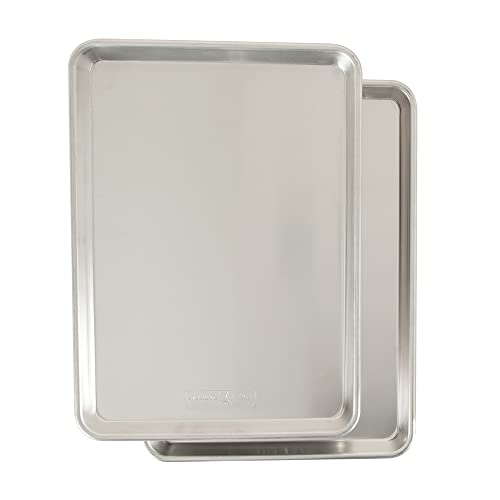
Nordic Ware Naturals Half Sheet, 2-Pack — Best Overall
Verified pick: Nordic Ware Naturals Half Sheet, 2-Pack — USA-made aluminum half sheets with an encapsulated galvanized steel rim that prevents warping, sold as a 2-pack.
If you bake cookies, roast vegetables, and toast nuts, this is the reference set. Heavy-gauge aluminium conducts heat evenly and quickly, the rolled rim locks the sheet flat against warping, and the uncoated surface develops a seasoned patina that releases better the longer you own it.
Strengths
- Most even browning of any material here
- Rolled rim resists warping at roasting temperatures
- Improves with age; a decades-long purchase
Trade-offs
- Hand-wash preferred; dishwashers dull and discolour aluminium
- Acidic foods can react with bare aluminium — line the pan for tomatoes
- Shows every stain, though none affect performance
The rolled rim is the detail to verify. A steel rod rolled inside the edge stiffens the whole sheet, and it is the difference between a pan that lies flat at 220°C and one that pops a corner up and spills oil. In the shop, flex the sheet by opposite corners: a good heavy-gauge pan barely moves. At home, never plunge a hot sheet into cold water — thermal shock warps even good pans over time.
Lining is the lifestyle that makes bare aluminium effortless. A sheet of parchment turns cleanup into lifting out the paper, protects the pan from acidic marinades, and gives cookies a gentle, even bottom. Many owners keep a rack and parchment beside the sheets and find the uncoated set, supposedly the high-maintenance option, becomes the lowest-effort one they own.
Best for: Serious home bakers, roasting / Not suited for: Dishwasher-only households
This pick sits in the mid-range tier. Check the current price on Amazon to see the current listing, available variants, and delivery options for your area.

GoodCook Everyday Nonstick Baking Sheet Set, 3-Pack — Best Easy Release
Verified pick: GoodCook Everyday Nonstick Baking Sheet Set, 3-Pack — a 3-pack of nonstick carbon steel cookie sheets in small (13×9), medium (15×10) and large (17×11) sizes.
Nonstick sets suit bakers whose priority is release and effortless washing: sticky glazes, caramelised edges, cheese-topped anything. Modern reinforced coatings are tougher than the flaky pans of memory, and at budget-tier pricing the set can be treated as a renewable tool rather than an heirloom.
Strengths
- Best release for sticky and sugary bakes
- Cleanup is a quick wash with a soft sponge
- Budget pricing makes replacement painless when coating ages
Trade-offs
- Coating is a finite life — expect years, not decades
- Metal utensils and abrasive scouring end it early
- Most nonstick has a lower maximum oven temperature than bare metal
Treat the coating’s temperature ceiling as a hard rule. Most nonstick sheets are rated well below broiler heat, and exceeding the rating is what blisters coatings — not ordinary baking. If your cooking includes high-heat roasting and finishing under the grill, keep one bare aluminium sheet for that work and let the nonstick set do the baking it is built for.
Longevity habits are simple: silicone or wooden tools, a soft sponge, no stacking without a cloth between pans, and no cutting pizzas or bars in the pan — the single most common way these sets die. Follow those, and a reinforced nonstick set gives several years of genuinely easier baking, which for busy households is the entire point.
Best for: Sticky bakes, low-effort cleanup / Not suited for: Broiler use, heirloom expectations
This pick sits in the budget tier. Check the current price on Amazon to see the current listing, available variants, and delivery options for your area.

USA Pan Bakeware Half Sheet Pan, Set of 2, Aluminized Steel — Best Durability Balance
Verified pick: USA Pan Bakeware Half Sheet Pan, Set of 2, Aluminized Steel — aluminized steel half sheet pans in a set of 2 baking sheets.
Aluminised steel is the professional compromise: the steel core gives strength and warp resistance, the aluminium-rich coating gives even heat and corrosion resistance. Commercial bakeries use it for a reason, and home sets in this material are the quiet overachievers of the category.
Strengths
- Excellent warp resistance from the steel core
- Bakes nearly as evenly as pure aluminium
- Coating resists the rust that plain steel invites
Trade-offs
- Heavier in the hand than aluminium sets
- Coating can wear at cut edges over many years
- Less common, so matching extra pans later can be tricky
Weight is the honest trade here. A full sheet of roasted vegetables on aluminised steel is a two-handed, oven-mitts-on lift, and smaller cooks should feel the pan’s weight before committing to a multi-pan set. In exchange, these sheets stay flat through years of high-heat roasting that would twist lesser pans into propellers.
Care is simple but specific: dry the sheets after washing rather than leaving them to drip, because the cut edges are where the coating is thinnest and moisture lingers. A minute in a still-warm oven after washing is the baker’s trick for bone-dry storage, and it keeps these pans looking new long after aluminium sets have gone cloudy.
Best for: High-heat roasting, longevity / Not suited for: Anyone wanting the lightest pans
This pick sits in the mid-range tier. Check the current price on Amazon to see the current listing, available variants, and delivery options for your area.
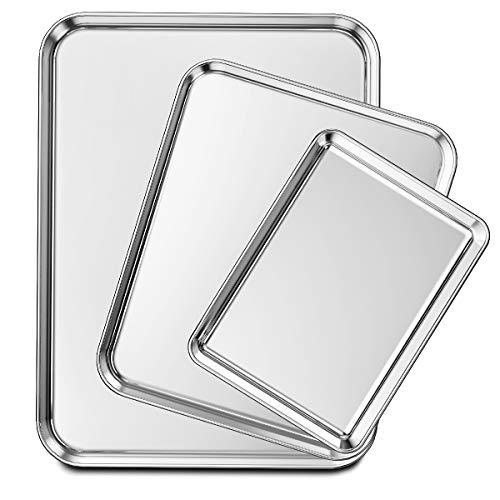
Wildone Baking Sheet Set of 3, Stainless Steel — Best for Dishwasher Households
Verified pick: Wildone Baking Sheet Set of 3, Stainless Steel — stainless steel cookie sheet pans in 9, 12 and 16 inch sizes, a set of 3.
Some kitchens run on a simple rule: everything goes in the dishwasher. Stainless steel is the only sheet material that fully honours that rule while also ignoring acidic foods, metal utensils, and decades of use. For those households it is not a compromise purchase; it is the correct one.
Strengths
- Fully dishwasher-safe and non-reactive with acidic foods
- Takes metal utensils and scouring without complaint
- Premium build holds resale-grade condition for years
Trade-offs
- Browns less evenly than aluminium; cookies colour more slowly and less uniformly
- Heavier and pricier than equivalent aluminium sets
- Water spots show unless dried — cosmetic only
Manage the browning difference rather than denying it. Stainless conducts heat less evenly, so rotate the sheet halfway through a bake, and consider a slightly longer bake for the colour you want. For roasting — where stainless sears beautifully and deglazes into pan sauces — the material is arguably superior. It is specifically delicate, even-browning work like shortbread where aluminium keeps its crown.
Tri-ply and heavy-gauge stainless sets narrow the performance gap considerably, at a price. If you bake weekly and dishwasher everything, the premium tier is defensible: amortised over the decades these pans last, it is among the cheapest sets in this guide per year of service.
Best for: Dishwasher households, acidic foods / Not suited for: Perfectionist cookie browning
This pick sits in the premium tier. Check the current price on Amazon to see the current listing, available variants, and delivery options for your area.

Aluminum Half Sheet Pan and Stainless Steel Cooling Rack Set, 13×18 — Best for Roasting and Bacon
Verified pick: Aluminum Half Sheet Pan and Stainless Steel Cooling Rack Set, 13×18 — a 13×18 rimmed aluminum half sheet baking pan with a fitted stainless steel cooling rack, of thick gauge.
The fitted rack changes what a sheet pan does. Food elevated on the rack roasts in circulating air — bacon stays flat and crisp, wings render, breaded cutlets stay crunchy underneath — and the same rack then cools cookies without a transfer. If your sheet-pan cooking leans savoury, this set earns its shelf space.
Strengths
- Rack enables crisping and rendering a flat sheet cannot
- Rack must fit the sheet exactly — this set guarantees the match
- Cookies cool on the rack, freeing the sheet for the next batch
Trade-offs
- Rack adds washing-up, especially after fatty roasts
- Rack wires can mark delicate cookie bottoms if used as a baking surface for them
- Set costs more than the sheets alone; wasted if you never roast on a rack
Fit is the entire product. A rack that is a centimetre too small slides; too large, it rocks on the rim. Buying sheet and rack as a matched set removes the guesswork that plagues separate purchases. Check the rack is oven-safe to the same temperatures as the sheet — some cooling racks are not baking racks, and the set format should guarantee both are.
Line the sheet under the rack with foil or parchment for fatty work and the washing-up objection mostly disappears. The rack itself benefits from a soak while you eat. Used this way, the set becomes the most versatile in the guide: sheet alone for cookies, rack over sheet for roasting, rack alone for cooling and for glazing work over the sheet to catch drips.
Best for: Bacon, wings, batch baking / Not suited for: Minimalist kitchens avoiding extras
This pick sits in the mid-range tier. Check the current price on Amazon to see the current listing, available variants, and delivery options for your area.

HONGBAKE Baking Sheet Pan Set of 3, Half/Quarter/Jelly Roll — Best Versatile Set
Verified pick: HONGBAKE Baking Sheet Pan Set of 3, Half/Quarter/Jelly Roll — nonstick half, quarter and jelly roll pans in a set of 3, with a diamond texture pattern and 0.8mm heavy-duty build.
A single half sheet is oversized for reheating two pastries and undersized thinking for a family roast. A mixed set matches pan to task: the quarter sheet for small jobs and toaster-oven households, the half sheet as the workhorse, and a jelly roll size in between for bars and smaller bakes. Energy and washing-up both shrink when the pan fits the food.
Strengths
- Right-sized pans heat faster and wash easier for small jobs
- Covers toaster-oven to family-roast range in one purchase
- Budget tier for the whole set
Trade-offs
- Thinner gauges are common in mixed sets — check each pan’s flex
- Storage of three sizes needs a system or they clatter
- The largest pan sets the oven-fit limit; measure your oven cavity
Judge the set pan by pan. Mixed sets sometimes pair a genuinely good half sheet with flimsy small pans. The quarter sheet matters more than its size suggests — it is the one you will use daily for reheating, toasting nuts, and small roasts — so its flatness and rim deserve the same corner-flex test as the big pan.
Measure your oven before ordering any set. A standard half sheet fits most ovens, but some European and compact ovens are a centimetre too narrow, and discovering that with a hot pan in your hands is miserable. Measure the cavity width between the rack supports, and keep a centimetre of clearance on each side for air circulation and safe handling.
Best for: Small households, varied tasks / Not suited for: Batch bakers needing duplicates
This pick sits in the budget tier. Check the current price on Amazon to see the current listing, available variants, and delivery options for your area.
Comparison Table
| Pick | Badge | Key trait | Best for |
|---|---|---|---|
| Nordic Ware Naturals Half Sheet, 2-Pack | Best Overall | Heavy aluminium, rolled rim | Serious home bakers, roasting |
| GoodCook Everyday Nonstick Baking Sheet Set, 3-Pack | Best Easy Release | Coated steel, easy release | Sticky bakes, low-effort cleanup |
| USA Pan Bakeware Half Sheet Pan, Set of 2, Aluminized Steel | Best Durability Balance | Steel core, aluminium coating | High-heat roasting, longevity |
| Wildone Baking Sheet Set of 3, Stainless Steel | Best for Dishwasher Households | Stainless, dishwasher-proof | Dishwasher households, acidic foods |
| Aluminum Half Sheet Pan and Stainless Steel Cooling Rack Set, 13×18 | Best for Roasting and Bacon | Sheets + fitted oven-safe racks | Bacon, wings, batch baking |
| HONGBAKE Baking Sheet Pan Set of 3, Half/Quarter/Jelly Roll | Best Versatile Set | Three sizes, everyday mix | Small households, varied tasks |
Read the table as a map rather than a ranking. The baking sheet sets that wins on one row can be the wrong choice on the next, because the differences that matter — fit, care, durability, and day-to-day handling — only show up against your own routine.
How to Choose Baking Sheet Sets
Gauge is the first thing to understand, because it predicts almost everything else. Gauge runs backwards — a lower gauge number is a thicker sheet. For aluminium, the heavier gauges stay flat, conduct evenly, and feel reassuringly rigid; thin sheets oil-can in the oven, browning food in patches and sometimes twisting permanently. Whatever material you choose, choose its heavy version. A baking sheet is a ten-year object; the saving on a thin one is repaid in ruined batches.
Size comes second, and the vocabulary is worth learning. A half sheet — roughly 46 by 33 centimetres — is the home standard and the size most recipes silently assume. A quarter sheet is its quarter-area sibling for small jobs. A jelly roll pan is slightly smaller than a half sheet with similar rims. Full sheets are commercial and fit almost no home oven. Build your set around half sheets unless your oven or household says otherwise, and measure the oven cavity before assuming.
Rims are the third call. Rimmed sheets — the default in this guide — contain juices, rolling food, and oven mishaps, and they are what sheet-pan dinners assume. Flat, rimless cookie sheets slide cookies off beautifully and suit nothing with liquid. Most kitchens need rimmed sheets first; a rimless sheet is a later luxury for dedicated cookie bakers.
Material, matched to your baking
Bake mostly cookies and cakes: aluminium’s evenness wins. Bake sticky, glazed, and cheesy things and hate washing up: nonstick, with eyes open about its finite life. Roast at high heat constantly: aluminised steel or aluminium with a rack set. Dishwasher everything and cook acidic foods: stainless, accepting slower browning. There is no shame in owning two materials — many serious kitchens run aluminium for baking and stainless for roasting.
Coatings and liners: parchment, mats, and bare metal
Parchment is the great equaliser: it gives any sheet nonstick manners, protects aluminium from acids, and makes cleanup trivial. Silicone mats bake cookie bottoms more gently and can soften browning; they suit delicate biscuits and annoy crisp-bottom bakers. Bare metal gives the firmest set and best colour on sturdy bakes. A good set plus parchment covers nearly everything; buy the set for its metal, not its promises.
How many sheets do you actually need?
Two half sheets cover most home baking: one in the oven, one being loaded. Batch cookie bakers who swap trays constantly may want three. Beyond that, a quarter sheet earns its place for small daily jobs. Sets that duplicate one size four times serve batch bakers and no one else — check the set composition against your real habits before the bundle price seduces you.
Warping: Why Sheets Twist and How to Stop Yours
A sheet warps when one part expands faster than another — thin metal, uneven heat, or cold water on a hot pan. The bang you sometimes hear mid-roast is the sheet snapping into its twisted shape; food slides, oil pools, and browning goes patchy. Heavy gauge, rolled rims, and heating the pan with the oven rather than inserting it into a fully blazing one all reduce the stress. The single worst habit is rinsing a roasting-hot sheet under the tap: let it cool on the hob until it is merely warm, every time.
A slightly warped sheet is not dead. It will still roast vegetables happily for years, and some flatten partially as they cool. But prevention is cheap and permanent: buy heavy, treat heat gently, and your set stays flat for the decades the material itself can last.
Seasoning and the Aluminium Patina
Bare aluminium darkens with use, and the darkening is a feature. The patina is a seasoned surface that releases food more easily and, many bakers swear, browns more reliably than bright new metal. Do not scour it back to silver; you are only resetting the clock. Wash with hot soapy water, dry promptly, and let the pan age. The exception is sticky, burnt-on sugar, which earns a soak and a non-abrasive scrub — the patina survives that fine.
Stainless and aluminised sheets do not season the same way, but they share the principle: these are working tools whose appearance tells their history, and performance is the metric. The sets in this guide were chosen to still be performing when their looks have become autobiographical.
How to Set Up a Baking Sheet for Perfect, Even Bakes
Most sheet-pan failures are setup failures. Run this routine and the pan you own performs at its best.
- Choose the right size: food in a single layer with space between pieces — crowding steams instead of roasting, on any pan.
- Decide the surface: parchment for cookies, sticky, or acidic food; bare metal for maximum browning; a fitted rack when fat must drain or air must circulate underneath.
- Preheat the oven fully, with the rack in the centre position; for delicate bakes, let the sheet come to room temperature rather than using one chilled from a cold cupboard against a hot oven.
- For high-heat roasting where searing matters, preheat the empty sheet in the oven, then add oiled food carefully — and remember the pan is hot when you would normally grab it.
- Rotate the sheet halfway through the bake, front to back, to cancel your oven’s hot spots; even the best pan cannot fix an uneven oven.
- Rest baked goods briefly on the sheet, then move them to a rack — cookies firm up as they cool, and leaving them on a hot pan overcooks the bottoms.
- Let the sheet cool before washing, wash warm with a soft sponge, and dry it fully before stacking or storing.
That routine — spacing, surface, rotation, cooling — is worth more than any single pan upgrade. Master it on the set you buy and the difference between materials shrinks to preference, which is where it belongs.
Sheet Pan Dinners: Where Your Baking Set Really Earns Its Keep
The modern sheet pan earns its living on weeknight dinners more than on baking, and dinner duty reorders the priorities in this guide. A pan for roasting vegetables, chicken thighs, and sausages needs a rim high enough to hold juices and rolling onions, a surface that tolerates a metal spatula at serving time, and flatness under load at high heat — because a warped pan pools oil at one end and steams the vegetables at the other. The aluminised steel and heavy aluminium picks are the dinner specialists; the nonstick set should be excused from the hottest, most aggressive roasting, where its coating ages fastest.
Spacing is the dinner skill. A sheet pan dinner fails by crowding: ingredients piled together steam in their own juices and never crisp. Two pans, each half full, beat one pan overloaded, every time — which is a concrete argument for the two-half-sheet sets in this guide and for the rack set, where the rack lifts food out of its own fat. If your household cooks sheet pan dinners twice a week, buy the set composition around that fact: two identical half sheets, not a decorative trio of sizes.
Sauces and glazes draw the material lines sharply. Sticky glazes weld themselves to bare metal and are the nonstick pan’s finest hour — or parchment’s, laid over your aluminium workhorse. Acidic tomato and vinegar marinades belong on stainless or on a liner, not on bare aluminium, where they can pit the surface and pick up a metallic note. None of this requires owning four sets; it requires knowing which of your pans, or which liner, tonight’s recipe is asking for.
Storing, Stacking, and Organising Sheet Pans in a Real Kitchen
Sheet pans are the kitchen’s worst storage citizens: large, flat, clattery, and always at the bottom of the cupboard under the roasting tin you need more. The sets in this guide mostly nest — same-size pans stack, mixed sizes nest inside each other — and nesting is a feature worth confirming, because a set that does not nest consumes a whole cupboard shelf in territorial protest. Nonstick pans should stack with a cloth or paper sheet between them; the coating you protect in storage is the coating that survives the year.
Vertical storage transforms the problem where the cupboard allows it. A simple rack or tension organiser that files pans on their edges, like books, ends the excavation ritual entirely, and it suits rimmed sheets particularly well because the rim gives the organiser something to hold. Measure the cupboard’s height against your largest pan’s long edge before buying the organiser — half sheets on edge need real clearance, and the jelly roll and quarter sheets will fit almost anywhere.
Finally, keep the set honest. Most kitchens accumulate pans the way desks accumulate pens, and the warped, the scarred, and the never-used quietly tax every storage system. A set bought deliberately — two half sheets, a quarter, a rack — plus the discipline to retire the casualties it replaces, leaves you with pans you can reach, in a cupboard that closes. That, more than any single pan’s browning curve, is what a good set buys you.
Reading a Baking Sheet Before You Buy: The Five-Minute Inspection
Whether you are in a shop or holding a delivery at the kitchen counter, five checks predict a sheet’s whole career. First, the corner flex: grip opposite corners and twist gently — a good heavy sheet resists as a unit, a thin one ripples. Second, the tabletop test: lay the sheet on a flat surface and press each corner; a pan that rocks or clicks against the surface is already warped or crowned, and ovens will not improve it. Third, the rim: run a finger along it for the rolled, finished edge that stiffens the pan and spares your thumbs; raw, sharp edges mark the cheapest construction in the category.
Fourth, the surface at an angle to the light. On aluminium and stainless, look for even finishing without deep scratches that will catch food from day one. On nonstick, look for coating that wraps the rim completely rather than ending at the edge, where peeling always begins. Fifth, the weight in the hand compared with its siblings on the shelf: within a material, heavier is almost always the better pan, because gauge is destiny in this category and your hand is a reliable gauge-meter once it has held two or three.
Apply the same inspection to the set as a system. Do the pans nest without forcing? Does the quarter sheet sit flat inside the half, or does it rock on a crown? Are the rack’s feet even, if the set includes one? A set is a small machine of parts that live together in a cupboard and an oven; five minutes of sceptical handling at the start is the cheapest quality control in the entire purchase, and it is available on every set in this guide regardless of tier.
Half Sheets and Recipe Culture: Why This Size Won
There is a quiet reason the half sheet dominates this guide and modern recipe writing alike: an entire generation of cookbooks, food writers, and test kitchens standardised on it. When a recipe says ‘on a rimmed baking sheet’, it means a half sheet, and its timings, spacing, and yields assume that area. Owning the standard size means recipes work as written; owning only odd sizes means translating every instruction and accepting crowding or spreading the recipe never intended. Standardisation is unfashionable to praise and enormously practical to own.
The quarter sheet is the standard’s useful shadow — the size of the toaster oven, the two-person household, and the side dish that should not colonise a half sheet’s worth of oven. Recipes scale down to it gracefully, and it reheats, toasts, and roasts for one or two with an efficiency the big pan cannot match. A set containing both sizes is, in effect, a set containing the two sizes recipe culture actually uses, which is the deeper reason the mixed set in this guide earns its place despite its budget tier.
If your baking leans professional — laminated doughs, large-format bars, catering quantities — the half sheet remains the unit; you simply own more of them, identically sized, so they stack, swap, and rotate through the oven without thought. Uniformity is the professional virtue this category rewards most, and it is available at every tier in this guide: pick your material, pick your gauge, and then buy the same pan again rather than a different one. Your future self, mid-service with a hot oven open, will approve.
Three Kitchens, Three Right Answers
The first kitchen belongs to a weekend baker: sourdough on Saturdays, cookies with children on Sundays, a roast most weeks. Her answer is the heavy aluminium pair plus parchment, because her baking is exactly the even-browning work aluminium exists for, and her roasting is honest enough to line a pan. The second kitchen is a busy family operation where everything goes in the dishwasher, tomato sauces are a food group, and pans are tools, not treasures. Its answer is stainless, bought once at the premium tier, because a set that matches the household’s actual habits outlasts three sets that demand habits the household will never adopt. The third kitchen is small, oven-challenged, and cooks for two: its answer is the mixed-size set, where the quarter sheet does the daily work and the half sheet waits for guests, because buying two large pans for a two-person kitchen is how cupboards fill with good intentions.
A fourth kitchen deserves a sentence: the rental, the first flat, the uncertain year. Its answer is the nonstick set, bought cheaply and without illusion, because a finite-life pan suits a finite-tenancy kitchen and the money saved belongs in the deposit. Every pick in this guide has a kitchen where it is the correct answer; the buying skill is recognising your own kitchen in the descriptions, including the unglamorous details about dishwashers and tenancy that brochures never ask about.
A Short Word on the Second Pan
Buried in this guide’s advice about set composition is a small truth worth surfacing on its own: the second pan is where the value lives. One sheet, however excellent, serialises your cooking — bake, wash, bake — and turns every two-tray recipe into a scheduling exercise with a hot pan cooling on the hob. The moment a second identical sheet enters the kitchen, batch baking becomes parallel, sheet pan dinners gain their uncrowded second tray, and the first pan’s washing can wait until the food is served. This is why the sets in this guide are sets, and why, if your budget forces a choice between one premium pan and two good ones, the two good ones will feed you better across a year of ordinary Tuesdays. Buy the pair, in the heaviest gauge the tier allows, and let the heirloom upgrade wait for a birthday.
A Note on Oven Hot Spots, the Pan’s Silent Partner
Every oven has hot spots, and every baker eventually maps theirs — usually by accident, via a tray of cookies with one dark corner. Map yours deliberately instead: bake a sheet of identical items, spaced evenly, and note which positions brown fastest. That map explains more about your results than any pan purchase, and it tells you how much of the rotation habit in this guide’s how-to your particular oven demands. Some ovens are honest and even; others have a corner that behaves like a small furnace, and against those, the half-turn rotation is not fussiness but the entire difference between a batch and a lesson. The best set in this guide cannot repeal your oven’s geography — but a baker who knows the map can make any good pan perform like the best one.
One more oven truth belongs in that map: the sheet’s position in the oven matters as much as its rotation. The centre rack is the default for a reason — it balances top and bottom heat for most bakes — while the lowest rack intensifies bottom browning for pizza-style work and the highest invites the grill’s aggression onto delicate tops. Note your oven’s behaviour at each level with the same cookie test, and the map becomes three-dimensional. Bakers who know their oven this well stop blaming pans, start predicting results, and find that the set they own — chosen heavy, flat, and honest — was capable all along.
Common Buying Mistakes
Buying thin sheets because the set was cheap. Thin sheets warp, brown unevenly, and get replaced — the expensive option in disguise. One heavy set outlasts three flimsy ones and bakes better every single time.
Putting a hot sheet under cold water. Thermal shock is the fastest way to twist even a good pan. Let it cool on the hob first; the washing-up can wait ten minutes.
Using nonstick under the broiler or with metal tools. Both destroy the coating that is the pan’s whole point. Keep nonstick for baking temperatures and soft tools, and keep one bare pan for grilling work.
Cutting food in the pan. Knife work on the sheet scars coatings and scores metal, creating sticking points forever after. Move the food to a board — it takes ten seconds.
Assuming one size fits your oven. Measure the oven cavity before ordering, especially for compact and European ovens. A half sheet that does not fit is not a bargain at any price.
Final Recommendation
Most home bakers should buy the heavy-gauge aluminium set and a roll of parchment: it is the combination professional results are built on, at a mid-range tier. Dishwasher households should go stainless without guilt, sticky-bake households nonstick without illusion, and roasters should add the fitted rack set. The mixed-size set is the smart budget answer for small households.
Whatever you choose, buy heavy, measure your oven, and learn the setup routine in the how-to section. A baking sheet set is a decade-long companion in the kitchen — the few minutes spent choosing the right metal and gauge pay you back at every single batch.
Related guides in this series: Best Cooling Racks Best Cookware Sets Best Measuring Spoons
Related guides
Frequently Asked Questions
What gauge baking sheet is best?
For aluminium, heavier is better — the thick, low-gauge sheets stay flat and brown evenly. Judge in hand if you can: a good sheet barely flexes when twisted by opposite corners. Thin, flexible sheets warp in the oven and brown food in patches, whatever their material or coating.
Aluminium or stainless steel baking sheets?
Aluminium bakes more evenly and is the baker’s default; stainless is dishwasher-proof, non-reactive, and nearly indestructible but browns more slowly and less evenly. Many kitchens own both — aluminium for baking, stainless for roasting and acidic foods.
Do I need a rim on a baking sheet?
For most cooking, yes. A rim contains juices, marinades, and rolling food, and sheet-pan dinners assume one. Rimless sheets exist for sliding cookies off easily and suit dedicated cookie baking only. Rimmed half sheets are the versatile default.
Why did my baking sheet warp in the oven?
Thin metal, uneven heating, or cold water on a hot pan. Heavy-gauge sheets with rolled rims resist warping; letting a hot sheet cool before washing prevents thermal shock. A warped sheet still roasts acceptably but will brown unevenly for baking.
How many baking sheets should a set include?
Two half sheets cover most homes — one in the oven, one being prepared. Add a quarter sheet for small daily jobs if the set offers one. Batch bakers may want a third half sheet. Sets duplicating one size many times over serve batch baking only.
Can nonstick baking sheets go under the broiler?
Generally no. Most nonstick coatings have a maximum temperature well below broiler heat, and exceeding it damages the coating. Check your set’s rating, and keep a bare aluminium or stainless sheet for grilling and finishing work.
Keep exploring: Best Rimmed Baking Sheets Best Half Sheet Pans Best Cookie Sheets


