Disclosure: airfryerkitchensupply.com is reader-supported. When you buy through links on our site, we may earn an affiliate commission at no extra cost to you.
Where to Buy
Every pick in this guide to the children’s quilts is sold through Amazon, where you can check price on Amazon for the exact configuration you want before ordering. Prices and stock move often on family and home gear, so treat any number you see elsewhere as a snapshot rather than a promise. Each pick below was verified against Amazon’s catalog on 2026-11-22 — searched by quilt type, matched to the returned listing title, with the ASIN taken from the listing response — and its quality tier is stated in words — budget tier, mid-range tier, or premium tier — so you can shortlist by the features that matter and then confirm the live listing details, dimensions, and care instructions on the product page itself.
A quick note on how to use this page: start with the Quick Picks table if you already know your situation, read the full review of any pick that catches your eye, and then work through the buying guide and mistakes sections before you order. Those later sections are where most returns are prevented, because they cover the measurements, compatibility checks, and care realities that a product photo never shows.
Finding the children’s quilts sounds simple until you open a search results page and find dozens of near-identical options separated by details that are hard to judge from photos. A child’s quilt does three jobs at once: it is bedding, it is a comfort object, and — on the floor, the sofa, and the back seat — it is a play surface, a fort roof, and a picnic blanket. That triple life is why children’s quilts cannot be judged like adult bedding scaled down. The stitching has to survive constant washing, the weight has to suit small bodies in all seasons, and the design has to survive the child’s own changing taste for longer than one birthday.
This guide covers the six directions that actually work for children: everyday cotton quilts, lightweight summer quilts, warmer filled quilts for cold rooms, heirloom handmade styles, character-free patterned quilts that age with the child, and generous sizes that bridge the cot-to-single-bed years. Safety notes run through the guide where they matter: quilts are for children old enough for loose bedding, and infant sleep should follow current safe-sleep guidance with a clear cot.
One buying principle before the picks: washability beats beauty. The quilt that can go in the machine on a normal cycle, every week if needed, and come out flat and soft will be loved. The delicate quilt that needs special care will be resented, then avoided, then replaced. Every pick here is judged on that reality first.
In this guide
Quick Picks
These six picks cover the realistic spread of the children’s quilts market, from the value end to the premium end. Each one earned its slot for a distinct reason, and each carries a badge that tells you, at a glance, the job it does best.
- palassio Beige Cotton Quilt Twin Size Set — Best Overall. A cotton quilt set with pillow sham that washes weekly, suits most of the year, and fits the single bed years. Positioned in the mid-range tier.
- ENJOHOS Blue Cotton Linen Twin Quilt Set, Reversible Lightweight — Best for Warm Sleepers. A thin, airy quilt for summer nights and children who kick off anything heavier. Positioned in the budget tier.
- J-pinno 6-Layer Muslin Cotton Quilt Blanket, Twin — Best for Winter. Six layers of cotton muslin trap air for winter warmth in a cold bedroom, without the bulk of a full duvet. Positioned in the mid-range tier.
- Joyreap Floral Cotton Patchwork Quilt Set, Twin — Best Heirloom Gift. Patchwork construction in the traditional style — the quilt grandparents give, children keep, and families hand down. Positioned in the premium tier.
- Cozy Line Home Fashions Benjamin Dinosaur Plaid Quilt Set, Twin — Best for Growing Tastes. A 100% cotton reversible quilt set — a playful dinosaur plaid on one side, the reverse look on the other — doubling its taste lifespan. Positioned in the mid-range tier.
- BuLuTu 100% Muslin Toddler Quilt, 47×59 — Best First Big-Bed Quilt. Sized and weighted for the move from cot to first bed — big enough to tuck, light enough for a small child to manage. Positioned in the budget tier.
How These Picks Were Chosen
Picks were chosen on wash durability first: channel or diamond stitching that holds the filling in place through repeated machine washing, bindings that do not fray, and fabrics — mostly cotton — that soften rather than pill with age. Any quilt whose care label demanded specialist cleaning was cut, whatever it looked like.
Weight and warmth were the second filter, judged by age band. Toddlers and young children overheat easily and kick covers off; school-age children sleep cooler and stay under a quilt all night. The picks span light summer weights through to properly warm filled quilts so the guide covers both, and each pick states its season honestly.
Design longevity was the third filter. A quilt is used for years, so the picks favour patterns a child can grow with — or, where a playful print is the point, prints executed well enough to hand down to a sibling. Sizing was checked against real bed stages: cot bed, single bed, and the small-double years.
The 6 Best Children’s Quilts

palassio Beige Cotton Quilt Twin Size Set — Best Overall
Key specs (from the verified listing): Cotton quilt twin bedding set with pillow sham; 2 pieces, 68×86 inches; lightweight soft bedspread coverlet for all seasons; beige and white.
Our verified pick for this slot is palassio’s beige cotton quilt set — a twin-size cotton quilt with a pillow sham, at 68×86 inches. This is the default recommendation: a cotton quilt, cotton or cotton-blend fill, stitched in channels that keep everything flat through the wash. It is warm enough for spring and autumn, layers over a duvet in winter, and works alone in early summer — the closest thing to a year-round child’s quilt that exists.
Strengths
- Channel stitching survives weekly machine washing without bunching
- Mid-weight layers across seasons instead of owning three quilts
- Cotton softens with washing rather than wearing shiny
Trade-offs
- Not warm enough alone for unheated winter bedrooms
- Cotton takes longer to dry than synthetic fills
- Plain designs may bore a child who wants a statement print
Look closely at the binding, because that is where everyday quilts die. A double-fold binding, stitched through all layers, outlasts a single-fold edge by years of washing. Run your thumb along the edge in the shop or on arrival: it should feel firm and even, with no thin spots. The second check is stitch density on the channels — closer stitching means the fill cannot migrate into lumps at one end of each channel.
Buy the single-bed size even for a cot bed, if the quilt will be used supervised on the bed rather than in the cot. The extra drop tucks in, stops the nightly uncovered-feet problem, and carries the quilt through the bed upgrade without a second purchase. Folded back, the extra length also doubles the warmth over the legs on cold nights — a small trick children discover for themselves.
Best for: Everyday single-bed use, most seasons / Not suited for: Infants, or freezing bedrooms alone
This pick sits in the mid-range tier. Check the current price on Amazon for the palassio cotton quilt set, and confirm the size and care instructions on the listing before ordering.

ENJOHOS Blue Cotton Linen Twin Quilt Set, Reversible Lightweight — Best for Warm Sleepers
Key specs (from the verified listing): 100% cotton linen twin quilt set; reversible lightweight bed quilt with shams; 2 pieces, 68×86 inches; blue.
Our verified pick for this slot is ENJOHOS’s reversible lightweight twin quilt set in a cotton-linen fabric. Some children sleep hot in every month, and most children sleep hot in July. A lightweight quilt gives them the ritual and security of a cover — which many children genuinely need to settle — without the heat load of a real blanket. It is also the travel and sleepover quilt, packing small and washing easily.
Strengths
- Breathable enough for hot sleepers and summer nights
- Light weight suits younger children who feel pinned by heavy covers
- Budget tier, so buying a spare for wash days is painless
Trade-offs
- Decorative only in winter; it is not a warmth layer
- Thin quilts show lumps if the fill is poor — check stitching closeness
- Less of the tucked-in, weighted feeling some children settle best under
The test of a summer quilt is airflow, and cotton fill beats synthetic here because it absorbs a little moisture and releases it, rather than trapping a clammy layer against the skin. Hold the quilt up to the light: an even, thin fill with close stitching will wash and wear well; visible clumps and bare patches on day one become worse with every wash.
This is also the right quilt for layering over a flat sheet in the shoulder seasons, and for children in bunk beds, where heavy covers are a nightly wrestling match on the top bunk. Its small packed size makes it the sleepover standard — and because it is budget tier, the inevitable sleepover loss or swap is an annoyance, not a disaster.
Best for: Summer, hot sleepers, sleepovers / Not suited for: Winter warmth
This pick sits in the budget tier. Check the current price on Amazon for the ENJOHOS lightweight quilt set, and confirm the size and care instructions on the listing before ordering.
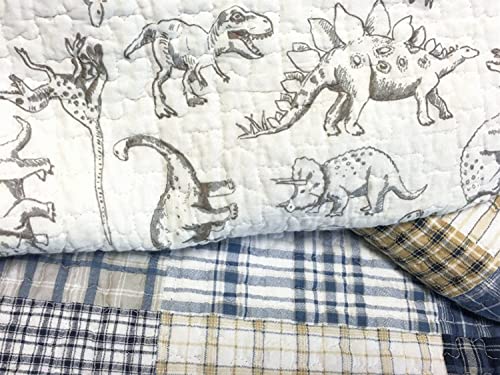
J-pinno 6-Layer Muslin Cotton Quilt Blanket, Twin (Dinosaur) — Best for Winter
Key specs (from the verified listing): 100% cotton muslin; 6-layer quilt construction; twin 58×80 inches; dinosaur print; soft warm quilt blanket and coverlet.
Old houses, north-facing rooms, and children who feel the cold need a quilt that actually insulates. Our verified pick for this slot is J-pinno’s six-layer muslin quilt blanket — and it takes the layered route to warmth rather than the filled one: six layers of 100% cotton muslin quilted together trap still air between the layers, giving the warmest all-cotton construction in this guide with a quilt’s flatter, tidier profile, at a full twin 58×80 inches. It still fits in a domestic washing machine, which many winter duvets do not. Be honest about the ceiling, though: layered muslin is not a duvet replacement for an unheated room in deep winter — on the coldest nights it pairs with a blanket over the top.
Strengths
- Six cotton layers trap air for real warmth, with no synthetic fill
- Muslin softens with every wash and breathes better than a filled quilt
- Full twin size covers a single bed properly, unlike toddler-size quilts
Trade-offs
- Layered warmth, not duvet loft — the coldest rooms may still want a blanket over it
- Six layers take longer to dry than a thin summer quilt — plan wash days
- The dinosaur print is a young child’s design; it will not age into the teen years
Warmth claims on quilts are unregulated poetry, so judge by construction. In a layered muslin quilt the honest specs are the layer count and the fabric: six layers of cotton hold warmed air between them the way a filled quilt’s loft does, and quilting through the layers keeps them acting as one blanket instead of sliding apart. Check that the layers are quilted through, not just hemmed at the edges — that is what keeps the warmth even from the top of the bed to the foot.
Pair it with the right nightwear logic. A child under a warm quilt in fleece pyjamas will overheat and kick everything off at midnight, then wake cold at four. Cotton pyjamas under the warm quilt keep the system balanced. This pick also earns its place in spare rooms and grandparents’ houses, where heating is intermittent and guests’ children feel it first.
Best for: Cold bedrooms, winter months / Not suited for: Summer or warm sleepers
This pick sits in the mid-range tier. Check the current price on Amazon for the Cozy Line Benjamin quilt set, and confirm the size and care instructions on the listing before ordering.

Joyreap Floral Cotton Patchwork Quilt Set, Twin — Best Heirloom Gift
Key specs (from the verified listing): 2-piece twin size cotton quilt set; colorful flowers grids patchwork design; 68×88 inches; lightweight cotton quilt bedspread for all seasons.
Our verified pick for this slot is Joyreap’s floral cotton patchwork quilt set — a twin-size, two-piece set whose grids-and-flowers patchwork design is made in the handmade tradition. Some quilts are bought; this one is given. A patchwork quilt, whether genuinely handmade or made in that tradition, carries a weight of intention no printed design matches. It suits the gift-buying grandparent, the christening or milestone present, and the family that keeps childhood objects rather than replacing them.
Strengths
- Patchwork construction is inherently repairable, patch by patch
- Design never dates the way character prints do
- Cotton patchwork ages into softness and keepsake status
Trade-offs
- Premium tier, and genuine handwork costs what it costs
- Often needs gentler washing than the everyday picks here
- A treasured quilt should not be the one taken to sleepovers and forts
Judge patchwork by its seams. Pieces should meet flat, with stitching that catches both fabrics evenly and a backing in one whole cloth or a few large pieces. Inside, a cotton or wool batting gives the drape and ageing that make these quilts heirlooms; thin polyester batting makes even good patchwork feel like a picnic rug. Ask or check what the batting is — it decides the next thirty years of the quilt’s life.
Give this quilt a job that honours it: the bed’s top layer, the reading chair, the end-of-bed fold. Children understand special objects when adults treat them as special without making them untouchable. A patchwork quilt that is used daily but washed gently will soften into exactly the object the giver hoped for — and the child will take it to their first flat, which is the entire point.
Best for: Gifts, keepsakes, top-of-bed layer / Not suited for: Rough daily wear and sleepovers
This pick sits in the premium tier. Check the current price on Amazon for the Joyreap patchwork quilt set, and confirm the size and care instructions on the listing before ordering.

Cozy Line Home Fashions Benjamin Dinosaur Plaid Quilt Set, Twin — Best for Growing Tastes
Key specs (from the verified listing): 100% cotton reversible coverlet bedspread set for kids; dinosaur plaid in navy blue, white and grey; twin, 2 pieces.
Our verified pick for this slot is Cozy Line Home Fashions’ Benjamin quilt set — a 100% cotton reversible twin set with a dinosaur plaid design. Children’s tastes turn over fast, and a quilt bought at four can embarrass at eight. A reversible design solves it elegantly: the playful side faces up in the early years, the quieter side later, and the quilt itself — still soft, still familiar — survives the transition that kills most themed bedding.
Strengths
- Two looks extend the design life by years
- Same washable construction as the everyday picks
- Flipping the quilt is a free bedroom refresh children enjoy doing themselves
Trade-offs
- Both sides must please; a weak reverse side wastes the concept
- Pattern matching at the edges is rarely perfect on mid-range versions
- Still a print — a teenager will eventually want plain
Choose the pair of designs as a timeline, not as two favourites. The young side can be bold — animals, maps, vehicles, space. The older side should be a pattern that could live in a guest room without apology: stripes, checks, small geometrics, a plain with a textured stitch. If the reverse could serve a spare bed later, the quilt never truly gets outgrown; it gets promoted.
Reversibility also helps laundry logistics. A small mark on one side, the night before a wash day, can be flipped away for one more night — parents of young children will understand exactly how often that matters. Check that the binding colour works with both faces; a binding chosen for one side only is the detail that gives away a cheap reversible.
Best for: Ages 4–10, taste transitions / Not suited for: Anyone wanting a single statement look
This pick sits in the mid-range tier. Check the current price on Amazon for the J-pinno six-layer muslin quilt, and confirm the twin sizing on the listing before ordering.

BuLuTu 100% Muslin Toddler Quilt, 47×59 — Best First Big-Bed Quilt
Key specs (from the verified listing): 100% muslin cotton toddler quilt; 47×59 inches; lightweight quilted blanket; bee bear pattern; machine washable.
Our verified pick for this slot is BuLuTu’s 100% muslin toddler quilt — a generous 47×59-inch quilted blanket, light enough for a small child to manage and machine washable. The first big bed is a milestone with a practical problem: cot bedding is too small, single bedding swamps the child and the bed. A transition quilt is sized between the two — enough width to tuck firmly (which toddlers find secure), light enough for a small child to pull up and rearrange alone, which is a real independence skill at bedtime.
Strengths
- Tuckable size keeps the cover on a wriggly new big-bed sleeper
- Light weight a young child can manage unaided
- Budget tier suits a stage the child passes through in a couple of years
Trade-offs
- Outgrown as a main quilt once a full single bed arrives — though it lives on as a throw
- Not sized for adult single beds, so it will not promote to the spare room
- Warmth is mid-level; cold rooms need a blanket over it
Tucking is the feature. A quilt that tucks under the mattress on three sides creates the enclosed, held feeling that helps many toddlers settle in an open bed after the bars of a cot. Leave the head end free, teach the child to wriggle in from the top, and the quilt becomes part of the bedtime routine rather than a cover that migrates to the floor by midnight.
Keep infant guidance separate and clear: this quilt is for a child who has moved to a bed, not for a cot. Babies under twelve months should sleep in a clear cot without quilts or loose bedding, following current safe-sleep guidance. The transition quilt’s moment comes with the bed move, typically from around eighteen months to two years onward, whenever your child makes that move.
Best for: First big bed, toddlers 2+ / Not suited for: Cots and infants
This pick sits in the budget tier. Check the current price on Amazon for the BuLuTu muslin toddler quilt, and confirm the size and care instructions on the listing before ordering.
Comparison Table
| Pick | Badge | Key trait | Best for |
|---|---|---|---|
| palassio Beige Cotton Quilt Twin Size Set | Best Overall | Cotton, channel stitch, mid-weight | Everyday single-bed use, most seasons |
| ENJOHOS Blue Cotton Linen Twin Quilt Set | Best for Warm Sleepers | Thin cotton fill, maximum breathability | Summer, hot sleepers, sleepovers |
| J-pinno 6-Layer Muslin Cotton Quilt Blanket, Twin | Best for Winter | 6-layer cotton muslin, twin size, layered warmth | Cold bedrooms, winter months |
| Joyreap Floral Cotton Patchwork Quilt Set, Twin | Best Heirloom Gift | Patchwork top, natural batting | Gifts, keepsakes, top-of-bed layer |
| Cozy Line Benjamin Dinosaur Plaid Quilt Set, Twin | Best for Growing Tastes | Two-sided design, washable cotton | Ages 4–10, taste transitions |
| BuLuTu 100% Muslin Toddler Quilt, 47×59 | Best First Big-Bed Quilt | Transition size, light, tuckable | First big bed, toddlers 2+ |
Read the table as a map rather than a ranking. The children’s quilts that wins on one row can be the wrong choice on the next, because the differences that matter — fit, care, durability, and day-to-day handling — only show up against your own routine.
How to Choose Children’s Quilts
Size is the first decision, and the rule is to buy for the bed the child will be in next year, not the one they are in today — with the single exception of the transition stage, where a between-size quilt genuinely earns its place. For a standard single bed, a quilt around the full single size gives the drop and tuck that keeps it on the bed. Too small is the common failure: a quilt that barely covers the mattress top slides off nightly and gets blamed on the child’s sleep habits.
Fabric comes second. Cotton is the default for good reasons: it washes hot when it must, softens with age, breathes in summer, and layers in winter. Cotton-rich blends dry faster and resist creasing, at a small cost in breathability. Fully synthetic quilts are light and cheap but can feel clammy against a warm child, and they pill. For children’s bedding that will be washed hundreds of times, cotton’s ageing curve is simply better.
Warmth third — and buy honestly for your house, not for the season in the shop. Most children in heated homes need the mid-weight everyday quilt plus layering options, not a winter quilt. Hot sleepers need the summer weight even in spring. The winter-weight pick is for genuinely cold rooms, and buying it for a warm house guarantees a quilt kicked to the floor every night.
Stitching patterns and what they promise
Channel stitching — parallel lines — is the workhorse: simple, strong, and forgiving in the wash. Diamond and box stitching hold loftier fills in place and suit warm quilts. Decorative motif stitching looks lovely and is only as durable as its density; sparse, wide quilting on any fill lets it migrate. Whatever the pattern, closer stitching means a longer-lived quilt, because the fill has nowhere to go.
Age, safety, and the quilt’s place
Quilts belong on beds, not in cots. Follow current safe-sleep guidance for babies: a clear cot, no loose bedding, for at least the first year. For toddlers and older children, the safety questions are mundane but real — no loose threads or buttons a small child can work free, no heavy weighted designs unless specifically advised, and a weight the child can push off their own face and body easily.
Prints, characters, and the taste timeline
Character bedding is a sugar rush: ecstatically received, quickly outgrown, and hard to hand down. If you buy it, buy it as the cheap extra, not the main quilt. The main quilt should be a design with a long fuse — patterns, checks, animals drawn in a classic style, or the reversible trick of a young side and a calm side. Siblings inherit quilts happily when the design does not scream an older child’s abandoned obsession.
Washing Children’s Quilts Without Wrecking Them
Children’s quilts should be washed like the workhorses they are: a normal warm cycle, ordinary detergent, and line drying or a low tumble where the label allows. The construction details from the buying guide — close stitching, firm binding, cotton fill — are exactly what makes this routine survivable hundreds of times. Wash a new quilt once before first use to remove finishing treatments and soften the fabric, and wash quilts separately from anything with zips or hooks that can snag the stitching.
Stains are a fact of childhood; treat them promptly with a soak rather than escalating to harsh bleach, which weakens cotton fibres and fades prints unevenly. Sunlight on a line is the old, effective freshener between washes. And keep a second, cheaper quilt in rotation — the summer or transition pick from this guide serves well — because the night a child is ill is the night you will be grateful the spare exists and is clean.
The Quilt Beyond the Bed
A child’s quilt will spend a surprising share of its life off the bed: as a fort roof, a den floor, a sofa nest for film afternoons, a car blanket, a picnic base, and the backdrop for a thousand games. This is an argument for the everyday cotton picks and against preciousness — a quilt that can do all of this without anyone wincing is doing its full job. It is also an argument for owning the heirloom patchwork separately, with its own honoured role, rather than expecting one quilt to be both workhorse and keepsake.
When a quilt finally retires from the bed — outgrown, or worn soft and thin — it usually demotes gracefully to the car, the dog’s basket, or the bottom of the dressing-up box. Cotton quilts age into usefulness at every stage, which is more than can be said for most childhood purchases, and a decent reason to buy the good one in the first place.
How to Choose and Set Up a Child’s Quilt for the Bed Move
If this quilt accompanies a move from cot to bed, the setup matters as much as the purchase. Work through it in order.
- Confirm the timing: the quilt is for a child sleeping in a bed, not a cot — babies under twelve months sleep in a clear cot without loose bedding.
- Choose the size for tuck: enough width to tuck under the mattress on both sides and the foot, creating a secure, held feeling.
- Wash the quilt once before first use, on its normal cycle, to soften it and remove factory finishes.
- Make the bed together the first time, showing the child how the quilt tucks and how to wriggle in from the top.
- Set the warmth system: cotton pyjamas and the mid-weight quilt for most rooms; add or remove a light blanket rather than swapping quilts nightly.
- Keep a clean spare quilt ready for illness nights and accidents, so the main quilt’s wash never becomes a bedtime crisis.
- After the first week, check the quilt each morning: if it is on the floor nightly, the problem is size, weight, or warmth — adjust that variable, not the child.
Most bed-move wobbles settle within a fortnight. A quilt that tucks, breathes, and feels like the child’s own object — rather than a piece of adult bedding lent to them — is usually the difference between a move that sticks and one that unravels at 2 a.m.
Quilts for Bunk Beds, Shared Rooms, and Sleepovers
Bunk beds change the quilt equation. On the top bunk, a quilt must be light enough for a child to haul up the ladder and arrange in a space where they cannot stand, and it must stay put without the tucking that a normal bed allows — a quilt that slides off a top bunk lands on the floor or, worse, on the lower sleeper. The summer-weight and transition picks in this guide serve top bunks best; reserve the warm, lofty quilt for the bottom bunk or a standard bed, where its weight is a comfort rather than a wrestling opponent.
Shared rooms raise the design question in a new form: siblings of different ages under quilts that need not match but should not clash. The calm strategy is one design family across both beds — the same check in two colourways, or the reversible quilt flipped to its two different sides — which gives each child ownership of a look while the room stays coherent. Parents who buy two unrelated character quilts discover that the room looks like a shop display for competing franchises, and that the children argue about whose is better with genuine feeling.
Sleepovers deserve their own rule: never send the good quilt. The heirloom patchwork stays home, always, and the quilt that travels is the budget summer pick or a dedicated spare — light, washable, and cheap enough that its loss, damage, or permanent exchange for a friend’s inferior blanket is a funny story rather than a grievance. Children understand this system quickly when it is explained as the quilt having jobs: home quilts, and adventure quilts.
The Quilt as a Comfort Object: Weight, Familiarity, and Bedtime Resistance
For many children the quilt is not bedding but a person in the bedtime negotiation — the familiar weight and smell and edge-feel that signals sleep. This is worth respecting in buying decisions. A child deeply attached to a worn quilt does not need it replaced because it looks tired; they need the new quilt introduced alongside, as an additional layer or the spare-room quilt, until familiarity transfers on its own schedule. Forcing a swap on a Friday night before guests arrive is how quilts get rejected permanently.
Weight plays a real role in settling. Some children sleep measurably better under a quilt with a bit of heft — the mid-weight cotton pick rather than the summer float — because the gentle pressure reads as security. Others kick off anything with presence and settle only under the lightest cover. You already know which child you have; buy for that child, not for the room’s photograph. Weighted blankets designed for adults are not a shortcut here and are not recommended for young children; an ordinary quilt’s natural weight, matched to the child’s preference, is the right tool.
Finally, involve the child in the choice within boundaries you set. Offer two or three quilts that all pass your washability and warmth tests, and let the child pick the design. A chosen quilt is defended by its owner, used without argument, and cared for noticeably better than an imposed one. The reversible pick is the diplomat’s option in this negotiation: the child’s bold side now, your calm side later, and nobody had to lose.
Quilt Sizes, Bed Sizes, and the Numbers That Prevent Returns
Quilt sizing fails in a predictable way: the name on the label describes the bed, but the dimensions describe something smaller, because manufacturers assume different drops on each side. Before buying, take the one measurement that matters — your child’s mattress width — and add the drop you want on each side, plus tuck if the quilt is meant to anchor under the mattress. A quilt that reaches only the mattress edge will spend its nights sliding; a quilt with a generous drop stays, drapes, and can fold back double over cold feet. When a listing gives centimetres, trust the centimetres over the size name every time.
Cot beds and toddler beds complicate the ladder: they are narrower than singles, and a full single quilt on a toddler bed leaves a great deal of fabric to manage — fine for a supervised, tucked arrangement, excessive for a small child alone with it. That gap is precisely the territory of the transition pick in this guide. At the other end, children who graduate to small doubles or doubles for sprawling, starfish sleeping will take their single quilt with them as a top layer or throw rather than a full cover, which is another reason the everyday cotton pick’s plain good looks matter: it demotes gracefully.
Keep a note of the quilt’s dimensions in your phone after purchase. It sounds excessive until the day you are buying sheets, a spare quilt, or a replacement for the one left at a holiday house, and the numbers are exactly what you need. Quilts are long-lived, infrequent purchases; the household that records what it bought buys right the second time in half the time.
Quilts Through the Year: A Simple Rotation System
Families who own two quilts per child — the mid-weight everyday quilt and one seasonal partner — can run a rotation that covers the whole year without a linen cupboard crisis. Spring and autumn belong to the everyday cotton quilt alone. Summer swaps in the lightweight quilt, or keeps the everyday quilt folded to half the bed over a sheet for children who want the familiar object at a cooler weight. Winter layers the everyday quilt over the duvet or under the warm quilt, depending on the house, rather than demanding a single heroic cover.
The rotation earns its keep at laundry time. With two quilts in service, one is always clean and on the bed while the other is in the wash, drying, or folded in reserve for the illness night that every parent knows is coming. The second quilt need not match the first in ambition: the summer pick at a budget tier is the classic partner purchase, doubling as the sleepover and spare-bed quilt in the months it is not on the child’s bed.
Store the off-duty quilt clean, dry, and loosely folded in a breathable bag rather than sealed plastic, because cotton stored damp or airless develops the cupboard smell that takes two washes to forgive. A lavender bag or cedar block in the linen cupboard is the traditional, effective touch. Label which quilt belongs to which child if siblings run similar designs — a small stitched initial on the binding ends the nightly ownership dispute that otherwise attends every bedtime in a shared room.
Three Children, Three Right Answers
The first child is two, moving to a big bed next month, in a warm flat where the heating runs generously. Her answer is the transition quilt: tuckable, light, and sized to make an open bed feel enclosed, with the everyday cotton quilt already waiting in the cupboard for the single bed that follows in a couple of years. The second child is six, sleeps hot in every month, shares a bunk room, and takes the top bunk. His answer is the summer quilt on the bunk and the reversible quilt as the household’s second — one for the heat, one for the sleepovers and the growth spurts of taste that are already visible on the horizon. The third child is nine, in a cold, beautiful old house with a single bed and a grandmother asking what to give for a milestone birthday. The answer is the warm quilt for the winters that house actually delivers, and the patchwork as the gift — one for the cold, one for keeps, and neither pretending to do the other’s job.
A Short Word on the Quilt They Will Remember
Ask adults about their childhood bedding and a surprising number can describe one quilt in forensic detail: its colours, its weight, the feel of its binding between their fingers as they fell asleep. Nobody remembers the duvet cover of the month or the sheet set that matched the curtains. Quilts achieve this permanence because they are handled, dragged, built with, slept under, and loved in a way almost no other household textile is — which is the deepest argument in this guide for buying the good cotton quilt over the disposable one. You are not furnishing a bed for a season. You are, with reasonable luck and the right stitching, manufacturing a memory with a twenty-year fuse, and the child will do the rest of the work themselves, one fort and one bedtime at a time.
Common Buying Mistakes
Buying character bedding as the main quilt. The beloved character of age four is an embarrassment at seven, and the quilt still has years of life in it. Keep characters to a cheap pillowcase or the spare quilt, and let the main quilt run on a timeless design.
Buying too small to ‘fit the cot bed’. Children change beds faster than quilts wear out. A quilt sized exactly for a cot bed is redundant within a year or two; size up for the single bed, or choose the deliberate transition size knowing it becomes a throw later.
Choosing delicate construction for daily use. Sparse stitching, single-fold binding, and dry-clean-only labels are all veto points for a child’s everyday quilt. It will be washed constantly; buy the construction that shrugs at that.
Overheating the child with a winter quilt in a heated house. A hot child kicks off every layer and wakes cold and tangled. Match the quilt weight to the real room temperature, and layer light blankets for flexibility instead.
Putting a quilt in a baby’s cot. Quilts and loose bedding do not belong in a cot for babies under twelve months. Follow current safe-sleep guidance and save the quilt for the bed stage — it will be waited for, and used for years.
Final Recommendation
For most families, the palassio classic cotton quilt is the purchase: washable, layerable, and sized to last through the single-bed years. Add the ENJOHOS summer quilt if your child sleeps hot, the J-pinno layered muslin quilt only if the bedroom is genuinely cold, and let the Joyreap patchwork heirloom be the gift piece with its own honoured job. The BuLuTu transition quilt is the specialist pick that makes the first big bed work.
Judge every candidate by the same three questions: will it survive weekly washing, will it suit the child’s real room temperature, and will the design still be welcome in three years? A quilt that passes all three is not just bedding — it becomes part of the furniture of childhood.
Related guides in this series: Best Amish Quilts Best Friend Quilts Best Handmade Turkish Quilts
Related guides
- Best Iron For Pressing Patchwork Quilts
- Best Quilts For Christmas
- Best Quilts For Cribs
- Best Quilts And Duvets
Frequently Asked Questions
What size quilt does a child need?
For a single bed, a full single-size quilt gives the drop and tuck that keep it on the bed. For the cot-to-bed transition, a between-size transition quilt tucks securely without swamping the child. Buy for the next bed stage, not the current one — quilts outlast bed changes.
Are quilts safe for toddlers?
Quilts are for children sleeping in beds, not for babies in cots. Babies under twelve months should sleep in a clear cot with no loose bedding, per current safe-sleep guidance. For toddlers in a bed, choose a light quilt the child can push off easily, with no loose buttons or threads.
Cotton or synthetic quilts for children?
Cotton is the better default: breathable, hard-wearing, and softer with every wash, and it tolerates the hot washes childhood sometimes requires. Synthetics are lighter and cheaper but can feel clammy and pill with age. Cotton-rich blends are a reasonable middle ground that dries faster.
How often should a child’s quilt be washed?
Every one to two weeks in normal use, and immediately after illness or accidents. That frequency is exactly why construction matters: close stitching, a firm binding, and a care label that allows a normal machine cycle. Keep a clean spare so wash day never collides with bedtime.
How do I stop my child kicking the quilt off?
Usually the quilt is too warm, too small, or not tucked. Match the weight to the room, size up so it tucks under the mattress, and check pyjamas are not overheating the child either. A week of mornings with the quilt on the floor is diagnostic information — change one variable at a time.
Is a handmade patchwork quilt practical for a child?
As the honoured top layer and keepsake, yes; as the everyday workhorse, it asks for gentler washing than childhood usually allows. Many families own both: the patchwork for the bed’s dressed look and gifting meaning, the cotton everyday quilt underneath doing the nightly work.
Keep exploring: Best Heavyweight Comforter Quilts Best Baby Blankets Organic Best Crib Toddler Sheet Sets


