Disclosure: airfryerkitchensupply.com is reader-supported. When you buy through links on our site, we may earn an affiliate commission at no extra cost to you.
Where to Buy
Every pick in this guide to the booster chairs for toddlers is sold through Amazon, where you can check price on Amazon for the exact configuration you want before ordering. Prices and stock move often on family and home gear, so treat any number you see elsewhere as a snapshot rather than a promise. Each pick below was confirmed against the airfry the Amazon catalogue on 2026-11-22 and carries an Amazon link, so you can shortlist by the features that matter and then confirm the live listing details, dimensions, and care instructions on the product page itself.
A quick note on how to use this page: start with the Quick Picks table if you already know your situation, read the full review of any pick that catches your eye, and then work through the buying guide and mistakes sections before you order. Those later sections are where most returns are prevented, because they cover the measurements, compatibility checks, and care realities that a product photo never shows.
Finding the booster chairs for toddlers sounds simple until you open a search results page and find dozens of near-identical options separated by details that are hard to judge from photos. A booster chair has one job — lift a toddler safely to table height so they can eat with the family — but the designs differ in ways that decide whether yours gets used daily or abandoned in a cupboard. Harness style, how the seat straps to your dining chair, tray size, and how the whole thing wipes down after a spaghetti night all separate the good from the frustrating.
Toddlers also change fast. The seat that fits a cautious eighteen-month-old has to keep working for a wriggly three-year-old who insists on climbing in alone, so adjustability and a harness that stays useful as your child grows matter more than cute colours. This guide weighs the six designs that cover real family life: high-back harness boosters, backless strap-on seats, travel boosters, and space-saving hook-on alternatives.
One honest note before the picks: no booster replaces supervision, and every model here assumes an adult dining chair that is itself stable, with a seat back the booster straps can grip. If your dining chairs are backless stools or very narrow ladder-backs, read the compatibility notes in the buying guide carefully, because strap geometry is where boosters succeed or fail.
In this guide
Quick Picks
These six picks cover the realistic spread of the booster chairs for toddlers market, from the value end to the premium end. Each one earned its slot for a distinct reason, and each carries a badge that tells you, at a glance, the job it does best.
- Fisher-Price Feeding Booster Seat for Toddlers — Best Overall. A supportive high back, a harness that keeps younger toddlers seated, and a tray that lifts off as they graduate to the table. Positioned in the mid-range tier. Check on Amazon
- OXO Tot Perch Toddler Booster Seat with Straps — Best for Small Kitchens. A simple raised cushion-seat that straps to a dining chair, disappears into a cupboard, and suits toddlers who no longer need a harness. Positioned in the budget tier. Check on Amazon
- Dreambaby Dining Booster Seat (Portable High Chair) — Best for Travel and Restaurants. Folds or packs small, straps to restaurant and grandparents’ chairs, and hides wipes and a bib in its own base. Positioned in the budget tier. Check on Amazon
- Inglesina Fast Table Chair with Dining Tray — Best Space-Saver. Clamps directly to the table edge, uses no dining chair at all, and folds flat against a wall when not in use. Positioned in the mid-range tier. Check on Amazon
- Dream On Me Munch N Go Booster Seat — Best for Growing With Your Child. Multiple height settings and a harness that converts in stages, built to span from first booster days to sitting at the table unaided. Positioned in the premium tier. Check on Amazon
- SMZCTYI Toddler Booster Seat Cushion for Dining Table — Best Budget Simplicity. A firm, wipeable cushion with a lap belt and a grippy base — the simplest possible lift for older toddlers at home. Positioned in the budget tier. Check on Amazon
How These Picks Were Chosen
The picks were chosen by comparing the features that decide daily usability: harness type and adjustability, the strap system that anchors the booster to an adult chair, seat height and footprint, tray design, weight limit, and how the surfaces clean after real meals. Models that relied on friction alone, with no chair straps, were excluded — a booster that can slide is a booster that will.
We also weighted growth room. A toddler booster is typically used from around eighteen months to four years, so seats with removable harness stages, adjustable heights, or a tray that detaches for table use scored higher than fixed designs a child outgrows in a season. Cleaning was scored just as hard: sealed surfaces and dishwasher-safe trays beat stitched seams and fabric that traps food.
Finally, each pick had to earn a distinct badge. If two designs did the same job the same way, only the stronger one stayed. The result is six boosters that genuinely differ — by harness, by footprint, by travel-worthiness — rather than six colour variations of one idea.
The 6 Best Booster Chairs for Toddlers
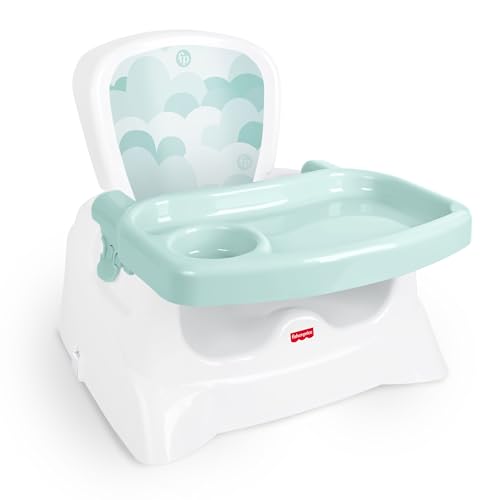
Fisher-Price Feeding Booster Seat for Toddlers — Best Overall
This is the booster most families should start with. The high back supports toddlers who still slump when tired, the three-point harness keeps an eighteen-month-old from standing up mid-meal, and the tray gives younger children their own contained eating surface while the harness and back convert away as they grow.
Strengths
- High back supports younger toddlers who cannot sit unsupported for a full meal
- Harness and chair straps work together, so the seat feels planted rather than perched
- Tray removes for washing and for pulling the child up to the family table later
Trade-offs
- Bulkiest of the strap-on designs; it claims a dining chair full-time
- Harness webbing needs regular wiping or it stiffens with dried food
- Tray is sized for toddler plates, not a full family dinner plate
The detail that sells this design is the strap routing. Straps pass under the chair seat and around the chair back, and on a standard dining chair the booster becomes effectively part of the chair. Test the fit on your own chairs before the return window closes: chairs with very thick upholstered backs or open slats can defeat the back strap, and no harness quality compensates for a loose anchor.
In daily use the removable tray is the feature you will thank. Toddler meals end with food in every seam, and a tray that lifts off and goes to the sink — or the dishwasher, on designs rated for it — turns a ten-minute scrub into a one-minute rinse. When your child is ready to eat at the table itself, the tray comes off permanently and the booster simply becomes a lift, which stretches the useful life of the purchase by a year or more.
Best for: Most toddlers from about 18 months / Not suited for: Backless stools or very narrow dining chairs
| Detail | What to know |
|---|---|
| Tray | Adjustable, removable tray |
| Safety | Safety straps for chair mounting |
| Use | Portable high chair / booster; folds for travel; ages 1+ per listing |
Check on Amazon — check the current price on Amazon before ordering, and confirm size, colour and configuration on the listing.

OXO Tot Perch Toddler Booster Seat with Straps — Best for Small Kitchens
Once a toddler can sit reliably and understands staying seated, a backless booster is often the better tool: lower, lighter, and far easier to store. This design suits children from about two and a half upward, in homes where the booster shares chairs with adults and cannot live on one permanently.
Strengths
- Small footprint stores in a cupboard or hangs on a hook between meals
- Dual straps keep it fixed despite having no back of its own
- Wipes clean in seconds because there are no seams or harness webbing
Trade-offs
- No harness, so it is wrong for younger or very mobile toddlers
- No back support for children who tire during long family meals
- Fixed height on most versions, so check the lift against your table height
Height is the whole question with a backless booster. Measure from your chair seat to the underside of your table, then check the booster’s lift puts your child’s elbows comfortably above the tabletop without their knees jammed underneath. A lift of roughly ten to thirteen centimetres suits most dining setups, but thick farmhouse tables with deep aprons eat into knee room fast.
Because there is no tray, this design pulls the child straight up to the family table, which many toddlers strongly prefer — eating exactly where the adults eat is a milestone they can feel. The trade is mess management: use a washable placemat under the plate, because the table, not a tray, now catches the spills.
Best for: Toddlers 2.5+ in small dining spaces / Not suited for: Children under two or climbers
| Detail | What to know |
|---|---|
| Style | Backless booster seat with straps |
| Seat | Wipeable seat; compact fold |
| Colour | Gray (per listing) |
Check on Amazon — check the current price on Amazon before ordering, and confirm size, colour and configuration on the listing.

Dreambaby Dining Booster Seat (Portable High Chair) — Best for Travel and Restaurants
Families who eat at grandparents’ houses, holiday rentals, and restaurants quickly learn that highchairs are not guaranteed. A travel booster lives in the car boot or a tote bag and turns almost any sturdy chair into a toddler seat in under a minute.
Strengths
- Lightweight with a carry handle or strap for genuinely painless transport
- Built-in storage swallows wipes, a bib, and a snack pot
- Straps adapt to a wide range of chair shapes found outside your home
Trade-offs
- Smaller seat and tray than home boosters; big toddlers outgrow it sooner
- Harness is usually simpler, aimed at keeping a child seated, not restraining a determined escape artist
- Feels less planted than a full-size home booster on wobbly rental chairs
Judge a travel booster by its strap length and buckle quality, because unfamiliar chairs are the whole point. Long straps with positive-locking buckles handle the deep, padded chairs in holiday rentals; short straps do not. Practise the strap routine at home once, so the first real use is not a wrestling match in a restaurant doorway.
The storage compartment sounds like a gimmick until the first outing, when the wipes you packed are exactly where the booster is. Keep the compartment stocked as a standing kit — wipes, bib, a spare spoon, a small bin bag — and the booster becomes a grab-and-go mealtime system rather than one more thing to assemble before leaving.
Best for: Eating away from home, grandparents’ houses / Not suited for: Everyday home use for large toddlers
| Detail | What to know |
|---|---|
| Travel | Built-in storage and shoulder strap |
| Safety | Three-point harness |
| Use | Portable high chair for dining table |
Check on Amazon — check the current price on Amazon before ordering, and confirm size, colour and configuration on the listing.

Inglesina Fast Table Chair with Dining Tray — Best Space-Saver
A hook-on chair answers a specific problem: no spare dining chair, or a table where a strapped booster eats knee room adults need. It clamps to the table edge, suspends the toddler at table height, and removes completely when guests come.
Strengths
- Uses zero floor or chair space — the only pick here that does
- Toddler sits right at the table, included in the meal from day one
- Folds nearly flat for storage in a drawer or against a wall
Trade-offs
- Table compatibility is strict: it needs a solid top of the right thickness and no glass or pedestal designs
- Lower weight limit than chair-mounted boosters, so it is outgrown earlier
- No tray on most versions, so the table edge takes the mess
Compatibility checking is not optional with this design. The tabletop must fall within the clamp’s stated thickness range, must be solid rather than hollow-core, and must not have an apron or bevel where the arms grip. Glass tables, single-pedestal tables, and flimsy folding tables are all out. Measure and check honestly; a hook-on chair on the right table is rock solid, and on the wrong table it should never be used at all.
Within those limits, the experience is lovely. The child sits at the true table height with feet dangling free, which many toddlers tolerate longer than a tray setup, and cleanup is a table wipe rather than a tray wash. It is also the easiest pick here to take to a holiday rental — provided you check the rental’s table first, which is exactly the kind of detail to confirm before you travel.
Best for: Small dining rooms with a solid table / Not suited for: Glass, pedestal, or lightweight tables
| Detail | What to know |
|---|---|
| Mounting | Hook-on chair; fits tables 0.8” to 3.5” thick |
| Capacity | For babies and toddlers up to 37 lbs (per listing) |
| Includes | Fast Dining Tray and travel bag (per listing) |
Check on Amazon — check the current price on Amazon before ordering, and confirm size, colour and configuration on the listing.

Dream On Me Munch N Go Booster Seat — Best for Growing With Your Child
If you would rather buy once, a stage-based booster adjusts its height, loses its tray, then loses its harness, following the child from early toddlerhood to the point where they only need a modest lift. It costs more upfront and earns it back in years of use.
Strengths
- Height settings match different tables and a growing child’s proportions
- Staged conversion keeps the harness exactly as long as it is needed, then removes it cleanly
- Typically the sturdiest build quality in the category
Trade-offs
- Premium tier pricing for features a fast-growing child may use briefly at each stage
- More parts means more crevices to clean and more pieces to keep track of
- Heavier than simple boosters, so it tends to live on one chair permanently
The height adjustment is the feature to interrogate. Settings should change the seat height in meaningful steps and lock positively, not slide on friction. As your child grows, you lower the booster so their feet and knees stay comfortable under the table while their elbows stay above it — a balance that shifts every few months and is exactly what fixed boosters cannot adapt to.
Treat the stages as a checklist rather than a schedule. Keep the tray while meals are still high-mess, keep the harness while standing-up attempts continue, and remove each element when the behaviour, not the birthday, says so. Children who eat at the table without a tray from about age three usually manage the transition in a week, especially if the booster itself stays familiar.
Best for: One-purchase families, long use window / Not suited for: Occasional use at a second home
| Detail | What to know |
|---|---|
| Heights | Adjustable 4 heights |
| Modes | 3-in-1 feeding, floor and table seat |
| Age / safety | For babies 6–36 months; 3-point safety harness (per listing) |
Check on Amazon — check the current price on Amazon before ordering, and confirm size, colour and configuration on the listing.

SMZCTYI Toddler Booster Seat Cushion for Dining Table — Best Budget Simplicity
For a three-year-old who mainly needs height, a booster cushion is the least fussy answer. It sits on the chair, adds a firm lift, includes a simple lap belt, and wipes clean like a placemat. It is furniture-simple rather than highchair-complex.
Strengths
- Nothing to assemble and almost nothing to break
- Firm foam holds its height instead of compressing flat under the child
- Doubles as a spare cushion for cinema trips and stadium seats
Trade-offs
- Non-slip bases grip less well on smooth wooden chairs than straps do
- Lap belt only — unsuitable for toddlers who still need torso support
- Foam thickness varies widely; thin versions add disappointingly little height
The non-slip base is the honest limitation. On upholstered or textured chair seats the cushion stays put; on polished wood it can creep as a child wriggles. Many families solve this by using the cushion on one designated chair with a rougher finish, or by placing a non-slip mat beneath it. If your chairs are all smooth wood and your toddler is a committed wriggler, choose a strapped design instead.
Firmness is the spec to check in reviews and in hand. A booster cushion should feel closer to a firm seat pad than a sofa cushion: if you can compress it to half its thickness with one hand, a toddler’s weight will do the same, and the promised lift disappears exactly when it is needed. Quality versions use high-density foam that keeps its working height for years.
Best for: Older toddlers needing height only / Not suited for: Smooth chairs plus very active toddlers
| Detail | What to know |
|---|---|
| Style | Removable chair cushion booster |
| Surface | PU washable cover; non-slip bottom |
| Straps | Double safety straps |
Check on Amazon — check the current price on Amazon before ordering, and confirm size, colour and configuration on the listing.
Comparison Table
| Pick | Badge | Key trait | Best for |
|---|---|---|---|
| Fisher-Price Feeding Booster Seat for Toddlers | Best Overall | High back + harness + removable tray | Most toddlers from about 18 months |
| OXO Tot Perch Toddler Booster Seat with Straps | Best for Small Kitchens | Backless, strap-secured, stores flat | Toddlers 2.5+ in small dining spaces |
| Dreambaby Dining Booster Seat (Portable High Chair) | Best for Travel and Restaurants | Portable, self-storing, quick straps | Eating away from home, grandparents’ houses |
| Inglesina Fast Table Chair with Dining Tray | Best Space-Saver | Clamps to table edge, folds flat | Small dining rooms with a solid table |
| Dream On Me Munch N Go Booster Seat | Best for Growing With Your Child | Multi-height, staged harness conversion | One-purchase families, long use window |
| SMZCTYI Toddler Booster Seat Cushion for Dining Table | Best Budget Simplicity | Firm cushion lift, lap belt, grippy base | Older toddlers needing height only |
Read the table as a map rather than a ranking. The booster chairs for toddlers that wins on one row can be the wrong choice on the next, because the differences that matter — fit, care, durability, and day-to-day handling — only show up against your own routine.
How to Choose Booster Chairs for Toddlers
The first decision is harness or no harness, and it is a developmental question, not an age printed on a box. If your toddler still tries to stand in a highchair, twists sideways to reach the floor, or cannot sit through a meal without support, you need a harness and ideally a back. If they climb into their chair, sit for family meals, and mainly lack height, a backless or cushion booster is simpler, cheaper, and easier to live with.
Second, audit your chairs before you fall for a design. Strap-on boosters need a chair with a seat the straps can pass under and, for the back strap, a backrest of reasonable width. Very narrow ladder-backs, stools, and benches defeat back straps. Measure your chair seat depth too: a booster footprint deeper than the chair seat will overhang and feel unstable no matter how tight the straps are.
Third, do the table maths. Sit your child on a stack of books on the dining chair and find the lift that puts their elbows just above the tabletop with shoulders relaxed. That lift — usually somewhere between eight and fifteen centimetres — is the seat height you are shopping for. Then check knee clearance under the table apron at that height, especially with tray designs, which add their own thickness above the child’s lap.
Tray or table?
A tray contains mess, gives a young toddler a defined eating space, and lets you serve food away from the table edge. Eating at the table itself includes the child socially and removes a part to wash, but spreads the mess wider. Many families use the tray until about age two and a half, then remove it. If that arc sounds like yours, choose a design whose tray detaches cleanly rather than one where the tray is structural.
Weight limits and the honest end of use
Every booster has a weight limit, and hook-on designs have the lowest. Children typically stop needing a lift somewhere between four and five, when their seated height lets them eat comfortably from a normal chair, sometimes with a cushion. Buy for the window you actually have: a child starting boosters at three does not need the staged, premium design built to span three years.
Cleaning as a design feature
Look for sealed, wipeable surfaces, trays that fit in your sink or dishwasher, and harness webbing that unclips for washing. Stitched fabric covers look soft in photos and become archaeology projects after a month of porridge. If a design has a removable, machine-washable cover, that is a genuine plus — check that it refits easily, because a cover that takes ten minutes to wrestle back on will simply stop being washed.
Booster Chairs and Safety, Without the Panic
Safety with boosters comes down to three unglamorous habits. First, the booster must be strapped to the chair every time, both straps, pulled snug — a booster placed loose on a chair is more dangerous than no booster, because it can slide out sideways. Second, the chair itself goes against the table or a wall so a child pushing with their feet cannot tip it backwards; never place a booster chair where a toddler’s feet can push off a table leg or wall at tipping distance. Third, the harness is used for every meal, not just the meals where you expect trouble.
Beyond habits, check the basics on any specific model before you buy: a current safety certification for your market, no recalls on that model line, and buckles a toddler cannot release but an adult can open one-handed in a hurry. Avoid second-hand boosters with frayed straps or unknown history, and retire any booster whose straps no longer hold tension. None of this is complicated, but it is the difference between a booster being a safety device and being furniture.
Making the Move from Highchair to Booster
The transition usually works best as a promotion, not a swap. Let the toddler watch the booster being fitted to a family chair, sit them in it for a favourite snack rather than a long dinner, and keep the first meals short and successful. Many children accept the booster instantly because it puts them at the table with everyone else; the ones who resist usually object to the harness change or the new tray, both of which fade within a week of consistent, low-pressure use.
Keep the highchair available for a fortnight if you have the space, for the overtired evenings when the old routine is easier. Once the booster has handled a full week of normal meals — including one messy one and one wriggly one — the highchair can go. If your toddler is moving to a booster mainly because a new sibling needs the highchair, start the transition a few weeks before the baby arrives, so the booster feels like the older child’s own upgrade rather than a displacement.
How to Fit a Booster Chair Correctly, Step by Step
A correct fit takes three minutes and is worth redoing whenever the booster moves chairs. Work through these steps in order.
- Choose the chair: a stable, four-legged dining chair with a backrest, placed on a hard floor rather than a thick rug.
- Position the booster centred on the chair seat, pushed back until its back meets the chair back with no gap a hand can slide into.
- Route the under-seat strap beneath the chair seat and buckle it, then pull it snug so the booster cannot slide forward or sideways when pushed firmly by hand.
- Route the back strap around the chair back, buckle, and tighten until the booster back stays in full contact with the chair back.
- Fit the tray if the design has one, checking it locks on both sides and sits level, at a height that lets the child’s forearms rest on it without shrugging.
- Seat your child, fasten the harness, and adjust it to a two-finger fit at the shoulders or hips — snug enough to prevent standing, loose enough to breathe and reach food.
- Push the chair in so the tray or table edge is close, then do a final rock test: grip the booster and push in every direction. Any sliding means a strap needs re-routing or tightening before the meal, not after.
Re-check strap tension weekly. Webbing creeps, chair pads compress, and toddlers grow — three small changes that quietly undo a good fit. A ten-second tug on each strap before the first meal of the week keeps the original setup honest.
Booster Chairs at Restaurants, Grandparents’ Houses, and Second Homes
The booster that lives on your dining chair solves home meals. It does not solve the restaurant highchair with the broken strap, the grandparents’ bench seating, or the holiday rental whose chairs nobody measured. Families who eat out often learn to read a room fast: a standard four-legged chair with a back is booster-friendly almost anywhere, which is why the travel pick in this guide straps to exactly that. Benches, stools, and sculptural dining chairs are the enemy, and in those rooms a hook-on chair on a solid table — or the restaurant’s own highchair, checked before you sit — is the safer plan.
At grandparents’ houses the dynamic is different: the booster may live there permanently, used twice a month, and the right purchase is the cheap, simple end of this guide rather than a duplicate of your home seat. A backless or cushion booster that stores in a cupboard between visits suits occasional use perfectly, provided the child is old enough for a harness-free design. If the grandchild is still in the harness stage, a second harness booster at the grandparents’ house is not extravagance; it is the difference between a relaxed family lunch and an adult spending the meal as a human seatbelt.
Second homes and caravans reward the same thinking. Measure the chairs there once, write the measurements in your phone, and buy to those numbers. The most common second-home mistake is assuming the chairs are ‘standard’ and discovering, booster in hand, that they are narrow ladder-backs the back strap cannot grip. Ten seconds with a tape measure on your last visit prevents the entire problem.
When Siblings, Twins, and Hand-Me-Downs Enter the Picture
A booster is one of the easiest hand-me-downs in the house because it has no fabric sizing and no expiry in the way a car seat does — but it still deserves an inspection before a younger sibling inherits it. Check every strap for fraying, confirm buckles click and hold under a firm pull, and look for cracks around the strap anchor points, where years of tension concentrate. Plastic that has gone chalky or brittle from sun exposure on a bright dining room chair should retire the seat, however sentimental the attachment.
Twins and close-spaced siblings raise a different question: two boosters means two dining chairs permanently claimed, and in a four-chair household that changes how the room works. Families in that position often choose one full harness booster for the younger child and graduate the older one early to a backless or cushion design, freeing both budget and chair space. The older child usually loves the promotion, which makes the transition easier than parents expect.
Finally, expect the booster years to overlap with the messiest eating years of a child’s life, and plan the dining room accordingly: a wipeable mat under the booster chair catches what the tray misses, washable chair pads protect upholstery from strap rub, and a small handheld vacuum living near the table will do more for your sanity than any single booster feature in this guide. The booster is a system, and the families who enjoy it most are the ones who set up the whole system once, properly.
Materials, Cleaning Chemistry, and the Life of the Straps
Booster chairs are made from a short list of materials, and each has a cleaning personality. Moulded plastic — the majority — wipes clean, tolerates ordinary kitchen cleaners, and shrugs off tomato sauce that would stain anything porous. Its enemy is abrasion: scouring pads rough the surface, and a roughened surface holds grime in its scratches, so the seat gets harder to clean the harder you clean it. Soft sponges and prompt wiping are the whole secret. Foam cushion boosters trade that wipeability for comfort, and their covers must come off for washing; a cushion booster whose cover does not remove is a countdown to unpleasantness, however charming it looks in the shop.
The straps deserve their own paragraph because they are both the safety system and the grime trap. Nylon webbing collects food in its weave, stiffens, and eventually smells of every meal it has attended. The fix is unglamorous: unclip the straps monthly, soak them in warm soapy water, scrub with an old toothbrush, and dry them fully before refitting — webbing refitted damp mildews quietly inside the buckle housings. While the straps are off, check the buckle springs and the anchor points in the shell. This fifteen-minute monthly ritual is the difference between a booster that serves two children gracefully and one that is retired early for reasons nobody can quite name.
Finally, think about where the booster lives between meals. A booster left permanently on the chair gathers kitchen grease film like everything else in a cooking space; a booster stored in a cupboard stays cleaner but must be re-strapped at every use, and re-strapping is where families start skipping the back strap. Choose the storage that preserves the full fitting routine in your household. The best booster is not the one with the best specification sheet — it is the one that is fitted completely, every time, by tired adults on ordinary evenings.
Booster Chairs and Mealtime Development: More Than a Lift
It is worth saying plainly what a booster is really for, because it explains the design choices throughout this guide. A toddler at the family table, at the right height, with their own defined place, is learning the social skill of the shared meal: waiting, watching, copying, joining. The booster is the enabling furniture for that lesson, which is why the tray-to-table transition matters — the child graduates from a served tray to the shared surface — and why eating at the table itself, rather than in a separate highchair station, is the milestone most families feel.
Height is the developmental detail. A child whose chin hovers at table level eats with raised shoulders, spills more, tires faster, and leaves the table sooner — not from naughtiness but from ergonomics. The right lift puts elbows comfortably on the table and feet supported or dangling freely without pressure behind the knees. When meals suddenly improve after a booster arrives, this is usually why, and when a booster ‘does not work’, a height check is the first diagnostic, before any conclusion about the child’s behaviour.
Independence is the final dividend. A booster a child can climb into — with the chair held steady and an adult present — and buckle with growing competence is a daily rehearsal of self-reliance at exactly the age children crave it. Choose buckles small hands can learn, keep the routine consistent, and the booster quietly becomes one of the tools by which a toddler becomes a person who comes to the table. That is a great deal of value from a moulded seat and two straps, and it is why buying the right one deserves the care this guide asks for.
Three Households, Three Right Answers
The first household has an eighteen-month-old, a farmhouse table with a deep apron, and grandparents who host Sunday lunch. Their answer is the high-back harness booster for home — its tray clears the apron problem by bringing the eating surface to the child — plus the travel booster living at the grandparents’ house, because Sunday lunch is a standing appointment, not an outing. The second household has a three-year-old, a tiny kitchen, and chairs that double as desk chairs by day. Their answer is the backless strap-on: fitted in seconds, stored in a cupboard, and honest about the fact that their toddler needs height, not restraint. The third household is expecting a second child and knows the highchair is about to be requisitioned. Their answer is the adjustable staged booster, bought early, introduced as a promotion, and timed so the older child’s new seat is a month old — and entirely theirs — before the baby arrives to claim the old one.
Common Buying Mistakes
Buying for the photo, not the chair. The most common booster failure is a beautiful seat that does not fit the family’s actual dining chairs. Measure chair seat depth, back width, and table height first, and let those numbers veto designs, however well reviewed.
Skipping the back strap. Many parents fit only the under-seat strap because it is easier to reach. The back strap is what stops the booster tipping forward when a toddler leans. Fit both, every time, or choose a design whose single-strap system is engineered as a whole.
Keeping the harness stage too long — or dropping it too soon. A harness removed early invites standing and climbing; a harness kept long after it is needed invites daily battles. Watch behaviour: consistent seated eating for a few weeks is the signal, not a birthday.
Ignoring the tray-to-table transition. Some boosters only work with their tray, which becomes a problem when a three-year-old wants to eat at the table like everyone else. If you plan to keep the booster past age three, confirm the tray detaches and the seat still fits under your table without it.
Assuming one booster suits every house. The booster that fits your dining chairs may not strap safely to grandparents’ chairs or rental furniture. That is the entire case for a travel booster as a second, cheap seat rather than forcing one design to do every job.
Final Recommendation
If you buy one booster from this list, make it the high-back harness design: it covers the widest age range, anchors the most securely, and converts gracefully as your toddler grows. Small kitchens and older toddlers are better served by the backless strap-on or the cushion, and regular travellers should add the travel booster as a second seat rather than compromising the home one.
Whichever you choose, do the chair audit and the table maths in the buying guide before ordering, and do the three-minute fitting routine the first time the booster meets your chair. Those two unglamorous steps are what separate the booster that gets used every day from the one that ends up in the cupboard.
Related guides in this series: Best Bouncer Chairs For Babies Best Baby Blankets Organic Best Breakfast Chairs
Related guides
- Best Table Chairs For Toddlers Babyletto
- Best Replica Ghost Chairs
- Best Minimalist Bedroom Chairs
- Best Pink Fabric Chairs
Frequently Asked Questions
What age can a toddler start using a booster chair?
Most toddlers can use a harness booster once they can sit unsupported and are eating confidently in a highchair, commonly around eighteen months. Backless and cushion boosters suit older toddlers, usually from about two and a half, who can sit reliably without torso support. The child’s sitting ability matters more than the exact age.
Can a booster chair replace a highchair entirely?
For many families, yes, especially harness boosters with trays, which do the same job on a dining chair. Highchairs still win for very young babies who need recline, and for kitchens where no dining chair can be spared full-time. From toddlerhood onward, a good booster covers meals completely.
Are hook-on table chairs safe?
On the right table, yes: a solid, heavy tabletop within the clamp’s thickness range, fitted exactly as instructed, holds securely. They are unsafe on glass, pedestal, hollow, or lightweight tables, and they carry lower weight limits than chair-mounted boosters. The table check is the safety check.
How do I clean a booster chair properly?
Wipe surfaces after meals, remove and wash the tray in the sink or dishwasher if rated for it, and unclip harness webbing for a soak when it stiffens with food. Avoid harsh solvents on plastic, and let everything dry fully before reassembly so straps do not develop odours.
How long will my child use a booster chair?
Typically until somewhere between four and five years old, when seated height on a normal chair lets them eat comfortably, sometimes with an ordinary cushion for a while after. Stage-based and adjustable designs stretch the window longest; travel boosters are outgrown soonest because of their compact seats.
What if my dining chairs have no backs?
Strap-on boosters that need a back strap are not suitable for stools or backless benches. Your options are a hook-on chair on a suitable table, a booster whose design is certified for under-seat strapping only, or returning to a freestanding highchair until your seating changes.
Keep exploring: Best Baby Car Seat Blankets Best Toddler Dining Booster Seats Best Travel Booster Seats


