Disclosure: airfryerkitchensupply.com is reader-supported. When you buy through links on our site, we may earn an affiliate commission at no extra cost to you.
Where to buy
All six picks in this guide to the best bath mats for carpeted bathroom floors were verified as live listings verification, each matched to the exact type, backing, and construction to buy, because a bath mat that works on carpet is a specification problem before it is a brand problem. For every pick, check the backing type and pile height named in its review against the listing, and check price on Amazon before ordering. Read the listing’s backing description word for word — on carpet, the difference between a mat that stays put and a mat that travels across the room is written in that one line.
- OLANLY Chenille Bath Rug 30×20 with Rubber Backing – check price on Amazon; choose the listing sold or shipped by Amazon or the brand store where available.
- Yimobra Memory Foam Bath Mat 31.5×20 – check price on Amazon; choose the listing sold or shipped by Amazon or the brand store where available.
- Smiry Ultra Thin Bath Mat 30×20, Low Pile with Non Slip Rubber Backing – check price on Amazon; choose the listing sold or shipped by Amazon or the brand store where available.
- Madison Park Sanctuary 100% Cotton Bath Rug 20×32, Low-Profile Woven – check price on Amazon; choose the listing sold or shipped by Amazon or the brand store where available.
- OLANLY Bathroom Runner Rug 70×24, Chenille with Rubber Backing – check price on Amazon; choose the listing sold or shipped by Amazon or the brand store where available.
- OLANLY Thick Chenille Bath Mat 30×20 – check price on Amazon; choose the listing sold or shipped by Amazon or the brand store where available.
The Carpet Problem: Why Most Bath Mats Fail Here
Looking for the best bath mats for carpeted bathroom floors means shopping against the grain of the entire category, because nearly every bath mat on the market is engineered for hard floors. Suction cups — the grip system on most tub and shower mats — are useless on carpet; there is nothing to suction to. Smooth PVC backings that grip tile beautifully skate across carpet pile like a sled. Tall, plush piles that feel luxurious on hardwood become a tripping, bunching, door-blocking nuisance when they sit on top of carpet that already has height of its own. And the absorbent top you need still has to do its job, because a carpeted bathroom’s real enemy is not slipping on tile — it is water soaking through the mat into carpet and padding that dry slowly and smell forever.
So the carpeted-bathroom brief is specific: a backing that grips carpet fibers mechanically — rubber, TPR, or a textured gripper surface that keys into the pile — instead of relying on suction or smooth friction. A low or medium pile, so the mat reads as a defined landing zone rather than a second carpet stacked on the first, and so the bathroom door still swings over it. Enough absorbency and a fast enough dry time that the carpet underneath stays dry between showers. And washability, because a mat protecting carpet will itself take the moisture, the toothpaste, and the traffic, and a mat you cannot wash becomes the problem it was bought to prevent.
Every pick below is a type that satisfies that brief, chosen for a different carpeted-bathroom job: the all-round chenille, the comfort memory foam, the gripper rug for deep pile, the woven cotton rug for easy washing, the runner for long floors, and the plush absorber for busy family bathrooms. Where a type has a failure mode on carpet, the review says so plainly.
In this guide
Quick Picks
- Best Overall: OLANLY Chenille Bath Rug 30×20 – thousands of absorbent chenille fingers on a rubber base that keys into carpet pile and stays where you put it. Check the current price on Amazon.
- Best Comfort: Yimobra Memory Foam Bath Mat – the cushioned step-out experience, with a non-slip backing and a quick-dry, machine-washable build. Check the current price on Amazon.
- Best for Deep-Pile Carpet: Smiry Ultra Thin Bath Mat 30×20 – a low-pile, thin profile that sits down into plush carpet instead of riding on top of it, on a non slip rubber backing. Check the current price on Amazon.
- Best Easy-Care: Madison Park Sanctuary Woven Cotton Bath Rug – a low-profile woven cotton rug that goes through the wash without a foam core to break down, and dries fast over the tub edge. Check the current price on Amazon.
- Best for Long Floors: OLANLY Bathroom Runner Rug 70×24 – one continuous chenille landing strip from tub to vanity for carpeted bathrooms with distance to cover. Check the current price on Amazon.
- Best Absorbency: OLANLY Thick Chenille Bath Mat – the thickest drinker in the guide for households where the floor gets wet several times a day. Check the current price on Amazon.
How These Picks Were Chosen
We filtered the category by the carpet brief first and by everything else second. Any mat whose grip system was suction cups was out — that excludes most in-tub mats and a surprising number of floor mats that borrow the design. Any mat with a smooth, glossy PVC underside was out, because smooth-on-pile is the skating combination. What survived had to show three things: a backing described as rubber, TPR, or a textured non-slip gripper; a pile height that keeps the total stack — carpet plus mat — low enough for a swinging door and a safe step; and a wash or care routine a normal household will actually perform.
Within the survivors we sorted by job rather than by softness, because softness is the one quality every listing advertises and the one that matters least on carpet, where the floor underneath is already soft. What matters is whether the mat stays put during a wet-footed exit from the tub, whether it drinks the water before the water reaches the carpet, and whether it dries before the next shower. The six types below are the constructions that answer those questions best, and each review names the carpet depth and household pattern the type suits — and the ones it does not.
The 6 Best Bath Mats for Carpeted Bathrooms
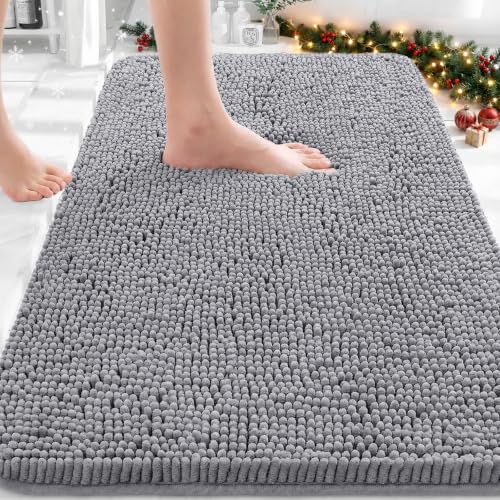
OLANLY Chenille Bath Rug 30×20 with Rubber Backing – Best Overall
Chenille is the workhorse construction of the bath mat world: thousands of short, dense microfiber fingers that wick water off wet feet on contact and hold a surprising amount of it. The versions that earn the Best Overall badge here are the low-profile ones on a genuine rubber backing. The rubber base is the carpet-relevant part — its weight and texture let it settle into carpet pile and resist the sideways creep that plagues lighter mats, while the short chenille pile keeps the total height low enough for doors and for a stable step. Step out of the shower onto it and the experience is exactly what a bath mat is for: dry, warm, and unmoving.
Strengths
- Chenille fingers absorb on contact and spread water across the mat instead of letting it pool and soak through.
- Rubber backing grips carpet mechanically and gives the mat enough heft to stay placed.
- Low profile clears swinging doors and feels stable — no wobble on top of the carpet’s own softness.
Trade-offs
- Rubber backings age; repeated hot washing and tumble drying crack them over time, so this type rewards gentle washing and air drying.
- Chenille traps lint and hair visibly and needs a shake outside between washes.
- On very deep plush carpet, even a low-profile mat can rock slightly; the gripper rug below sits deeper.
The ownership routine is simple: shake it out weekly, wash it cool and gentle when it stops smelling fresh, and dry it flat or over the tub rather than in a hot dryer. Treated that way, a rubber-backed chenille mat is the rare bathroom textile that lasts for years. Treated like a towel — hot wash, hot dry, every week — the backing will be confetti within a season, and the failure will be blamed on the mat rather than the dryer. Buy this type if you want the default answer: the mat most carpeted bathrooms should start with.
Best for: most carpeted bathrooms, especially low- and medium-pile carpet. / Not suited for: households that machine-dry everything on hot.
Check on Amazon – check the current price on Amazon and confirm the size and color against your floor.

Yimobra Memory Foam Bath Mat 31.5×20 – Best Comfort
Memory foam mats sell a feeling: the slow, cushioned sink when you step out of the shower. On hard floors that feeling is pure luxury. On carpet it needs scrutiny, because foam plus carpet pile is softness stacked on softness, and the wrong foam mat on thick carpet feels like standing on a mattress — pleasant for a second, unstable for a wet exit. The versions that work on carpet are the thinner foam mats with a non-slip backing rather than a smooth one: enough foam to cushion, enough backing texture to anchor, and a total height that keeps your footing honest. The Yimobra is the verified example here — a quick-dry memory foam mat, machine washable, in a 31.5-by-20-inch size that covers a full step-out zone.
Strengths
- The most comfortable step-out in the guide, especially appreciated by anyone with sore feet or knees first thing in the morning.
- Foam absorbs a meaningful amount of water and releases it slowly, protecting the carpet beneath during a normal shower routine.
- The velvety microfiber covers look tidy and come in the widest color range of any type here.
Trade-offs
- Memory foam dries slowly; in a bathroom with several showers a day it can stay damp and start to smell if it never gets aired.
- On deep-pile carpet the stack can feel unstable — this type suits low-pile carpet best.
- Foam still asks for a gentler wash cycle than woven cotton rugs, and its backing should be checked as it ages.
Choose the foam mat for the right bathroom: a primary ensuite on low-pile carpet, used by one or two people, where the mat gets hours to dry between uses and the morning step-out is a small daily pleasure worth optimizing. Skip it for the kids’ bathroom with four showers before school. Comfort is a real criterion — a mat you enjoy is a mat you keep using — but it ranks below dryness and stability, and this pick is honest about that order.
Best for: low-pile carpeted ensuites and comfort-first buyers. / Not suited for: deep-pile carpet or high-traffic family bathrooms.
Check on Amazon – check the current price on Amazon and pick the size that covers your step-out zone.

Smiry Ultra Thin Bath Mat 30×20, Low Pile – Best for Deep-Pile Carpet
The verified example is the Smiry ultra thin bath mat, 30 x 20 inches in grey: its listing confirms a low-pile, quick-dry absorbent surface on a non slip rubber backing, machine washable. Deep-pile carpet inverts the usual advice. On plush carpet, a thick mat does not sit on the floor; it floats on a sea of fibers, rocking and migrating with every step. The answer is to go thin: a low-pile microfiber rug whose gripper backing — a field of small rubberized dots or a textured latex surface — can reach down between the carpet fibers and key in. The rug settles into the pile rather than riding on it, the step feels like carpet with a defined, drier landing zone, and the whole assembly stays low enough for any door.
Strengths
- Thin profile nests into deep pile instead of floating on it — the most stable option for plush carpet.
- Gripper-dot backings hold position without the stiffness of a full rubber slab.
- Microfiber drinks water fast and dries faster than chenille or foam, suiting busy bathrooms.
Trade-offs
- Thin means less cushion; on hard floors this type would feel skimpy, and even on carpet it is function-first.
- Gripper dots wear with washing; the hold at month twelve is good, not new.
- Absorbency per step is lower than the plush pick — it manages shower water well but not a child’s full bath splash campaign.
If your carpet is the plush, toes-disappear kind, start here rather than adapting a hard-floor mat and fighting it all year. The low-pile rug also travels well between rooms and washes easily, which makes it the pragmatic pick for renters in carpeted apartments who need the bathroom solved this week with one purchase.
Best for: deep-pile and plush carpeted bathrooms, rentals, and function-first buyers. / Not suited for: buyers who want a plush, cushioned step.
Check on Amazon – check the current price on Amazon.
Two of the three verified picks in this guide — the OLANLY chenille rugs — share a care profile worth stating once: machine washable, best in cool water, and happiest dried flat or over the tub rather than tumble-dried hot, because their rubber backings are the grip the whole purchase depends on. The Yimobra foam mat washes on a gentle cycle as well. None of the three asks for special detergent or hand care; the discipline is thermal, not chemical, and it is the same discipline the woven and runner types below reward.

Madison Park Sanctuary Woven Cotton Bath Rug 20×32 – Best Easy-Care
The woven cotton rug is the oldest design in this guide and the easiest to live with. The verified example is the Madison Park Sanctuary bath rug, 20 x 32 inches in white: 100% cotton in a low-profile woven design, ultra soft and absorbent, non-slip, and machine washable per its listing. Woven low and flat like a heavy towel-rug, with no foam core, it bends, folds, and goes through a normal wash and dry without the foam-breakdown anxiety of the cushioned types. Its grip on carpet comes from weight, weave texture, and the friction of cotton against carpet fiber — adequate on low and medium pile, and honest about its limits on plush. What it returns for that compromise is the simplest ownership in the category: when it is dirty, you wash it like laundry, because it is laundry.
Strengths
- Fully machine washable and dryable with no foam core to break down — the lowest-maintenance pick here.
- Flat profile stores on a towel bar, hangs over the tub to dry in hours, and never blocks a door.
- Cotton absorbs well and feels like a textile, not a product, which suits traditional bathrooms.
Trade-offs
- Grip is the weakest of the six types; on slick, low-twist carpet it can shift and needs the occasional straightening kick.
- Thinner water barrier than rubber-backed mats — a flooded floor event will reach the carpet through it.
- Cotton shows its age in fading and softening; it reads as a rug, and eventually as an old rug.
The woven cotton rug is the right answer for guest bathrooms, for households that wash bathroom textiles weekly as a religion, and for anyone who has killed a rubber-backed mat in the dryer and sworn never again. Buy two and rotate: one on the floor, one in the wash, and the carpet underneath never meets a damp mat left too long.
Best for: wash-routine households, guest bathrooms, and low/medium-pile carpet. / Not suited for: flood-prone kids’ bathrooms or anyone needing maximum grip.
Check on Amazon – check the current price on Amazon; buy two to rotate.

OLANLY Bathroom Runner Rug 70×24 – Best for Long Floors
The verified example is the OLANLY bathroom runner rug, 70 x 24 inches in grey: extra soft absorbent chenille on a quick-drying rubber backing, machine washable, sold explicitly as a long bath mat. Some carpeted bathrooms are not a square with a tub; they are a corridor — tub at one end, double vanity along the wall, toilet at the far end — and two small mats leave a cold, damp archipelago of bare carpet between them. The runner solves the geometry: one long, low-profile mat, in the same rubber-backed chenille or low-pile microfiber constructions as the top picks, that lays a continuous dry path along the working length of the room. On carpet it has a second advantage: its length and weight make it the least mobile mat in the guide once placed.
Strengths
- Continuous coverage from tub to vanity; no wet-footed hops across bare carpet between mats.
- Length and weight anchor it — runners creep less than any small mat on carpet.
- One item to wash and place instead of a set to align every laundry day.
Trade-offs
- Needs a big washing machine or a tub soak; a runner is a commitment on laundry day.
- Measure before buying: a runner that meets a door swing or a toilet base at the wrong point bunches at the obstacle.
- More material means slower drying after a wash.
Measure the run from the tub edge to the end of the vanity, subtract a hand’s width at each end, and buy the runner that lands in that window. In long primary bathrooms — the very rooms most likely to be carpeted in older homes — the runner is not an extravagance; it is the only configuration that actually covers the floor the keyword is about.
Best for: long carpeted bathrooms and double-vanity layouts. / Not suited for: small bathrooms or small washing machines.
Check on Amazon – check the current price on Amazon; measure your floor run first.

OLANLY Thick Chenille Bath Mat 30×20 – Best Absorbency
The last pick serves the wettest bathrooms: family rooms where the tub hosts children, the shower runs back-to-back, and the floor’s problem is volume. A plush, thick chenille mat with a full rubber backing holds the most water of any type here, and the OLANLY Thick Chenille is the verified example: extra-soft, high-pile chenille over a rubber base that keys into carpet and keeps the mat planted under heavy daily traffic. The pile drinks splash and drip at a rate the thin rugs cannot match, keeping the carpet beneath dry through a full evening of baths.
Strengths
- Maximum absorbency in the guide — the pick for splash-heavy family bathrooms.
- Full rubber backing grips carpet and survives the machine washing this class of mat constantly needs.
- Plush pile is warm and forgiving for kids sitting on the floor at bath time.
Trade-offs
- The tallest stack on carpet; check door clearance carefully and expect a more deliberate step.
- Holds the most water means dries the slowest — it needs airing over the tub between heavy-use days.
- Plush pile shows footprints, lint, and wear patterns fastest of the six types.
This is a specialist pick and proud of it. In a quiet ensuite it is overkill with a drying problem; in a family bathroom it is the difference between carpet that stays dry and carpet that slowly becomes a mildew archive. If your floor’s enemy is volume, buy the volume answer and give it the airing routine it asks for.
Best for: family bathrooms with heavy daily water volume on low/medium-pile carpet. / Not suited for: low-clearance doors or bathrooms that never get aired.
Check on Amazon – check the current price on Amazon and verify door clearance before ordering.
Comparison Table
| Pick | Badge | Key spec | Best for |
|---|---|---|---|
| OLANLY Chenille Bath Rug 30×20 | Best Overall | Chenille absorbency, rubber backing, low profile | Most carpeted bathrooms |
| Yimobra Memory Foam Bath Mat 31.5×20 | Best Comfort | Memory foam cushion, non-slip backing, machine washable | Low-pile ensuites, comfort-first buyers |
| Smiry Ultra Thin Bath Mat 30×20 | Best for Deep-Pile Carpet | Low-pile thin profile, non slip rubber backing, fast drying | Plush carpet and rentals |
| Madison Park Sanctuary Cotton Bath Rug 20×32 | Best Easy-Care | 100% cotton low-profile woven design, non-slip, fully washable | Weekly-wash households, guest baths |
| OLANLY Bathroom Runner Rug 70×24 | Best for Long Floors | Continuous 70-inch chenille runner, rubber backing | Long bathrooms, double vanities |
| OLANLY Thick Chenille Bath Mat 30×20 | Best Absorbency | Thick chenille pile, rubber backing, maximum water capacity | Family bathrooms with heavy use |
How to Choose a Bath Mat When the Floor Is Carpet
Begin with the carpet, not the mat. Crouch down and press the pile: if your fingers disappear, you have deep pile and the thin gripper rug is your starting point; if the carpet is a tight, low loop or a short cut pile, the rubber-backed chenille and even the foam mat come into play. Next, swing the bathroom door over the spot where the mat will live and note the clearance — the total stack of carpet plus mat must pass under it without dragging, or you will move the mat every time the door opens and eventually stop using it. Then count the showers: a bathroom used once a morning can host a slow-drying plush or foam mat, while a bathroom used five times before 8 a.m. needs the fast-drying microfiber or a two-mat cotton rotation.
Color and pattern deserve one practical paragraph, because on carpet the mat is unusually visible — a defined rectangle in the middle of a uniform field. Match the mat to the carpet’s tone family rather than the towels: a mat that fights the carpet color makes the whole room look like a landing pad, while a tonal mat reads as part of the floor and lets towels and shower curtains carry the accent color. In high-traffic family bathrooms, mid-tone heathered weaves hide the lint, hair, and toothpaste evidence of real life far better than either white or black, both of which show everything. This is not decoration advice for its own sake; a mat that looks dirty gets washed on the wrong schedule or replaced early, and a mat that looks clean at a glance still needs its real schedule — which is why the section on keeping the floor dry talks about smell and touch, not appearance.
Finally, decide your laundry personality honestly. Rubber and TPR backings reward cool, gentle washing and air drying; if your household washes everything hot and dries it hotter, the woven cotton rug is not a compromise — it is the only pick whose care instructions match your life. A mat whose care you will not perform is a mat with an expiry date, and on carpet the expiry announces itself as a smell rising from the floor you were trying to protect.
How to Keep a Carpeted Bathroom Dry and Fresh
The mat is the first line, not the whole defense. After the last shower of the day, drape the mat over the tub edge or a towel bar for an hour so both its faces dry; a mat left flat on carpet overnight after a wet evening traps exactly the moisture it collected against the carpet it protects. Run the bathroom fan during and after showers, or crack a window, because ambient humidity is what turns a slightly damp carpet pad into a smell. Once a week, lift the mat and check the carpet beneath with the back of your hand: it should feel dry and smell like nothing. If it feels cool-damp, the mat is being overwhelmed — step up absorbency, add a second mat at the tub exit, or shorten the interval between airings.
Wash on the mat’s schedule, not the calendar’s: chenille and microfiber when they stop smelling neutral, cotton weekly in rotation, foam spot-cleaned and aired, plush mats whenever they stay damp into the next day. And keep a small, washable step-out towel at the tub edge in kids’ bathrooms as a sacrificial first layer; it catches the biggest splash, goes in any wash, and spares the real mat for the job it is good at.
Backing Types Decoded: What Actually Grips Carpet
Listings describe backings in a fog of near-synonyms, so here is the translation table that matters on carpet. Natural or synthetic rubber backings — the heavy, matte, slightly tacky slab under chenille mats — grip by weight and surface friction against the pile, and they are the benchmark for staying put. TPR, thermoplastic rubber, is rubber’s more wash-tolerant cousin: flexible, grippy, and common under plush mats. Latex spray backings, the thin coating on many woven rugs, add mild hold and keep a rug’s shape; they suit woven cotton rugs where the weave itself supplies most of the friction. Gripper dots — fields of small rubberized bumps — work like cleats, pressing between carpet fibers; on deep pile they outperform flat slabs because they reach into the pile instead of bridging across its tips.
And the two to avoid on carpet: smooth PVC, which is engineered to cling to smooth tile and behaves like a puck on ice over pile, and suction cups, which need a sealed hard surface to function at all. A listing that cannot tell you what its backing is made of is telling you something. When the backing line says only “non-slip” with no material named, assume the cheapest interpretation and keep scrolling — on carpet, the unnamed backing is the one that will be sliding into the hallway by Friday.
Matching the Mat to Your Carpet’s Depth
Carpet depth decides the shortlist before any other preference gets a vote. Low-pile and loop carpets — the tight, commercial-style carpets common in newer bathrooms and rentals — behave almost like hard floors with better manners: every pick in this guide works on them, including the memory foam, and the deciding factors become absorbency and care. Medium cut pile, the residential standard, is the chenille mat’s home ground; rubber and TPR backings settle into it, grip honestly, and the step stays stable. Deep plush and shag are the inversion zone: thickness stops being comfort and becomes instability, and the correct move is down, not up — the thinnest rug with the cleverest backing, accepting less cushion in exchange for a mat that behaves like part of the floor.
There is a special case worth naming: carpet tiles and carpet over radiant heat. Tiles can lift at the corners under a heavy, frequently moved mat, so choose lighter constructions and lift rather than drag the mat when you move it. Radiant heat argues for thinner mats generally — a thick insulating mat over a heated floor creates a warm, damp sandwich that dries nothing — and for strict airing discipline. In both cases the woven cotton rug, light and fully washable, quietly becomes the professional’s choice.
The Moisture Math of a Carpeted Bathroom
It is worth understanding why this category deserves a guide of its own. A hard bathroom floor forgives water: it pools visibly, evaporates, or gets mopped. A carpeted bathroom hides water. Every shower sends a load of drips and wet-foot traffic onto the floor; the mat’s job is to intercept that load and then release it to the air before the next load arrives. If interception exceeds release for days in a row, the surplus migrates downward into carpet backing and pad, which dry an order of magnitude more slowly than the surface. That is the whole mildew story of carpeted bathrooms, and it explains this guide’s recurring obsessions: absorbency matched to volume, drying speed matched to frequency, and the nightly airing that resets the balance.
The practical consequence is that two households can buy the same mat and get opposite results. A couple showering once each morning gives any decent mat twenty-two hours to dry; it will succeed almost regardless of type. A family running five showers and a bath through the same mat gives it a load it physically cannot release in the gaps, and it will fail — blamed, unfairly, as a bad mat. Match the mat to the math: volume households need either the highest absorbency paired with airing, or the fastest-drying construction paired with rotation. The guide’s picks are organized by exactly that logic, and the household that reads its own routine honestly will land on the right one the first time.
Sizing and Placement: Covering the Wet Path
Walk your bathroom’s wet path barefoot in your mind: out of the tub or shower, one step to dry ground, a turn, two steps to the vanity, a stand at the sink. The mat system has to cover that path’s first steps completely, because the first steps carry the most water. A mat that covers the exit but not the turn leaves the turn — executed on wet feet, mid-pivot — as the slip and soak point. In practice this means the standard small mat suits a compact bathroom where exit and vanity are one step apart, and everything larger wants either the runner or a deliberate two-mat layout with the mats touching, not gapped.
Placement details that matter on carpet: butt the mat’s edge close to the tub or shower threshold so the first footfall lands fully on it; align the long edge with the vanity in runner layouts so the standing zone is covered where you drip longest, at the sink; and keep mats out of the toilet’s immediate arc, where they complicate cleaning and collect the worst traffic in the room. Once placed, press the mat down across its whole surface with your hands — seating it into the pile — because a mat laid loosely on carpet takes days of traffic to settle, and it migrates while it settles. After the first wash, re-seat it the same way. Two minutes of placement discipline is the difference between a mat that lives in one spot for a year and a mat you straighten every single morning.
Renters, Older Homes, and the Bathrooms That Come With Them
Carpeted bathrooms concentrate in two kinds of housing: older homes built when wall-to-wall carpet signified luxury, and rental apartments where the carpet predates the tenant and will outlast them. Both change what “best” means. In an older home you own, the mat is part of a long defense of a floor you may eventually replace; invest in the absorbency your household’s volume demands, and consider the runner for the big primary bathrooms these houses often have. In a rental, the calculus is deposit-shaped: the mat is cheap insurance against a moisture stain you will be charged for, and the winning traits are grip that leaves no residue, a backing that will not bond to or discolor the carpet beneath — a real risk with cheap rubber backings left in place for a year — and a size that covers the exit completely. Lift a rental’s mat monthly, not weekly, and check for any backing transfer to the pile; catch it early and it cleans, leave it a year and it is a conversation with the landlord.
One more rental-specific note: avoid adhesive solutions entirely. Rug tapes, gripper sprays, and stick-on pads that promise to solve creep can pull carpet fibers or leave residue that costs more than the mat. The mechanical-grip picks in this guide exist precisely so nothing sticky ever touches the floor. When you move out, the mat rolls up, the carpet shows nothing, and the deposit conversation is about something else.
Common Buying Mistakes
- Buying a suction-cup mat for a carpeted floor. Suction needs a smooth, hard surface. On carpet those cups do nothing and the mat is a loose raft.
- Choosing by softness alone. On carpet, grip, profile, and drying speed matter more than plushness — the floor already provides the softness.
- Ignoring door clearance. Carpet plus a tall mat defeats many bathroom doors. Measure the stack before ordering, not after the first dragged morning.
- Killing the backing in the dryer. Hot tumble drying cracks rubber backings. Wash cool, air dry, or choose the woven cotton rug that tolerates your routine.
- Leaving a wet mat flat overnight. The mat collects water to protect the carpet; left in place wet, it hands that water to the carpet slowly. Air it after the last shower.
- One small mat for a long bathroom. Gaps of bare carpet between mats are where the water lands. Cover the working path, with a runner if the room is long.
Final Recommendation
Start with the low-profile rubber-backed chenille mat — the OLANLY Chenille Bath Rug: it is the type that satisfies the carpet brief — grip, absorbency, low stack, sane care — for the widest range of carpeted bathrooms. Move to the low-pile Smiry ultra thin mat if your carpet is deep and plush, to the Yimobra memory foam if your carpet is low and your mornings value comfort, to the Madison Park woven cotton rug if your laundry runs hot and weekly, to the OLANLY runner if your bathroom is a corridor, and to the plush OLANLY Thick Chenille if your family’s water volume defeats everything thinner. In every case, air the mat after the last shower and check the carpet beneath weekly; the mat protects the carpet only when the routine protects the mat. That routine — grip matched to pile, absorbency matched to volume, drying matched to frequency — is the entire discipline of the carpeted bathroom, and it costs nothing beyond the attention this guide has tried to organize. Get those three matches right and the carpet you were worried about stays dry, sweet-smelling, and unremarkable for years, which is all anyone has ever asked of a bathroom floor, and considerably more than most carpeted bathrooms get from the hard-floor mats they are usually sold.
Working through the rest of a carpeted bathroom refresh? These guides in the same series are the natural next reads: Best Bath Mats For Not Slipping · Best Bath Mats With Cats · Best Odor Resistant Bath Sheets · Best Bathroom Sink Top Storage
Related guides
Frequently Asked Questions
Will a non-slip bath mat actually stay put on carpet?
The right backing will. Rubber, TPR, and gripper-dot backings key into carpet fibers mechanically and hold well in normal use. Suction cups and smooth PVC backings will not — they are designed for hard floors and skate on pile.
Why not just use a towel on the floor?
A towel absorbs but does not grip, does not stay placed, and holds water against the carpet with no barrier or structure. It is a fine emergency measure and a poor system; a backed mat is the same idea engineered to stay put and dry out.
How do I stop the carpet under the mat from smelling?
Dry the interface. Air the mat over the tub after the last shower, ventilate the room, and check beneath weekly. If the carpet already smells, the moisture has been winning for a while: dry the area thoroughly, clean the carpet, and restart with a fresh mat and the airing routine.
What size mat do I need?
Cover the step-out zone fully: the mat should extend beyond both feet at the tub or shower exit and along the vanity where you stand. In long bathrooms, a runner that covers the whole working path beats two small mats with a gap between them.
Can I put a memory foam mat on thick carpet?
You can, but expect a soft, slightly unstable stack. Foam over deep pile suits low-traffic ensuites; for plush carpet in a busy bathroom, the thin gripper rug is the safer, more stable choice.
My mat keeps creeping across the carpet. What fixes it?
Creep means the backing is not keying into the pile — usually a smooth or worn backing, or a mat too light for its size. First, seat the mat by pressing it down across its whole surface after every wash. If it still travels, the honest fix is a different backing: gripper dots for deep pile, a full rubber or TPR slab for low and medium pile. Rug tape and pads made for hard floors do not translate to carpet and mostly add a layer that itself slides.
Should I put a waterproof layer under the mat?
Usually no. A waterproof sheet under the mat traps whatever moisture does get through against the carpet and prevents the underside from drying — the opposite of the goal. The system that works is an absorbent, backed mat that is aired daily. The exception is a known flood source, like a tub children splash out of nightly; there, fix the splash pattern with the high-absorbency pick at the tub edge rather than sealing the floor.
How often should a bath mat on carpet be washed?
Whenever it stops smelling neutral after drying — weekly for cotton in rotation, every one to two weeks for chenille and microfiber in normal use, and immediately whenever it has stayed damp into the following day.


