Disclosure: airfryerkitchensupply.com is reader-supported. When you buy through links on our site, we may earn an affiliate commission at no extra cost to you.
Where to buy
Every stick burner below is a current Amazon listing verified. The shortlist: the Oklahoma Joe’s Highland as the benchmark backyard offset, its Highland Reverse Flow sibling if even chamber heat is your priority, and the Char-Broil Offset Smoker if the budget is the binding constraint. Each review links to its listing so you can check the current price on Amazon — and, just as importantly, the dimensions, because a stick burner is a piece of patio furniture you will walk around for a decade.
Best Wood Stick Smokers: The Fire Is the Ingredient
A stick burner is the original wood smoker: a steel cooking chamber, a firebox offset to one side, and a fire built from actual splits of wood — not pellets, not charcoal with chunks for accent, but logs, burned down to a coal bed and fed piece by piece for as long as the cook lasts. Shoppers searching for the best wood stick smokers are choosing the most demanding and most rewarding format in barbecue. Demanding, because the fire is yours: temperature is a split size, a damper position and a decision you remake every half hour. Rewarding, because no automated machine fully reproduces the flavour of food cooked over a live wood fire — the depth, the bark, the smoke ring that other formats chase with accessories, a stick burner produces as a matter of physics.
The honest market picture has two storeys. The ground floor — where this guide shops — is the manufactured backyard offset: Oklahoma Joe’s, Dyna-Glo, Char-Broil and Royal Gourmet machines that burn real splits and make real barbecue at prices a household can reach. The upper storey is the fabricator world: small shops welding quarter-inch steel into tuned instruments with long waitlists, sold direct rather than through Amazon. This guide names that tier honestly in the buying sections — a serious stick burner should know it exists — but links only what could be verified as a current Amazon unit listing. Within the shippable field, the six picks below cover the format’s real decision points: traditional versus reverse flow, horizontal versus vertical, dedicated offset versus a combo with a gas grill attached, and the budget floor below which a stick burner stops being an instrument.
In this guide
Quick Picks
- Oklahoma Joe’s Highland Offset Smoker — Best Overall Stick Burner. 900 sq in, heavy steel for the class, and the traditional offset layout in its most proven backyard form. Check on Amazon
- Oklahoma Joe’s Highland Reverse Flow Offset Smoker — Best for Even Heat. Baffled reverse-flow draft evens the chamber’s temperature and adds a charcoal pan system, at 1,093 sq in. Check on Amazon
- Oklahoma Joe’s Longhorn Combo Offset Smoker and Grill — Best Offset Plus Gas. A full offset smoker married to a gas grill: stick-burn on weekends, gas on Tuesdays, one footprint. Check on Amazon
- Dyna-Glo Wide Body Vertical Offset Charcoal Smoker — Best Vertical Stick Burner. Stacks offset capacity upward for small patios, with a firebox that takes chunks and small splits. Check on Amazon
- Royal Gourmet CC1830S Charcoal Grill and Offset Smoker — Best Value Capacity. 783 sq in of barrel-and-offset cooking at a value position, with a front shelf that earns its keep. Check on Amazon
- Char-Broil Offset Smoker — Best Budget Stick Burner. The classic entry offset (model 12201570-A1): the cheapest honest way to find out whether the stick-burning life is yours. Check on Amazon
How These Picks Were Chosen
Stick burners live and die by air and steel, so the criteria were physical. Steel thickness and weight came first, because a firebox and chamber that hold heat forgive the small timing errors every stick burner makes; thin steel turns each gust of wind into a temperature event. Sealing came second — door fit, stack and firebox joints — because a stick burner is an air-management device, and leaks are uncommanded vents. Draft design was assessed on its type (traditional, reverse flow, vertical stack) and on the controllability of both intake and exhaust. Capacity was measured in briskets and rib racks laid flat, not in headline square inches, and firebox size was judged by the split length it accepts, since a firebox that forces you to cut every split in half doubles the work of every cook.
Every candidate also had to be a genuine stick-capable offset — a firebox sized for splits, not a grill with a chip tray — and a verified, current Amazon unit listing, with the returned title matching the machine described. Famous fabricator names that sell only direct were excluded from the linked picks and are discussed in prose instead. Prices and ratings returned by the listing were not used.
The 6 Best Wood Stick Smokers

Oklahoma Joe’s Highland Offset Smoker — Best Overall Stick Burner
The Highland is the backyard stick burner against which the manufactured field is measured: a traditional horizontal offset with 900 square inches of cooking area, a firebox that takes proper splits and doubles as a small grill, and steel heavy enough that the chamber holds its temperature through a feeding cycle instead of lurching. Its draft is the classic layout — fire at one end, stack at the other — which produces the format’s signature gradient: hotter near the firebox, gentler at the stack end. Experienced owners do not fight that gradient; they cook with it, and the Highland rewards them with the deepest flavour available at this level of the market.
Strengths
- True split-burning firebox and 900 sq in — the complete traditional offset experience
- Heaviest construction in its class; holds a coal bed and temperature credibly
- Enormous owner community: every mod, gasket and technique is documented
Trade-offs
- Chamber gradient is real — expect to rotate food and learn your hot spots
- Demands a seasoned split supply and tending every 30–45 minutes
- Seams and doors benefit from the gasket treatment most owners eventually add
Key specs (from the verified listing): offset charcoal smoker grill; 900 sq in cooking area; black finish; side firebox with grill surface.
What makes the Highland the default recommendation is the ratio of instrument to investment. It is heavy enough to cook honestly in imperfect weather, simple enough that every weakness it has is a known weakness with a known remedy (gaskets for the doors, a tuning plate or water pan for the gradient, a charcoal basket for longer burns), and common enough that a new owner is never alone with a problem. Its firebox teaches proper stick craft: splits laid across the coal bed, pre-heating the next split on the firebox lid so it ignites clean instead of smouldering — the small rituals that separate clean smoke from bitter smoke. If a shopper wants one manufactured stick burner to learn the whole discipline on, this is the machine the discipline itself would recommend.
Best for: aspiring pitmasters wanting the benchmark traditional offset at a reachable price. / Not suited for: anyone wanting unattended cooking, or lacking a wood supply.
Check on Amazon — check the current price on Amazon and the current Highland configuration.

Oklahoma Joe’s Highland Reverse Flow Offset Smoker — Best for Even Heat
The Reverse Flow takes the Highland platform and re-plumbs its draft: smoke and heat travel under a baffle plate to the far end of the chamber, then reverse and flow back across the food to a stack mounted at the firebox end. The physics pays two dividends a stick burner feels on every cook — a markedly more even temperature from end to end, and smoke that spends longer in contact with the meat. At 1,093 square inches it is also the largest horizontal chamber in this guide, with a charcoal pan system that gives the firebox a second, steadier personality for cooks where you want offset flavour with less drama.
Strengths
- Reverse-flow baffle delivers the most even chamber heat of any pick here
- 1,093 sq in — the biggest horizontal cooking area in the guide
- Charcoal pan option softens the fire-management workload when you want it to
Trade-offs
- The baffle plate needs cleaning discipline — it collects what the draft carries
- Heavier and pricier than the standard Highland; assembly is a bigger job
- Even heat is a preference, not a universal good — some cooks exploit the traditional gradient deliberately
Key specs (from the verified listing): reverse flow offset charcoal smoker and grill; 1,093 sq in cooking area; baffle system with charcoal pan configuration.
Choose the Reverse Flow if your cooks are large, mixed and intolerant of rotation duty: four briskets that must finish together, a wedding-scale load of ribs where the far rack cannot lag the near one. The evenness also forgives a newer stick burner one whole category of error, which is why many owners recommend it as the first offset for cooks who entertain. What it asks in return is respect for the baffle — scrape it, keep its drain path clear, and season it like the cooking surface it effectively is. In the manufactured field, this is as close to fabricator behaviour as the tier gets, and for the evenness-obsessed it is the correct Highland to buy.
Best for: large, mixed loads and cooks who want fabricator-style evenness without fabricator logistics. / Not suited for: minimalists, small households, or gradient traditionalists.
Check on Amazon — check price on Amazon and confirm the reverse-flow configuration in the listing.

Oklahoma Joe’s Longhorn Combo Offset Smoker and Grill — Best Offset Plus Gas
The Longhorn Combo answers a household negotiation every stick burner recognises: the offset is a weekend commitment, but dinner is every day. One side of this machine is a full offset smoker chamber with its firebox, burning splits the traditional way; the other is a gas grill for the Tuesday chicken. At 1,060 square inches of total cooking area (per the verified listing), neither half is a token. For the patio that can hold exactly one large cooker, the combo is how the stick-burning life survives contact with a family’s calendar.
Strengths
- A genuine offset smoker and a genuine gas grill in one footprint — no format surrendered
- 1,060 sq in total across the chambers covers both the holiday smoke and the weeknight grill
- The gas side keeps the household fed while the offset side is mid-brisket
Trade-offs
- The largest, heaviest footprint in this guide — measure the patio and the gate
- Two machines’ worth of cleaning and upkeep in one frame
- The offset chamber is smaller than the dedicated Highland’s for the same money
Key specs (from the verified listing): offset charcoal smoker and grill combo; 1,060 sq in cooking area; combined gas grill and offset smoker configuration.
Judge the Longhorn as a household system rather than a purist’s instrument and it makes complete sense. The offset half cooks with the same firebox craft as its siblings — splits, coal bed, damper discipline — and produces the same flavour; the gas half exists so that the offset is never resented, because a cooker that also solves Tuesday is a cooker that stays. The costs are real: it is a lot of steel to assemble, move and keep clean, and a dedicated-offset buyer gets more smoking chamber per dollar from the Highland. But for the one-cooker patio, this is the only pick that refuses to choose between the craft and the calendar, and many families will find that refusal worth more than chamber inches.
Best for: one-cooker households that want weekend stick burning and weeknight gas in a single unit. / Not suited for: small patios, purists maximising offset capacity, or anyone dreading assembly day.
Check on Amazon — check the current price on Amazon and the combo’s dimensions.
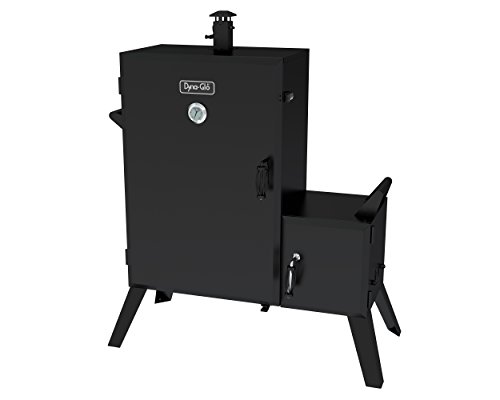
Dyna-Glo Wide Body Vertical Offset Charcoal Smoker — Best Vertical Stick Burner
The vertical offset rearranges the stick burner’s geometry: the firebox sits low and to the side, and the cooking chamber rises above it in a wide cabinet of stacked grates. The Wide Body earns its place in a stick-burner guide because its firebox genuinely burns wood — chunks and modest splits alongside charcoal — and the rising draft gives the format a natural, steady pull. What it buys the stick burner is capacity per patio tile: gathering-sized loads stacked upward, in a footprint a horizontal offset cannot approach.
Strengths
- Stacked wide cabinet: the most food per square foot of patio in this guide
- Real offset firebox flavour in a vertical, space-saving format
- Multiple grates at multiple heights let you run a mixed load in one firing
Trade-offs
- Firebox takes smaller splits than the horizontal offsets — expect to cut wood down
- Temperature stratifies by height; the grate map must be learned and used
- Light-gauge construction benefits from gaskets and a careful assembly
Key specs (from the verified listing): wide body vertical offset charcoal smoker; offset firebox; black finish (see listing for grate count and total area).
The vertical’s stick-burning character is its own: the draft is eager, the fire wants to run, and the skill it teaches is restraint — smaller fuel, patient dampers, and cooking each grate at its own temperature rather than pretending the cabinet is uniform. Cooks who master it gain something the horizontal owners cannot match: a brisket, two butts and a tray of beans in one firing, on a patio corner. Its firebox size is the honest limitation to weigh — if your wood supply is long splits and your heart is set on burning them whole, the horizontal picks are your format. If your constraint is space and your loads are large, this is the stick burner that fits your life.
Best for: space-limited stick burners cooking large, mixed loads. / Not suited for: cooks with long-split wood supplies, or buyers wanting heavy-gauge steel.
Check on Amazon — check price on Amazon and the listed grate configuration.

Royal Gourmet CC1830S Charcoal Grill and Offset Smoker — Best Value Capacity
The CC1830S is the value play among horizontal offsets: 783 square inches of total cooking area in a barrel grill with an attached offset firebox, finished with the working details — a wooden front shelf, adjustable charcoal pan, a lid thermometer — that make a long cook day run smoothly. It burns charcoal and wood in the firebox in the traditional arrangement, and while its steel is lighter than the Oklahoma Joe’s machines, its capacity-per-dollar is the best in this guide.
Strengths
- 783 sq in and a real offset firebox at a value position
- Front shelf and adjustable charcoal pan are genuinely useful on long cooks
- The main barrel doubles as a charcoal grill — two formats in the purchase
Trade-offs
- Lighter steel: temperature responds faster to wind and feeding lapses
- Sealing is owner-finished — budget the gasket session into ownership
- Firebox is sized for chunks and shorter splits rather than long splits
Key specs (from the verified listing): 783 sq in total cooking area; barrel charcoal grill with offset smoker; wooden front and side shelf design per the listing family.
The CC1830S makes sense for the stick burner whose budget is real but whose ambition is full-sized. Its lighter construction is not a secret and not a scandal — it is the trade that buys 783 square inches at this position — and its consequences are manageable: cook in a sheltered spot, feed the fire in smaller, more frequent additions, and seal the lids once, properly. Owners who do those things report exactly what the design promises: real offset flavour and gathering capacity without the premium outlay. It is also a sensible first offset for the cook who suspects the craft will hook them and expects to graduate to heavier steel later — the education transfers completely, and the Royal Gourmet remains as the party-overflow cooker.
Best for: value-focused stick burners wanting full-size offset capacity. / Not suited for: windy, exposed sites, or buyers wanting set-and-forget steel mass.
Check on Amazon — check the current price on Amazon and the listed cooking area.
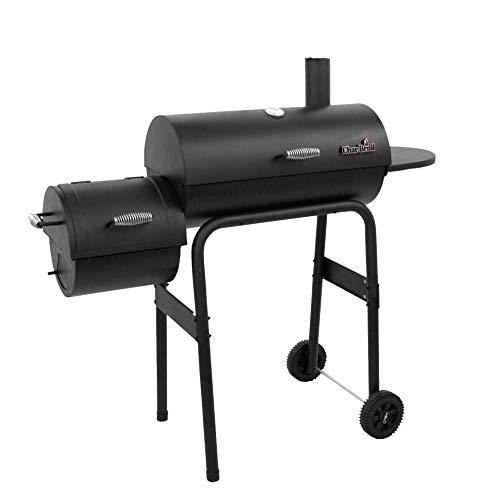
Char-Broil Offset Smoker — Best Budget Stick Burner
The Char-Broil Offset (model 12201570-A1) is the format’s long-standing entry ticket: a traditional side-firebox offset in its simplest honest form, priced so that finding out whether you are a stick burner costs less than the wood pile you will burn learning. It has the layout that matters — firebox, chamber, stack, dampers — in light steel with few refinements, and it has introduced more people to real wood-fire cooking than any fabricator ever will.
Strengths
- The lowest-cost genuine offset layout — splits, coal bed, draft, all present
- Simple construction means simple learning: nothing between you and the fire’s behaviour
- Light enough to place and reposition without a crew
Trade-offs
- Thin steel swings with the weather; this is the most hands-on fire in the guide
- Small firebox and chamber — plan on shorter splits and household-sized loads
- Longevity is owner-dependent: cover it, seal it, and keep the ash out
Key specs (from the verified listing): offset smoker; black finish; model 12201570-A1 (see listing for cooking area and dimensions).
There is a respectable school of thought that says every stick burner should start here, and it is not wrong: the Char-Broil’s thin steel and eager draft teach fire management faster than a forgiving machine can, because the fire answers every decision within minutes. Cooks who learn on it and graduate carry skills that transfer upward intact; cooks who discover the life is not for them have spent the least to learn it. Its limits are equally instructive — capacity, weather resistance, refinement — and naming them is the review’s job, not a dismissal. As the budget door into the oldest format in barbecue, it remains exactly what it has always been: enough smoker to fall in love with fire.
Best for: budget-first beginners testing the stick-burning life. / Not suited for: large loads, harsh climates, or buyers wanting a decade-long primary cooker out of the box.
Check on Amazon — check price on Amazon and confirm the model in the listing.
Comparison Table
| Pick | Badge | Key spec | Best for |
|---|---|---|---|
| Oklahoma Joe’s Highland | Best Overall | Traditional offset, 900 sq in | The benchmark backyard stick burner |
| Oklahoma Joe’s Highland Reverse Flow | Best for Even Heat | Reverse-flow baffle, 1,093 sq in | Large loads that must finish together |
| Oklahoma Joe’s Longhorn Combo | Best Offset Plus Gas | Offset + gas grill, 1,060 sq in total | One-cooker households |
| Dyna-Glo Wide Body Vertical Offset | Best Vertical | Stacked wide cabinet, offset firebox | Capacity on a small footprint |
| Royal Gourmet CC1830S | Best Value Capacity | 783 sq in, barrel + offset | Full-size offset on a value budget |
| Char-Broil Offset 12201570-A1 | Best Budget | Classic entry offset layout | Testing the stick-burning life cheaply |
How to Choose a Wood Stick Smoker
Start with the wood, not the smoker. A stick burner eats seasoned splits — oak, hickory, pecan, fruitwood — dried until they burn clean, in quantities a casual shopper underestimates: a long brisket cook works through a small stack. Before choosing among these six, answer honestly where your splits come from, what they cost, and where they will live. A stick burner with a reliable wood supply is a joy; without one, it is a charcoal grill with extra steps. Every pick here can burn charcoal with chunks as a fallback, but the format’s soul is splits.
Choose your draft philosophy. Traditional flow (Highland, Royal Gourmet, Char-Broil) gives you a gradient to cook with — fierce near the firebox, gentle at the stack — and the simplest construction. Reverse flow (the Highland RF) spends a baffle to flatten that gradient, for cooks whose loads must finish uniformly. Vertical draft (the Dyna-Glo) stacks the gradient upward and trades split length for footprint. None is superior in the abstract; each matches a cooking style, and the style you actually have should choose.
Weigh steel against budget with open eyes. Steel thickness is the stick burner’s fuel economy, weather resistance and lifespan in one number. The manufactured field tops out well below fabricator plate, and within it, the Oklahoma Joe’s machines carry the most mass for the money. If your site is windy or your winters are cold, steel is not a luxury — it is the difference between a fire you steer and a fire you chase. Sheltered patio, mild climate, tight budget: the lighter picks cook beautifully and their owners know it.
Size the firebox to your splits and your patience. A larger firebox holds a larger coal bed, which is the stick burner’s battery — it smooths the temperature between feedings and lets you burn splits at their natural length. Small fireboxes (the budget and vertical picks) demand shorter wood and more frequent attention. Match the box to the wood you can actually get: if your supplier cuts long, buy a box that takes long.
Respect the fabricator tier — and your place in the journey. Above these six sit the small-shop fabricators, selling thick-steel, hand-tuned offsets direct, at multiples of these prices and with waiting lists. They are genuinely better instruments. They are also, for most households, the second stick burner — bought with the knowledge a first season on a Highland or a Char-Broil provides. This guide’s picks are how you earn that knowledge without the waitlist, and several of them will simply be the last stick burner their owners ever need.
How to Run a Stick Burner: Fire Management Step by Step
Step 1 — Build the coal bed first. Start with a chimney or two of lit charcoal, or burn splits down until you have a deep bed of glowing coals. The coal bed is your foundation and your insurance: splits added to it ignite cleanly, and it carries the temperature through every feeding.
Step 2 — Pre-heat your splits. Rest the next split on top of the firebox or beside the fire so it is hot and dry when its turn comes. A pre-heated split catches in seconds and burns clean; a cold split smoulders, and smoulder is where bitter smoke is born.
Step 3 — Feed little and often. Add one split at a time, on a rhythm — every 30 to 45 minutes on the backyard offsets here — rather than loading the box and walking away. Watch the stack: thin, pale blue smoke is the goal; thick white smoke means the fire needs air or time, not more wood.
Step 4 — Steer with air, gently. Control temperature primarily with the intake damper, keep the exhaust open enough to draw, and make small adjustments with patience between them — a stick burner’s temperature answers over minutes, not seconds. Chasing the gauge with constant changes is the beginner’s oscillation trap.
Step 5 — Cook in the gradient, or across it. Place food knowing your chamber’s map: delicate items away from the firebox, items that want colour nearer it, and rotate on long cooks if your draft is traditional. On the reverse-flow and vertical picks, use their evenness or stratification as the design intends. The fire is the ingredient; the map is the recipe.
Modifications That Matter — and When to Bother
Manufactured offsets inspire a modification culture, and a stick-burner guide should sort it honestly. The modification that matters most is sealing: high-temperature gasket tape on the cooking chamber and firebox doors converts leaked air into controlled air, and on every pick in this guide it is the highest-value hour an owner can spend — after the first few cooks, when you know where your machine actually leaks. Second is fire management hardware: a charcoal basket for the firebox gives longer, steadier burns on charcoal-assisted cooks, and a simple grate-level thermometer tells you the truth the lid gauge approximates.
Third, and only for traditional-flow owners who cook large loads, is the tuning plate or baffle that narrows the chamber gradient — genuinely useful, genuinely optional, and pointless for cooks whose loads are small. What does not matter, whatever the forums say: cosmetic upgrades, stack extensions fitted before you have evidence of a draft problem, and any modification made in the first month. The discipline is to let the machine teach you its needs in order. A stick burner modified on evidence becomes a personal instrument; one modified on enthusiasm becomes a project that cooks occasionally.
Common Buying Mistakes
Buying a stick burner for its silhouette. The offset shape is iconic, and it seduces people who have not priced the life that comes with it: splits, tending, weather, ash. Buy the craft or do not buy the cooker — the secondhand market is paved with beautiful, rusting intentions.
Burning unseasoned wood and blaming the smoker. Green or wet splits are the single largest cause of bad stick-burner food. They smoulder, they coat meat in acrid creosote, and they make a good machine taste broken. Seasoned wood — dried for months, reading dry and light for its size — is not an accessory; it is half the purchase.
Judging by chamber size and ignoring the firebox. A huge chamber behind a small firebox is a machine that cannot hold temperature on a long cook. The firebox is the engine; size it to your splits and your cook lengths, and let the chamber follow.
Sealing every leak before learning the fire. Gaskets help — this guide recommends them — but a new owner who spends month one modifying instead of cooking learns neither the machine nor the craft. Cook first, note where smoke escapes and whether it matters, then seal with knowledge.
Expecting offset flavour on a pellet schedule. The stick burner’s flavour is inseparable from its attendance. If your Saturdays cannot hold a fire-tending rhythm, the honest purchase is an automated machine from this site’s other guides — and the offset can wait for a season of life that has room for it.
The Wood Pile: Split Size, Seasoning and Storage
Since the wood is half the machine, it deserves the same scrutiny as the steel. Split size should match the firebox: for the backyard offsets in this guide, splits roughly the length of your forearm and the thickness of a wrist are the working standard — large enough to burn down into lasting coals, small enough to ignite cleanly when added. Oversized splits smoulder at the edges and dirty the smoke; undersized splits burn to ash before they build the bed. If your supplier’s wood arrives long, a splitting axe and a saw are part of the stick burner’s toolkit, and an hour of processing buys a weekend of easy fires.
Seasoning is the quality that decides flavour more than species does. Freshly cut hardwood holds too much water: it hisses, steams and smoulders, laying bitter compounds on the meat. Properly seasoned splits — stacked off the ground, covered on top, air moving through the pile for months — feel light for their size, have cracked, checked ends, and ring rather than thud when knocked together. If you buy wood, buy it a season ahead when you can, and store the working pile somewhere dry and close to the cooker; the walk to the wood pile at hour seven, in the rain, in the dark, is where stick burners are made or unmade.
Species strategy for a season: build the pile on oak if it is available — it is the forgiving base that burns steadily under everything — then add one accent wood at a time. Hickory for the brisket months, fruitwood when the poultry and pork ribs dominate, pecan if your region offers it. A mixed pile used thoughtlessly produces muddled smoke; a base wood with deliberate accents produces a style, and developing a style is, in the end, the entire point of choosing this format.
Your First Season on a Stick Burner
Cook one: chicken halves and sausages. Short, hot-adjacent, and forgiving — a two-hour fire that teaches the coal bed, the feeding rhythm and your chamber’s gradient without betting a brisket on your first day. Eat well, take notes, and resist modifying anything yet.
Cooks two to four: ribs and pork butt. The middle-distance curriculum. Ribs teach timing and fire steadiness across an afternoon; a pork butt teaches the long burn — split consumption, weather effects, and the patience to let a fire be a fire. By the fourth cook your feeding rhythm should be a habit rather than a decision.
Cook five and beyond: brisket, and the gradient as a tool. Now the big cook, with the notebook from the earlier sessions as your guide: where the brisket sits, when it rotates, how your fire behaves at hour nine. This is also when a first modification — gaskets, usually — can be judged on evidence instead of internet enthusiasm.
The season’s real graduation is not a dish; it is the cook where the fire stops being the event and becomes the background — where you are thinking about the meat, the guests and the timing, while your hands feed the fire on their own schedule. Every pick in this guide can take you there. The ones that cannot are the ones their owners bought for the silhouette.
Final Recommendation
Buy the Oklahoma Joe’s Highland if you want the benchmark stick burner to learn and grow on; buy its Reverse Flow sibling if your loads are large and must finish evenly. Households negotiating one cooker should take the Longhorn Combo, small patios the Dyna-Glo Wide Body Vertical, value hunters the Royal Gourmet CC1830S, and the curious on a budget the Char-Broil Offset — then source seasoned wood before the cooker arrives, because the fire is the ingredient and the ingredient comes first.
Related reading in this cluster: Best Wood Smokers, Best Wood Burning Offset Bbq Smokers, Best Wood Smokers Under $1000, Best Vertical Offset Smokers, and Best Wood Burning Bbq Smokers.
Frequently Asked Questions
What wood should I burn in a stick smoker?
Seasoned hardwood splits: oak as the all-purpose base, hickory for assertive beef and pork flavour, pecan as a smoother middle, and fruitwoods — apple, cherry, peach — for poultry and pork when you want a lighter touch. The critical word is seasoned: wood dried until it burns clean and hot. Green wood, softwood and treated or painted wood have no place in a firebox — the first ruins flavour, the rest are not food-safe fuel at all.
How often do I need to add wood to a stick burner?
On the backyard offsets in this guide, expect to add a split every 30 to 45 minutes to hold a steady smoking temperature, varying with split size, weather and how open the dampers run. That rhythm is the format’s defining commitment — it is why stick burning is a craft day rather than an appliance cycle — and why every buyer should test their appetite for it honestly before purchasing.
What is the difference between a traditional and a reverse flow offset?
In a traditional offset, heat and smoke travel straight from the firebox across the chamber to the stack, producing a temperature gradient — hotter near the fire. In a reverse flow, a baffle forces the heat under the chamber first, then back across the food to a stack at the firebox end, which evens the temperature and lengthens the smoke’s path. Traditional is simpler and lets you cook with the gradient; reverse flow is more uniform and more forgiving of large, mixed loads.
Can a stick burner also burn charcoal?
Yes — every pick here can run on charcoal with wood chunks, and many owners do exactly that for shorter or less attended cooks, sometimes using a charcoal basket in the firebox for a longer, steadier burn. The flavour is a step toward the charcoal formats — still excellent, less intense than a pure split fire. Think of charcoal as the stick burner’s second gear, not a betrayal of the format.
Why do fabricator offsets cost so much more?
Steel, labour and tuning. A fabricator offset uses plate several times thicker than manufactured machines, welded rather than bolted, with draft geometry tuned model by model — and it is built in small numbers by skilled welders. What the money buys is temperature stability in bad weather, longevity measured in decades, and evenness. What it does not buy is a different category of flavour: a well-run Highland and a well-run fabricator both cook over clean wood fire, and the cook matters more than the plate.
How do I keep the smoke clean and avoid bitter meat?
Burn a small, hot, well-oxygenated fire: establish a real coal bed, pre-heat splits before adding them, feed little and often, and keep the exhaust drawing. Thin blue smoke is the sign of clean combustion; thick white smoke means the fire is smouldering and needs air or patience, not more wood. Most bitter barbecue blamed on equipment is a fire-management result — which is good news, because fire management is learnable, and it is the core skill every pick in this guide exists to teach.
How much wood will I use in a year of stick burning?
More than you expect, and planning for it is part of the purchase. A single long brisket cook works through a modest stack of splits; a household smoking twice a month will consume a substantial pile across a year — the kind of quantity that rewards a relationship with a local wood supplier or a delivery by the fraction of a cord, stored under cover. Cooks who process their own wood from storm-fallen hardwood turn the format’s biggest running cost into its cheapest, which is why so many rural stick burners regard the wood pile as a feature of the life rather than a bill.
Can I leave a stick burner unattended overnight?
Not in the way a pellet grill allows, and this guide will not pretend otherwise. A stick fire needs feeding on its rhythm — roughly every half hour to three quarters of an hour on these backyard machines — so an overnight brisket on an offset is a night of catnaps and fire checks, which devotees treat as part of the ceremony and everyone else should treat as a deciding fact. If unattended overnight cooking is essential to your life, buy the automated machine for those cooks and let the stick burner own the days you can give it.
Do stick burners work in cold or windy weather?
They work, and they ask more of you — that is the honest summary. Wind steals heat and disturbs draft, cold multiplies fuel consumption, and thin-steel machines feel both first. The countermeasures are placement (a sheltered corner out of the prevailing wind), a larger coal bed, smaller and more frequent split additions, and on the coldest days an insulating blanket over the chamber for the owners who cook year-round. The heavier picks in this guide forgive weather better; none of them repeal it, and a stick burner who cooks in January has earned the meal twice.
What size splits should I buy for a backyard offset?
For the fireboxes in this guide, splits around forearm length and wrist thickness are the working standard: substantial enough to coal down and hold heat, small enough to ignite cleanly when they join the fire. Much larger pieces belong in bigger fabricator fireboxes; much smaller ones burn away before building the bed. If your supplier sells a standard fireplace length, expect to cut some pieces down — a normal part of stick-burner life that a saw and ten minutes handle — and favour the supplier whose wood is genuinely seasoned over the one whose splits are merely the perfect size.
How do I know if stick burning is really for me before buying?
Answer three questions honestly. Do you enjoy tending things — a garden, a fire pit, a long cook — for their own sake? Do you have a free weekend day most months and a source of seasoned wood? And does the idea of learning a fire the way musicians learn an instrument excite rather than exhaust you? Three yeses mean buy the Highland and begin. Any no points you toward the automated formats in this site’s other guides, with the offset waiting patiently for a season of life that answers differently.


