Disclosure: airfryerkitchensupply.com is reader-supported. When you buy through links on our site, we may earn an affiliate commission at no extra cost to you.
Where to buy
Every smoker below is a current Amazon listing verified. The short version: the Weber Smokey Mountain 22-inch is the classic charcoal answer, the Traeger Pro 22 is the set-and-forget pellet answer, and the Oklahoma Joe’s Highland is the true stick-burning offset answer. Each review links to its listing so you can check the current price on Amazon and confirm dimensions before ordering.
Best Wood Smokers: Five Formats, One Real Fire
“Wood smoker” is the broadest phrase in barbecue, and shoppers using it usually mean one thing: a cooker fuelled by real wood in some form, not by gas or electricity with a token handful of chips. Within that honest definition sit five genuinely different formats — pellet grills that burn compressed hardwood under electronic control, charcoal bullet smokers that burn charcoal with wood chunks, offset stick burners that burn splits of wood in a side firebox, drum smokers that hang or rack meat over a charcoal basket, vertical offsets that stack the chamber above the fire, and gravity-fed charcoal machines that automate a charcoal fire with a fan. The best wood smokers are not a single ranking so much as a match between format and cook: how much involvement you want, how strong you like your smoke, and how much food you cook at once.
Here is the market truth this guide is built on: smoke flavour intensity and convenience trade against each other along a predictable line. The offset stick burner sits at the flavour extreme — nothing else tastes like food cooked over a live split-wood fire — and at the involvement extreme, needing fuel and attention every half hour or so. The pellet grill sits at the opposite end: mild, clean smoke and a fire that manages itself all night. Everything else arranges itself between those poles, and none of the positions on the line is the “wrong” one. The six picks below were chosen as the strongest representative of each major format, every one verified as a current Amazon listing, so this page works as both a ranking and a format guide: read the reviews for the machines, and read the sections after them for the reasoning that should actually drive your choice.
A note on what did not make the list and why: electric smokers with wood-chip trays (a fine category, covered elsewhere on this site) were excluded because the search asks for wood-fuelled smokers, and the fire in an electric cabinet is a heating element, not wood. Kamado cookers were left to their own guide for the same taxonomic reason — they are grill-first ceramics that smoke well, not smokers first. What remains is the honest wood-fired field.
In this guide
Quick Picks
- Weber Smokey Mountain Cooker 22-inch — Best Overall Wood Smoker. The charcoal bullet that has taught more pitmasters than any other cooker: deep flavour, huge capacity, minimal moving parts. Check on Amazon
- Oklahoma Joe’s Highland Offset Smoker — Best Stick Burner. A true offset that burns splits and charcoal in a side firebox, delivering the benchmark wood-fire flavour at a backyard price. Check on Amazon
- Traeger Pro 22 Wood Pellet Grill & Smoker — Best Set-and-Forget. Pellet convenience with real hardwood fuel: set the temperature and the auger tends the fire for you. Check on Amazon
- Pit Barrel Cooker Premier Series 18.5-inch — Best Drum Smoker. Hang ribs and poultry over charcoal in a barrel that runs hot, fast and nearly foolproof. Check on Amazon
- Dyna-Glo Wide Body Vertical Offset Charcoal Smoker — Best Vertical Capacity. A wide-body cabinet offset that stacks serious capacity into a modest footprint. Check on Amazon
- Masterbuilt Gravity Series 1050 Digital Charcoal Grill & Smoker — Best Automated Charcoal. A gravity-fed charcoal hopper with digital control: charcoal flavour with pellet-style convenience at the largest scale here. Check on Amazon
How These Picks Were Chosen
Because this search spans formats, candidates were not ranked against each other on a single scale — they were selected as the best example of each format a wood-smoker shopper is realistically choosing between, then assessed within that format. For charcoal and stick-burning machines the criteria were steel thickness, damper and door sealing (air control is temperature control on a manual cooker), grate capacity in real food, and ash handling. For automated machines — pellet and gravity — the criteria were controller quality, hopper endurance, and the manufacturer’s parts ecosystem. Across all formats, build honesty mattered: a smoker is a fire container that lives outdoors, and thin, poorly sealed examples make their owners fight the equipment instead of learning the craft.
Every pick also had to be a verifiable, current Amazon listing, with the returned title matching the machine described — configuration, size and fuel type all confirmed from the listing data rather than from memory or marketing. Where a famous name in a format could not be verified as a unit listing (some premium offset fabricators sell direct only), it is discussed honestly in the guide text as an unlinked alternative rather than linked on a guess. Prices and ratings from the listing were not used anywhere in this article, per this site’s standing rules.
The 6 Best Wood Smokers

Weber Smokey Mountain Cooker 22-inch — Best Overall Wood Smoker
The Smokey Mountain is the closest thing barbecue has to a standard answer. A porcelain-enameled bullet: charcoal and wood chunks in the base, a water pan in the middle, two cooking grates above, and dampers to steer the whole system. In the 22-inch size it holds an almost absurd amount of food — multiple briskets, four pork butts, ribs in racks — yet once the vents are set it will hold a steady smoking temperature for hours with the calm of a much more expensive cooker. The flavour is the charcoal-and-wood-chunk profile that defines American barbecue for most people, deeper than any pellet grill and more forgiving than a stick burner.
Strengths
- Proven three-decade design with unmatched owner knowledge — every technique and mod is documented
- Dual grates and a large charcoal ring give genuine crowd capacity and long unattended burns
- Porcelain-enameled steel shrugs off weather and cleans up easily
Trade-offs
- Accessing the lower grate means lifting the upper food — a known bullet-smoker chore
- Temperature control is manual: vents, weather and fuel quality are your responsibility
- The door and seams leak a little smoke and heat until gaskets or time seal them
Key specs (from the verified listing): 22-inch charcoal smoker; dual cooking grates; porcelain-enameled kettle; temperature control dampers.
Why does a simple bullet top a list containing automated machines? Because it is the format with the fewest failure modes and the most transferable skills. Everything you learn on a Smokey Mountain — fire building, vent logic, wood selection, water-pan management — applies to every charcoal cooker you will ever touch, and the machine itself has essentially nothing electronic to fail in year five. It is also the value centre of this guide: competition teams win on these, restaurants have been built on their output, and the cost of entry is a fraction of a premium pellet grill. If a shopper can name only one requirement — “I want to learn real wood-fired smoking” — this is the machine that teaches it best, and its only real demand is that you show up and tend it modestly. For the majority of wood-smoker buyers, that is not a drawback; it is the hobby.
Best for: learners and traditionalists who want deep charcoal-and-wood flavour with proven, simple hardware. / Not suited for: cooks who want to set a temperature and walk away for twelve hours.
Check on Amazon — check the current price on Amazon and confirm the 22-inch size in the listing.

Oklahoma Joe’s Highland Offset Smoker — Best Stick Burner
The Highland is the entry point to the oldest format in American barbecue: a horizontal cooking chamber with a firebox on the side, where you burn actual splits of wood — or charcoal with wood — and hot smoke draws across the meat and out the stack. This is the format that produces the flavour every other machine in this guide is approximating, and the Highland delivers it at a price that lets a backyard cook find out whether the stick-burning life is for them. Its 900 square inches of cooking area (per the verified listing) handles a brisket and ribs together, and the heavy steel body holds heat like a proper offset should.
Strengths
- True offset firebox burns wood splits — the benchmark smoke flavour, full stop
- 900 sq in cooking area with a firebox that doubles as a small grill
- Heavy-gauge construction for the price class; feels like equipment, not tin
Trade-offs
- Demands tending every 30–45 minutes — this is a craft commitment, not an appliance
- Temperature varies across the chamber; learning your hot spots is part of ownership
- Burns far more fuel than any automated format, and needs a supply of seasoned splits
Key specs (from the verified listing): offset charcoal smoker grill; 900 sq in cooking area; black finish; firebox with cooking surface.
Buy the Highland with clear eyes and it will make you happy for years; buy it expecting an appliance and it will be listed for sale by autumn. The work is the point: splitting wood to size, building a clean coal bed, feeding the fire little and often, reading smoke colour — thin and blue is right, white and billowing is a fire that needs air. Owners who take to it describe the cooks as the best days of their month, and the food justifies them: bark, smoke ring and depth that pellet owners chase with accessories. Practical notes: season it thoroughly before the first cook, budget for a gasket kit and a tuning plate if you want to narrow the chamber’s temperature gradient, and source your wood before the cooker arrives — a stick burner without seasoned splits is a sculpture. As the gateway to real stick burning, nothing else at this level is close.
Best for: aspiring pitmasters who want authentic split-wood flavour and enjoy tending a fire. / Not suited for: anyone whose schedule forbids active cooking, or who lacks a wood supply.
Check on Amazon — check price on Amazon and confirm the current Highland configuration.

Traeger Pro 22 Wood Pellet Grill & Smoker — Best Set-and-Forget
At the convenience pole of the wood-smoker world sits the pellet grill, and the Pro 22 is its most proven expression: hardwood pellets in an 18 lb hopper, an auger that feeds the fire pot, a controller that holds your set temperature, and 572 square inches of cooking space. The wood is real — pellets are pure compressed hardwood — but the fire-tending is fully automated, which means an overnight brisket requires of you exactly one decision: the temperature. The smoke flavour is milder and cleaner than charcoal or splits, and for a great many households that trade is not a compromise at all but the reason they smoke every weekend instead of twice a year.
Strengths
- True set-and-forget operation with a meat probe included — the lowest-effort real-wood smoking here
- Consistent results cook after cook; the learning curve is about food, not fire
- Huge owner community, recipe ecosystem and parts availability
Trade-offs
- Mildest smoke flavour in this guide — pellet smoke is clean by design
- Depends on electricity and dry pellet storage; a damp hopper stops the show
- 450°F ceiling limits true grilling and searing ambitions
Key specs (from the verified listing): 572 sq in cooking area; 18 lb hopper; 450°F maximum; 6-in-1 versatility; meat probe included.
The Pro 22’s place in a wood-smokers guide sometimes draws purist objections, so the case deserves stating plainly: pellets are wood, the smoke is wood smoke, and the barbecue that comes off this machine — brisket with a real smoke ring, ribs with genuine bark — is wood-smoked barbecue by any honest definition. What it is not is intense. Cooks who grew up on offset flavour sometimes find pellet output polite, and the standard remedies (a smoke-mode first hour, stronger pellet species, a supplemental smoke tube) narrow but do not erase the gap. Weigh that against the lived reality of the other formats — the offset’s half-hourly tending, the bullet’s vent management — and the Pro 22’s popularity explains itself. It is the wood smoker for people whose constraint is time, and there are more of those people than any other kind.
Best for: busy households wanting real wood smoke with appliance-level effort. / Not suited for: flavour maximalists, or off-grid cooking without power.
Check on Amazon — check the current price on Amazon before ordering.

Pit Barrel Cooker Premier Series 18.5-inch — Best Drum Smoker
The drum smoker is barbecue’s beautiful simplification: a steel barrel, a charcoal basket in the bottom, and hooks that hang meat vertically in the rising heat. The Pit Barrel Cooker is the format’s defining product — porcelain-coated steel, an 18.5-inch barrel, and a cooking method that sounds like a gimmick until you taste ribs that cooked hanging over charcoal, basting in their own drippings as the fat hits the fire. It runs hotter than a low-and-slow cabinet by design, which means ribs in hours rather than half a day, and its temperature is governed by a preset vent that removes nearly all adjustment — and nearly all ways to get it wrong.
Strengths
- Hanging method produces distinctive, drip-basted flavour and remarkably even ribs
- Fastest cooks in this guide — the drum runs hot by design and finishes food sooner
- Almost nothing to adjust or break; the learning curve is the shortest of the manual formats
Trade-offs
- Fixed-temperature philosophy limits low-and-slow experimentation and delicate cooks
- Hanging suits ribs, poultry and roasts; flat briskets need the grate and careful placement
- Capacity is real but shaped by the barrel — large flat items are not its strength
Key specs (from the verified listing): 18.5-inch drum smoker; porcelain coated steel; hanging hooks and grate system per the listing configuration.
The Pit Barrel’s secret is that its constraints are features. A beginner with a bullet smoker can mismanage vents for a month; a Pit Barrel owner lights the basket the prescribed way, hangs the food and is mostly done deciding. The flavour signature is also genuinely different from everything else here — the vaporised drippings create a grilled-smoked hybrid taste that drum devotees describe as the point, not a compromise. Where it loses marks is versatility: there is no low-temperature cheese smoking, no delicate fish programme, and the brisket-on-a-grate arrangement works but cedes the format’s elegance. As a second smoker for a pellet owner who wants charcoal character on weekends, or as a first smoker for someone whose menu is ribs, chicken and roasts, it is one of the most satisfying purchases in barbecue.
Best for: rib and poultry lovers who want charcoal character with minimal management. / Not suited for: cooks wanting precise low-temperature control or frequent large briskets.
Check on Amazon — check price on Amazon and the included accessories in the listing.
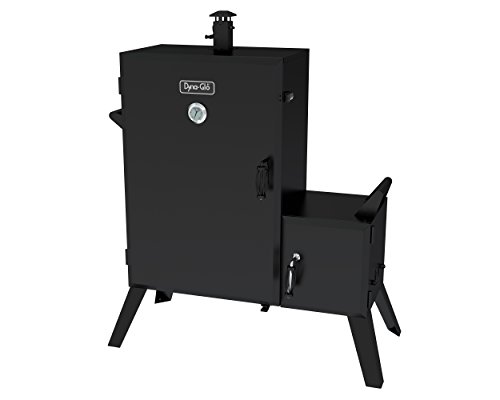
Dyna-Glo Wide Body Vertical Offset Charcoal Smoker — Best Vertical Capacity
The vertical offset takes the stick burner’s firebox and puts a tall cabinet above it, so smoke rises through stacked grates — and the Dyna-Glo Wide Body is the format’s value benchmark, with a wider cabinet than the standard verticals and room for the kind of mixed loads (brisket up top, butts below, sausage wherever it fits) that feed a gathering. It burns charcoal with wood chunks or splits in the offset box, giving it genuine wood-fire flavour with a footprint closer to a filing cabinet than a locomotive.
Strengths
- Stacked-grate capacity in a small footprint — the most food per patio square foot here
- True offset firebox delivers real wood smoke flavour, not chip-tray flavour
- Wide-body cabinet fits full briskets and large pans that narrow verticals cannot
Trade-offs
- Temperature stratifies by height — top and bottom grates cook at different rates
- Light-gauge steel for the class; gaskets and a seal-up session noticeably improve it
- Like all offsets, it wants regular tending and a ready fuel supply
Key specs (from the verified listing): wide body vertical offset charcoal smoker; offset firebox; black finish (see listing for grate count and total cooking area).
Vertical offsets reward a specific kind of cook: the one who thinks in loads. If your typical session is one brisket, this format is overkill; if your sessions are “the whole neighbourhood is coming and I am doing brisket, two butts, three chickens and a pan of beans,” the cabinet layout is unmatched at this price, because everything stacks in one fire’s worth of fuel. The stratification that critics cite is, to experienced vertical cooks, a feature — delicate items ride high where it is gentler, items that want heat sit low. Budget an afternoon for assembly and sealing, learn the grate map with a cheap biscuit test (tins of biscuits across each grate reveal hot and cool zones in fifteen minutes), and the Wide Body becomes a high-capacity wood smoker that costs less than most machines in this guide while out-cooking them on volume.
Best for: high-volume cooks with limited patio space who want real offset flavour. / Not suited for: single-brisket minimalists, or buyers wanting thick-steel, sealed-from-the-factory construction.
Check on Amazon — check the current price on Amazon and the listed cooking area.

Masterbuilt Gravity Series 1050 Digital Charcoal Grill & Smoker — Best Automated Charcoal
The Gravity 1050 is the format disruptor: a hopper of charcoal, held above a fire and fed by gravity, with a fan and digital controller holding any temperature you set — the automation of a pellet grill with the fuel and flavour of a charcoal cooker, at 1,050 square inches. It smokes low with wood chunks mixed into the charcoal, grills hotter than any pellet machine can dream of, and connects to an app so the automation is monitorable from the couch. For the wood-smoker shopper who wants charcoal character without charcoal management, this is the machine that ended the argument.
Strengths
- Charcoal-and-wood flavour with digital set-and-hold convenience — the format’s whole promise, delivered
- 1,050 sq in is the largest capacity in this guide, with genuine high-heat grilling on top
- App control and fast heat-up make it the most flexible single cooker here
Trade-offs
- Highest fuel consumption and ash production of the automated formats
- More moving parts and electronics than a bullet or drum — expect more maintenance attention
- Charcoal must be stored dry and in quantity; the hopper eats bags on long cooks
Key specs (from the verified listing): 1,050 sq in cooking area; GravityFed charcoal hopper; digital control with free app; model MB20071218.
Position the 1050 correctly and it is easy to recommend: it is not the cheapest to run, nor the simplest to maintain, nor the most traditional — it is the most capable. The smoke flavour lands between pellet and offset, closer to charcoal because it is charcoal, and the ability to finish a smoked brisket’s burnt ends or a tray of wings at genuine grilling heat, in the same machine, in the same session, is a workflow no other pick here matches. Ownership demands are the honest price: keep the hopper and ash pan managed, treat the fan and switches kindly, and feed it dry fuel. Households that grill as much as they smoke will find it the best single answer in this guide; pure low-and-slow traditionalists will find its talents wasted on them and should buy the Weber or the offset instead.
Best for: cooks wanting charcoal flavour, digital convenience and maximum capacity in one machine. / Not suited for: minimalists, low-maintenance seekers, or the tightest budgets.
Check on Amazon — check price on Amazon and the current Gravity 1050 configuration.
Comparison Table
| Pick | Badge | Key spec | Best for |
|---|---|---|---|
| Weber Smokey Mountain 22 | Best Overall | Charcoal bullet, dual grates, porcelain enamel | Learning real wood-fired smoking |
| Oklahoma Joe’s Highland | Best Stick Burner | Offset firebox, 900 sq in | Authentic split-wood flavour |
| Traeger Pro 22 | Best Set-and-Forget | Pellet, 572 sq in, 18 lb hopper | Effortless overnight smoking |
| Pit Barrel Cooker 18.5 | Best Drum | Hanging method, porcelain steel barrel | Fast, drip-basted ribs and poultry |
| Dyna-Glo Wide Body Vertical Offset | Best Vertical Capacity | Offset firebox, stacked wide cabinet | Big loads on a small footprint |
| Masterbuilt Gravity 1050 | Best Automated Charcoal | Gravity charcoal, 1,050 sq in, app control | Charcoal flavour plus digital ease |
How to Choose a Wood Smoker: The Format Decision
Start with your honest availability, not your aspirations. Every format in this guide makes excellent barbecue in the hands of someone whose life fits it. The offset makes the best-tasting food and the worst Saturday if you have toddlers, a shift schedule or a short attention span — its cooks are attended events. The pellet grill makes very good food while you are at a football game. The bullet sits between: mostly stable, occasionally checked. Choose by the calendar first; flavour differences are smaller than lifestyle differences.
Then choose your smoke intensity. If you know you love assertive smoke — the kind from a Texas offset — buy toward that end of the line: the Highland, the Dyna-Glo vertical, or the Gravity with wood chunks. If your household prefers smoke as a seasoning rather than the main event, the pellet grill’s clean profile will make more people happy more often, and the bullet with a light hand on the chunks lands in between. There is no virtue in buying more smoke than your table enjoys.
Consider your wood supply before your cooker. Stick burners eat seasoned splits by the stack; if you cannot source oak, hickory or fruitwood splits locally at sane prices, an offset becomes an expensive charcoal grill. Charcoal formats need bagged charcoal and chunks — universally available. Pellets are the most logistically civilised fuel ever sold for smoking. The best wood smoker is partly the one whose fuel your life can actually supply.
Match capacity to your real loads. A brisket needs roughly 22 inches of grate length and room for air to circulate; ribs multiply fast at gatherings. The vertical and the Gravity win on volume, the bullet is the capacity-per-dollar champion, and the drum is the specialist. Oversizing a manual smoker wastes fuel on every cook; oversizing an automated one mostly wastes money once. Either way, buy for the cooks you will actually do monthly.
Respect the premium fabricator tier — honestly. Above the Highland sits a world of small-shop offset fabricators (thick steel, tuned draft, waitlists, direct sales) that this guide cannot link because they do not sell through Amazon. If the Highland teaches you that stick burning is your life, that tier is your graduation, and nothing here pretends otherwise. Within the shippable, warrantied, Amazon-available field, the six picks above are the honest best of each format.
How to Run a Wood Smoker: The Universal First Cook
Step 1 — Season the cooker. Every format benefits: coat the interior lightly with cooking oil and run a medium fire for a couple of hours. This burns off manufacturing residue and lays the first protective layer of seasoning on the steel.
Step 2 — Learn your temperatures empty. Before meat is at stake, run the smoker at your target smoking temperature and map it: where the gauges read versus a probe at grate level, how the vents or controller respond, how long a fuel load lasts. An hour of empty practice prevents a season of surprises.
Step 3 — Cook pork butt first. It is the most forgiving cut in barbecue and it teaches the full cycle — rub, smoke, stall, wrap or not, rest, pull — on every format. Judge the result by tenderness and moisture, not by the clock.
Step 4 — Keep a cook log. Fuel used, weather, vent or controller settings, timing, result. Wood smoking is a craft of small adjustments, and the log is how adjustments accumulate into skill instead of evaporating between weekends.
Step 5 — Clean for the next fire. Ash out (cold, always), grease managed, grates brushed. A smoker left full of ash and grease corrodes from the inside and flavours the next cook with the last one.
Running Costs and Upkeep, Format by Format
The purchase price is the smallest honest difference between these formats; the years after are where they diverge. A pellet grill is the cheapest wood smoker to run per hour — roughly a pound of pellets an hour at smoking temperatures, with pellets sold everywhere, storing compactly and leaving a cup of ash. Its upkeep is a vacuum, a brush and, every few seasons, an igniter or a probe. A bullet smoker burns a bag of charcoal across a long cook plus a few wood chunks — modest money, modest ash, and upkeep limited to grates and the occasional gasket. The drum is similarly frugal, with the bonus that its simplicity leaves almost nothing to replace.
At the other end, the stick burner is the most expensive format to feed and the cheapest to maintain: splits by the stack cost real money unless you process your own wood, but the machine itself is a steel box with hinges — there is nothing in it that cannot be fixed with a wire brush and paint. The vertical offset shares the offset’s fuel appetite with somewhat better efficiency from its stack effect. The Gravity machine burns charcoal at a grill’s pace rather than a smoker’s sip, and its fan, switches and igniter join the wear-parts list — the price of automation on a charcoal fire.
None of these numbers should decide the purchase alone, but they should inform it honestly: a household that smokes weekly will feel fuel costs within a year, while a household that smokes monthly will never recoup a premium machine’s price in fuel savings. Buy the format whose total life — purchase, fuel, parts, and your own Saturdays — fits the way you actually live.
Common Buying Mistakes
Buying an offset for its looks. The locomotive silhouette is seductive, but a stick burner is a commitment to attended cooking and a wood supply. Buy it for the craft or do not buy it — the classifieds are full of beautiful, rusting regrets.
Assuming electric-chip smokers and wood smokers are interchangeable. They are different categories with different flavour ceilings. If the keyword in your head is “wood smoker,” you want a fire that is wood — pellets, charcoal and chunks, or splits — not an element warming a chip tray.
Judging capacity by headline square inches. Manufacturers count every rack and warming shelf. What matters is the main grate’s usable footprint and whether your actual cuts fit with air space around them. A brisket that touches the walls cooks unevenly in any format.
Skipping the fuel budget. The cooker is the one-time cost; fuel is forever. Stick burners and the Gravity burn the most, pellets the least per hour, bullets in between. A cheap cooker with expensive habits can cost more by year two than the premium alternative.
Ignoring weather exposure. Manual smokers are steel and fire; automated ones add electronics. All of them live outdoors and all of them need a cover and, for the automated formats, dry fuel storage. The purchase is not complete until the machine is protected.
Wood Species: What to Burn in Each Format
The wood decision splits cleanly by format, and getting it right matters more than most equipment upgrades. In a stick burner, the wood is the fire itself, so species and seasoning are everything: oak is the professional’s base wood — steady heat, medium smoke, forgiving burn — with hickory added when you want assertive, bacon-like depth on beef and pork, pecan as hickory’s smoother sibling, and fruitwoods (apple, cherry, peach where available) reserved for poultry and pork when a lighter, sweeter smoke is wanted. Mesquite burns hot and strong and punishes long cooks; most stick burners use it for short grilling in the firebox, not for a twelve-hour brisket. Above all, the wood must be seasoned — dried until it burns clean. Green or wet wood is the number-one cause of the bitter, acrid flavour beginners blame on their cooker.
In charcoal formats — the bullet, the drum, the vertical offset — wood plays a supporting role as chunks buried in the charcoal. Three to five fist-sized chunks is the working dose for a long cook; more does not mean more better, it means oversmoked meat, because charcoal-format smoke has nowhere to go but through the food for hours. The same species logic applies at lower volume: oak and hickory for beef, fruitwood for poultry and fish, and never resinous softwood under any circumstances. In the gravity machine, chunks can be layered through the charcoal hopper or placed in the ash pan to smoulder — a flexibility owners use to run an oak base with a hickory accent, tuning flavour cook by cook.
In a pellet grill the species decision arrives as a bag choice, and the physics differ: pellets burn so completely that flavour differences between species are real but compressed. Hickory pellets read as the strongest, blends built on oak are the all-purpose default, and fruitwood pellets are the mild end for chicken and fish. The beginner error is buying the strongest bag and concluding pellet smoke is harsh, or buying the mildest and concluding it is absent. Start with an oak-based blend, learn your machine, then branch out one bag at a time — the same discipline the stick burner applies to splits, translated to a fuel you buy by the bag.
Clean Fire: The Skill Every Format Rewards
Ask experienced cooks from every format what separates good wood-smoked food from bad, and one answer repeats: the fire, not the recipe. Wood smoke is a spectrum. At one end is the thin, nearly blue smoke of a clean, hot, well-oxygenated fire — sweet, complex, the flavour this entire category exists for. At the other is thick white smoke from a smouldering, starved fire, which carries the bitter compounds that coat meat in acrid, ashtray notes. Every pick in this guide can produce both; the operator decides which.
The practical rules travel across formats. Let the fire establish before the food goes on — the heavy white smoke of startup should be gone, replaced by heat shimmer and thin blue smoke. Feed manual fires little and often rather than in smothering loads. Keep exhaust vents more open than instinct suggests and control temperature primarily with intake air and fuel size, because a choked fire is a dirty fire. On automated machines, clean burning is mostly about fuel quality and a clean fire pot: dry pellets, vacuumed ash, and a startup allowed to complete before the lid closes on the food. Master this one idea and the format wars fade — a clean fire on a bullet will beat a dirty fire on a premium offset every single Saturday.
Final Recommendation
If you buy one wood smoker from this page, make it the Weber Smokey Mountain 22-inch: it teaches the craft, feeds a crowd and will outlast your interest in lesser machines. If your heart is set on the real stick-burning tradition, the Oklahoma Joe’s Highland is the honest gateway, and if your calendar rules your cooking, the Traeger Pro 22 will put wood-smoked food on your table more often than any other machine here. Rib specialists should try the Pit Barrel Cooker, volume cooks the Dyna-Glo Wide Body, and technology-friendly charcoal lovers the Masterbuilt Gravity 1050.
Go deeper in this cluster: Best Wood Smokers For Beginners, Best Wood Smokers For Home Use, Best Wood Stick Smokers, Best Wood Burning Offset Bbq Smokers, and Best Wood Backyard Smokers.
Frequently Asked Questions
What is the difference between a wood smoker and a pellet grill?
A pellet grill is a type of wood smoker — it burns real hardwood, in pellet form, under electronic control. The broader category also includes charcoal smokers that burn charcoal with wood chunks, offset smokers that burn wood splits directly, and drum and gravity-fed designs. The differences are involvement and smoke intensity: pellets are the most automated and mildest; stick burners are the most manual and most intense; charcoal formats sit between.
Which wood smoker makes the strongest smoke flavour?
The offset stick burner, burning seasoned splits in a side firebox — the Highland in this guide. Nothing automated fully matches a live split-wood fire for depth of flavour. Charcoal formats with wood chunks come next, then gravity-fed charcoal, then pellet grills, whose clean combustion produces the mildest smoke. Strongest is not automatically best, though: many households prefer the middle of the range for everyday eating.
How much wood does a stick burner use?
A backyard offset typically works through a split every 30–45 minutes to hold temperature, so a long brisket cook consumes a small stack. That is why the guide stresses sourcing: you need seasoned hardwood splits — oak, hickory, pecan or fruitwood, dried until the moisture is low — available locally and in quantity. Charcoal can substitute or supplement, but a stick burner fed only charcoal is an offset running below its purpose.
Can a wood smoker be used in winter?
Yes, and many owners prefer winter smoking — cold air, hot smoker, no insects. Expect higher fuel consumption in every format, more in thin-steel manual cookers, and protect automated machines’ fuel from moisture: pellets and charcoal that have absorbed damp air are the leading cause of winter failures. Welding-blanket insulation on a bullet or offset is a long-standing owner trick for bitter days.
Do I need a water pan?
It depends on the format. Bullet smokers are designed around one: it stabilises temperature and adds humidity. Drums cook beautifully without one because the drippings themselves humidify the barrel. Offsets traditionally run dry or with a small pan near the firebox. Pellet grills rarely need one. Follow your format’s design rather than treating the water pan as a universal rule — it is a tool of specific machines.
How long do wood smokers last?
A porcelain-enameled bullet or a heavy drum can serve for decades with grate replacements and basic rust care. Thin-steel offsets and verticals last years longer when kept covered and their ash removed promptly, since ash plus moisture is corrosive. Automated machines add electronics to the equation — controllers and igniters are wear parts with multi-year lives, replaceable on all the major brands represented here.
What is the easiest wood smoker to start with if I have never smoked anything?
For pure ease with real wood fire, the drum and the pellet grill tie from opposite directions: the Pit Barrel removes nearly every decision from a charcoal cook, while the Traeger removes the fire management itself. The bullet is the best teacher if you want to learn the craft deliberately. The offset, for all its flavour glory, is the hardest first machine — start there only if the fire-tending itself is the attraction, because for a stick burner, it has to be.
What is the best wood smoker for brisket specifically?
Each format has a defensible answer, which is why brisket is the great leveller of this category. For flavour, the offset — its live fire produces the bark and depth brisket is judged by. For consistency while you sleep, the pellet grill, whose overnight steadiness removes the variable that ruins more briskets than any other. For value and capacity, the bullet, which has cooked more excellent briskets than any machine in history relative to its price. The honest recommendation: choose by the cook you can reliably execute, because a well-run brisket on any of these six beats a mismanaged brisket on the “best” one.
Are wood smokers worth it compared with gas or electric smokers?
If flavour is the point of the purchase, yes — a wood fire produces a depth and complexity that gas and electric machines approximate with chips but do not equal, because in a wood smoker the fire is the fuel, the heat and the seasoning at once. If the point is purely convenience, the honest answer is that you are trading effort for that flavour in every format except the pellet grill, which is why it outsells the others. Most owners who make the trade knowingly never go back; the ones who regret it are those who bought the flavour without pricing the effort.


