Disclosure: airfryerkitchensupply.com is reader-supported. When you buy through links on our site, we may earn an affiliate commission at no extra cost to you.
Where to buy
Each smoker below was verified as a live Amazon listing before it made this list. Check the current price on Amazon for the Oklahoma Joe’s Longhorn Offset, the Oklahoma Joe’s Highland Reverse Flow, the Dyna-Glo Wide Body Vertical Offset, the Oklahoma Joe’s Bronco Drum Smoker, the Char-Griller Smokin Pro, and the Masterbuilt Gravity Series 1150. Heavy steel cookers are freight items whose delivered pricing moves around; the live listing is the only figure worth planning around.
Introduction: Meat, Wood, and Time
The best wood meat smokers are built around a single conviction: meat cooked slowly in the smoke of a real wood fire tastes like nothing else on earth, and no shortcut fully replaces it. This is the stick-burner end of the barbecue world — offsets and drums that burn splits of oak, hickory, and fruit wood, where the cook manages a live fire for six, ten, fourteen hours and the reward is bark with genuine depth, a smoke ring that penetrates, and rendered fat perfumed by hardwood. If you have eaten brisket from a well-run offset and brisket from a gas smoker with a chip box on consecutive days, you already know why this category exists and why its devotees accept the workload.
That workload is the honest price, and this guide will not hide it. A wood meat smoker is not an appliance; it is an instrument. You will learn fire management the way a musician learns scales — coal beds, split sizes, damper positions, the look of clean smoke — and your first briskets will be tuition. What this roundup does is match the instrument to the student. Two picks are conventional and reverse-flow offsets from the Oklahoma Joe’s tradition, one is a vertical offset for capacity in a small footprint, one is a drum smoker — the simplest, most forgiving wood cooker of all — one is a budget offset for learners, and one is a gravity-fed charcoal cooker for cooks who want wood-and-charcoal smoke with a fan standing watch over the fire. Every one of them burns real wood as a primary fuel and produces meat that justifies the smoke in your clothes.
A note on scope: pellet smokers, electric smokers, and propane smokers all have their place, and sister guides in this cluster cover the pellet side thoroughly. They are excluded here on purpose, because the person searching for a wood meat smoker is asking for the fire itself — and this list respects that intent rather than diluting it. What follows is therefore a smaller, more opinionated list than a general smoker roundup: six cookers, each defensible as the best answer for a particular kind of meat cook, with the reasoning and the reservations laid out in the open for each one.
In this guide
Quick Picks
- Best Overall: Oklahoma Joe’s Longhorn Offset — 1,060 square inches of classic offset, the reference backyard stick-burner. Check the current price on Amazon.
- Best Reverse Flow: Oklahoma Joe’s Highland Reverse Flow — a baffle plate evens out chamber temperatures across 1,093 square inches. Check the current price on Amazon.
- Best Capacity per Footprint: Dyna-Glo Wide Body Vertical Offset — stacked racks in a wide vertical chamber for rib-and-chicken volume. Check the current price on Amazon.
- Best Drum Smoker: Oklahoma Joe’s Bronco — an 18-inch heavy-duty drum with 284 square inches that hangs meat and holds temperature with drum-smoker ease. Check the current price on Amazon.
- Best Budget: Char-Griller Smokin Pro — 1,130 square inches and a side fire box at an entry tier for learning the craft. Check the current price on Amazon.
- Best Hands-Off Wood Smoke: Masterbuilt Gravity Series 1150 — gravity-fed charcoal and wood chunks with digital control across 1,150 square inches. Check the current price on Amazon.
How These Picks Were Chosen
The entry requirement was strict: the cooker must burn wood splits or wood-with-charcoal as its primary heat and smoke source, in a chamber designed for meat over hours. That admitted offsets (conventional and reverse-flow), vertical offsets, and drums, plus one gravity-fed charcoal cooker that burns wood chunks throughout its hopper. It excluded pellet, electric, and propane units by design, and it excluded novelty mini-smokers that cannot fit a brisket.
Judging criteria were the ones that decide real cooks. Firebox size came first, because a firebox that cannot hold a coal bed plus standard splits forces the cook into charcoal-only fires with chunk smoke — a lesser thing wearing an offset’s shape. Chamber steel and door sealing came next, since temperature stability over ten hours is the difference between barbecue and babysitting. Temperature evenness mattered: conventional offsets run a gradient, reverse-flow designs flatten it, drums sidestep it with distance and convection, and each pick is honest about which behavior you are buying. Capacity was measured in briskets, butts, and rib racks rather than square inches alone. Finally, each pick had to represent a distinct philosophy of wood smoking, so the list functions as a decision tree rather than a pile of similar barrels.
The 6 Best Wood Meat Smokers

Oklahoma Joe’s Longhorn Offset Charcoal Smoker — Best Overall
The Longhorn is the archetype: a big horizontal offset with 1,060 square inches of cooking area, a generous side firebox, and the heavy, simple construction that has made the Oklahoma Joe’s pattern the default backyard stick-burner for decades. Its conventional flow — fire at one end, chimney at the other — creates the temperature gradient that experienced cooks exploit: brisket at the cool end, beans and sausages riding the hot end, everything kissed by a cross-draft of clean oak smoke. Build quality in this class is about mass and simplicity, and the Longhorn delivers both: thick steel that banks heat, porcelain-coated grates that clean up well, and a firebox door sized for real splits.
Strengths
- The reference offset experience: clean smoke, deep bark, true stick-burner flavor.
- 1,060 square inches handles two briskets or a whole party spread.
- Heavy construction holds temperature far better than budget barrels.
Trade-offs
- Fire-tending every 30 to 45 minutes is the deal, for the whole cook.
- The hot-to-cool gradient demands rotation on long cooks.
- It is a large, heavy cooker that claims serious patio territory.
Who thrives with the Longhorn is the cook who wants to learn barbecue as a craft rather than buy barbecue as a result. The first cooks teach the coal bed: a base of lump charcoal, then splits added one at a time, each allowed to catch fully before the dampers settle. By the fourth or fifth cook, the rhythm becomes meditative — coffee at dawn, a split at the half hour, meat emerging at dusk with a bark like mahogany. Its grilling ability in the main chamber is a useful bonus for steaks over the same fire, but make no mistake: this is a smoker first, and as a smoker it is the standard the rest of this list is measured against.
Best for: aspiring pitmasters who want the true offset craft / Not suited for: cooks who need sleep more than smoke on brisket night
Check the current price on Amazon

Oklahoma Joe’s Highland Reverse Flow Offset Smoker — Best Reverse Flow
The Highland Reverse Flow attacks the conventional offset’s one structural flaw — uneven temperature — with a baffle plate. Smoke and heat from the firebox are forced beneath a steel plate that runs the length of the chamber, traveling to the far end before rising and flowing back across the meat toward a chimney relocated near the firebox. The result is a chamber that cooks measurably more evenly end to end, with the plate itself radiating gentle heat upward. Across its 1,093 square inches, that evenness means four racks of ribs finish together instead of in sequence, and a brisket cooks flat without the point racing ahead of the flat.
Strengths
- Reverse-flow baffle delivers the most even chamber in this roundup.
- Large capacity with the same heavy Oklahoma Joe’s construction as the Longhorn.
- Even heat forgives beginners who have not yet learned rotation discipline.
Trade-offs
- The baffle plate needs scraping and seasoning care; drippings bake onto it.
- Slightly slower to respond to fire changes than a conventional offset.
- Same fire-tending commitment as any stick-burner — reverse flow evens heat, it does not automate it.
Choose the reverse flow if your cooks are wide — multiple racks, whole spreads — or if you are the kind of beginner who would rather the cooker forgive your learning curve. Purists argue conventional offsets give marginally better airflow snap and bark; in blind plates of food, the difference is small, while the difference in stress across a ten-hour cook is large. For most backyards, even heat wins, and this is the most forgiving serious stick-burner on the list.
Best for: cooks feeding crowds and beginners who want even heat / Not suited for: minimalists who dislike cleaning a baffle plate
Check the current price on Amazon
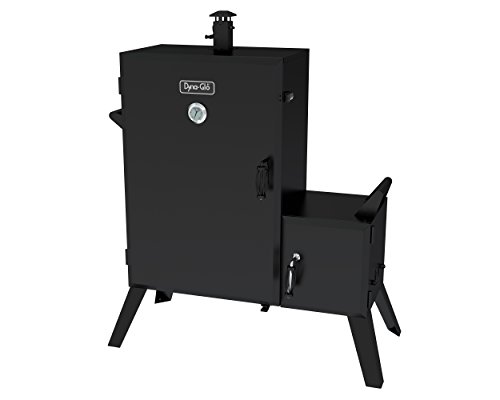
Dyna-Glo Wide Body Vertical Offset Charcoal Smoker — Best Capacity per Footprint
Stand the offset upright and everything changes. The Wide Body’s firebox sits low beside a tall chamber, and smoke rises through stacked racks — which means ribs, chickens, butts, and pans of sides all cook in the footprint of a small patio chair. The wide body is the important detail: unlike narrow verticals that force you to cut rib racks in half, this chamber takes full racks laid flat. It burns charcoal with wood chunks, or small splits in the firebox, and once its doors are gasketed it holds a steady smoking temperature with the strong natural draft verticals are known for.
Strengths
- Stacked racks deliver party capacity from a corner-sized footprint.
- Full rib racks fit flat — the wide body earns its name.
- Rising smoke and heat baste food continuously and evenly.
Trade-offs
- Temperature differs by rack height; rotating food between levels is routine.
- Doors leak until sealed with gasket tape, as with most cookers in its tier.
- It is a dedicated smoker — grilling is limited to a small firebox grate.
The Wide Body is the answer for the townhouse patio, the narrow side yard, the cook whose smoking ambitions outgrew their square footage. Its signature cook is ribs by the half-dozen racks, each level finishing in rotation, but it is equally happy hanging a holiday load of chickens while a butt cruises on the middle rack. If your constraint is space rather than money or time, this design buys you more barbecue per square foot than anything else in the roundup.
Best for: small patios with big smoking ambitions / Not suited for: cooks who also need a real grill in the same unit
Check the current price on Amazon

Oklahoma Joe’s Bronco Drum Smoker — Best Drum Smoker
The drum smoker is barbecue’s beautiful simplifier, and the Bronco is its best-dressed backyard example: an 18-inch heavy-duty charcoal drum with 284 square inches of grate, a hinged lid, and the hardware to hang meat from hooks inside the barrel. Drum cooking is direct-heat smoking — meat cooks above the coals with no deflector, dripping fat onto the fire, which flashes into a flavor vapor that no offset can imitate. It is a different smoke dialect from the offset’s, more grilled, more primal, and fanatically loved by its converts. Drums are also famously easy to run: set the intake, and the sealed barrel holds temperature for hours with a steadiness that shames finicky offsets.
Strengths
- The most forgiving fire management in this roundup — drums just hold temperature.
- Fat-on-coals flavor is unique, intense, and addictive on chicken and ribs.
- Hanging hooks cook ribs and half chickens with zero grate-flipping.
Trade-offs
- 284 square inches is the smallest capacity here — one brisket, not two.
- Direct-heat style is a different flavor from offset smoking; purists of either camp notice.
- Refueling mid-cook means lifting food and grate out — plan cooks around one charcoal load.
For a first wood smoker, the Bronco makes a powerful argument against the offset: half the fuss, faster cooks (drums run happily a little hotter), and chicken that will ruin restaurant chicken for you forever. Ribs hung in a drum, basted by their own vapor, are a regional treasure for a reason. Buy it for weeknight-feasible smoking and small gatherings; graduate to an offset later if the craft pulls you, and keep the drum forever for poultry.
Best for: beginners and chicken-and-rib devotees who value ease / Not suited for: cooking two briskets at once
Check the current price on Amazon

Char-Griller Smokin Pro Charcoal Grill and Offset Smoker — Best Budget
The Smokin Pro is how thousands of pitmasters started: a big barrel grill with a side fire box, 1,130 square inches of total space, dual dampers, and cast iron grates, at an entry tier that leaves budget for the gasket kit, thermometer, and wood supply that complete the setup. Its steel is thinner than the Oklahoma Joe’s pair, and its temperature manners are correspondingly livelier — but the shape of the craft is all here. Small clean fires, a sealed chamber, and patience produce brisket and ribs that embarrass the price tag, and every lesson learned transfers directly to a heavier cooker later.
Strengths
- The cheapest honest route into true offset smoking at real capacity.
- Dual damper control teaches fine airflow management.
- Main chamber doubles as a full-size charcoal grill.
Trade-offs
- Thin steel burns more fuel and swings more in wind and cold.
- Needs gasket sealing out of the box for serious temperature control.
- Longevity depends on rust discipline — cover it, empty the ash, every time.
Read the Smokin Pro as tuition rather than compromise. A season on this cooker teaches fire sizing, smoke quality, damper logic, and meat judgment — the entire curriculum — for the lowest entry cost in the roundup. Cooks who discover they love the ritual will upgrade with knowledge; cooks who discover they do not have spent the least to learn it. Either way it earns its keep, and as a grill-smoker for big family cookouts it remains useful long after a fancier smoker arrives.
Best for: learners and big families on a budget / Not suited for: set-and-forget cooks or harsh-climate smoking without shelter
Check the current price on Amazon
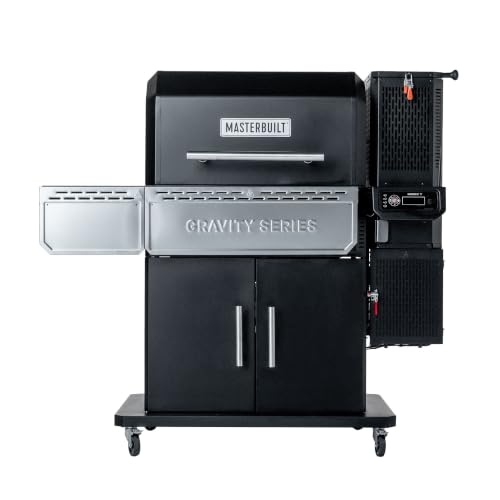
Masterbuilt Gravity Series 1150 — Best Hands-Off Wood Smoke
The Gravity 1150 is the peace treaty between wood flavor and modern life. A tall hopper gravity-feeds charcoal — with wood chunks layered through it — onto a small grate, while a fan and digital controller hold your set temperature across 1,150 square inches of cooking space, monitored from an app. The smoke is charcoal-and-hardwood smoke: genuine, present, and cleaner than a stick-burner’s, a half-step lighter on brisket and indistinguishable on pork and poultry for most palates. What it buys is the night: load the hopper, set the temperature, and sleep while a brisket cooks — an impossibility on every other pick in this roundup.
Strengths
- Real charcoal-and-wood cooking with digital, app-monitored temperature control.
- The largest capacity here, with fast heat-up to grilling temperatures.
- Shutdown slides starve the fire and save unused charcoal for the next cook.
Trade-offs
- Smoke intensity trails a clean-burning offset on beef, the connoisseur’s cut.
- Requires power and has a fan, switches, and seals to maintain.
- Grease management must be disciplined in a fan-driven cooker.
The honest verdict is that the Gravity 1150 is the best wood meat smoker for people whose lives do not contain a free ten-hour Saturday — which is most people. Layer chunks generously through the hopper, keep the grease tray clean, and it turns out barbecue that wins compliments from offset owners, who then ask how it works and go quiet for a moment. It is not a stick-burner and does not claim to be; it is the closest automation has come to the fire.
Best for: busy cooks who want real wood smoke without fire-tending / Not suited for: off-grid use or offset purists
Check the current price on Amazon
Comparison Table
| Pick | Badge | Key spec | Best for |
|---|---|---|---|
| Oklahoma Joe’s Longhorn Offset | Best Overall | 1,060 sq in conventional offset | The classic stick-burner craft |
| Oklahoma Joe’s Highland Reverse Flow | Best Reverse Flow | 1,093 sq in, baffle plate | Even heat across big cooks |
| Dyna-Glo Wide Body Vertical Offset | Best Capacity per Footprint | Wide vertical chamber, stacked racks | Volume smoking in small spaces |
| Oklahoma Joe’s Bronco Drum | Best Drum | 18-inch drum, 284 sq in, hanging hooks | Easy fires and supreme chicken and ribs |
| Char-Griller Smokin Pro | Best Budget | 1,130 sq in, side fire box | Learning offset smoking cheaply |
| Masterbuilt Gravity Series 1150 | Best Hands-Off | 1,150 sq in, gravity hopper, digital control | Overnight cooks without tending |
How to Choose a Wood Meat Smoker: Offset, Reverse Flow, Drum, or Vertical
Begin with the fire you are willing to keep. A conventional offset like the Longhorn gives the purest smoke and the most control in expert hands, at the cost of a temperature gradient you must manage and a fire you must feed. Choose it if barbecue is becoming your hobby in the serious sense — if you read about coal beds for pleasure and own a hatchet you like. A reverse-flow offset trades a little of that airflow character for evenness; choose it if you cook wide loads — four rib racks, a brisket plus sides — and want them finishing together, or if you are a beginner who wants the cooker to forgive uneven fire-building while you learn.
The drum is the pragmatist’s masterpiece. Its sealed, vertical design is thermally honest: heat rises, meat hangs or sits above the coals, drippings vaporize into flavor, and the whole system holds temperature with a fraction of an offset’s attention. Choose a drum if your smoking is mostly ribs, chicken, and pork, if your cooks need to fit real schedules, and if you are honest that a simpler fire kept well beats a noble fire kept badly. The vertical offset is the capacity specialist: choose it when patio space is the binding constraint but rib racks are not negotiable, and accept rack-rotation as the price of altitude. The gravity-fed cooker stands apart as the automation answer — choose it when the cook’s hours matter more than the last increment of smoke depth, and never apologize for that arithmetic.
Two physical checks cut through all marketing. First, firebox door size: it must admit the splits you can actually buy, whole, without a cutting session before every cook. Second, steel you can feel: rap the chamber with a knuckle and lift the lid — mass is temperature stability, and no baffle, gasket, or gadget fully substitutes for it. Everything else — casters, shelves, thermometer placement — is comfort. Buy the fire and the steel first.
Wood Selection for Meat: Matching Species to Cut
Wood choice is seasoning, and like seasoning it should serve the meat rather than shout over it. Oak is the pitmaster’s base note — clean, medium, endlessly reliable — and the right default for brisket, where a ten-hour exposure magnifies any wood’s flaws. Hickory is the assertive classic for pork shoulder and ribs, bacon-adjacent and bold, best used in balance: all-hickory fires can push pork toward bitterness on very long cooks, which is why many cooks blend hickory with oak. Pecan is hickory’s smoother sibling and arguably the finest single wood for poultry, giving golden skin and a rounded smoke that never bullies. Fruit woods — apple and cherry — are the gentle end: apple for pork and chicken when guests prefer a lighter smoke, cherry when you want that deep mahogany color on everything it touches.
Mesquite is the spice to respect: magnificent in short bursts on beef grilled hot, punishing in a long smoker session. Whatever the species, seasoning of the wood itself matters more than the label — splits should be dry, with bark that is tight or removed, and sized to your firebox so they ignite fully rather than smolder. A fire of properly sized, dry splits burns with thin pale smoke and a sweet smell; a fire of oversized or damp wood produces the white billows and acrid bite that give wood smoking a bad name among people who have only eaten it done badly. Buy from a supplier who sells cooking wood, store it off the ground under cover with air flow, and your smoker’s output improves before you change a single technique.
How to Run an Offset Fire for a Brisket, Step by Step
Start ninety minutes before the meat goes on. Build a full chimney of lump charcoal, let it ash over completely, and spread it as a coal bed across the firebox grate. Lay two splits on the bed, leave the firebox door cracked, and let them ignite fully — you are building the engine, not smoking yet. As the splits burn down into the bed, close the door, set the intake damper mostly open and the chimney damper fully open, and watch the chamber climb. When it settles near your target with thin, pale smoke, the brisket goes on, fat side toward the heat source as your school of barbecue dictates. From here the rhythm is simple to say and satisfying to do: every thirty to forty-five minutes, check the coal bed; when it thins, add one split, pre-warmed on top of the firebox so it ignites instantly instead of smoldering; adjust the intake in small increments and then wait — dampers respond slowly, and chasing the needle is how beginners oscillate between too hot and too cool.
Through the middle hours, manage by the log and the look: bark setting dark and firm, fat rendering, the stall arriving and passing without panic. Wrap when the bark is right, not when a clock says so, and rest the finished brisket long and warm — an hour at minimum, longer happily — before slicing against the grain. The same fire discipline scales down to ribs and across to pork butt with only the timing changed. Master this one cook and every other meat in the smoker becomes a variation, which is why brisket is the craft’s final exam and its best teacher.
Common Buying Mistakes
The most expensive mistake is buying a thin, leaky offset because it looks like the real thing in photographs. Shape is not substance: an offset’s magic comes from mass, draft, and a firebox that breathes, and a featherweight imitation delivers the workload of stick-burning with none of the stability. If the budget is tight, the honest budget pick in this list — or a drum — beats a flimsy offset every time. The second mistake is ignoring the wood supply. A stick-burner without a source of seasoned splits is a charcoal cooker with delusions; confirm you can buy cooking wood locally, at sane cost, before the smoker arrives.
Third, new buyers chronically under-buy thermometers and over-buy gadgets. A dual-probe thermometer — one probe at grate level, one in the meat — is the instrument that makes every other decision rational, while the third set of novelty tongs is not. Fourth, do not judge a smoker by a single cook, especially a first brisket; fire management is a skill measured in months, and the cooker most often blamed is simply the cooker whose owner has cooked least. Finally, size honestly: a giant offset heated for two racks of ribs wastes wood and time, while a drum asked to feed thirty teaches the same lesson from the other side. Match the chamber to the cooks you will actually run.
What Wood Smoke Actually Does to Meat: Bark, Ring, and Render
Understanding why wood-smoked meat tastes different helps you cook it better, because each prized effect has a cause you can manage. Bark — the dark, chewy, intensely flavored crust on brisket and pork — forms when rub, smoke compounds, rendered fat, and dry surface heat interact over hours. It needs two things beginners often deny it: time in clean smoke before any wrapping, and a surface that starts dry. Meat that goes on wet, or gets spritzed every twenty minutes from the start, steams its own bark away. The smoke ring, that pink band just under the surface, is a chemical signature of wood and charcoal combustion gases reacting with the meat’s myoglobin; it stops forming once the surface gets hot, which is why meat that starts cold and cooks in strong early smoke shows the deepest ring. The ring is cosmetic — it carries no flavor by itself — but it is a reliable witness that the early fire burned the way it should.
Rendering is the quiet third act. Collagen and fat do not melt at a magic moment; they transform gradually across a long middle stretch of the cook, and wood smokers earn their keep by holding meat in that transformation zone for hours without drying the surface. This is where fire discipline pays: wild temperature swings rush some parts of the meat and stall others, while a steady fire lets a whole brisket arrive together. When cooks say an offset produces a texture pellet cookers imitate but rarely match, this long, even, smoke-washed render is what they are tasting — and it is also why the resting period matters, since the render finishes and the juices settle while the meat sits wrapped and warm.
The Learning Curve: What Your First Five Cooks Will Teach You
Cook one, ideally a pork butt, teaches the machine: how long startup really takes, where the temperature settles with the dampers at your best guess, and how much charcoal the coal bed wants to be. It will probably run hot at some point and cool at another, and the pork will forgive all of it — that is why it goes first. Cook two, ribs, teaches timing and touch: ribs cannot be probed like a roast, so you learn the bend test and the look of pull-back on the bones, and you learn how your smoker’s gradient means the rack near the firebox finishes first. Cook three is where most owners deliberately practice fire discipline alone — a cheap cook, chicken or sausages, run with a notebook, adding one split at a time and logging what each damper change does twenty minutes later. That boring cook is the highest-value session of the five; it converts superstition into knowledge.
Cook four exposes your weather. Wind across the chimney, a cold morning, a surprise rain — every wood smoker has a meteorological personality, and by now you will start compensating automatically: cooker repositioned, fire built a touch bigger, cook started an hour earlier. Cook five, often the first brisket, assembles everything — and usually produces the moment that hooks people on this category for good, when the slicing reveals a black bark, a deep ring, and juice that runs. Owners who quit wood smoking almost always quit during cooks one and two, mistaking tuition for verdict. The five-cook curriculum exists so you do not.
Ribs, Brisket, and Poultry: One Smoker, Three Different Cooks
It helps to see how differently the same smoker behaves across the classic meats, because buyers often imagine one setting serves all. Brisket is the marathon: the lowest practical fire, the longest exposure, and a premium on steadiness — this is the cook that justifies heavy steel and reverse-flow evenness, and the one where the Gravity 1150’s automation changes the cook’s life most. Ribs are the middle distance: a few hours, a fire that can run a touch hotter, and judgment by bend and bone rather than by probe. Ribs forgive small swings and reward attention to bark and glaze timing, which makes them the ideal second cook on any new smoker and the meat drums and verticals were seemingly born to cook in quantity.
Poultry is the sprinter with a trap in it. Chicken wants smoke early, while its surface is cool enough to take color and flavor, then higher heat to crisp skin that low temperatures leave rubbery. On an offset, that means a hotter fire for birds than for brisket — or a finish over the firebox grate; on a drum, the direct heat does it naturally, which is why drum chicken has such devotees. Turkey adds scale to the same problem: a big bird in a vertical or offset needs early smoke and a confident finish, plus a rest that lets the breast stay juicy. The practical lesson for buyers is that the smoker you choose tilts your menu: offsets flatter the marathon meats, drums flatter the sprinter, verticals flatter volume, and the gravity cooker flatters whatever you point it at, a little less intensely. None of these is a wrong tilt — but knowing yours before you buy is the difference between a smoker that fits your table and one that fights it.
Splits, Chunks, and Chips: Fuel Forms and How to Size Them
Wood reaches a smoker in three forms, and confusing them is a quiet source of bad cooks. Splits — split logs roughly the length of your forearm — are the offset’s true fuel: each one ignites, flames, and collapses into coals over thirty to forty-five minutes, which sets the tending rhythm of the whole category. A split should be sized to catch quickly and burn cleanly; the common beginner error is splits too large, which smolder at the edges, smoke white, and drag the chamber temperature down while they struggle. When in doubt, split it again — two small splits burn cleaner and steadier than one heroic log, every time. Chunks, fist-sized pieces, are the fuel of charcoal cookers: buried in a kamado’s lump, stacked in a drum’s basket, or layered through a gravity hopper, they smolder gently and meter smoke across hours. Three to five chunks is a full dose for most cooks; the instinct to add ten produces the oversmoked, bitter result that gives the hobby a bad name at the neighborhood level.
Chips are the third form, and in this category they are mostly a distraction: they burn out in minutes, belong to gas and electric smokers, and in a real fire they simply vanish. If a recipe written for a chip-box smoker lands in your hands, translate its “handful of chips” into one chunk and move on. Storage closes the loop: splits stacked off the ground with airflow and a covered top will season and keep; wood stored in a sealed plastic bin sweats and sours. Keep a small reserve of your driest splits near the smoker — the “next split” that goes on the firebox to pre-warm — and the rhythm of clean fire becomes almost automatic. Fuel is not an accessory to a wood meat smoker. It is half the machine.
Final Recommendation
For the fullest expression of wood-smoked meat, buy the Oklahoma Joe’s Longhorn and commit to the craft. If even heat matters more than tradition, the Highland Reverse Flow is the smarter first serious smoker. Space-poor cooks should take the Dyna-Glo Wide Body, beginners who value ease the Bronco drum, budget learners the Smokin Pro, and busy cooks who still want real wood smoke the Gravity Series 1150.
More from this cluster: Best Wood Smokers, Best Wood Stick Smokers, Best Wood Burning Offset Bbq Smokers, Best Wood Bbq Smokers For Competition, Best Wood Smokers For Beginners, and Best Wood Grill And Smokers.
Frequently Asked Questions
What is the difference between a conventional offset and a reverse flow?
In a conventional offset, smoke travels straight from the firebox across the chamber to the chimney, creating a hotter zone near the fire. In a reverse flow, a baffle plate forces the smoke under the plate to the far end first, then back across the meat, evening out temperatures and adding radiant heat from the plate itself. Reverse flow is more forgiving; conventional flow is more traditional and a touch more responsive.
How much wood does a long brisket cook actually use?
Plan on a steady rhythm of one split every thirty to forty-five minutes across the cook, built on a charcoal coal bed — in practice, a small stack of splits roughly the size of a milk crate for a full brisket session on a backyard offset. Drums and gravity cookers use considerably less, burning charcoal with wood as a component rather than the main event. Buying cooking wood by the stack rather than the bag transforms the economics of the hobby.
Why does my offset lose temperature when I add a split?
A cold, large split absorbs heat and smothers the coal bed while it struggles to ignite. Use smaller splits, pre-warm the next split on top of the firebox or at its edge, and add wood before the bed gets thin rather than after the temperature has already fallen. If dips persist, the coal bed is too small — build a bigger charcoal base at the start.
Can I smoke good meat on a drum smoker, or is it a compromise?
It is a different tradition, not a lesser one. Drum smokers cook with direct radiant heat and fat vapor, producing intensely flavored ribs and chicken faster than an offset, with famously steady temperatures. Brisket from a drum is excellent, with a more grilled character. Competition circuits have drum divisions for a reason: in practiced hands, the drum is a peer, not a stepping stone.
What temperature should a wood smoker run?
Most meats thrive in the classic low-and-slow band, with poultry often cooked hotter to set skin. The more important point is steadiness at the temperature you choose: a cooker held evenly at a slightly higher heat will out-cook a cooker swinging wildly around a theoretically perfect number. Learn your cooker’s natural cruising temperature — every offset has one — and build your recipes around it.
Should I burn bark-on or bark-off splits?
Either can cook well, and the debate is louder than the difference. Bark that is tight and dry ignites and burns away quickly in a hot fire; loose, damp, or mossy bark smolders and can add an earthy off-note, so strip anything that looks suspect. Most experienced cooks burn clean bark-on splits in a hot, well-drafted fire without a second thought, and save their worry for the things that matter more: dry wood, right size, clean flame. If you buy wood by the stack, sort it once on delivery — the driest, cleanest splits to the front for smoking, the rougher pieces to the back for grilling fires and fire pits — and every cook afterward starts with the right fuel already in hand.
Is a wood smoker worth it if I already own a pellet grill?
For many cooks, the two end up complementary rather than redundant: the pellet grill handles weeknights and set-and-forget cooks, while the wood smoker comes out when the cook itself is the point of the day. If you regularly find yourself wishing your pellet-smoked brisket had deeper bark and smoke, a stick-burner or drum is the honest answer to that wish. If you never find yourself wishing that, save your money and your Saturdays — the pellet grill is already your smoker, and that is a perfectly respectable place to land.
How do I know my smoke is clean?
Look at the chimney and use your nose. Clean smoke is thin, pale blue or nearly clear, and smells sweet and woody. Dirty smoke is thick, white, and billowing, and it smells acrid — that is the smoke that makes meat bitter. If you see white billows, the fire needs air or smaller fuel: open the intake, let the split catch fully, and wait before adding more wood.


