Disclosure: airfryerkitchensupply.com is reader-supported. When you buy through links on our site, we may earn an affiliate commission at no extra cost to you.
Where to buy
All six fans below were confirmed as current Amazon listings before this guide was written. Window fans are light and ship easily, but measure your window opening against the fan’s stated width range and expansion panels before ordering — fit is the whole game with this product type, and the measuring section below walks through it.
Quick links to the verified picks in this guide: Bionaire Window Fan with Reversible Airflow Blades · Lasko Electrically Reversible Twin Window Fan W09550 · HOLMES Dual 8-inch Twin Window Fan with Thermostat · Comfort Zone Reversible Twin Window Fan 3-Speed · Genesis Twin Fan High Velocity Reversible AirFlow Fan · Vornado TRANSOM Window Fan. Every product link in this article points to a listing we confirmed before writing; anything we could not confirm is discussed in plain text only, with no link.
The best window exhaust fan for smokers is the difference between a room you can smoke in and a house that smells like you did. Cigar, pipe and cigarette smoke is a stubborn pollutant: it lingers in still air for hours, soaks into curtains and upholstery, and drifts under doors into rooms where nobody agreed to share it. A window exhaust fan attacks the problem at the physics level — it creates negative pressure in the smoking room, pulling fresh air in through the door gap and pushing smoke-laden air straight outside before it can settle into the furniture. The fans that do this job well share specific traits: genuinely reversible airflow (exhaust at the push of a button, not by physically flipping the fan around), twin blades that move serious air through a window-sized opening, a thermostat so the fan manages itself, and panels that seal the window opening so smoke cannot sneak back around the edges. This guide ranks six verified window fans for the smoking-room job specifically — exhaust power, reversal convenience, sealing and noise — and explains the room setup that matters as much as the fan: where the makeup air comes from, why a cracked door beats a sealed one, and how to keep the smoke’s path to the window short.
In this guide
Quick Picks
Bionaire Window Fan with Reversible Airflow Blades — Best Overall: Reversible blades, programmable thermostat, remote and an LED display, fitting 24–36 inch windows — the most complete smoke-room fan here. — Check the current price on Amazon
Lasko Electrically Reversible Twin Window Fan W09550 — Best Set-and-Forget: Lasko’s electrically reversible twin with remote — one button flips between intake and exhaust, backed by the biggest name in home fans. — Check the current price on Amazon
HOLMES Dual 8-inch Twin Window Fan with Thermostat — Best Compact Classic: Dual 8-inch blades with one-touch thermostat control — a long-running compact design that fits smaller windows the big twins cannot. — Check the current price on Amazon
Comfort Zone Reversible Twin Window Fan 3-Speed — Best Budget Pick: Three speeds, expandable width and manual reversal including a cross-ventilation mode — the most flexible budget fan in the window. — Check the current price on Amazon
Genesis Twin Fan High Velocity Reversible AirFlow Fan — Best for Fast Purges: High-velocity twin blades with adjustable thermostat and reversible airflow — the fastest room-clearing muscle in this guide. — Check the current price on Amazon
Vornado TRANSOM Window Fan — Best Looking / Best Weather-Sealed: A low-profile transom design with a weather-resistant case, four speeds, remote and reversible exhaust — the fan that does not look like a fan. — Check the current price on Amazon
How These Picks Were Chosen
Exhaust was the gate. A fan only made this list if it could move air outward through a window as a primary function — electrically reversible models ranked highest, manually reversible models next, and pure intake fans were excluded no matter how powerful, because a smoking room needs a one-way door for smoke, not a breeze machine.
Every fan was verified on this site’s Amazon integration: searched by brand and model, the returned title matched to the fan we meant to recommend, the ASIN recorded only on a confident match. Twin-window-fan designs dominate this category honestly — they are the form factor that fits a window, seals reasonably, and moves air in both directions — so the list reflects the market as it is, differentiated by reversal method, controls and build.
We ranked for the smoking use case specifically: exhaust strength and blade size for clearing a room between and during sessions, remote and thermostat convenience (you will adjust this fan from your chair, mid-cigar), panel sealing to keep exhaust from short-circuiting back inside, and noise character — a fan you can talk over at the speed that still clears smoke.
A frank note on scope: a window fan manages smoke in a room you control. It does not make indoor smoking harmless, it does not remove odor already soaked into furnishings, and it is not a solution for shared walls where your exhaust becomes a neighbor’s intake. The guide says plainly where the limits are, because a fan bought with realistic expectations is a fan that gets kept.
The 6 Best Window Exhaust Fans for Smokers

Bionaire Window Fan with Reversible Airflow Blades — Best Overall
The Bionaire is the fan that treats exhaust as a system rather than a setting. Its blades reverse airflow electrically — intake or exhaust from the remote, from your chair, without touching the unit — which is precisely the interaction pattern a smoking room demands: exhaust hard while you smoke, flip to intake for a few minutes of fresh-air flush afterward, then let the programmable thermostat hold the room while the fan idles down. The LED display and remote make those adjustments a glance and a click.
It suits the dedicated smoking room or study: a regular cigar or pipe ritual in a defined space with a double-hung window in the 24–36 inch range. Three speeds give a real range from background clearing to a full post-session purge. It is less suited to very small or very large windows outside its fit range, and to buyers wanting the absolute highest-velocity blast — velocity specialists like the Genesis below move air more aggressively, at the cost of refinement.
Ownership notes: the programmable thermostat is the feature owners underuse — set it, and the fan keeps clearing residual smoke after you have left the room, shutting itself down when the room reaches temperature rather than running all night. The remote’s range and the display’s readability from across a lamplit room are the small daily pleasures that make this the guide’s top pick.
Strengths
- True electric reversal — exhaust or intake from the remote
- Programmable thermostat manages post-session clearing automatically
- Fits the common 24–36 in window range with extender panels
Trade-offs
- Mid-pack on raw velocity versus high-velocity specialists
- Fit range excludes unusually small or oversized windows
- Premium tier among twin window fans
| Fit | Windows 24–36 in wide (per Amazon title) |
| Speeds | 3, with programmable thermostat |
| Controls | Remote control and LED display |
| Airflow | Reversible blades — intake and exhaust |
Judge a smoking-room fan by the whole session: the smoke cleared during, the purge after, and the room’s smell the next morning. The Bionaire wins because it handles all three phases with the least effort from the smoker — reversal without standing, a thermostat that finishes the job after you leave, and speeds that cover clearing and purging. In a room used for smoking several times a week, that completeness is worth more than any single specification.
Best for: dedicated smoking rooms and studies used several times a week / Not suited for: windows outside the 24–36 in range
Check the current price on Amazon

Lasko Electrically Reversible Twin Window Fan W09550 — Best Set-and-Forget
Lasko is the default brand in American home air movement, and the W09550 is its proper window fan: twin blades in a window-sealing housing, electrically reversible so the remote flips the whole unit between intake and exhaust, and controls simple enough to operate without looking. For a smoking room, that one-button reversal is the headline — no removing the fan, no flipping it in the frame, no breaking the window seal you carefully fitted.
It suits the smoker who wants the appliance to disappear into routine: exhaust on when you light up, intake flush when you finish, thermostat-style management in between (model configurations vary in their exact control set, so check the listing’s feature list for the current version). Lasko’s parts and support ubiquity is a genuine ownership advantage in a category full of white-label fans. It is less suited to buyers chasing maximum velocity or the slimmest profile — this is a full-size twin window unit that fills its window honestly.
Ownership notes: the intake/exhaust symmetry makes this fan the best dual-season pick here too — the same unit that clears smoke in January pulls evening cool air in during summer, which is how a smoking-room purchase justifies itself to the rest of the household. Keep the grilles vacuumed; twin fans in exhaust duty pull room dust through themselves constantly, and a clean fan is a quiet fan.
Strengths
- Electric reversal from the remote — no refitting the window
- Lasko support, parts and documentation everywhere
- Genuinely useful year-round: exhaust for smoke, intake for cooling
Trade-offs
- Full-size housing fills the window it sits in
- Not the velocity leader in this group
- Control set varies by production version — verify features on the listing
| Airflow | Electrically reversible twin fan (per Amazon title) |
| Controls | Remote control (per Amazon title) |
| Format | Twin window fan with expansion panels |
The W09550 is the pick for buyers who trust the boring virtues: it reverses properly, it is supported forever, and it does the smoking-room job every day without drama. If the Bionaire is the enthusiast’s choice, the Lasko is the pragmatist’s — and in a room that gets smoked in daily, pragmatism compounds. It is also the easiest recommendation to hand to a non-technical household member, which matters more often than buying guides admit.
Best for: daily-use smoking rooms wanting simple, supported reliability / Not suited for: maximum-velocity seekers
Check the current price on Amazon

HOLMES Dual 8-inch Twin Window Fan with Thermostat — Best Compact Classic
The Holmes twin has been a fixture of American windows for years, and its formula is compact competence: two 8-inch blades, an LED one-touch thermostat, and a housing sized for the smaller double-hung windows common in bedrooms, dens and older homes — exactly the rooms that become smoking rooms. Its thermostat control lets it run the post-session clear-down automatically, and its smaller footprint suits windows the 9-inch twins crowd.
It suits smaller rooms and smaller windows, and buyers who value a proven, simple control scheme. The honest trade-off is reversal: on this class of Holmes twin, reversing airflow is a manual affair rather than a remote button, which means the intake-flush-after-exhaust routine takes a trip to the window. During the smoke itself — the phase that matters most — it exhausts steadily and quietly, and many owners simply leave it in exhaust orientation permanently, which is a perfectly sound strategy.
Ownership notes: the Holmes’s longevity in the market means replacement parts, instructions and owner knowledge are everywhere. Its compact size also makes it the easiest fan here to remove and store for a season. Set the thermostat thoughtfully — a fan that runs until the room is cool will also run until the smoke is gone, and in a smoking room that double duty is the point.
Strengths
- Compact dual 8-inch design fits smaller windows
- One-touch thermostat automates post-session clearing
- Long-running, well-documented design with easy parts knowledge
Trade-offs
- Reversal is manual rather than remote-controlled
- Smaller blades move less air than 9-inch twins
- Basic feature set versus the newest rivals
| Blades | Dual 8-inch (per Amazon title) |
| Controls | LED one-touch thermostat (per Amazon title) |
| Format | Twin window fan |
Not every smoking room is a wood-paneled study; many are a spare bedroom or a den with a modest window, and that is the Holmes’s home turf. It clears a small room respectably, manages itself on the thermostat, and costs its owner almost no attention. Buy it for fit and simplicity, accept the manual reversal, and it will do the job for years — as it already has in a great many windows.
Best for: smaller smoking rooms and smaller windows / Not suited for: buyers wanting remote-controlled reversal
Check the current price on Amazon

Comfort Zone Reversible Twin Window Fan 3-Speed — Best Budget Pick
Comfort Zone’s twin is the value workhorse of this category, and it has a trick the premium fans should copy: three airflow modes. Beyond intake and exhaust, its independently controlled twin motors allow cross-ventilation — one blade in, one blade out — which in a smoking room creates a circulating sweep that pushes lingering smoke toward the exhaust side instead of letting it pool in corners. Reversal is manual, via the fan’s controls, but the mode flexibility is real and useful.
It suits budget-conscious buyers setting up a first smoking room, renters who need expandable-width fit without modifications, and anyone whose room shape traps smoke in dead corners. Three speeds cover the range from background to purge. The trade-offs are the manual controls (no remote in this configuration), a lighter build feel than the Bionaire or Lasko, and noise that grows noticeable at the top speed — the eternal budget-fan bargain.
Ownership notes: the expandable width panels make this the easiest fan here to fit well in an imperfect window, and a good seal matters more to real exhaust performance than a spec-sheet velocity edge. Take the extra five minutes to fit the panels snugly and this budget fan will out-exhaust a badly fitted premium one. The cross-ventilation mode is also the best tool here for the morning-after freshening of a room that hosted a long session.
Strengths
- Cross-ventilation mode sweeps smoke from room corners
- Expandable width fits awkward windows easily
- Three speeds at a budget tier
Trade-offs
- Manual reversal; no remote control
- Top speed is audibly busy
- Lighter build than premium rivals
| Speeds | 3 (per Amazon title) |
| Airflow | Intake, exhaust and cross-ventilation (per Amazon title) |
| Fit | Expandable width panels |
The Comfort Zone is proof that the smoking-room job rewards fit and airflow pattern as much as raw power. Its cross-ventilation genuinely addresses the way smoke behaves in a real room — pooling in the corners away from the window — and its price tier makes it the rational first fan: buy it, learn your room’s airflow, and upgrade later only if the routine proves permanent. Many owners never do upgrade, which says plenty.
Best for: first smoking-room setups, renters and odd-shaped windows / Not suited for: remote-control convenience seekers
Check the current price on Amazon
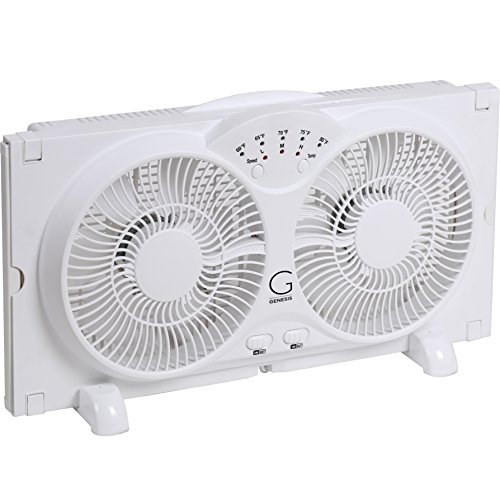
Genesis Twin Fan High Velocity Reversible AirFlow Fan — Best for Fast Purges
The Genesis is built around one idea: move a lot of air, fast. Its high-velocity twin design is aimed at whole-room air exchange, and for a smoking room that translates into the shortest purge times here — the fan you run at full song for ten minutes after a session to return the room to neutral, or during a multi-guest session where smoke production outpaces a gentler fan’s clearing. The adjustable thermostat and LED indicators keep it civilized when you are not asking for maximum effort.
It suits larger smoking rooms, group sessions — a poker night with three cigars going is a different pollution load than a solo pipe — and rooms where the fan must also serve as the summer cooling fan. Reversal on this class is handled at the unit rather than by remote, and high velocity means high voice: at full speed you will talk over it rather than through it. Used as intended — hard during and briefly after, gentle otherwise — that trade is entirely manageable.
Ownership notes: the ETL certification and the thermostat’s adjustability are the details to appreciate; this is a fan designed to be run hard and to manage itself afterward. Its Max Cool positioning also makes it the strongest pure cooling fan in the group, so the smoking room’s fan earns its window in July as well as January. Keep intake screens clean in heavy use; velocity fans show dust loading quickly.
Strengths
- Highest air-moving urgency here — fastest post-session purges
- Adjustable thermostat with clear LED indicators
- Doubles as a powerful summer cooling fan
Trade-offs
- Loud at full velocity — a purge tool, not a whisper
- Reversal at the unit, not by remote
- Overkill for a small solo smoking corner
| Design | High velocity reversible twin (per Amazon title) |
| Controls | Adjustable thermostat, LED indicators |
| Certification | ETL certified (per Amazon title) |
Every smoking room eventually hosts the session that overwhelms a gentle fan: guests, multiple cigars, a long evening. The Genesis is insurance against that evening and a purge tool for all the others. If your room is large or your sessions are social, its muscle is the right specification; if your smoking is a solo hour with a book, its talents are wasted and the quieter picks serve you better. Match the fan to the session, not the spec sheet.
Best for: large rooms and social, multi-smoker sessions / Not suited for: quiet solo reading-room smoking
Check the current price on Amazon
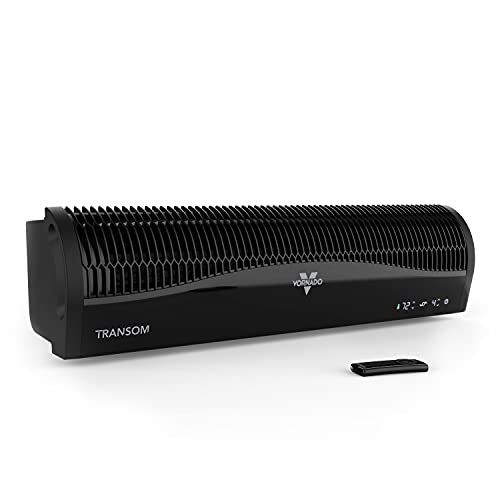
Vornado TRANSOM Window Fan — Best Looking / Best Weather-Sealed
The TRANSOM is the design object’s answer to the window fan: a long, low unit that sits in the window like a piece of architecture rather than a appliance, from Vornado, a brand built on air-circulation engineering. It offers four speeds, remote control and a reversible exhaust mode, in a weather-resistant case — a meaningful detail for a fan that lives in a window year-round, facing the weather on one side and your smoke on the other.
It suits the smoking room that is also a living space with standards: the study or den where a white plastic twin would look like a dorm room, and where the fan stays installed permanently. Its low profile preserves more of the window’s view and light than a tall twin. The trade-offs are a premium tier, and a form factor optimized for whole-room circulation finesse rather than the brute purge velocity of the Genesis; its exhaust is capable and controlled rather than violent.
Ownership notes: the weather-resistant case and Vornado’s support make this the most confident year-round, leave-it-installed choice here. The remote and four speeds give fine control for the smoking routine — low exhaust during, higher purge after — and its composed noise character at low speeds suits rooms where conversation and music share the air with the smoke.
Strengths
- Low-profile design preserves the window and the room’s look
- Weather-resistant case for permanent installation
- Four speeds and remote with reversible exhaust
Trade-offs
- Premium tier
- Purge velocity is composed, not class-leading
- Form factor favors standard window geometries
| Speeds | 4, with remote control (per Amazon title) |
| Airflow | Reversible exhaust mode (per Amazon title) |
| Case | Weather resistant (per Amazon title) |
The TRANSOM is for the smoker whose room is finished, furnished and photographed — the fan as part of the room rather than an apology in the window. Its performance is thoroughly competent for solo and small-group sessions, its manners are the best here, and it is the one fan in this guide guests will ask about for the right reasons. If your sessions are heavy and frequent, pair your expectations with the Genesis class; if they are civilized and regular, this is the connoisseur’s window fan.
Best for: finished smoking rooms and permanent installations / Not suited for: maximum purge power or minimum spend
Check the current price on Amazon
Comparison Table
| Pick | Badge | Key spec | Best for |
|---|---|---|---|
| Bionaire Window Fan with Reversible Airflow Blades | Best Overall | Electric reversal, thermostat, remote | dedicated smoking rooms and studies used several times a week |
| Lasko Electrically Reversible Twin Window Fan W09550 | Best Set-and-Forget | Electric reversal twin, remote | daily-use smoking rooms wanting simple, supported reliability |
| HOLMES Dual 8-inch Twin Window Fan with Thermostat | Best Compact Classic | Dual 8-in blades, thermostat | smaller smoking rooms and smaller windows |
| Comfort Zone Reversible Twin Window Fan 3-Speed | Best Budget Pick | 3 modes incl. cross-ventilation | first smoking-room setups, renters and odd-shaped windows |
| Genesis Twin Fan High Velocity Reversible AirFlow Fan | Best for Fast Purges | High velocity twin, thermostat | large rooms and social, multi-smoker sessions |
| Vornado TRANSOM Window Fan | Best Looking / Best Weather-Sealed | Low-profile, weather-sealed, 4 speeds | finished smoking rooms and permanent installations |
How to Choose a Window Exhaust Fan for a Smoking Room
Start with reversal, because it defines the routine. Electrically reversible fans (Bionaire, Lasko, Vornado) flip between exhaust and intake from the remote — the effortless pattern of exhaust-during, intake-flush-after. Manually reversible fans do the same job with a walk to the window. Either works; what does not work for this use is an intake-only fan, however powerful, because pushing air in merely distributes smoke through the house.
Next, fit. Measure your window’s opening width and confirm the fan’s range and panel system cover it with room to seal. An exhaust fan with gaps around it short-circuits: it pulls its ‘fresh’ air from the gap beside itself instead of from the room, and your smoke stays home. Five minutes with foam weatherstripping around the panels routinely matters more than one speed setting of difference between models.
Finally, match velocity to your sessions. Solo smoking needs steady, quiet clearing. Social smoking needs purge power. Thermostat control is worth having in both cases, because the hour after the session — when the fan should keep working unattended — is where most of the odor-prevention actually happens.
- Electric reversal for effortlessness; manual reversal is fine on a budget
- Seal the window fit — gaps destroy exhaust performance
- Thermostat = automatic post-session clearing while you relax
- Size velocity to your biggest session, noise to your typical one
Setting Up the Room: Airflow Is a System, Not a Fan
An exhaust fan can only push out air that the room lets in. For the system to work, makeup air must enter from the room’s other side — typically under or around the door — so the airflow path crosses the room and sweeps smoke with it. A smoking room sealed tight against the house will starve the fan and underperform; a door left open a crack, or a modest under-door gap, is the correct configuration. Sit between the door and the window where you can, so the airflow carries smoke away from you toward the exhaust.
Keep the smoke’s journey short and downhill in effort: the ashtray and your chair near the window side of the room means smoke is captured young, before it mixes into the whole room’s air and finds the curtains. A small desk fan pointed gently toward the window can help shepherd smoke on still days, but aim it softly — turbulence spreads smoke before it clears it. Soft furnishings are the enemy of freshness; leather and wood forgive smoke, deep fabric remembers it. Choose the room’s furnishings with the habit in mind and every fan in this guide will seem twice as effective.
What a Window Fan Can and Cannot Do About Smoke and Odor
Be clear-eyed about the physics and the chemistry. A good exhaust setup removes the great majority of airborne smoke during a session and purges the rest within an hour after — that is a transformation of the room’s livability, and it protects the rest of the house almost completely when the door discipline is right. What it cannot do is extract odor molecules already absorbed into carpet, upholstery and drapes over months, or make the habit invisible to a sensitive nose entering mid-session.
It also cannot make indoor smoking safe — ventilation reduces exposure; it does not eliminate the health effects of smoke for the smoker or for anyone sharing the air, and no fan changes that. The honest role of these fans is comfort and containment within a home the smoker owns and controls, respecting other occupants and neighbors. Within that role, they are superb tools. Outside it, no product in this guide should be asked to perform miracles.
Noise, Speeds and the Conversation Test
Fan noise in a smoking room is not an abstract specification — it competes with conversation, music and the television for hours at a time. The practical test is whether you can talk at normal volume at the speed the fan needs to run during a session. Most twins in this guide pass that test at low and medium speeds and fail it at maximum — which is fine, because maximum is a purge setting for an emptying room, not a session setting.
Run the routine the way the pros of this small world do: medium exhaust while smoking (quiet enough for company, strong enough to keep the air visibly moving toward the window), high purge for ten to fifteen minutes after the last ash, then thermostat-managed low until the room is neutral. That pattern uses each fan’s range as designed and keeps both the air and the peace.
Pairing the Fan With an Air Purifier and Soft-Furnishing Discipline
The fan handles the airborne phase; a purifier handles what escapes it. In a serious smoking room, the two work as a team: the exhaust fan is the primary defense, running during and after sessions, while a purifier with a substantial activated-carbon stage scrubs the residual odor and particles the fan missed, especially on still days when you would rather not open the window at all. Neither replaces the other — a purifier alone recirculates smoke through the room for hours before cleaning it, and a fan alone leaves the last few percent lingering.
Furnishing discipline multiplies both machines. Hard surfaces, leather and washable throws forgive; deep-pile carpet, heavy drapes and open bookshelves full of paper absorb and re-emit odor for days. The classic smoking room — wood, leather, a rug that can be beaten outdoors — is not an aesthetic accident; it is odor engineering from before the machines existed. Set the room up that way and the fan’s job becomes easy enough that any pick in this guide handles it.
Seasonal Use: The Fan’s Second Career
A reversible window fan in a smoking room earns its window all year. In summer it becomes the room’s cooling system on mild evenings — intake mode pulling in night air is genuinely effective air conditioning for a single room, and the same seal that kept smoke in check keeps the cool air directed. In shoulder seasons it ventilates the stale, heated air that makes indoor rooms stuffy, smoking or not.
This second career matters to the purchase decision: a fan used three hundred days a year justifies a better model than a fan used for Saturday cigars. If your smoking room doubles as a home office or reading room — as most do — buy for the daily ventilation job and the smoking job together, which is another reason the reversible, thermostat-equipped picks lead this guide.
Renters and Shared Walls: The Diplomatic Setup
If you rent, or your smoking room shares a wall and a landing with neighbors, the fan decision is partly diplomatic. A window exhaust keeps smoke out of your own hallway, which is the part you control; where your window sits relative to your neighbor’s windows decides the rest. Exhausting toward your own yard or roofline is courteous; exhausting directly across a narrow light-well into a neighbor’s bedroom window is a complaint with a time stamp on it.
Renters should also favor the no-modification fans in this guide — every pick installs in the window without screws into the building fabric when fitted carefully — and should keep the landlord conversation honest and early. A contained, ventilated, single-room setup presented plainly is a far easier conversation than a smell discovered later.
How to Install and Set Up a Window Exhaust Fan for Smoking
Twenty minutes of careful fitting buys you years of effective exhaust. The steps below are the universal pattern for twin and transom window fans in a double-hung window.
- Measure and test-fit first: confirm the fan’s width range against your opening, extend the side panels to a snug fit, and mark where foam weatherstripping is needed to close the remaining gaps.
- Install the fan in the window with the sash lowered onto it (or per the model’s design), secure it as the manual directs, and seal every gap around the housing and panels — this seal is the difference between a system and a decoration.
- Set the fan to exhaust and run the tissue test: hold a tissue near the door’s gap — it should pull gently toward the room — and near the window edges, where it should show air leaving, not entering, around the fan.
- Establish the room’s airflow path: chair and ashtray on the window side, door closed with its natural gap (or cracked an inch), and nothing blocking the path between door and window.
- Program the routine: thermostat set so the fan continues after sessions, remote placed where you sit, and speeds chosen — medium for sessions, high for purges — before the first cigar is lit, not during.
- After the first session, do the next-morning test: enter the room fresh and judge honestly. If odor lingers, extend the post-session purge and check the seals before blaming the fan’s power.
Maintain the system monthly: vacuum the grilles and blades (exhaust fans ingest the room’s dust), re-check the window seals each season, and wipe blades if they grow a film — a fan in a smoking room works in dirty air by definition, and a clean fan moves noticeably more of it.
One last calibration: after a month of sessions, look at the fan itself. A light film on the exhaust side is normal evidence the system is working — the smoke is leaving on the fan’s blades rather than settling on your walls. A heavy build-up means your post-session purge is too short, and the fix is time, not a bigger fan.
Common Buying Mistakes
Mistake 1: Buying an intake-only fan for a smoking room. Pushing air into the room pressurizes it and drives smoke under the door into the house. The smoking room needs negative pressure — exhaust out, makeup air in through the door gap. Reversibility is not a luxury feature here; it is the job description.
Mistake 2: Leaving gaps around the fan. An unsealed exhaust fan breathes through its own gaps and barely touches the room’s air. Foam weatherstripping around the housing and panels is the cheapest performance upgrade in this entire guide.
Mistake 3: Sealing the room completely. The opposite error: weatherstripping the door shut starves the fan of makeup air and guts its flow. The door needs its gap; the window needs its seal. Knowing which is which is the whole setup.
Mistake 4: Sitting far from the window. Smoke that crosses the whole room before exiting has visited every curtain on the way. Put the chair and ashtray on the window side and let the smoke be captured young.
Mistake 5: Turning the fan off when the cigar ends. Most odor prevention happens in the hour after the session, while residual smoke is still airborne and removable. Use the thermostat or a timer mindset: purge on high briefly, then let it clear on low while you go about your evening.
Mistake 6: Expecting the fan to fix old odor. A fan prevents new odor from settling; it cannot extract months of smoke from a sofa. Deep-clean or replace the worst soft furnishings when you set up the room, or the room will smell of its history no matter how well it ventilates now.
Final Recommendation
Buy once, fit it properly, and this is one of the cheapest quality-of-life upgrades a smoker’s household can make — the room stays a pleasure, the house stays neutral, and the ritual stays contained to the room that chose it.
For most smoking rooms, the Bionaire is the complete answer: electric reversal, a programmable thermostat to finish the job after you leave, and a fit range that covers most windows. The Lasko W09550 is the equally sensible pragmatist’s pick with the best support network in the business. Choose the Holmes for smaller windows, the Comfort Zone for budget and corner-sweeping cross-ventilation, the Genesis when your sessions are social and your purges need muscle, and the Vornado TRANSOM when the room’s appearance matters as much as its air.
Whichever fan you install, fit it sealed, sit near the window, keep the door’s gap working, and let the fan run after the session ends. That system — more than any single product — is what makes a smoking room a room the rest of the house can live with.
Related guides on this site:
Best Filterless Air Purifier For Smokers Best Electronic Air Cleaner For Smokers Best Fire Protective Mat For Smokers Best Window A C 120 Volt 10000 Btu
Frequently Asked Questions
Will a window exhaust fan keep smoke from reaching the rest of the house?
Largely, yes — if the setup is right. The fan creates negative pressure, so air flows into the smoking room under the door rather than out of it, carrying smoke to the window instead. The conditions are a well-sealed window installation and a closed door with a normal gap. An open door or a leaky fan fit will defeat it.
How long should I run the fan after finishing a cigar?
A good routine is ten to fifteen minutes on high to purge, then thirty to sixty minutes on low or thermostat control to clear the residual. Rooms with heavy furnishings need the longer end. The next-morning sniff test is your calibration tool — adjust the routine until the room passes it.
Is a twin window fan better than a single exhaust fan for smoke?
For window installation, generally yes: twins move more air through a window-shaped opening, seal better with their panels, and the better models reverse electrically and offer cross-ventilation. A hardwired wall exhaust fan can outperform both but requires cutting the wall — a different commitment entirely.
Can I use one of these fans in winter without freezing the room?
The fan will happily exhaust in winter; the room will lose heat while it runs, which is the honest cost of ventilation. The thermostat-equipped models help by stopping when the room reaches a set point, and shorter, higher-speed purges lose less heat than long low runs. Many cold-climate smokers accept a cooler room during sessions as part of the ritual.
Do these fans work in horizontal sliding windows?
Most twin window fans are designed for double-hung windows and install vertically. Some can be adapted to sliding windows mounted sideways if the manufacturer allows it — check the listing’s stated window compatibility for your exact fan rather than improvising, because the panel sealing depends on the intended orientation.
Will an exhaust fan bother my neighbors?
It exhausts diluted room air, which disperses quickly outdoors, but if your window is close to a neighbor’s window or patio, be a good citizen: run the fan during reasonable hours, and know that a charcoal-filter air purifier used alongside can reduce what reaches the property line. Courtesy scales better than any technology.
What CFM do I need for a smoking room?
Think in air changes rather than a magic number: you want the fan to exchange the room’s air several times per hour during a session. For a typical 120-180 sq ft room with normal ceilings, the twin fans in this guide are in the right class; large rooms and group sessions argue for the high-velocity end of the list. A fan that achieves a visible, steady drift of smoke toward the window is doing its job — the tissue test at the door tells you more than any rating.


