Disclosure: airfryerkitchensupply.com is reader-supported. When you buy through links on our site, we may earn an affiliate commission at no extra cost to you.
Where to buy
All six grills below were confirmed as current Amazon listings before this guide was written. Portable grills ship in compact boxes and assemble quickly, but check the listing for what is included — several models need a separate adapter hose to run from a refillable 20 lb tank instead of disposable 1 lb canisters, and that hose is rarely in the box.
Quick links to the verified picks in this guide: Coleman RoadTrip 285 · Weber Traveler · Napoleon TravelQ PRO285 · Cuisinart Chef’s Style Portable Propane Tabletop Grill CGG-306 · Weber Q 2800N+ · Magma Cabo Gas Grill A10-703. Every product link in this article points to a listing we confirmed before writing; anything we could not confirm is discussed in plain text only, with no link.
The best wind resistant propane tailgate grills exist because of one miserable, universal experience: a parking-lot cookout where the breeze keeps stealing your flame, one side of the grate runs hot, the other side sulks, and the burgers come off in waves of done and not-done while the game clock ticks. Wind is the tailgate grill’s natural enemy. It strips heat from the cooking chamber, cools one side of the grate, makes small burners struggle to hold temperature, and in gusty conditions can blow a weak flame out entirely. No portable grill is truly windproof — physics does not allow it — but good design fights back: deep lids that shelter the grate, burners recessed below wind level, cast cooking bodies that hold heat, enclosed or hooded designs that keep gusts from reaching the flame, and enough burner power in reserve to recover after a gust. This guide ranks six verified propane portables by how their design copes with wind first, and by tailgate practicality — legs, latches, weight, setup — second, because a grill that cooks beautifully but takes twenty minutes to assemble in a parking lot has failed its actual job.
In this guide
Quick Picks
Coleman RoadTrip 285 — Best Overall: Three burners, 20,000 BTU and a stand-up folding design with a proper lid — the tailgate standard, and strong in wind thanks to burner zoning. — Check the current price on Amazon
Weber Traveler — Best Premium Tailgate Grill: A one-handed folding cart, a low enclosed profile and Weber build — the most polished wind-sheltered design in this class. — Check the current price on Amazon
Napoleon TravelQ PRO285 — Best Wind Fighter: Cast aluminum body, dual stainless burners and a high domed lid — the heaviest, most heat-retentive small grill here, and it shrugs off gusts. — Check the current price on Amazon
Cuisinart Chef’s Style Portable Propane Tabletop Grill CGG-306 — Best Tabletop Value: Twin 10,000 BTU burners under a stainless lid, 275 sq in — serious tabletop power that handles wind with output to spare. — Check the current price on Amazon
Weber Q 2800N+ — Best Compact All-Rounder: A wide 250–700°F range, cast aluminum body and Weber’s Q-shaped burner — compact, composed in wind, and unusually versatile. — Check the current price on Amazon
Magma Cabo Gas Grill A10-703 — Best for Boats and Brutal Wind: A marine grill built for open-water wind, with a lock-down lid and balanced heat — the toughest weather pedigree in this guide. — Check the current price on Amazon
How These Picks Were Chosen
Wind resistance was judged on design, not marketing. We looked for the features that demonstrably help in a breeze: a lid that closes over the grate and stays closed, burners positioned low and sheltered inside the body, cast aluminum or heavy steel construction that stores heat, a cooking chamber without large open gaps at grate level, and burner output generous for the grate size so the grill can recover heat after gusts. Tabletop models earned credit for working low behind a vehicle or windbreak; stand models earned credit for hoods and enclosed fireboxes.
Every grill was verified on this site’s Amazon integration — searched by brand and model, the returned title matched to the grill we intended to recommend, and the ASIN recorded only on a confident match. Nothing here is linked on memory or on a retailer’s say-so.
We also weighted the tailgate brief honestly: the grill must travel. Folding or collapsing legs, a latching lid, manageable weight, and ignition that works with cold hands all counted. A competition-grade patio grill that happens to be small did not make the list; these are machines designed to live in a trunk and cook in a parking lot, a campsite or a windy beach.
Finally, a note on honesty: manufacturers rarely publish a wind rating, because there is no standard test. Our rankings therefore rest on the physics of each design and on the long ownership record of these well-known models, and the buying guide below explains how to position and run any portable grill so wind matters less.
One more filter deserves stating: every grill here runs on standard propane connections and is supported with replacement parts — regulators, grates, igniters, drip pans — because a tailgate grill that cannot be repaired after season three is a rental, not a purchase. The brands in this guide have the installed base and parts pipelines to keep their portables cooking for years, and that support record weighed as heavily as any cooking test.
The 6 Best Wind Resistant Propane Tailgate Grills

Coleman RoadTrip 285 — Best Overall
The RoadTrip 285 is the grill you will see most often in stadium parking lots, and that popularity is earned. Its three independently controlled burners are the wind story: when a breeze cools one side of the grate, you have burner authority to compensate zone by zone instead of watching one global temperature sag. The lid closes over the whole cooking surface, the stand folds and rolls, and the whole thing sets up at standing height without a table.
It suits the serious tailgater cooking for a group — burgers and dogs in volume, with swap-top versatility for griddle and stove grates sold for the platform. Three burners under a mid-size grate means real zoning: sear on one side, hold on the other, toast buns on the third. It is less suited to the solo camper counting ounces, and its open stand design means the underside is exposed to crosswinds even though the lidded chamber above cooks steadily.
Ownership notes: the wheels and collapsing scissor stand are the convenience kings of this class, and the drip tray pulls out for cleaning in a way most portables should copy. Run it from a 20 lb tank with an adapter hose at home base and keep 1 lb canisters for true away games. In wind, park it with the lid hinge facing the breeze so the lid itself becomes the windbreak when you open it.
Strengths
- Three burner zones let you compensate for wind-cooled spots
- Full lid and stand-up height cook like a real grill, not a camp toy
- Huge accessory ecosystem: griddle and stove tops swap in seconds
Trade-offs
- Heavier and bulkier than tabletop models when packed
- Underside is open to crosswinds despite the lidded chamber
- Needs an adapter hose (sold separately) for 20 lb tanks
| Output | 20,000 BTU across 3 burners (per Amazon title) |
| Ignition | Instastart push-button |
| Format | Stand-up, folding with wheels |
The 285 wins this guide because tailgating is a team sport and wind is a team problem. Its answer to a gusty day is not one trick but a system: lid down to shelter the chamber, three burners to rebuild heat where the wind stole it, and enough grate to cook in batches that come off together. It is also the easiest recommendation to support — parts, covers and accessories are everywhere because the installed base is enormous. If you tailgate for a crowd more than a couple of times a season, start here.
Best for: group tailgates, stadium lots and family camping / Not suited for: ultralight solo travel or tiny car trunks
Check the current price on Amazon

Weber Traveler — Best Premium Tailgate Grill
The Traveler is what happens when a serious grill company designs a portable from scratch instead of shrinking a patio grill. The cooking box sits low in its folding cart, the lid profile is compact, and the whole unit folds with one hand and rolls like luggage. That low, enclosed stance is exactly what you want in wind: less sail area, a chamber that stays shut and sheltered, and a burner working inside a body designed to keep its heat.
It suits the tailgater who also camps, RVs and beach-cooks, and who values a grill that feels like equipment rather than a compromise. The single burner demands zone cooking by food placement rather than by knob — a real technique adjustment — and the grate size is a two-to-four-person proposition, not a team feed. The build quality, ignition reliability and parts support are the best in this guide, and you pay a premium tier price for them.
Ownership notes: the Traveler’s party trick is the fold — practice it twice at home and it becomes a thirty-second parking-lot routine. The porcelain-enameled cast iron grate holds heat beautifully through lid openings, which is another quiet wind advantage: recovery after you peek is fast. Keep the grease tray emptied; a grill this tidy deserves a tidy owner.
Strengths
- Low, enclosed, lidded design is inherently wind-sheltered
- One-hand fold and roll — fastest serious setup in the class
- Weber ignition, build quality and parts support
Trade-offs
- Single burner means placement-based heat zones only
- Premium-tier price for a mid-size grate
- Cooking for a big group means batches
| Format | Folding cart grill with wheels (per Amazon title) |
| Grate | Porcelain-enameled cast iron |
| Use cases | Camping, tailgating and travel (per Amazon title) |
In a crosswind, the Traveler behaves like it was designed by people who cook outdoors in real weather — because it was. The chamber stays composed, the lid does its job, and the food cooks evenly enough that you stop thinking about the breeze. It is the pick for buyers who keep gear for a decade and hate flimsiness, and its resale and parts story reflect that. For pure wind-fighting in a portable propane package, this and the RoadTrip are the two honest answers, chosen by group size and budget.
Best for: quality-focused tailgaters, campers and RVers / Not suited for: feeding a dozen people at once or tight budgets
Check the current price on Amazon
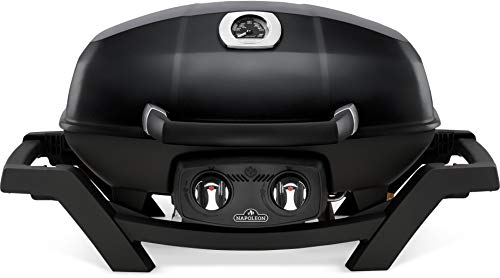
Napoleon TravelQ PRO285 — Best Wind Fighter
Napoleon’s PRO285 attacks wind with mass. The cast aluminum body stores heat the way a cast iron pan does, so a gust that would crash a thin steel grill’s temperature barely dents the cooking environment inside. Two stainless steel burners give you genuine two-zone control, the porcelainized cast iron grids are wavy — Napoleon’s signature — to stop food rolling and distribute heat, and the domed lid fits whole chickens and roasts that flat portables cannot close over.
It suits the cook who grills seriously in exposed places: beach lots, lakeside campsites, mountain trailheads where the breeze never really stops. The cast body makes it heavier than its size suggests, and it is a tabletop format, so your tailgate setup needs a surface. Owners who prioritize cooking performance over carry weight consistently rate it the best small grill they have owned — and wind performance is the core of that reputation.
Ownership notes: let the cast body work for you — preheat it fully and it will coast through lid openings and gusts alike. The wind guard and lid design also make it a confident winter tailgate grill. Its legs fold for transport, and on the optional scissor cart it becomes a stand grill. Keep the grids seasoned and they will outlast the car you carry them in.
Strengths
- Cast aluminum body holds heat through gusts and lid openings
- Dual stainless burners for true two-zone cooking
- High dome lid fits roasts and whole birds
Trade-offs
- Heavy for its size — mass is the price of the performance
- Tabletop format needs a table or the optional cart
- Premium tier for a compact grate
| Body | Cast aluminum |
| Burners | 2 stainless steel (per Amazon title) |
| Format | Portable tabletop, folding legs |
If wind is your primary enemy — not an occasional nuisance but the defining condition of where you cook — this is your grill. Physics favors mass and enclosure, and the PRO285 has more of both per square inch than anything else in this guide. It will not cook for twelve, and it will not disappear into a trunk corner, but in a stiff breeze at a cold November tailgate it will simply cook, evenly and calmly, while lighter grills around it struggle. That composure is worth its weight, literally.
Best for: exposed, windy cooking spots and serious small-batch grilling / Not suited for: weight-watchers or crowd feeding
Check the current price on Amazon

Cuisinart Chef’s Style Portable Propane Tabletop Grill CGG-306 — Best Tabletop Value
The Cuisinart CGG-306 takes the opposite approach to wind from the Napoleon: not mass, but muscle. Two burners at 10,000 BTU each is a lot of fire under 275 square inches, and a grill with power in reserve recovers from gusts the way a big engine recovers from a hill — by simply having more to give. The stainless steel lid closes over a genuinely two-zone cooking surface, and the whole unit sits low on a table where a vehicle or cooler can break the wind for it.
It suits the value-minded tailgater who cooks on a folding table and wants real two-zone grilling for four to six people. The stainless construction wipes down easily and looks sharp doing it. It is less suited to stand-alone use — there is no cart, the legs are short tabletop legs — and thin stainless, while strong for its weight, does not hold heat like cast bodies once the lid opens. In sustained wind you will cook lid-down and lean on the burners, which this grill happily allows.
Ownership notes: the twist-start ignition and simple controls make it a friendly grill for occasional users and borrowed-gear situations. Because it is light, secure it on the table in real gusts — a grill this portable should be placed, not just set down. Its drip pan is small; for fatty cooks, check it mid-session rather than discovering its limits.
Strengths
- 20,000 total BTU across two zones — power in reserve against gusts
- 275 sq in cooks for a small group on a tabletop footprint
- Stainless build, simple controls, easy cleanup
Trade-offs
- Needs a table; no stand or cart included
- Thin walls lose heat faster than cast bodies when the lid opens
- Small drip pan needs attention on fatty cooks
| Output | Twin 10,000 BTU burners (per Amazon title) |
| Cooking area | 275 sq in (per Amazon title) |
| Format | Tabletop, stainless lid |
This is the smart-money tabletop: enough power to bully through a breezy day, enough area to feed the crew around one vehicle, and a price position that leaves room in the budget for the adapter hose and a good cover. It does not have the Napoleon’s thermal mass or the Weber’s polish, but on the metric most tailgaters actually feel — food cooked evenly, on time, in imperfect weather — it delivers well above its tier.
Best for: tabletop tailgates for four to six on a sensible budget / Not suited for: stand-alone setups without a table
Check the current price on Amazon

Weber Q 2800N+ — Best Compact All-Rounder
The Q series has been the connoisseur’s portable for two decades, and the 2800N+ is its current flagship form: a cast aluminum body and lid, a burner shaped to match the grate for even heat, and a temperature range — 250 to 700°F per the listing — that covers low roasting through genuine searing. Cast construction plus a deep, close-fitting lid makes the Q family naturally wind-resistant; owners have cooked on them in exposed places for years.
It suits the two-to-four-person tailgate, the balcony-adjacent cook (where rules allow), and the camper who wants one grill that roasts a chicken on Friday and sears steaks on Saturday. The plus-burner arrangement gives a hotter center for searing with a gentler perimeter. It is less suited to volume cooking, and like the Traveler it carries Weber’s premium tier pricing and thrives on the optional cart rather than a tailgate alone.
Ownership notes: the Q’s cast iron grate seasons into a superb cooking surface, and the removable drip pan system is the tidiest in the class — disposable pans make parking-lot cleanup a non-event. The wide temperature range also makes it the best cold-weather small grill here: at low settings it will hold roasting temperatures that flimsier portables cannot reach in a November wind.
Strengths
- Cast aluminum body and deep lid — inherently wind-calm
- Exceptionally wide 250–700°F working range
- Even, Q-shaped burner and superb cast iron grate
Trade-offs
- Premium tier; cart is an extra purchase
- Single-zone layout takes technique for mixed loads
- Grate size suits small groups only
| Temperature range | 250–700°F (per Amazon title) |
| Body | Cast aluminum |
| Format | Portable, cart optional |
Choose the Q 2800N+ when the tailgate is two cars and a small crew, and when you also want the grill to earn its keep at home and at camp. Its wind manners come from the same cast, enclosed design that made the original Q famous, and the N+ generation’s broader range removes the old Q’s one weakness — low-temperature control. It is a decade-long appliance disguised as a portable.
Best for: small crews wanting one versatile, durable portable / Not suited for: large-group tailgates
Check the current price on Amazon

Magma Cabo Gas Grill A10-703 — Best for Boats and Brutal Wind
Magma builds grills for boats, and a boat is a tailgate with worse wind and no parking lot to hide in. The Cabo’s design reflects that world: a polished stainless body, a lid that locks down for transport and stays put in weather, a burner system tuned for even heat in moving air, and tabletop legs that plant it firmly. If a grill can cook on a rail in a harbor breeze, a stadium lot holds no terrors for it.
It suits boaters first, obviously, but also RVers, beach tailgaters and anyone whose cooking spots are exposed by geography. The 9 by 18 inch grate is a two-to-three-person surface — this is a precision instrument, not a crowd feeder — and marine-grade pricing reflects marine-grade materials. The mount ecosystem for rails and posts is sold separately and is part of the system’s appeal for boat owners.
Ownership notes: the Cabo’s stainless construction shrugs off salt air that would eat a painted grill, which also makes it the longest-lived pick here in coastal use. Its lid-locking design travels without rattles or spills, and the whole unit cleans up with the simplicity of a product designed to be maintained on a dock. For land-only users, you are paying for corrosion resistance you may not need — unless your tailgate is at the beach, where you need exactly that.
Strengths
- Marine design brief: wind and weather are its home conditions
- Locking lid and sturdy legs for transport and exposed spots
- Stainless construction resists coastal corrosion for years
Trade-offs
- Small 9×18 in grate feeds two to three people
- Marine-grade price tier
- Rail and post mounts are separate purchases
| Grate | 9 x 18 in (per Amazon title) |
| Design | Marine propane grill for boats, RVs and tailgating (per Amazon title) |
| Format | Tabletop legs, locking lid |
The Cabo is the specialist’s answer: when the question is purely ‘what cooks in the worst wind?’, the marine grill wins, because its designers never got to assume a calm day. For the boater-tailgater — and there are more of them than you’d think, from marina lots to lakeside ramps — it is not even a close call. Landlocked group tailgaters should look up this list; exposed-condition cooks should start here.
Best for: boaters, RVers and beach or lakeside tailgates / Not suited for: feeding groups or budget-first buyers
Check the current price on Amazon
Comparison Table
| Pick | Badge | Key spec | Best for |
|---|---|---|---|
| Coleman RoadTrip 285 | Best Overall | 3 burners, 20,000 BTU, stand-up folder | group tailgates, stadium lots and family camping |
| Weber Traveler | Best Premium Tailgate Grill | Folding cart, enclosed low profile | quality-focused tailgaters, campers and RVers |
| Napoleon TravelQ PRO285 | Best Wind Fighter | Cast aluminum body, 2 burners, dome lid | exposed, windy cooking spots and serious small-batch grilling |
| Cuisinart Chef’s Style Portable Propane Tabletop Grill CGG-306 | Best Tabletop Value | 2×10,000 BTU, 275 sq in, tabletop | tabletop tailgates for four to six on a sensible budget |
| Weber Q 2800N+ | Best Compact All-Rounder | 250–700°F range, cast body | small crews wanting one versatile, durable portable |
| Magma Cabo Gas Grill A10-703 | Best for Boats and Brutal Wind | Marine grade, locking lid, 9×18 in | boaters, RVers and beach or lakeside tailgates |
How to Choose a Wind Resistant Propane Tailgate Grill
Start with where the wind actually hits a grill: at grate level, through gaps between lid and body, and across any open underside. The designs that cope best share three traits — a lid that encloses the cooking chamber completely, a body with thermal mass (cast aluminum or iron beats thin steel), and burners with output to spare for the grate size. Rate every candidate on those three traits before you look at color, brand or price tier, and the shortlist writes itself.
Then match the format to your vehicle and crew. Stand-up folders like the RoadTrip serve groups and spare you the table hunt. Tabletops need a surface but pack smaller and sit lower, out of the wind, behind a vehicle. Cart grills like the Traveler split the difference with the fastest setup. Crew size decides grate area; be honest — cooking in two relaxed batches for eight is better than crushing twelve burgers onto a grate sized for six.
- Enclosed lidded chamber first, burner power second, looks last
- Cast bodies hold heat through gusts; thin steel recovers by burner power
- Stand, cart or tabletop: pick for your vehicle and crew size
- Plan the fuel: 1 lb canisters for away games, 20 lb tank + hose for base camp
Positioning and Technique: Cooking Well in Wind With Any Grill
Half of wind resistance is where you put the grill. Park the vehicle as a windbreak and set the grill in its lee, a few feet out from the bumper. Face the lid hinge toward the wind so opening the lid does not turn it into a sail that dumps your heat — or worse, slams. On a stand grill, keep the lid closed as much as the cook allows; every opening in a gust costs minutes of recovery on a light grill, seconds on a cast one.
Cook in the wind’s rhythm: do your lid-open work — flipping, saucing, moving food — in the lulls, and batch tasks so the lid opens three times, not thirteen. Use a wind screen or a simple folding barrier on the windward side if your lot allows it, keeping it clear of the grill’s vents and never enclosing the grill itself, which is a fire and carbon-monoxide hazard. And always, always keep the grill attended in gusts: a tipped portable is a serious problem, so weight the stand, chock the wheels, and never cook on a dry grassy verge in high wind.
Propane Practicalities: Canisters, Tanks and Cold Weather
Disposable 1 lb canisters are the tailgate default: light, clean and good for a typical cook or two per canister depending on burner use. Their weakness is cold — as the canister empties and chills, pressure drops and flames weaken, which in wind can look like a grill problem. Keep spares warm in the vehicle, not in the cold trunk, and swap rather than shake.
For home tailgates and long sessions, an adapter hose to a 20 lb tank transforms any of these grills: steadier pressure, far lower fuel cost per cook, and no mid-cook canister swaps. Whichever fuel you use, check connections with soapy water for bubbles when you set up, keep the hose routed away from feet and hot surfaces, and let the grill cool before it goes back in the vehicle — every time, without exception.
BTU, Burners and What the Numbers Do Not Tell You
BTU figures are the most misread numbers in portable grilling. What matters in wind is BTU per square inch combined with how enclosed the chamber is: a modest-output grill with a tight lid and cast body will out-cook a high-output grill with a leaky, open design on a gusty day, because the heat it makes stays where the food is. Multiple burners matter for a different reason — zoning. Wind cools unevenly, and a second burner knob is a correction tool, letting you push heat to the cold side instead of rotating food endlessly.
Judge ignition too. Push-button and matchless systems that light first time with cold, gloved hands are a safety feature in wind, where relighting a blown-out burner with a lighter is nobody’s favorite job. All six picks here use reliable electronic or piezo ignition for exactly that reason.
Tailgate Cooking Workflow: Feeding a Crew From a Small Grate
The grills in this guide cook for groups by rhythm, not by area. The pattern that works: dense, fast items first while the crew is arriving and grazing — wings, sausages, skewers — then the main event in one or two full-grate batches, then a holding phase where the cool zone keeps food hot under the lid while people come back for seconds. Staggering this way, a 275 sq in grate feeds eight people without a single cold plate, and the cook actually watches some of the pregame show.
Sauce discipline matters more in wind: sugary sauces go on in the last minutes, under the lid, because open-lid basting in a gust both cools the grate and blows sauce where it does not belong. Keep a squeeze bottle rather than a brush-and-bowl setup — one hand, three seconds, lid back down. These are small things, but tailgating is a game of small things done in the right order.
Care, Storage and Making a Portable Last Ten Seasons
Portable grills die young from three causes: grease left to go rancid in the tray, moisture trapped under a latched lid all winter, and road vibration shaking fasteners loose. The countermeasures are boring and total about ten minutes per outing: scrape the grate hot, empty the drip tray when you pack, wipe the chamber when you get home, and store the grill dry with the lid cracked or the cover breathable.
Once a season, do the deeper pass: check burner ports for spider nests and rust (a paperclip clears most ports), inspect the hose for cracks, test the igniter, and snug the leg and stand hardware. Propane portables are simple machines — there is almost nothing on them a home owner cannot maintain — and the grills in this guide reward that maintenance with the kind of decade-long service that makes their price tiers look very different in hindsight.
Safety in Gusty Conditions: The Non-Negotiables
Wind does not just cool food; it moves flames, tips light equipment and carries embers and napkins into places they should not be. The rules that keep a windy tailgate safe are absolute. Anchor the setup: stands weighted or wheels chocked, tabletops on surfaces that cannot rock. Keep the grill attended whenever it is lit — in gusts, this means the cook stays with it, full stop. Maintain clearance from vehicles, tents and canopies, remembering that a gust can lean a flame and lift a canopy into the heat zone.
Keep children and the cooler traffic lane on the lee side, away from the grill’s hot and hinged parts, and know where your extinguisher is before you need it. When the wind is truly extreme — the kind that folds chairs and sandblasts the lot — the correct call is to not light the grill at all. Sandwiches have fed many great tailgates. A grill guide that will not say that is not being straight with you, and straight is the whole point of this site.
How to Set Up a Tailgate Grill Station That Wind Cannot Ruin
A good tailgate setup is a small system: grill, fuel, surface, and shelter, arranged once and repeated until it is muscle memory.
- Scout the spot on arrival: park so the vehicle blocks the prevailing wind, and claim the lee side for the cooking station, away from foot traffic and fuel cans.
- Set the grill upwind-stable: stand legs locked, wheels chocked or the tabletop planted on a solid surface, lid hinge facing the breeze. Level matters — grease should run to the tray, not the corner.
- Connect fuel and leak-check: hand-tighten the canister or hose, open the valve, and brush soapy water on the joints. Bubbles mean stop and refit. No bubbles, proceed.
- Preheat with the lid down for a full ten minutes in wind — longer than a calm day — so the grate and body store the heat that will carry you through lid openings.
- Stage food in cook order on the downwind side, with tools, tray and a lidded bin for finished food. Wind carries ash, napkins and heat; a staged station keeps the lid’s open time to seconds per task.
- Cook lid-down, open in lulls, and use the zones: sear on the hot side, hold finished food on the cool side under the lid’s shelter. Keep a spare warm canister ready if you are on 1 lb fuel.
- Shut down properly: burners off, valve closed, grill cooled before packing. Ash-free propane makes this quick — which is half the reason it owns the tailgate.
Back home, empty the drip tray while the memory is fresh, wipe the grate, and store the grill dry with the lid latched. Tailgate gear dies in the off-season from neglect, not from use; ten minutes after each game is what makes a grill last a decade of seasons.
Common Buying Mistakes
Mistake 1: Buying the biggest BTU number. Output without enclosure is just heat donated to the parking lot. In wind, a sealed chamber and thermal mass beat raw BTU every time — judge the system, not the sticker.
Mistake 2: Setting up wherever the chairs are. The social spot and the cooking spot are different places on a windy day. Cook in the vehicle’s lee even if it is ten feet from the circle; carry the food, not the grill’s suffering.
Mistake 3: Cooking with the lid up “to keep an eye on things”. Lid-up grilling in wind is how you get raw tops and burnt bottoms. Trust the zones, open briefly in lulls, and let the enclosed chamber do the work it was designed for.
Mistake 4: Running one cold canister to empty. A chilling, near-empty 1 lb canister loses pressure and the flame fades exactly when you need recovery power. Swap early, keep spares warm, or run a tank and hose.
Mistake 5: Forgetting the table. Half the grills in this guide are tabletops. Arriving with a tabletop grill and no table means cooking on a cooler lid at knee height. Match the grill format to the gear you actually bring.
Mistake 6: Packing a hot grill. Propane grills cool fast, but ‘fast’ is not ‘instantly’. A rushed pack-up with a warm grill melts trunk liners and worse. Build the cool-down into your postgame routine.
Final Recommendation
For the classic group tailgate, the Coleman RoadTrip 285 is the default answer: three zones to fight wind with, a stand that sets up anywhere, and an accessory shelf a mile deep. For the buyer who wants the best-built portable and cooks for a smaller crew, the Weber Traveler and Q 2800N+ are the decade-long purchases. For genuinely exposed cooking — the beach lot, the lakeside, the boat — the Napoleon PRO285’s cast mass and the Magma Cabo’s marine pedigree are the two honest specialists, and the Cuisinart CGG-306 is the tabletop value that punches through a breezy day on burner power.
No portable grill defeats wind outright; the winners here respect it, shelter from it, and carry enough heat and control to cook through it. Set up in the lee, keep the lid down, and any of these six will feed your crew while the flags are still snapping.
Related guides on this site:
Best Wifi Pellet Smokers Best Gas Grill Smokers Pellet Grill Black Friday Deals Best Electric Smokers With Bluetooth
Frequently Asked Questions
Can wind really blow out a propane grill burner?
On small portables with exposed burners and low settings, yes — a strong gust can lift or extinguish a weak flame, which is why enclosed, lidded designs and healthy burner output matter. If a burner does blow out, turn the knob off, wait for gas to clear, and relight per the manual rather than immediately sparking it.
Is a heavier grill always better in wind?
Heavier usually means more thermal mass, which genuinely helps temperature stability — that is the Napoleon and Magma advantage. But an enclosed design with strong burners, like the Cuisinart, can compensate with power. Weight helps; it is not the only path, and you still have to carry the thing.
How do I keep food from cooling when serving at a windy tailgate?
Cook in batches matched to eating speed, hold finished food in a covered pan on the grill’s cool zone, and serve into lidded trays rather than open plates. A simple insulated food carrier or a cooler used as a hot box keeps batches at serving temperature between trips.
Can I use these grills on a wooden deck or picnic table?
Tabletop models belong on heat-safe, stable surfaces — many owners use a grill mat or a metal tray beneath them, and you should keep clearance from combustibles and never leave them unattended. When in doubt, the ground or a dedicated stand is the safer stage, and local venue rules always win.
One-pound canisters or a 20 lb tank: which is better for tailgating?
Canisters for true away games — light, self-contained, no hose to trip over. A tank and adapter hose for home tailgates, RV base camps and long cooks — steadier pressure, cheaper fuel, no mid-cook swaps. Most serious tailgaters in this guide’s audience end up owning both setups.
Do I need a windscreen for my tailgate grill?
Not if you position well and chose an enclosed grill — the vehicle is your windscreen. A folding barrier on the windward side helps in open lots, but never enclose the grill on multiple sides or block its vents: airflow restriction and heat buildup create real hazards. Shelter the cook zone, not the cooker.
Are these grills allowed at stadium tailgates?
Rules vary by venue and change over time: many lots allow propane and ban charcoal, some restrict grill size or require clearance from vehicles, and some ban open flames entirely on certain days. Check your venue’s current tailgating policy before the season, and always have the fire extinguisher conversation with yourself honestly — a small extinguisher in the vehicle is cheap wisdom.
How long does a 1 lb propane canister last on these grills?
As a planning figure, expect roughly one to two hours of total burner time depending on how many burners you run and how hard — a three-burner grill at full song empties a canister far faster than a single burner at roast temperature. For a typical tailgate session of preheating plus an hour of mixed cooking, carry one canister in the grill and one warm spare, and you will not think about fuel again.


